
Our readers keep the lights on and the weekend projects moving. As an Amazon Associate, I earn from qualifying purchases.
An affordable GPS watch walks a tightrope. Skimp on the satellite chipset and you lose signal under the first office tower or tree canopy. Overspend on brand premiums and you could have bought a year of race entries. The real challenge isn’t finding a watch with GPS—it’s finding one that locks fast, holds the track through urban canyons, and still leaves cash in your pocket for the gear that actually matters.
I’m Rikta — the founder and writer behind FitlyFast. I spend my time stress-testing satellite acquisition times, battery drain per hour of dual-frequency tracking, and how well budget-tier silicon handles a full training block.
The best affordable gps watch isn’t the cheapest on the shelf. It’s the one that delivers sub-10-second satellite lock, multi-day battery under heavy GPS use, and enough build integrity to survive a fall on pavement—all without forcing you into a subscription model or a compromised display.
How To Choose The Best Affordable GPS Watch
The budget GPS watch market has matured fast. Five years ago, you had to choose between a reliable GPS track or a decent display—you couldn’t get both for under . Today, affordable options pack dual-frequency chipsets, AMOLED screens, and multi-day battery life. The trap is assuming all budget watches are equal. They’re not. The key specs that separate a good one from a frustrating one come down to four areas.
GPS Chipset: Multi-Band Matters More Than Multi-System
A watch that claims support for “5 satellite systems” is still using a single frequency unless it specifically says L1+L5 or dual-band. Dual-frequency GPS locks faster, holds the signal better near tall buildings, and produces smoother track logs on trails. Single-frequency GPS is fine for open fields and wide roads, but expect dropouts in dense urban environments or under heavy tree cover. For an affordable watch, dual-band is the single best upgrade you can prioritize.
Battery Life: GPS Hours Are the Only Spec That Counts
Manufacturers advertise “up to 14 days of daily use” which means very little to a runner or hiker. What matters is how many hours the watch can log continuous GPS tracking on a single charge. A good budget watch should deliver at least 20 hours of full GPS mode. Dual-frequency mode drains faster—expect roughly half the hours. If you run 5 hours per week, 20 GPS hours means one charge every four weeks. That’s the true convenience metric.
Display Type: AMOLED vs. MIP
AMOLED offers vibrant colors, deep blacks, and great contrast indoors, but it drains more battery and can be harder to read in direct sunlight unless the brightness is very high (1500 nits or more). MIP (memory-in-pixel) displays are always-on, use almost no power, and are the most readable in bright sunlight. The tradeoff is a more muted, lower-resolution look. For runners who train exclusively outdoors, MIP is often the smarter choice. For gym-goers and everyday wear, AMOLED looks better and feels more premium.
Health Sensors and Software: Don’t Pay for What You Won’t Use
Many affordable watches cram in blood oxygen, stress tracking, and sleep staging sensors. The accuracy of these on budget hardware varies wildly. If you need reliable heart rate data for zone training, look for a watch with a known sensor platform (like Coros or Polar). If you just want step counting and basic sleep duration, most budget watches will do. Avoid paying extra for health features that aren’t validated against medical-grade equipment—they’re often worthless for serious analysis.
Quick Comparison
On smaller screens, swipe sideways to see the full table.
| Model | Category | Best For | Key Spec | Amazon |
|---|---|---|---|---|
| Amazfit Active 2 | Mid-Range | All-day wear + weekend runs | 1.32″ AMOLED, 10-day battery | Amazon |
| AMAZTIM T3 Ultra | Mid-Range | Work site durability + GPS | 470mAh battery, MIL-STD-810H | Amazon |
| Amazfit Active Max | Premium Value | Long battery + offline maps | 25-day battery, 4GB storage | Amazon |
| KOSPET Tank M4C | Premium Value | Outdoor work + walkie-talkie | Dual-band GPS, 5-level flashlight | Amazon |
| COROS PACE 3 | Premium | Serious runners, daily training | 30g weight, 38h GPS battery | Amazon |
| SUUNTO 9 Peak Pro | Premium | Adventurers, multi-day treks | 40h GPS mode, 300h tour mode | Amazon |
| POLAR Grit X | Premium | Trail running, mountain biking | 40h GPS + HR, 100m waterproof | Amazon |
| COROS PACE Pro | Premium | Runners who want AMOLED + maps | 1.3″ AMOLED, offline topo maps | Amazon |
| Garmin Instinct 3 | Premium | Off-grid durability, solar option | Multi-band GPS, solar charging | Amazon |
In‑Depth Reviews
1. Amazfit Active 2 Sport Smart Watch

The Amazfit Active 2 hits the sweet spot where features meet build quality without crossing into luxury pricing. Its 1.32-inch AMOLED display is bright and crisp, and the stainless steel case gives it a durable, non-toy-like feel that many watches at this level lack. The BioTracker heart rate sensor is noticeably more responsive than previous Amazfit generations, and the watch supports offline map downloads with turn-by-turn directions—a feature typically reserved for watches costing twice as much.
GPS performance is solid thanks to five satellite positioning systems, though this is a single-frequency implementation. Expect reliable tracks on open roads and wide trails, but occasional wander in dense urban zones. The 10-day battery estimate is honest for typical use with notifications and some heart rate monitoring; with GPS active for an hour daily, expect closer to 7 days. The Zepp OS is intuitive, and the app requires no hidden subscription, which is refreshing in this category.
The Active 2 is best suited for the runner or daily commuter who wants a polished smartwatch experience without the Apple or Garmin tax. It lacks the extreme battery endurance of dedicated sports watches and the depth of training metrics offered by Coros or Polar, but for the price, it delivers an unusually premium-feeling package that covers the essentials well.
Why it’s great
- Premium stainless steel build with sapphire glass option
- Free offline maps with turn-by-turn navigation
- Accurate heart rate and sleep tracking for the price tier
- No subscription fees for the Zepp app
Good to know
- Single-frequency GPS; occasional dropouts in cities
- Zepp Flow voice commands limited to Android
- Sleep tracking accuracy lags behind Coros and Polar
2. AMAZTIM T3 Ultra GPS Smart Watch

The AMAZTIM T3 Ultra is built differently—literally. With a stainless steel body that meets MIL-STD-810H military standards, it’s designed to survive drops, temperature extremes, and vibration that would crack a standard polymer case. The dual-band GPS with six satellite systems delivers fast lock times, often under 15 seconds, and maintains tracks reliably even in rugged terrain. The 1.43-inch AMOLED display hits 1000 nits brightness, making it readable in direct sunlight.
The headline feature is the 470mAh battery, which is roughly double the capacity of many competitors in this range. Real-world use with GPS on for a few hours weekly yields roughly 12-16 days between charges. The 170 sports modes are broad, though many are simple repackaging of the same sensor data. The altitude barometer and compass are genuinely useful for hikers and construction workers who need environmental data on their wrist.
Where the T3 Ultra stumbles is software polish. The UI is less refined than Amazfit’s Zepp OS or Coros’s interface, and some users report inconsistent syncing. The blood pressure sensor is a gimmick—do not rely on it for actual health decisions. For blue-collar workers, outdoor enthusiasts, or anyone who needs a watch that can take a beating, the AMAZTIM delivers durability that few budget watches can match.
Why it’s great
- Military-grade durability (MIL-STD-810H tested)
- Rapid dual-band GPS lock with 6 satellite systems
- Excellent battery capacity (470mAh) with long real-world life
- Built-in compass and barometric altimeter
Good to know
- Software feels less polished than competitors
- BP sensor is inaccurate and not clinically useful
- Charging cable is very short
3. Amazfit Active Max Smart Watch
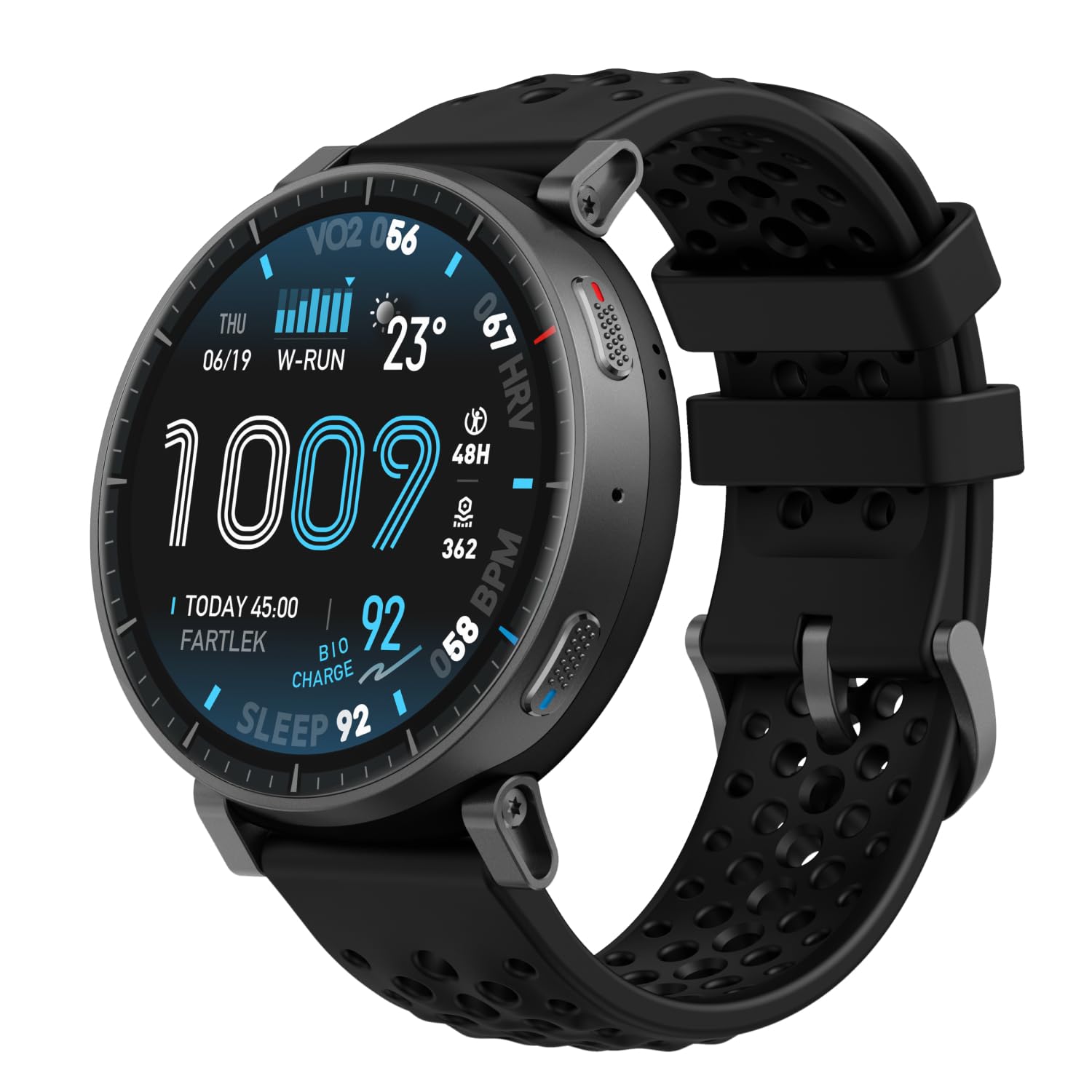
The Amazfit Active Max is the endurance specialist of this lineup. Its 3000-nit AMOLED display is absurdly bright—you can read it clearly under direct midday sun without squinting. The 25-day battery claim holds up under moderate use; with GPS workouts three times a week, you’ll still push two weeks between charges. The 4GB of onboard storage is a rare find at this price, letting you load music and offline maps directly onto the watch.
GPS performance uses five satellite systems, and while it isn’t dual-band, the tracking is stable enough for road running and cycling. The Zepp Coach feature provides personalized training plans that adapt based on your recovery and performance, which is a genuinely useful tool for runners who lack a coach but want structured progression. The BioCharge energy monitoring gives you a rough readiness score—not as refined as whoop or Garmin Body Battery, but functional.
What holds the Active Max back from true sports-watch status is the lack of dual-frequency GPS and the absence of advanced training metrics like running power or recovery time suggestions. It’s a phenomenal everyday smartwatch with excellent battery endurance, but pure runners chasing precise data may find the metrics too simplified for serious training.
Why it’s great
- Exceptional 25-day battery life with typical use
- Very bright (3000-nit) AMOLED display
- 4GB storage for music and offline maps
- Free Zepp Coach for adaptive training plans
Good to know
- Single-frequency GPS only
- Limited advanced running metrics compared to Coros/Polar
- No support for external sensors like chest HR straps
4. KOSPET Tank M4C Outdoor Smart Watch
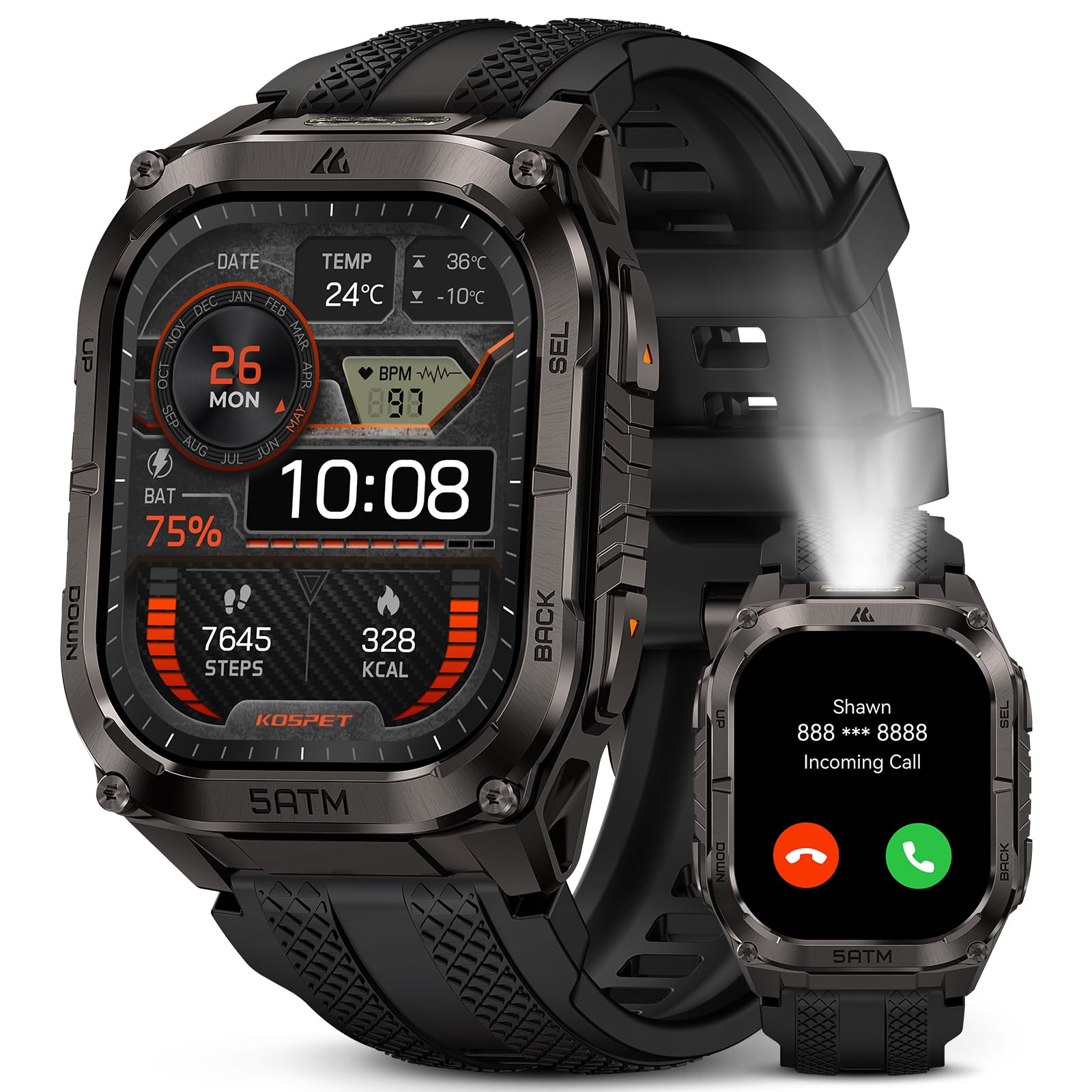
The KOSPET Tank M4C is the most feature-dense watch in this lineup, and it wears its versatility on its sleeve. The dual-band (L1+L5) GPS with six satellite systems is a standout at this price—providing the kind of positional accuracy you’d expect from watches twice the cost. The 1.96-inch AMOLED display is among the largest in the budget category, protected by Corning Gorilla Glass 3. The built-in walkie-talkie function (up to 4 people) is a unique addition for group outdoor work, though range is limited by line-of-sight.
The 500mAh battery is the largest capacity here, translating to roughly 16 days of typical use or 21 hours of continuous GPS tracking. The 5-level LED flashlight is genuinely useful—bright enough for finding gear in a dark truck or tent. The watch is rated 5 ATM waterproof, so swimming and rain are fine, but it’s not dive-rated. The stainless steel case and liquid silicone rubber band feel substantial without being overly heavy.
Software remains the weaker link. The menu navigation can feel clunky, and the companion app lacks the polish of Amazfit’s Zepp or Garmin’s Connect. Some users have reported units failing after a few weeks, and customer support responsiveness has been inconsistent. If you need a rugged tool watch with superior GPS and don’t mind a less refined user experience, the Tank M4C delivers hardware that punches above its class.
Why it’s great
- True dual-band (L1+L5) GPS for accurate tracking
- Large 1.96-inch AMOLED display with Gorilla Glass 3
- Built-in walkie-talkie for group communication
- 500mAh battery with 21 hours of GPS mode
Good to know
- Software UI is clunky and lacks polish
- Customer support has mixed reviews
- No keyboard for text replies despite Bluetooth calling
5. COROS PACE 3 GPS Sport Watch

The COROS PACE 3 is the benchmark that other affordable GPS watches are measured against. At just 30 grams with the nylon band, it’s virtually weightless on the wrist—ideal for runners who can’t stand the bulk of traditional sports watches. The dual-frequency GPS chipset delivers exceptional accuracy, holding tracks steady even in downtown high-rise corridors. The 1.2-inch transflective touchscreen is always-on and remarkably readable in direct sunlight, a feature that outdoor athletes quickly learn to value over AMOLED.
Battery life is where the PACE 3 truly dominates its price bracket: 38 hours of continuous GPS tracking with dual-frequency enabled, or 24 days of daily use with standard settings. That’s more than enough for ultra training and multi-day adventures. The COROS app provides detailed training metrics including running power, form analysis, and recovery suggestions. The breadcrumb navigation is simple but effective, and the route planner in the app syncs seamlessly to the watch.
What the PACE 3 lacks is smartwatch frills. There’s no music storage, no offline maps (just breadcrumb navigation), and the display is MIP rather than flashy AMOLED. It’s laser-focused on training data. For the runner who cares about accurate pace, distance, heart rate, and elevation data without distractions, the PACE 3 is the most capable affordable option available. Some users have reported charging cradle connection issues after months of use, so handle the charging port with care.
Why it’s great
- Industry-best dual-frequency GPS accuracy for the price
- Ultra-lightweight at 30g with nylon strap
- 38-hour GPS battery life for serious training
- Excellent COROS app with running power and recovery metrics
Good to know
- No music storage or offline maps
- MIP display looks less vibrant than AMOLED
- Charging cable connection can become loose over time
6. SUUNTO 9 Peak Pro Sports GPS Watch

Suunto’s heritage shows in the 9 Peak Pro. Handcrafted in Finland with a stainless steel case and sapphire glass, it’s built to a standard that most budget watches can’t approach. The 9 Peak Pro uses four satellite systems but does not feature dual-band GPS—a surprising omission at this tier. That said, the tracking is still reliable for most outdoor scenarios, and the 40-hour best GPS mode battery covers multi-day expeditions. The endurance mode stretches to 70 hours, and the tour mode (with GPS points recorded less frequently) reaches 300 hours.
The Suunto app is excellent for structured workout creation and real-time guidance. You can build custom intervals and drills, then send them directly to the watch. The 97 sport modes are well-curated rather than padded, and the weather alerts with avalanche maps add genuine safety value for backcountry adventurers. The 10-minute charge for 2 hours of GPS tracking is a practical life-saver before a sudden trail run.
Where the 9 Peak Pro shows its age is display technology. The touchscreen is functional but not as responsive as modern AMOLED watches, and the screen clarity in bright sunlight is merely adequate. The sleep tracking is also less accurate than dedicated sports watches like the COROS PACE 3 or Polar Grit X. For the adventurous athlete who values build quality, battery flexibility, and safety features over pixel-perfect screens, this Suunto remains a strong contender.
Why it’s great
- Excellent build quality with sapphire glass and stainless steel
- Versatile battery modes: 40h GPS, 70h endurance, 300h tour
- Fast 10-minute charge provides 2 hours of GPS
- Strong Suunto app for workout creation and route planning
Good to know
- No dual-band GPS despite premium positioning
- Sleep tracking accuracy is inconsistent
- Touchscreen feels less responsive than current competitors
7. POLAR Grit X Rugged Multisport GPS Watch

The Polar Grit X is designed for the trail runner and mountain biker who needs reliable navigation and training features in a lightweight, durable package. At 64 grams, it’s significantly lighter than other rugged outdoor watches, yet it still passes MIL-STD-810G military standards and is water-resistant to 100 meters. The Hill Splitter feature is unique: it automatically detects uphill and downhill sections and splits your performance data by ascent and descent, giving you actionable insight into your climbing efficiency and descending control.
Battery life is a strong point, with up to 40 hours of continuous GPS and heart rate tracking. With power save options, you can stretch that to 100 hours. The Komoot integration provides real-time turn-by-turn navigation, and the barometric altimeter gives accurate elevation data during climbs. Polar’s Nightly Recharge feature measures overnight recovery to tell you how ready your body is for the next day’s effort. The FuelWise system reminds you to eat and drink at optimal intervals during long efforts.
The Grit X’s display is a color MIP screen—legible in direct sunlight but not as sharp or vibrant as the AMOLED panels on newer watches. Wrist-based heart rate accuracy is good but not chest-strap level; serious athletes will want to pair the Polar H10 for precise data. The plastic case feels durable enough but lacks the premium heft of metal-bodied alternatives. For the dedicated trail athlete who values training features and battery endurance over fashion, the Grit X is a specialized tool that performs its mission exceptionally well.
Why it’s great
- Unique Hill Splitter for precise uphill/downhill analysis
- Lightweight (64g) for a rugged outdoor watch
- 40-hour GPS+HR battery, stretchable to 100 hours
- Komoot navigation with turn-by-turn guidance
Good to know
- MIP display is less vibrant than AMOLED competitors
- Wrist HR less accurate than Polar H10 chest strap
- Plastic case lacks premium feel of metal builds
8. COROS PACE Pro GPS Sport Watch

The COROS PACE Pro takes everything that made the PACE 3 great and adds a brilliant 1.3-inch AMOLED display plus full offline topographical maps. The 1500-nit brightness ensures the screen is legible even in harsh sunlight, and the always-on mode works without the battery penalty you’d expect. The processor is the fastest in COROS’s lineup, with 2x the performance of the PACE 3, making menu scrolling and map panning fluid. The gesture-activated backlight is responsive enough for mid-run glances.
Battery life is still impressive for an AMOLED watch: 38 hours of outdoor activities with standard GPS, or 31 hours with dual-frequency mode enabled. In daily use with always-on display, expect about 6 days—drop that to 20 days with wrist-gesture activation. The offline maps are a game-changer for trail runners who want topographical context without carrying a phone. The USB-C charging with the included keychain adapter is a thoughtful touch, reducing the need for proprietary cables.
Where the PACE Pro falls short is the watch band and watch face quality, which feel less premium than the hardware justifies. The silicone band attracts dust, and the default watch faces are utilitarian rather than attractive. The price also pushes it out of the strict “budget” category. If you want COROS’s training ecosystem with the visual clarity of AMOLED and offline mapping, the PACE Pro delivers—but you pay a noticeable premium over the already-excellent PACE 3 for those upgrades.
Why it’s great
- Stunning 1.3-inch AMOLED with 1500-nit brightness
- Full offline topographical maps for trail navigation
- Fastest processor in COROS lineup with fluid UI
- USB-C charging with keychain adapter
Good to know
- Premium price pushes it out of strict budget range
- Default watch bands and faces feel less premium
- Battery life with always-on display is about 6 days
9. Garmin Instinct 3 45mm Solar

The Garmin Instinct 3 Solar is the ultimate form of the “set it and forget it” GPS watch. The solar charging lens extends battery life indefinitely under normal wear (with 3 hours of 50,000 lux exposure daily), meaning you can essentially never charge it if you spend enough time outdoors. The multi-band GPS with SatIQ technology automatically switches between single and multi-band modes based on your environment, conserving battery when possible and maximizing accuracy when needed.
The build is pure toughness: a fiber-reinforced polymer case with a metal-reinforced bezel, MIL-STD-810-rated for thermal and shock resistance, and 10 ATM water rating. The MIP display is black and white only—no color—but it’s the most readable display in direct sunlight of any watch here. The built-in LED flashlight with variable intensities is genuinely useful for camping and late-night navigation. Garmin’s health monitoring ecosystem (wrist HR, Pulse Ox, sleep tracking) is mature and reasonably accurate, though not medical-grade.
The tradeoffs are significant for a watch at this price. There’s no color display, no music storage, no offline maps, and the screen resolution looks dated. The Garmin Connect app, while powerful, requires constant background syncing, which can be a battery drain on your phone. The Instinct 3 is a specialized tool for the off-grid adventurer who values battery longevity and durability above all else. If you need a smartwatch experience with apps and maps, look elsewhere. If you need a watch that survives the wilderness on solar power alone, this is unmatched.
Why it’s great
- Solar charging enables unlimited battery life outdoors
- Multi-band GPS with SatIQ for optimal accuracy/battery balance
- Extremely durable MIL-STD-810 and 10 ATM rated
- MIP display is the most sunlight-readable in the lineup
Good to know
- Black and white display with no color or high resolution
- No music storage, offline maps, or smartwatch apps
- Garmin Connect app must run in background for syncing
FAQ
Do I need dual-frequency GPS for city running?
How many hours of GPS battery do I actually need?
Can I use an affordable GPS watch for navigation on trails?
Are subscription fees common with budget GPS watches?
Which affordable GPS watch has the best heart rate accuracy?
Final Thoughts: The Verdict
For most users, the best affordable gps watch winner is the COROS PACE 3 because it combines dual-frequency GPS accuracy, best-in-class 38-hour battery life, and a featherweight 30g design into a package that prioritizes pure training performance over smartwatch fluff. If you want a bigger and brighter AMOLED display with offline maps and more everyday smartwatch features, grab the Amazfit Active Max. And for the most extreme durability with solar charging that eliminates battery anxiety entirely, nothing beats the Garmin Instinct 3 for off-grid adventures.