
Our readers keep the lights on and the weekend projects moving. As an Amazon Associate, I earn from qualifying purchases.
The struggle to follow a conversation at a family dinner or hear the television at a normal volume is a daily frustration for millions of seniors. Affordable hearing aids promise a solution, but sorting through noise reduction claims, battery life specs, and comfort features can feel overwhelming when all you really want is to reconnect with the people you love. This guide cuts through the marketing to compare nine over-the-counter models built for real-world use.
I’m Rikta — the co-founder and writer behind FitlyFast. My analysis of hearing aid specifications involves cross-referencing hundreds of verified user reports with the technical claims made by manufacturers to identify which affordable devices actually deliver on their promises.
After reviewing dozens of rechargeable models with varying gain levels, app integrations, and feedback cancellation technologies, I have assembled the definitive list of the best affordable hearing aids for seniors that balance clear sound with practical daily operation.
How To Choose The Best Affordable Hearing Aids For Seniors
The hearing aid market has shifted dramatically. Older analog amplifiers that simply made everything louder are being replaced by digital OTC devices that use intelligent chips to separate speech from background noise. For seniors on a budget, understanding a few core specifications is the difference between buying a device that collects dust and one that restores daily connection.
Peak Sound Gain: The Decibel Number That Matters
Peak sound gain measures how much the device amplifies incoming sound. Gain levels between 30 dB and 40 dB suit mild hearing loss, while 40 dB to 50 dB covers moderate loss. Be wary of listings that advertise channel counts instead of gain — 16 channels mean little if the amplifier tops out at 25 dB. Always check the maximum gain spec for your specific hearing profile.
Feedback Cancellation: Comfort During Real Life
The squealing whistle that occurs when a hearing aid amplifies its own output is the top reason seniors stop wearing their devices. Modern digital hearing aids use feedback cancellation systems that detect and suppress this whistle before it becomes audible. Without this feature, hugging a grandchild or putting on a hat triggers an annoying screech that undermines confidence in the device.
Battery Life Structure: Runtime Versus Backup
A hearing aid that lasts 10 hours on a single charge is useless if you forget to recharge it overnight. The total system runtime — device battery plus charging case capacity — determines real-world usability. Models that combine 15 to 25 hours of device runtime with three or four additional case charges offer the practical advantage of multiday use without obsessive charging habits.
App Accessibility: Useful Tool or Unnecessary Complexity
App-controlled hearing aids let users adjust volume, switch scene modes, and sometimes run hearing tests from a smartphone. For seniors comfortable with a phone, this offers precise personalization. However, app dependency can be a barrier. Devices that retain physical button controls and volume memory functions are safer choices for seniors who prefer simple, repeatable operation without screen interaction.
Quick Comparison
On smaller screens, swipe sideways to see the full table.
| Model | Category | Best For | Key Spec | Amazon |
|---|---|---|---|---|
| ELEHEAR-Beyond (Gold) | Premium | AI Noise Cancellation | 50 dB peak gain | Amazon |
| ELEHEAR-Beyond (White) | Premium | App Customization | 50 dB peak gain | Amazon |
| Vivtone Xpure 2.0 | Premium | Bluetooth Streaming | 24-hour runtime | Amazon |
| ELEHEAR-Delight | Mid-Range | Nearly Invisible ITC Fit | 45 dB peak gain | Amazon |
| iBstone Nova | Mid-Range | First-Time Users | 80% noise reduction | Amazon |
| Vivtone Lucid508 | Mid-Range | 125-hour backup power | 41 dB peak gain | Amazon |
| WASOCA BT | Mid-Range | Bluetooth 2-in-1 | 18-hour runtime | Amazon |
| WLU UFO8 | Value | 4 Hearing Modes | 35 dB peak gain | Amazon |
| NVBOTY | Budget | Ultra-Budget Entry | 40 dB peak gain | Amazon |
In‑Depth Reviews
1. ELEHEAR-Beyond (Gold) OTC Hearing Aids

The ELEHEAR-Beyond sets a high bar in the affordable category with its VocClear AI technology, boosting speech clarity by 17% while cutting 24 dB of background noise. The 50 dB peak gain covers moderate hearing loss confidently, and the four scene modes accessible through the app let you dial in the right profile for quiet conversations, noisy restaurants, or outdoor settings. Users consistently report that the sound feels natural rather than artificially amplified, which reduces the mental fatigue common with cheaper amplifiers.
Battery life reaches up to 20 hours per charge, and the charging case holds four additional full cycles for a total of 100 hours — enough for a workweek away from a wall outlet. A 15-minute quick charge provides six hours of runtime. The behind-the-ear design remains discreet and fits comfortably alongside glasses, a critical detail for seniors who wear both. The included nine pairs of ear domes allow a precise seal, without which any hearing aid risks feedback.
The ELEHEAR app adds real value with a frequency slider and directionality control, letting you focus sound from the front versus a 360-degree pickup. Some users note that the wire length is slightly short and that aftermarket retention wires improve the fit. Customer support is email-based with no direct phone line, a minor drawback for seniors who prefer voice assistance. Still, the combination of 50 dB gain, effective AI noise reduction, and app flexibility makes this the most complete package in the group.
Why it’s great
- 50 dB peak gain handles moderate loss effectively
- VocClear AI reduces 24 dB of background noise
- 100-hour total battery with quick charge feature
- Comfortable with glasses, discreet BTE design
Good to know
- Wires may be too short for some ear shapes
- No phone support, email only
- Struggles in very noisy environments
2. ELEHEAR-Beyond (White) OTC Hearing Aids

The white variant of the ELEHEAR-Beyond shares the same hardware core as the gold model — 50 dB maximum gain, 24 dB noise attenuation, and VocClear AI speech enhancement — but adds a few distinct software features. The smartphone app includes AI translation and serene sound relief modes, plus a user-customized compensation setting that fine-tunes frequency response based on your personal hearing test results. This level of personalization is rare at this price tier and brings OTC performance close to prescription-level tailoring.
Real-world user reports consistently praise its ability to outperform prescription hearing aids costing several times more. One long-time user reported that the ELEHEAR-Beyond outperformed audiologist-fitted devices in background noise control and comfort. The Receiver-in-Canal design with lightweight housing makes the device nearly invisible, and the automatic on/off function when removing or inserting into the charging case removes a common point of confusion for seniors.
The app allows per-ear volume and tone adjustments, which is essential when hearing loss is asymmetric. Some users note that music streaming through Bluetooth can sound slightly underwater, and the noise cancellation struggles in environments with high-frequency clatter like a restaurant kitchen. However, for everyday conversation, television watching, and phone calls, the Beyond delivers clarity that rivals premium devices at a fraction of the cost. The included warranty and remote audiologist support provide peace of mind for first-time OTC buyers.
Why it’s great
- Superior to many prescription aids in speech clarity
- App hearing test enables personalized frequency settings
- Auto on/off eliminates user error
- Remote audiologist support available
Good to know
- Bluetooth music quality is not audiophile grade
- Noise cancellation can be overwhelmed by sharp sounds
- Charging case is somewhat large for pocket carry
3. Vivtone Xpure 2.0 Bluetooth Hearing Aids

The Vivtone Xpure 2.0 distinguishes itself with a focus on Bluetooth streaming quality alongside hearing assistance. The Receiver-in-Canal design minimizes distortion, and the companion app provides a hearing test to calibrate volume and frequency response for each ear independently. Users report that the amplification at 80% volume is sufficient for moderate hearing loss, and the ability to stream phone calls and music directly means seniors can leave their TV listening headphones in the drawer.
Battery performance is exceptional: 24 hours of hearing aid operation on a full charge, with the charging case providing a full week of standby power. The quick 2.5-hour recharge cycle for both the devices and the case means less time tethered to an outlet. Many user reviews compare the sound quality favorably to prescription models costing many times more, noting that the earpieces stay in place during daily activities better than expensive custom-fitted units.
The app offers multiple sound modes for quiet, noisy, and outdoor environments, which can be switched quickly without digging into phone menus. A concern from some users is that the ear tubes lack stabilizers, causing them to shift during eating and occasionally fall out. The music streaming quality is described as slightly tinny compared to dedicated earbuds, though acceptable for casual listening. For seniors who prioritize phone calls and limited music streaming alongside hearing help, the Xpure 2.0 delivers strong value with real human phone support.
Why it’s great
- 24-hour runtime with week-long charging case
- Bluetooth streaming for calls and music
- App hearing test enables personalized tuning
- Real human phone support available
Good to know
- Ear tubes lack stabilizers, may shift during eating
- Music streaming quality is not high fidelity
- Case is relatively large
4. ELEHEAR-Delight OTC Hearing Aids
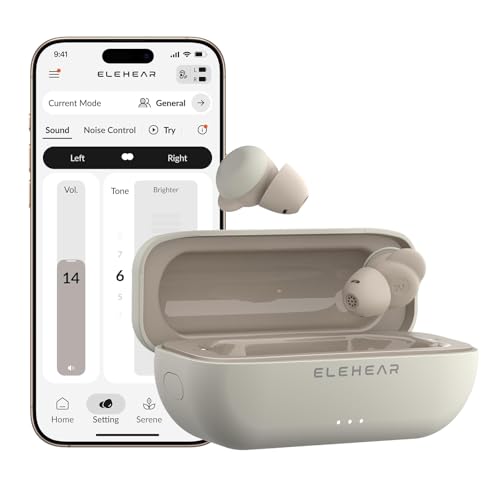
The ELEHEAR-Delight uses an In-The-Canal (ITC) form factor that is significantly more discreet than behind-the-ear styles. With 45 dB peak gain and VocClear AI powered by a Deep Neural Network, it delivers speech enhancement that rivals its more expensive Beyond sibling. The DNN Hybrid Feedback Cancellation system prevents the whistling that plagues lesser devices, even during hugs or when adjusting the volume. Users switching from prescription aids report that the Delight sounds more natural than units costing many times more.
The smart app includes AI-powered real-time translation in multiple languages — a genuinely useful feature for travel or multicultural families. Bluetooth 5.3 provides stable streaming for calls and media, and the IP67 rating means the devices survive rain, sweat, and hand washing splashes without worry. The ergonomic ear-wing structure reduces the plugged-up sensation that makes some seniors reject in-ear devices, and the included charging case provides reliable multiday power.
Some users find the Delight slightly larger than other in-ear models, which can cause ear pain after several hours of wear. The app, while functional, is not as polished as the Beyond app and can feel sluggish during mode switching. However, for seniors who prioritize a discreet appearance and advanced noise cancellation over raw gain, the Delight represents a compelling mid-range option that does not look or feel like a traditional hearing aid.
Why it’s great
- Nearly invisible ITC design is discreet
- DNN feedback cancellation eliminates whistling
- IP67 water resistance handles daily moisture
- AI translation useful for travel
Good to know
- Larger than some in-ear competitors
- May cause ear pain after extended wear
- App could be more responsive
5. iBstone Nova Hearing Aids
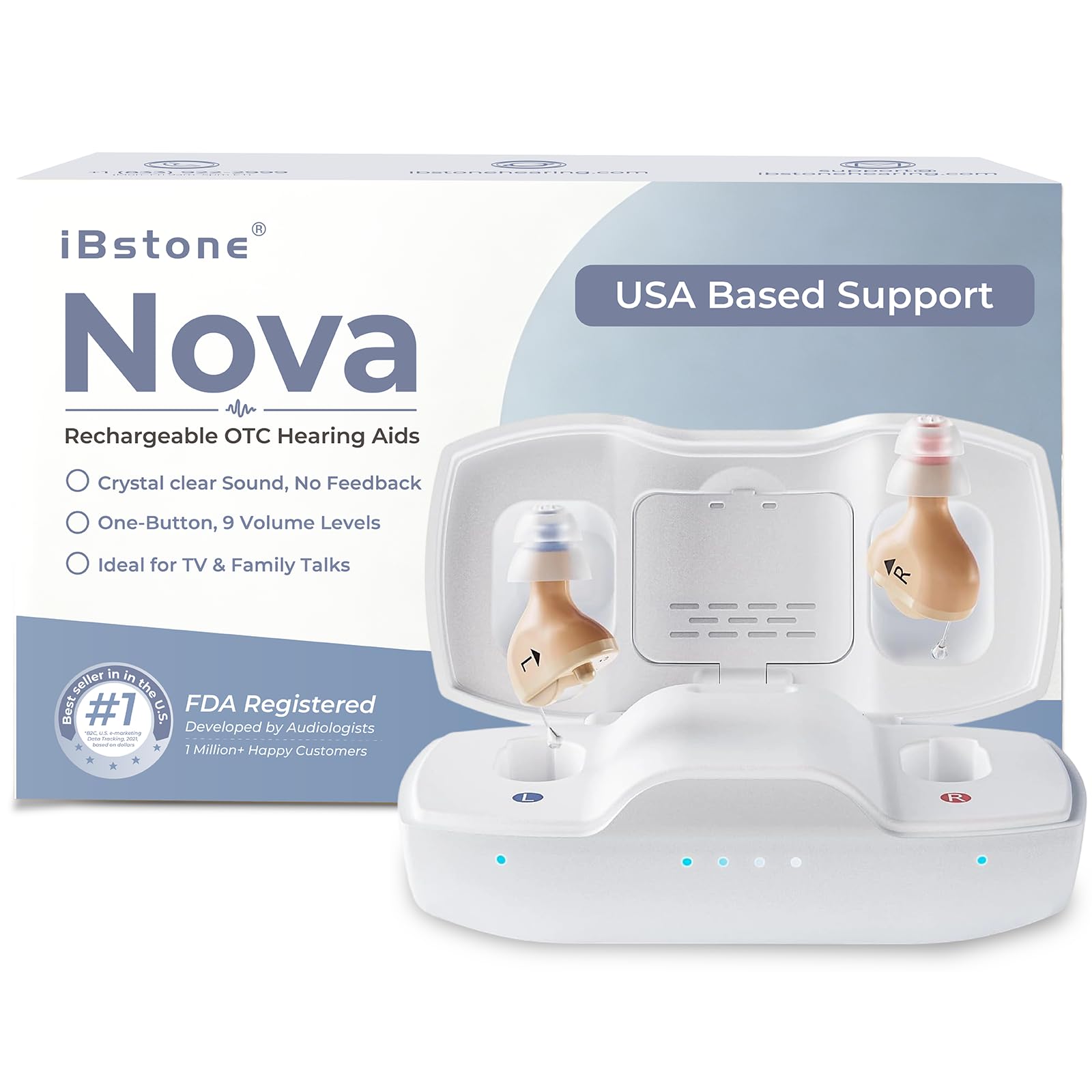
The iBstone Nova is engineered specifically for first-time hearing aid users who are nervous about the adjustment period. The built-in professional chip claims 80% background noise reduction with zero feedback whistling, even during close contact. The completely-in-canal design is small and lightweight, and the package includes nine pairs of soft tips to achieve a pain-free seal. User reviews consistently highlight the Nova as comfortable enough to forget you are wearing it for 16 hours straight.
The charging case includes a built-in dehydrator that automatically removes moisture, a thoughtful feature that extends the lifespan of the electronics by preventing humidity damage. The 1.5-hour fast charge provides enough power for daily use, and the three listening modes let you switch between quiet, noisy, and outdoor settings. Many users in their seventies report that the Nova allowed them to hear their grandchildren clearly for the first time in years, with emotional testimonials underscoring the real-world impact of good sound reproduction.
The volume and mode controls are raised buttons that avoid accidental taps, though some users find the volume adjustment cumbersome — you cannot easily mute the devices while wearing them. The three noise reduction modes offer subtle differences, and some users want more aggressive filtering. The 30-day family trial with 12-month service is generous, but customer support is email-based with no phone option. For seniors ready to try their first hearing aid without a huge financial commitment, the Nova offers a well-supported entry point.
Why it’s great
- Zero feedback whistling, even during hugs
- Nine ear tip sizes for precise comfort
- Charging case has built-in dehydrator
- 30-day trial reduces purchase anxiety
Good to know
- Volume control is cumbersome to use
- Noise reduction modes have subtle differences
- No phone support available
6. Vivtone Lucid508 Hearing Aids
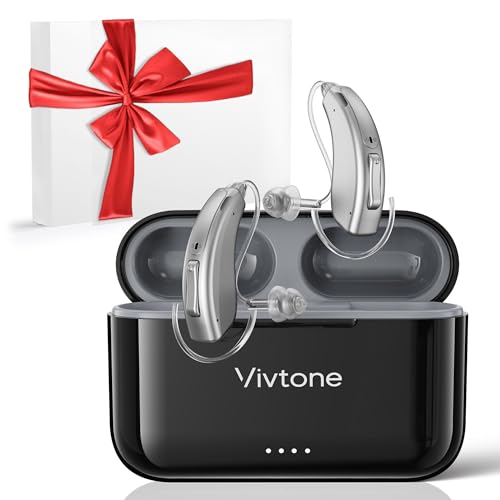
The Vivtone Lucid508 offers 41 dB peak gain with a standout feature: a tinnitus masking mode that plays a gentle tone to distract from ringing in the ears. This is a rare inclusion at this price point and can be genuinely life-changing for seniors whose hearing loss is compounded by chronic tinnitus. The device has two operational modes — quiet and noisy — plus the masking mode, all controlled by an easy button interface without needing a smartphone.
The battery case charges both units four times, providing 125 hours of total backup power. The hearing aids themselves run for 25 hours on a single 2-hour charge. The behind-the-ear design is smaller than many competitors, using medical-grade materials that remain comfortable for all-day wear. An anti-lost lanyard and clip come included, a practical addition for seniors who worry about misplacing their devices.
Sound quality is described as clear but slightly tinny by some users — reminiscent of an old telephone rather than natural hearing. The volume rocker is small and can be hard to manipulate for fingers with reduced dexterity. The charging case lies flat rather than standing upright, which makes inserting the hearing aids awkward for some seniors. However, for users who need tinnitus relief alongside hearing amplification, the Lucid508 delivers a combination not found in most competing devices at this price level.
Why it’s great
- Tinnitus masking mode included
- 125-hour total backup battery life
- 25-hour single charge runtime
- Anti-lost lanyard and clip included
Good to know
- Sound quality can be tinny
- Volume rocker is small and stiff
- Charging case does not stand upright
7. WASOCA Bluetooth Hearing Aids

The WASOCA combines hearing amplification with a Bluetooth headset in a single in-ear device, allowing users to answer phone calls without removing their hearing aids. The digital chip provides intelligent noise reduction to minimize whistling, and the 18-hour battery life covers a full day of mixed use. Five volume levels and three listening scenarios (universal, noise reduction, strong noise reduction) are accessible via both the device buttons and the smartphone app.
The app control is a genuine differentiator — it allows independent left and right ear volume and mode adjustments, plus a fitting test to match the sound profile to your specific loss pattern. The bright side is that seniors comfortable with a phone can fine-tune their experience more precisely than with button-only devices. The included charging case provides two additional full charges, and the 2-hour full recharge cycle is convenient.
User experiences are mixed. Some report that clarity is hard to achieve, with noticeable echo in the sound reproduction. A concerning number of reviews describe units that stopped charging entirely after weeks or months of use, pointing to potential reliability issues with the battery charging circuitry. The in-ear design is small, but the fit can be tricky for users with very small ear canals. For seniors who want Bluetooth call capability and are willing to accept some inconsistency, the WASOCA offers a feature-rich package at a mid-range price.
Why it’s great
- Bluetooth 2-in-1 for calls without removing aids
- App allows per-ear volume and mode adjustment
- Fast 2-hour full recharge
- Three listening scenarios for different environments
Good to know
- Some units develop charging failures
- Sound can have noticeable echo
- Fit may be difficult for small ear canals
8. WLU UFO8 Hearing Aids
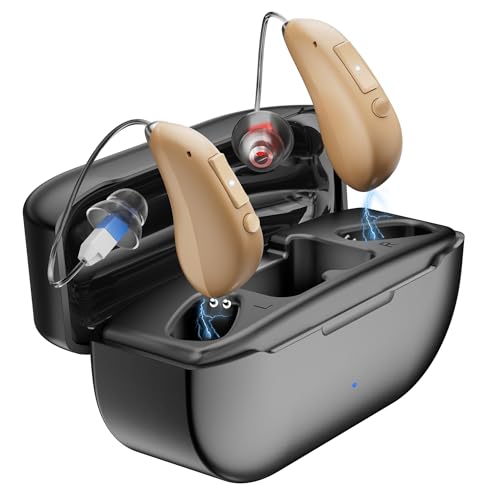
The WLU UFO8 targets seniors with mild to moderate hearing loss — the manufacturer explicitly states it is not suitable for severe loss. It offers four hearing modes: two normal modes and two with noise reduction, each with a profile for mild and moderate loss respectively. Five volume levels provide 23 to 35 dB of gain adjustment, and the independent left and right ear control allows asymmetric tuning without requiring a smartphone.
Battery life is a strong point: 10 hours continuous use per charge, with the Type-C charging case extending total runtime to 48 hours. The single-unit weight of 5 grams makes the behind-the-ear form factor exceptionally lightweight and comfortable for long wear. The included eight pairs of ear domes in multiple sizes ensure a good seal, which is essential for preventing feedback and maintaining sound quality. Users report that the noise cancellation effectively reduces background hum while keeping speech clear.
Some critical reviews describe units failing completely within the first month, with customer support unresponsive to warranty claims. The 35 dB peak gain is lower than many competitors, meaning users with more advanced hearing loss will need a more powerful device. The physical button controls are simple enough for seniors to operate without confusion, but the plastic build does not feel as robust as premium alternatives. For a budget-conscious buyer with confirmed mild loss, the WLU offers a targeted solution that prioritizes simplicity.
Why it’s great
- Four hearing modes with mild/moderate profiles
- Independent left and right ear volume control
- Lightweight 5-gram design is comfortable
- Inclusive warranty and 24-hour response promise
Good to know
- 35 dB gain insufficient for severe hearing loss
- Some units fail within the first month
- Customer support responsiveness varies
9. NVBOTY Rechargeable Hearing Aids

The NVBOTY is the most accessible entry point in this list, providing 40 dB of peak gain with a 16-channel digital chip for adaptive noise reduction. The five volume levels span 24 to 40 dB, and the volume memory function means you do not have to readjust after each use. The beige, compact design is nearly invisible behind the ear, and the silicone ear plugs are soft enough for extended wear without pressure points.
Battery performance is respectable: 25 hours of continuous use per charge, with the charging case extending total runtime to 80 to 100 hours. The device charges quickly and automatically powers off when placed in the case. Many users report significant improvements in hearing television dialogue and one-on-one conversations, with the discreet design receiving positive remarks from those who want to avoid the stigma of visible hearing aids.
The trade-offs are significant. Several user reviews describe the sound as robotic and the power/volume button as confusing to operate. A concerning pattern involves units that stop working after about a month of use, with no manufacturer support available for replacements or refunds. The sound quality for music is notably poor, with buzzing at certain pitches. For the price, the NVBOTY works adequately for basic amplification needs, but reliability issues make it a risk for anyone who depends on their hearing aids daily.
Why it’s great
- Very low barrier to entry for first-time buyers
- Volume memory function simplifies daily use
- Discreet beige BTE design
- 80-100 hour total battery with charging case
Good to know
- Sound can be robotic and tinny
- Button operation is confusing for some users
- Units may fail after a month with no support
FAQ
Can affordable hearing aids handle moderate hearing loss or are they only for mild cases?
What is the difference between an amplifier and a real hearing aid at this price?
Do I need an app to use these hearing aids or can my parent operate them without a smartphone?
How do I know which ear dome size is correct for my ear canal?
Why do some hearing aids stop working after a few months and how can I avoid that?
Final Thoughts: The Verdict
For most users, the affordable hearing aids for seniors winner is the ELEHEAR-Beyond (Gold) because it combines 50 dB gain, effective AI noise cancellation, and a comfortable BTE design at a price that undercuts prescription models by thousands. If you want a nearly invisible in-ear device with advanced app features, grab the ELEHEAR-Delight. And for first-time users who need zero whistling and a supportive trial period, nothing beats the iBstone Nova.