
Our readers keep the lights on and the weekend projects moving. As an Amazon Associate, I earn from qualifying purchases.
Wrist-based optical heart rate sensors are convenient, but they lag during interval sprints, drift on the bike, and lose signal on the rower. A dedicated chest strap or armband solves that by reading your pulse directly from the torso or upper arm, where motion interference is far lower. The right pick delivers real-time data you can actually trust to set your zones, pace your recovery, and stop guessing during every workout.
I’m Rikta — the co-founder and writer behind FitlyFast. I’ve combed through hundreds of verified buyer reports, cross-referenced accuracy claims with real-world feedback, and compared battery architectures, connectivity protocols, and sensor types across the current market to separate the reliable performers from the ones that drop signal mid-sprint.
This guide walks you through the top contenders so you can lock in a dependable partner for your training without overpaying for features you will not use. It is your complete resource for finding the best affordable heart rate monitor that matches your sport and your budget.
How To Choose The Best Affordable Heart Rate Monitor
Picking the right monitor means prioritizing the sensor type and strap design that match your primary activity. Chest straps use ECG technology, which picks up the heart’s electrical signal directly — this makes them the gold standard for cycling, rowing, and high-intensity intervals where movement can confuse optical wrist sensors. Armbands use optical technology similar to a smartwatch but sit on a more stable part of the body, offering a comfortable middle ground for runners and gym-goers who dislike chest straps. Battery type matters almost as much: a replaceable CR2032 coin cell lasts hundreds of hours but requires a spare on hand, while a rechargeable lithium pack removes that hassle but introduces eventual battery degradation.
Sensor Type: ECG Chest vs. Optical Arm
ECG chest straps measure the electrical activity of your heart with electrode pads that contact the skin directly under the strap. They respond to changes in heart rate almost instantly — critical for interval training where a two-second lag means you miss your recovery window. Optical armbands use light-emitting diodes to detect blood volume changes under the skin. They are slightly slower to react but far more comfortable for long, steady-state runs or all-day wear. If your training revolves around structured intervals or power-based cycling, an ECG chest strap offers the better value. If you prioritize comfort and ease of putting the device on, an optical armband is the smarter pick.
Connectivity: Bluetooth vs. ANT+
Bluetooth connects directly to your phone and pairs with apps like Strava, Zwift, and Peloton. ANT+ is a protocol that gym equipment, bike computers (Garmin, Wahoo), and some smartwatches rely on for lower-latency data. A dual-mode monitor that supports both protocols is the safest investment because it guarantees compatibility with indoor bike trainers, treadmills, and any future device you add to your setup. Single-protocol units are cheaper but can leave you stranded if you upgrade to ANT+-only equipment later.
Battery Life and Power Architecture
A chest strap with a replaceable CR2032 battery can run between 500 and 1,000 hours before you swap the cell — that is effectively years of regular use. Rechargeable armbands offer convenience (no spare battery to carry) but typically deliver 20 to 35 hours per charge, meaning you need to plug them in weekly if you train daily. Check whether the chest strap allows easy battery replacement; some sealed units force you to buy a whole new sensor when the battery dies, which negates the affordability advantage.
Strap Comfort and Fit
The strap is the part of the monitor that touches your body for the entire workout. Look for soft, breathable fabric with silicone grippers or a textured backing that prevents the strap from sliding during sweaty sessions. For chest straps, the electrode area should be wide enough to maintain skin contact without digging in. For armbands, the band should be adjustable across a range of arm circumferences and stay secure during overhead movements or heavy weightlifting. A strap that chafes or slips will ruin your focus regardless of how accurate the sensor is.
Quick Comparison
On smaller screens, swipe sideways to see the full table.
| Model | Category | Best For | Key Spec | Amazon |
|---|---|---|---|---|
| Magene H603 | Chest Strap | Long battery life & quiet reliability | 1,000‑hour replaceable battery | Amazon |
| COOSPO HW9 | Armband | Rechargeable & feature‑rich | 35‑hour rechargeable battery | Amazon |
| Scosche Rhythm+ 2.0 | Armband | Advanced HRV & recovery data | 24‑hour rechargeable battery | Amazon |
| COOSPO HW807 | Armband | Quick zone feedback & value | 20‑hour rechargeable battery | Amazon |
| CYCPLUS H1 Armband | Armband | Fast magnetic charging | 110‑hour rechargeable battery | Amazon |
| CYCPLUS H2Pro | Chest Strap | Comfort & accuracy for larger builds | 500‑hour replaceable battery | Amazon |
| moofit HR8 | Chest Strap | Entry‑level dual‑mode chest strap | 500‑hour replaceable battery | Amazon |
In‑Depth Reviews
1. Magene H603 Chest Strap

The Magene H603 delivers the longest rated battery life in this roundup — up to 1,000 hours from a single CR2032 cell — which means you could train four times a week for over two years before worrying about a replacement. Its ECG-based sensor uses a proprietary algorithm to filter out noise from movement and sweat, and the split chest strap design lets you detach the sensor module for storage or battery swaps without replacing the whole band. The four interchangeable color shells are a cosmetic bonus, but the real value is the dual Bluetooth/ANT+ output that lets you record simultaneously to a phone app and a bike computer.
Real-world tester feedback confirms the H603 pairs reliably with Garmin Edge units, Wahoo fitness apps, and Zwift, with many users reporting zero signal drops over multi-hour rides. The red LED flash confirms the sensor is active, which removes the guesswork about whether the monitor is actually transmitting. Some units have shown accuracy drift after a month of heavy use, but the majority of verified reviews place its consistency on par with monitors that cost twice as much.
The strap is soft and flexible, and the electrode area is wide enough to maintain contact even during dynamic movements like mountain biking or burpee intervals. The H603 is an exceptional choice for athletes who want a set-and-forget chest strap that will not need a battery swap for multiple training cycles.
Why it’s great
- Industry-leading 1,000-hour battery life from a replaceable coin cell
- Dual Bluetooth & ANT+ output for simultaneous device pairing
- Comfortable split strap design with wide electrode coverage
Good to know
- Some units experienced accuracy drift after extended use
- Strap may require dampening in dry conditions for best contact
2. COOSPO HW9 Armband

The COOSPO HW9 packs more software-driven features than any other armband near its price point. A five-color LED ring provides instant heart rate zone feedback, and you can customize the max heart rate threshold inside the Coosporide app — exceed that limit and the armband vibrates as a safety warning. The optical sensor claims ±1 BPM accuracy, and real-world users report it matches Apple Watch and chest strap readings during steady-state runs and indoor cycling sessions.
Battery life is rated at 35 hours per charge with a magnetic charging cable that snaps on securely. Many testers noted they only charge the HW9 once a month with moderate daily use, making it one of the most convenient recharging options on the list. Bluetooth 5.0 and ANT+ allow two simultaneous connections, so you can stream data to a phone and a Garmin watch at the same time without any signal clash.
The strap material uses a mix of ABS and nylon that feels breathable against the skin, but some users found the band stretched out after a few months of regular wear, which could compromise the fit on smaller forearms. The lack of an auto-shutoff means you have to remember to long-press the button to power it down after every workout, or the battery drains overnight. For athletes who value customizable zone alerts and vibration feedback, the HW9 is a compelling option.
Why it’s great
- 5‑color LED zone indicator with customizable max HR vibration alert
- Rechargeable battery lasts up to 35 hours between charges
- Dual Bluetooth & ANT+ output for simultaneous device syncing
Good to know
- No auto-shutoff; requires manual long‑press to turn off
- Strap material can stretch out over several months of use
3. Scosche Rhythm+ 2.0 Armband

The Scosche Rhythm+ 2.0 stands apart because of its HRV mode, which captures RR interval data from subtle heartbeat variations. This makes it a valuable tool for athletes who track recovery, sleep quality, and daily stress through apps like HRV4Training, Morpheus, or Welltory. The optical sensor sits on the forearm, bicep, or tricep using a lightweight, breathable strap that stays locked in place during high-intensity intervals and heavy resistance training.
Its IP68 waterproof rating is the highest in this group, meaning it survives full submersion — though it is not marketed for swimming, it shrugs off sweat, rain, and hose-downs without issue. Bluetooth and ANT+ connectivity is stable, and testers consistently report that the Rhythm+ 2.0 pairs instantly with Coros watches, Apple Watch, and Wahoo bike computers, with no dropouts during multi-hour rides. The 24-hour battery life is shorter than the HW9, but the trade-off is a slim profile that many users find more comfortable for all-day wear.
A few verified buyers noted that the proprietary charger is a mild inconvenience if you forget it on a trip, and the armband fit can be tricky to fine-tune once you have it on because the elastic lacks incremental adjustment points. Some light-skinned users reported excellent accuracy, while others with darker skin tones occasionally experienced reading gaps — a known limitation of optical sensors generally. For athletes who want recovery analytics in addition to live heart rate data, the Rhythm+ 2.0 justifies its premium position.
Why it’s great
- Dedicated HRV mode captures RR interval data for recovery tracking
- IP68 waterproof rating handles sweat, rain, and submersion
- Comfortable, low‑profile armband that stays secure during intense movement
Good to know
- Proprietary charger is easy to misplace; no standard USB‑C port
- Optical accuracy can fluctuate on darker skin tones
4. COOSPO HW807 Armband

The COOSPO HW807 is a proven optical armband that has been a community favorite for years because it delivers consistent heart rate data at a price that undercuts most brand-name alternatives. It uses the same ±1 BPM optical sensor technology found in pricier models, with a three-color LED that gives you a quick visual of your current zone: green below 80 BPM, orange between 80 and 140, and red above 140. That simple feedback loop helps you adjust intensity without looking at a phone screen.
It connects via Bluetooth 5.0 and ANT+ and works with over 200 fitness apps, including Wahoo Fitness, Strava, Peloton, and Zwift. Testers report reliable pairing with Garmin Edge and Wahoo bike computers, as well as direct connection to Concept2 rowers and NordicTrack treadmills. The battery provides about 20 hours of runtime per charge, which requires a weekly top-off for daily trainers but is manageable. The included two arm straps offer flexibility for different arm circumferences, and the sensor itself is lightweight at just 10 grams.
Some users experienced occasional cadence-locking during runs — where the optical sensor picks up arm swing frequency instead of heart rate — causing short spikes that resolve after a few seconds. The color-coded zone indicator is slightly slow to update, so you may see a delay when crossing between zones. For athletes who want a reliable, comfortable armband for zone-based training and gym equipment compatibility, the HW807 remains a strong contender.
Why it’s great
- Proven optical sensor with ±1 BPM accuracy and 3‑color zone LED
- Compatible with over 200 apps and gym equipment via Bluetooth & ANT+
- Comes with two adjustable arm straps for different fit preferences
Good to know
- Can experience cadence‑locking during high‑cadence running
- LED zone indicator has a slight delay between zone transitions
5. CYCPLUS H1 Armband

The CYCPLUS H1 Armband stands out for its extreme battery efficiency: a 30-minute full charge delivers up to 110 hours of continuous use. That is more than four times the runtime of many competing optical armbands, making it ideal for ultrarunners, cyclists who do multi-day events, or anyone who hates frequent charging cycles. The optical sensor claims ±1 BPM accuracy, and the unit uses a single-button interface for power on/off — no app pairing required for basic operation.
Bluetooth 5.1 and ANT+ dual-mode connectivity ensure stable pairing with Garmin and Wahoo devices, and the three-color LED zone indicator (green under 80 BPM, orange 80-140, red above 140) gives immediate visual feedback. The armband secures with a silicone band and a tang buckle, which some users found less secure than hook-and-loop straps during explosive movements like mountain biking — the buckle can pop loose if the band is not tightened perfectly. The magnetic charger is also quite weak, so the unit can fall off the charging puck if bumped.
Testers praised the H1’s comfort for long runs and its seamless connection to Specialized e-bikes and Garmin Edge 840 units. However, a few verified buyers reported that the Velcro-style strap came undone during mountain bike descents, and others mentioned that the band slips on sweaty skin, causing intermittent signal loss. For athletes who prioritize battery longevity and fast charging above all else, the H1 delivers that specific advantage.
Why it’s great
- 110‑hour battery life from a 30‑minute magnetic charge
- Bluetooth 5.1 & ANT+ dual‑mode for wide device compatibility
- Three‑color LED zone indicator for at‑a‑glance intensity awareness
Good to know
- Tang buckle strap can come undone during high‑impact activities
- Magnetic charger connection is weak; unit can detach easily
6. CYCPLUS H2Pro Chest Strap
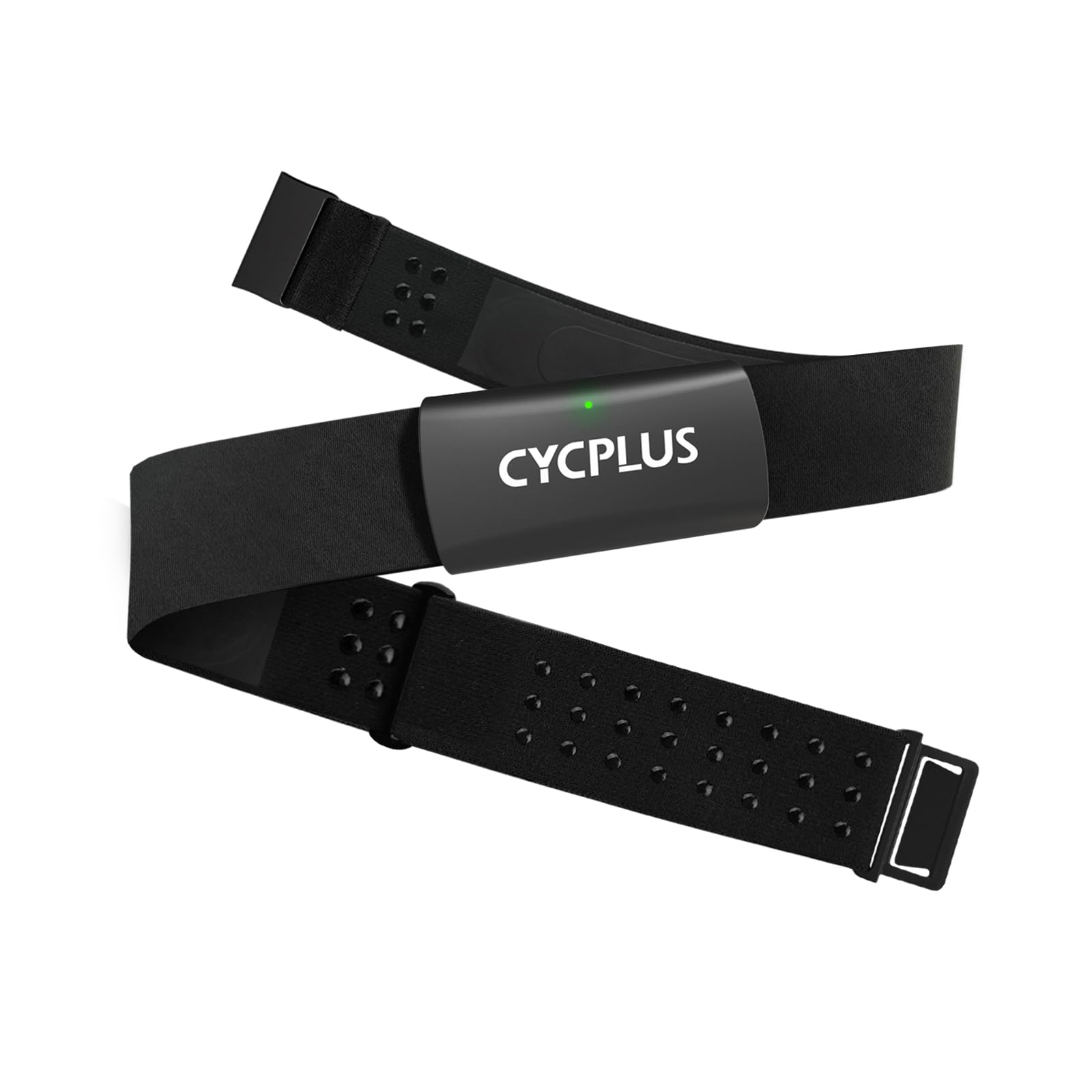
The CYCPLUS H2Pro uses an ECG algorithm designed to reject noise from breathing, muscle tension, and sweat, which makes it particularly effective for athletes who struggle with erratic readings from other chest straps. The sensor module weighs just 21 grams (34 grams with the strap), and the fabric strap uses soft, breathable material that conforms well to different chest sizes — several female testers noted it sits comfortably under a sports bra band without digging in. Battery life is rated at 500 hours from a single CR2032 coin cell, which matches the moofit HR8 but uses a different electrode layout for potentially better contact consistency.
It pairs via Bluetooth or ANT+ with smartphones, Garmin and Wahoo bike computers, and fitness equipment. In real-world use, the H2Pro connects quickly to Zwift, Strava, and the CYCPLUS FIT app, and testers reported accurate heart rate variability (HRV) data for recovery monitoring. A few users noted that the sensor must be removed from the strap after each workout to prevent parasitic battery drain — otherwise the battery dies faster than the 500-hour rating suggests. Some buyers also found the initial Bluetooth pairing process finicky, requiring multiple attempts before the app recognized the device.
The strap length is adjustable from roughly 25 to 52 inches, accommodating a wide range of body types. The IPX7 waterproof rating handles heavy sweating and rain without issue. For athletes who want a lightweight, comfortable chest strap with genuine noise-rejection technology and HRV tracking, the H2Pro is a strong mid-range pick.
Why it’s great
- ECG algorithm rejects noise from movement, breathing, and sweat
- Extremely lightweight sensor (34g total); comfortable for larger chests
- Supports HRV data for recovery and training load analysis
Good to know
- Sensor must be detached from strap after each use to avoid battery drain
- Initial Bluetooth pairing can be temperamental with some phones
7. moofit HR8 Chest Strap

The moofit HR8 is the most budget-friendly chest strap in this roundup, and it delivers the core essentials: ECG-based heart rate tracking with ±1 BPM accuracy, Bluetooth 5.0/ANT+ dual connectivity, and a replaceable CR2032 battery good for 500 hours. The strap uses a breathable fabric with improved electrode contacts, and the buckle is easy to fasten even when you are already sweaty. The sensor module is lightweight at 66 grams and IP67 rated, so it handles rain and heavy sweat without worry.
Real-world users report that the HR8 connects reliably to Peloton bikes, Garmin watches, and apps like Strava and Zwift for the first few weeks, but a noticeable number of verified reviews mention connection inconsistencies after six to eight weeks of daily use — some units stop pairing or deliver erratic readings mid-workout. The manufacturer has been responsive in some cases, offering replacements after the return window closed. The strap length adjusts from 63.5 cm to 132 cm, accommodating most waist and chest sizes, but the ABS plastic sensor housing feels less durable than the Magene or CYCPLUS alternatives.
For beginners or casual fitness enthusiasts who want to dip a toe into chest-strap monitoring without spending much, the HR8 provides acceptable performance for the price. However, athletes who train daily or rely on consistent data for structured interval work may find the reliability gap frustrating over time. It works well with Apple Health and basic fitness apps, making it a reasonable entry point for zone-aware training on a tight budget.
Why it’s great
- Lowest entry cost for a dual‑mode ECG chest strap
- 500‑hour battery life with easy CR2032 replacement
- IP67 sweatproof rating for wet training conditions
Good to know
- Some units lose pairing reliability after 6–8 weeks of daily use
- ABS sensor housing feels less durable than premium competitors
FAQ
Can I use a chest strap heart rate monitor without a phone or watch?
Why does my optical armband occasionally show 180 BPM when I am walking?
Is a heart rate variability (HRV) feature worth paying extra for?
How do I know if my monitor is compatible with my gym equipment?
Should I wet the chest strap electrodes before every workout?
Final Thoughts: The Verdict
For most users, the best affordable heart rate monitor winner is the Magene H603 because it combines ECG-level accuracy, 1,000-hour replaceable battery life, and dual Bluetooth/ANT+ connectivity at a price that undercuts competitors with shorter lifespans. If you want a rechargeable armband with zone alerts and vibration feedback, grab the COOSPO HW9. And for advanced HRV data to track recovery and sleep quality, nothing beats the Scosche Rhythm+ 2.0.