
Our readers keep the lights on and the weekend projects moving. As an Amazon Associate, I earn from qualifying purchases.
Specs are compiled from manufacturer listings and verified buyer reviews and can change over time — please confirm the key details on the product page before buying.
Induction ranges heat up fast, respond to a turned dial instantly, and use less energy than gas or standard electric coils. But when you are shopping for an affordable induction range, the real challenge is separating genuine value from features that look good on paper but fall short in your kitchen. This guide cuts through the noise and focuses on the three models that actually deliver on the promise: faster cooking, precise control, and a price that does not make you wince.
I’m Rikta — the founder and writer behind FitlyFast. This guide is built by comparing the manufacturers’ published specifications and the patterns across verified customer reviews, so you get each pick’s real strengths and trade-offs instead of marketing spin.
After digging through the specs and dozens of owner experiences, the best affordable induction range for most households is the Kenmore 5.6 cu. ft. model — it packs the largest oven, true convection, and an air fry mode into a package that stays realistically priced.
Our Picks at a Glance
How To Choose The Best Affordable Induction Range
An induction range is a big purchase, so knowing the three specs that define your daily experience — fit, oven space, and cooktop layout — saves you from an expensive mistake.
Oven capacity and convection type
Oven size is measured in cubic feet, and it directly determines whether a turkey tray or a full sheet of cookies fits. A 5.3 to 5.6 cu. ft. oven handles a full holiday meal easily, while a 2.92 cu. ft. model suits a couple or a small apartment. “True convection” means a separate heating element works with the fan for even temperature across every rack — it browns more evenly than a standard convection fan that just circulates hot air.
Cooktop element size and layout
Induction elements have a diameter — typically around 6 to 8 inches — and that diameter determines the pan size they work with. A small element heats only the center of a large skillet, leading to hot spots. Look for dual-ring or multi-size elements so a 6-inch pan and a 10-inch pan both get even contact. The spacing between elements matters too: tight placement means two large pots may bump into each other.
Form factor: freestanding vs. slide-in
A freestanding range has finished sides and a backguard, so it can sit at the end of a counter or stand alone. A slide-in model has unfinished sides designed to fit flush between cabinets, giving a built-in look. Slide-ins are slightly trickier to install but leave no gap for crumbs to fall into. Both install into a standard 30-inch opening — always measure your cutout width first.
Quick Comparison
| Model | Best For | Oven Capacity | Cooktop Elements | Form Factor | Amazon |
|---|---|---|---|---|---|
| Kenmore 5.6 cu. ft.★ Best Overall | Best Overall — large families & value | 5.6 cu. ft. | 4 dual-ring elements | Freestanding | Amazon |
| GE Profile PHS930YPFS | Best for tech & precision | 5.3 cu. ft. | 4 elements, 11″ 3700W + 2 synced 8″ 2500W | Slide-in | Amazon |
| Summit 24″ WEM665W | Best for small spaces | 2.92 cu. ft. | 4 zones (2x 8.25″, 2x 6.25″) | Freestanding | Amazon |
In‑Depth Reviews
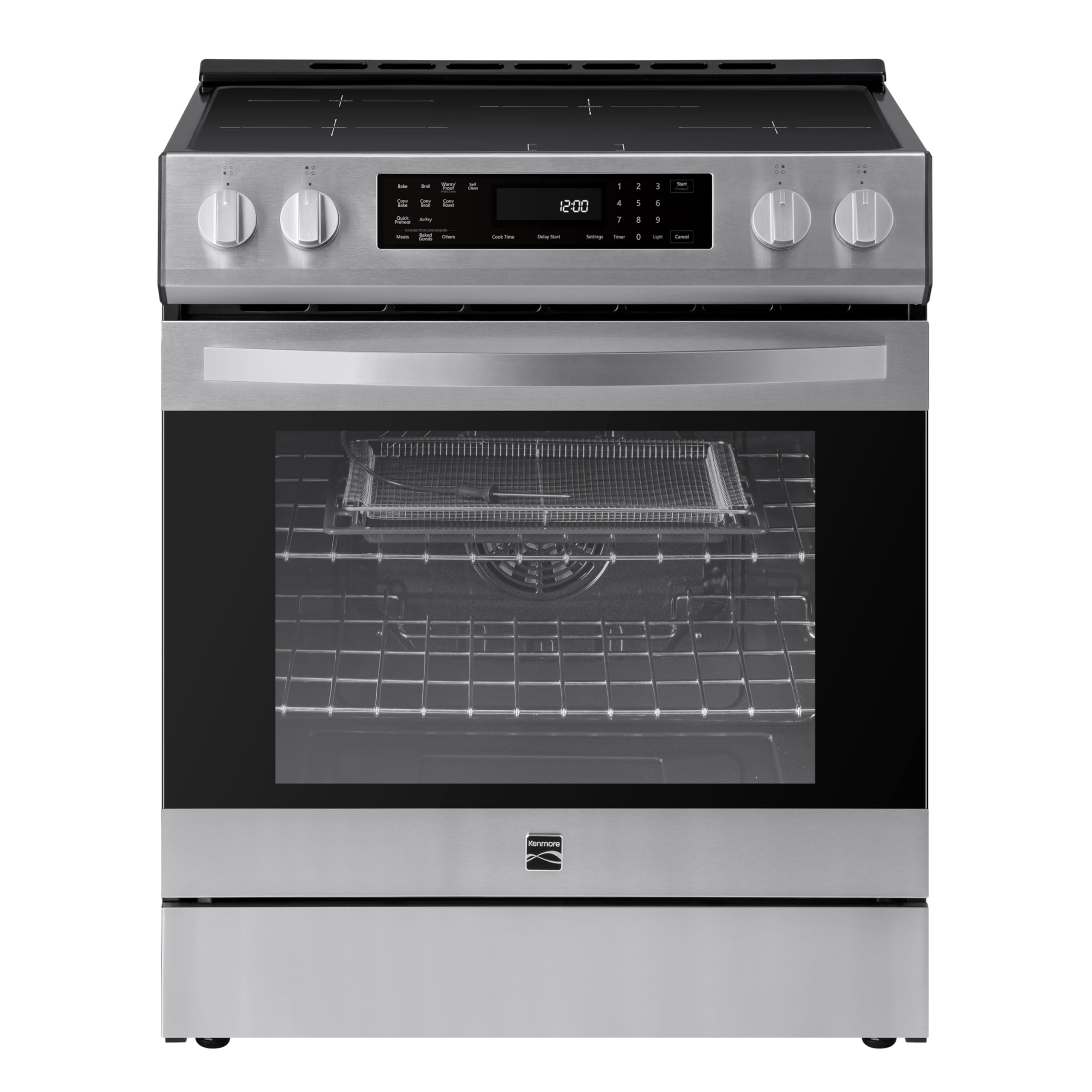
1. Kenmore 5.6 cu. ft. Electric Induction Range – Stainless Steel
The biggest oven in the budget bracket, paired with a true convection fan and an air fry function.
Your oven cavity defines what you can cook, and this Kenmore gives you 5.6 cubic feet — the largest oven in this group and a noticeable jump over the GE Profile model. That extra space means a 25-pound turkey or a full-size sheet tray slides in without touching the walls. The true convection system (a fan with a separate heating element) circulates hot air evenly, so cookies on the top rack and the bottom rack brown at the same rate.
The induction cooktop features four dual-ring elements, which let you adjust the heated zone to match different pan sizes — a small saucepan gets a small ring, a big Dutch oven uses the full diameter. Owners praise the turbo boil function that brings a pot of water to a rolling boil noticeably faster than a gas burner. The self-clean cycle and the storage drawer below the oven add everyday convenience that more expensive ranges sometimes skip. Some buyers report that the knob controls only rotate one direction for on/off and that the element indicators are small intersecting lines rather than the usual circles — it works fine but takes a day to get used to. A handful of owners experienced oven temperature inconsistency and found service support frustrating, so inspect the unit early and register the warranty.
Biggest strengths
- Largest oven capacity of the three (5.6 cu. ft. vs. 5.3 and 2.92 cu. ft.) — fits a full holiday roast
- True convection plus air fry mode for crisp results without extra oil
- Self-clean cycle and chrome racks make post-Thanksgiving cleanup quick
Trade-offs to know
- No power cord included — you need to buy a wiring adapter or cord separately
- Element layout is tight for two large skillets side by side
- Some units have shown oven temp variation and backordered replacement parts
Best for a busy family kitchen: you get the biggest usable oven, true convection, and an air fryer all at a mid-range price, so you cook one meal for six instead of two batches.
Think twice if: you need a dead-simple control panel — the knob-and-indicator setup takes a few meals to memorize — or if service availability in your area is thin, because parts support has been inconsistent for some.
2. GE Profile PHS930YPFS 30″ Smart Slide-In Induction Range

An 11-inch, 3700-watt element that boils a quart of water in 101 seconds and swipes like a smartphone.
This is the range that made me a believer in induction speed. The dedicated 11-inch element (3700 watts) is the largest and most powerful in this lineup — it heats a big stockpot edge to edge and brings water to a boil faster than most gas burners can manage. Two synchronized 8-inch, 2500-watt elements let you run a griddle or a roasting pan across both zones at the same temperature, which is rare at this price.
The Glide Touch controls are a pleasant surprise: you slide your finger across a smooth glass surface to raise or lower the heat instead of hunting for tiny buttons. The slide-in form factor sits flush between cabinets, giving a built-in look that hides crumbs. The Wi-Fi connectivity lets you preheat the oven on your way home or turn off the oven light through the app — a feature that the Kenmore lacks. Owners mention that the induction cooktop is extremely responsive and that the oven bakes evenly. The honest trade-off is the glass top can get scratched by cast iron pans if you slide them, and some buyers mention that the oven light switches on too easily and the air fry mode feels weak compared to a dedicated air fryer. The anti-tilt bracket and adjustable levelers are behind the drawer and can be hard to reach during installation.
Speed leader: the 3700-watt element is the fastest burner here — it outperforms the Kenmore’s turbo boil in raw power and handles large pans better thanks to the 11-inch diameter.
One real caveat: the induction glass can be damaged by rough-bottomed cookware (cast iron especially), and a few owners note inconsistent coil buzzing at high power levels, so treat the cooktop gently and use a scraper for spills.
Grab this if: you want the fastest possible boil, smartphone control, and a flush slide-in look that complements new countertops — the precision and Wi-Fi features are worth the premium.
Look elsewhere if: you cook a lot with cast iron (the top scratches), or you want the largest oven — the 5.3 cu. ft. capacity is smaller than the Kenmore’s 5.6 cu. ft.
3. Summit 24″ Induction Range, 2.92 cu. ft. Oven, White – WEM665W
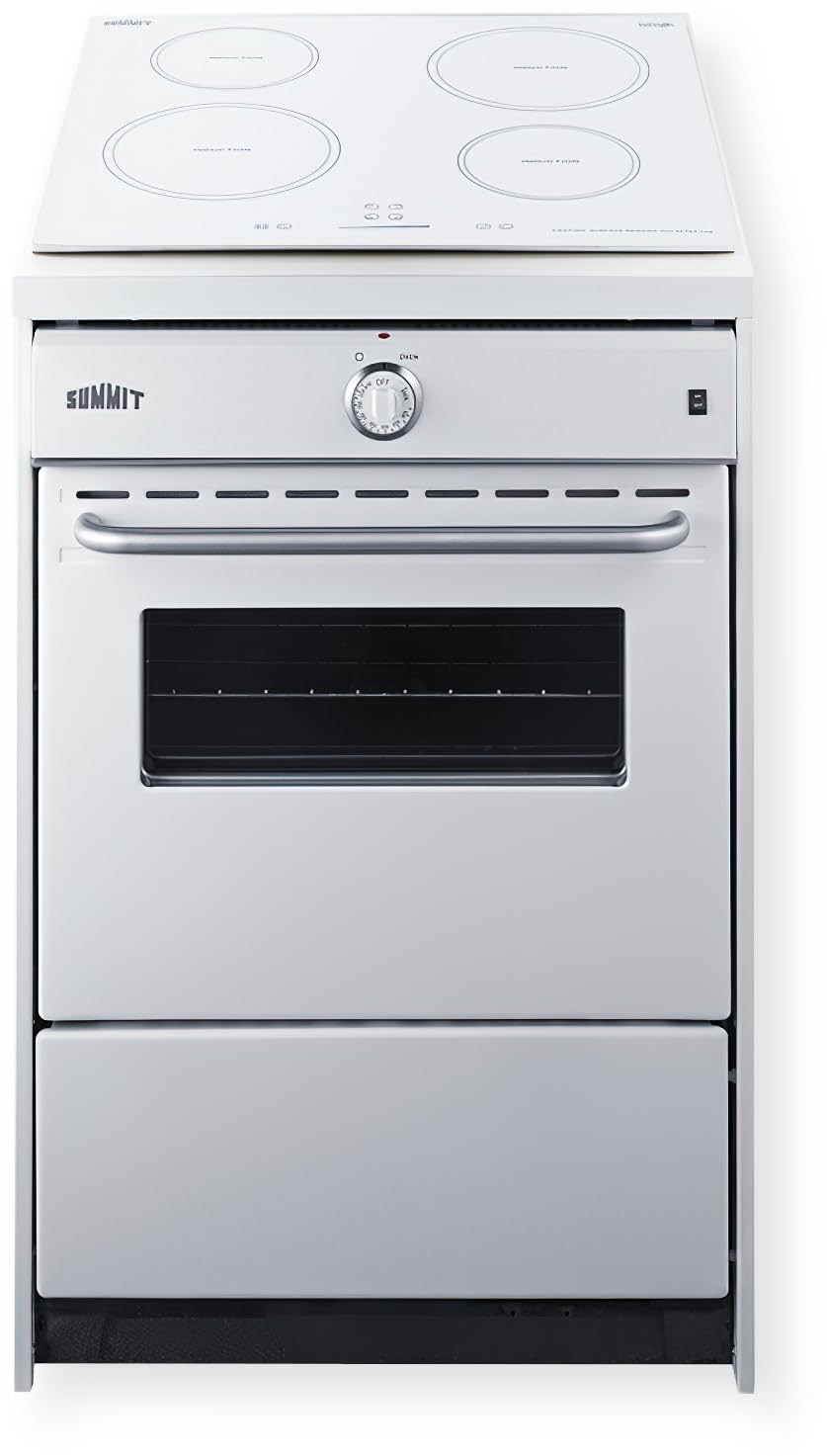
A full-size induction cooking surface squeezed into a 24-inch frame for apartments, condos, and tiny kitchens.
Not every kitchen has room for a 30-inch range, and the Summit fills that gap without cutting corners on the cooking surface. At 24 inches wide, it fits where standard ranges cannot — think galley kitchens, small condos, or an ADU. Yet you still get four induction zones: two 8.25-inch elements for larger pots and two 6.25-inch elements for everyday pans. The oven cavity measures 2.92 cubic feet, which is enough for a 13×9 baking dish or a small roast but noticeably tighter than the other two ranges here (the Kenmore has 5.6 cu. ft., the GE Profile has 5.3 cu. ft.).
Owners love the clean, knob-free appearance — the flush induction top looks modern and wipes clean in seconds. The wide elements (8.25-inch) are a real plus because many compact ranges pair them with tiny 5-inch burners. The Summit avoids that mistake. A few customers note an initial setup issue where the induction cooktop would not power on even though the oven worked — inspecting the internal cord connection and contacting support resolved it for some but not all. The oven bakes reliably once it gets going, and the heavy 150-pound build makes it feel solid rather than hollow. At 35.75 inches tall, it is a bit shorter than the standard 36-inch range, so check your counter height.
What makes it special
- Fits a standard 24-inch cutout — the only induction range at this width with four full-size zones
- Two 8.25-inch elements handle large skillets well, unlike most compact burners
- Smooth knob-free top is easy to clean and looks clean in a small kitchen
What to watch for
- No power cord included — you must buy a cord separately and wire it yourself
- Oven capacity (2.92 cu. ft.) (Kenmore 5.6 cu. ft.), so baking a full holiday meal requires two batches
- A few units arrived with an induction board that did not activate on first plug-in, requiring return or service
Reach for this if: your kitchen has a 24-inch opening and you want real induction cooking, not a compromise electric coil in a skinny frame — the two large elements make this feel like a full-size range.
Pass if: you bake large quantities often (the 2.92 cu. ft. oven is tight for a turkey and sides) or you need a plug-and-play install — this range requires professional wiring and a separate cord purchase.
Understanding the Specs
True convection vs. standard convection
A standard convection fan just blows hot air around the oven cavity. True convection uses a separate heating element that works with the fan, so every shelf bakes at the same temperature — cookies on the top rack brown the same as the bottom rack. It matters most when you fill two oven racks at once or bake delicate items like custards and pies.
Induction element diameter and pan contact
Each induction zone has a specific diameter — 6.25 inches, 8.25 inches, or 11 inches. The pan bottom must be at least as wide as the element for the electromagnetic field to make contact, otherwise only the center of the pan gets hot, leading to burnt food around the edges. A dual-ring or multi-size element heats the full surface even when your pan is smaller than the burner.
Freestanding vs. slide-in form factor
A freestanding range has finished sides and a backguard, so it can sit alone or at the end of a counter without looking unfinished. A slide-in model has no finished sides and no backguard; it slides flush between cabinets for a custom built-in look — crumbs fall straight down the gap between the range and the counter, not onto a cooktop ledge. Both fit a 30-inch opening, but slide-ins need a flat rear wall without an outlet blocking them.
Self-clean cycle and its limitations
A self-clean oven heats to around 800°F for two to three hours, turning food spills into ash that you wipe away. It saves hours of scrubbing. The downside is the extreme heat strains the oven’s components over time, and the house can smell like burning during the cycle. Many owners use the steam-clean or quick-clean option for light spills instead of the full self-clean cycle.
FAQ
Can I use any pans on an induction cooktop?
Does an induction range need a special electrical outlet?
Will a slide-in induction range fit the same space as my old freestanding range?
What does the self-clean cycle actually do?
How long does an induction range typically last?
Can I bake a full-size turkey in a 2.92 cu. ft. oven?
Is the air fry mode on these ranges as good as a dedicated air fryer?
Will the induction top scratch from cast iron cookware?
Final Thoughts: The Verdict
For the majority of shoppers, the best affordable induction range winner is the Kenmore 5.6 cu. ft. model because it delivers the largest oven, true convection, and an air fry mode at a price that does not require financing. If you want the fastest boil and smartphone control, grab the GE Profile PHS930YPFS. And for a small kitchen with a 24-inch opening, the Summit 24″ Induction Range is the one to reach for — it packs four real induction zones into a narrow frame that standard ranges cannot fit.
How We Picked
We do not accept paid placement. Every pick is matched to a real buyer and a real use-case; we do not hands-on test units.
Sources & Methodology
Specifications: manufacturer listings and product documentation. Review insights: verified customer reviews, as of July 2026. Pricing: not shown on this page (it changes often); check the current price via the retailer link.
As an Amazon Associate, FitlyFast earns from qualifying purchases. This does not affect which products we feature.