
Our readers keep the lights on and the weekend projects moving. As an Amazon Associate, I earn from qualifying purchases.
The right robot lawn mower eliminates the weekend chore of pushing a heavy machine in the heat. But choosing an affordable model often means accepting trade-offs in navigation accuracy, battery life, or build quality that can turn a time-saver into a constant frustration. The goal is to find a unit that mows reliably without demanding constant rescues or expensive repairs.
I’m Rikta — the founder and writer behind FitlyFast. I’ve spent countless hours dissecting the engineering details, real customer feedback, and firmware quirks of dozens of wire-free mowers to separate the dependable daily drivers from the overhyped gadgets.
This guide covers only models that skip the perimeter wire entirely, using RTK, vision, or a hybrid of both to navigate your yard. If you’re looking for the best overall affordable robot lawn mower that balances setup simplicity, cut quality, and obstacle handling, the Segway Navimow i105N earns the top spot for its polished ecosystem and centimeter-level accuracy.
How To Choose The Best Affordable Robot Lawn Mower
The market is flooded with wire-free mowers that promise total autonomy, but the difference between a set-and-forget tool and a yard ornament often comes down to four specific factors. Beginners tend to over-focus on acres-per-charge while ignoring the navigation system that makes or breaks the daily cut. Here is what actually matters.
Navigation System: RTK, Pure Vision, or Hybrid
RTK satellite positioning delivers centimeter-level accuracy but requires a clear view of the sky — heavy tree canopy or narrow side yards can cause signal dropouts. Pure vision systems use stereo cameras to map and navigate without any satellite dependency, making them ideal for shaded or fenced yards, though they struggle in low light or on lawns with patchy grass. Hybrid models combine both, using RTK for broad positioning and vision for local obstacle avoidance, offering the most reliable performance across varied conditions.
Battery and Charging Cycle
A 60-minute run time sounds decent until you realize the mower needs 70 minutes to recharge. For a quarter-acre lot, that can stretch the total mowing session to four or five hours across multiple charge cycles. Models with faster charge rates or longer run times reduce the number of interruptions. Check the mow-to-charge ratio, not just the single-session run time.
Obstacle Avoidance and Detection
Basic bumper sensors stop the mower on contact but don’t prevent collisions. Vision-based systems with AI object recognition can identify and steer around pets, toys, and garden beds before hitting them. The number of objects a system can recognize (some claim over 1,000) matters less than how it handles low obstacles like rocks or roots and how well it navigates in dimmer conditions.
Quick Comparison
On smaller screens, swipe sideways to see the full table.
| Model | Category | Best For | Key Spec | Amazon |
|---|---|---|---|---|
| Segway Navimow i105N | Hybrid RTK+Vision | All-around reliability | 7.1 in cutting width, 3.6 in max height, 24 lbs | Amazon |
| RoboUP Raccoon 2 SE | Pure Vision | Ultra-easy no-app setup | 7.9 in cutting width, 3.15 in max height, 26.2 lbs | Amazon |
| ANTHBOT M9 | Dual Vision+NRTK | Slopes up to 45% | 7.9 in cutting width, 1.2-2.7 in height, 21.6 lbs | Amazon |
| ECOVACS Goat O1000 RTK | RTK+Vision | Edge-to-edge precision | 8.66 in cutting width, 3.2 in max height, 44.5 lbs | Amazon |
| ANTHBOT Genie600 | Full Band RTK+4‑Eye | Shaded yards under dense trees | 7.9 in cutting width, 2.76 in max height, 45 lbs | Amazon |
| YARDCARE M800Plus | GPS+3D Vision | Buyers wanting magnetic strip no-go zones | 7 in cutting width, 2.4 in max height, 28.7 lbs | Amazon |
| BESTMOW T100 | RTK+4‑Eye Vision | Larger lawns up to 1.5 acres | 8.6 in cutting width, 4 in max height, 41 lbs | Amazon |
| ANTHBOT Genie1000 | Full Band RTK+4‑Eye | Versatile mid-size coverage | 7.9 in cutting width, 2.76 in max height, 46 lbs | Amazon |
| eufy E15 | Pure Vision | Small flat fenced yards | 8 in cutting width, 3 in max height, 28 lbs | Amazon |
| WORX Landroid Vision Cloud WR320 | Cloud RTK+Vision | Patterned mowing stripes | 8.7 in cutting width, 3.54 in max height, 44.5 lbs | Amazon |
| eufy E18 | Pure Vision | Hands-off auto mapping | 8 in cutting width, 3 in max height, 28 lbs | Amazon |
In‑Depth Reviews
1. Segway Navimow i105N

The Navimow i105N uses a customized RTK satellite module bolstered by a forward-facing camera for vision-based obstacle detection. EFLS 2.0 handles narrow corridors and under-tree areas where pure GPS would fail, maintaining centimeter-level positioning even in partially shaded zones. The 7.1-inch cutting width is narrower than some competitors, but the planned mowing patterns — which change direction after full coverage — reduce visible track marks on the lawn.
Setup involves attaching the GNSS antenna to a clear spot and walking the perimeter with the app. The AI-assisted mapping feature identifies clear lawn edges and auto-navigates the mapped area, cutting the initial configuration time significantly compared to manual perimeter walks. The mower handles slopes adequately for most residential yards, though very uneven terrain or deep ruts can cause it to get stuck, requiring removal of the front bumper to increase ground clearance.
Battery life runs about 90-95 minutes per charge, with a 65-70 minute recharge cycle. For a typical 4,000-square-foot lawn, the job takes roughly 2.5 charging cycles and finishes within half a day. The app supports multi-zone management across up to 12 zones, with separate schedules and mowing directions per zone. A 3-year warranty adds long-term peace of mind.
Why it’s great
- Reliable hybrid navigation works under trees and in narrow spaces
- Three-year warranty beats most competitors by a full year
- Planned mowing patterns produce clean, even stripes without random lines
Good to know
- Front bumper can snag on ground dips; removal improves clearance
- Requires a clear sightline for the GNSS antenna mount
- No 4G module included; optional add-on for Wi-Fi-free yards
2. RoboUP Raccoon 2 SE
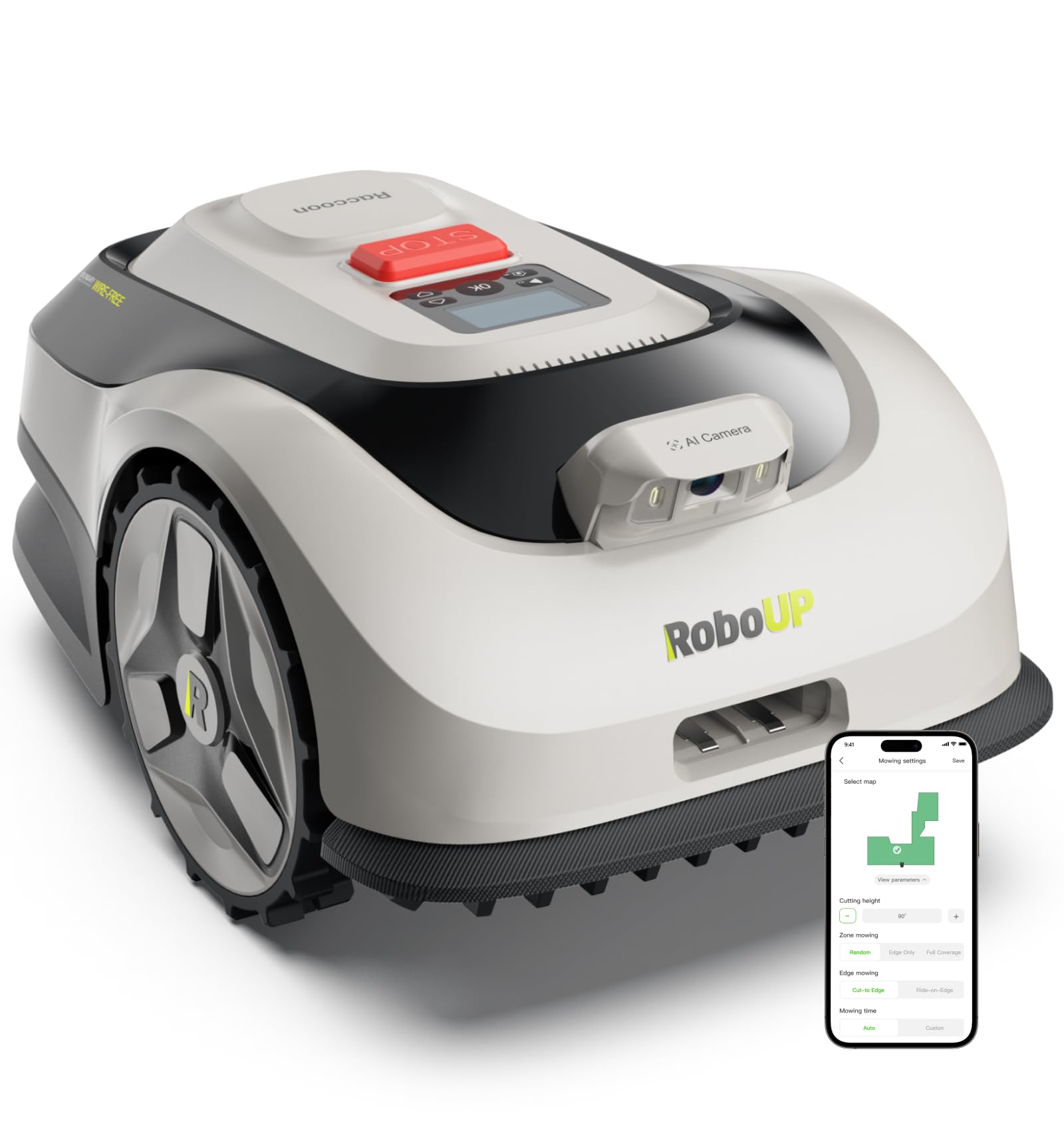
The Raccoon 2 SE is one of the few affordable mowers that doesn’t require a smartphone at all. A single button on the onboard panel initiates mowing, and the AI vision system handles mapping and navigation independently. This makes it a strong candidate for older homeowners or anyone who prefers a truly appliance-like experience without app logins, firmware updates, or Bluetooth pairing headaches.
The 7.9-inch cutting disc offers 12 height settings from 1.18 to 3.15 inches, adjusted via the app when you do use it. The AI obstacle avoidance detects over 300 object types, including pets and toys, and the bumper sensor acts as a backup for objects the camera might miss. Several verified buyers reported it navigating around chickens, dogs, and flower beds without incident. The unit weighs about 26 pounds, making it easy to carry across the yard to start in a specific spot.
For lawns under 860 square feet, the Raccoon 2 SE can start mowing immediately without any mapping step — just place it on the grass and press the button. The built-in rain sensor automatically returns it to the charging station during wet weather, and the low-noise operation means it won’t disturb neighbors during evening runs. OTA updates keep the firmware current without manual intervention.
Why it’s great
- No app required for basic operation — one-button start works out of the box
- AI obstacle avoidance reliably dodges pets, toys, and garden features
- Ultra-quiet operation allows day or night mowing without complaints
Good to know
- Best suited for small to medium lawns under 0.25 acre
- Pure vision system may struggle in very low-light conditions
- Some users reported mapping issues on complex dual-zone yards
3. ANTHBOT M9
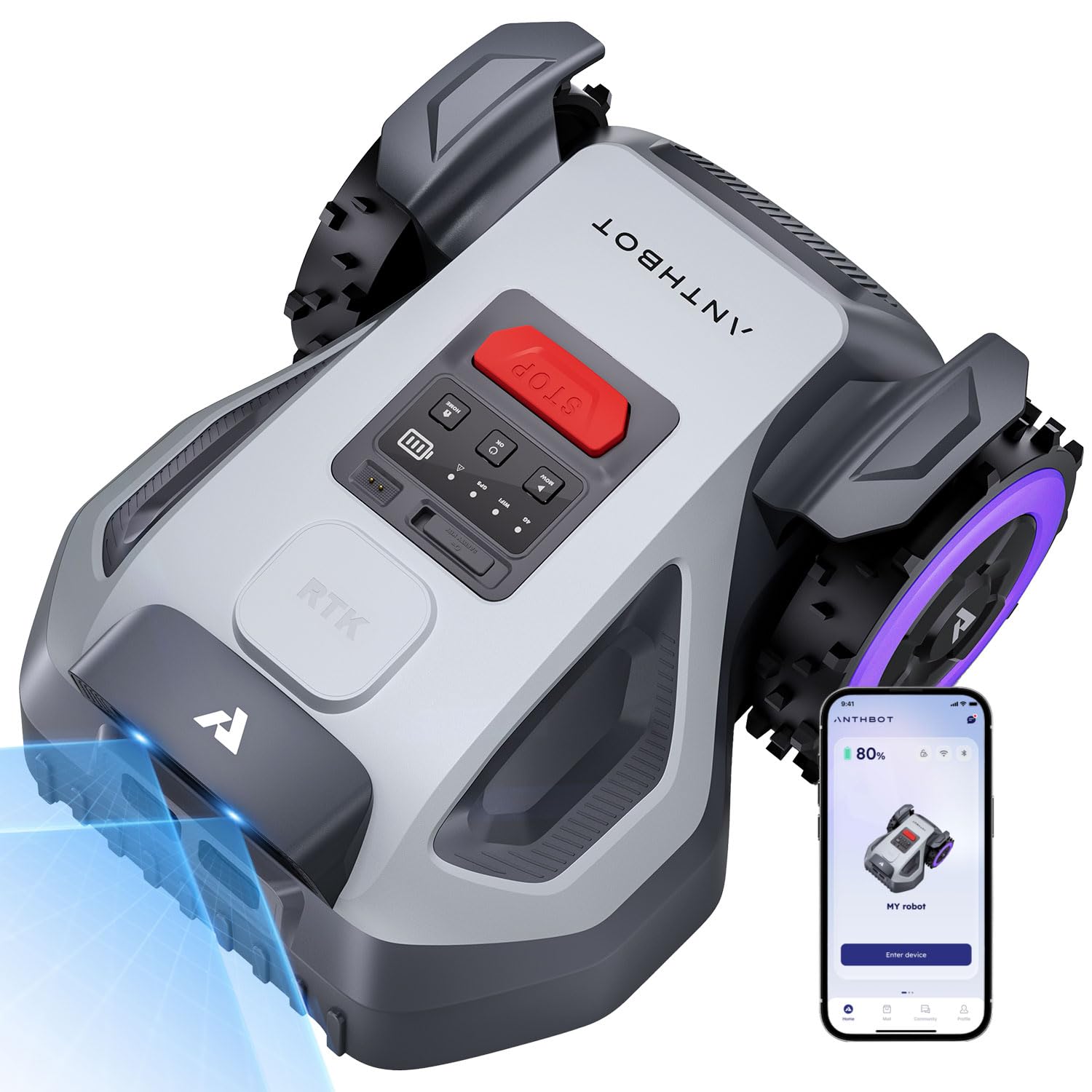
The ANTHBOT M9 combines dual HDR cameras with a full-band RTK reference station for centimeter-level positioning that remains stable even under heavy tree cover. The stand-out spec here is the 45% slope rating — that’s roughly 24 degrees — which covers over 99% of residential yards, including those with pronounced inclines that cause many budget mowers to slip or stall. The five free-rotating blades are designed to create a carpet-like finish rather than a simple chop.
The ACC (Adaptive Cruise Control) system automatically walks the mower across the lawn during initial mapping, creating a virtual map in about ten minutes without requiring the user to manually drive it. The app supports up to 30 work zones with customizable mowing paths, cutting heights, and schedules per zone. A 7.9-inch cutting width with adjustable height from 1.2 to 2.8 inches gives flexibility for different grass types.
Several users reported consistent obstacle avoidance performance on complex lawns, though a few noted that the app interface has some design quirks and missing features, like the inability to paint vision sensitivity areas. The mower manages regular maintenance cuts very well but can struggle with overgrown grass if allowed to grow too tall between sessions. IPX6 waterproofing means it can handle heavy rain without issue.
Why it’s great
- 45% slope rating handles steep hills that stall most budget models
- Dual HDR cameras with RTK deliver stable positioning under trees
- Five rotating blades produce a clean, uniform cut finish
Good to know
- Initial setup requires patience for RTK station placement
- App interface has some missing settings and inconsistent design elements
- Struggles with tall grass; best for regular weekly maintenance
4. ECOVACS Goat O1000 RTK
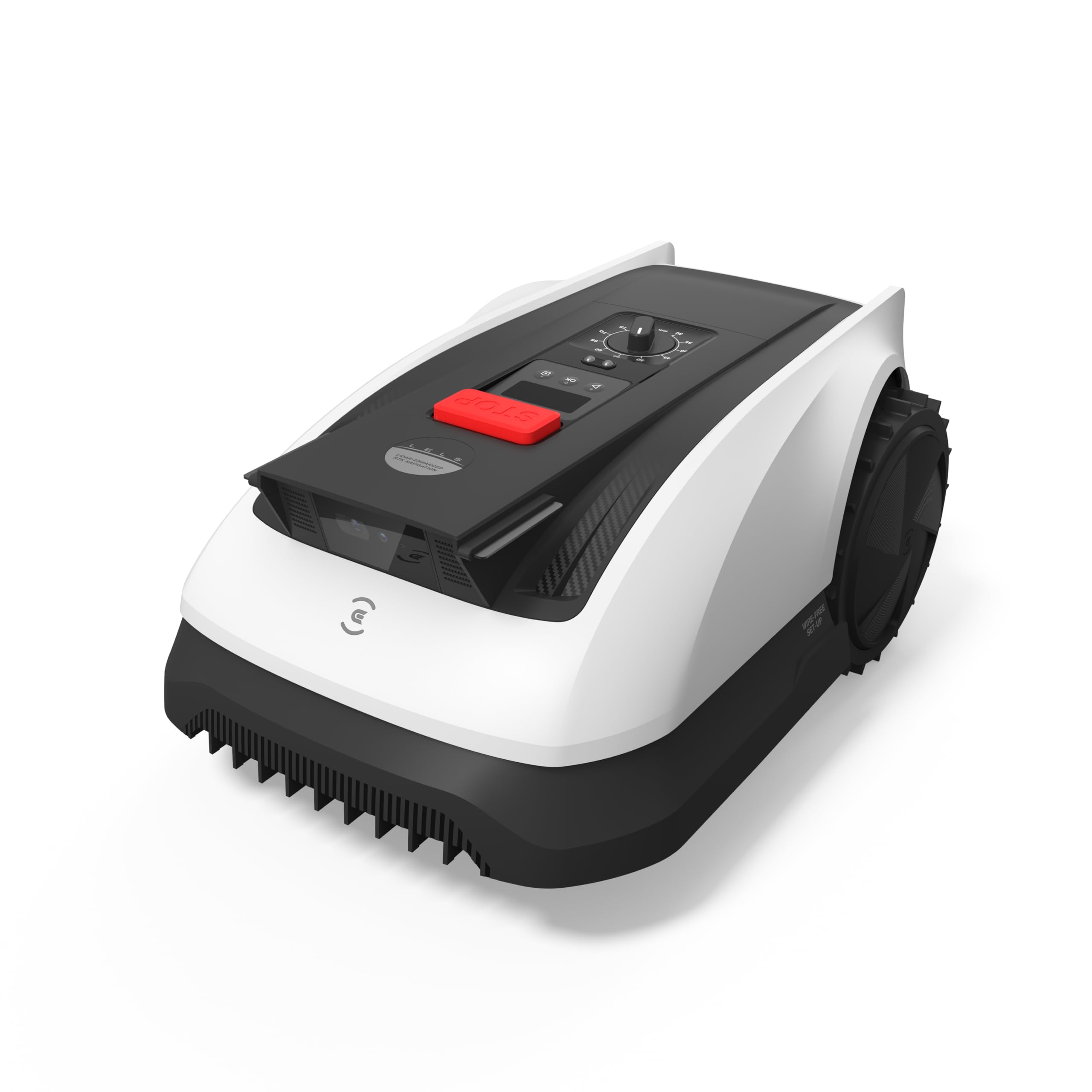
ECOVACS brings its home robot cleaning expertise outdoors with the Goat O1000, and the focus is clearly on edge precision. The TruEdge Consistent Edge Mowing feature uses LELS navigation to follow boundaries closely, and the zero-edge cutting design means the blades extend right to the mower’s chassis edge, reducing the leftover grass strips that typically require manual trimming with a string trimmer. The 8.66-inch cutting width is the widest among the models reviewed here, covering more ground per pass.
The AIVI 3D obstacle avoidance system uses a depth-sensing camera to detect and route around objects, including small wildlife like hedgehogs. The ultra-slim 1.31-foot chassis can navigate paths as narrow as 2.3 feet, making it suitable for side yards with tight clearance. The 45% climbing ability mirrors the ANTHBOT M9’s slope rating, though the heavier 44.5-pound weight makes it less portable than lighter alternatives.
User reports praise the cut quality and quiet operation, but several noted a significant limitation: the app caps the maximum map size at 10,700 square feet, which means it cannot handle larger lawns despite marketing that suggests otherwise. Some users also experienced RTK signal loss in yards with heavy tree canopy, causing “out of bounds” errors that interrupt the mowing session. The easy-edit map features in the app are genuinely useful for adjusting zones.
Why it’s great
- TruEdge system cuts right to boundary edges, reducing manual trimming
- Widest cutting width (8.66 in) for faster coverage
- Slim chassis navigates narrow 2.3 ft side paths easily
Good to know
- Map size capped at 10,700 sq ft in app — not suitable for larger lots
- RTK signal can drop under dense tree canopy
- Heavy 44.5 lb design makes it difficult to manually relocate
5. ANTHBOT Genie600
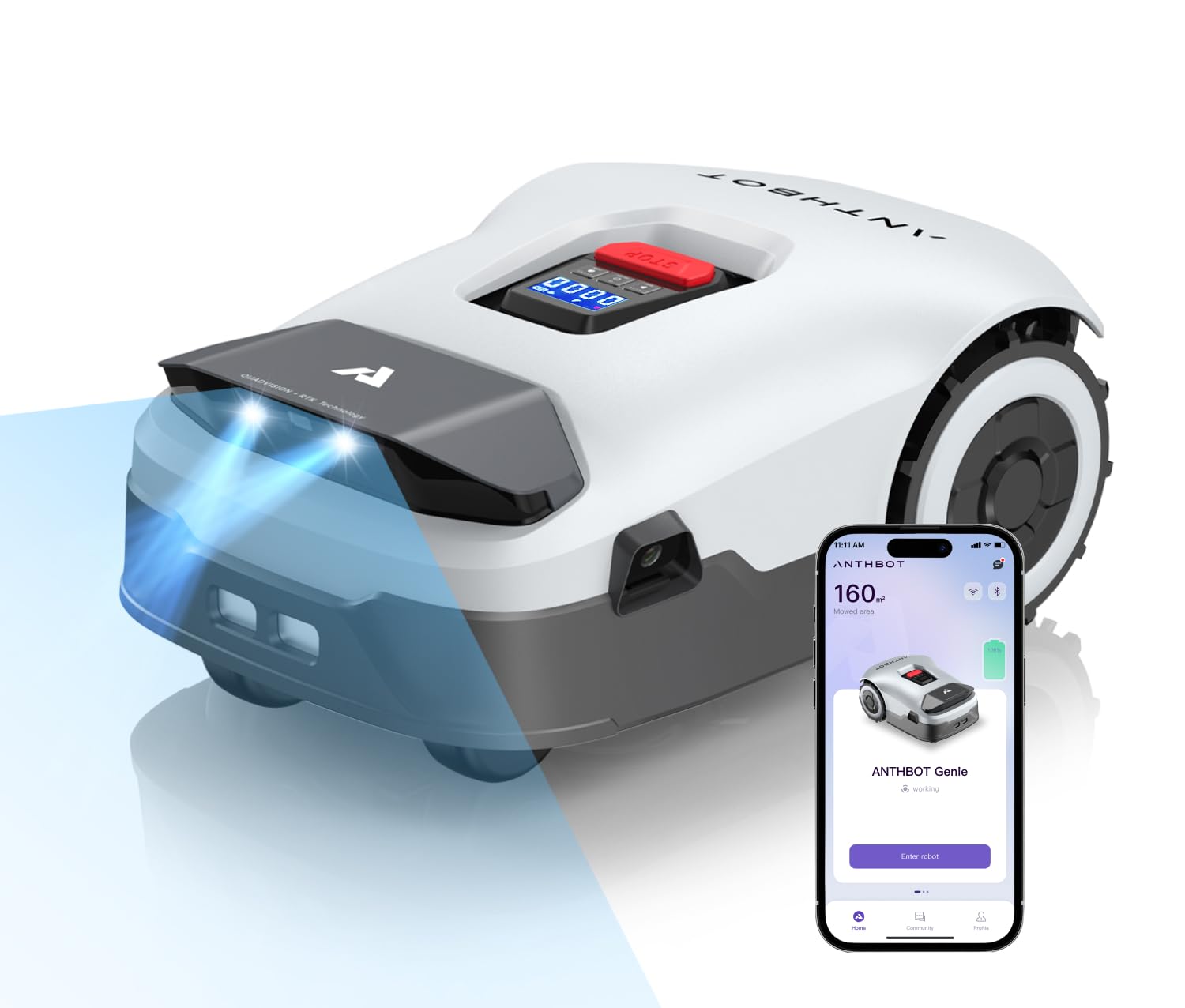
The Genie600 uses a full-band RTK module paired with four cameras (300-degree field of view) to maintain positioning even in areas where standard GPS drops out — under dense trees, near eaves, or alongside buildings. The dual positioning system switches seamlessly between satellite and vision-based tracking, preventing the “lost signal” interruptions that plague pure RTK mowers in shaded yards. The 7.9-inch cutting width and 1.18-2.76 inch height range offer solid flexibility for most grass types.
The ACC hands-free auto mapping feature uses AI boundary recognition to map the lawn automatically, with the 4-camera system identifying boundaries and creating optimal cutting routes. The app supports multi-zone management for up to 20 zones and includes a no-go zone feature for marking areas like pools or flower beds. The Intelligent Hosting Mode can adjust mowing schedules based on lawn size, seasonal changes, and weather conditions automatically.
Some users reported that the battery life is marginal for larger lawns — around 4 hours of run time for a quarter-acre requires two recharge cycles to complete the job. Several long-term users noted that after a year of use, battery capacity degraded noticeably, requiring a subscription for full app functionality. The Genie600 is a strong performer for small, shaded yards, but the subscription model and battery longevity are worth considering.
Why it’s great
- Excellent GPS performance under dense tree canopy and near structures
- 300-degree camera view detects and avoids over 1,000 object types
- Hands-free auto mapping reduces initial setup time significantly
Good to know
- Battery life may not complete a quarter-acre in a single charge cycle
- Full app functionality may require a subscription after the first year
- Battery capacity has been reported to degrade noticeably after 12 months
6. YARDCARE M800Plus
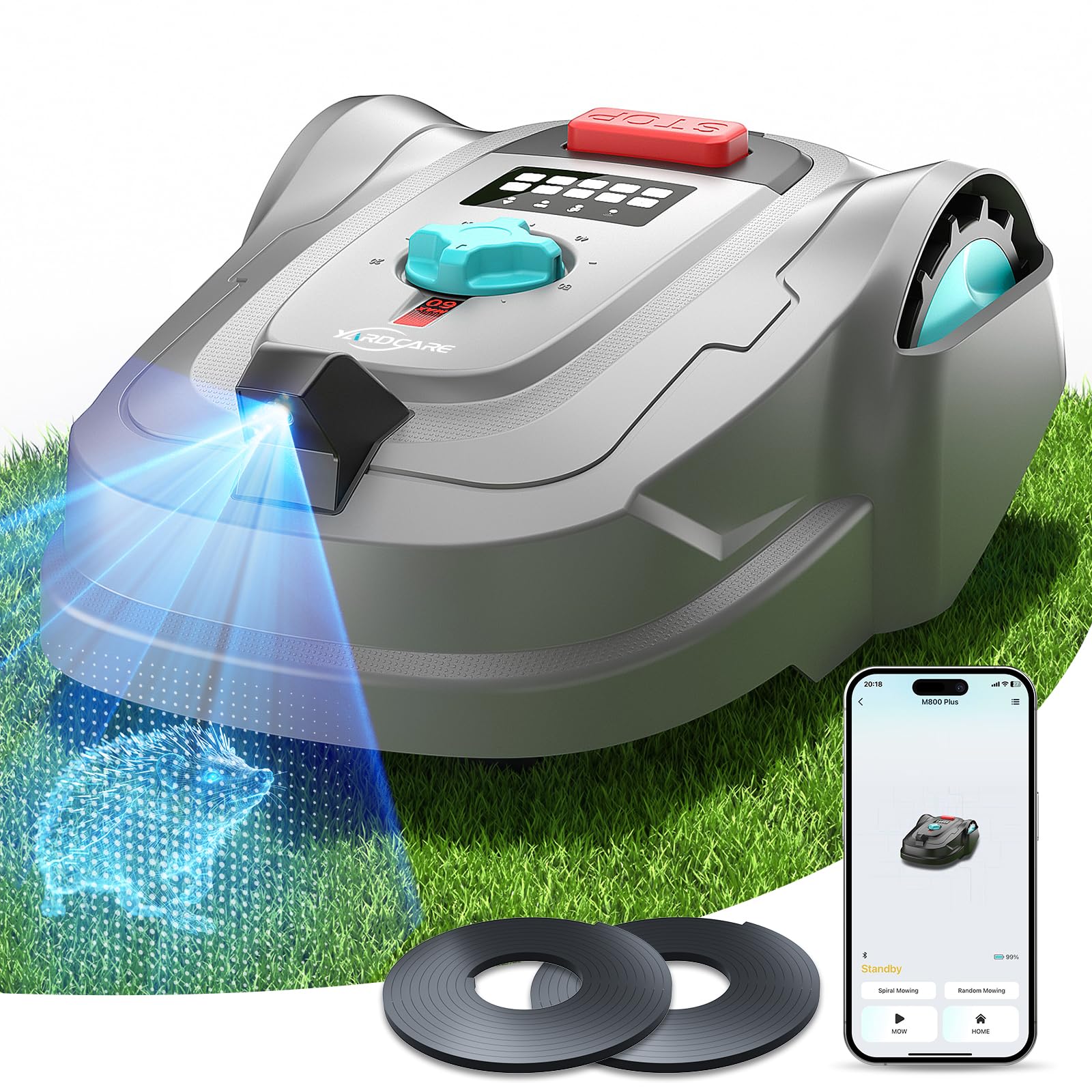
The YARDCARE M800Plus takes a hybrid approach by combining GPS and 3D vision navigation with a physical magnetic strip for creating no-go zones. This is a practical compromise for users who want wire-free navigation in the main area but need a reliable physical boundary around specific obstacles. The 32.8-foot strip is included, eliminating the need for digging or external power sources. The 3D vision system identifies grass and non-grass areas to keep the mower on the lawn.
The cutting width is 7 inches with a height range from 0.8 to 2.4 inches — the lower minimum height is useful for Bermuda grass or golf-green-style lawns. The spiral spot mowing mode targets thicker or faster-growing patches with improved local coverage. The 35% slope capability handles most residential inclines. The app supports schedule management, mowing pattern selection, and firmware updates.
User feedback is noticeably divided. Some praise the easy cordless setup and quiet operation, while others report frequent stuck-in-place errors, missed strips along edges, and unreliable return-to-base behavior. The mower seems to perform best on perfectly flat, even lawns with clear boundaries; uneven terrain causes it to get stuck often and drain the battery while beeping for help. This is a budget-conscious pick for simple, manicured lawns only.
Why it’s great
- Included magnetic strip provides reliable no-go zone marking without digging
- Lower minimum cutting height (0.8 in) suits short-grass varieties
- Spiral spot mowing mode targets thicker patches effectively
Good to know
- Frequent stuck errors on uneven ground require constant supervision
- Random mowing pattern can leave uneven results on complex lawns
- Return-to-base reliability is inconsistent in multi-zone setups
7. BESTMOW T100
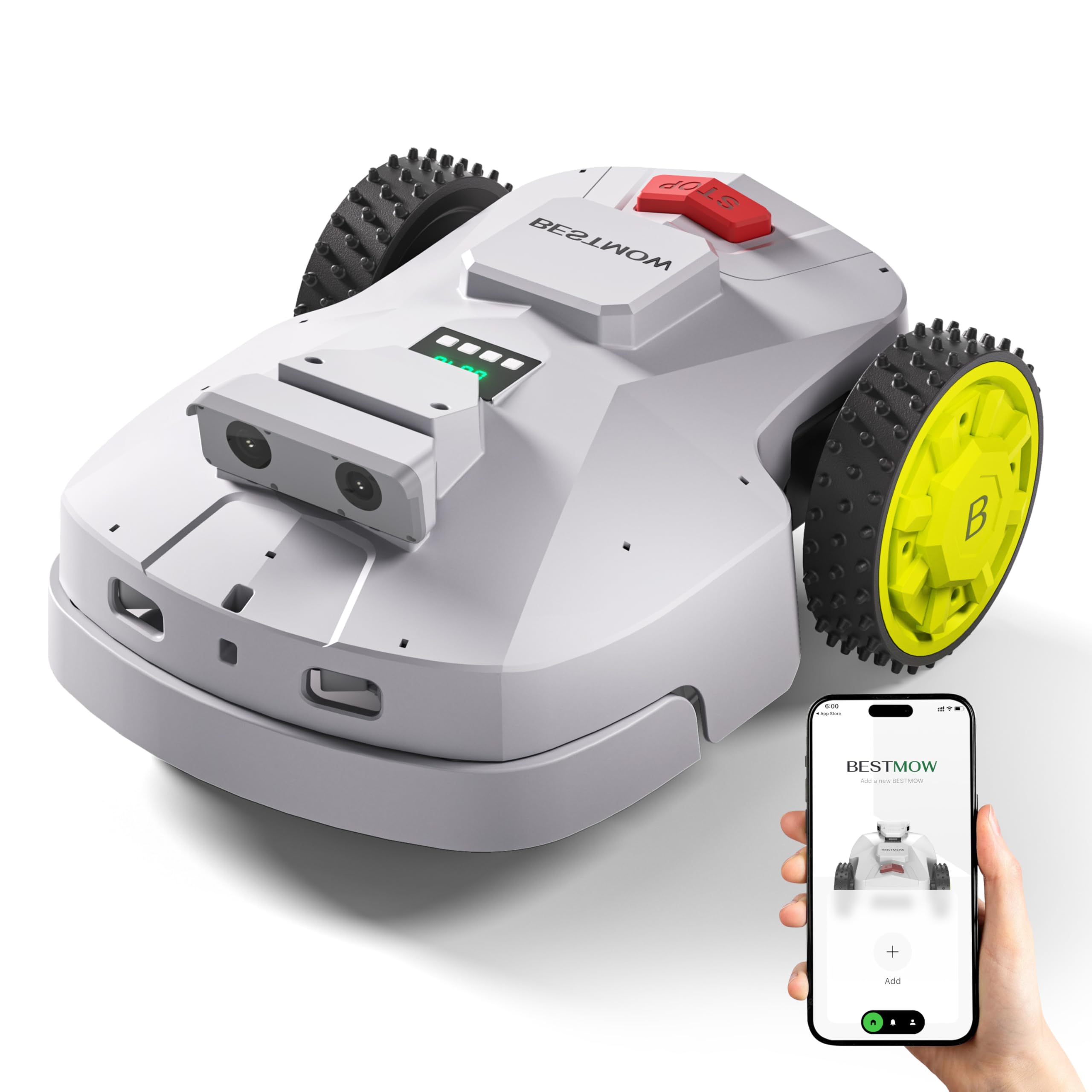
The BESTMOW T100 targets larger properties with a rated coverage of up to 1.5 acres, positioning it as a budget-friendly alternative for owners who would otherwise need a riding mower. The RTK+4-eye vision navigation system creates efficient mowing patterns for complex terrains with varying elevations. The standout spec is the 4-inch maximum cutting height — the tallest in this roundup — allowing it to handle tall fescue and other long-blade grass types without bogging down. The 8.6-inch cutting width helps cover ground faster per pass.
The anti-theft protection requires a one-time activation code provided after purchase, which adds security but also creates a complication: if you buy a used unit without the code, the mower won’t function. The self-charging feature returns the mower to base when the 4-hour battery runs low and resumes after charging. The app allows schedule management, real-time tracking, and custom zone settings. The ultra-quiet motor design permits day or night operation without disturbing neighbors.
User reports note that the T100 works very well for regular maintenance cutting, especially on short grass. However, several users experienced serious issues: the mower can fail to connect to satellites after several months, and customer support responsiveness has been inconsistent. The activation code system also means that purchasing a returned or used unit carries significant risk of incompatibility. Daytime performance is strong, but the camera struggles in low-light conditions, making night mowing problematic.
Why it’s great
- 4-inch max cutting height handles tall grass types other mowers can’t
- Rated coverage up to 1.5 acres suits larger properties
- 4-hour battery life reduces the number of recharge cycles needed
Good to know
- Activation code requirement makes used purchases risky
- Camera struggles in low light; night mowing is not reliable
- Customer support responsiveness has been inconsistent in recent months
8. ANTHBOT Genie1000
The Genie1000 is effectively a larger-area version of the Genie600, with a rated coverage of up to 0.5 acres thanks to an algorithm upgrade and signal coverage technology breakthrough. The full-band RTK and 4-eye vision system is identical in principle, providing the same excellent performance under tree cover and near structures. The 7.9-inch cutting width and 1.18-2.76 inch height range match the Genie600’s specs, making this a capacity upgrade rather than a feature upgrade.
The 20+ multi-zone management and no-go zone features are carried over, and the Intelligent Hosting Mode remains one of the more useful scheduling tools in this price range — it auto-adjusts based on weather, season, and lawn growth rate. The 4-camera system with a 300-degree field of view detects over 1,000 object types for obstacle avoidance. The mower weighs 46 pounds, making it less portable but more stable on inclines.
Users with large, steep, and uneven lawns reported that the Genie1000 handles most areas well, though it can get stuck on the steepest sections outside the rated parameters. Edge trimming is not perfect; some manual perimeter tuning is required. A few users experienced frustrating errors, including the mower losing GPS, zones shifting in the app, and poor customer support response times. The Genie1000 delivers strong value for its coverage area, but the firmware and support experience remain inconsistent.
Why it’s great
- Supports up to 0.5 acres with reliable full-band RTK positioning
- Intelligent Hosting Mode auto-adjusts schedules based on weather and season
- 300-degree camera view provides strong obstacle detection coverage
Good to know
- Some users report GPS loss and zone map shifting over time
- Not a true edge trimmer; some manual perimeter work is needed
- Heavy 46 lb build makes manual relocation a two-hand job
9. eufy E15
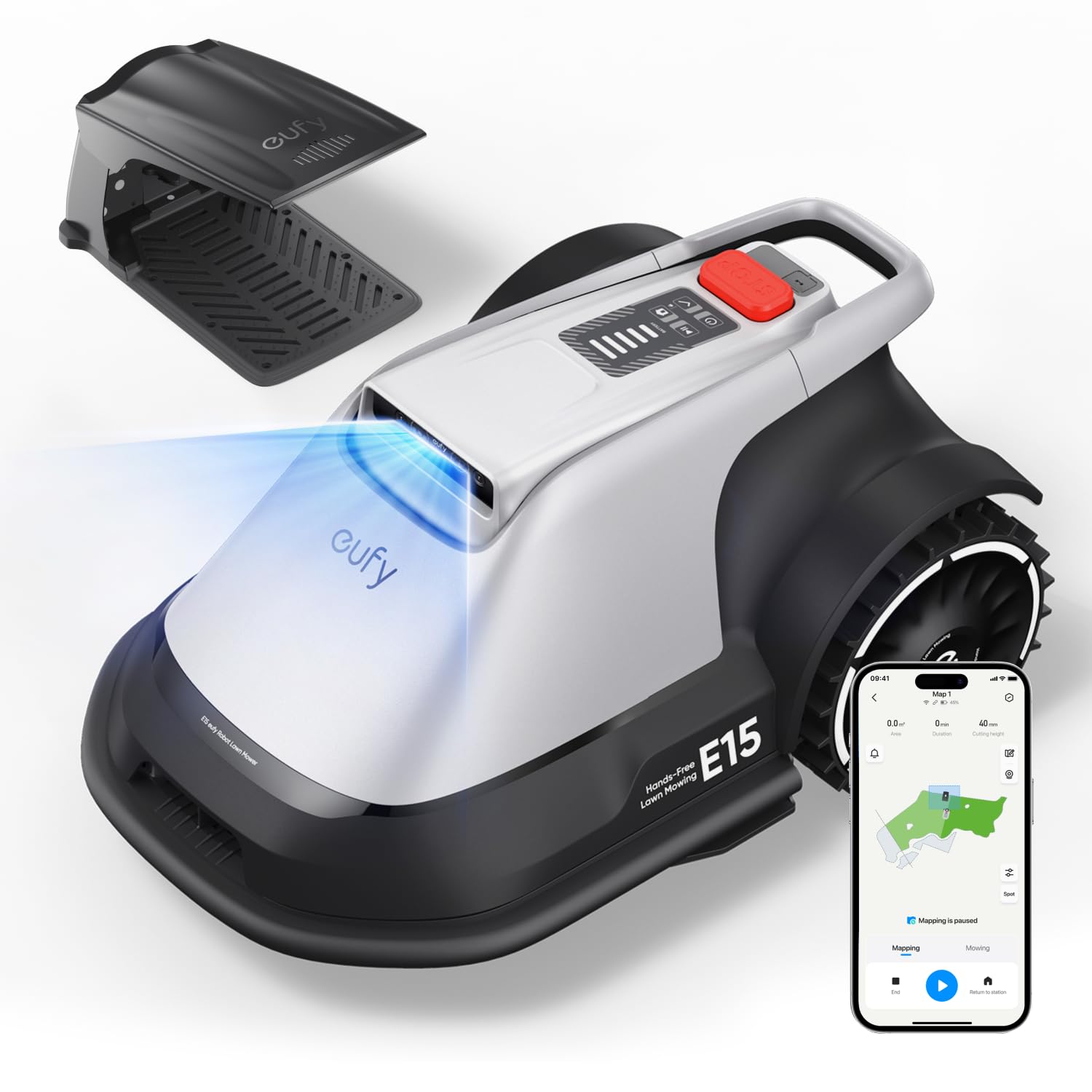
The eufy E15 uses pure vision navigation (V-FSD 1.0) with stereo cameras and Vision SLAM, meaning it requires no RTK antenna tower, no boundary wires, and no external reference station. This makes setup incredibly simple: place the base in the yard, open the app, and let the mower auto-map the lawn. The system works best in fenced or clearly bounded yards where the grass edge is distinct from paving or garden beds. The 8-inch cutting width with a 1-3 inch height range handles most residential grass types.
The AI 3D obstacle avoidance system detects low obstacles like rocks and toys, and tall obstacles like trees and pool borders. The Ride-on Edge technology cuts right to the lawn’s boundary, though users report that some corners and tight edges still require manual trimming. The parallel cutting pattern produces clean stripes rather than random tracks, and the smart coverage detection automatically re-mows any missed spots. GPS anti-theft tracking is built in without requiring a subscription.
The E15 is specifically designed for lawns up to 0.2 acres (8,700 square feet) with slopes no steeper than 18 degrees and grass height under 3.5 inches. It is not suitable for St. Augustine or dense Zoysia grass. Some users found the auto-mapping problematic on sandy or patchy lawns where the vision system struggled to distinguish grass from bare soil. The unit is also quite slow, and may miss corners in irregularly shaped yards. It performs best on flat, defined lawns.
Why it’s great
- Pure vision system requires no external antenna or RTK station
- Auto-mapping is quick and intuitive for fenced yards
- Built-in GPS anti-theft tracking with no subscription needed
Good to know
- Vision system struggles on patchy or sandy lawns without clear grass boundaries
- Maximum coverage is only 0.2 acres — not suitable for larger lots
- Slow mowing speed and missed corners may require supplemental trimming
10. WORX Landroid Vision Cloud WR320
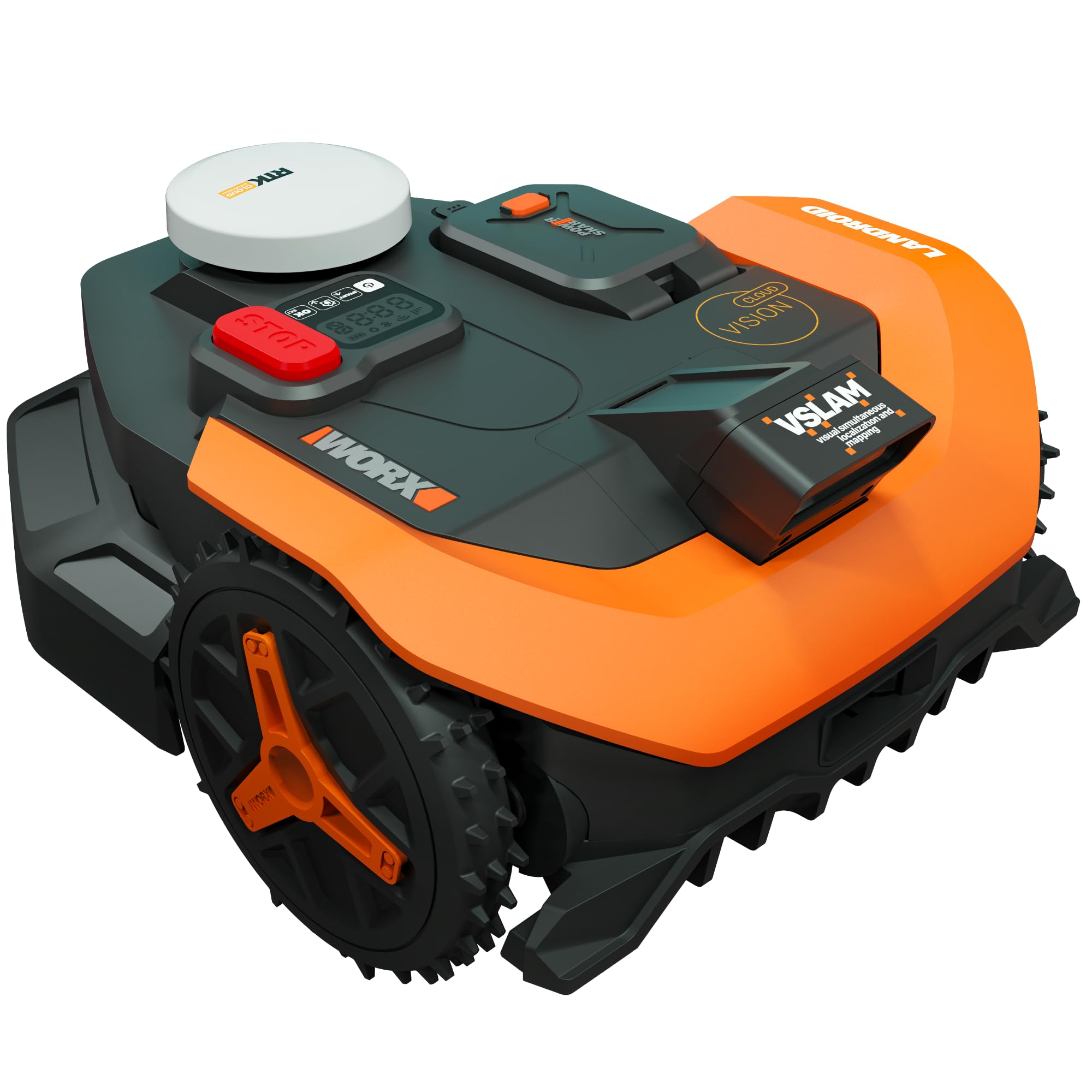
The WORX WR320 differentiates itself with cloud-delivered RTK accuracy — no local antenna installation is required, and there are no ongoing cloud subscription fees. The Vision AI system uses a neural network processing up to 10 trillion operations per second to recognize and understand objects, not just detect them. This enables the mower to distinguish between a fixed boundary that requires close trimming and a ridable edge like a curb that can be crossed. The 8.7-inch cutting width is the widest in this lineup.
The mower offers four distinct mowing patterns — Parallel, Checkerboard, Diamond, and Natural — which can be switched via the app for different aesthetic results. The cut-to-edge border cutting uses the boundary understanding to minimize leftover grass along lawn edges. The RTK-accurate navigation maintains straight, evenly spaced stripes even in shaded areas, using V-SLAM sensor fusion to handle gaps in satellite coverage. The RadioLink connectivity extends Bluetooth and Wi-Fi range across larger lawns beyond standard router coverage.
Users who successfully set up the WR320 praise its exceptional AI obstacle recognition, quiet operation, and excellent edge cutting. However, the setup process is demanding: it requires a dedicated 2.4GHz Wi-Fi network, and many users experienced frustrating issues with mapping inconsistency, app connection losses, and frequent error beeping. The manual is poorly detailed, and some users reported defective units that never functioned correctly. When it works, it’s outstanding; when it doesn’t, the troubleshooting can be exhausting.
Why it’s great
- Cloud-based RTK eliminates need for local antenna installation
- Four distinct mowing patterns create professional-looking stripes
- Neural network understands boundary types for better edge trimming
Good to know
- Setup requires a dedicated 2.4GHz Wi-Fi network and patience
- Some units experience persistent mapping and app connection issues
- Customer service and manual quality have been criticized by users
11. eufy E18
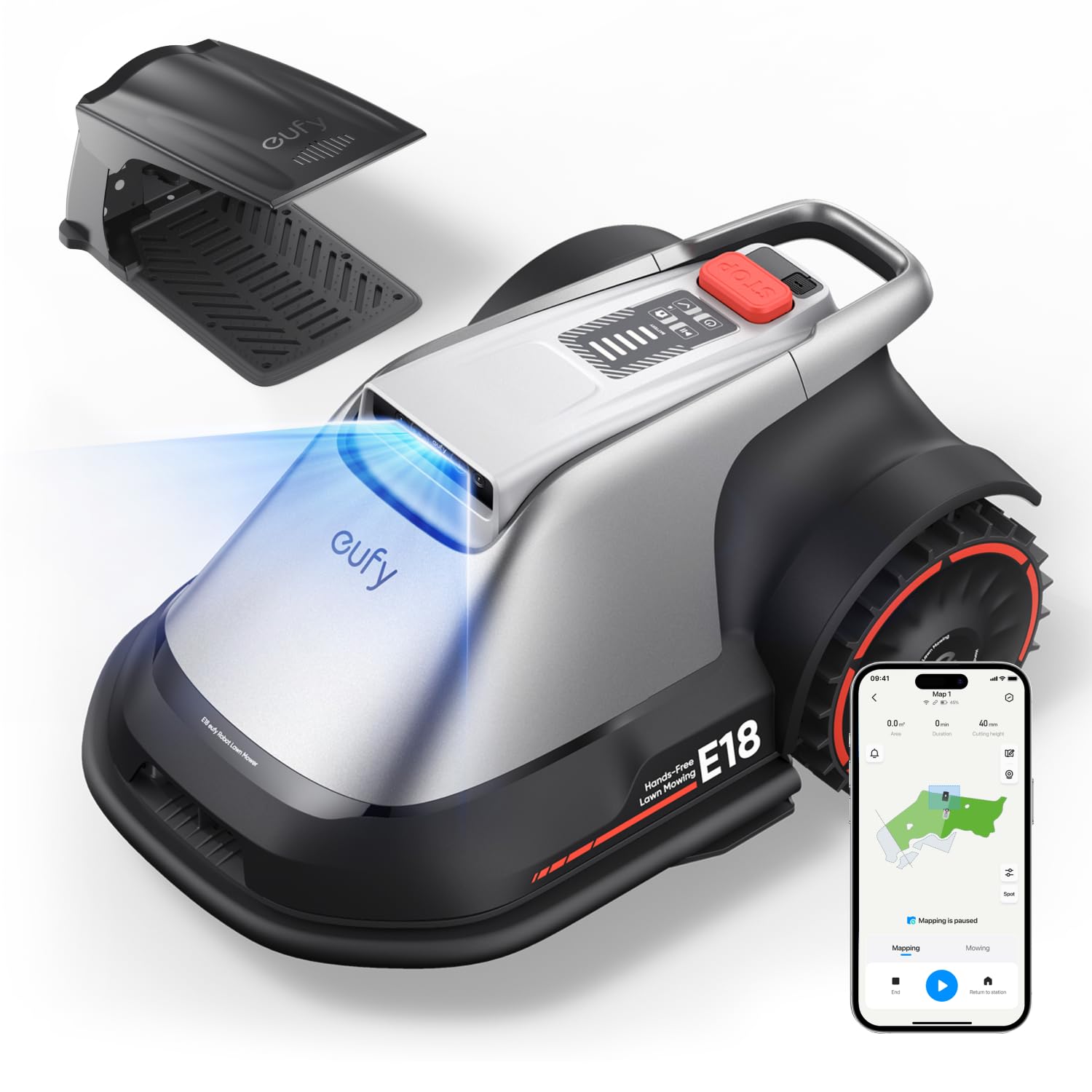
The eufy E18 is a larger-capacity sibling to the E15, extending the maximum coverage to 0.3 acres (13,000 square feet) while maintaining the same pure vision navigation system. V-FSD 1.0 uses high-precision stereo cameras and SLAM algorithms for hands-free auto mapping — no boundary wires, no RTK tower, no external reference station. The setup process is among the quickest in this category, with the mower mapping the entire yard autonomously in roughly five minutes. The 8-inch cutting width and 1-3 inch height range mirror the E15’s specs.
The 3D obstacle perception system detects and navigates around pools, tree trunks, garden furniture, and pets. The Ride-on-Edge technology covers fence lines and garden borders for a clean result. The parallel cutting pattern produces uniform stripes, and the smart coverage detection re-mows skipped areas automatically. Three power modes — eco, standard, and powerful — let you adjust cutting aggressiveness based on grass thickness. The built-in GPS anti-theft tracking provides real-time location monitoring via the eufy app.
One notable issue reported by long-term users is significant battery degradation after the first year: some units lost enough capacity to cut only about one-third of a 3,000-square-foot lawn on a single charge. eufy’s customer support replaced the affected batteries, but it’s a point worth monitoring. The E18 also struggles with overgrown grass and is best used for regular weekly maintenance rather than recovery cutting. It cannot mulch leaves and lacks flexible scheduling options like every-other-day patterns.
Why it’s great
- Hands-free auto mapping in about five minutes with no external hardware
- Three power modes allow adjustment for grass thickness and battery conservation
- GPS anti-theft tracking is built in without an ongoing subscription fee
Good to know
- Several users reported significant battery degradation after 12 months of use
- Struggles with tall or overgrown grass; best for regular weekly cuts
- Cannot mulch leaves and lacks flexible multi-day scheduling options
FAQ
How often should I replace the blades on a robot lawn mower?
Can an affordable robot lawn mower handle wet grass?
What is the typical lifespan of a robot lawn mower battery?
Final Thoughts: The Verdict
For most users, the affordable robot lawn mower winner is the Segway Navimow i105N because it delivers reliable hybrid RTK+vision navigation, a polished multi-zone app, and a 3-year warranty that justifies the mid-range investment. If your yard has tall grass or steep slopes up to 45%, grab the ANTHBOT M9 for its dual camera system and exceptional climbing ability. And for a completely wire-free, no-app-required experience that works out of the box, nothing beats the RoboUP Raccoon 2 SE.