
Our readers keep the lights on and the weekend projects moving. As an Amazon Associate, I earn from qualifying purchases.
The difference between a sewing machine that frustrates you every Saturday and one that turns a pile of fabric into a finished dress in an afternoon is rarely the brand name on the front. It’s the internal frame material, the feed dog design, and whether the tension system can handle the two layers of denim you plan to hem. The affordable segment of this market is packed with plastic-bodied machines that rattle over thick seams and thread-path catches that snap the top thread mid-stitch. If you want to buy once and sew happily for years, you need to look past the decorative-stitch count and check the chassis construction first.
I’m Rikta — the co-founder and writer behind FitlyFast. I’ve spent weeks analyzing motor torque specs, bobbin case materials, presser foot compatibility, and real owner feedback across a dozen sewing-machine models to separate durable, tunable machines from those that will leave you rethreading every ten minutes.
This guide walks you through the mechanical and electronic trade-offs you’ll face at each budget level, with nine hands-on reviews that cut through marketing claims. Whether you’re a beginner building a wardrobe or an experienced sewist adding a backup unit, the following analysis will help you identify the affordable sewing machine that delivers reliable, repeatable stitches without the hidden costs of frustration and repairs.
How To Choose The Best Affordable Sewing Machine
The most common mistake buyers make is judging a machine by its advertised stitch count rather than its build quality and feeding mechanism. A machine with 200 decorative stitches that skips every third stitch on a hem is far less useful than a 25-stitch machine with a solid metal frame, smooth feeding dogs, and a tension system that stays put. Keep these three factors at the top of your checklist.
Internal Frame Material — Metal vs. Plastic
Open the box and lift the machine. If it feels suspiciously light (under 11 pounds), it almost certainly has a plastic internal chassis. A plastic frame flexes under the resistance of thick fabric layers, which causes the needle to drift and stitches to become uneven. A metal frame — found on models from Janome, Juki, and the higher-end Brother units — maintains rigidity and keeps the needle bar stationary, producing consistent stitches even when you’re sewing through six layers of denim or a quilt sandwich. Check the product specifications for “metal frame” or “all-metal skeleton”; if the description is vague, assume it’s plastic.
Bobbin System — Drop-in vs. Front-loading
For an affordable machine, a top-drop, jam-resistant bobbin system is the single feature that saves the most time. Front-loading bobbins (common on older mechanical machines) require you to remove the accessory tray, slide the bobbin into a vertical case, and then manually adjust the tension screw on the bobbin case itself. Drop-in bobbins sit under a clear cover plate on top of the machine; you drop the bobbin in, pull the thread through a slot, and close the cover. They jam less often, and when they do jam, clearing the thread takes seconds instead of a disassembly. Every machine in this guide that earns a top recommendation uses a drop-in bobbin system.
Feed Dog System and Presser Foot Pressure
The feed dogs — those metal teeth that rise through the needle plate to pull fabric forward — determine whether your fabric feeds evenly or puckers. On entry-level machines, the feed dogs are often two-piece plastic units that wear down over time. Mid-range and premium models use a seven-piece feed dog system (like the Janome JW8100) or a Superior Plus Feed System (like the Janome 3160QDC-G) that moves fabric without shifting or stretching. For quilting, adjustable presser foot pressure is a must-have; without it, thick layers tend to creep or bunch under the presser foot. If your sewing plans include quilts, upholstery, or heavy canvas, look for a machine with an adjustable foot pressure dial.
Quick Comparison
On smaller screens, swipe sideways to see the full table.
| Model | Category | Best For | Key Spec | Amazon |
|---|---|---|---|---|
| Janome JW8100 | Computerized | Quilting & Heavy Fabrics | 7-piece feed dog system | Amazon |
| Brother CP100X | Computerized | All-Around Home Sewing | 10 sewing feet + walking foot | Amazon |
| SINGER Heavy Duty 6800C | Computerized | Denim, Canvas & Upholstery | 586 stitch applications | Amazon |
| EverSewn Charlotte | Computerized | Beginner-to-Intermediate Growth | 80 stitches / 7mm max width | Amazon |
| PooLin EOC02 | Computerized | 200 Stitch Decorative Projects | LCD screen, start/stop button | Amazon |
| Brother XM3700 | Mechanical | First-Time Buyers | 37 built-in stitches | Amazon |
| FEIYUE FYe310 | Mechanical | Simple Hems & Repairs | Servo motor, 25 stitches | Amazon |
| Janome 3160QDC-G | Computerized | Quilting & Garment Making | Superior Plus Feed System | Amazon |
| Juki TL-2010Q | Mechanical (Straight Stitch) | High-Speed Piecing & Quilting | Auto thread trimmer / knee lifter | Amazon |
In‑Depth Reviews
1. Janome JW8100

The Janome JW8100 is the machine that rewrites the affordable sewing machine equation. While most budget models compromise on internal build quality, Janome equips this computerized unit with a full metal frame and a seven-piece feed dog system that moves fabric evenly without slipping or puckering — even when you’re feeding four layers of quilting cotton or a single layer of silk charmeuse. The 100 built-in stitches include seven one-step auto buttonholes, and the intuitive LCD screen with dedicated buttons makes stitch selection faster than scrolling through a mechanical dial.
The included accessory package is the richest in this tier: an extra-wide extension table, a hard cover, an even-feed (walking) foot for quilting, a quarter-inch piecing foot, plus the standard zipper, satin stitch, and buttonhole feet. Owners report that the automatic needle threader works reliably, the jam-proof drop-in bobbin doesn’t tangle, and the machine handles denim and canvas with zero hesitation. The only recurring note is that the work light could be brighter, but that’s a common complaint across every machine in this class.
For a buyer who wants one machine that can do garment sewing, quilting, and home décor projects without feeling limited after six months, the JW8100 delivers durability and feature depth that usually costs twice as much. It’s the safest, most capable investment in the affordable range.
Why it’s great
- Full metal frame — no plastic chassis flex
- Seven-piece feed dogs handle thick and thin fabrics evenly
- Includes extension table, hard cover, and walking foot
- Start/stop button and speed slider for pedal-free sewing
Good to know
- Work light could be brighter for dark fabric work
- Heavier than typical entry-level machines (12 lb)
2. SINGER Heavy Duty 6800C

The SINGER Heavy Duty 6800C is a computerized machine that punches far above its placement on the price spectrum, largely due to its 60-percent-stronger motor and full metal frame. With 586 stitch applications including basic, stretch, decorative patterns, and two built-in lettering fonts, this machine offers more stitch variety than any other model in the affordable category, plus nine one-step buttonhole styles for professional-looking closures. The LCD screen shows the selected stitch image and recommends the appropriate presser foot — a helpful guide for newer sewists who aren’t yet sure which foot to use.
The accessory kit is the most complete in the roundup: ten presser feet including an even-feed (walking) foot, open-toe foot, satin stitch foot, and cording foot, plus four transparent bobbins and a soft cover. The built-in needle threader, top drop-in bobbin, and automatic thread cutter streamline the workflow significantly, and the speed control slider lets you dial down the pace when you need precise control around curves or buttonholes. Owners report quiet, smooth operation and consistent stitches across denim, canvas, and layered quilting materials.
The main trade-off is that the accompanying needles are not heavy-duty enough for the machine’s motor power — experienced users recommend swapping immediately to Schmetz denim or topstitch needles for thick fabric work. The soft cover also offers less protection than a hard case, so machine owners who travel to classes or retreats may prefer a separate carrying case. For a home sewist who wants a computerized machine with the muscle to handle jeans and upholstery while still offering decorative stitch options, the 6800C is a compelling value.
Why it’s great
- Powerful motor handles thick fabrics without hesitation
- Ten presser feet included — walking foot, open toe, cording
- Auto thread cutter saves time on every seam
- LCD screen shows foot recommendation for each stitch
Good to know
- Included needles wear quickly on heavy fabric — upgrade recommended
- Soft cover only; hard case sold separately
3. Brother CP100X

The Brother CP100X occupies a sweet spot in the Brother lineup: it carries 100 built-in stitches (utility, decorative, heirloom, and eight auto-size buttonholes) inside a durable metal frame that costs less than many plastic-chassis competitors. The fixed needle bar design keeps the needle locked in position during sewing, which produces cleaner, straighter lines — a detail that matters when you’re topstitching a collar or piecing a quilt top. The included wide table attaches easily for larger projects like quilts and curtains, and the machine weighs just 10.5 pounds, making it one of the more portable metal-frame options.
Brother includes ten presser feet in the box, notably a walking foot and a quilting foot that are often sold separately on other mid-range machines. The automatic needle threader has been redesigned from earlier Brother models and works more reliably, though a few owners note that bobbin winding can occasionally tangle under the spool — easily fixed by manually guiding the thread during the first few seconds. The accessory pouch doubles as a protective cover, and the free arm allows easy work on cuffs and sleeves.
The CP100X is quieter than many comparably priced machines, with a smooth motor that doesn’t vibrate across the table even at higher speeds. It handles cotton, linen, and light denim with no tension issues, and the feed dogs can be lowered for free-motion quilting. If you want a machine that grows with you from beginner patchwork to intermediate garment construction, the CP100X balances power, stitch selection, and build quality effectively.
Why it’s great
- Metal frame construction for durability
- 10 feet including walking and quilting foot
- Fixed needle bar for even stitch lines
- Lightweight (10.5 lb) with wide table
Good to know
- Bobbin winding may need manual guidance initially
- Needle threader can be bulky for some users
4. EverSewn Charlotte

The EverSewn Charlotte is a rarity in the affordable sewing machine space: a computerized model with 80 built-in stitches and a 7-millimeter maximum stitch width, packaged inside an all-metal skeleton at a price that competing brands reserve for plastic-framed machines. The 6.5-inch sewing space to the right of the needle gives you more room than most comparably sized machines for free-motion quilting or maneuvering bulky rolled hems. The feed dogs drop for quilting and embroidery work, and the seven included presser feet cover the basics without overwhelming a new sewist.
The fingertip speed control slider and start/stop button allow pedal-free operation, which is a great feature for users with mobility limitations or for anyone who wants consistent speed on long seams without foot fatigue. The automatic needle threader works reliably even with fine needles, and the drop-in bobbin with a clear cover lets you monitor thread supply mid-project. Owner reviews highlight that the machine handles knit fabrics, linen, cotton, and light-to-medium denim well, and the instructional manual is praised for clear step-by-step illustrations that make tension adjustments and threading easy to learn.
The Charlotte does have limits: it may struggle with more than six layers of heavy knit fabric, and the LED light could be brighter to illuminate the right side of the needle plate. Some users reported an initial need to recalibrate tension settings, but this is standard for any new machine that ships with factory tension. For a beginner who wants a machine that won’t feel limiting after three months, the Charlotte offers an excellent balance of computerized control, durable build, and ease of learning.
Why it’s great
- All-metal skeleton — rare at this price point
- 80 stitches with 7mm width for wider decorative patterns
- Speed slider and start/stop for pedal-free sewing
- Clear, detailed manual for new sewists
Good to know
- Work light could be brighter on the right side
- May hesitate on 6+ layers of heavy knit fabric
5. PooLin EOC02
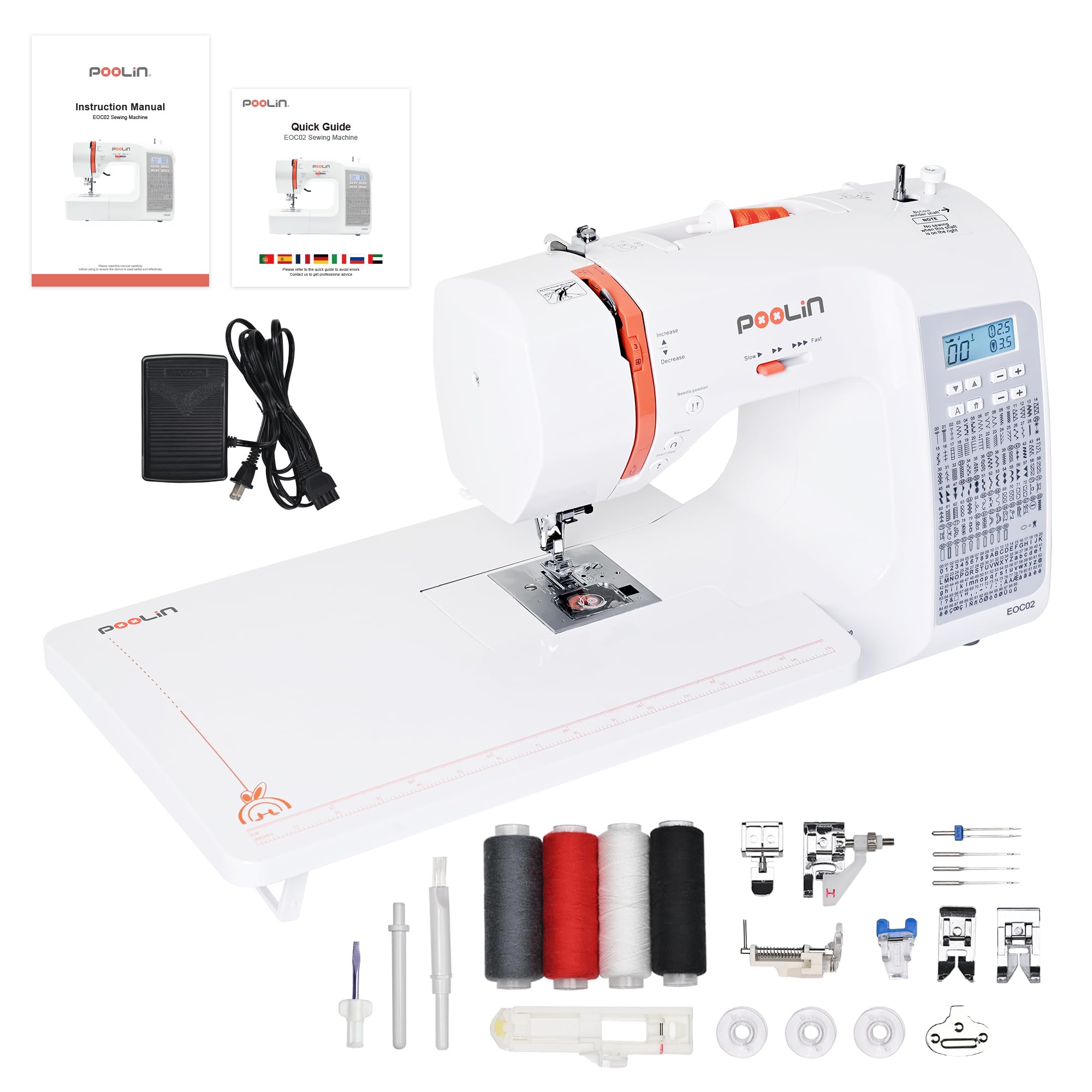
The PooLin EOC02 enters the affordable sewing machine category with a feature set that would have been impossible at this price five years ago: 200 built-in stitches including alphanumeric patterns, a crisp LCD screen, seven presser feet, and a wide extension table, all wrapped in a metal-and-plastic body. The on-screen stitch selection and intuitive control panel make it easy to navigate the enormous stitch library without flipping through a manual. The automatic needle threader and one-touch start/stop button reduce setup time, and the speed control slider gives you precise command over stitching pace across different fabric types.
Fabric compatibility spans from delicate satin and organza through stretch knits all the way to heavy denim and canvas up to 6mm thick, though the manufacturer recommends using a stabilizer for stretch materials to maintain stitch consistency. Owners consistently praise the machine’s quiet operation and smooth feeding, with several noting that handle zippers, vinyl, and multiple layers right out of the box without any tension adjustment. The customer support team offers direct video guidance, and the brand runs active social media groups where users share tips and troubleshoot — a support level uncommon at this price tier.
Potential downsides include the absence of a walking foot in the included seven-foot set (you’ll need to buy one separately for quilting), and the instruction manual, while complete, requires careful reading due to the machine’s extensive features. For someone who loves decorative stitching, garment embellishment, and alphabet monogramming without wanting to invest in a dedicated embroidery machine, the PooLin EOC02 is the most feature-rich option reviewed here.
Why it’s great
- 200 stitches including alphanumeric fonts for personalization
- Large LCD display for easy stitch selection
- Very quiet and smooth during operation
- Active customer support with video tutorials and community group
Good to know
- Walking foot not included — sold separately for quilting
- Feature-dense menu requires manual study
6. Brother XM3700

The Brother XM3700 is built for the absolute beginner who wants a machine that threads easily, doesn’t jam often, and includes clear on-machine guides that turn a confusing first session into a productive afternoon. The 37 built-in stitches include basic, stretch, and decorative patterns, plus a one-step auto-size buttonhole that produces consistent results without guesswork. The automatic needle threader — Brother’s redesigned version — pushes the thread through the needle reliably, though first-timers will need a couple of tries to master the motion.
The jam-resistant drop-in top bobbin is the standout feature for new sewists; it eliminates the frustration of tangled bobbin thread that plagues front-loading systems. The machine comes with five presser feet (zigzag, zipper, blind stitch, buttonhole, and button sewing) plus a twin needle for decorative double-needle stitching, and the free arm facilitates cuff and sleeve work. Owners confirm the machine handles heavy and delicate fabrics with consistent stitches, and the accessory pouch and user manual are well-organized.
The main limitation is that the 37-stitch library includes only the essentials — no alphabet or heirloom patterns — which may feel constraining as skills grow beyond basic garment construction and repairs. The machine is lightweight enough to move one-handed, but some of that weight savings comes from a higher plastic content in the body, so it won’t be as vibration-resistant on thick fabrics as a metal-frame model. For a first-time buyer on a strict budget who needs a reliable, easy-to-thread machine for everyday mending and simple projects, the XM3700 is a solid, low-friction entry point.
Why it’s great
- Jam-resistant drop-in bobbin — beginner-friendly design
- Easy threading with on-machine arrow guides
- Lightweight and portable (12.5 lb)
- Brother lifetime technical support included
Good to know
- Body is higher plastic content — not as stable on thick fabrics
- Stitch library limited to basic and stretch patterns
7. FEIYUE FYe310

The FEIYUE FYe310 is an interesting budget contender because it uses a servo motor — typically found on higher-end industrial-style machines — rather than the standard single-phase induction motor common at this price. The servo motor improves energy efficiency by 10 percent and cuts power consumption by 35 percent, but more importantly, it includes intelligent jam protection: if the machine detects a thread jam or overload, the handwheel locks and the light flashes to alert you before the motor or needle can be damaged. This safety feature alone makes the FYe310 a lower-risk choice for a beginner who might accidentally feed too much fabric.
The 25 built-in stitches cover basic, decorative, and stretch options, and the machine comes with six bobbins, three needles, five presser feet, and a foot pedal right in the box. The integrated metal frame provides enough stability to sew through thick denim and canvas layers, and the automatic needle threader saves time during setup. Several owners noted that the machine is easy to use for beginners and has helpful product page video tutorials that walk through setup and first stitches.
However, quality control appears to be inconsistent: one verified review reported receiving a machine with a glued-shut bobbin drawer and a stuck handwheel, alongside a damaged needle threader. The strong plastic smell during initial use, reported by multiple owners, suggests off-gassing from the casing that may linger through several sessions. If you receive a functional unit, the FYe310 offers decent value with its servo motor and jam protection — but the variability in manufacturing means you should inspect the unit thoroughly on arrival and be prepared to exercise the return policy if necessary.
Why it’s great
- Servo motor with intelligent jam protection
- Integrated metal frame for thick fabric handling
- Generous accessory kit (6 bobbins, 5 feet)
- Video tutorials on product page for beginners
Good to know
- QC inconsistency reported — check for defects on arrival
- Strong plastic smell during initial use
8. Janome 3160QDC-G

The Janome 3160QDC-G is a dedicated quilting and garment-making machine that brings premium fabric-feeding technology to a more approachable price point. The Superior Plus Feed System (SFS+) uses a wider, more aggressive feed dog design that prevents fabric from shifting or puckering even on slick materials like satin and rayon, and it excels at managing the multiple layers of a quilt sandwich. The machine includes an automatic thread cutter, a built-in needle threader, a speed control slider, and a start/stop button — plus adjustable presser foot pressure, which is essential for free-motion quilting and sewing over bulky seams.
The bonus quilt kit that ships with the 3160QDC-G adds a walking foot, an open-toe darning foot for free-motion work, and a quarter-inch seam foot, plus an extension table and a hard cover. This kit alone represents significant added value; purchasing these accessories separately would cost as much as an entry-level machine. Owners consistently note how quiet this machine operates — it produces a soft hum rather than the rattling vibration common in budget models — and that the thread cutter and needle up/down features dramatically speed up chain piecing and block assembly.
The trade-off is a slower maximum stitching speed compared to mechanical heavy-duty machines, which may frustrate experienced sewists who are used to 1,000+ stitches per minute. The on-board thread cutter is push-button (not automatic at the end of each seam), so you still have to manually initiate the trim. For a quilter or garment maker who values stitch precision, zero fabric creep, and a whisper-quiet workroom, the Janome 3160QDC-G justifies its higher entry price with mechanical refinement that cheaper machines can’t match.
Why it’s great
- Superior Plus Feed System prevents fabric shifting
- Includes bonus quilt kit with walking foot and free-motion foot
- Whisper-quiet operation
- Adjustable presser foot pressure for quilters
Good to know
- Slower max speed than mechanical heavy-duty machines
- Auto thread cutter is push-button, not fully automatic
9. Juki TL-2010Q

The Juki TL-2010Q is not a general-purpose machine — it’s a specialized, high-speed straight-stitch machine designed for quilters, tailors, and upholstery workers who need a flawless quarter-inch seam at speeds that leave consumer machines in the dust. It uses an aluminum frame instead of steel or plastic, keeping the weight manageable at 38 pounds while maintaining the rigidity needed for fast, vibration-free stitching through multiple layers of heavy fabric. The automatic thread trimmer cuts both needle and bobbin threads simultaneously with a light press of a button, saving seconds on every seam end.
The kneelift lever raises the presser foot as high as 12 millimeters without taking your hands off the fabric — a feature that experienced quilters and garment makers consider indispensable for repositioning thick layers or bulky quilt sandwiches. The push-lever automatic needle threader is effective once you learn the specific motion, though several owners note it has a slight learning curve. The machine produces a smooth, consistent stitch at high speed, and the aluminum construction means it runs quieter than many machines with steel frames. It easily powers through five layers of thick vinyl, denim, and upholstery fabric with a simple adjustment to stitch length.
The TL-2010Q does not do zigzag, buttonholes, or any decorative stitch — it is a pure straight-stitch machine. The walking foot pressure must be adjusted carefully for each new fabric type, and the foot pedal can accidentally trigger the thread cutter if you slide your foot sideways, which some users have solved by rotating the pedal 90 degrees. For a piecing enthusiast or someone who sews heavy-duty projects all day, this machine pays for itself in time saved and consistent tension. For anyone who needs a single machine that handles everything, the TL-2010Q is too specialized — but if you’re ready to add a dedicated straight-stitch workhorse to your setup, nothing in this guide can match its speed and reliability.
Why it’s great
- Aluminum frame — light weight with extreme rigidity
- Knee lifter for hands-free presser foot control
- Automatic thread trimmer saves time on every seam
- Effortless power through denim, canvas, and vinyl layers
Good to know
- Straight stitch only — no zigzag or buttonholes
- Foot pedal can accidentally trigger thread cutter
- Needle threader requires practice to use reliably
FAQ
How many built-in stitches do I really need for garment sewing?
Can an affordable sewing machine handle denim and canvas?
What does the automatic needle threader actually do?
Is a walking foot necessary for quilting?
Final Thoughts: The Verdict
For most users, the affordable sewing machine winner is the Janome JW8100 because it combines a full metal frame, a seven-piece feed dog system, and a generous accessory kit (including walking foot and extension table) at a price that rivals plastic-bodied competitors. If you want decorative stitch variety and an LCD interface for creative projects, grab the PooLin EOC02 with its 200-stitch library. And for quilters who prioritize precise, high-speed straight stitching and don’t need zigzag or buttonholes, nothing beats the Juki TL-2010Q as a dedicated piecing and quilting workhorse.