
Our readers keep the lights on and the weekend projects moving. As an Amazon Associate, I earn from qualifying purchases.
The real challenge is carving out the middle ground — a portable power station that actually delivers on its watt-hour rating without demanding a second mortgage. The chemistry inside the battery, the continuous output rating, and the real-world cycle life separate a smart buy from an expensive lesson.
I’m Rikta — the co-founder and writer behind FitlyFast. I’ve spent hundreds of hours analyzing specifications across this category, from charge controllers and BMS topologies to inverter surge ratings and battery chemistry degradation curves, to find the units that give you the most usable capacity per dollar.
Whether you are outfitting an RV, preparing for storm season, or building an off-grid camp setup, this guide cuts through the marketing to find the affordable solar generator that combines genuine cycle longevity with usable AC output in a package that actually fits your budget.
How To Choose The Best Affordable Solar Generator
An affordable solar generator is a balance of three factors: usable AC output, battery cycle life, and solar recharge speed. Skimp on any one, and the unit becomes either a paperweight or a money pit. Below are the critical decision points.
Battery Chemistry: LiFePO4 vs. Standard Lithium-Ion
Lithium Iron Phosphate (LiFePO4) is the baseline for any serious purchase in this category. Standard lithium-ion cells degrade to 80% capacity after roughly 500 full cycles; LiFePO4 routinely delivers 3000 to 4000 cycles before hitting the same threshold. On a daily-use schedule, that is the difference between a battery that dies in two years and one that lasts a decade. Paying a slight premium for LiFePO4 upfront is the single biggest cost-saving decision you can make over the life of the unit.
AC Output: Continuous Rating vs. Surge Rating
The continuous AC wattage rating determines what you can reliably run — a mini-fridge (80-150W), a CPAP machine (30-60W), or a microwave (1000-1300W). The surge rating handles the momentary inrush current when a motor starts (like a fridge compressor or a power tool). A unit with a modest 1800W continuous output but a strong surge headroom of 3600W will run a small fridge far more reliably than a unit with a higher continuous figure but weak surge capacity. Always check the surge spec if you plan to run any motor-driven appliance.
Solar Input: MPPT Voltage and Panel Compatibility
The maximum solar input in watts and the MPPT voltage range dictate how quickly you can recharge from panels. A unit accepting 500W of solar input with a wide voltage range (like 12-60V) will charge on overcast days and with different panel configurations, while a unit with tight voltage limits may only work with the brand’s own panels. For true off-grid use, prioritize units with at least 400W of solar input support and open voltage compatibility.
Quick Comparison
On smaller screens, swipe sideways to see the full table.
| Model | Category | Best For | Key Spec | Amazon |
|---|---|---|---|---|
| Jackery Explorer 1000 v2 | Mid-Range | Lightweight camping & single-appliance backup | 1070Wh / 1500W cont. / 23.8 lbs | Amazon |
| BLUETTI Elite 100 V2 | Mid-Range | Quiet home backup & mobile office | 1024Wh / 1800W cont. / 25 lbs | Amazon |
| OUPES Mega 1 w/ 100W Panel | Mid-Range | All-in-one kit with solar panel included | 1024Wh / 2000W cont. / 27.8 lbs | Amazon |
| DABBSSON 2000L | Mid-Range | High-capacity runtime for multi-day trips | 2048Wh / 2200W cont. / 41 lbs | Amazon |
| EF ECOFLOW Delta 2 w/ 220W Panel | Premium | Expandable system with included bifacial panel | 1024Wh / 1800W cont. / expandable to 3kWh | Amazon |
| Anker SOLIX C2000 Gen 2 | Premium | Ultra-fast AC recharge & low standby draw | 2048Wh / 2400W cont. / 41.7 lbs | Amazon |
| Segway Cube 2000 | Premium | Expandable stackable system (up to 5kWh) | 2048Wh / 2200W cont. / IP56 rated | Amazon |
| ABOK Ark3600 | Premium | Whole-home portable backup with wheeled cart | 3840Wh / 3600W cont. / wheeled design | Amazon |
| Jackery HomePower 3000 w/ 2x200W Panels | Premium | High-capacity home backup with dual solar panels | 3072Wh / 3600W cont. / 59.5 lbs | Amazon |
| AFERIY Nomad1800-A | Budget | Entry-level UPS & quiet daily power backup | 1024Wh / 1800W cont. / 25.6 lbs | Amazon |
| EBL Acc2400 | Budget | High capacity at the lowest price point | 1843Wh / 2400W cont. / 54 lbs | Amazon |
In‑Depth Reviews
1. Jackery Explorer 1000 v2

At just 23.8 pounds with a foldable handle, the Jackery Explorer 1000 v2 delivers 1070Wh of LiFePO4 capacity and 1500W of continuous AC output — a combination that makes it the lightest genuine 1kWh station in this class. The 3000W surge headroom handles startup draws from small fridges and power tools without tripping. Real-world testing shows it powers a kitchen refrigerator for over 14 hours on a full charge, drawing roughly 132W when the compressor cycles.
The fast-charge capability, enabled through the Jackery App, takes the battery from empty to full in one hour — though the unit defaults to a gentler 1.7-hour charge to preserve the LFP cell health over its 4000-cycle-rated lifespan. Three pure sine wave AC ports, dual USB-C (one at 100W PD), and a 12V car port cover most device mixes. Owners consistently report that the fan stays nearly silent during draws under 200W, making it unobtrusive for indoor overnight use.
The major trade-off is that the Explorer 1000 v2 only accepts solar input from Jackery-branded panels, limiting flexibility if you already own third-party panels. The app, while functional for switching charge modes, has occasional Bluetooth connection bugs. Still, for a buyer who prioritizes portability and consistent, documented real-world runtime over expandability, this is the most balanced performer in the segment.
Why it’s great
- Remarkably light for the capacity (23.8 lbs)
- Fast 1-hour wall recharge via App mode
- Verified 14+ hour fridge runtime
Good to know
- Solar input limited to Jackery panels only
- No expansion battery option
- App required for 1-hour charge mode
2. BLUETTI Elite 100 V2
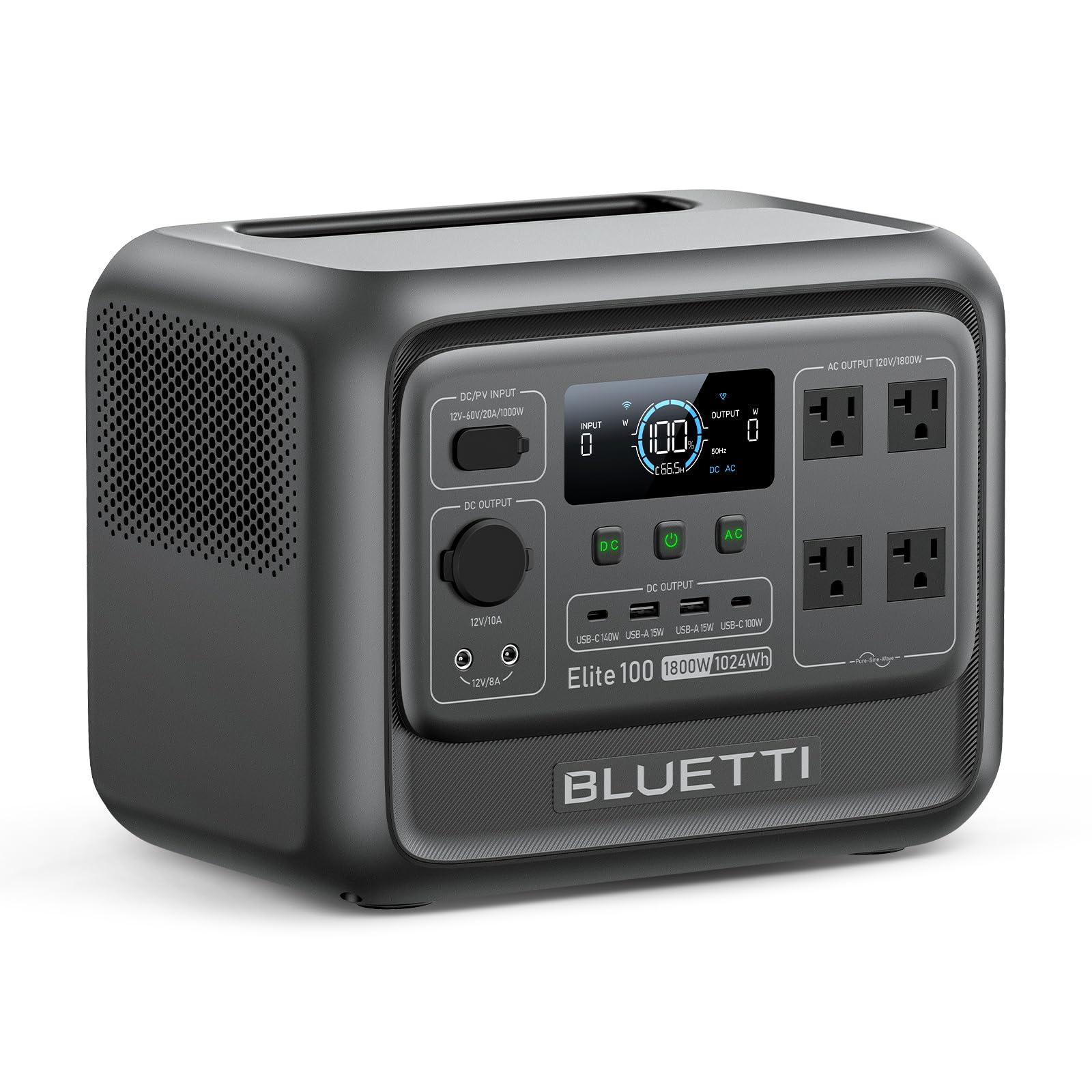
The BLUETTI Elite 100 V2 packs 1024Wh of LiFePO4 storage and 1800W continuous AC output (3600W surge) into a chassis that is 35% smaller and 30% lighter (25 lbs) than the previous generation. The forward-facing port layout is a subtle but critical design win — you can plug in bulky AC adapters without the cables curling around the sides. The 10ms UPS switchover makes it a legitimate home backup unit for sensitive electronics like Wi-Fi routers and desktop PCs.
What sets this unit apart in the mid-range is the 1200W TurboBoost AC input, which refills the battery from empty to 80% in about 45 minutes. The advertised 70-minute full recharge is achievable without engaging any special app mode. Silent mode keeps noise at 30dB, which is genuinely quiet enough for a bedroom. Owners using it for CPAP backup report several nights of operation on a single charge, and mobile professionals running a laptop, printer, and hotspot find it eliminates off-site work anxiety.
The primary drawback is the lack of a built-in light and the absence of a wireless charging pad — small omissions in an otherwise well-specced unit. The BLUETTI app handles remote monitoring well but does not support powering on the unit via Bluetooth or Wi-Fi. If you need a compact power station that charges faster than anything near its price bracket, the Elite 100 V2 is a top contender.
Why it’s great
- Fast 1200W AC recharge (70 min full)
- 10ms UPS for seamless home backup
- Compact 17L form factor
Good to know
- No built-in LED camping light
- Cannot power on via app
- No wireless charging pad
3. OUPES Mega 1 w/ 100W Panel
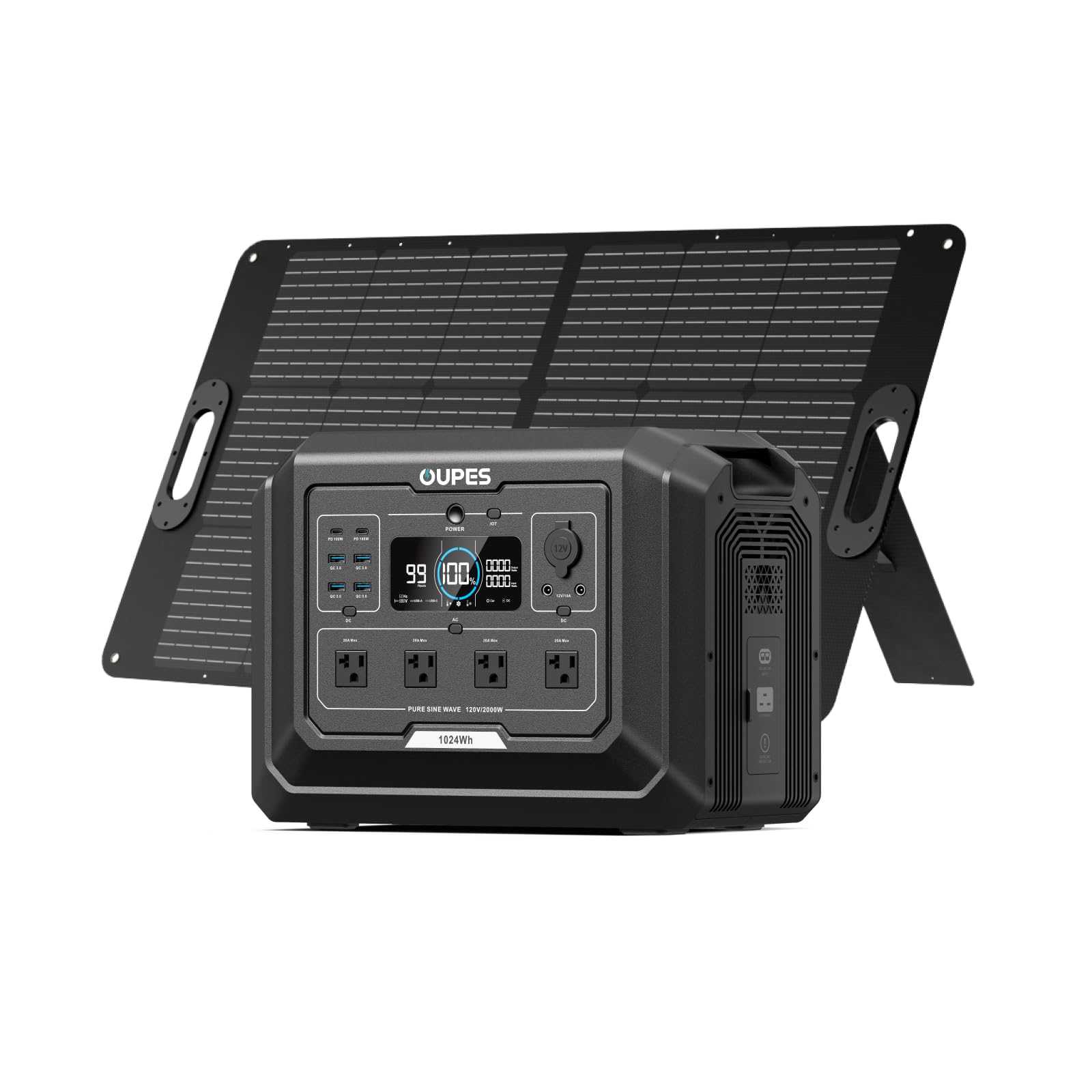
The OUPES Mega 1 is one of the few affordable solar generators that ships with a matching 100W solar panel right in the box, making it a true plug-and-play off-grid kit. The 1024Wh LiFePO4 battery feeds a 2000W continuous inverter (4500W surge) — a rare output rating at this price point. The 36-minute AC charge time to 80% is the fastest in this comparison, thanks to aggressive internal charging circuitry. Dual charging (AC plus solar simultaneously) drops the 0-80% window to just 26 minutes.
The unit’s expandability is a standout feature: you can add two OUPES B2 extra batteries to reach 5120Wh, transforming the 27.8-pound portable box into a multi-day power reserve. The 100W solar panel included in the kit is monocrystalline and efficient enough to show meaningful charging even on partially overcast days, based on owner reports. The app provides real-time monitoring of input and output wattage, battery level, and charge scheduling via Bluetooth or Wi-Fi.
On the downside, the 20ms UPS switchover is slower than the 10ms offered by competing units — acceptable for most appliances but noticeable on sensitive electronics. The included 100W panel is entry-level; serious off-grid users will want to add higher-wattage panels to exploit the unit’s 800W solar input capacity. For a buyer who wants a complete kit with expansion headroom, the OUPES Mega 1 delivers exceptional initial value.
Why it’s great
- 2000W continuous output (rare at this price)
- Expandable to 5120Wh capacity
- Fastest 0-80% AC charge (36 min)
Good to know
- 20ms UPS is slower than premium rivals
- Included 100W panel is entry-level
- Expansion batteries sold separately
4. DABBSSON 2000L
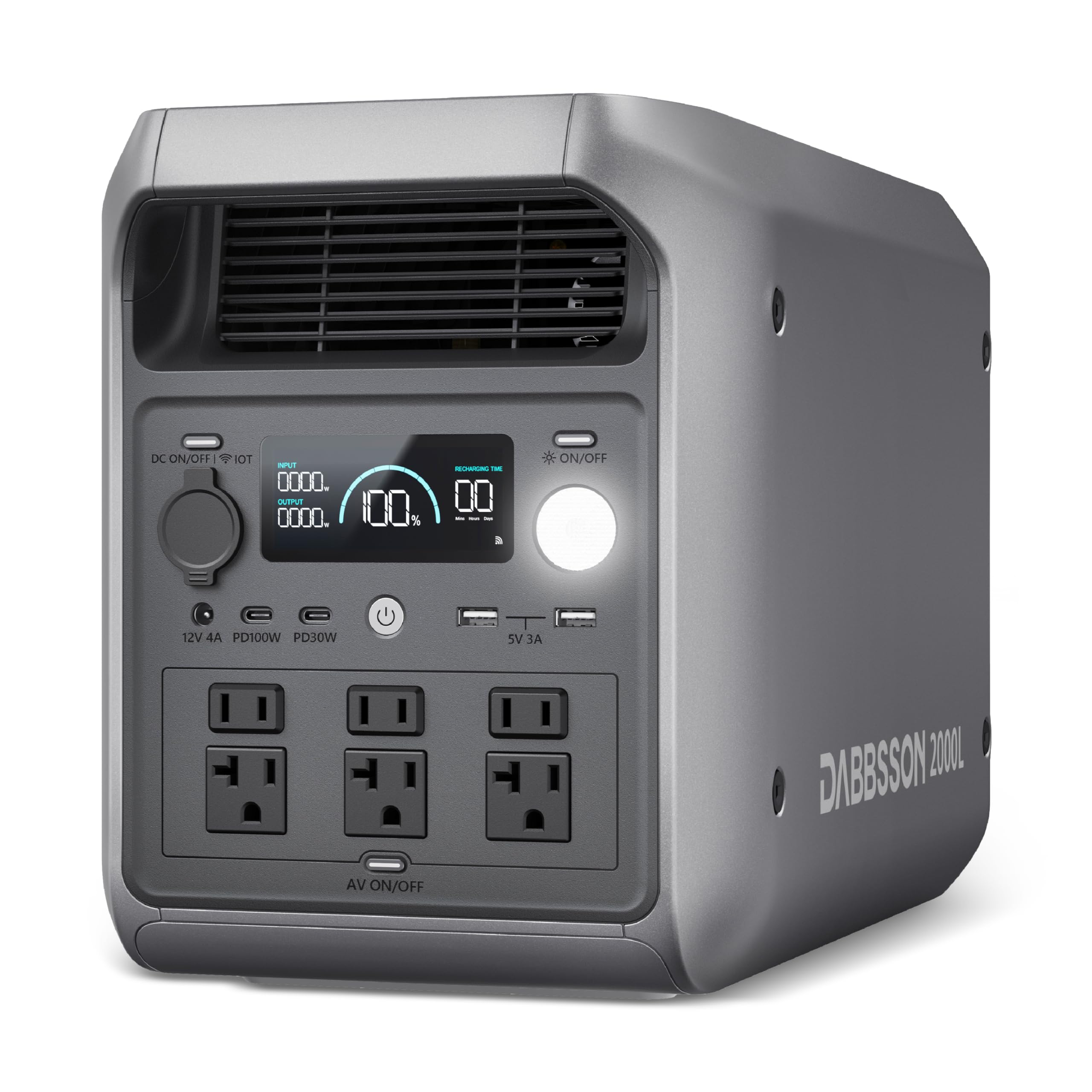
The DABBSSON 2000L introduces semi-solid LiFePO4 cells — an intermediate chemistry between standard LFP and solid-state — that offer higher energy density and improved thermal stability. The result is a 2048Wh station that weighs just 41 pounds, which is unusually light for a 2kWh-capacity unit. The 2200W continuous output (3300W surge) powers heavy draws like an air fryer or microwave, and the six AC outlets mean you never have to juggle plugs.
Real-world testing shows this unit running a kitchen-grade refrigerator plus two freezers for 7.5 hours, and the 10ms EPS switchover protects computers and NAS drives during outages without interruption. The one-hour full AC recharge is competitive for the capacity class, and solar input up to 800W via MPPT allows for rapid panel-based top-ups. The Dabbsson App gives remote control over charging speed, scheduling, and usage monitoring — a feature set that is usually reserved for premium-priced models.
The biggest caveat is the 5-year warranty, which is split into a standard 3 years plus a 2-year extension. While coverage is solid, some competitors offer standard 5-year terms without a split. A few owners have noted that the included documentation is sparse, particularly for the app’s configuration menus. For buyers who need a high-capacity, fast-charging station that can handle heavy appliances without breaking into the premium tier, the DABBSSON 2000L is a standout choice.
Why it’s great
- 41 lbs for 2048Wh capacity
- 3300W surge drives heavy appliances
- 10ms EPS for sensitive electronics
Good to know
- 5-year warranty split into 3+2 terms
- Sparse user manual and app documentation
- Semi-solid chemistry is newer, less proven long-term
5. EF ECOFLOW Delta 2 w/ 220W Panel

The EF ECOFLOW Delta 2 pairs a 1024Wh LiFePO4 power station with a 220W bifacial solar panel that captures energy from both sides, yielding up to 25% more harvest than a standard panel of the same footprint. The station itself delivers 1800W continuous AC output through 15 ports, and you can add expansion batteries to reach up to 3kWh of total capacity — a modular approach that lets you scale your investment over time.
The seven-times-faster AC charging compared to the original Delta series refills the battery in roughly one hour without any special app activation. The 220W bifacial panel is genuinely effective: owners in sunny climates report pulling around 175W by mid-morning and boosting to nearly 200W using a reflective ground sheet. The 500W solar input allows for flexible panel configurations, and the XT60 connector works with most third-party panels in the 12-60V range.
The main complaints center on the elastic retention bands on the folding panel kickstand, which are prone to loosening over time, and an app with occasional connection bugs that can reset user charge range settings. At the premium end of the affordable spectrum, the Delta 2 kit delivers the most efficient solar harvesting of any unit on this list, making it ideal for buyers who plan to spend significant time off-grid and want every watt of sun they can get.
Why it’s great
- 220W bifacial panel captures 25% more energy
- Expandable to 3kWh with extra batteries
- Fast 7X AC recharge
Good to know
- Kickstand bands wear out over time
- App has Bluetooth connection bugs
- Panel needs precise sun angle for peak output
6. Anker SOLIX C2000 Gen 2
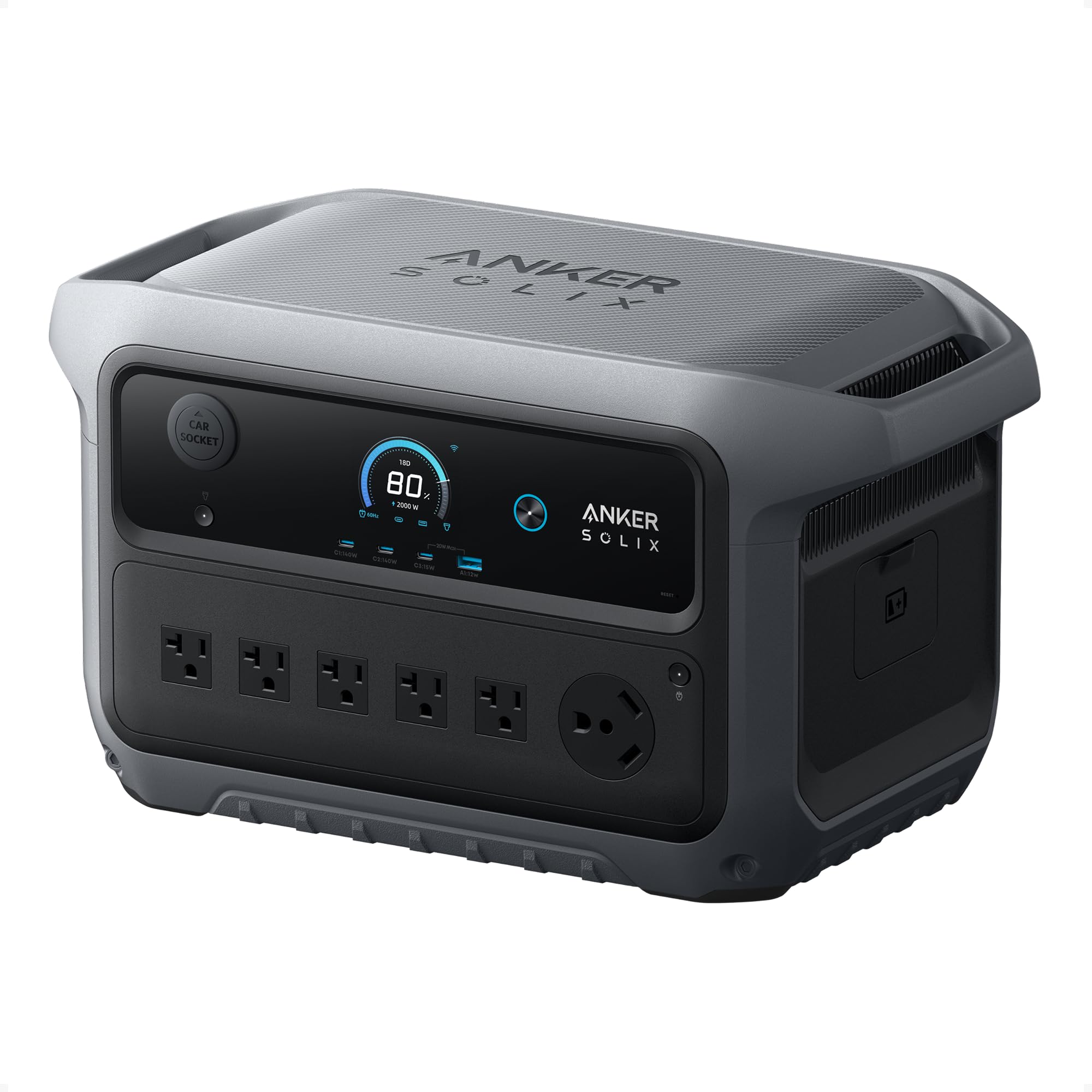
The Anker SOLIX C2000 Gen 2 delivers 2048Wh of LiFePO4 capacity and 2400W continuous AC output (4000W surge) in a chassis that is 25% lighter and 29% smaller than comparable 2kWh units, at 41.7 pounds. The headline feature is the 58-minute full recharge from a wall outlet — one of the fastest charging cycles in the 2kWh class. The ultra-low 9W standby draw means you can leave it plugged in and ready without wasting power.
With an expansion battery, the C2000 Gen 2 reaches 4kWh and can run a dual-door refrigerator for up to 64 hours based on Anker’s estimates. The 800W alternator charging support is a hidden gem for van-lifers: it refills the battery in three hours through a vehicle’s alternator, which is eight times faster than a standard 12V cigarette socket. The app provides clear usage prediction graphs that help you budget power during an outage.
The unit does not ship with a solar panel, so buyers need to factor that cost in separately. Some owners have noted that the app, while functional, does not include a printed manual and the initial setup requires a firmware update that can take 15-20 minutes. If your priority is a fast-recharging, low-standby powerhouse that can scale to 4kWh for whole-home essentials, the C2000 Gen 2 is the most technically refined option at this tier.
Why it’s great
- 58-minute full recharge (fastest in 2kWh class)
- Ultra-low 9W standby consumption
- 800W alternator charging for van/RV use
Good to know
- No solar panel included in the box
- App requires firmware update on first setup
- No printed user manual provided
7. Segway Cube 2000
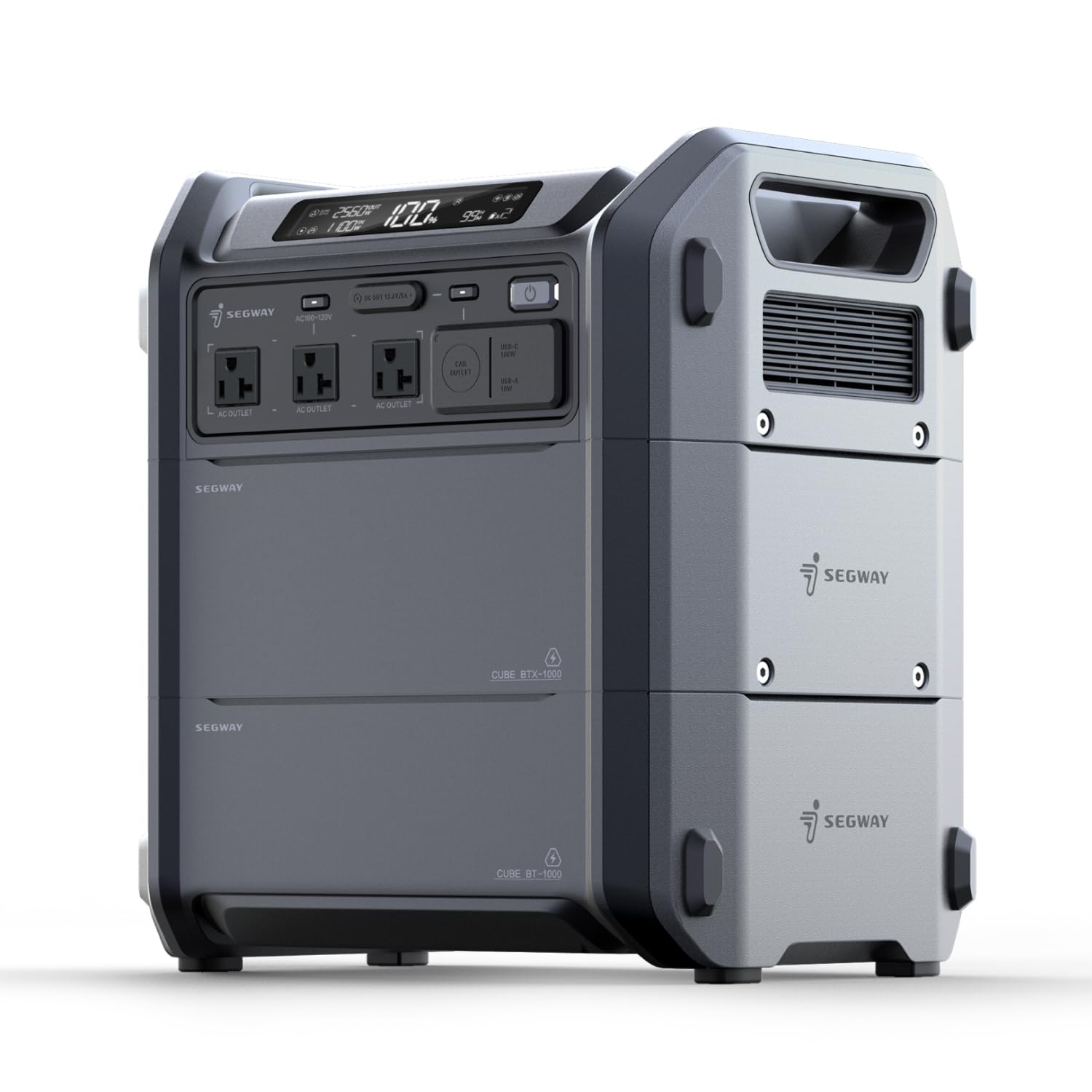
The Segway Cube 2000 takes a modular, stackable approach to power storage. The base unit offers 2048Wh of LiFePO4 capacity with 2200W continuous AC output (4400W surge with R-drive engaged), and you can stack up to three BTX-1000 expansion batteries wirelessly for a total of 5kWh. The stackable design eliminates loose cables between batteries and reduces the overall footprint compared to daisy-chained units.
The IP56 rating is rare in this category and means the Cube 2000 can survive dust, rain, and hose-down cleaning — a meaningful advantage for outdoor job sites, marine environments, and dusty camping locations. The dual 100W USB-C ports provide true laptop-grade charging, and the 1.8-hour full recharge keeps downtime minimal. The MPPT solar controller achieves up to 97% efficiency, which translates to noticeably faster solar charging on partly cloudy days.
The notable risk is inconsistent quality control: while most owners report excellent performance, a few units have arrived with degraded battery health, including one that lost a full charge while sitting in a closet over three months. The app is required for initial activation, and the default beeping when the unit powers on can only be disabled through the app. If the modular stacking design appeals to you, the Cube 2000 offers unrivaled expandability and weather resistance for the price.
Why it’s great
- Stackable expansion to 5kWh capacity
- IP56 weather and dust resistance
- 97% MPPT solar efficiency
Good to know
- Inconsistent battery charge retention out of box
- App required for initial activation
- Default beeping only turns off via app
8. ABOK Ark3600
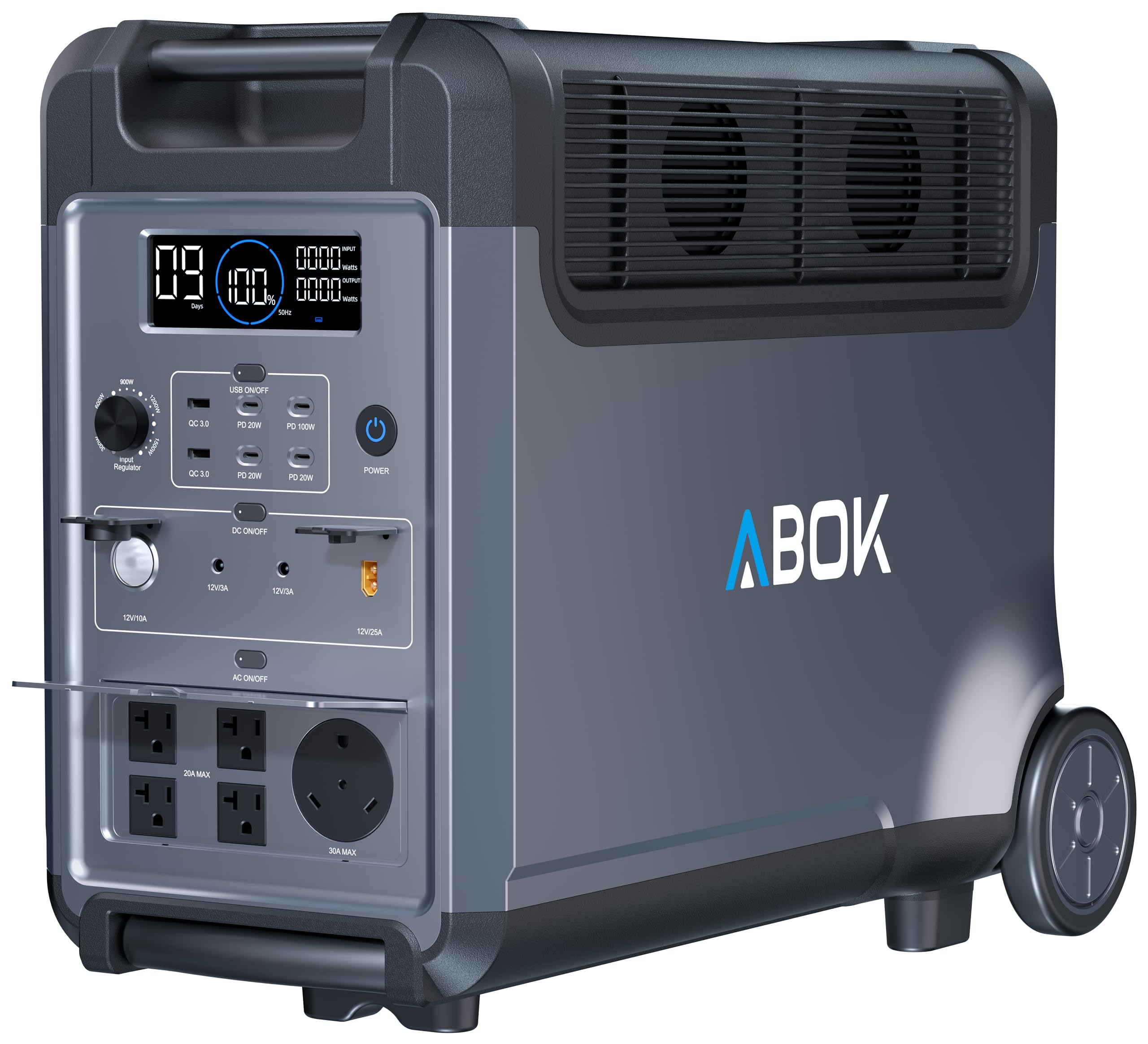
The ABOK Ark3600 packs 3840Wh of LiFePO4 capacity and a 3600W continuous inverter (4500W peak) into a wheeled cart form factor with an extendable telescoping handle. At 92 pounds, it is not portable in the backpack sense, but the wheels transform it into a station you can roll from the garage to the living room during an outage. The expandable capacity reaches a staggering 11520Wh with additional batteries, making this a true whole-home backup solution.
The 15 output ports include a rare 30A AC outlet alongside four 20A AC outlets, dual 100W USB-C (plus three standard USB-C), and an XT60 port for direct solar or DC input. The full recharge time is three hours from AC alone, or 1.29 hours with combined AC and solar input. Owners have successfully run a wetvac, heat gun, and hammer drill simultaneously for a full workday, and others have powered boiler pumps through sub-zero nights to prevent pipe bursts.
The downsides are the weight — even with wheels, moving it up stairs is a two-person job — and the lack of a 240V outlet, which limits its compatibility with large RV air conditioners or well pumps. The ABOK customer support team has proven responsive, including warranty repairs for units with damaged solar inputs from overvoltage. For a buyer who needs massive capacity and is willing to trade portability for raw power, the Ark3600 is the most capability per dollar on this list.
Why it’s great
- 3840Wh expandable to 11520Wh capacity
- Wheeled cart design for easy rolling
- Runs heavy tools and appliances simultaneously
Good to know
- 92 lbs — not truly portable without wheels
- Lacks 240V outlet for large RVs/pumps
- App documentation is sparse
9. Jackery HomePower 3000 w/ 2x200W Panels
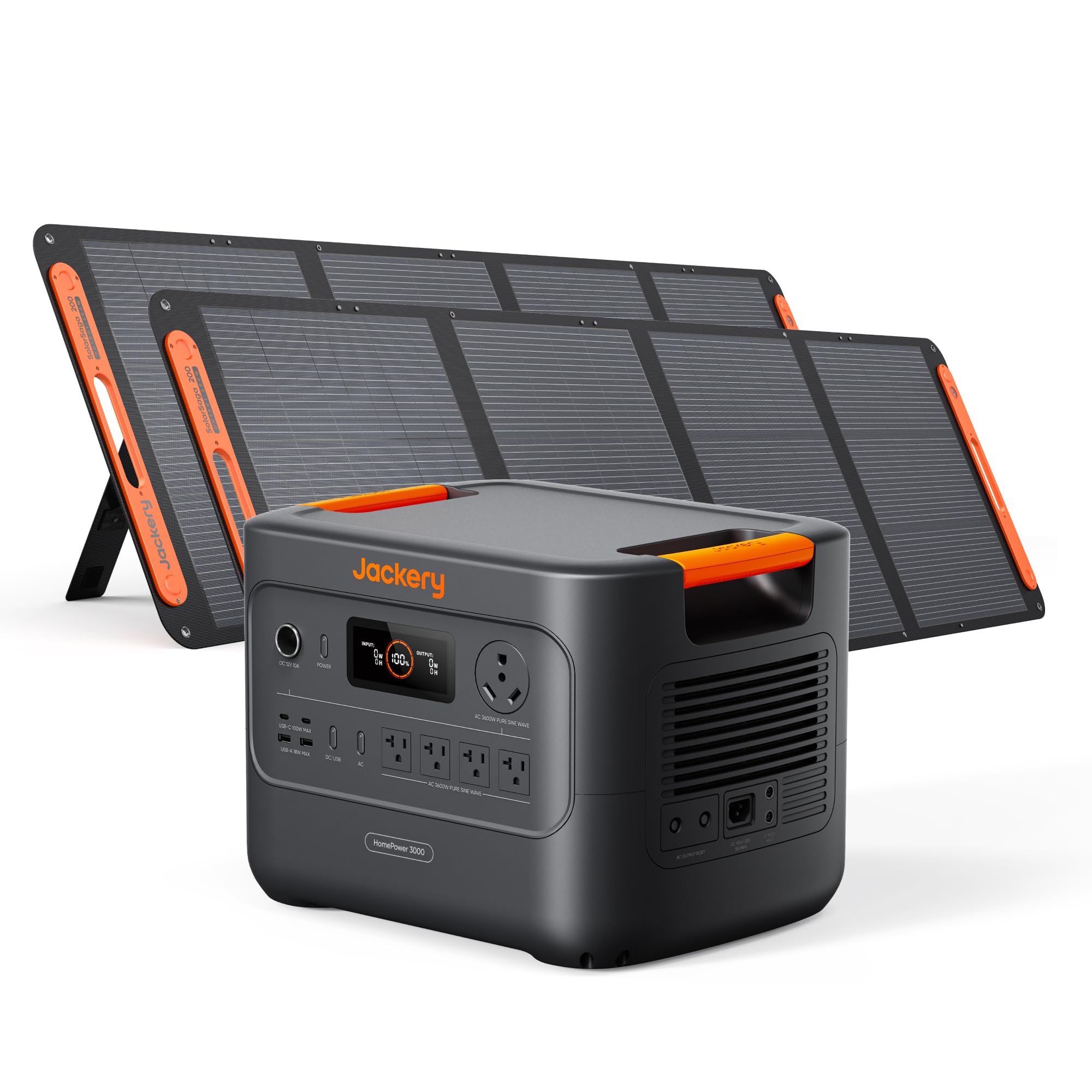
The Jackery HomePower 3000 brings 3072Wh of LiFePO4 storage and 3600W continuous output (7200W surge) — enough to run a household refrigerator, lights, a Wi-Fi router, and a fan for up to 15 hours per Jackery’s estimates. The included dual 200W SolarSaga panels provide 400W of solar input, giving you a complete backup system straight out of the two boxes (station and panels ship separately).
The ≤20ms UPS switchover handles security cameras, medical fridges, and smart home hubs without interruption during an outage. The ChargeShield 2.0 technology uses AI algorithms to optimize charging speed and battery health, and the LiFePO4 cells are rated for 4000 cycles to 70% capacity. The CTB (Cell-to-Body) construction makes this the lightest and smallest 3kWh station on the market, at 59.5 pounds and roughly 47% smaller than comparable capacity units.
The main limitation is that the battery is non-expandable — you cannot add extra capacity beyond the internal 3072Wh. The unit is also heavy enough that Jackery recommends a wheel kit (sold separately) for easy movement. A few early buyers have reported random power shutoffs under minimal load conditions, though Jackery’s support has been responsive in addressing these. For buyers who want a complete, ready-to-run home backup system without the complexity of mixing brands, this kit delivers exceptional convenience.
Why it’s great
- Complete kit with dual 200W solar panels
- 7200W surge handles large appliance startups
- Lightest 3kWh station (59.5 lbs)
Good to know
- Battery is non-expandable
- Wheel kit sold separately
- Station and panels ship in separate boxes
10. AFERIY Nomad1800-A
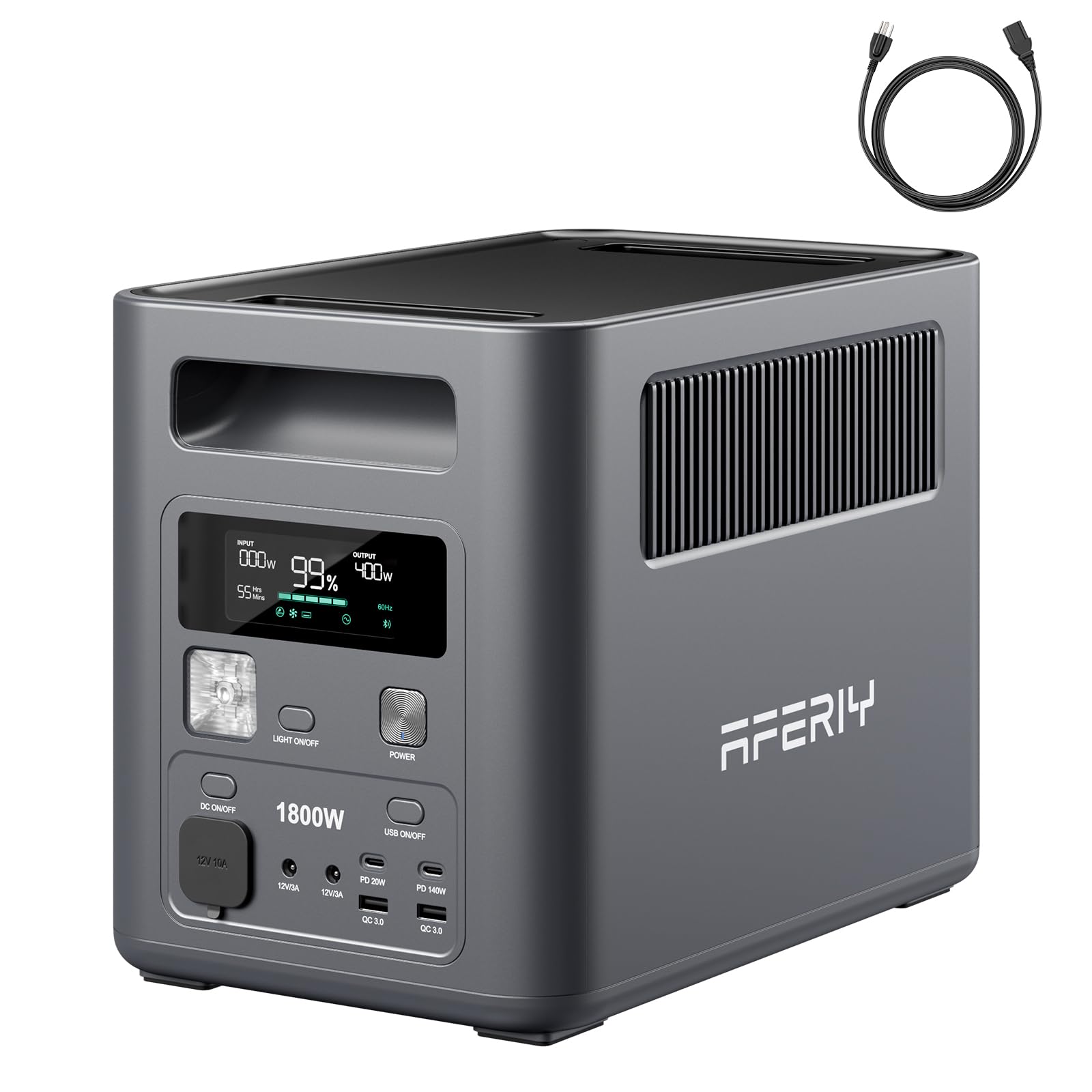
The AFERIY Nomad1800-A is a 1024Wh LiFePO4 station with 1800W continuous AC output (3600W surge) that hits the lowest price point of any 1kWh unit on this list. It measures just 13.77 x 8.66 x 10.35 inches and weighs 25.57 pounds — dimensions that make it easy to slide into a trunk or an RV storage bay. The 10ms UPS switchover is faster than many premium units and keeps your computer and router running seamlessly during blackouts.
The station supports four charging methods: AC (0-80% in 55 minutes), solar, car, and combined AC+solar (0-80% in 35 minutes). The operating noise stays below 30dB in most daily use scenarios, making it viable for indoor living spaces and quiet campsites. The 13 ports include four AC outlets, a 140W PD USB-C port for fast laptop charging, and a wireless charging pad on top of the unit.
The primary compromise is on the build quality: the ABS plastic case feels less substantial than the aluminum-reinforced chassis of pricier alternatives, and the companion app is functional but lacks the polish of BLUETTI’s or Jackery’s software. A few buyers report confusion about solar panel compatibility — the unit takes MC4 connectors but does not include a panel. For budget-conscious buyers who need genuine LiFePO4 safety, fast UPS protection, and enough juice for a weekend camping trip or a short power outage, this is the most accessible entry point.
Why it’s great
- Lowest price entry point for 1kWh LiFePO4
- 10ms UPS for sensitive electronics
- Compact, one-hand-carryable size
Good to know
- ABS plastic case feels less premium
- App interface lacks polish
- No solar panel included
11. EBL Acc2400
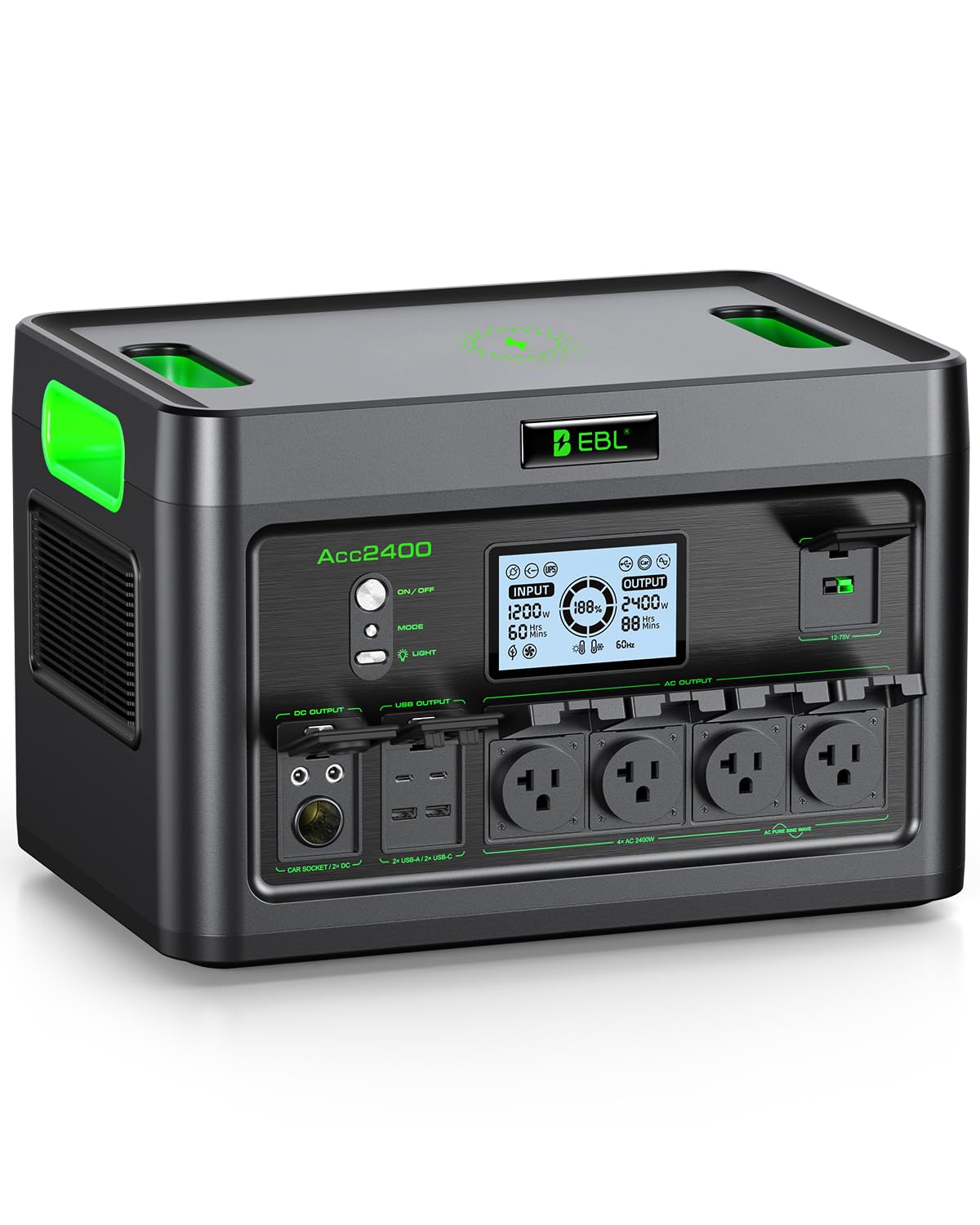
The EBL Acc2400 offers 1843Wh of LiFePO4 capacity and 2400W continuous AC output at the lowest price per watt-hour in this comparison. It is a straightforward, no-frills power station with 12 output ports, including four AC outlets, dual USB-C PD (100W max), a wireless charging pad, and 2 DC ports. The 0.1-second EPS switchover provides basic automatic backup during blackouts to prevent data loss on connected computers.
The unit is built with flame-retardant ABS plastic and includes a 4-mode LED light for camping and emergency use. The dual-side handles make it easier to carry than its 54-pound weight suggests. For the price, the capacity-to-weight ratio is strong: you get nearly twice the storage of a 1kWh station without a proportional weight penalty. Owners who use it for CPAP, camping, and running box fans for cooling report solid day-to-day reliability.
The trade-offs are significant for a buyer who needs fast charging or reliable app support. The AC recharge time is a sluggish 8 hours, and the solar input port has been reported as incompatible with some common third-party 100W panels. A small number of units have exhibited premature capacity fade, with the seller offering replacements under warranty. For buyers who prioritize raw upfront capacity and are comfortable with a slower recharge cycle, the EBL Acc2400 delivers the most watt-hours for the lowest cash outlay.
Why it’s great
- Highest capacity-to-price ratio on the list
- 12 versatile output ports
- Flame-retardant casing for safety
Good to know
- 8-hour AC recharge is very slow
- Solar port may be incompatible with some panels
- Inconsistent capacity retention reported
FAQ
How many watts do I need to run a refrigerator from an affordable solar generator?
Can I mix different solar panel brands with a budget LiFePO4 generator?
Does the 10ms vs 20ms UPS switchover matter for home appliances?
Final Thoughts: The Verdict
For most users, the affordable solar generator winner is the Jackery Explorer 1000 v2 because it delivers the lightest 1kWh LiFePO4 package with verified real-world runtime and a fast recharge option that preserves battery health. If you want expandable capacity and a complete panel kit for true off-grid independence, grab the OUPES Mega 1 w/ 100W Panel. And for the absolute lowest entry price into the LiFePO4 category with solid UPS protection, nothing beats the AFERIY Nomad1800-A.