
Our readers keep the lights on and the weekend projects moving. As an Amazon Associate, I earn from qualifying purchases.
Flattering consumer speakers are designed to make everything sound good—which is the last thing you want when you are mixing, mastering, or editing audio. The entire point of a studio monitor is to reveal the flaws in your track so you can fix them, not hide them. This guide separates the gear that delivers a true, flat frequency response from the ones that just look the part, focusing specifically on options that won’t drain your production budget.
I’m Rikta — the founder and writer behind FitlyFast. I’ve spent years analyzing market trends, comparing driver materials, and cross-referencing amplifier specs and real-world measurements to identify which affordable monitors actually deliver usable reference sound for home studios, podcast rigs, and gaming setups.
Whether you are upgrading from headphones or buying your first pair of powered speakers, you need a clear, honest translation of specifications. This deep-dive into the market’s top affordable studio monitors will give you the confidence to choose a pair that translates directly to better mixes.
How To Choose The Best Affordable Studio Monitors
Choosing your first or next pair of monitors on a budget means ignoring marketing fluff focused on consumer bass and honing in on measured accuracy. The three factors below are non-negotiable when shopping in the affordable tier.
Driver Size, Material, and Cabinet Design
The woofer size directly dictates the low-frequency extension — a 5-inch driver typically reaches down to about 55Hz, while a 6.5-inch driver can hit 45Hz. For near-field desktop use where you sit within three feet of the speakers, a 5-inch driver is often ideal because it offers a tighter bass response with less room interaction. Driver material matters: woven composite cones (like those in the PreSonus Eris E5 XT) offer stiffness for clean transients, while carbon fiber (Micca PB42X) provides excellent damping. The cabinet itself should be rigid — look for thick MDF rather than plastic, as resonance from the box can color the midrange frequencies you are trying to judge.
Amplifier Architecture and Headroom
At this price level, you get Class AB or Class D amplification. Class AB (used in the PreSonus E5 XT) is traditional and offers a warmer character but runs hotter and is less efficient. Class D (used in the JBL 305P MkII) is lighter, cooler, and more power-efficient, often delivering higher peak SPL levels for a given power supply. The critical spec here is the continuous RMS power split across the woofer and tweeter — a bi-amplified design with separate amps for each driver provides cleaner crossover behavior. Look for at least 50 watts total per speaker for a moderate-sized room.
Input Versatility and Room Acoustic Controls
Balanced connections (XLR or TRS) are essential for long cable runs without picking up hum from computer monitors, power strips, or other studio gear. Unbalanced RCA inputs are a common fallback, but as the PreSonus E5 XT reviews show, RCA can be prone to radio frequency interference. The second must-have feature is acoustic tuning: high-frequency trim, low-frequency trim, and wall-mounted/boundary EQ switches. These controls let you compensate for the bass boost that occurs when monitors are placed against a wall, ensuring you are hearing the track, not the room.
Quick Comparison
On smaller screens, swipe sideways to see the full table.
| Model | Category | Best For | Key Spec | Amazon |
|---|---|---|---|---|
| PreSonus Eris E5 XT | Near-field | Critical mixing & production | Class AB bi-amp, 102dB SPL | Amazon |
| JBL 305P MkII (Pair) | Powered Reference | Wide sweet spot mixing | Image Control Waveguide | Amazon |
| ADAM Audio T5V | High-Res Recording | Detailed high-frequency work | U-ART ribbon tweeter | Amazon |
| Edifier MR5 | 3-Way Active | Detailed separation & videography | 3-way crossover, 110W RMS | Amazon |
| Edifier MR3 (Pair) | Bluetooth Desktop | Hi-Res desktop monitoring | Hi-Res Certified, 40kHz top | Amazon |
| JBL 306P MkII (Pair) | Full-Range | Deep bass without subwoofer | 6.5-inch woofer, boundary EQ | Amazon |
| Pioneer DJ DM-50D | DJ/Mix Desktop | DJ practice & production | DSP DJ/Production mode | Amazon |
| Pioneer DJ DM-40D | Compact DJ | Small desk DJ monitoring | DECO convex diffuser | Amazon |
| Micca PB42X (Pair) | Entry-Level Desktop | Desktop computer audio | Carbon fiber woofer, 4-inch | Amazon |
In‑Depth Reviews
1. PreSonus Eris E5 XT (Single)

The PreSonus Eris E5 XT earns the top spot because it delivers a genuinely flat response with a 5.25-inch woven composite woofer and a silk-dome tweeter, backed by 80 watts of Class AB bi-amplification hitting 102 dB SPL. The 100-degree horizontal by 60-degree vertical EBM waveguide creates a wide sweet spot that makes critical listening far less fatiguing than narrower designs. Acoustic tuning controls — Level, HPF, LF Trim, HF Trim, and Acoustic Space — give you real room compensation usually found on pricier units, letting you dial out wall-bounce bass or tame a bright room without relying on software EQ.
Owners consistently praise the imaging and tight bass, with many noting a 24-48 hour burn-in period before the drivers fully settle. The balanced XLR and TRS inputs allow clean long-cable runs, but the RCA input is documented as susceptible to radio frequency interference noise — a known trade-off for the connectivity suite. The front porting is a major practical advantage: you can push these close to a wall without the bass getting muddy, making them forgiving in less-than-ideal studio spaces.
Each monitor ships as a single unit, so you need to buy two for a stereo pair, but the per-unit cost remains competitive for the build and SPL capability. The included Studio One Prime and Studio Magic plug-in suite adds production software value that offsets the separate purchase of monitors. For someone stepping up from entry-level gear, the E5 XT provides a reference-grade listening experience that reveals mix issues without being overly analytical to the point of being unpleasant to listen to for hours.
Why it’s great
- Woven composite woofer delivers clean transients and tight lows
- Front port design allows flexible placement near walls
- Extensive acoustic tuning controls match room conditions
Good to know
- RCA input is highly susceptible to RF interference
- Sold as a single monitor, not a pair
- Bass roll-off below 50Hz may require a sub for bass-heavy genres
2. JBL 305P MkII (Pair)

The JBL 305P MkII is a two-way powered reference monitor that ships as a pair, making it a convenient and cost-effective entry into pro-grade monitoring. Each monitor pairs a 5-inch woofer with a 1-inch tweeter, driven by dual 41-watt Class-D amplifiers — total 82 watts per speaker. The defining feature is JBL’s patented Image Control Waveguide, which delivers a wide horizontal sweet spot that stays coherent even when you move off-axis, a crucial advantage for collaborative sessions where multiple people listen simultaneously.
User reviews highlight the clean, balanced sound that reveals detail across the frequency spectrum without coloration. Many describe it as a noticeable upgrade from smaller PreSonus or M-Audio entry models, especially in low-mid fullness and depth. The Slip Stream port tunes the low-end extension to be tight rather than boomy, while the Boundary EQ and HF Trim switches let you compensate for desk or wall placement without a separate DSP unit. The MDF enclosure and XLR/TRS input options ensure robust connectivity for any audio interface.
One common trait among JBL monitors is their sensitivity — these will reveal flaws in your source material, but they also make good recordings sound truly immersive. Some users find them almost too clinical for casual listening, but for mixing and mastering, that is precisely the goal. The pair format saves setup time, and the 100-hour reliability testing JBL applies gives confidence in long-term durability for daily production use.
Why it’s great
- Wide sweet spot from the Image Control Waveguide
- Boundary EQ compensates for wall and desk placement
- Sold as a matched pair for easy stereo setup
Good to know
- Clinical sound may be unflattering for casual listening
- Rear porting requires careful placement away from walls
- Requires separate TRS or XLR cables (not included)
3. ADAM Audio T5V (Single)
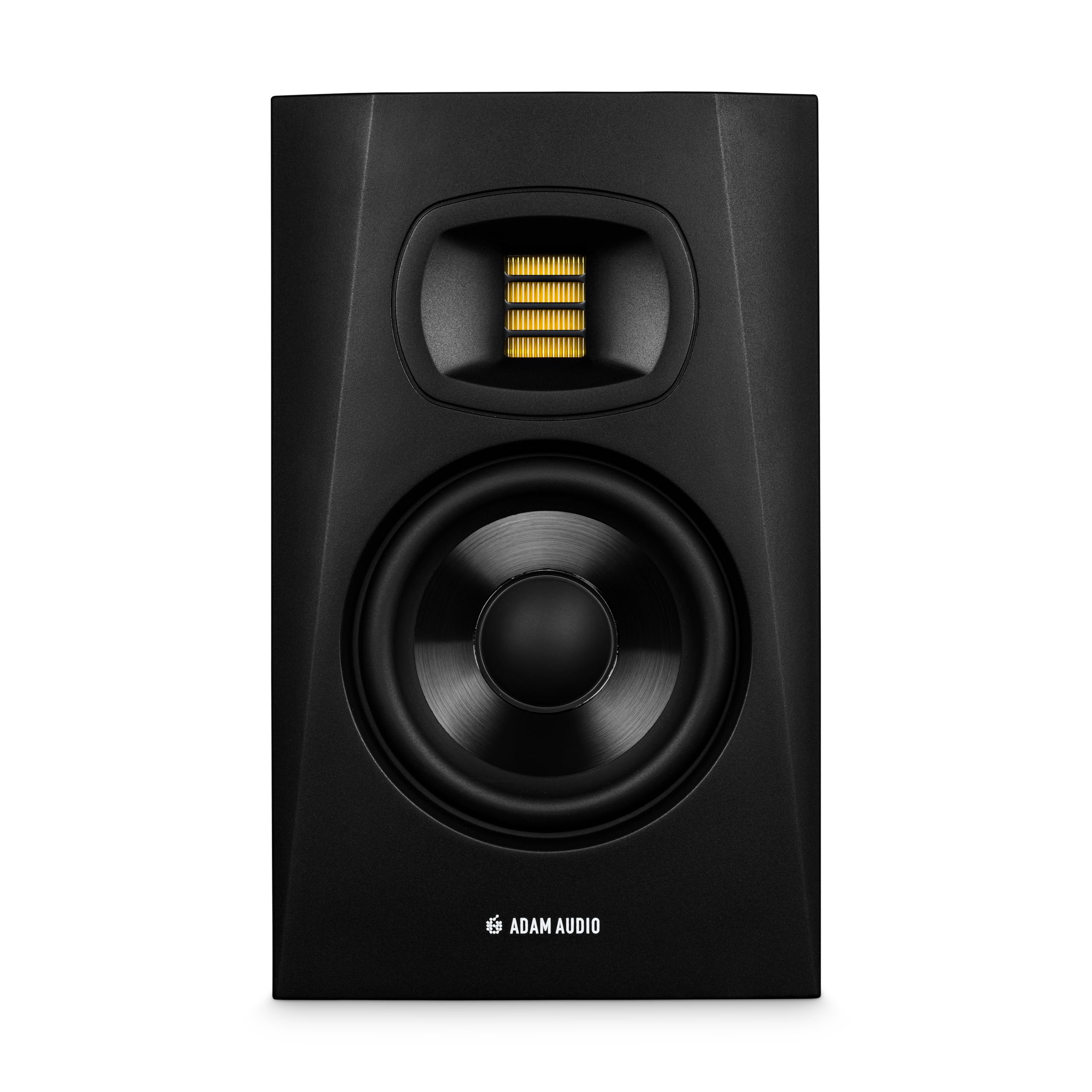
The ADAM Audio T5V stands out in the affordable tier because of its U-ART (Ultimate Accelerating Ribbon Technology) tweeter, a design usually reserved for monitors costing several times more. This folded-ribbon transducer moves air faster than a standard dome tweeter, resulting in vastly improved transient response and high-frequency detail — you hear the attack of a snare drum or the texture of a vocal sibilance with a realism that domes simply cannot match at this price. Coupled with a 5-inch woofer and a rear-firing bass reflex port, the T5V delivers a full-range presentation that reveals mix depth.
The beveled cabinet and HPS waveguide ensure a wide dispersion pattern, while the DSP-based high- and low-shelf filters allow precise acoustic adaptation without degrading the signal path. Owners report that even at lower listening volumes, the clarity remains intact — the tweeter does not lose its sparkle when turned down, a common issue with lesser dome tweeters. The cabinet feels robust and professional, with a slightly textured finish that resists fingerprints and studio dust.
Connection is straightforward with XLR and TRS inputs, though the lack of Bluetooth or RCA means your interface needs balanced outputs. The T5V is sold as a single unit, so budgeting for a pair doubles the cost. For those who spend hours editing dialog, mixing acoustic music, or critiquing high-frequency content like cymbals and string instruments, the U-ART tweeter provides a level of detail that directly translates to more precise high-end decisions in the mix.
Why it’s great
- U-ART ribbon tweeter for unmatched transient detail
- DSP-based room filters maintain signal integrity
- Beveled cabinet reduces edge diffraction
Good to know
- Sold as a single unit — pair purchase doubles cost
- Rear port limits close-wall placement options
- No RCA or Bluetooth input, requires balanced source
4. Edifier MR5 (Pair)

The Edifier MR5 is a 3-way active studio monitor — a rarity at this price point — that uses a 5-inch long-throw woofer, a dedicated 3.75-inch midrange driver, and a 1-inch silk dome tweeter. This configuration reduces the burden on the woofer, allowing each driver to operate in its ideal frequency band, which translates to cleaner instrument separation especially in the critical midrange where vocals and guitars sit. The 110W RMS Class D amplifier delivers a peak SPL of 101dB, enough for a medium-sized room without strain.
A standout feature is the room compensation system accessible both via physical rear knobs and the EDIFIER ConneX app. You can adjust Low Cut-Off, Desktop Control, and Acoustic Space presets to correct for boundary effects and desk resonances — useful if your workstation is in a corner or against a wall. The dimpled tweeter waveguide improves off-axis response consistency, so moving your head around the mix position doesn’t drastically change the perceived balance. Connectivity is generous: XLR, TRS, RCA, AUX, plus Bluetooth 6.0 with LDAC for high-resolution wireless streaming.
Reviewers consistently note the crystal-clear sound with rich bass that doesn’t require a subwoofer for most content. The build quality is solid with MDF cabinets that resist resonance, and the front-panel headphone output is convenient for late-night sessions. Some users find the app interface lacking polish, and the rear knobs can be difficult to reach if the monitors are placed in a cabinet, but the overall balance of value, power, and connectivity makes the MR5 a strong contender for those who need both precision and flexibility.
Why it’s great
- Three-way active design for superior instrument separation
- Room compensation via app and physical controls
- Versatile inputs including LDAC Bluetooth
Good to know
- Rear knobs hard to access in tight spaces
- Higher price tier for the category
- App lacks advanced EQ features
5. Edifier MR3 (Pair)

The Edifier MR3 is a compact 2-way active monitor set that punches above its size with Hi-Res Audio certification and a flat frequency response spanning 52Hz to 40kHz. Each speaker houses a 3.5-inch mid-low driver and a 1-inch tweeter, driven by 18W RMS per channel — modest power, but sufficient for near-field desktop use at a distance of two to three feet. The real appeal is the connectivity suite: balanced TRS, RCA, AUX, and Bluetooth 5.4 with multi-point connection, all in a package that fits neatly on a crowded desk.
Users report clean, neutral sound with tight bass and sparkling highs, with many noting the absence of hiss or distortion even at moderate volumes. The three sound modes — Music, Monitor, and Custom — allow quick switching between flattering playback and analytical listening. The EDIFIER ConneX app provides deeper EQ adjustments, letting you fine-tune the output for your specific room acoustics. The MDF cabinet construction minimizes unwanted resonance, maintaining clarity in the upper bass and lower mids where smaller speakers often sound boxy.
The MR3 excels as a desktop pairing for video editing, casual production, and high-quality music listening. The headphone output on the front is convenient for switching between monitors and cans. The compact size means bass extension is limited — below 60Hz, the roll-off is noticeable, so electronic producers or those mixing sub-heavy genres will want to add a subwoofer. For spoken word, acoustic music, and general mixing, the MR3 offers reference-like clarity in a package that does not dominate your workspace.
Why it’s great
- Hi-Res certified with response to 40kHz
- Compact footprint ideal for crowded desks
- Multi-point Bluetooth 5.4 and balanced inputs
Good to know
- Limited low-end extension without a subwoofer
- 18W RMS per speaker is modest power
- 3.5-inch driver limits maximum SPL for larger rooms
6. JBL 306P MkII (Pair)

The JBL 306P MkII is the larger sibling of the 305P, swapping the 5-inch woofer for a 6.5-inch driver that delivers noticeably deeper bass extension and higher overall output capability. The larger driver moves more air, providing low-end response that often eliminates the need for a separate subwoofer in small to medium rooms. The same Image Control Waveguide and Boundary EQ found on the 305P are present here, maintaining the wide sweet spot and placement flexibility that define the MkII series.
User feedback emphasizes the clean, balanced sound across the entire frequency spectrum, with particular praise for the low-mid fullness and tight bass that does not bleed into the mids. The dual reinforced XLR jacks with double-sleeved ports provide a secure connection that survives the rigors of a working studio, and the new driver design optimizes damping for improved transient response and lower harmonic distortion compared to the previous generation. The pair format includes both monitors, simplifying ordering and ensuring matched components out of the box.
The size difference is significant — these are larger cabinets that require more desk space and careful placement away from rear walls to avoid bass buildup. Some users note they are overkill for small desktop setups but perfect for mixing desks or secondary monitoring stations. The 306P MkII excels for genres that demand accurate low-frequency reproduction, such as hip-hop, EDM, and film scoring, where the sub-50Hz information matters for mix translation. For those with the physical space, the 306P MkII provides a full-range experience that few affordable monitors can match.
Why it’s great
- 6.5-inch woofer delivers deep bass without a sub
- Reinforced XLR jacks for durability
- Boundary EQ ensures accurate placement near walls
Good to know
- Large cabinets require significant desk space
- Rear porting needs careful placement for tight bass
- High output may be overwhelming for very small rooms
7. Pioneer DJ DM-50D (Pair)

The Pioneer DJ DM-50D is purpose-built for the DJ workflow, featuring a DSP-based switch that toggles between DJ mode and Production mode. DJ mode bumps the low-end and upper presence for a more exciting listening experience when practicing routines, while Production mode flattens the response for more accurate mix evaluation. The 5-inch active drivers deliver tight bass and crisp highs, with a Class D amplifier providing clean power at 96kHz sampling for low-noise performance.
Users appreciate the easy connectivity to DJ controllers via RCA and mini-jack, and the front-panel headphone socket allows quick monitoring without reaching for the mixer. The sleek black design fits into both home studio and club-like setups. Reviews note that the speakers can get very loud without distortion, making them suitable for small parties or loud practice sessions. The absence of mounting holes is a limitation for those who want to wall-mount, but the stable desktop design works well on a standard DJ table.
The trade-off for the DJ-focused tuning is that the frequency response is not as flat as dedicated production monitors — the upper mids have a slight dip that can mask detail in vocals and guitars. For dedicated mixing and mastering, the JBL or PreSonus options offer a more neutral canvas. However, for DJs who need one set of speakers for both beatmatching practice and occasional production, the DM-50D provides a versatile compromise that saves desk space and eliminates the need for a separate monitoring system.
Why it’s great
- DSP mode switch for DJ practice and production
- High output level without distortion
- Front headphone jack for easy monitoring
Good to know
- Upper mid dip reduces vocal and guitar clarity
- No wall-mounting holes available
- Not as flat as dedicated production monitors
8. Pioneer DJ DM-40D (Pair)

The Pioneer DJ DM-40D is the compact companion to the DM-50D, featuring 4-inch woofers that make it ideal for tight desks or portable DJ setups. Despite the smaller driver size, the Class D amplifier with 96kHz sampling DSP ensures clean sound, and the DECO convex diffusers on the tweeters create a wide stereo image that feels larger than the physical footprint suggests. The 2-Way Sound Mode switch toggles between DJ and Production DSP settings, adapting the frequency response for different use cases.
User feedback highlights the clear audio quality with punchy bass that exceeds expectations for a 4-inch system, especially for practicing DJ transitions and beatmatching. The RCA and mini-jack inputs make connection to controllers and mixers straightforward, and the front headphone socket provides quick cue monitoring. Bluetooth connectivity lets you stream music from a phone for reference listening between practice sessions, expanding the utility beyond just DJ work.
The smaller woofer limits low-frequency extension, so the DM-40D will not reproduce deep sub-bass the way a 5-inch or 6.5-inch monitor can. Some users note that the sound, while clear, is not neutral enough for critical mixing — the upper mids have a dip that affects vocal and guitar detail. For dedicated production, the DM-40D serves better as a secondary reference or space-saving DJ monitor than a primary mixing tool. For beatmatching practice, podcast monitoring, or gaming audio, the compact size and versatile connectivity make it a sensible entry-level choice.
Why it’s great
- Ultra-compact size fits tight workspaces
- DECO diffusers create spacious stereo imaging
- Bluetooth and DJ/Production sound modes
Good to know
- 4-inch woofer limits low-end extension
- Not neutral enough for serious mixing
- Upper mid dip reduces some detail
9. Micca PB42X (Pair)

The Micca PB42X is the gateway to powered monitors for those transitioning from computer speakers. The balanced woven carbon fiber woofer provides enhanced transient response for its size, while the silk dome tweeter delivers smooth treble that avoids the harshness common in budget drivers. The ported enclosure extends the bass response of the 4-inch driver deeper than a sealed box would, and the optimized crossover ensures a balanced and dynamic presentation across the frequency range.
User reviews consistently praise the natural mids and clear vocals, with many noting that the PB42X outperforms options from Audioengine at a fraction of the cost. The 15W RMS per channel from the built-in Class-D amplifier is sufficient for desktop listening at moderate levels, though the bass rolls off noticeably below 80Hz, making a subwoofer a necessary addition for bass-heavy genres. The supplied cables are adequate for a desktop arrangement, and the frustration-free packaging is a nice touch for immediate setup.
The primary limitations are the bass extension and the lack of balanced inputs — the PB42X relies on RCA and a wired connection to the passive speaker, which can introduce hum in electrically noisy environments. The tweeter can sound harsh during the initial break-in period, softening after several hours of use. For vocal-driven music, podcasting, and general computer audio where a flat response is desired on a tight budget, the PB42X delivers remarkable clarity. For production work requiring sub-bass information, a subwoofer is essential, pushing the total system cost closer to the mid-range tier.
Why it’s great
- Exceptional vocal clarity and natural mids
- Carbon fiber woofer provides clean transients
- Very affordable entry point for powered monitors
Good to know
- Bass roll-off below 80Hz demands a subwoofer
- Tweeter can sound harsh before break-in
- Lacks balanced inputs (RCA only)
FAQ
Do I need a subwoofer with a 5-inch studio monitor?
Should I buy a single monitor or a pair to start?
How far should I place the monitors from the wall?
What is the difference between near-field and mid-field monitors?
Final Thoughts: The Verdict
For most users, the affordable studio monitors winner is the PreSonus Eris E5 XT because it combines a genuinely flat frequency response, comprehensive acoustic tuning controls, and a front-ported design that simplifies placement — all while delivering 102dB SPL from a trustworthy Class AB bi-amp setup. If you prioritize a wide sweet spot and want a matched pair right out of the box, grab the JBL 305P MkII. And for high-frequency detail that rivals monitors costing three times as much, nothing beats the ADAM Audio T5V with its U-ART ribbon tweeter.