
Our readers keep the lights on and the weekend projects moving. As an Amazon Associate, I earn from qualifying purchases.
Building a true home theater system used to mean dropping serious cash on bulky receivers, floor-standing speakers, and endless spools of speaker wire. Today, the landscape is different. You can buy a complete surround setup with wireless rears, a dedicated subwoofer, and even Dolby Atmos height channels for what a single mid-range soundbar cost just a few years ago. The challenge has shifted from “Can I afford it?” to “Which affordable setup actually delivers the spatial audio I’m after without the hiss, the cutouts, or the muddled dialogue?”
I’m Rikta — the co-founder and writer behind FitlyFast. I’ve combed through dozens of specification sheets, cross-referenced channel configurations, driver sizes, wireless standards, and real-world customer feedback to separate the systems that truly fill a room with sound from the ones that just get loud.
The goal is straightforward: find the setup that delivers genuine directional audio, clear center-channel dialogue, and a subwoofer that adds weight without rattling the picture frames. After comparing 9 models, here is the definitive guide to the best affordable surround sound speakers you can buy right now.
How To Choose The Best Affordable Surround Sound Speakers
The market is flooded with soundbars claiming “virtual surround” and “immersive audio.” The key is knowing which physical hardware features actually deliver the soundstage you’re paying for. A few core specs separate a true surround experience from a glorified stereo bar with some echo processing.
Channel Configuration and Dolby Atmos
The first number in a channel spec (like 5.1.2) tells you the count of traditional speakers. The second is the number of subwoofers. The third is the number of upward-firing or height channels. For genuine overhead effects, you want a system with at least two height channels — the “.2” in 5.1.2. Systems labeled 5.1 or 7.1 without a third digit rely entirely on psychoacoustic processing to simulate height. It can sound wide, but it won’t sound like rain is falling from above. Dolby Atmos certification matters, but only if the hardware includes the physical drivers to reproduce those height signals.
Subwoofer Driver Size and Bass Frequency
A subwoofer’s impact is directly tied to its driver diameter. A 4-inch driver can produce a thump, but a 10-inch driver creates the chest-pressure rumble you feel in an action film. Look for a frequency response that dips down to at least 40 Hz. Any subwoofer that only reaches 50 Hz or higher will sound boomy rather than deep. Also note whether the subwoofer is wireless or requires a wired connection to the soundbar — wireless placement is far more flexible, but some budget units still lock you into a nearby outlet location.
Rear Speaker Connectivity and Placement
True surround requires speakers behind the listening position. The easiest setups use completely wireless rear speakers that pair automatically with the main soundbar. Others use a wired connection from the rear speakers to each other, with a single wireless link back to the bar. Budget systems sometimes run long cables from the subwoofer to every satellite, which works but creates a tripping hazard. Pay attention to cable lengths included in the box — some rear cables stretch 30 feet, others only 10 feet, which dictates where you can place the rear channels.
Dialogue Clarity and Center Channel
A dedicated center channel speaker is the single most important component for clear dialogue. Soundbars that share dialogue between left and right drivers tend to push voices into the side walls, making speech sound diffuse. A physical center driver — especially one with Voice Enhancement or Clear Voice technology — locks vocal frequencies to the screen. Many affordable systems now include a center channel in the soundbar or a separate center satellite. Check whether the system has a dedicated center driver before buying if you value intelligibility.
Quick Comparison
On smaller screens, swipe sideways to see the full table.
| Model | Category | Best For | Key Spec | Amazon |
|---|---|---|---|---|
| Hisense AX5140Q | 5.1.4 Soundbar | True Atmos height immersion | 5.1.4ch, 6.5″ sub, up-firing drivers | Amazon |
| Sony HT-S60 | 5.1 Soundbar | BRAVIA TV pairing & clarity | 5.1ch, Dolby Atmos & DTS:X | Amazon |
| JBL Bar 700MK2 | 7.1 Soundbar | Detachable rears & convenience | 7.1ch, 10″ sub, detachable surround | Amazon |
| Amazon Fire TV Soundbar Plus | 5.1 Soundbar | Dialogue boost & Fire TV integration | 5.1ch, Dolby Atmos, DTS:X | Amazon |
| ULTIMEA Skywave F40 | 5.1.2 Soundbar | Compact space Atmos | 5.1.2ch, 5.25″ sub, up-firing drivers | Amazon |
| ULTIMEA Aura A60 | 7.1 Soundbar | Multiple surround speakers | 7.1ch, 4″ sub, 4 surround speakers | Amazon |
| LG S40TR | 4.1 Soundbar | Entry-level wireless rears | 4.1ch, wireless sub & rears | Amazon |
| Klipsch Reference Cinema | 5.1.4 Passive | Audiophile passive upgrade | 5.1.4ch, 10″ sub, horn-loaded tweets | Amazon |
| Bobtot 5.1 System | 5.1 Passive | Budget wired setup & karaoke | 5.1ch, 10″ sub, microphone inputs | Amazon |
In-Depth Reviews
1. Hisense AX5140Q 5.1.4ch Soundbar
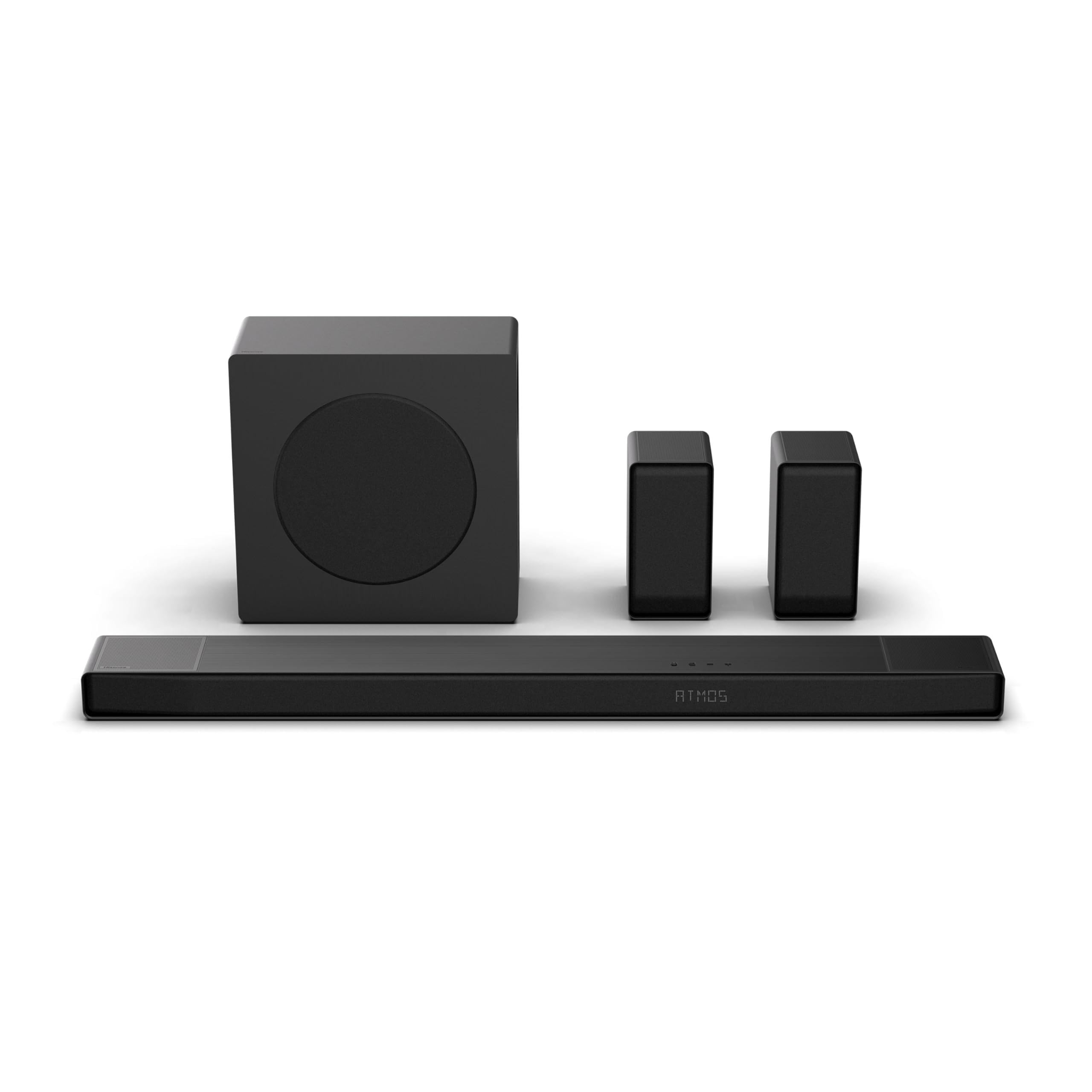
The Hisense AX5140Q punches well above its weight class with a true 5.1.4 channel configuration. That means six front-firing drivers, two dedicated up-firing Atmos drivers, and four surround channels from the wireless rear speakers. A 6.5-inch wireless subwoofer digs down to 40 Hz, delivering bass that fills the room without overwhelming the midrange. The seven Quick Touch EQ modes let you switch between music, movies, and news with one button press, and the built-in room calibration adjusts the sound field to your specific space.
Setup is surprisingly simple for a system with this many channels. The rear speakers and subwoofer pair wirelessly to the soundbar, and HDMI eARC carries lossless Dolby Atmos and DTS:X audio from your TV with a single cable. The 4K HDR passthrough means you can connect a source directly to the soundbar without degrading video quality. Bluetooth 5.3 streaming is stable for music playback from a phone.
The up-firing drivers create a convincing height layer — helicopters panning overhead in a movie feel distinctly above you rather than just bouncing off the ceiling. The dialogue is locked to the center channel and remains intelligible even during dense action sequences. Some users note that the height effects are subtler than premium separates, but for a mid-range all-in-one system, the spatial immersion is remarkable. The matte black design blends into any TV setup.
Why it’s great
- True 5.1.4 Atmos with dedicated up-firing drivers
- Wireless sub and rear speakers simplify placement
- Seven EQ modes and room calibration fine-tune the sound
Good to know
- Height channels are subtle compared to dedicated speaker systems
- Rear speakers can feel underpowered in larger living rooms
2. Sony BRAVIA Theater System 6 HT-S60

Sony’s HT-S60 delivers a 5.1-channel surround experience built around a dedicated center channel for crystal-clear dialogue. The soundbar houses three front-firing drivers, while the wireless rear speakers and subwoofer complete the surround field. Support for both Dolby Atmos and DTS:X means you get object-based audio from streaming services and Blu-ray discs alike. The included wireless rear amp box keeps the rear speaker wiring clean — only the box needs power, and the speakers connect to it with short cables.
The standout feature is Voice Zoom 3, available when paired with a compatible BRAVIA TV. This AI-driven processing analyzes dialogue in real time and raises it above background noise without making voices sound tinny or unnatural. The BRAVIA Connect app gives you granular control over sound profiles and volume levels from your phone. Multi Stereo mode pushes the same signal to all speakers, which works well for parties or open-concept living spaces where you want fill rather than direction.
The subwoofer is wired to the soundbar, which limits placement flexibility to within cable reach of the TV. The system also uses virtual processing rather than physical up-firing drivers for height effects — the soundstage feels wide and immersive, but there is no tangible overhead sensation. Build quality is solid, with a low-profile design that sits cleanly under any TV. The rear speakers are small enough to mount on walls without dominating the room.
Why it’s great
- Voice Zoom 3 dialogue enhancement with BRAVIA TVs
- Clean surround field with wireless rear amp box
- Dolby Atmos and DTS:X support included
Good to know
- Subwoofer requires wired connection to soundbar
- No physical up-firing drivers for true overhead Atmos
3. JBL Bar 700MK2 7.1ch Soundbar

JBL took a creative approach with the Bar 700MK2: the side speakers detach from the main soundbar and function as completely wireless rear surround speakers. Each detachable speaker contains a rechargeable battery that lasts through several movie sessions, and when you’re done, you click them back onto the bar for overnight charging. No power outlets, no cables, no wall warts near your seating area. The main bar delivers a 7.1-channel soundstage with Dolby Atmos decoding, and the 10-inch wireless subwoofer adds serious low-end weight.
The MultiBeam 3.0 processing creates a wide soundstage from the front bar alone, but the real magic happens when you position the detachable speakers behind you. The directional audio pans smoothly from front to back, making action sequences feel genuinely three-dimensional. PureVoice 2.0 automatically adjusts dialogue level based on scene dynamics and your volume setting, so whispered lines stay audible without boosting explosion levels. The JBL ONE app includes a precise EQ for fine-tuning.
Battery life on the detachable speakers is rated for roughly 10 hours of continuous playback, and they charge fully overnight when docked. The 780-watt total power output is plenty for medium to large rooms, though some users find the lower mid-bass range slightly recessed until adjusted via the app EQ. Night listening mode mutes the soundbar and subwoofer while feeding audio only to the detachable speakers, letting you watch without disturbing others. The included wall-mount brackets offer flexible installation.
Why it’s great
- Detachable wireless rears with rechargeable batteries
- 10-inch subwoofer delivers deep, room-filling bass
- PureVoice 2.0 keeps dialogue clear at any volume
Good to know
- Lower mid-bass may need EQ adjustment out of the box
- Rear speakers lack the raw volume of wired alternatives
4. Amazon Fire TV Soundbar Plus 5.1

Amazon’s Fire TV Soundbar Plus is a 5.1-channel system designed for effortless integration with Fire TV devices. The soundbar, wireless subwoofer, and wireless rear speakers pair automatically out of the box — plug them into power, connect the soundbar to your TV via HDMI eARC, and the system handles the rest. The dedicated center channel driver sharpens dialogue, and the 5-level dialogue boost lets you fine-tune voice clarity without affecting the rest of the mix. Dolby Atmos and DTS:X decoding are both supported.
The subwoofer is wireless but does require a nearby power outlet. It produces clean, punchy bass that enhances action scenes without sounding muddy. The rear speakers are small and unobtrusive, and they connect wirelessly to the soundbar for placement flexibility. Movie, Music, Sports, and Night modes optimize the EQ profile for different content types. The Fire TV remote controls both the TV and soundbar volume through HDMI-CEC, simplifying the user experience significantly.
One missing feature is physical up-firing drivers — the system relies on virtual processing for height information. The soundstage extends wide and wraps around the listening position, but overhead effects are simulated rather than discrete. Build quality is decent, though the soundbar chassis is made of plastic rather than metal. For users who prioritize dialogue clarity and seamless Fire TV ecosystem compatibility, this system delivers excellent value. The surround panning is precise, and the subwoofer adds weight without dominating the room.
Why it’s great
- 5-level dialogue boost for pinpoint voice clarity
- Seamless HDMI-CEC integration with Fire TV devices
- Wireless subwoofer and rear speakers with simple setup
Good to know
- No physical up-firing drivers for true overhead Atmos
- Chassis uses plastic rather than metal construction
5. ULTIMEA Skywave F40 5.1.2ch Soundbar
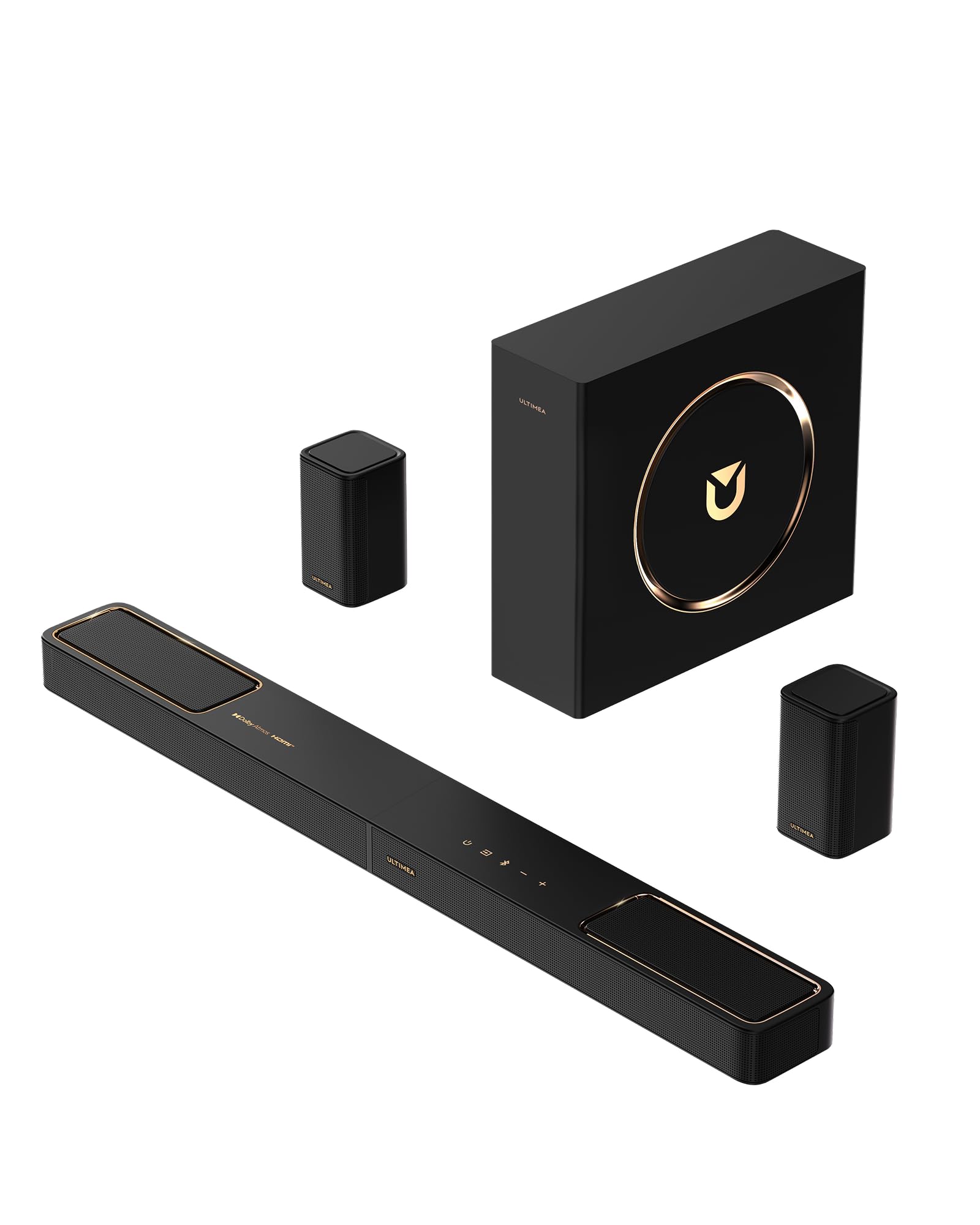
The ULTIMEA Skywave F40 packs a 5.1.2-channel Dolby Atmos system into a compact form factor perfect for smaller rooms and apartments. The key differentiator is the inclusion of up-firing drivers — not virtual processing — that bounce sound off the ceiling to create a tangible overhead layer. The neodymium core magnets and 18-core voice coils in those up-firing channels deliver focused high-frequency dynamics that make rain, helicopters, and overhead explosions feel genuinely vertical. The 5.25-inch wired subwoofer uses BassMX technology for deep, resonant low end.
SurroundX processing combines the two rear surround speakers with the up-firing drivers to build a 360-degree sound field. The HDMI eARC connection supports lossless 5.1.2-channel audio at up to 37 Mbps bandwidth, preserving every detail in the Atmos mix. The Ultimea app gives you a 10-band graphic EQ, 121 preset sound profiles, and 13-step level adjustments for each surround channel. OTA firmware updates keep the system current with new features.
The subwoofer is wired rather than wireless, which means you’ll need to route the cable from the soundbar to the sub location. The rear speakers are wireless to the soundbar but wired to each other via a 6-meter cable. The system is not compatible with DTS formats, so if your media library relies on DTS tracks, this won’t decode them directly. Build quality is solid with a metal enclosure on the soundbar. The up-firing effect is noticeable in rooms with standard 8- to 9-foot flat ceilings.
Why it’s great
- Physical up-firing drivers produce real overhead Atmos effects
- 121 preset EQs and 10-band graphic EQ in the app
- Lossless 5.1.2 audio via HDMI eARC
Good to know
- Subwoofer is wired, not wireless
- Does not support DTS audio decoding
6. ULTIMEA Aura A60 7.1ch Soundbar

The ULTIMEA Aura A60 stretches the affordable surround concept by including four physical surround speakers — two front satellites and two rear satellites — creating a true 7.1-channel array. The center channel in the main soundbar handles dialogue. The front satellites widen the soundstage, while the rear satellites lock in behind you for precise directional audio. A 4-inch wired subwoofer with BassMX technology handles the low end. The system decodes Dolby Atmos using the 7.1 layout to create an immersive bubble of sound.
Setup is straightforward: the left and right front satellites are wired to the soundbar with 2-meter cables, and the rear satellites connect wirelessly to the soundbar but are wired to each other via a 6-meter cable. The HDMI eARC connection handles high-bandwidth audio. The Ultimea app provides 121 preset EQ matrices, a 10-band equalizer, and tailored modes for Movie, Music, Voice, Sport, Game, and Night listening. The system is recommended for spaces between 108 and 270 square feet.
The four discrete surround speakers create a noticeably wider and more enveloping sound field than a typical 5.1 soundbar with two rears. Effects pan smoothly between the front and rear satellites. The 4-inch subwoofer is the weakest link — it provides decent punch but lacks the depth and authority of larger drivers. The included wall mounts for all speakers make installation flexible. Some users report that the satellite speakers are smaller than expected but produce clean, clear sound without distortion at normal listening levels.
Why it’s great
- Four physical surround speakers for a wide sound field
- 121 preset EQs and extensive app customization
- HDMI eARC supports high-bandwidth audio
Good to know
- 4-inch subwoofer lacks deep bass extension
- Front satellites use wired connections
7. LG S40TR 4.1ch Soundbar

The LG S40TR is a 4.1-channel system designed for buyers who want the immersion of wireless rear speakers without spending into the premium tier. The soundbar houses three front channels — left, right, and center — while the included wireless subwoofer and wireless rear speakers complete the surround field. Dolby Digital and DTS Digital compatibility ensures standard surround soundtracks play correctly. Clear Voice Plus processes the center channel to improve dialogue clarity without making voices sound hollow or artificially boosted.
Setup is remarkably painless. The subwoofer and rear speakers pair automatically with the soundbar out of the box. The rear speakers are wired to each other with a supplied cable, but the link back to the soundbar is wireless. The WOW Orchestra feature lets you combine the LG TV speakers with the soundbar for added fullness. HDMI ARC is the recommended connection method, though optical input is available for older TVs. The LG Soundbar App provides a 3-band equalizer for bass, mid, and treble adjustments.
This is a 4.1 system, not 5.1 — there is no dedicated center channel driver in the soundbar itself. The surround decoding uses the front left and right drivers plus the rears to create a phantom center. The subwoofer produces satisfying bass for a bedroom or small den but won’t rattle the walls in a large living room. The AI Sound Pro mode levels volume fluctuations between quiet dialogue and loud effects. The metal grill design keeps dust out and gives the soundbar a premium look that belies its entry-level placement.
Why it’s great
- Wireless subwoofer and rear speakers with auto-pairing
- Clear Voice Plus improves dialogue intelligibility
- Compact footprint ideal for bedrooms and small dens
Good to know
- 4.1 channel lacks a dedicated center driver
- Subwoofer bass is moderate, not cinematic
8. Klipsch Reference Cinema Dolby Atmos 5.1.4 System

The Klipsch Reference Cinema system takes a different approach from the soundbar-based units on this list. This is a full passive speaker system that requires an external AV receiver to power it, but the upside is true audiophile-grade performance. The package includes four satellite speakers with integrated Dolby Atmos up-firing modules, a center channel, and a 10-inch powered subwoofer. Each satellite uses Klipsch’s signature Tractrix 90×90 horn technology with aluminum tweeters for high-frequency response that is crisp, detailed, and efficient.
The up-firing Atmos modules on all four satellites create a 5.1.4 channel layout — four height channels from the front and rear positions — which provides a more coherent overhead sound field than two-channel Atmos systems. The 10-inch subwoofer includes a built-in all-digital amplifier that delivers ample power with low distortion. The satellites produce surprising bass for their size, allowing for a crossover setting around 100 Hz that keeps the subwoofer focused on the deepest frequencies. The system lacks speaker wire and an AV receiver, so you need to supply those separately.
Clarity and dynamics are the defining characteristics of this system. Horn-loaded tweeters project sound with precision, making dialogue cut through the mix without sounding harsh. The overhead effects are more convincing than any soundbar-based system because the physical separation between channels is greater. The subwoofer is competent but not class-leading — some enthusiasts swap it for a larger Klipsch sub over time. The satellite speakers are made of sturdy plastic with magnetic grilles and copper-spun cones that look premium. This system rewards careful setup and calibration.
Why it’s great
- True 5.1.4 Atmos with up-firing modules on all satellites
- Horn-loaded aluminum tweeters deliver detailed highs
- 10-inch subwoofer with built-in amplifier
Good to know
- Requires external AV receiver (not included)
- Speaker wire must be purchased separately
9. Bobtot 1200W 5.1 Home Theater System
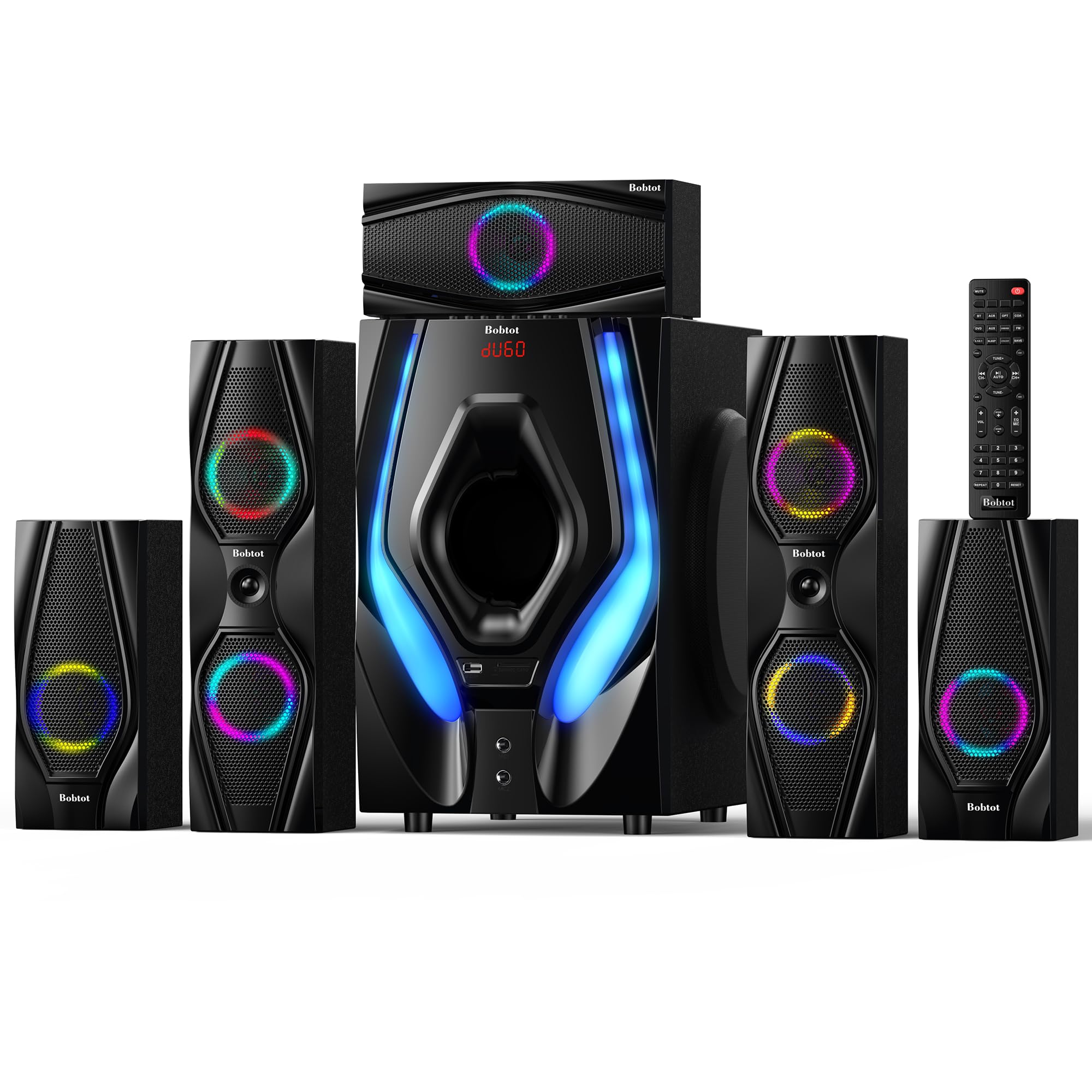
The Bobtot 1200W system is a wired 5.1-channel passive speaker set with a 10-inch subwoofer that houses the built-in receiver and amplifier. This is the most traditional home-theater-in-a-box approach: five satellite speakers (two front, two rear, one center) connect to the subwoofer via long included cables, and the subwoofer handles all amplification and input switching. The front and rear speaker cables stretch 13 feet and 31 feet respectively, offering plenty of placement flexibility. The system includes ARC, optical, coaxial, AUX, and Bluetooth 5.3 inputs.
A unique feature is the LED ambient lighting on the subwoofer, which offers four modes including a beat-synced option and a spectrum EQ analyzer. The system also includes two 1/4-inch microphone inputs with echo control for karaoke, plus FM radio and USB/SD card playback. The remote control lets you adjust individual speaker volumes and the subwoofer level independently. The 5.1/2.1 channel switch lets you toggle between full surround and a stereo-plus-sub setup for music listening.
The 10-inch subwoofer produces deep, physical bass that fills a medium to large room. The satellite speakers deliver clear highs and mids, though they can show distortion at maximum volume. The wired nature of the system means running cables across the room, which may not suit every living space. Reliability concerns surface in some user accounts, particularly with wireless connectivity issues on replacement units. The system works best for dedicated home theater rooms where cable management is planned and the priority is maximum bass for the lowest investment.
Why it’s great
- 10-inch subwoofer delivers serious low-frequency power
- Karaoke microphone inputs and LED lighting add versatility
- Long speaker cables allow flexible satellite placement
Good to know
- Fully wired system requires significant cable management
- Reliability reports are mixed across long-term use
FAQ
Do I need an AV receiver for affordable surround sound speakers?
How important are up-firing drivers for Dolby Atmos?
Can I mix and match speakers from different brands?
What room size is best for a 5.1 surround system?
Final Thoughts: The Verdict
For most users, the best affordable surround sound speakers winner is the Hisense AX5140Q because it delivers genuine 5.1.4 Dolby Atmos with dedicated up-firing drivers, a powerful 6.5-inch wireless subwoofer, and seamless HDMI eARC connectivity at a price that undercuts competitor systems with fewer channels. If you want the convenience of detachable wireless rear speakers and the deepest subwoofer bass, grab the JBL Bar 700MK2. And for a compact room where physical overhead effects matter, the ULTIMEA Skywave F40 is the best choice.