
Our readers keep the lights on and the weekend projects moving. As an Amazon Associate, I earn from qualifying purchases.
The trail camera market is flooded with models that promise crisp deer photos but deliver blurry blobs and dead batteries after a single weekend. The real pain isn’t capturing a buck — it’s wasting time hiking out to swap AAs on a camera that missed the shot anyway, leaving you with an empty SD card and a lighter wallet. For hunters and wildlife watchers shopping on a budget, the challenge is finding a unit that pairs reliable motion detection with decent night vision without forcing you into a pricey cellular plan or constant maintenance.
I’m Rikta — the co-founder and writer behind FitlyFast. I’ve spent countless hours digging through spec sheets, customer durability reports, and real-world field tests to separate the dependable affordable trail cameras from the ones that die in the rain.
A great affordable trail camera must balance trigger speed, night vision range, battery efficiency, and build quality in a package that doesn’t require a second mortgage on your hunting lease.
How To Choose The Best Affordable Trail Camera
An affordable trail camera doesn’t mean you have to accept slow triggers and ghostly night images. The key is knowing which specs matter most for your specific terrain and game. Below are the four non-negotiable criteria that separate a field-worthy camera from a plastic brick with a lens.
Trigger Speed and Detection Zone
The single metric that decides whether you see a buck or an empty frame is trigger speed. Look for a rate of 0.2 seconds or faster; the best affordable models hit 0.1 seconds. Equally important is the detection angle — a wide 100° beam combined with side PIR sensors catches animals moving from the flanks, not just straight-on traffic.
Night Vision Quality and Flash Type
Low-glow 850nm LEDs provide brighter images at shorter distances but are faintly visible to game. No-glow 940nm LEDs are invisible to wildlife, making them ideal for security-minded or pressured properties, though they sacrifice some range. The best budget trail cameras still deliver usable images out to 65-100 feet with either technology — check sample photos from owners in your region.
Power Architecture: Solar, Battery, or Both
Battery drain is the hidden cost of trail cameras. An affordable camera with a built-in rechargeable battery and detachable solar panel eliminates the need for disposable AAs entirely. Even without solar, models that accept standard rechargeable cells and feature ultra-low-power standby (common on non-cellular, non-WiFi units) dramatically reduce trips to the woods.
Connectivity vs. Simplicity
Cellular cameras add a monthly fee and are often overkill for a 10-acre woodlot. WiFi and Bluetooth models let you preview images from 40-55 feet away without pulling the SD card — a huge convenience at no extra cost. For pure reliability and minimal power draw, a non-cellular, non-WiFi unit with a good optical lens is still the most dependable and affordable trail camera for remote spots where you only check every few weeks.
Quick Comparison
On smaller screens, swipe sideways to see the full table.
| Model | Category | Best For | Key Spec | Amazon |
|---|---|---|---|---|
| MAXDONE Solar 4K 64MP | Solar WiFi | Year-round set-and-forget | 0.1s trigger, 65ft low-glow | Amazon |
| MAXDONE Solar 2-Pack | Solar WiFi 2pk | Multiple property coverage | 4K video, 65ft low-glow | Amazon |
| Assark Solar 48MP | Solar WiFi | Phone-friendly app control | 0.2s trigger, 1080P video | Amazon |
| GardePro E5S | Budget Classic | Pure reliability, no extras | 0.1s trigger, 100ft no-glow | Amazon |
| Meidase P70 2-Pack | Value 2-Pack | Two cameras on a budget | 0.1s trigger, 100ft no-glow | Amazon |
| TACTACAM Reveal X PRO | Cellular | Remote real-time alerts | 96ft range, GPS tracking | Amazon |
| Moultrie Edge 3 2-Pack | Cellular Premium | AI buck detection 2-pack | 0.5s trigger, 100ft low-glow | Amazon |
In‑Depth Reviews
1. MAXDONE Solar Trail Camera WiFi Bluetooth — 4K 64MP

This unit nails the three pillars of a great affordable trail camera: a 0.1-second trigger speed that rarely misses fast-moving deer, 64MP stills and 4K video that provide crisp ID-level detail, and a 5200mAh rechargeable battery kept topped up by the integrated solar panel. Owners report the battery stays at 100% for months even in partly shaded setups, eliminating the biggest recurring cost of trail cameras — disposable AAs. The 65-foot low-glow night vision delivers clear, usable images without the harsh white flash that spooks wary bucks.
WiFi 6 and Bluetooth connectivity allow you to preview and download images from up to 55 feet away via the free app, so you never have to pop the SD card just to check if something walked through last night. The camera generates its own hotspot — it does not connect to home WiFi or cellular networks, which keeps the privacy of your data local and removes any subscription fee. The IP66 waterproof housing handles heavy rain and snow without fogging the lens.
Setup is genuinely beginner-friendly: the app walks you through Bluetooth pairing, the included 32GB TF card means no separate purchase, and the solar panel attaches with a simple detachable cable. The 100° wide detection angle combined with the 5-shot burst mode captures multiple angles of a passing animal, giving you a better chance of seeing antler points. For the price, this is the most complete solar-powered trail camera we’ve tested.
Why it’s great
- Built-in solar panel keeps the 5200mAh battery perpetually charged in moderate sunlight
- 0.1-second trigger speed and 5-shot burst catch fast-moving game reliably
- Comes with a pre-installed 32GB TF card and includes the mounting strap and bracket
- Free app allows image preview and download without removing the SD card
Good to know
- Does not connect to home WiFi; uses its own local hotspot with a 55-foot range
- No cellular option — you must be within Bluetooth/WiFi range to view images
- Night vision is low-glow (850nm), faintly visible to extremely wary animals
2. MAXDONE Solar Trail Camera 2 Pack — 4K 64MP WiFi Bluetooth
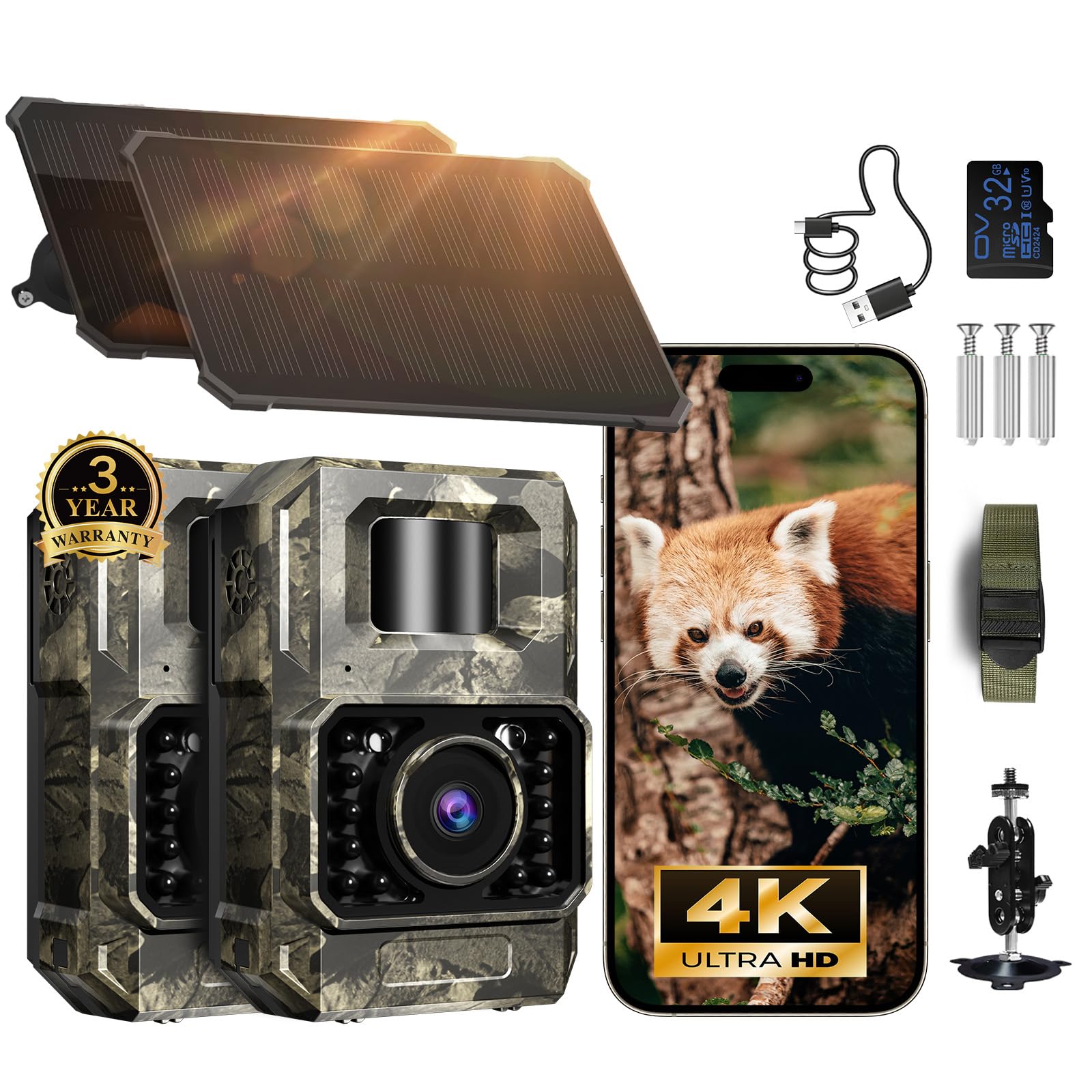
Essentially the same class-leading hardware as the single-pack MAXDONE but doubled, this 2-pack is the most efficient way to cover multiple trails, a large food plot, or both ends of a property line for a single investment. Each camera retains the same 0.1-second trigger, 64MP stills with 4K/30fps video, and the solar-rechargeable battery system that owners confirm keeps the cameras humming for months without manual battery swaps. The included 32GB SD cards mean each unit is ready to deploy out of the box.
Both cameras use the same TrailCam GO app with WiFi 6 hotspot connectivity (up to 55 feet), so you can walk within range of each unit, preview images, and download the ones you want without ever touching the SD card. The lack of cellular costs is a major advantage for the budget-minded buyer — there is no monthly plan, and all images stay on the local SD card unless you deliberately pull them over WiFi. The IP66 waterproof rating has been validated by owners in freezing winter storms and humid summer conditions.
Each camera ships with a detachable solar panel, mounting straps, and a bracket. The 100° wide-angle lens captures a broad field without fisheye distortion. Owners consistently praise the crisp daytime colors and the surprisingly detailed night video at 65 feet. If you need two cameras and want the maintenance-free solar convenience, this 2-pack beats buying two separate units by a wide margin on value and consistency.
Why it’s great
- Two fully equipped solar cameras for less than the price of two single units
- Each camera includes a 32GB SD card, saving an immediate accessory cost
- App-controlled WiFi preview for both cameras from your phone within 55 feet
- Solar rechargeable battery eliminates ongoing AA purchases across both units
Good to know
- No home WiFi or cellular support; each camera creates its own local hotspot
- Battery compartment still uses a screw-terminal connection; ensure the solar panel cable is fully seated
- App connection range can drop to ~40 feet in dense brush
3. Assark Solar Trail Camera — 48MP 1080P WiFi Bluetooth

While the MAXDONE leads on spec sheets, the Assark PH960W edges ahead in app polish and user experience. The “TrialCam Go” app provides a clean, responsive interface for adjusting PIR sensitivity, setting timelapse intervals, and downloading individual clips without batch restrictions. The 0.2-second trigger speed is a hair slower than the 0.1-second leaders, but owners confirm it catches everything from squirrels to coyotes without missed activations. The 48MP stills and 1080P video at 30fps provide enough detail for identifying antler points and tracking movement patterns.
The solar panel and rechargeable lithium battery system performs admirably, with Florida users reporting zero battery drops even through humid, partly cloudy summers. The 850nm low-glow IR LEDs push clear night images to about 15-18 feet in practice according to detailed user testing, which is adequate for narrow trails and feeder monitoring but falls short of the 65-foot class leaders. The IP66 waterproof shell shrugs off thunderstorms, and the camera ships with a 32GB micro SD card pre-installed — no accessory trip required.
A few downsides: the rubber port cover makes accessing the solar plug slightly fiddly, the app lacks a built-in landscape mode for easy on-phone viewing, and the microSD card slot is tight enough that users with thick fingers may need tweezers. The WiFi hotspot connects only to the phone, not home networks, and the range is about 45 feet. Still, for the price, this is one of the most user-friendly affordable trail cameras with solar backup and a genuinely good app experience.
Why it’s great
- App-based PIR sensitivity adjustment and motion zone configuration are intuitive
- Included 32GB micro SD card and solar panel — fully operational out of the box
- USB-C auxiliary charging port for rapid power top-up in the field
- Consistent, reliable solar charging in diverse climates (users confirm Florida humidity, no issue)
Good to know
- Effective night vision range is noticeably shorter (~15-18 feet) than 65-100 foot competitors
- Tight microSD slot and rubber solar port cover can be frustrating to operate
- App does not support batch download; you must select files individually over WiFi
4. GardePro E5S Trail Camera — 64MP 1296P No WiFi

This is the stripped-down workhorse for buyers who want the absolute best trigger speed and night vision range without paying for WiFi, Bluetooth, or solar. The E5S uses three independent PIR sensors — one center and two side-mounted — to achieve a consistent 0.1-second trigger from almost any approach angle. Combined with 100 feet of true no-glow 940nm infrared night vision, this is the best affordable trail camera for properties where spooking game with any visible flash is unacceptable.
The 64MP stills and 1296P HD video are sharp in daytime, and the no-glow IR produces remarkably bright, ghost-free images at night — a feature typically found on cameras costing twice as much. The trade-off is power: this unit runs on 8 AA batteries (not included) and has no built-in rechargeable option, though it supports the GardePro SP350 external solar panel (sold separately). Owners report that a set of Energizer Lithium AAs lasts an entire season in areas with moderate traffic, but heavy-use timelapse or video-heavy setups will drain them faster.
Build quality is rugged: IP66 waterproofing, a 1/4″-20 tripod thread for flexible mounting, and a camouflage shell that blends into hardwoods. The 2.4-inch color display and button-operated menu feel utilitarian but get the job done without a phone. The lack of any wireless connectivity means you must physically retrieve the SD card to see images, which is the main limitation for lazy-checkers. GardePro’s customer support receives consistent praise for rapid warranty replacements.
Why it’s great
- Triple PIR sensor system provides near-instant 0.1-second trigger from any direction
- 100-foot no-glow IR range is genuinely invisible to wildlife and produces clean images
- Extremely low standby power draw preserves battery life in timelapse mode
- Rugged IP66 shell with tripod thread for adaptable mounting
Good to know
- Requires 8 AA batteries (not included); no built-in rechargeable option
- No wireless connectivity — you must pull the SD card or use a USB cable to view images
- Video audio reported to have occasional crackling; check firmware
5. Meidase P70 2-Pack Trail Camera — 64MP 1296P No WiFi
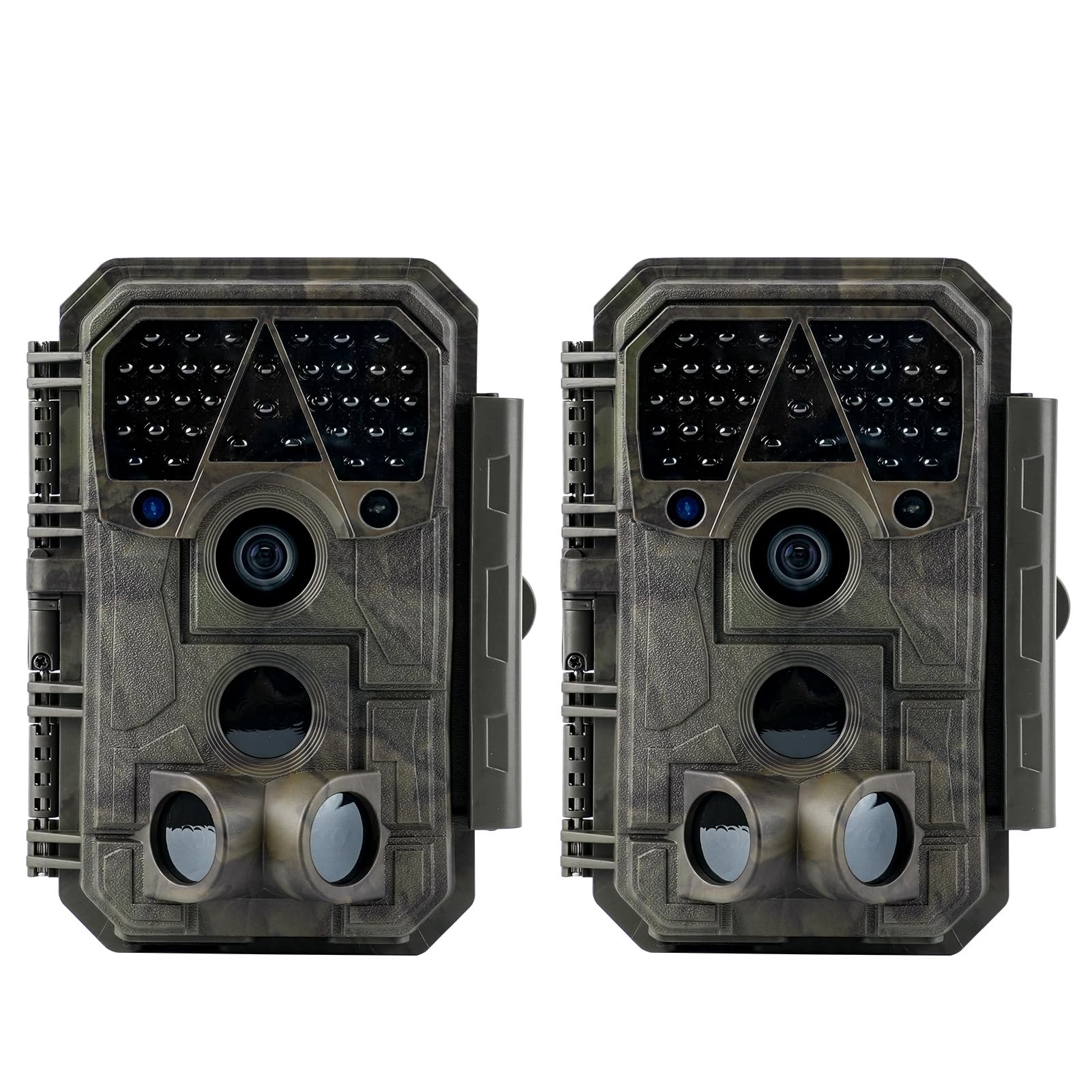
For the lowest per-camera cost in this guide, the Meidase P70 2-pack delivers two surprisingly capable no-glow trail cameras that share the same core specs as the GardePro E5S: 64MP stills, 1296P video, 100-foot no-glow IR night vision, and a 0.1-second trigger speed with side-sensor support. The f/1.6 aperture lens pulls in more light than many competitors at this price point, resulting in night images that rival units in the premium tier. The 2.4-inch color display is bright and easy to navigate, and the menu buttons are large enough for gloved hands.
The trade-off is in build finish and accessory support. The Meidase uses H.264 compression to keep file sizes small, and it records in standard .mp4 and .mov formats for universal playback. Owners confirm that the camera handles Florida heat and thunderstorms without condensation, and the side PIR sensors genuinely reduce missed lateral triggers. The main complaint is that the calendar and time must be reset after each battery change — a minor nuisance that doesn’t affect image quality. The camera also tends to generate a high number of false triggers during high wind (up to 1,000 events in 24 hours), so sensitivity tuning is essential.
For two cameras under the price of a single premium unit, the Meidase P70 2-pack is the smart buy for covering a larger area on a tight budget. It lacks any wireless connectivity, so you must collect SD cards manually, but the image quality and trigger consistency make the extra hikes worthwhile. Meidase also offers the optional SP350 solar panel if you want to add solar to one or both cameras.
Why it’s great
- Two cameras with 64MP stills and 100-foot no-glow night vision at a very low per-unit cost
- f/1.6 aperture lens and 940nm IR provide bright, clear night images without visible flash
- H.264 .mp4 format ensures easy playback on any device without conversion
- Large buttons and clear 2.4-inch menu display work well with gloves
Good to know
- No rechargeable battery or solar panel included; 8 AA batteries per camera required (not included)
- SD cards not included with the camera; must be purchased separately
- Calendar/time resets after battery swap; false triggers increase significantly in windy conditions
6. TACTACAM Reveal X PRO Cellular Trail Camera — HD Photo/Video
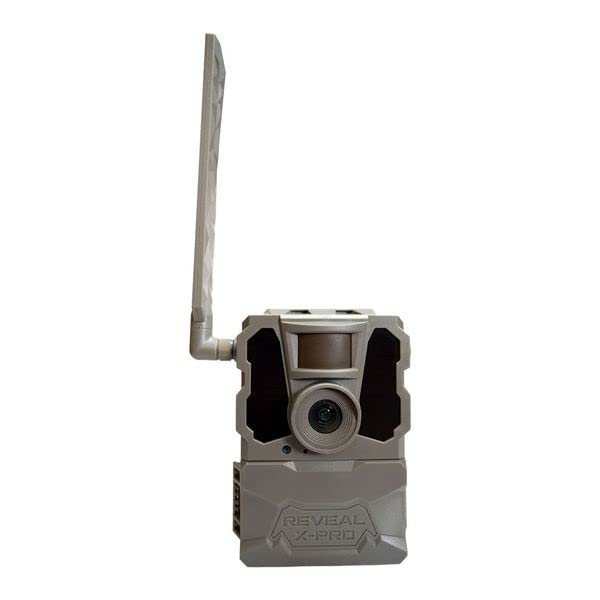
If you need real-time photo delivery to your phone from a remote property without hiking, the Reveal X PRO brings cellular connectivity into the affordable conversation. This model ships with both Verizon and AT&T SIM cards built in — you simply pick the carrier with the best coverage at your spot and activate a plan starting at a modest monthly fee. The integrated GPS tracking logs the camera’s location, and the 16MP stills and HD video are crisp enough for deer management decisions. The no-glow IR flash extends to 96 feet, matching or beating many non-cellular cameras.
The most appreciated feature among owners is the Hybrid Mode, which balances image resolution and delivery speed against battery consumption. For security-minded users, the auto-upload to the cloud means that even if the camera is stolen, your images are safe. The built-in 2.4-inch LCD screen allows on-camera photo review and programming without the app. One major caution: this camera chews through 12 AA batteries rapidly; the community overwhelmingly recommends using the TACTACAM rechargeable lithium battery pack and their dedicated solar panel to make the economics work long-term.
With a recommended 32GB Class 10 U3 SD card (sold separately) and the basic plan, the monthly cost is about the same as a streaming service. The 0.5-second trigger speed is adequate for deer, but fast-moving coyotes or turkeys may produce partial frames. This is the right choice for the buyer who values time saved on SD card collection more than raw trigger speed, especially when covering multiple isolated hunting properties.
Why it’s great
- Dual-carrier cellular (Verizon and AT&T) provides reliable coverage in most hunting areas
- Integrated GPS tracking and cloud backup prevent total image loss if camera is stolen
- No-glow IR reaches 96 feet with minimal battery penalty in Hybrid Mode
- Built-in LCD screen for on-location preview without requiring a phone
Good to know
- Requires a monthly cellular plan starting at a modest fee; adds long-term cost
- 12 AA batteries drain quickly; rechargeable battery pack and solar panel are strongly recommended
- 0.5-second trigger speed is relatively slow; fast-moving game may be partially cropped
7. Moultrie Edge 3 Cellular Trail Camera 2-Pack — 40MP AI Buck Detection
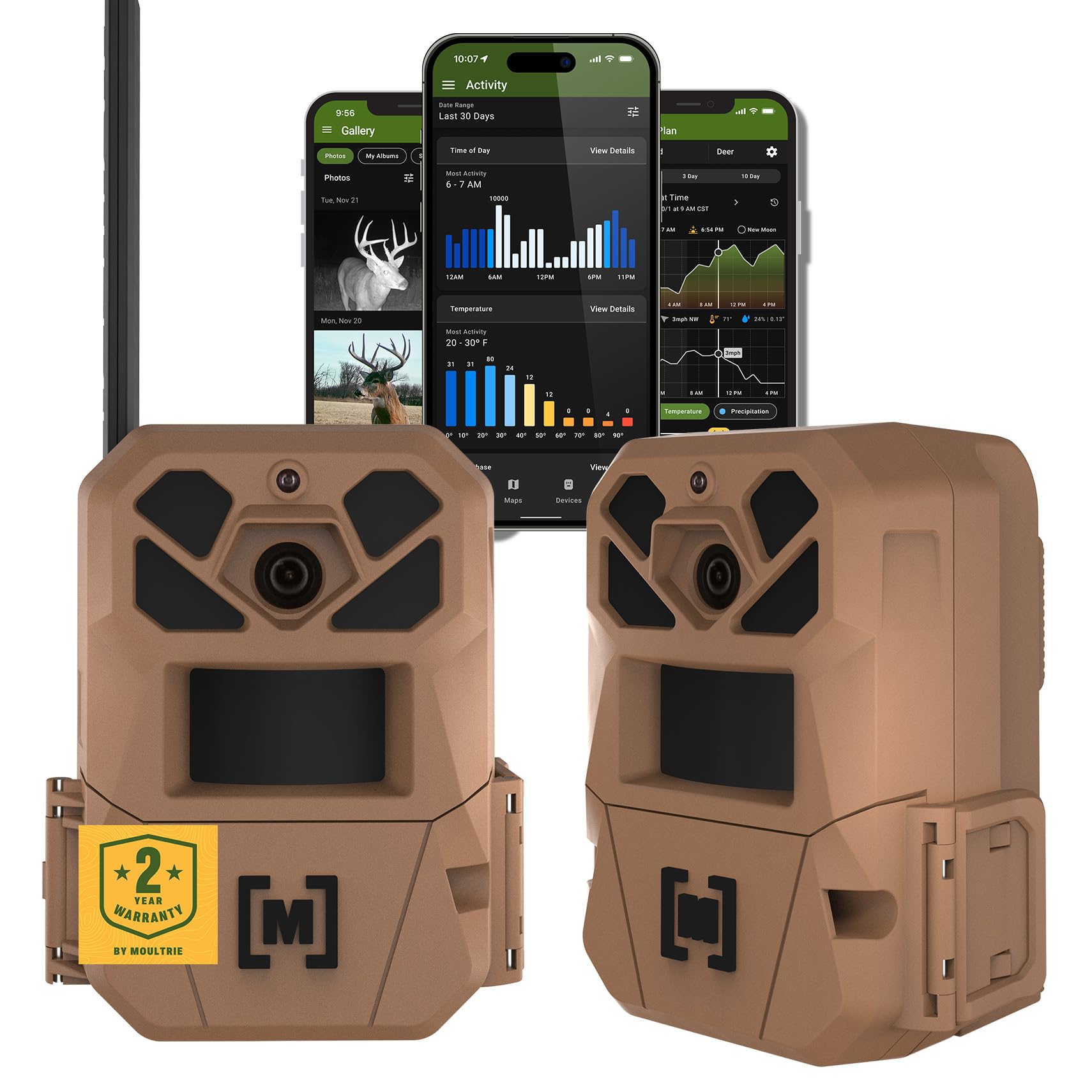
The Moultrie Edge 3 is the most technologically advanced camera on this list, combining 4-carrier cellular auto-connect (no SIM swapping needed) with AI buck detection that sends instant photo alerts only when a mature antlered deer appears — eliminating the flood of raccoon and squirrel shots that plague standard motion sensors. The 40MP photos and 1080p HD video are delivered straight to the Moultrie Mobile app within seconds, and the Live Aim feature lets you preview the camera view on your phone for precise placement before mounting. Built-in GPS automatically maps each camera in the app so you never forget where you hung it.
The 100-foot low-glow detection range and 0.5-second trigger speed are adequate for most hunting scenarios, though faster-moving species may occasionally blur. The real killer feature for serious hunters is the AI integration: the system learns which deer are mature, reducing false alerts and data usage. The 2-pack makes covering two distinct pinch points or a food plot and a scrape line easy. The cameras also remotely control compatible Moultrie feeders, letting you adjust feed times and check levels from the same app without stepping foot on the property.
The catch is the ongoing cost: flexible data plans start at a modest monthly fee per camera, and the AA batteries included with the cameras drain quickly. The Moultrie Edge lithium battery packs and solar panel are essentially required for season-long operation. A minor but notable complaint: there is no built-in locking cable support, so required lockboxes for public land add to the setup complexity. For the dedicated hunter who wants AI-filtered buck intel delivered to their phone, this is the most capable affordable trail camera 2-pack available, but the true total cost of ownership goes beyond the initial purchase.
Why it’s great
- AI buck detection sends alerts only for mature deer, drastically reducing false notifications
- 4-carrier auto-connect picks the strongest network in your area without manual SIM switching
- Live Aim allows phone-guided camera placement, and GPS maps every camera location
- App-controlled feeder integration centralizes bait and camera management
Good to know
- Monthly data plan required per camera; cost adds up over a season
- Standard AA batteries drain quickly; Moultrie lithium battery pack and solar panel recommended
- 0.5-second trigger speed is the slowest in this guide; may miss fast-moving shots
- No integrated lock support; public-land users must purchase a separate lockbox
FAQ
Can an affordable trail camera with solar power really replace disposable batteries?
Is a WiFi trail camera without cellular worth the higher upfront cost over a basic SD-card model?
How many false triggers should I expect from a budget motion-activated trail camera?
Final Thoughts: The Verdict
For most users, the affordable trail camera winner is the MAXDONE Solar 4K 64MP because its 0.1-second trigger, solar-rechargeable battery, and WiFi app control deliver the perfect balance of image quality and convenience without any monthly fees. If you want true 100-foot no-glow night vision in a dead-simple, ultra-reliable package, grab the GardePro E5S. And for covering two trails simultaneously with identical performance on a tight budget, nothing beats the Meidase P70 2-Pack.