
Our readers keep the lights on and the weekend projects moving. As an Amazon Associate, I earn from qualifying purchases.
A vacuum tube amplifier isn’t just audio gear—it’s a commitment to second-order harmonic distortion, high-voltage plate circuits, and the physical ritual of glass glowing in a dim room. But the affordable market is littered with hollow “tube flavor” hybrids that use a single 12AX7 for marketing while the heavy lifting comes from a cold Class D chip. Finding a genuine circuit that delivers real plate voltage, a proper output transformer, and the option to roll tubes without a soldering iron takes more than sorting by price.
I’m Rikta — the founder and writer behind FitlyFast. I’ve spent years analyzing circuit topologies, output transformer specs, and customer reports from both entry-level and high-end tube amplifier buyers to separate real value from gimmicks in this niche.
Whether you are after a pure single-ended Class A experience, a hybrid that balances table warmth with solid-state muscle, or a guitar combo that breaks up sweetly, this guide identifies the top contenders in the market for a best affordable tube amplifier with a focus on measurable build quality and sonic character.
How To Choose The Best Affordable Tube Amplifier
Choosing the right tube amp in the value tier is about understanding where the corners were cut—and where they weren’t. A amplifier that stuffs a real 180V plate circuit into a metal chassis is a fundamentally different product from one that uses a tube as a decorative buffer for a solid-state chip.
Output Stage Topology: Pure, Hybrid, or Single-Ended
The biggest split in affordable tube amplifiers is how the output stage works. Pure tube amps run the speaker signal entirely through vacuum tubes—both the preamp and the power amp. Hybrid designs use a tube preamp section feeding a solid-state power stage, which gives you some tube coloration with higher wattage and lower heat. Single-ended Class A designs are the most “tube-like” but produce only 3-12 watts, making them dependent on high-sensitivity speakers (92dB+).
Plate Voltage and the “Real Tube” Test
A common budget trap is low-voltage tube stages that run at 12V or 24V. These starve the tube of the high voltage it needs to produce the harmonic distortion profile and headroom that define the tube sound. Look for a stated plate voltage of 180V or higher in the preamp section. The AIYIMA T20, for example, advertises a full 180V circuit, while many cheaper units run tubes at a fraction of that.
Speaker Sensitivity Matching
This is the single most common mistake. A pure tube amp producing 5 watts can fill a room with sound if paired with 95dB speakers, but will sound anemic through 84dB floorstanders. Always check your speaker’s sensitivity rating before buying a low-wattage pure tube or single-ended amp. Hybrid designs with solid-state output stages offer a wider safety margin here.
Quick Comparison
On smaller screens, swipe sideways to see the full table.
| Model | Category | Best For | Key Spec | Amazon |
|---|---|---|---|---|
| AIYIMA T20 | Preamp | Adding tube flavor to any system | 180V plate voltage, balanced XLR | Amazon |
| Dayton HTA100 | Hybrid | Versatile all-in-one with phono input | 50W RMS x 2, USB DAC | Amazon |
| Juson JTA100 | Hybrid | High-power home theater integration | 200W total, phono input | Amazon |
| Dayton HTA200 | Hybrid | High-power listening with motorized volume | 100W RMS x 2, motorized knob | Amazon |
| Dared MP-5BT | Hybrid | Compact desktop elegance with aptX | 25W x 2, aptX Bluetooth, USB DAC | Amazon |
| Douk Audio F5 | Pure Class A | True single-ended tube sound | 3.2W x 2, pure Class A | Amazon |
| Rockville BluTube | Hybrid | Budget all-in-one with visual flair | 35W x 2 @ 4 ohm, VU meter | Amazon |
| Reisong A10 | Pure Tube | Classic EL34 pure tube sound | 12W x 2, EL34 tubes, point-to-point | Amazon |
| Monoprice 611705 | Guitar | Guitar practice and home recording | 5W all-tube, Celestion speaker | Amazon |
In‑Depth Reviews
1. AIYIMA T20 Fully Balanced Tube Preamp

The AIYIMA T20 earns the top spot because it delivers the highest plate voltage in this lineup at a cost that undercuts every other preamp with XLR balanced outputs. The 180V high-voltage circuit for the ECC83/12AX7 tube is the genuine article—not a starved-plate gimmick—and the fully balanced XLR and RCA signal path ensures noise-free transmission into any power amplifier or active speaker. The included LME49720 and OPA1612 op-amps, plus the ability to swap both the vacuum tube and the operational amplifiers, gives you four layers of tonal customization that no other product at this price matches.
On the bench, the T20 posts impressive numbers: a SNR of at least 112dB, THD+N at 0.003%, and 109dB of dynamic range. The all-metal unibody chassis with sandblasted finish provides excellent EMI shielding. The 20-second intelligent soft-start system pre-warms the tube before passing signal, which extends tube life and eliminates the cold-start thump that plagues cheaper designs. Owners report that upgrading the power supply and rolling in Mullard or Telefunken tubes transforms the T20 into a performer that competes with preamps costing three times as much.
This is a line-stage preamp only—it has no phono input and cannot drive speakers directly. You will need a separate power amplifier or powered speakers. The remote and large digital volume display make system integration smooth, but the lack of an internal phono stage means turntable users need a separate phono preamp like the AIYIMA T3 PRO. For anyone building a system around a power amp or active monitors, the T20 is the most cost-effective way to inject genuine tube warmth into the signal chain.
Why it’s great
- Full 180V plate voltage delivers real tube harmonics, not starved-plate coloration
- Balanced XLR and RCA outputs with sub-0.003% THD+N for pristine signal integrity
- Swappable op-amps and vacuum tubes enable deep tonal customization
Good to know
- Preamp only—requires a separate amplifier or powered speakers to produce sound
- No phono input; turntable users need an external phono stage
- Uses proprietary 12V DC adapter; incompatible power supplies damage the unit
2. Dayton Audio HTA100 Integrated Stereo Hybrid Tube Amplifier

The Dayton HTA100 is the best all-in-one value in affordable tube amplification because it pairs a genuine tube preamp section with a Class A/B solid-state output stage that delivers 50 watts RMS per channel. That power figure alone makes it compatible with a much wider range of speakers than pure tube designs. The front panel VU meters and exposed tube glow provide the vintage aesthetic, while the back panel includes an RCA phono input for turntables—a feature missing from many competitors in this price bracket.
From a connectivity standpoint, the HTA100 covers nearly every modern source: Bluetooth 5.0 for wireless streaming, a USB DAC input for computer audio, standard RCA inputs, and the aforementioned phono stage with a ground terminal. Owners driving bookshelf speakers from Sony, Boston Acoustics, and Triangle consistently report a warm, non-fatiguing sound that avoids the clinical edge of many solid-state Class D amplifiers. The tube preamp section imparts a subtle harmonic richness to the midrange without muddying the bass or rolling off the treble.
The headphone output is genuinely usable, driving both dynamic and planar magnetic headphones to reasonable levels. The remote control is basic but functional. Some users note that the factory tubes are adequate but benefit from replacement with NOS or premium production tubes for greater clarity. The bass and treble tone knobs offer useful adjustment without introducing audible noise. At this price point, no other hybrid amplifier offers the combination of phono input, USB DAC, and full 50-watt output in a chassis this well-finished.
Why it’s great
- 50W RMS per channel of Class A/B power suits most bookshelf and floorstanding speakers
- Built-in phono preamp with ground terminal for direct turntable connection
- USB DAC, Bluetooth 5.0, and RCA inputs cover all common audio sources
Good to know
- Hybrid topology means the output stage is solid-state, not pure tube
- Remote control is reported as slow and unresponsive by multiple owners
- Factory tubes are adequate but upgrading improves soundstage depth
3. Juson Audio JTA100 2025 Version Integrated Hybrid
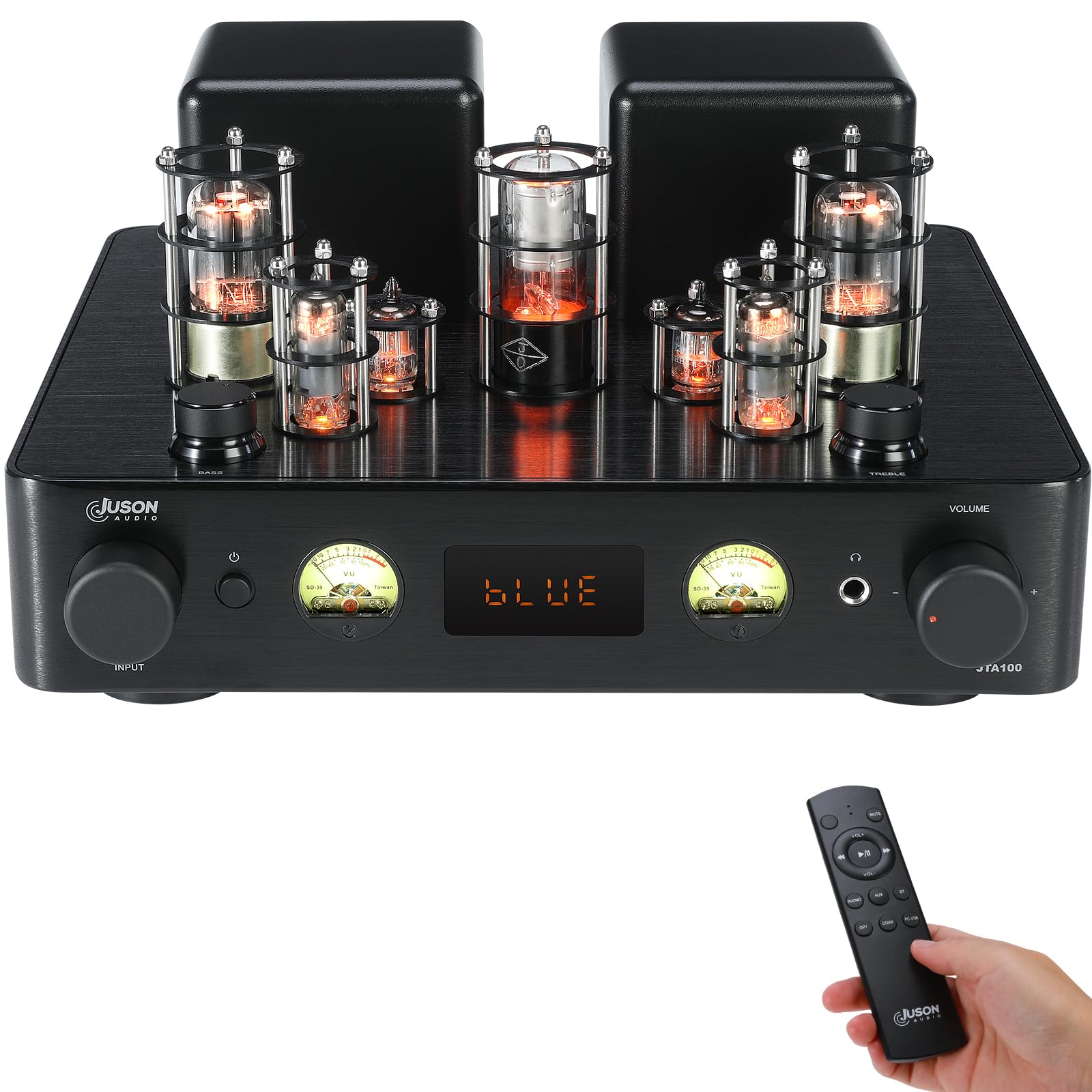
The Juson JTA100 fills a specific role that the other hybrid amplifiers in this roundup do not: it offers the highest total power output of any unit listed while retaining a vacuum tube preamp section. At 200 watts total RMS (100W x 2), this amplifier can drive demanding floorstanding speakers and fill large rooms without breaking a sweat. The front panel features a retro-styled VU meter and a small LED display, and the included remote control covers volume and input selection.
Input versatility is the JTA100’s second strong suit. It includes AUX, coaxial, optical, phono (with ground), and Bluetooth 5.0. The headphone output includes a high-low gain switch that drives 16-ohm to 600-ohm headphones, making it one of the few affordable tube hybrids that can properly drive high-impedance studio cans. Owners using Klipsch RP-600M II speakers report that upgrading the stock 6N7 tubes to PSVANE Horizon EL34s deepens the bass and widens the soundstage dramatically, confirming that the tube stage is genuinely in the signal path and not just decorative.
Build quality is solid, with a heavy metal chassis and decent binding posts. A small number of owners mention loose feet or light-feeling knobs, and customer service responsiveness has been inconsistent. The gain structure works best with sources that output a standard 2V line level; very quiet sources may require the volume knob to be pushed past the halfway point. If you need high power from a tube preamp hybrid and want a phono input built in, this is the strongest candidate in the value range.
Why it’s great
- Power output is the highest in the affordable hybrid category, suitable for large speakers and rooms
- High-low gain headphone jack drives 600-ohm headphones properly
- Phono input, optical, coax, and BT 5.0 provide complete source flexibility
Good to know
- Build quality reports vary, with occasional loose-foot complaints and missing customer support
- Stock tubes benefit heavily from an EL34 upgrade for fuller bass response
- Knobs and controls feel less premium than the chassis suggests
4. Dayton Audio HTA200 Integrated Stereo Hybrid Tube Amplifier

The Dayton HTA200 is essentially the HTA100’s bigger sibling, doubling the power output to 100 watts RMS per channel and adding a motorized volume knob that can be controlled via the remote. The core topology remains the same: a vacuum tube preamp section feeding a Class A/B solid-state output stage. This gives the HTA200 the same warm, rounded tonal character as the HTA100 but with significantly more headroom for large speakers and high dynamic range music.
Connectivity mirrors the HTA100 with Bluetooth 5.0, USB DAC, optical input, and a phono preamp for turntables. The motorized volume knob is a genuinely useful upgrade—it allows precise level matching from across the room without walking to the rack. The front panel VU meters are backlit and responsive, adding to the visual appeal. Owner reports consistently praise the HTA200 for its ability to drive large Focal Aria and Triangle Borea speakers without strain, delivering a soundstage that feels wide and unhurried compared to Class D alternatives.
One practical advantage over the HTA100 is thermal performance: the HTA200 runs cooler because its larger chassis and fan (which rarely spins) dissipate heat more efficiently. The remote is the same sluggish unit as the HTA100, which remains the most common criticism. Some owners replace it with a universal remote. The factory tubes are functional, but rolling in higher-quality 12AX7 variants yields a noticeable improvement in imaging precision. For users who need high power and want the motorized volume convenience, the HTA200 justifies its premium over the HTA100.
Why it’s great
- 100W RMS per channel of Class A/B power with genuine tube preamp warmth
- Motorized volume knob with remote control for convenient level adjustment
- Phono preamp, optical, USB DAC, and Bluetooth cover all modern sources
Good to know
- Remote control quality is poor, described as sluggish and plasticky by many owners
- Output stage is solid-state—not a pure tube amplifier
- Larger chassis than the HTA100 still runs warm, though cooler than most pure Class A designs
5. Dared MP-5BT Hybrid Integrated Amplifier
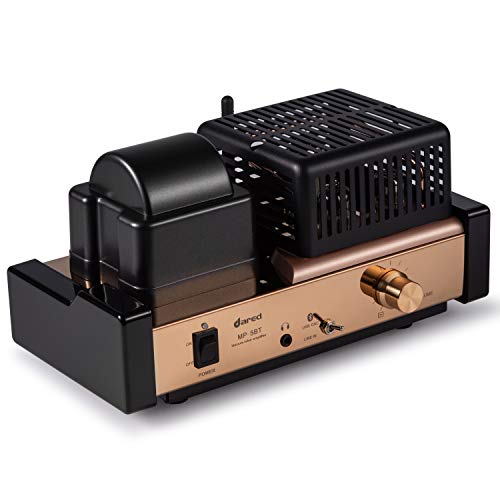
The Dared MP-5BT is the smallest and most visually distinctive hybrid in this guide, with a gold-plated stainless steel chassis flanked by thick lacquered wood side panels. It uses a 6N1 and 6N2 tube pair in the preamp stage and a 6E2 magic-eye tube for visual effect, feeding a solid-state Class AB output stage that delivers 25 watts per channel. The compact footprint makes it ideal for desktop systems where space is at a premium, and the included aptX Bluetooth module provides clean wireless streaming.
Owner feedback from long-time audiophiles indicates the MP-5BT outperforms expectations for its size. One 40-year enthusiast replaced a much more expensive Ayon Orion II with the Dared for a secondary system, reporting that the tonality and imaging were surprisingly engaging. The USB-DAC input works well for computer audio sources, and the 3.5mm headphone output is adequate for personal listening. Build quality receives consistent praise, with the internal layout described as hand-built and tidy.
The 25 watts per channel limit is real—this amplifier works best with efficient bookshelf speakers (88dB or higher sensitivity). A small minority of buyers report Bluetooth pairing issues or underpowered output with inefficient speakers. The wood side panels, while beautiful, require care to avoid scratches. The NewSong seller is recommended for customer support. If your priority is a desktop-sized hybrid with high-end aesthetics and you already own efficient speakers, the Dared MP-5BT is a compelling choice that feels more expensive than it is.
Why it’s great
- Beautiful gold chassis with lacquered wood panels offers high-end aesthetics
- aptX Bluetooth and USB-DAC input work reliably for desktop audio streaming
- Compact footprint fits easily on a desk or narrow shelf
Good to know
- 25W per channel limits speaker compatibility to efficient bookshelf designs
- Some owners report Bluetooth connectivity issues that require a restart
- Wood side panels are susceptible to scuffs and scratches with regular handling
6. Douk Audio F5 Pure Class A Vacuum Tube Amplifier

The Douk Audio F5 is a rare affordable pure Class A single-ended tube amplifier with no solid-state components in the signal path. It uses 6N1 and 6L6 tubes in a classic single-ended configuration, outputting approximately 3.2 watts per channel. This is not a typo—3.2 watts. The low power is the defining constraint of this amplifier, making it exclusively suitable for owners of high-efficiency speakers rated at 95dB sensitivity or higher. When matched correctly, the F5 delivers the hallmark single-ended sound: lush midrange, airy highs, and a sense of presence that hybrid designs cannot replicate.
The chassis is a heavy 14.5-pound aluminum block that provides excellent vibration damping. The pluggable tube socket design allows for easy tube rolling without soldering. Reviews from owners who have invested in tube upgrades—Tung-sol 6L6G and Gold Lion 12AX7, for example—describe a significantly opened-up soundstage with tighter bass and more refined high-frequency extension.
Several caveats apply: the metal chassis can produce a ringing sound that some owners dampen with silicone pads. The amplifier runs hot, requiring ventilation clearance. The low power means it will distort unpleasantly past moderate listening levels with anything less than very efficient speakers. One owner reported a catastrophic failure on first power-up. For the right buyer—one with sensitive speakers and a willingness to experiment with tube rolling and minor mods—the F5 offers the most authentic single-ended tube experience available at this price.
Why it’s great
- Genuine pure Class A single-ended tube circuit with no solid-state output stage
- Heavy 14.5 lb aluminum chassis provides excellent resonance control
- Pluggable tube sockets and easy-access layout simplify tube rolling and DIY mods
Good to know
- 3.2W output requires extremely efficient speakers (95dB+ sensitivity) to achieve satisfying volume
- Runs very hot and needs good ventilation; metal chassis may ring at certain frequencies
- Quality control reports are mixed—a small number of units have failed on first power-up
7. Rockville BluTube LED 70W Hybrid

The Rockville BluTube LED is the most visually dramatic entry in this roundup, with blue LED-illuminated tubes, blue-lit knobs, and a front-facing VU meter. Under the showmanship, this is a hybrid amplifier: a tube preamp stage using Chinese 6P15 and N1 tubes feeding a Class D or Class AB solid-state output stage rated at 25 watts per channel into 8 ohms and 35 watts into 4 ohms. The “70W” in the marketing is a peak figure, not continuous RMS. Understanding this distinction is essential for realistic expectations.
Input connectivity is generous for the price: Bluetooth, optical, coaxial, HDMI, USB for media files, and RCA inputs. The subwoofer output and headphone jack add further utility. Owner reports indicate that the amplifier benefits significantly from a 30-40 hour burn-in period, during which the sound opens up and the VU meter starts moving properly. The tube rolling community has identified the stock tubes as backward compatible with EL84 variants, allowing upgrades to Genalex 12AX7 and EL84 for a brighter, more linear presentation.
Build quality is the most significant compromise. The chassis uses a combination of metal and plastic components, and the hollow tower design has been described as “empty” by some owners. A small but notable number of reports cite units failing after 6-9 months of use, with the amplifier overheating and shutting down during normal listening sessions. If the visual appeal of blue-lit tubes is a high priority and you are comfortable with the risk of early failure, the BluTube offers a unique look at an entry-level price. Budget-conscious buyers should weigh the higher reliability of the Dayton or Dared alternatives.
Why it’s great
- Blue LED tube illumination and VU meter create a striking visual centerpiece for any system
- Wide input selection includes HDMI, optical, USB, and Bluetooth for maximum flexibility
- Tube rolling to EL84-compatible tubes is possible and improves sound quality
Good to know
- Reported reliability issues with some units failing after 6-9 months of moderate use
- Build quality mixes metal and plastic; the chassis feels less substantial than competitors
- “70W” marketing is peak power, not continuous RMS—real output is 25-35W per channel
8. Reisong A10 EL34 Single-Ended Class A Amplifier
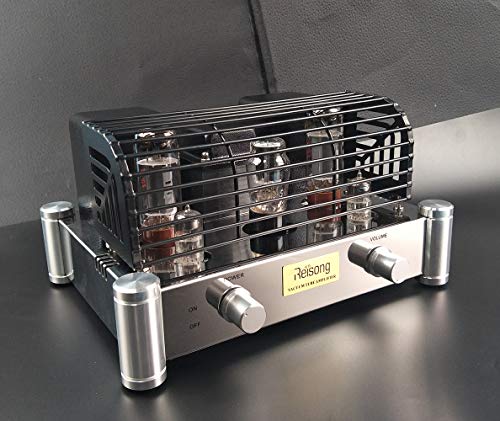
The Reisong A10 is a pure tube single-ended Class A amplifier using EL34 output tubes and 6N2J driver tubes, with a 5Z4PJ rectifier tube, wired with point-to-point hand-soldering. The manufacturer is upfront about the power limitation, explicitly recommending speakers with 89dB sensitivity or higher. This honesty is refreshing in a category where amplifiers are often oversold.
Build quality is a standout feature. The A10 uses a heavy 12-kilogram (26.4-pound) chassis with a stainless steel and aluminum construction that feels substantial. The point-to-point wiring, a construction method preferred by purists for its signal integrity and ease of repair, is clearly visible through the ventilation slots. Owner reports consistently mention superb packaging and a “top-shelf” build feel. The sound signature is described as warm, spacious, and “alive,” with a natural soundstage that excels with acoustic jazz and vocal recordings.
Several owners have documented tube rolling experiments, with the Gold Lion KT77 and Voskhod 6N2P combination being a favorite upgrade. A common mod involves changing a cathode resistor to reduce distortion and clean up the sound. The amplifier’s 12-watt limitation is real—it will run out of headroom quickly with low-sensitivity speakers or at party volumes. A small number of units have arrived with defective tubes or loose power switches, though the seller has generally provided quick replacements. For the purist who values point-to-point construction, EL34 output tubes, and genuine single-ended circuit design, the A10 represents a strong value.
Why it’s great
- Genuine point-to-point hand-wiring with EL34 tubes offers classic single-ended tube sound
- Exceptional build quality with a 26.4 lb chassis, stainless steel, and aluminum construction
- Tube rolling and minor modding are well-documented by the owner community
Good to know
- 12W output limits speaker compatibility strictly to efficient bookshelf designs (89dB+)
- Some units arrive with defective tubes or loose hardware, though seller support is responsive
- Stock capacitors and cathode resistors benefit from DIY upgrades for cleaner sound
9. Monoprice Stage Right 1×8 Guitar Combo Tube Amplifier

The Monoprice Stage Right 611705 is the only dedicated guitar amplifier in this guide, included because it represents the most affordable entry point into all-tube amplification for electric guitar players. It uses a 12AX7 preamp tube and a 6V6GT power tube in a 5-watt combo configuration, with the Celestion Super 8 GBA-15 speaker. The 1-watt and 5-watt switchable output lets players dial in power tube breakup at manageable volumes—the 1-watt setting is genuinely bedroom-friendly while the 5-watt setting can keep up with a drummer in a small rehearsal room.
Owner feedback highlights two distinct paths: players who replace the stock speaker report a dramatic improvement in tone, often describing the result as “chimey” and “boutique-like.” The Celestion Eight 15 upgrade is a popular and inexpensive mod. Players who run the amp through a larger external cabinet—a 2×12 or 4×12—report that the 5-watt headroom surprises them, producing a rich overdrive that sounds far larger than the physical size suggests. The low and high input jacks offer useful gain staging flexibility: the low input attenuates the signal by roughly 50% for cleaner pickups, while the high input is easier to overdrive.
The build quality is solid for the price bracket, with a wood enclosure and a durable tolex covering. Some minor quality control issues have been reported, including protruding screws and untrimmed tolex edges. The hardwired 3-foot power cord is a minor inconvenience for pedalboard setups. The external speaker output is a genuine bonus for players who want to use the Monoprice as a head. For a beginner seeking their first all-tube amp, or for a seasoned player wanting a low-wattage recording tool, the Monoprice Stage Right delivers authentic tube tone at an entry-level cost that is difficult to beat.
Why it’s great
- Genuine all-tube circuit with 12AX7 preamp and 6V6GT power tube at an entry-level price
- Switchable 1W/5W output allows power tube breakup at home-friendly volumes
- External speaker output and Celestion speaker make it versatile for practice and recording
Good to know
- Stock 8″ speaker sounds thin and bright; a speaker upgrade is almost essential for good tone
- Chassis removal for speaker replacement is difficult due to tolex bonding
- Minor fit-and-finish issues like sharp screws and untrimmed tolex are common
FAQ
Can a 5-watt tube amplifier really fill a room with sound?
Is a hybrid tube amplifier a waste of money compared to a pure tube design?
What does tube rolling mean and should I do it?
Do I need a separate phono preamp for my turntable with these amplifiers?
Final Thoughts: The Verdict
For most users seeking true tube character with balanced connectivity, the best affordable tube amplifier winner is the AIYIMA T20 because its 180V plate voltage, balanced XLR outputs, and op-amp/tube swappability provide the most authentic and customizable tube preamp experience at a price that undercuts the competition. If you want a complete integrated hybrid amplifier with phono input and enough power for standard speakers, grab the Dayton Audio HTA100. And for the pure single-ended tube sound with EL34 output tubes and point-to-point construction, nothing beats the Reisong A10 for its build quality and classic circuit design.