
Our readers keep the lights on and the weekend projects moving. As an Amazon Associate, I earn from qualifying purchases.
Shaky footage, grainy low-light images, and a confusing mix of specs can turn the dream of starting a YouTube channel into a frustrating money pit. The right camera lets you focus on storytelling, not fighting with gear. The choice comes down to sensor size, stabilization type, and whether you need interchangeable lenses for creative flexibility or a pocket gimbal for run-and-gun efficiency.
I’m Rikta — the co-founder and writer behind FitlyFast. I’ve spent hundreds of hours studying market trends, analyzing sensor technology, and cross-referencing customer feedback on mirrorless and compact video cameras to help you cut through the noise and find the tool that actually fits your workflow.
Whether you are filming sit-down tutorials or active day-in-the-life vlogs, this guide breaks down the specs and real-world performance of the best affordable video camera for youtube on the current market.
How To Choose The Best Affordable Video Camera For YouTube
Starting your search without a clear priority list can lead to overspending on features you don’t need or missing the one spec that actually matters for your content style. Focus on the three factors that define YouTube video quality: sensor performance, stabilization hardware, and autofocus reliability.
Sensor Size and Low-Light Capability
For YouTube, a 1-inch CMOS sensor is the baseline for clean, detailed footage in well-lit indoor or outdoor settings. APS-C sensors found in mirrorless cameras like the Canon EOS R100 or Sony a6400 offer significantly better dynamic range and noise control when filming in dim interiors or during golden hour. Full-frame options deliver the best shallow depth of field but come with a higher price tag and larger lens systems. If you film mostly at home with controlled lighting, a 1-inch sensor is perfectly sufficient.
Stabilization — Gimbal vs. Digital vs. In-Body
Handheld walking footage is the biggest killer of vlog quality. Optical gimbal stabilization, as seen in the DJI Osmo Pocket 3 and Xtra Muse, physically counteracts movement to deliver smooth footage without cropping the frame. Digital stabilization crops the image and can introduce jello-like warping in fast movement. In-body image stabilization (IBIS) found in some mirrorless bodies helps but rarely matches the butter-smooth results of a dedicated gimbal system for active shooting.
Autofocus and Subject Tracking
When you’re talking to the camera alone, reliable face and eye detection autofocus is non-negotiable. Sony’s Real-time Eye AF and Canon’s Dual Pixel CMOS AF are industry leaders, locking onto your face even as you move around the frame. Cameras with basic contrast-detect AF will hunt and pulse in and out of focus, ruining otherwise usable takes. Make sure your chosen camera has phase-detection or hybrid autofocus with subject tracking for self-recording.
Quick Comparison
On smaller screens, swipe sideways to see the full table.
| Model | Category | Best For | Key Spec | Amazon |
|---|---|---|---|---|
| DJI Osmo Pocket 3 | Pocket Gimbal | Walking vlogs & travel | 1-inch CMOS, 3-axis gimbal | Amazon |
| Xtra Muse Pocket Gimbal | Pocket Gimbal | Budget vlog stabilization | 1-inch CMOS, 3-axis gimbal | Amazon |
| Insta360 Luna Ultra | Pocket Gimbal | 8K cinematic vlogging | Dual Leica lenses, detachable screen | Amazon |
| Sony ZV-1 | Compact Point-and-Shoot | Product showcase & sit-down videos | 1-inch Exmor RS, 24-70mm F1.8-2.8 | Amazon |
| Sony ZV-1F | Compact Point-and-Shoot | Ultra-wide selfie vlogging | 1-inch sensor, 20mm F2 lens | Amazon |
| Sony a6400 | Mirrorless Interchangeable | Fast-action & sharp tracking | APS-C 24.2MP, 0.02 sec AF | Amazon |
| Canon EOS R100 (Kit) | Mirrorless Interchangeable | Entry-level interchangeable lens | APS-C 24.1MP, 4K/24p | Amazon |
| Canon EOS R100 Bundle | Mirrorless Bundle | Beginner with accessories | APS-C 24.1MP, 4K/24p | Amazon |
| Canon EOS 2000D / Rebel T7 | DSLR Entry | Budget stills with video | APS-C 24.1MP, 1080/30p | Amazon |
| Canon EOS RP | Full-Frame Mirrorless | Full-frame cinematic look | Full-frame 26.2MP, 4K/24p | Amazon |
| Nikon Z50 II | Mirrorless Two-Lens Kit | Dual-lens travel versatility | APS-C 20.9MP, 4K/60p | Amazon |
In‑Depth Reviews
1. DJI Osmo Pocket 3
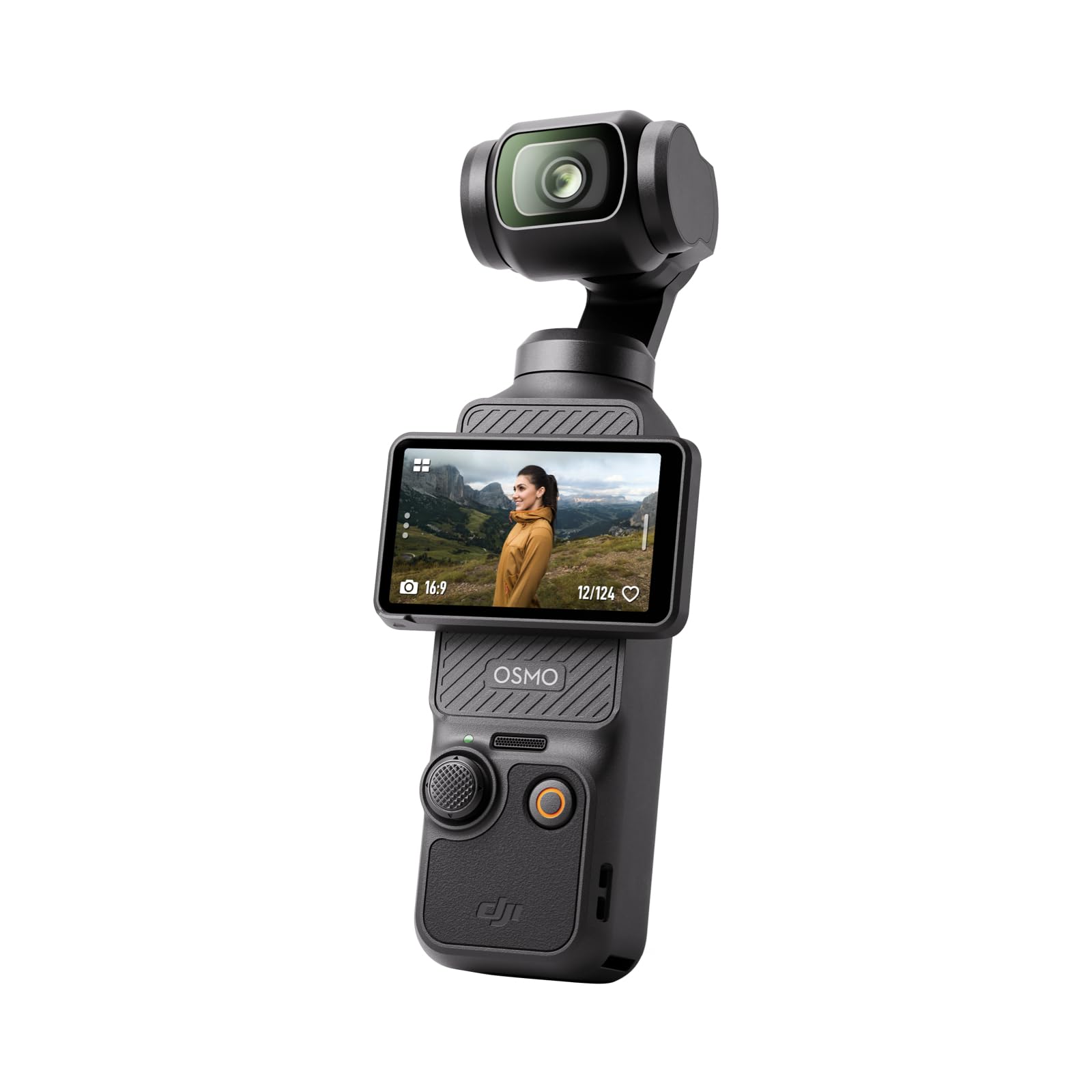
The Osmo Pocket 3 sets the gold standard for pocket-sized vlog cameras with its 1-inch CMOS sensor and rock-solid 3-axis mechanical gimbal. No digital cropping, no micro-shakes — pure smooth 4K/120fps footage that rivals cameras twice its size. The rotating 2-inch touchscreen makes framing effortless whether you shoot in horizontal or portrait orientation, and the ActiveTrack 6.0 keeps you center-frame even during fast movement.
Audio quality gets a major upgrade with DJI’s OsmoAudio feature, allowing direct connection to two DJI Mic 2 transmitters for wireless, interference-free sound. The D-Log M color profile and 10-bit depth give you room to grade footage in post without banding, which is a rare find in this price tier. Battery life clocks in around 166 minutes of continuous recording, and USB PD fast charging gets you back filming quickly.
Some reviewers note the battery is only 1300 mAh, so shooting in 4K will drain faster than 1080p, but the fast charging makes it manageable. The protective cover and 1/4-inch threaded handle are included, though the battery charger is sold separately. For vloggers who want gimbal-smooth footage without the bulk of a separate gimbal rig, this is the benchmark.
Why it’s great
- Outstanding 3-axis mechanical stabilization for shake-free walking footage
- 4K/120fps with 10-bit D-Log M for professional color grading flexibility
- Rotating touchscreen enables seamless switching between landscape and portrait
- Captures excellent detail and dynamic range for its compact size
Good to know
- Battery life varies significantly between 1080p and 4K shooting modes
- Battery charger is not included in the box
- Pricier than entry-level fixed-lens alternatives
2. Xtra Muse Vlogging Camera

The Xtra Muse delivers a 1-inch CMOS sensor with 4K/120fps recording and a fully integrated 3-axis gimbal stabilizer at a price point that undercuts premium competitors. The built-in gimbal eliminates the need for an external stabilization rig, making it ideal for content creators who want smooth walking shots without the added bulk and cost of a separate gimbal setup.
Face and object tracking work reliably in bright conditions, and the touchscreen interface is intuitive enough for beginners to pick up quickly. The X-Log 10-bit color mode allows for decent color grading in post, and the inclusion of a carrying bag, wrist strap, and 1/4-inch threaded handle makes the bundle ready to shoot out of the box.
Reviewers note the battery lasts roughly two hours in mixed use, which matches the mid-range territory, and the camera can be extended via an external USB battery for longer sessions. The overall build quality feels solid for its price class, though the included carrying accessories are functional rather than premium. It’s a strong middle-ground option for those who want gimbal stability on a tighter budget.
Why it’s great
- Built-in 3-axis gimbal stabilizer eliminates external rig requirements
- 4K/120fps from a 1-inch CMOS sensor delivers sharp, detailed video
- 10-bit X-Log color profile enables post-production flexibility
- Complete bundle includes carrying bag, handle, and essential accessories
Good to know
- Battery life averages around 2 hours in real-world vlogging conditions
- Face tracking performance can struggle in extremely low-light scenarios
- Build quality feels functional rather than premium compared to market leaders
3. Insta360 Luna Ultra
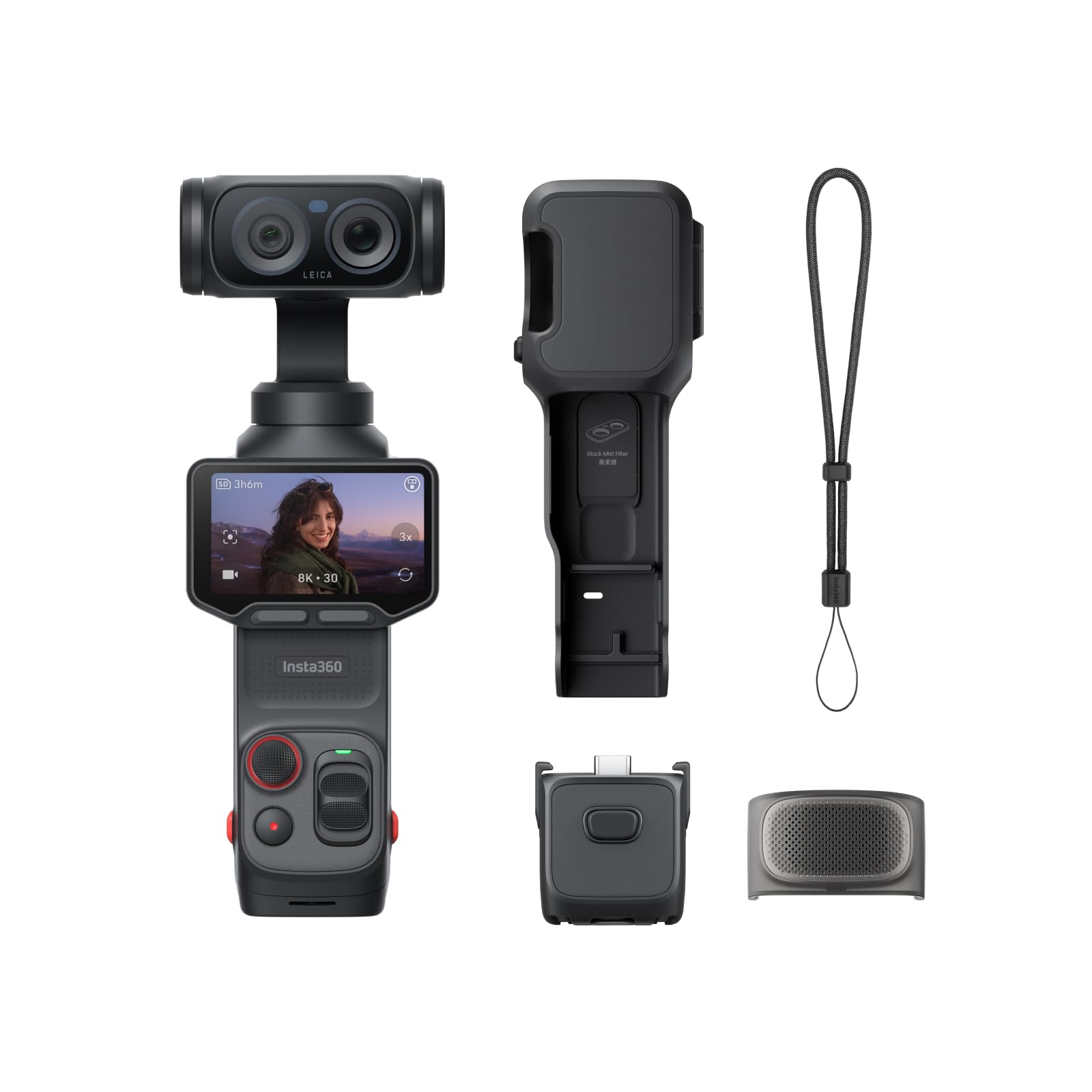
The Insta360 Luna Ultra pushes the boundaries of pocket camera specs with dual Leica lenses, an 8K Dolby Vision recording mode, and a detachable 2-inch OLED touchscreen. The primary 1-inch sensor handles general shots, while the telephoto lens with a 1/1.3-inch sensor provides up to 6x lossless zoom with natural optical bokeh, making it a genuine alternative to larger mirrorless rigs for narrative YouTube content.
The detachable screen is a standout feature for solo creators — you can place the camera on a tripod and walk up to 20 meters away while maintaining full control over framing and settings. The 14-stop dynamic range and 10-bit I-Log color space deliver impressive latitude for color grading, and the AI noise reduction in PureVideo mode produces clean 4K/60fps footage in low-light conditions.
Some early adopters report firmware glitches related to the detachable screen’s contact pins and occasional black-screen lockups, though these appear to be isolated cases. The battery life claims of up to 4 hours are realistic at lower resolutions, and the fast charging to 80 percent in 23 minutes is genuinely useful for all-day shoots. It’s a premium tool for creators who want maximum cinematic capability in a portable package.
Why it’s great
- Dual Leica optical system with 6x lossless zoom and natural bokeh
- 8K Dolby Vision recording with 14 stops of dynamic range
- Detachable 2-inch OLED touchscreen for remote solo shooting up to 20 meters
- Exceptional low-light performance with AI-driven PureVideo mode
Good to know
- Some users report firmware glitches with the detachable screen contacts
- Premium pricing positions it as a significant investment for most creators
- Micro SD storage requirement adds to overall cost
4. Sony ZV-1

The Sony ZV-1 is purpose-built for the sit-down YouTube creator, featuring a 20.1MP 1-inch stacked Exmor RS CMOS sensor paired with a fast ZEISS Vario-Sonnar T lens (24-70mm equivalent, F1.8-2.8). The large aperture delivers genuine background defocus for a professional look, and the Product Showcase Setting smoothly transitions focus from your face to an object held up to the lens — a killer feature for tech reviewers and cooking channels.
The side-flip 3-inch LCD screen works well for self-recording, and the forward-directional 3-capsule microphone with the included windscreen captures clean sound without an external mic in quiet environments. The Hybrid Log-Gamma (HLG) and S-Log profiles give video editors room to work with color in post, and the Real-time Eye AF is sticky enough for moving presenters.
Battery life is the primary frustration, with most reviewers reporting around 45 minutes to two hours of actual recording time, depending on settings. A dummy battery solution or spare batteries are strongly recommended for longer shoots. The camera also lacks a built-in EVF and has no lens interchangeability, so you are locked into the zoom range. For focused video-first production, it remains a top compact performer.
Why it’s great
- Fast F1.8-2.8 ZEISS lens creates beautiful background blur effortlessly
- Product showcase mode transitions focus from face to object seamlessly
- Excellent Real-time Eye AF locks onto subjects reliably during movement
- Built-in directional mic captures usable audio with included windscreen
Good to know
- Battery life is limited — expect around 45 minutes to 2 hours of record time
- Fixed lens eliminates the option for interchangeable glass upgrades
- Can overheat during extended 4K recording sessions in warm environments
5. Sony ZV-1F

The Sony ZV-1F is the most accessible entry in Sony’s vlogging line, built around a 20mm ultra-wide lens and a 1-inch sensor with an F2 maximum aperture. The ultra-wide focal length is a deliberate choice — it keeps you and your background in frame even at arm’s length, making it ideal for walking selfies and scenery shots. The side-articulating touchscreen is bright and responsive, and the 3-capsule directional mic with the included windscreen produces noticeably clear vocals for a built-in solution.
The camera inherits Sony’s excellent Eye AF and autofocus tracking technology, which performs reliably in good light. The product showcase mode focuses on objects held close to the lens, and the background defocus button gives instant shallow depth of field with one press. The ZV-1F is also extremely lightweight at roughly 8.0 ounces, reducing arm fatigue during extended handheld shooting.
The most common criticism is battery life, with many users reporting approximately 45 minutes of continuous recording. The fixed 20mm lens also means you have zero zoom flexibility — you must physically move closer or crop in post. The lack of a flash limits flexibility in complete darkness, but for bright indoor or daytime outdoor vlogging, the ZV-1F delivers sharp, colorful footage with minimal effort.
Why it’s great
- Ultra-wide 20mm F2 lens keeps you and surroundings in the frame easily
- Extremely lightweight design reduces fatigue during handheld vlogging
- Directional 3-capsule mic with windscreen delivers clear vocal recording
- Simple interface with background defocus button for instant shallow depth of field
Good to know
- Battery life is very limited — expect less than an hour of continuous recording
- Fixed wide-angle lens offers no optical zoom capability
- Camera is fragile; even minor drops can potentially damage autofocus system
6. Sony a6400

The Sony a6400 is a mirrorless workhorse that prioritizes autofocus speed above all else. The 24.2MP APS-C Exmor sensor with a front-end LSI achieves a 0.02-second phase-detect autofocus lock time, giving you near-instant focus acquisition that competes with cameras costing significantly more. The Real-time Eye AF tracks human and animal eyes with high precision, making it an excellent choice for YouTube channels with active on-camera movement or pet content.
Video quality is strong with 4K oversampled from the full sensor width, delivering sharp, fine-grained detail without pixel binning. The 180-degree tiltable 3-inch touchscreen flips up for self-recording, though it can be blocked by the hotshoe-mounted mic — a common workaround is to use a side-mounted cold shoe adapter. The E PZ 16-50mm OSS II kit lens provides optical stabilization and a usable zoom range for general vlogging.
The main trade-off is battery life, with reviewers recommending multiple spare batteries for video-heavy shoots. The menu system is Sony’s older interface, which can be less intuitive for beginners compared to Canon’s touch-focused GUI. If continuous tracking speed and APS-C sensor quality are your priorities, the a6400 delivers exceptional value for its price tier.
Why it’s great
- Industry-leading 0.02 second autofocus with built-in eye detection tracking
- APS-C sensor provides excellent dynamic range and low noise at higher ISO
- 4K oversampled from full sensor width for sharp, detailed footage
- Compact body with a wide range of compatible E-mount lenses
Good to know
- Battery life is moderate — multiple spare batteries recommended for video days
- Menu system uses the older Sony interface which takes time to learn
- Flip-up screen can be partially obstructed by hotshoe-mounted accessories
7. Canon EOS R100 Mirrorless Kit

The Canon EOS R100 is the lightest and most affordable body in the EOS R series, combining a 24.1MP APS-C CMOS sensor with the DIGIC 8 processor and Canon’s Dual Pixel CMOS AF with face and eye detection. The RF-S 18-45mm F4.5-6.3 kit lens is compact and portable, making the entire package easy to slip into a small bag for everyday carry. The body weighs roughly 11.5 ounces (without lens), reducing neck strain during long shoots.
Video capability includes 4K recording at up to 24fps and 1080p at 120fps for slow-motion b-roll. The autofocus system covers 143 zones and supports animal and vehicle detect AF in addition to human eye detection. The variable-angle touchscreen is not included — the fixed 3-inch LCD is adequate but limits flexibility for self-recording. For studio-style sit-down content, this is less of an issue, but vloggers who film themselves will find the fixed screen restrictive.
The DIGIC 8 processor is an older generation, so you get 4K at 24fps rather than 30fps or 60fps, which can feel dated for fast-moving subjects. The menu system is beginner-friendly, and the wireless photo transfer via Canon’s app works seamlessly. This body is best suited to beginner photography-focused creators who plan to shoot occasional YouTube videos rather than heavy vloggers needing 4K/60fps and a flip-out screen.
Why it’s great
- Compact and lightweight APS-C mirrorless body ideal for portable carry
- Dual Pixel CMOS AF with face, eye, animal, and vehicle detect AF
- Access to Canon’s growing RF lens ecosystem for future upgrades
- Beginner-friendly menu system with wireless smartphone image transfer
Good to know
- 4K video is limited to 24fps, which can cause motion judder in fast scenes
- Fixed 3-inch LCD screen does not articulate for self-recording vlogging
- Battery charger is not included with the camera kit
8. Canon EOS R100 Bundle
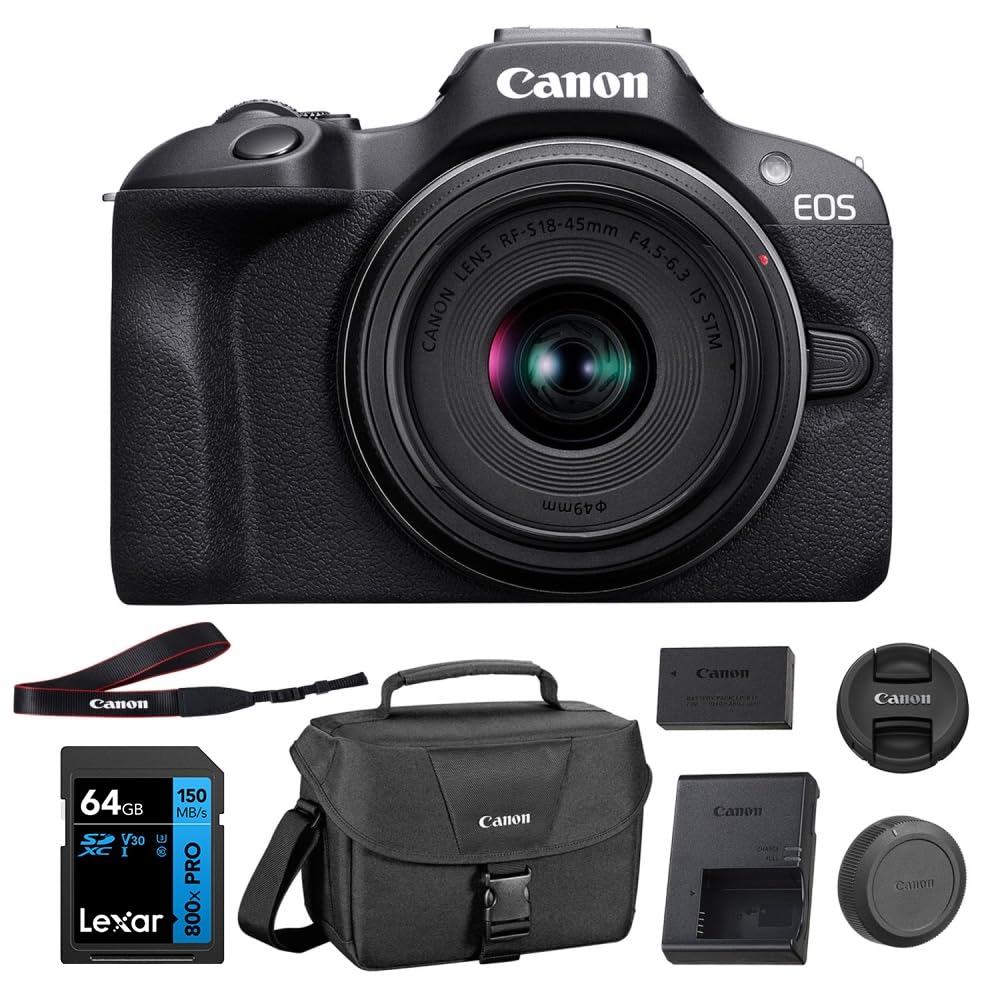
This bundle version of the Canon EOS R100 adds a Lexar 64GB UHS-I SD memory card and a Canon EOS 200ES shoulder bag to the standard body-and-lens kit. The inclusion of the bag and card means you can start shooting immediately without any separate accessory purchases — a convenience that appeals to parents buying for students or absolute beginners looking for an all-in-one photography starter kit.
The camera performance is identical to the standard R100 kit: the 24.1MP APS-C sensor, DIGIC 8 processor, 4K/24fps video, and Dual Pixel AF with eye detection. Both the standard kit and this bundled version share the same fixed 3-inch LCD screen, which does not tilt or flip for self-recording. The RF-S 18-45mm lens offers 4 stops of optical image stabilization, reducing shake during handheld stills.
User feedback consistently praises the camera as a great beginner-first camera for photography classes or teenagers learning the craft. The shoulder bag provides basic protection but is not heavily padded, so it works best for casual day trips rather than rugged travel. If the priority is a ready-to-shoot photography package with YouTube video as an occasional extra, this bundle delivers solid value.
Why it’s great
- All-in-one bundle includes 64GB SD card and shoulder bag for immediate use
- Excellent still image quality from the 24.1MP APS-C sensor and DIGIC 8 processor
- Optical IS in the kit lens provides up to 4 stops of shake reduction for photos
- Simple, intuitive controls suitable for students and family photography
Good to know
- Same fixed 3-inch LCD as standalone — unsuitable for self-recording vloggers
- 4K video maxes out at 24fps, limiting smoothness for action content
- Included shoulder bag offers basic protection, not heavy-duty padding
9. Canon EOS 2000D / Rebel T7

The Canon EOS 2000D (Rebel T7 in North America) is an entry-level DSLR that has been a staple for beginner photographers for years. The 24.1MP APS-C CMOS sensor with the DIGIC 4+ image processor delivers competent stills, but the video specs are strictly entry-level: Full HD 1080p at 30fps with no 4K option. The 9-point phase-detect autofocus system feels dated compared to modern mirrorless AF, and continuous shooting tops out at 3 fps.
This essential bundle packages the camera body with the EF-S 18-55mm F3.5-5.6 zoom lens, a 64GB memory card, an LED video light, a Gripster tripod, and a carrying case. For someone learning the fundamentals of photography and needing basic video capability for YouTube, the bundle provides everything needed to start without additional purchases. The optical viewfinder offers a traditional shooting experience that some still prefer over electronic viewfinders.
The renewed nature of this product means it has been inspected and tested, with most reviewers reporting units in excellent condition. The lack of 4K video is the biggest limitation for YouTube creators, as 1080p footage cropped to a 16:9 frame can look soft compared to modern standards. This camera is best suited to budget-conscious beginners who prioritize learning still photography over high-resolution video production.
Why it’s great
- Complete camera kit with lens, memory card, tripod, and LED light included
- Optical viewfinder provides a traditional, responsive shooting experience
- 24.1MP APS-C sensor delivers competent still image quality
- Renewed units offer significant savings with most arriving in excellent condition
Good to know
- Video is limited to Full HD 1080p at 30fps — no 4K recording available
- 9-point AF system is basic and lacks eye tracking or subject detection
- DIGIC 4+ processor shows its age with slower burst rates and older menus
10. Canon EOS RP

The Canon EOS RP is the most affordable path into full-frame mirrorless photography and video, featuring a 26.2MP full-frame CMOS sensor and the DIGIC 8 processor. The RF 24-105mm F4-7.1 IS STM kit lens provides a versatile zoom range with 5 stops of optical image stabilization, allowing clean handheld footage in moderate light. The full-frame sensor delivers the shallow depth of field and low-light performance that APS-C cameras at this price cannot match.
Video capabilities include 4K recording at 24fps (with a 1.6x crop factor), Full HD at 60fps, and a clean HDMI output for external recording. The Dual Pixel CMOS AF works well for sit-down content, though it can struggle in very low light scenes. The body is compact for a full-frame camera at roughly 1.01 pounds, and the RF mount offers compatibility with Canon’s expanding lens lineup plus older EF lenses via an adapter.
The main video limitation is the 4K crop factor, which means your field of view narrows significantly, making wide-angle self-recording challenging without a very wide lens. The battery life is decent for stills but expect to carry spares for extended video work. Reviewers upgrading from older Canon DSLRs like the T3i or T7 consistently report a huge leap in image quality and AF performance, making this a strong upgrade path for photo-focused creators.
Why it’s great
- Full-frame sensor provides superior depth of field and low-light performance
- RF 24-105mm kit lens includes 5 stops of optical image stabilization
- Clean HDMI output allows for external recording with professional monitors
- Relatively lightweight for a full-frame body, improving travel usability
Good to know
- 4K video has a 1.6x crop factor, reducing wide-angle field of view
- Autofocus can hunt in extremely dim environments
- Kit lens is sharp in the center but soft at the edges above f/8
11. Nikon Z50 II

The Nikon Z50 II is a compact APS-C mirrorless camera that arrives with two lenses: the NIKKOR Z DX 16-50mm f/3.5-6.3 VR and the NIKKOR Z DX 50-250mm f/4.5-6.3 VR, covering a versatile 16-250mm focal range. The 20.9MP DX-format CMOS sensor is several times larger than a typical smartphone sensor, capturing lifelike color and detail from dawn to dusk. The Picture Control button gives instant access to 31 built-in presets, allowing you to apply distinct looks in-camera without post-processing.
Video features include 4K UHD 60p recording, in-camera Full HD 120fps slow-motion, built-in electronic VR stabilization, and a product review mode for focusing on objects held to the lens. The autofocus system automatically detects and tracks nine distinct subjects — people, dogs, cats, birds, and vehicles — with dedicated bird and airplane modes for greater accuracy. The Nikon SnapBridge app enables wireless photo and video transfer to your smartphone in seconds.
The kit’s two-lens setup provides significant reach for different shooting scenarios without needing additional purchases. The electronic viewfinder is responsive and clear, and the body is light enough to carry on extended trips. Reviewers note that the menu system has a learning curve, and the camera is more photography-focused than video-focused, despite its capable video specs. For creators who want a do-everything travel kit with strong photo capability and solid 4K/60p video, the Z50 II is a compelling package.
Why it’s great
- Two included lenses (16-50mm VR and 50-250mm VR) cover wide to telephoto
- 31 in-camera Picture Control presets for instant aesthetic customization
- 4K/60p video with 120fps slow-motion and electronic VR stabilization
- Reliable subject detection AF for people, animals, and vehicles
Good to know
- Menu system has a learning curve, especially for first-time mirrorless users
- Camera is more optimized for still photography than dedicated video work
- Two-lens kit adds bulk compared to all-in-one compact zoom solutions
FAQ
Do I need a camera with a 1-inch sensor for YouTube, or is a smartphone enough?
What is the minimum 4K frame rate I should accept for YouTube vlogging?
How important is a flip-out screen for self-recording?
Why do some mirrorless cameras have 4K crop and others do not?
Final Thoughts: The Verdict
For most users, the affordable video camera for youtube winner is the DJI Osmo Pocket 3 because its 1-inch sensor and 3-axis mechanical gimbal deliver gimbal-smooth footage without any post-processing or external rig, all in a pocketable form factor that works for both sit-down and walking content. If you want interchangeable lenses and fast autofocus for a more traditional shooting experience, grab the Sony a6400. And for the ultimate cinematic capability in a compact body, nothing beats the Insta360 Luna Ultra with its dual Leica lenses and 8K Dolby Vision recording.