
Our readers keep the lights on and the weekend projects moving. As an Amazon Associate, I earn from qualifying purchases.
Choosing the right water filter pitcher means balancing flow rate, certified contaminant reduction, and a fridge-friendly footprint. The “affordable” tag covers a wide range, from slim countertop models to electric dispensers, each built around a different filtration philosophy.
I’m Rikta — the founder and writer behind FitlyFast. I spend my weeks dissecting water filter specs from NSF certification sheets, real-customer TDS readings, and filter lifespan data to separate marketing claims from measurable performance.
This guide compares seven models head-to-head using third-party certifications, real-world gallon ratings, and pitch-by-pitch differences in how they handle chlorine, lead, and PFAS. The goal is to help you find the best affordable water filter pitcher that matches your tap chemistry and fridge dimensions without overpaying.
How To Choose The Best Affordable Water Filter Pitcher
Not all water filter pitchers are created equal—a low upfront price often masks higher long-term filter costs or weaker contaminant reduction. Understanding three key factors will help you pick a model that actually fits your tap water chemistry and daily usage.
Certification Priority: NSF 42 vs. NSF 53 vs. NSF 401
NSF 42 covers aesthetic improvements like chlorine taste and odor — the baseline for any respectable pitcher. NSF 53 adds health-related contaminant reduction for lead, mercury, and cysts. NSF 401 targets emerging contaminants like pharmaceuticals and PFOA/PFOS. For most municipal tap water, a model certified to at least NSF 42 and 53 offers the best balance of safety and flavor. Skipping certification verification can leave you with a pitcher that only masks taste without actually reducing harmful substances.
Filter Lifespan and Replacement Cost
A cheap pitcher becomes expensive if you replace filters every two weeks. Standard filters typically last 40 gallons or 2 months. Longer-life filters (up to 200 gallons or 6 months) reduce annual costs but require a higher initial investment. Calculate your household’s water consumption: a 3-person household using 2 gallons per day for drinking and cooking burns through a 40-gallon filter in about three weeks. In that scenario, a 200-gallon filter pays for itself within four months.
Fridge Dimensions and Pour Geometry
Most pitchers list a height between 9.5 and 10.5 inches, but your fridge’s shelf clearance and door bin depth vary widely. A model that’s 9.84 inches tall may fit a standard shelf but top out against a 10-inch bin. Measure your fridge’s usable space — including the lip of the shelf — before committing. Also consider pour spout design: a long, angled spout prevents drips down the side of the pitcher, while a short spout requires tilting the pitcher more aggressively, which can spill unfiltered water from the reservoir into the finished water.
Quick Comparison
On smaller screens, swipe sideways to see the full table.
| Model | Category | Best For | Key Spec | Amazon |
|---|---|---|---|---|
| Hydros 40 oz Slim | Mid-Range | Travel & tight fridge spaces | 40-sec fill time | Amazon |
| Culligan ZeroWater 10-Cup | Premium | Removing dissolved solids & PFAS | TDS meter & 5-stage filter | Amazon |
| Brita Standard Filter (6-pack) | Refill | Budget refills for existing Brita pitchers | 40-gallon / 2-month life | Amazon |
| Brita Everyday 10-Cup | Mid-Range | Daily household use, coffee makers | 10-cup / 40-gal filter | Amazon |
| AQUAPHOR Opal 12 Cup | Premium | Families wanting a glass-like look | 12-cup / B15 filter | Amazon |
| PUR 7-Cup PPT710BA | Mid-Range | Small households & RV use | Filter indicator light | Amazon |
| Waterdrop ED02W | Premium | On-demand electric dispensing | 200-gal / 30-day battery | Amazon |
In‑Depth Reviews
1. AQUAPHOR 12 Cup Opal Water Filter Pitcher
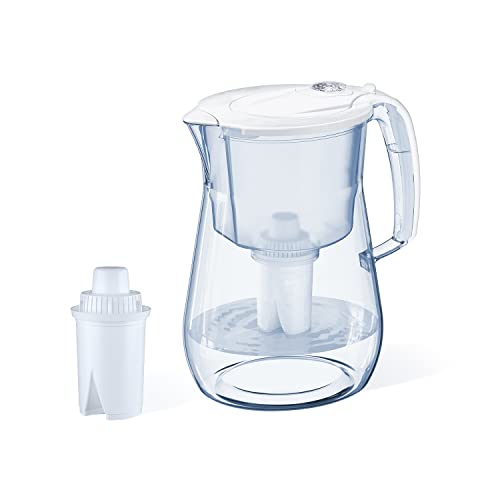
The AQUAPHOR Opal delivers a 12-cup capacity in a fridge-friendly 9.84-inch height, with a B15 filter that reduces chlorine taste, odor, and heavy metals. Users consistently praise the fast flow rate, with several noting it fills faster than comparable Brita models. The unbreakable, glass-like body looks premium on the counter while remaining lightweight enough for everyday lifting.
The B15 filter uses AQUAPHOR’s proprietary Aqualene fiber, which provides a larger surface area than standard granular carbon blocks. This translates to a more consistent flow rate over the filter’s lifespan — something the Brita standard filter loses after the first few gallons. The printed manufacturing date on the filter ensures you know exactly how fresh the media is before installation.
The secure lid and curved ergonomic handle make one-handed pouring spill-free. The filter change indicator is a simple mechanical timer, not a battery-powered meter, so there are no corroded contacts to worry about. Some users found the lid difficult to snap on when wet, but that’s a minor tradeoff for the overall build quality and filtration speed.
Why it’s great
- Fast flow rate beats most mid-range pitchers
- Dishwasher-safe body for easy cleaning
- Unbreakable, glass-like appearance
Good to know
- Lid can be tricky to seat when wet
- 12-cup capacity makes the full pitcher heavy for some seniors
2. PUR 7-Cup Water Filter Pitcher PPT710BA

The PUR PPT710BA is a 7-cup slim pitcher that fits RV fridges and compact apartment shelves without sacrificing filtration power. Its 3-in-1 filter is NSF certified to reduce microplastics, chlorine, lead, and mercury — a broader contaminant range than the standard Brita filter. The filter indicator light is battery-powered and provides a clear visual cue when replacement is due, removing the guesswork from filter maintenance.
Users highlight the stay-tight lid design that allows one-handed pouring without the top popping off, a common complaint with older pitcher models. The space-saving footprint measures just 4.5 inches wide, making it one of the narrowest certified pitchers on the market. The 7-cup capacity is ideal for 1-2 person households, though heavy users may find themselves refilling the reservoir more frequently than with a 10-cup model.
The genuine PUR filter is not compatible with other brands, so you’re locked into the PUR filter ecosystem. Replacement filters cost slightly more per gallon than Brita’s standard option but provide a more thorough reduction profile. A few users noted slower flow rates compared to the AQUAPHOR, but the NSF certification on microplastics makes it a strong choice for those concerned about microplastic ingestion.
Why it’s great
- NSF certified to reduce microplastics
- Stay-tight lid prevents spills during pouring
- Very narrow footprint for tight fridge spaces
Good to know
- Filter indicator requires battery replacement
- 7-cup capacity may require multiple refills for larger households
3. Waterdrop ED02W Compact Electric Water Filter Pitcher

The Waterdrop ED02W breaks the traditional pitcher mold with a rechargeable electric pump that dispenses filtered water at the touch of a button. It holds 14 cups of filtered water — the largest capacity in this guide — and uses a carbon block filter certified under NSF 42, 53, 401, and 372 to reduce over 45 substances including chlorine, lead, mercury, benzene, PFOA, and PFOS. The filter lasts 200 gallons or 3 months, drastically reducing annual replacement costs compared to standard 40-gallon filters.
The 30-day battery life on a single USB-C charge makes it truly portable for camping, RVs, or desk use. Users report the on-demand dispensing eliminates the wait time associated with gravity-fed pitchers, and the one-key control is intuitive for all ages. The unit does not reduce TDS — Waterdrop explicitly states this — so if you want mineral-stripped water similar to ZeroWater, this is not the model for you.
Some users noted that the initial flush produces black carbon fines, which is normal for any new carbon block filter. The compact 10.6 x 4.6 x 10.2-inch footprint fits most fridge shelves and standard countertops. The only real downside is the price premium over gravity pitchers, but the convenience factor and long filter life offset the upfront cost for frequent water drinkers.
Why it’s great
- 200-gallon filter lasts 3 months, reducing annual filter costs
- Electric dispensing with 30-day battery life
- NSF 42, 53, 401 & 372 certified for broad contaminant reduction
Good to know
- Does not reduce TDS — minerals remain in water
- Filter can be hard to remove during replacement
4. Hydros Water Filter Pitcher, 40 oz Slim Design

The Hydros 40 oz slim pitcher is designed around speed — its patented Fast Flo Tech fills the reservoir in about 40 seconds, roughly five times faster than standard Brita or PUR filters. The slim profile (just over 3 inches wide) fits into the narrowest fridge door bins and carry-on luggage, making it a popular choice for travelers who want to filter hotel tap water without buying plastic bottles.
The filters are made from natural coconut shell carbon with a BPA-free lining and are recyclable through the company’s mail-back program. The pitcher is NSF 42 certified, removing 99% of sediment and 90% of chlorine. Users consistently report improved taste, especially with water that has a strong metallic or chlorinous profile. The 40 oz capacity (5 cups) is on the smaller side, so larger households will need to refill frequently.
A few users reported a bleachy aftertaste with the initial pitcher, suggesting potential manufacturing residue. The base is wider than the slim top, so measuring your fridge door bin depth is critical before purchase. Overall, it’s an excellent secondary pitcher for travel or for those who value filtration speed above all else.
Why it’s great
- Extremely fast filtration — 40 seconds from tap to table
- Slim design fits luggage and tight fridge doors
- Recyclable coconut carbon filters reduce plastic waste
Good to know
- Small 40 oz capacity requires frequent refills
- Base may be too wide for some fridge door bins
5. Culligan with ZeroWater Technology 10-Cup Pitcher
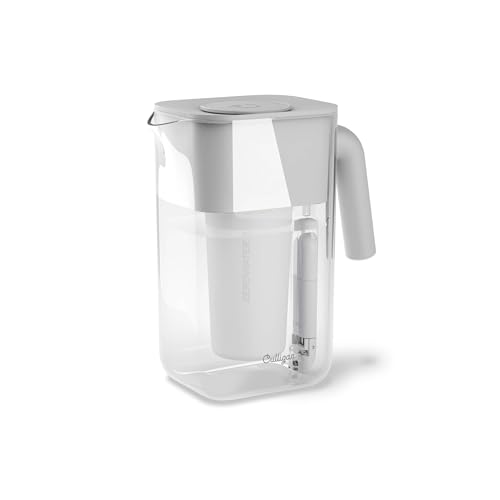
The Culligan ZeroWater pitcher is the only model in this guide that features a built-in TDS meter, giving you real-time feedback on total dissolved solids reduction. It uses a 5-stage advanced filtration system certified by IAPMO to reduce total PFAS (forever chemicals), lead, mercury, fluoride, and chlorine. When the meter reads 0, the filter has removed virtually all dissolved solids, including beneficial minerals — producing water similar to distilled quality.
Users with contaminated well water or high-TDS municipal supplies report dramatic improvements in taste and clarity. The 10-cup capacity (80 fluid ounces) is adequate for a 3-person household. The sliding lid design is simpler and more secure than Brita’s flip-top, and the ergonomic handle balances the weight well even when full. Replacement filters are pricier than standard Brita cartridges, but the level of contaminant reduction is in a different league.
The TDS meter requires a AAA battery and is located under the handle, making it a bit fiddly to access. A few users reported water damage to the battery compartment after a few weeks, suggesting a design vulnerability. If you don’t need zero-TDS water, the faster flow rate of a standard pitcher may serve you better. But for those dealing with PFAS or very hard water, this pitcher is the most effective affordable option available.
Why it’s great
- IAPMO certified to reduce PFAS and other emerging contaminants
- Built-in TDS meter provides objective filter performance data
- 5-stage filter removes up to 99.9% of dissolved solids
Good to know
- Replacement filters are significantly more expensive than standard options
- TDS meter battery compartment is vulnerable to water ingress
6. Brita Large 10-Cup Water Filter Pitcher
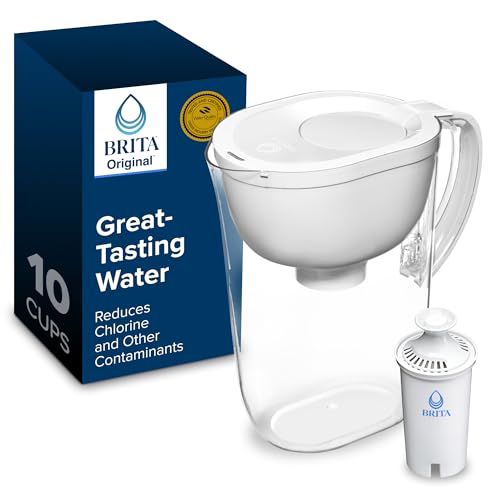
The Brita Everyday 10-Cup pitcher is the benchmark against which all other gravity pitchers are measured. It’s NSF certified to reduce chlorine taste and odor, mercury, copper, zinc, and cadmium. The space-efficient design (10.7 x 5.4 x 10.1 inches) fits most refrigerator shelves, and the easy-fill locking lid prevents spills during refills. It comes with one standard filter (good for 40 gallons or 2 months) and is compatible with Brita’s Longlast+ filter (120 gallons, 6 months).
Users praise the improved design over older Brita models — the inset cap prevents the lid from falling off mid-pour, and the ergonomic handle makes pouring comfortable even when the pitcher is full. The 10-cup capacity is perfect for filling a standard coffee maker carafe, and the filter life tracking stickers (included) help you remember replacement dates. The filter installs in seconds with no presoaking required.
The standard filter’s flow rate slows noticeably after about 30 gallons, so the Longlast+ upgrade is worth considering if you’re a heavy user. The pitcher is also on the larger side for compact fridges — measure your shelf height before buying. For its combination of proven performance, easy availability of replacement filters, and reasonable upfront cost, the Brita Everyday remains a solid foundation for any household’s filtration needs.
Why it’s great
- Proven NSF certification for common contaminants
- Compatible with both standard and Longlast+ filters
- Secure locking lid prevents spillage
Good to know
- Standard filter flow rate decreases significantly after 30 gallons
- Full 10-cup pitcher is heavy for some users
7. Brita Standard Water Filter 6-Pack
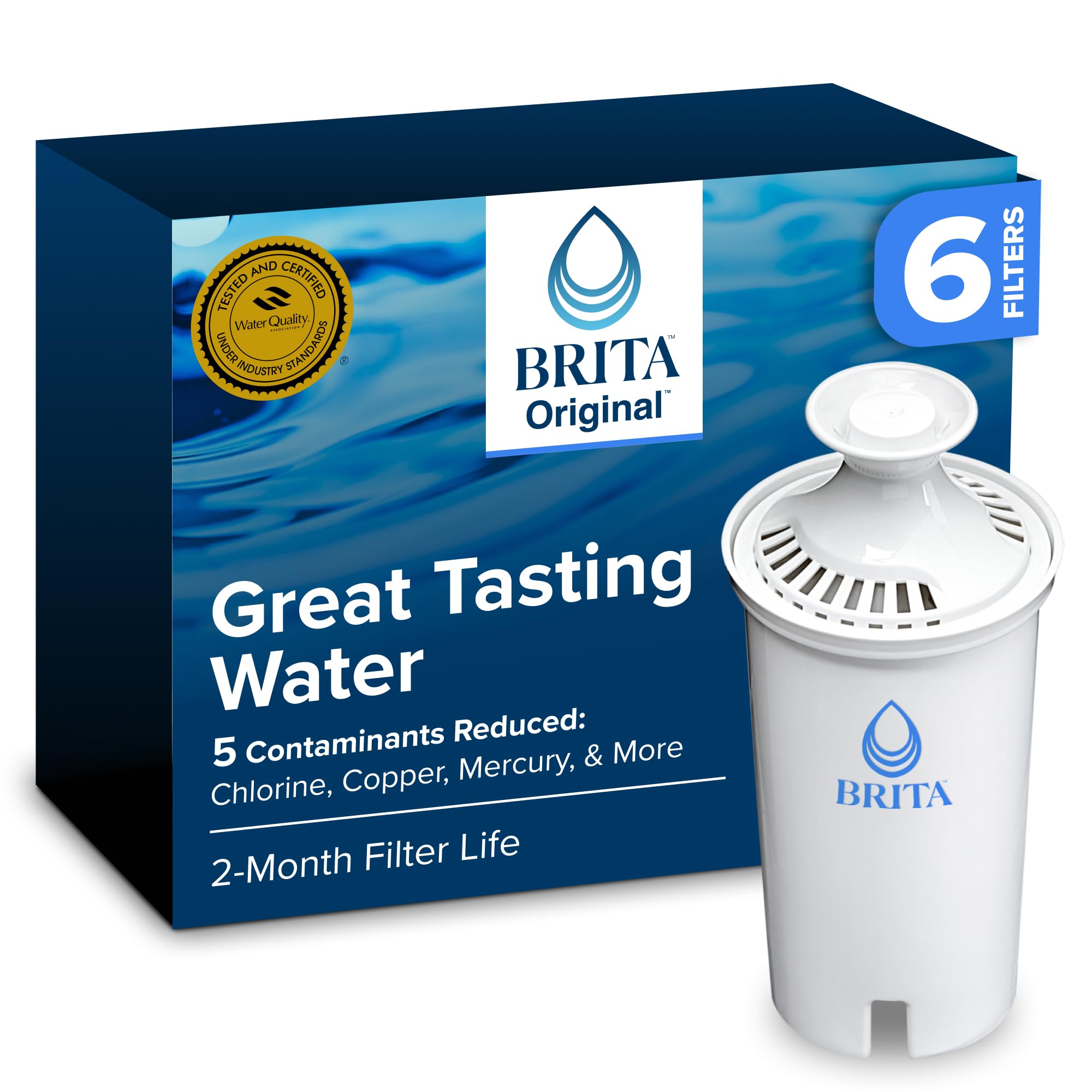
This 6-pack of Brita Standard filters is the budget-friendly way to keep your existing Brita pitcher running for a full year. Each filter lasts 40 gallons or 2 months, reducing chlorine taste/odor, copper, cadmium, and mercury. The filters require no presoaking — just pop one in, flush with cold water for 15 seconds, and you’re good to go.
Users consistently highlight the value of the multi-pack: buying six filters at once cuts the per-filter cost by roughly a third compared to buying singles. The filters fit all Brita pitchers and dispensers except the Stream model. The installation is straightforward, and the 40-gallon lifespan is accurate for most municipal tap water with moderate sediment levels.
The standard filter does not reduce lead or PFAS, so if those contaminants are a concern in your area, you’ll need the Brita Longlast+ filter (sold separately) or a different filtration system entirely. Some users reported minor inconsistency in flow rate between individual filters in the same pack, but this is anecdotal and doesn’t affect taste performance. For the price per gallon, this is the most economical way to maintain great-tasting water for a large family.
Why it’s great
- Multi-pack pricing cuts per-filter cost by ~33%
- No presoak required — install and use immediately
- Fits all Brita pitchers and dispensers (except Stream)
Good to know
- Does not reduce lead or PFAS — use Longlast+ for those contaminants
- Flow rate can vary slightly between individual filters
FAQ
How often should I replace the filter in my affordable water filter pitcher?
Can I use an affordable water filter pitcher with well water?
What is the difference between NSF 42 and NSF 53 certification for pitchers?
Do affordable water filter pitchers remove fluoride?
Should I refrigerate my water filter pitcher?
Final Thoughts: The Verdict
For most users, the best affordable water filter pitcher winner is the AQUAPHOR Opal 12 Cup because it combines the fastest flow rate among certified pitchers with a 12-cup capacity, dishwasher-safe body, and filter replacement costs lower than Brita over the long term. If you need zero-TDS water for a CPAP machine or to remove PFAS, grab the Culligan ZeroWater 10-Cup for its built-in TDS meter and 5-stage filtration. And for on-demand convenience without lifting a heavy pitcher, nothing beats the Waterdrop ED02W with its 200-gallon filter and rechargeable electric dispensing.