
Our readers keep the lights on and the weekend projects moving. As an Amazon Associate, I earn from qualifying purchases.
A welding helmet is your most critical piece of safety gear, but the wrong one turns every bead into a gamble with your eyesight. Cheap models with blurry, green-tinted lenses force you to lift your hood constantly, slowing your work and increasing the chance of a flash burn. An affordable auto-darkening helmet with true color optics and fast switching eliminates that frustration, letting you lay down clean welds with confidence from the first strike.
I’m Rikta — the co-founder and writer behind FitlyFast. My buying guides are built on hours of cross-referencing technical specs, customer feedback, and real-world performance metrics to help you find gear that delivers genuine value without the premium price tag.
After analyzing response times, optical clarity ratings, viewing dimensions, and arc sensor configurations across dozens of models, I’ve narrowed the market to the seven contenders that define the affordable welding helmet category today.
How To Choose The Best Affordable Welding Helmet
Every welding helmet in this price range makes trade-offs. The goal is to identify which compromises affect your safety and weld quality, and which ones are acceptable to save money. Focus on four specs that define real-world performance: optical clarity, switching speed, arc sensor count, and viewing area size.
Optical Clarity Rating (1/1/1/1)
Optical clarity is rated on a scale where 1 is best and 3 is worst. A 1/1/1/1 rating means the lens produces minimal distortion, consistent color across the viewing area, and smooth light diffusion. Lower-rated lenses create a grainy or wavy view that causes eye fatigue after 20 minutes of welding. For an affordable helmet, a 1/1/1/1 rating is the single spec that separates a usable tool from a frustration.
Switching Speed and Arc Sensors
Auto-darkening lenses need to switch from light to dark in under 1/10,000 of a second to protect your eyes from a sudden arc flash. The number of arc sensors — ideally four — determines how reliably the helmet detects the arc from different angles. Two-sensor helmets can miss the arc if you’re welding in a tight corner or with your head tilted, resulting in a dangerous flash exposure. Four sensors eliminate that blind spot.
Viewing Area Dimensions
A larger viewing window reduces the need to reposition your head to see the weld puddle. Look for dimensions around 3.94 x 3.65 inches or larger. Smaller windows around 3.62 x 1.65 inches work for basic tack welding but become restrictive when you’re running long beads or working in tight positions. The extra viewing area directly improves weld accuracy.
Shade Range Flexibility
Different welding processes require different shade levels. MIG and stick welding typically need shades 9-13, while TIG welding at low amperage may require shades as light as 5. A helmet that covers shade 4 (light state) through shade 13 (dark state) is versatile enough for home shop and light professional use. Fixed shade helmets are cheaper but force you to own multiple hoods or flip the helmet up between passes.
Quick Comparison
On smaller screens, swipe sideways to see the full table.
| Model | Category | Best For | Key Spec | Amazon |
|---|---|---|---|---|
| MIGVAN H-23 | Auto-Darkening | Best Overall | 1/10000 sec switching, 4 sensors | Amazon |
| ARCCAPTAIN LY800J | Auto-Darkening | Premium Visuals | 1/1/1/1 optics, 3.94×3.66 screen | Amazon |
| Omolith OM-17800F-FS | Auto-Darkening | Large Viewing Area | 3.94×3.66 screen, 4 sensors | Amazon |
| TRQWH LE04 | Auto-Darkening | Versatile Shade Range | 1/30000 sec, shade 4-13 | Amazon |
| NDUUN ND600DF-R805-TC | Auto-Darkening | Budget Starter Kit | 2 sensors, 3.62×1.65 screen | Amazon |
| Jackson Safety 14975 | Fixed Shade | Indestructible Simplicity | Fixed shade 10, non-electronic | Amazon |
| Fibre-Metal 110PWE | Passive | Pro Pipeline Work | Fiberglass shell, compact | Amazon |
In‑Depth Reviews
1. MIGVAN H-23
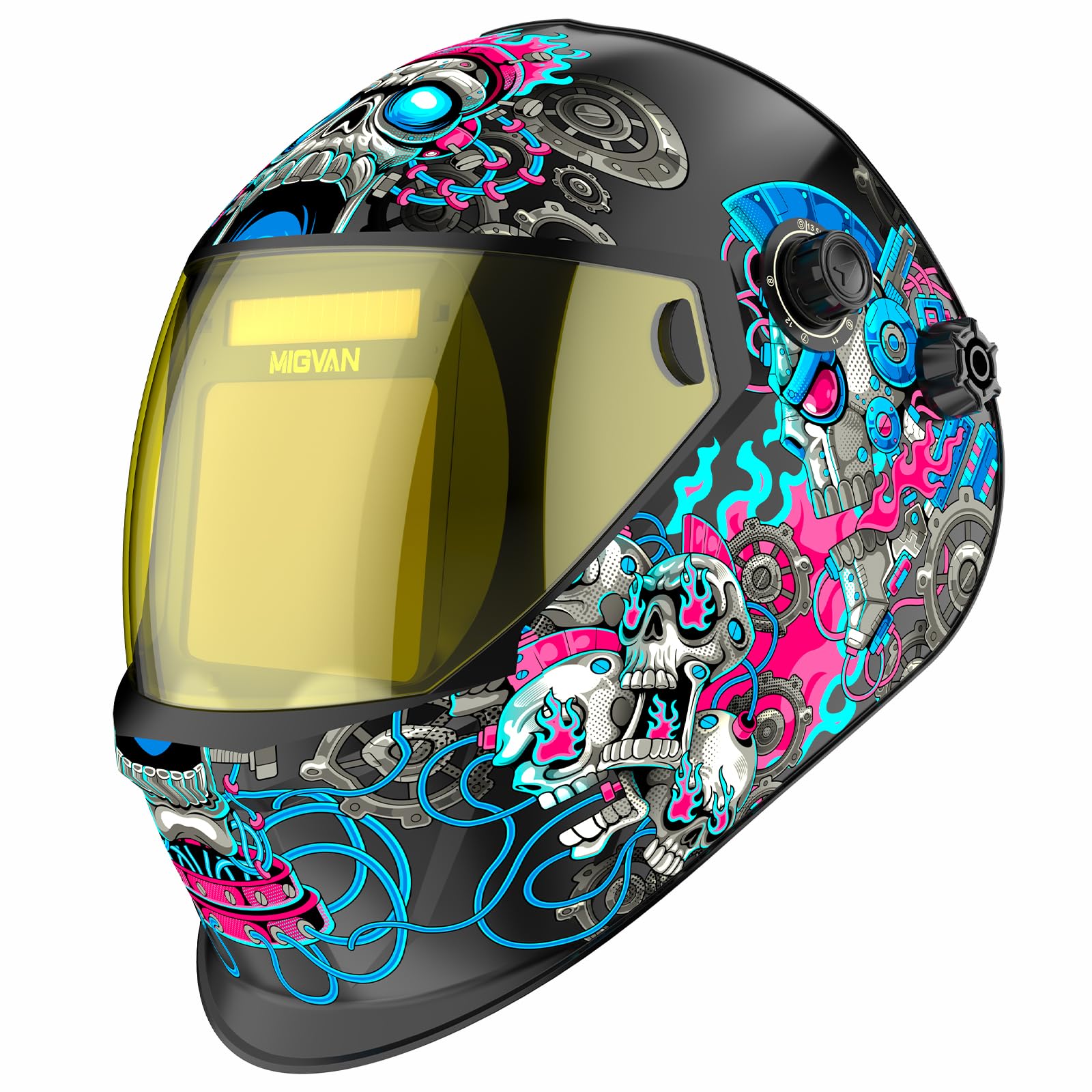
The MIGVAN H-23 earns the top spot by combining a 1/1/1/1 optical clarity lens with four arc sensors and a 1/10,000 second switching speed — specs that rival helmets costing three times as much. The true color golden lens eliminates the fluorescent green tint that makes it hard to read the weld puddle, giving you a natural view of the workpiece without eye strain. The large viewing area provides enough peripheral vision to track your arc without repositioning your head mid-pass.
Power comes from a hybrid system — solar cells on the front and a replaceable lithium battery — so you never worry about dead CR2450s in the middle of a job. The shade range covers DIN4 in light state and DIN5-9/9-13 in dark, making it compatible with TIG, MIG, stick, and plasma cutting. The headgear adjusts with a padded ratchet system that stays secure without creating pressure points, even during extended overhead welding.
Outer and inner protective lenses are easily replaceable, extending the life of the main filter. The included heavy-duty storage bag keeps the shell scratch-free between uses. For the home hobbyist or light professional, this helmet delivers the best balance of optical quality and protection in the affordable segment.
Why it’s great
- 1/1/1/1 optical clarity with true color golden lens
- Four arc sensors prevent flash from angle misses
- Solar and rechargeable battery hybrid power system
Good to know
- Full-face design limits air circulation during long sessions
- Headgear lacks the premium feel of professional brands
2. ARCCAPTAIN LY800J
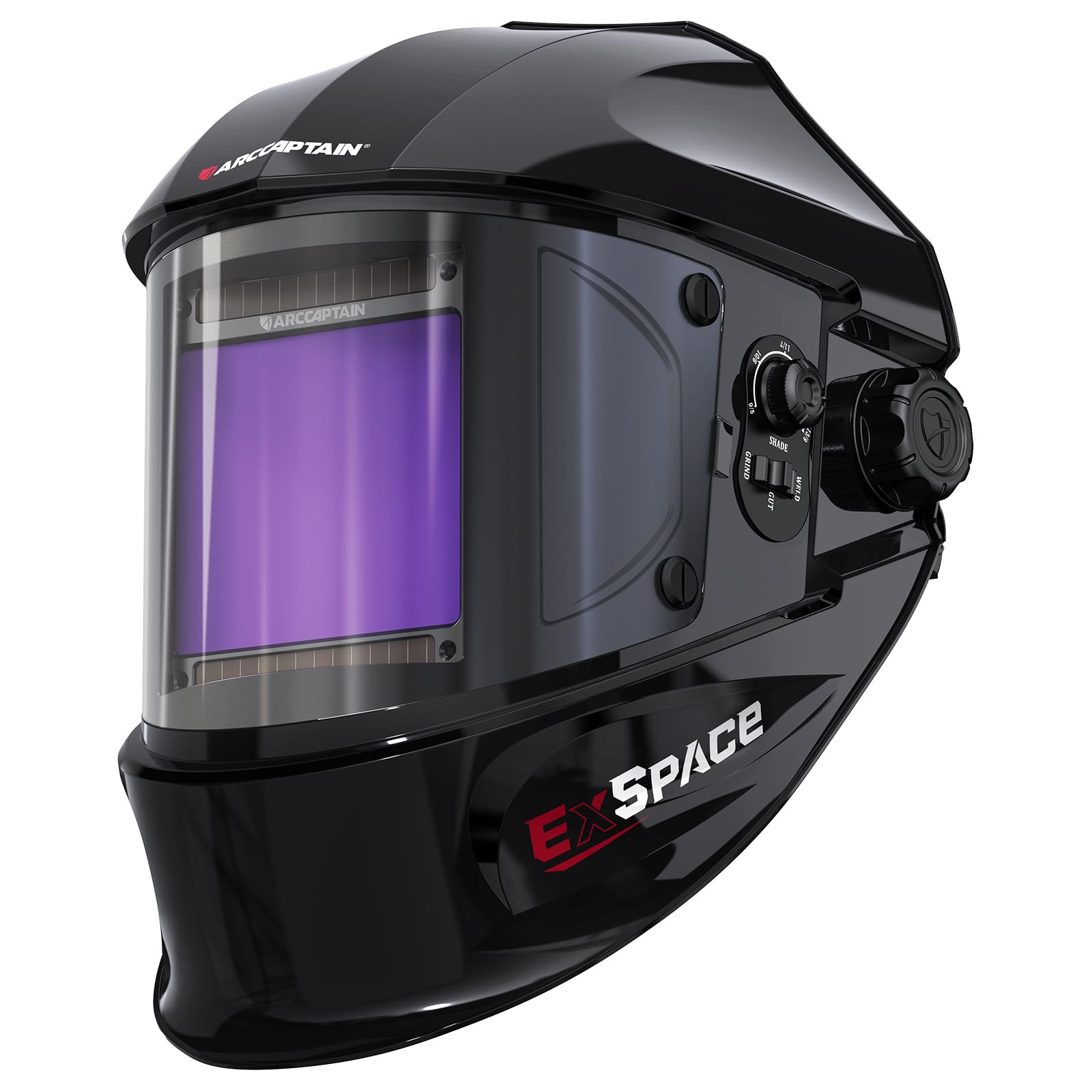
The ARCCAPTAIN LY800J matches the MIGVAN on optical clarity but pushes the switching speed to an impressive 1/25,000 seconds — fast enough to protect your eyes even during high-frequency TIG starts. The 3.94 x 3.66 inch viewing screen is among the largest at this price point, giving you a full picture of your weld zone without craning your neck. The 12-in-1 smart filter provides automatic UV/IR protection up to DIN 16, adding a layer of safety for sustained arc exposure.
Two solar panels on the front and two CR2450 lithium batteries on the back provide years of service life. The knob controls are designed for gloved operation, with distinct detents for sensitivity and delay adjustments. The eco-friendly PP shell has a tensile strength of 120 MPa and flexural modulus of 4000 MPa, so it handles drops and shop abuse better than thinner budget shells. The included storage bag and three replacement lenses round out a complete package.
Some users report the headgear feels softer than ideal, failing to hold position perfectly on larger heads. However, ARCCAPTAIN’s customer service has a reputation for sending replacements or refunds when issues arise. If you prioritize a massive clear view and the fastest darkening speed available, this is the helmet to buy.
Why it’s great
- 1/25,000 second switching speed for instant protection
- Generous 3.94×3.66 viewing area
- 12-in-1 smart filter with UV/IR protection
Good to know
- Headgear can feel too soft and lose position
- Some units may need customer service follow-up
3. Omolith OM-17800F-FS
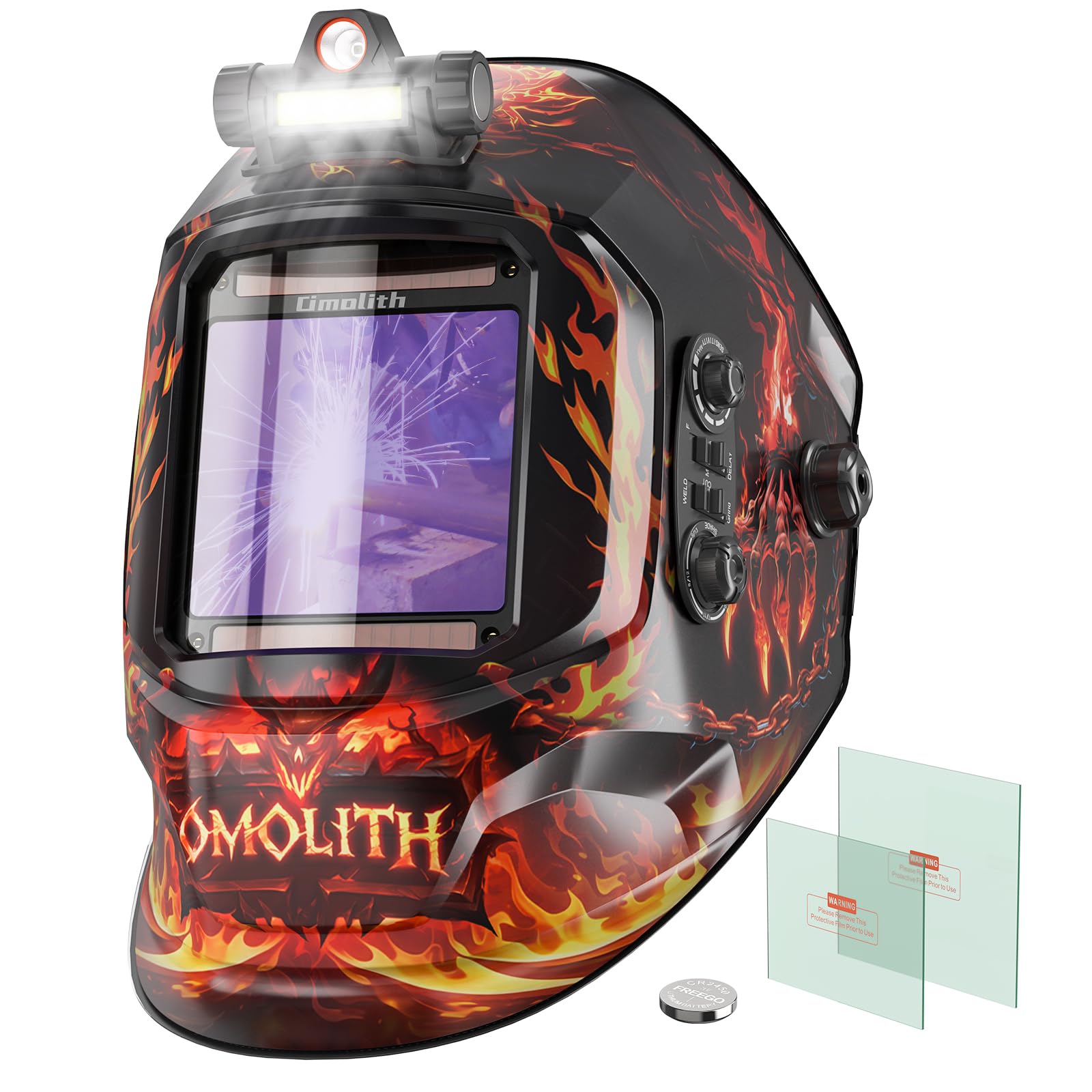
The Omolith OM-17800F-FS focuses on maximizing visual real estate without sacrificing switching speed. The 3.94 x 3.66 inch viewing screen and 1/1/1/1 optical clarity deliver the same top-tier lens quality as the higher-priced contenders. A standout feature is cheater lens compatibility — if you wear reading glasses, you can drop in a magnifying lens and weld without bifocals. Four premium arc sensors ensure the lens darkens reliably regardless of your head angle.
Power comes from a lithium battery with solar assist, keeping the auto-darkening function active for years before a replacement is needed. The ergonomic headgear adjusts to fit large heads comfortably and cinches down small enough for younger welders. At 2.2 pounds, it’s one of the lighter options, reducing neck fatigue during overhead welding or all-day fabrication work.
Reviewers consistently note that the headgear adjustment mechanism feels basic compared to more expensive models. The ratchet lacks the fine increments of professional hoods, but it holds firm once set. For the hobbyist or home shop welder who wants a large, clear window and the ability to use a cheater lens, this helmet delivers outstanding value.
Why it’s great
- Cheater lens compatible for welders who wear glasses
- Lightweight at 2.2 pounds for extended comfort
- Large 3.94×3.66 viewing screen with 1/1/1/1 clarity
Good to know
- Headgear adjustment feels basic
- Not designed for daily heavy industrial use
4. TRQWH LE04
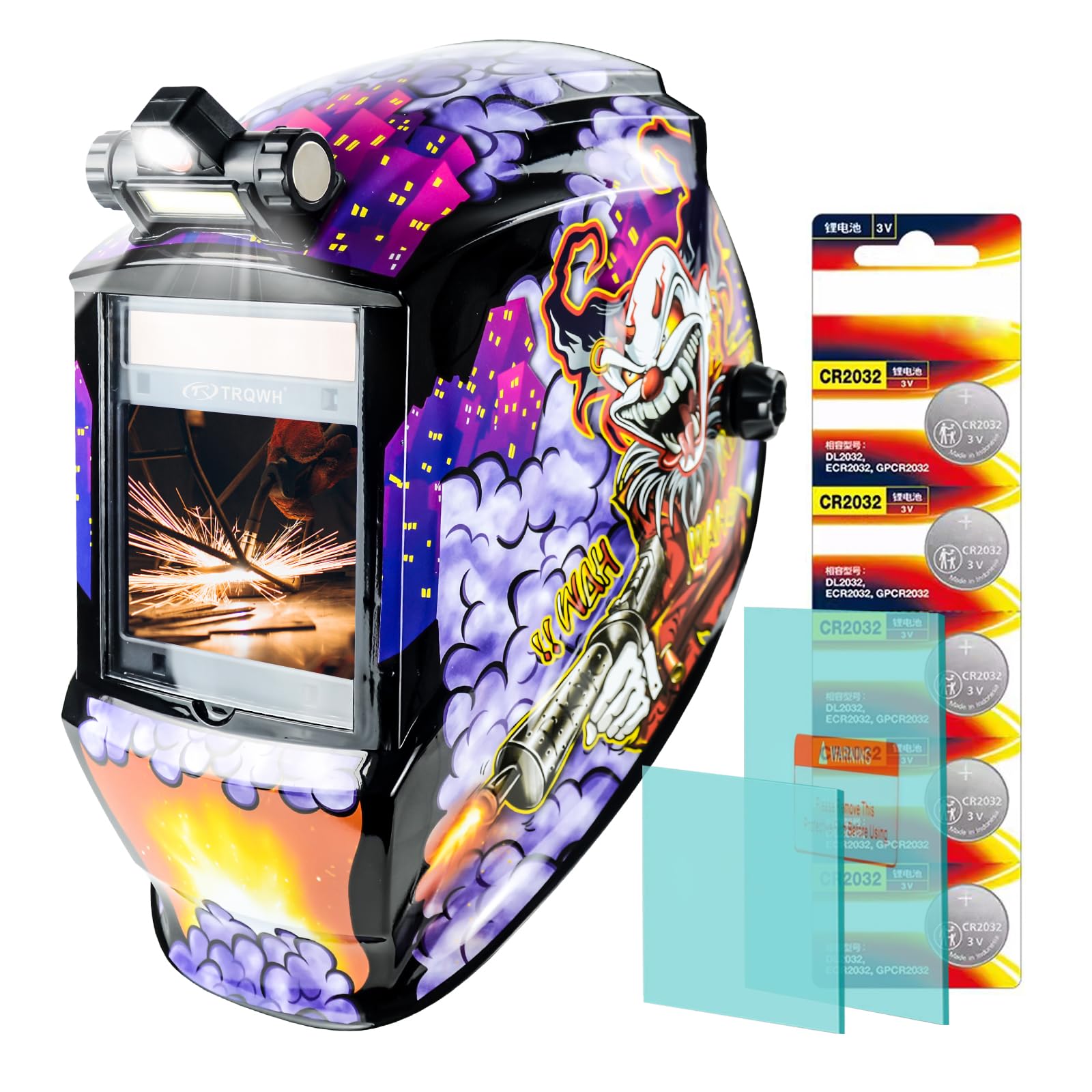
The TRQWH LE04 stands out for its incredibly fast 1/30,000 second switching time — the quickest in this lineup. The true color technology uses a premium lens coating that eliminates the green haze found on old-school auto-darkening filters, giving you a natural view of the weld puddle and base metal. The shade range covers DIN4 in light state and DIN5-9/9-13 in dark, giving you flexibility to run everything from low-amp TIG to high-current stick welding without swapping hoods.
Four arc sensors are positioned across the front of the shell, providing 360-degree arc detection to prevent flash from side-starting or tight-corner welds. The solar cell and CR2450 replaceable lithium battery combination means the helmet stays operational for months between charges. The headgear includes a padded forehead sponge that absorbs sweat and reduces slipping, along with side knobs for angle adjustment and a rear ratchet for band tension.
Some users note that the included headgear lacks detailed assembly instructions, which can be frustrating during first setup. The shell material is impact-resistant PP that meets ANSI Z87.1 standards, but it doesn’t feel as robust as the fiberglass options. For the welder who switches processes frequently and wants the fastest possible darkening, the TRQWH delivers excellent performance at a compelling price.
Why it’s great
- Fastest switching at 1/30,000 second
- Four arc sensors for full coverage
- Wide shade range 4-13 for multi-process use
Good to know
- Assembly instructions are minimal
- Shell feels less durable than fiberglass alternatives
5. NDUUN ND600DF-R805-TC
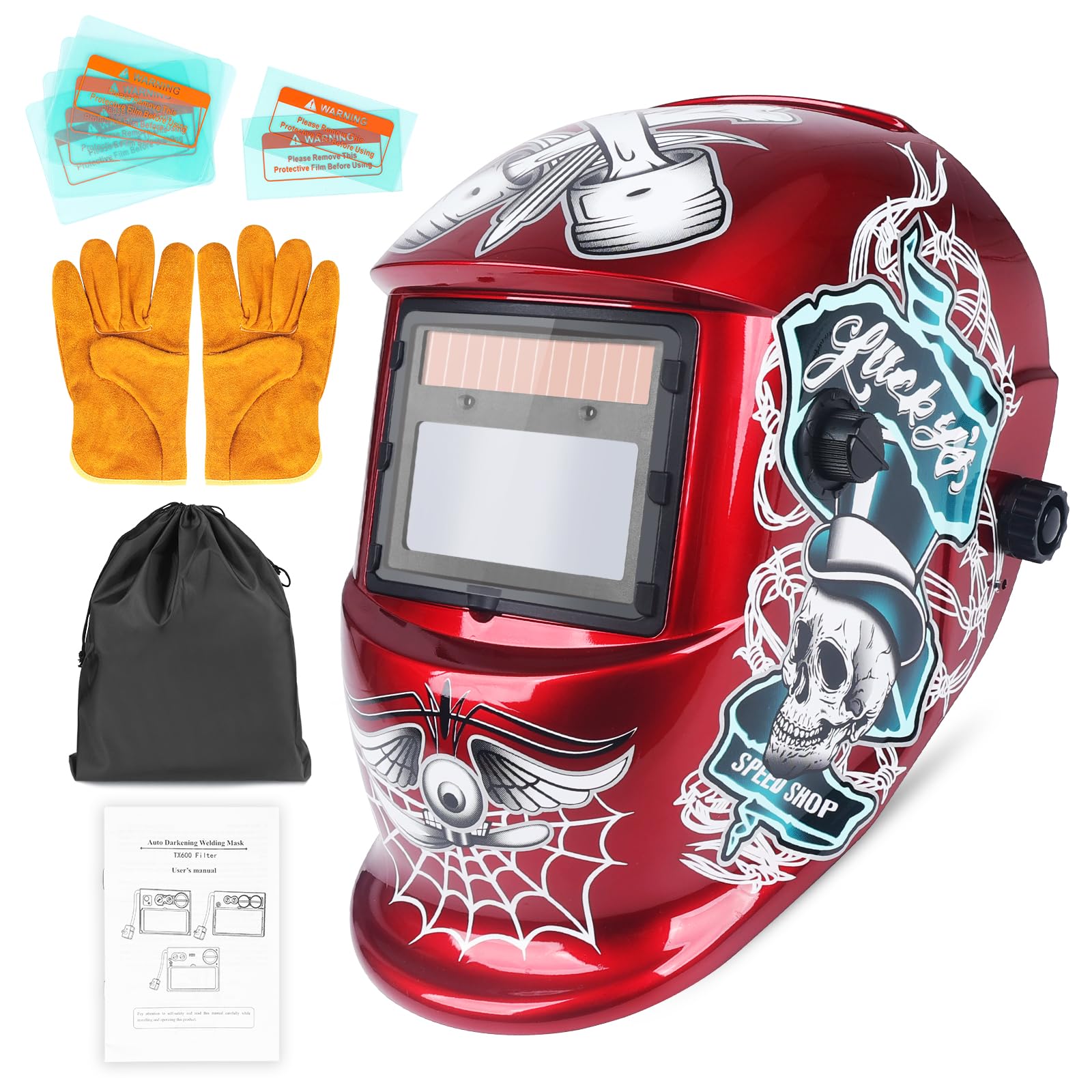
The NDUUN ND600DF-R805-TC is the entry-level auto-darkening helmet that proves you don’t need to spend a lot to get reliable protection. It uses two arc sensors rather than four, which means you need to be more aware of your head position to avoid missing the arc. The switching speed is rated at 3/10,000 seconds — slower than premium models but still within safe limits for hobbyist MIG and stick welding. The true color filter improves visibility over the old green-only lenses, though the 3.62 x 1.65 inch viewing area is noticeably smaller than the larger options in this guide.
Solar panel technology with battery backup keeps the auto-darkening circuit powered without frequent battery changes. The headgear is lightweight and comfortable enough for extended wear, with an adjustable band and padded interior. An unexpected bonus is the kit includes welding gloves, a storage bag, and extra protective lenses — everything a beginner needs to start welding immediately after unboxing.
The plastic shell feels thin compared to mid-range helmets, and the sensitivity adjustment requires some trial and error to dial in. If you’re learning to weld or only fire up the welder a few times a month, this helmet provides all the essential safety features at the lowest possible entry cost. Just be prepared to upgrade when you outgrow the smaller viewing window.
Why it’s great
- Includes gloves, bag, and spare lenses for beginners
- Solar powered with battery backup for long life
- Comfortable lightweight headgear
Good to know
- Only two arc sensors — need to position head carefully
- Smaller 3.62×1.65 viewing window
- Plastic shell feels thin
6. Jackson Safety 14975
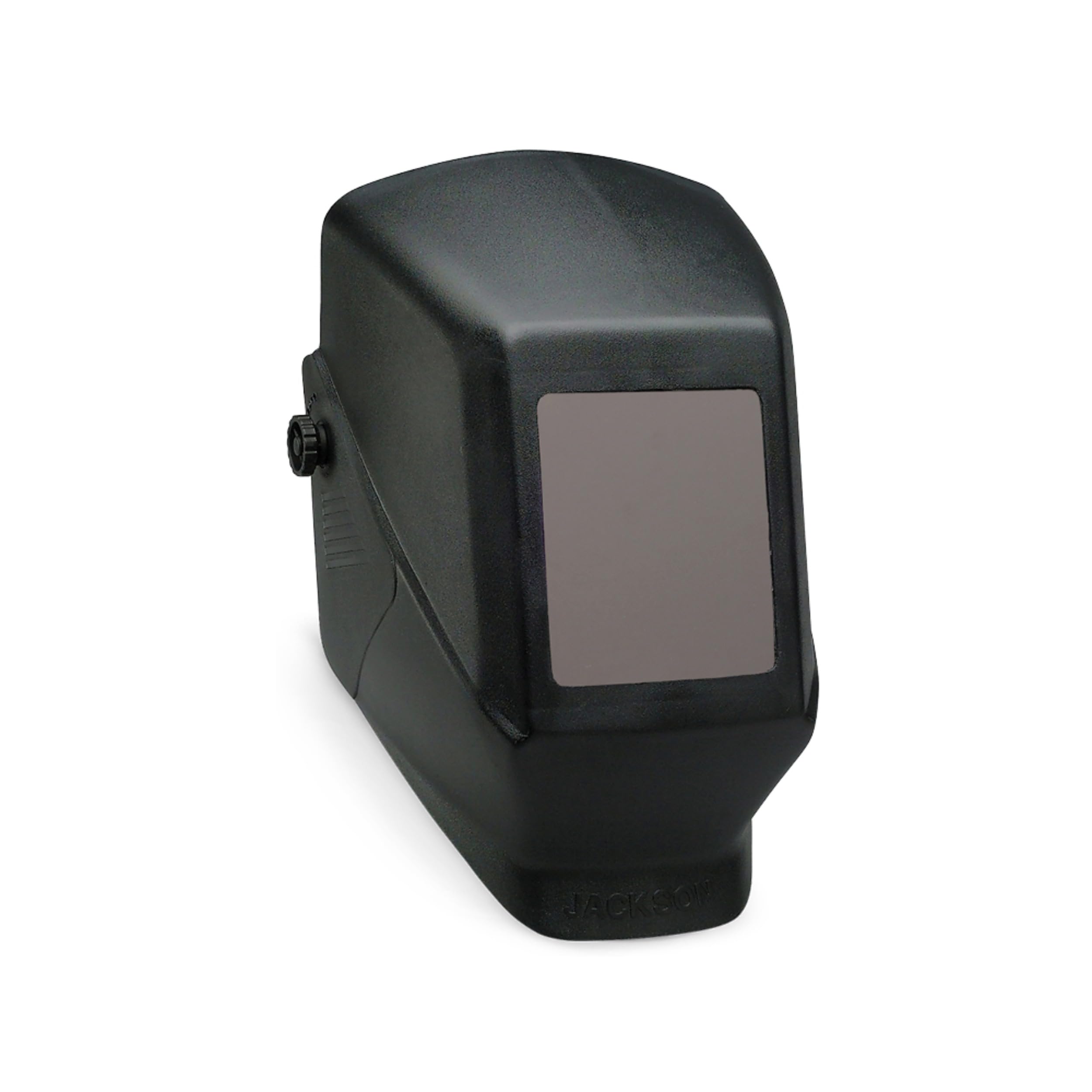
The Jackson Safety 14975 is a fixed shade #10 passive helmet that strips away electronics for absolute reliability. There is no battery to die, no sensor to fail, no auto-darkening filter to lag. The shade #10 filter plate is factory installed and provides consistent protection for MIG and stick welding every time you flip the hood down. The durable thermoplastic shell includes an extended front lip that deflects sparks and slag away from your throat — a feature often missing from budget auto-darkening helmets.
The headgear is among the best in its price range, with a comfortable padded band that adjusts to fit both adults and children. The narrow shell design is specifically engineered for working in tight spaces where a full-size hood won’t fit. It’s also hard hat adaptable, letting you attach it directly to a hard hat for construction or industrial environments that require head protection. The large viewing area accommodates a shade #10 filter plate that provides a clear orange-tinted view of your weld.
You must flip the hood up and down manually between passes — there is no auto-darkening convenience. This takes practice and becomes tiring during long welding sessions. If you prefer the simplicity of a passive lens that never fails, or need a backup hood that fits in tight spaces, the Jackson Safety 14975 is a durable, budget-friendly choice that will last for years.
Why it’s great
- No electronics to fail — always works
- Hard hat adaptable for construction settings
- Narrow shell fits in tight spaces
Good to know
- Fixed shade 10, not variable
- Requires manual flip between passes
7. Fibre-Metal 110PWE

The Fibre-Metal 110PWE, known universally among pipe welders as the “sugar scoop,” is a fiberglass passive helmet built for the toughest industrial environments. Unlike plastic shells that can crack under impact, the fiberglass construction is impact-resistant, moisture-proof, and self-extinguishing. The compact design is essential for pipeline work where a standard helmet bumps into overhead pipes and adjacent equipment. This hood has been the go-to choice for professional pipe welders for decades because of its unmatched durability and simple reliability.
The shell accepts standard 2 x 4.25 inch filter plates, giving you the freedom to install any passive or auto-darkening drop-in lens you prefer. Many professionals run a Wens blue lens or Phillips Safety gold lens for improved contrast. The rubber headband is comfortable and easy to replace, and replacement parts are widely available and inexpensive. The smooth deflective surface sheds spatter without sticking, reducing cleanup time between welds.
There is no built-in auto-darkening feature — you must supply your own filter plate or invest in a drop-in auto-darkening cartridge. The trim of the shell may need minor shaping to avoid collarbone interference for some users. If you weld in tight, dirty, industrial conditions and want a hood that will survive being dropped, crushed, and covered in spatter for a decade or more, the Fibre-Metal 110PWE is the ultimate choice.
Why it’s great
- Fiberglass shell is nearly indestructible
- Compact design for tight pipeline work
- Accepts any 2×4.25 drop-in lens
Good to know
- No auto-darkening — you must supply a lens
- Shell may need minor trim for collarbone clearance
FAQ
What shade number should I use for MIG welding?
Can I use an auto-darkening helmet for TIG welding?
How often should I replace the protective lens covers?
What does the grinding mode on a welding helmet do?
Are solar-powered welding helmets reliable in low-light shops?
Final Thoughts: The Verdict
For most users, the affordable welding helmet winner is the MIGVAN H-23 because it delivers 1/1/1/1 optical clarity, four arc sensors, and a true color lens at a price that undercuts the competition by a wide margin. If you want the absolute fastest switching and largest viewing area, grab the ARCCAPTAIN LY800J. And for the professional pipe welder who needs a fiberglass shell that survives years of abuse, nothing beats the Fibre-Metal 110PWE with your choice of drop-in auto-darkening lens.