
Our readers keep the lights on and the weekend projects moving. As an Amazon Associate, I earn from qualifying purchases.
That split-second crackle in the middle of a solo or the sudden silence when you step two feet too far from your amp—these are the true costs of a poorly chosen wireless system. An affordable wireless guitar system is not a luxury; it is a reliability check on your signal path that either frees your movement or introduces a new set of problems.
I’m Rikta — the co-founder and writer behind FitlyFast. I have spent hundreds of hours analyzing wireless audio transmission specs, reading through verified buyer reports on dropout rates and latency issues, and cross-referencing frequency bands against real-world interference patterns to build this guide.
This guide examines seven wireless guitar systems, balancing transmission range, latency figures, battery life, and frequency reliability so you can identify a truly reliable affordable wireless guitar system that won’t sabotage your playing.
How To Choose The Best Affordable Wireless Guitar System
A budget-friendly wireless guitar system can sound exactly like a cable, or it can hiss, pop, and drop out mid-set. The difference comes down to three technical pillars: frequency band, real-world latency, and active pickup compatibility. Understand these, and you eliminate the guesswork.
Frequency Band: 2.4GHz vs 5.8GHz
The 2.4GHz band is crowded—Bluetooth devices, Wi-Fi routers, and even microwave ovens compete for the same airspace. A 5.8GHz system operates in a far cleaner range, drastically reducing the chance of signal dropouts in venues or home studios saturated with wireless gear. If your practice space or stage has heavy Wi-Fi traffic, step to a 5.8GHz unit.
Latency: The 7-Millisecond Threshold
Human perception detects a delay between playing a note and hearing it at roughly 10-12 milliseconds. Any system advertising sub-7ms latency is effectively transparent. Above 12ms, you risk feeling a sluggish, disconnected response, especially during fast runs or heavy picking. Check the spec sheet for latency in milliseconds, not subjective claims of “fast response.”
Active vs Passive Pickup Support
Guitars with active pickups—most high-output humbuckers or piezo-equipped acoustics—output a much hotter signal than passive pickups. Many budget systems distort or clip when fed this signal. Look for a unit that explicitly states it handles active pickups, often through a dedicated input mode or pad setting. Skipping this check can lead to unusable, crackling audio even on a brand-new system.
Quick Comparison
On smaller screens, swipe sideways to see the full table.
| Model | Category | Best For | Key Spec | Amazon |
|---|---|---|---|---|
| NUX C-5RC | Premium | Gigging reliability with charging case | 5.8GHz / Charging case | Amazon |
| Positive Grid Spark Link | Premium | Ultra-low latency and Spark amp pairing | Under 3ms latency | Amazon |
| Xvive A58 | Premium | Active pickup compatibility with scanning | Active/Passive Modes | Amazon |
| JOYO JW-02S | Mid-Range | Clean 5.8GHz with ground isolation | 5.8GHz / Under 6ms | Amazon |
| LEKATO WS-50 | Mid-Range | Long-range 300ft outdoor use | 5.8GHz / 300ft range | Amazon |
| MOOER Air P05 | Budget | Ultra-compact home practice | 2.4GHz / 8hr battery | Amazon |
| LEKATO WS-60 | Budget | Stereo instrument and multi-channel use | 2.4GHz / Stereo support | Amazon |
In‑Depth Reviews
1. NUX C-5RC

The NUX C-5RC stands apart because of its charging case—a practical innovation that ensures both transmitter and receiver are topped up and stored together, ready for any gig or rehearsal. Operating on the 5.8GHz band, it sidesteps the Wi-Fi and Bluetooth congestion that plagues 2.4GHz units, providing a consistently clean signal even in denser wireless environments. The automatic pairing means you power both units on and they connect instantly without menu-diving.
This system handles both active and passive pickups gracefully, which is critical for players switching between a high-output humbucker guitar and a piezo-equipped acoustic on the same stage. Users report a cable-like tone with no shrillness or interference, even near light switches that cause other systems to squeal. The included mute function lets you silence your signal during tuning or instrument changes without unplugging.
The battery life hovers around three hours per full charge—shorter than some competitors, but the charging case completely negates this limitation by recharging the units between sets. The transmitter and receiver are ultra-compact, weighing just over an ounce each. A few users noted battery degradation after extended use, but the overall build quality and interference-free performance make this the most complete package for the price.
Why it’s great
- Charging case keeps units ready and organized
- 5.8GHz eliminates Wi-Fi interference
- Auto-matching setup is instant and reliable
- Works with active and passive pickups
Good to know
- Battery life is about 3 hours per charge
- Batteries may degrade after several years of heavy use
2. Positive Grid Spark Link

The Spark Link pushes latency down to under 3 milliseconds, a figure that rivals high-end professional wireless systems costing several times more. This near-zero delay means your picking dynamics and touch feel completely natural, with no sluggishness or smearing during fast passages. The 110-degree hinged plug design ensures a secure fit on virtually any guitar body, including deeper cutaways where straight plugs often bind.
Transmission quality is 24-bit/48kHz with a 20Hz-20kHz frequency range, preserving the full harmonic content of your instrument. The rechargeable battery delivers up to 6 hours of playtime, and the dual-end USB-C cable charges both transmitter and receiver simultaneously. The auto-off feature after 30 minutes saves battery when you step away between sets.
Some users reported random signal drops with active pickups on certain guitar models, particularly with high-output Fishman systems—a quick power cycle usually resolves it. The button labels on the back have low contrast, making them hard to read in low light, though a small piece of tape solves this. For players who prize feel and response above all else, the Spark Link delivers a cable-free experience that feels identical to a wired connection.
Why it’s great
- Sub-3ms latency is class-leading
- 110-degree hinge fits all guitar bodies
- 6-hour battery life covers long sessions
- Auto-off conserves charge when idle
Good to know
- Occasional drops with high-output active pickups
- Back labeling is difficult to read in dim light
3. Xvive A58
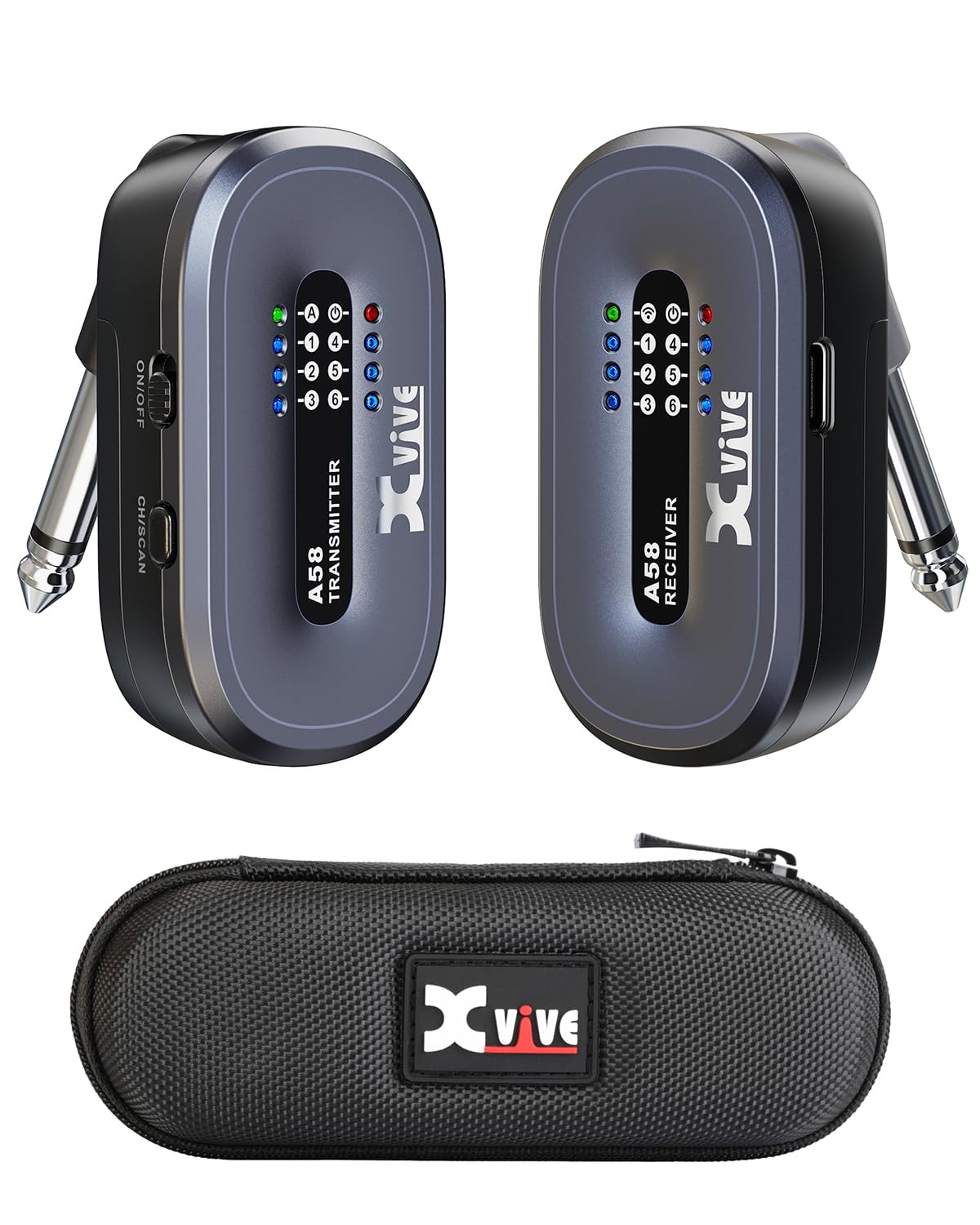
The Xvive A58 is the first 5.8GHz system in its price tier to include a dedicated Active mode toggle on the transmitter, solving the clipping problem that plagues many budget units when paired with high-output active pickups. A long press on the Channel button switches the input pad, allowing it to handle instruments like active EMG-equipped basses or piezo acoustics without distortion. The channel scan mode on the receiver automatically finds the cleanest frequency, further reducing dropout risk.
Audio quality is 24-bit/48kHz, and the frequency response covers the full 20Hz-20kHz range. The transmission range reaches up to 100 feet with clear line of sight, which is generous for most stages and large rehearsal spaces. Charging is via USB-C, and a quick 10-minute charge gives roughly an hour of play—handy for last-minute setups.
The oblong shape is less elegant than some competitors, and the On/Off button sits close to the channel selector, which can lead to accidental channel changes during live play. Battery life sits around 4-5 hours, which is solid but not outstanding. For players who jump between active and passive instruments, the A58’s mode switching is a genuine performance-saver that lower-priced options lack.
Why it’s great
- Dedicated Active mode for high-output pickups
- Channel scan finds cleanest frequency automatically
- USB-C charging with 10-min quick charge
- 100-foot range handles large stages
Good to know
- Button placement can cause accidental channel changes
- Oblong shape is less streamlined
4. JOYO JW-02S

The JOYO JW-02S uses the 5.8GHz band to deliver a noticeably cleaner signal than many 2.4GHz units at a similar price. Beyond frequency advantage, the system provides ground isolation—breaking the ground loop that often introduces background hiss from unshielded guitars. This is a subtle but meaningful benefit for players using instruments with noisy single-coil pickups in less-than-ideal electrical environments.
Latency is rated at under 6 milliseconds, well below the threshold of perception. The 220-degree rotatable 1/4-inch jack fits any guitar or bass without obstruction, and the battery life stretches to 6 hours per charge—enough for a full day of rehearsals. The transmitter and receiver are lightweight at 70 grams each and use USB-C for charging.
A small number of users reported distortion or brief blackouts even within the 20-meter range, though these issues appear inconsistent across units. The button placement on the side can trigger accidental power-ons during transport. For home and studio players who want 5.8GHz reliability without stepping into premium pricing, the JOYO JW-02S delivers strong value with the added benefit of cleaner signal chains.
Why it’s great
- 5.8GHz avoids Wi-Fi congestion
- Ground isolation eliminates background hiss
- 6-hour battery covers long sessions
- Rotating jack fits all guitars
Good to know
- Some units experience distortion at close range
- Side button may accidentally power on in a bag
5. LEKATO WS-50

The LEKATO WS-50 offers one of the longest effective transmission ranges among affordable wireless systems—up to 300 feet outdoors—making it a standout choice for musicians who need to roam a large stage or outdoor area. It uses the 5.8GHz frequency, keeping it clear of the crowded 2.4GHz spectrum, and supports four simultaneous channels if you need to run multiple instruments.
Latency is rated below 6 milliseconds, and the 24-bit/48kHz audio quality ensures full frequency response from 10Hz to 22kHz. The 220-degree rotatable plug design fits most guitars and basses. Battery life is roughly 5 hours on a full charge, and the USB charging is straightforward. Users consistently praise the lack of hiss, lag, or interference, even through walls at 40-50 feet.
The unit does not include a carrying case, which would be a welcome addition for gigging players. A few users noted slight noise when operating near a laptop, likely due to electromagnetic interference. For players who perform in large venues or outdoor settings and need maximum freedom of movement, the WS-50 provides exceptional range at a mid-range price point.
Why it’s great
- 300-foot outdoor range is best in class
- 5.8GHz avoids interference
- 4-channel support for multiple instruments
- Rotatable plug fits all guitars
Good to know
- No carrying case included
- Slight noise near laptops in some cases
6. MOOER Air P05

The MOOER Air P05 is built for players who mostly practice at home or in the studio but want the convenience of wireless without spending much. It operates on the 2.4GHz band with four selectable channels, giving you options if one frequency gets crowded. The 20-meter range is adequate for most bedroom or small rehearsal spaces, and the low harmonic distortion of under 0.05% keeps the audio reasonably clean.
Battery life is the standout spec here at 8 hours, which means you can leave it charged for multiple practice sessions without anxiety. The built-in 400mAh lithium battery charges via USB and even works with portable power banks. The automatic sleep mode engages when the device is idle, preserving battery between uses. At 85 grams, the units are extremely lightweight and unobtrusive.
Sound quality reports are mixed—some users describe it as excellent for the price, while others report popping sounds and unusable noise, suggesting potential quality control inconsistencies. The 2.4GHz band is also more susceptible to interference in environments with heavy Wi-Fi traffic. For bedroom players on a tight budget who value long battery life above all else, the Air P05 works—but serious gigging musicians should look to the 5.8GHz options above.
Why it’s great
- 8-hour battery life is best for long sessions
- Ultra-compact and lightweight design
- Auto sleep mode saves battery
- Charges from portable power banks
Good to know
- 2.4GHz band prone to interference
- Quality control reports of popping sounds
7. LEKATO WS-60

The LEKATO WS-60 is unusual in the budget wireless category because it supports true stereo transmission, making it a viable option for players using stereo-capable guitars, piezo/magnetic dual pickup systems, or even keyboard players who need a wireless stereo signal. The 2-in-1 plugs include both 1/8-inch and 1/4-inch stereo and mono adapters, allowing connection to a wide range of instruments and audio interfaces beyond just guitars.
The system operates on the 2.4GHz band with six channels, so multiple units can run simultaneously without interference. Latency is rated under 12 milliseconds, which is acceptable for most players but higher than the sub-7ms systems in this list. The transmission range is over 100 feet, and sound quality at 24-bit/48kHz is praised even by former pro audio engineers.
The default stereo adapters can cause silence with certain passive pickups—switching to the included mono plugs resolves this. Battery life is around 4-5 hours, and the double-end USB cable charges both units. An occasional 2.4GHz interference crackle may appear in crowded wireless environments, but movement often clears it. The WS-60 is a niche pick for the stereo-capable musician who needs flexibility across instruments, not just a standard guitar-to-amp connection.
Why it’s great
- True stereo transmission suits dual-pickup instruments
- 2-in-1 plugs for mono and stereo use
- 6 channels allow multiple simultaneous units
- Sound quality praised by pro engineers
Good to know
- Default stereo adapters don’t work with some pickups
- Higher latency at under 12ms
- 2.4GHz interference possible in crowded spaces
FAQ
Will a wireless guitar system work with active pickups?
What is the difference between 2.4GHz and 5.8GHz wireless guitar systems?
Can I use a wireless guitar system with an acoustic-electric guitar?
Final Thoughts: The Verdict
For most users, the affordable wireless guitar system winner is the NUX C-5RC because its charging case solves the battery management problem while delivering interference-free 5.8GHz performance. If you want the lowest possible latency for the most natural feel, grab the Positive Grid Spark Link. And for active pickup compatibility with automatic channel scanning, nothing beats the Xvive A58.