
Our readers keep the lights on and the weekend projects moving. As an Amazon Associate, I earn from qualifying purchases.
Specs are compiled from manufacturer listings and verified buyer reviews and can change over time — please confirm the key details on the product page before buying.
Choosing an AI graphics card means balancing raw computing power, video memory (VRAM), and the software ecosystem that turns those parts into actual results. Your choice hinges on whether you prioritize local model training, image generation, or AI-enhanced gaming. We cut through the hype to spotlight cards that truly perform in AI tasks.
I’m Rikta — the founder and writer behind FitlyFast. This guide is built by comparing the manufacturers’ published specifications and the patterns across verified customer reviews, so you get each pick’s real strengths and trade-offs instead of marketing spin.
From the mighty RTX 5090 to the budget-friendly RTX 5060 Ti, we’ve analyzed the best options to help you find your ideal ai graphics card for your specific needs and budget.
Our Picks at a Glance


How To Choose The Best AI Graphics Card
AI work demands different specs than pure gaming. You need to weigh video memory, compute power, and which software you plan to run. First, define your main workload: training, inference, or a gaming-AI mix.
VRAM is the first question
VRAM stores your model and data during processing. More VRAM lets you run larger models without memory errors. For serious AI work like running a 70B parameter language model, you’ll need a professional card with massive memory like 48GB or 96GB, something gaming cards simply don’t offer.
NVIDIA vs. AMD for AI
Most AI software works smoothly with NVIDIA’s CUDA platform (a set of tools that lets software tap into the GPU’s processing power), so GeForce and professional RTX cards are the safer bet for machine learning. AMD’s RDNA 4 architecture (the design of its latest graphics chips) includes its own AI accelerators, but fewer programs support them. If you’re diving into machine learning, NVIDIA’s ecosystem is the safer bet.
Quick Comparison
| Model | Best For | VRAM | Memory Bus | Max Resolution | Amazon |
|---|---|---|---|---|---|
| ASRock RX 9070 XT★ Best Overall | High-FPS Gaming | 16 GB GDDR6 | 256-bit | 7680 x 4320 | Amazon |
| MSI RTX 5060 TiBest Value | 1080p Gaming | 8 GB GDDR7 | 128-bit | 7680 x 4320 | Amazon |
| ZOTAC RTX 4070Compact Pick | Compact Gaming | 12 GB GDDR6X | 192-bit | 7680 x 4320 | Amazon |
| GIGABYTE RTX 5070 Ti | High-End 4K | 16 GB GDDR7 | 256-bit | 7680 x 4320 | Amazon |
| PNY RTX 5070 Ti | Balanced 4K | 16 GB GDDR7 | 256-bit | 7680 x 4320 | Amazon |
| GIGABYTE RTX 4070 Ti Super | Creator Workflows | 16 GB GDDR6X | 256-bit | 7680 x 4320 | Amazon |
| NVIDIA RTX 5080 FE | 4K Max Settings | 16 GB GDDR7 | 256-bit | 3840 x 2160 | Amazon |
| MSI RTX 5080 Suprim | Premium 4K | 16 GB GDDR7 | 256-bit | 7680 x 4320 | Amazon |
| MSI RTX 4080 Super | Silent 4K Gaming | 16 GB GDDR6X | 256-bit | 4k or higher | Amazon |
| ASUS ROG Astral 5090 | Extreme Performance | 32 GB GDDR7 | 512-bit | 7680 x 4320 | Amazon |
| PNY RTX A6000 | AI Inference | 48 GB GDDR6 | — | 7680 x 4320 | Amazon |
| RTX PRO 6000 | Professional AI | 96 GB GDDR7 | — | 16384 x 9216 | Amazon |
In-Depth Reviews
1. ASRock Radeon RX 9070 XT Steel Legend 16GB
Our pick — over 4.5★ from 350+ verified ratings; the strongest balance of quality and price.
The gaming-first AI card that runs cool under 4K ray tracing while crushing frame rates.
What wins people over here is sheer performance — it’s the most-praised trait among owners by a wide margin. The RX 9070 XT packs 64 Compute Units with 3rd Gen Ray Tracing and 2nd Gen AI Accelerators, so you get uncompromising 4K gaming and AI-enhanced workloads in one package. Buyers report temperatures of 50-60°C under 4K ray tracing, which is genuinely impressive for a card working this hard.
The factory overclock raises the boost clock to 2970 MHz (with a Game Clock at 2400 MHz), delivering peak performance straight from the start. That 2970 MHz boost beats the ZOTAC RTX 4070’s 2490 MHz by a 19% margin, giving you noticeably more headroom. The 16GB of GDDR6 memory on a 256-bit bus running at 20 Gbps provides the bandwidth for heavy 4K textures and ray tracing without stutter.
Owners call it one of the best gaming GPUs to date, noting it beats most Nvidia cards in pure gaming fps. The quiet operation and cool running temperatures get consistent praise, and it looks stunning in an all-white build. The honest caveat: the 16GB VRAM is less than some competitors offer, and its AI productivity performance trails Nvidia’s CUDA-based cards.
Owners Rave About
- Performance is the standout — 43 owners single it out as the top trait
- Runs cool at 50-60°C under 4K ray tracing loads
- Delivers 1080p at 120-800fps depending on the title
Consider This
- 16GB VRAM is less than some high-end rivals offer
- RGB software can be buggy, though settings persist
- AI productivity performance trails Nvidia’s ecosystem
Grab this if: you want a gaming powerhouse that handles AI-enhanced workloads and 4K ray tracing without breaking a sweat.
Think twice if: your main focus is AI model training — Nvidia’s CUDA software support is far more mature.
2. MSI GeForce RTX 5060 Ti 8G Ventus 2X OC Plus
The budget-friendly entry point into RTX 50-series that keeps your 1080p frames high.
For a first PC build or a budget-minded upgrade, this card delivers solid 1080p performance without draining your wallet. Its 8GB of GDDR7 memory runs at a fast 28 Gbps across a 128-bit bus — that memory speed is 40% faster than the ASRock RX 9070 XT’s 20 Gbps, making it snappy for its class. Owners mention 100+ FPS in Dying Light 1 on High settings and Dying Light 2 on Medium with a Ryzen 5 5500.
The dual STORMFORCE fans keep things quiet, with owners noting silent operation even at 60°C. The card sips around 180W of power, so a 550W PSU is plenty for most systems, and it works with PCIe 5.0 for modern motherboards. It’s a clean upgrade path from older cards like the GTX 1070 Ti, giving a big generational jump in stability and frame rates.
The recurring gripe is the 8GB VRAM — owners call it a “midd” card for modern titles, best bought when the price is right. If you’re gaming at 1080p and want RTX 50-series features like DLSS, this is a strong budget pick. For AI work or 1440p gaming, you’ll want more memory.
What Makes It Great
- Quiet fans even under load at 60°C
- Low 180W power draw works with most PSUs
- Fast 28 Gbps GDDR7 memory speed
The Trade-Off
- 8GB VRAM is limiting for modern AAA titles
- Best value only when you find it at a discount
Reach for this if: your budget is tight and you play at 1080p — it delivers stable high-ultra frames quietly.
Look elsewhere if: you plan to push 1440p or run AI models, where 8GB VRAM will bottleneck you.
3. ZOTAC Gaming GeForce RTX 4070 Twin Edge OC
The compact workhorse that quietly handles both demanding games and local AI generation.
Performance is the headline here, with owners praising how it runs games at 1440p with high frame rates and even handles 4K with tweaks. The DLSS 3 technology is what owners call “game-changing” — one owner’s Cyberpunk 2079 jumped from ~35fps to 100+ at 1440p maxed with frame generation. That same DLSS 3 makes it a solid choice for AI-assisted workflows, staying quiet even under LLM and image generation loads.
The boost clock sits at 2490 MHz with 12GB of GDDR6X memory on a 192-bit bus running at 21 Gbps. The IceStorm 2.0 Advanced Cooling with two 90mm fans and FREEZE fan stop keeps things quiet in lighter loads. It’s 8K ready with 3x DisplayPort 1.4a and 1x HDMI 2.1a, giving you plenty of modern display options.
The main downside is value — owners find it slightly overpriced, and some report unreliable Nvidia drivers causing crashes or FPS swings. It’s bigger than you might expect, so check your case clearance. For a compact card that punches above its weight in both gaming and AI tasks, this is a strong contender.
Standout Strengths
- Quiet even under LLM and image generation loads
- DLSS 3 frame generation is a standout
- Handles 4K gaming with settings tweaks
Keep In Mind
- Some owners find it slightly overpriced
- Nvidia driver issues reported in a few cases
Best suited for: gamers and creators wanting a compact card that handles 1440p easily and AI workloads quietly.
Not ideal if: you’re strictly budget-conscious — a few owners felt the price was a touch high for the specs.
4. GIGABYTE GeForce RTX 5070 Ti Gaming OC 16G

The high-end 4K monster that gets you near-flagship performance at a fraction of the price.
Performance dominates the conversation here — it’s the most-praised trait among owners, with 114 singling it out. The RTX 5070 Ti uses 16GB of GDDR7 memory on a 256-bit bus, which is a 2.0x step up in both memory capacity and bus width compared to the MSI RTX 5060 Ti’s 8GB and 128-bit design. Customers note 168 FPS on a 32-inch 4K OLED monitor, and one notes their frame rates aren’t far off a friend’s RTX 5090.
The WINDFORCE cooling system keeps temperatures below 35°C according to owners, running quietly with no coil whine. DLSS 4 frame generation feels like native 180fps according to one owner, with max settings hitting 125-180fps. It runs 877 mods in Fallout 4 at 90fps 1440p max and Black Myth Wukong at 120fps cinematic — real-world proof of its headroom.
The card is large and heavy, so you’ll want to confirm your case fits it — it measures 13.46″L x 5.59″W. Some owners note the RGB on fans only lights when spinning, and the included sag bracket can block front panel USB-C on certain motherboards. Value for money gets mixed reviews, but the performance per dollar is hard to argue with.
Owners Can’t Stop Praising
- Cooling keeps temps below 35°C with no coil whine
- Delivers 168 FPS on a 32-inch 4K OLED monitor
- 2x performance over older RTX 2080 at same power
Watch Out For
- Large and heavy — check your case dimensions
- Sag bracket can block front panel USB-C on some boards
Choose this for: 4K gaming at high refresh rates with near-5090 performance at a lower cost.
Be aware: its size and weight demand a roomy case with good support.
5. PNY GeForce RTX 5070 Ti Epic-X RGB OC
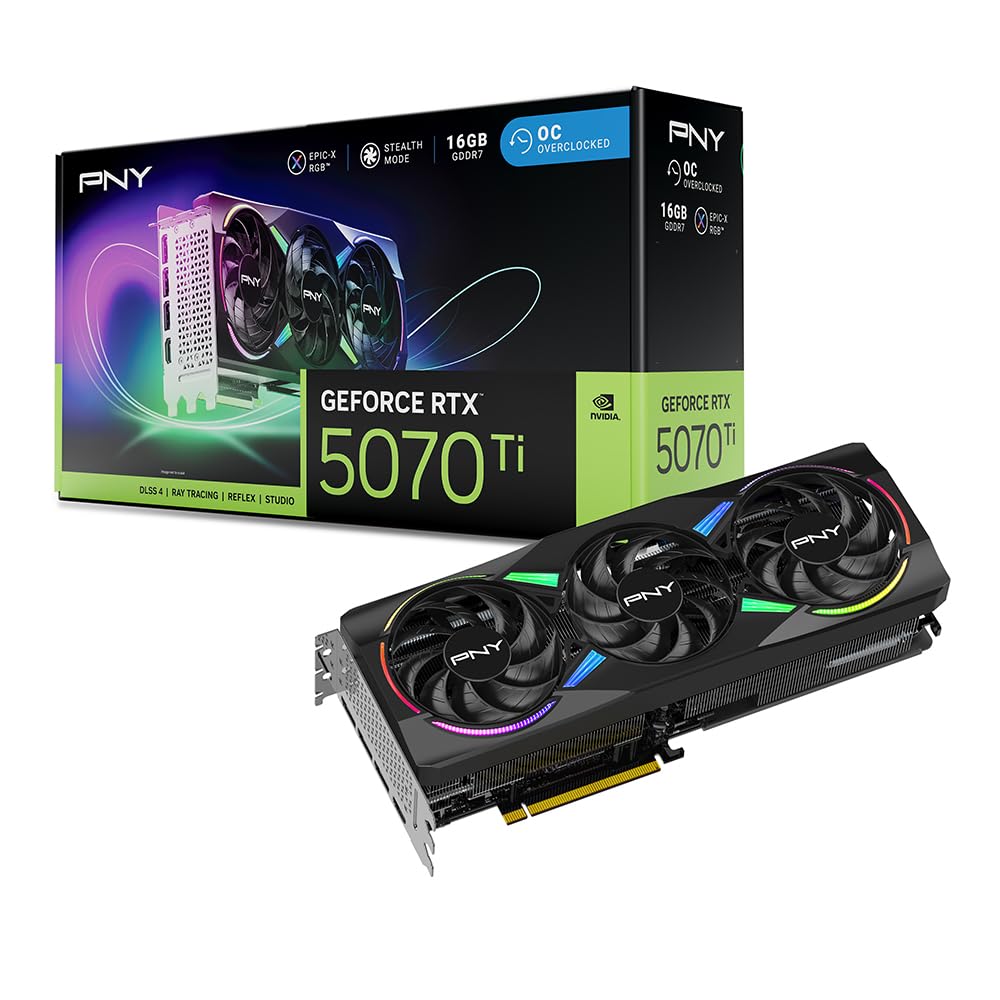
The best-built card in the RTX 50-series lineup, with a cooler that stays silent under heavy AI loads.
Build quality is what wins people over here — 20 owners call it the top trait, praising a cooler with “numerous radiator fins” that keeps things quiet even under heavy load. The card draws up to 300W max with no coil whine, and owners note it hits or beats average benchmarks across the board. Its 16GB of GDDR7 memory on a 256-bit bus gives it the same memory headroom as the GIGABYTE 5070 Ti.
The boost speed hits 2640 MHz with a core clock at 2295 MHz, and the fifth-gen Tensor Cores deliver the AI horsepower for DLSS 4 and creative workflows. Owners mention it stays stable even on older platforms like a 5800X3D. The RGB is bright and adds serious flair, though not as customizable as some rivals’ software.
The sensible verdict: it’s a premium-priced card, but the cooling and build quality justify the cost for most owners. It’s large — around 12 inches and thick — so case compatibility is a must-check. You’ll need a new PSU with the included 16-pin to three 8-pin power cable, and owners stress using only the included cables to avoid component damage.
What Shines
- Build quality praised by 20 owners as the standout trait
- Quiet operation even under heavy load with no coil whine
- Stable on older platforms like X470 with 5800X3D
Before You Buy
- Large size demands careful case compatibility checks
- RGB customization is limited compared to some rivals
Reach for this if: you want the best-built 5070 Ti with premium cooling for long AI or gaming sessions.
Pass if: your case is compact or you want deep RGB customization.
6. GIGABYTE GeForce RTX 4070 Ti Super Eagle OC 16G
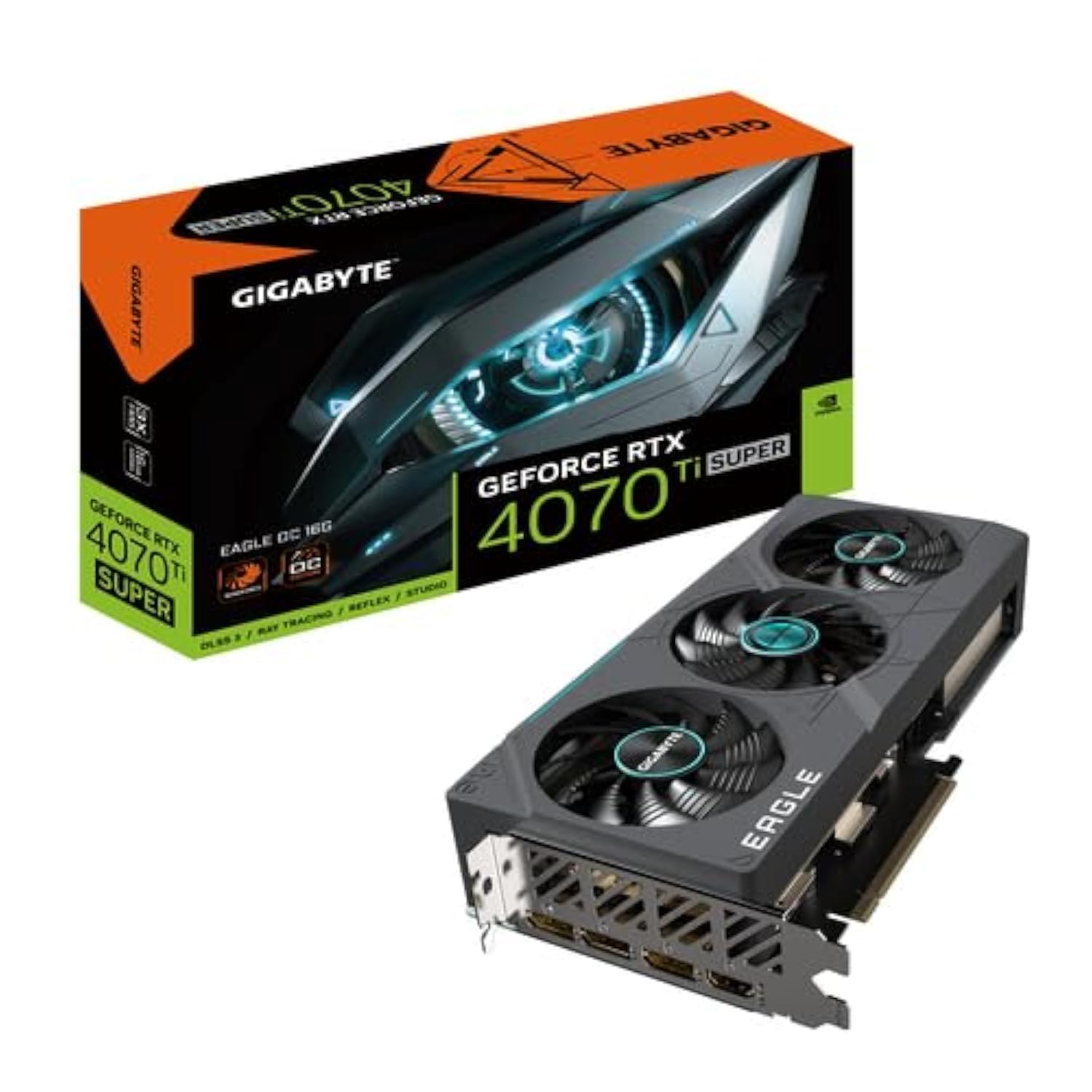
The stable diffusion workhorse with 16GB of VRAM that keeps your generations flowing smoothly.
Performance leads the conversation at 23 mentions, with owners reporting flawless 1440p gaming and one hitting 165 fps at ultra-high resolution. The 16GB of GDDR6X memory (a fast type of video memory) on a 256-bit bus (a wide data path that moves lots of data at once) is the balance for Stable Diffusion — owners note it’s sufficient when a minimum of 12GB is needed, pulling 150-450W during generation at full GPU utilization. It even handles 4K gaming and light mining on the side.
The 3X WINDFORCE fans keep temperatures in the 60s even at full load in FurMark, and the card runs quiet while doing it. The Dual BIOS and protection metal backplate add durability, plus an anti-sag bracket is included. GIGABYTE backs it with a 4-year warranty (with online registration), which is longer than most rivals offer.
At 1400g and 10.27″L x 4.96″W, it’s more compact than the 5070 Ti options, reducing weight and crack risk in your PCIe slot. The value gets mixed reviews — some call it pricey, others find it a great deal. For creators who need reliable VRAM for AI generation without jumping to a 5090, this is a smart pick.
Owners Applaud
- 16GB VRAM is ideal for Stable Diffusion workloads
- Cooling holds 60s at full load in FurMark stress test
- 4-year warranty with online registration
The Catch
- Value for money draws mixed reviews
- Less VRAM (16GB vs 24GB) than some pricier rivals
Best for: creators running Stable Diffusion or other AI generation who want a reliable, cool card with 16GB VRAM.
Skip if: you want to future-proof for very large AI models — you’ll want a 5090 or professional card.
7. NVIDIA GeForce RTX 5080 Founders Edition

The reference card that delivers flagship-tier Blackwell performance with a surprisingly light footprint.
Card quality is the most-praised trait here, with 12 owners describing it as “perfection” — it’s a premium-built reference card that stays cool under demanding loads. The RTX 5080 FE pushes a boost clock of 2806 MHz with 16GB of GDDR7 memory on a 256-bit bus, making it a serious AI and 4K gaming contender. Reviewers point out ~200 FPS in most games at max settings, a huge upgrade from the RTX 4070 FE.
The Blackwell architecture brings fifth-gen Tensor Cores for FP4 and DLSS 4, plus NVIDIA Reflex 2 with Frame Warp for competitive play. It’s light at just 2 pounds and needs no support bracket, though it is bulky. Temps stay great even in graphically demanding games, and one owner plans to undervolt for efficiency and lifespan.
Value is the divide — some call it worth the price, others find it pricey, especially since availability can attract scalpers. The 3840×2160 max resolution is a bit lower than other cards in this list. If you can find it at a fair price, this is the definitive mid-flagship AI card for serious users.
Flagship Strengths
- Premium build quality described as “perfection”
- Light at 2 pounds with no support bracket needed
- ~200 FPS in most games at max settings
Be Mindful
- Value is polarizing — some find it too pricey
- Lower max resolution (3840×2160) than some rivals
Grab it for: a flagship Blackwell card with top-tier quality, light weight, and excellent cooling.
Wait if: you’re price-sensitive and can’t find it near MSRP — scalpers inflate the cost.
8. MSI Gaming RTX 5080 16G SUPRIM SOC

The overclocking behemoth that handles anything you throw at it while staying cool and quiet.
Owners describe this as “everything you would expect from a GPU worth over 1.5k” — quiet, premium materials, cool, and amazing performance. The SUPRIM SOC pushes a 2760 MHz boost clock with 16GB of GDDR7 on a 256-bit bus, making it one of the fastest 5080 variants available. It’s built on NVIDIA’s Blackwell architecture with DisplayPort x 3 (v2.1a) and HDMI 2.1b for maximum display flexibility.
The cooling is a highlight — owners note it “overclocks great while the temperatures remain cool” because it uses the same massive cooler as the 5090. That means you get flagship-tier thermal headroom in a card that’s still reasonably sized. It supports up to 7680 x 4320 resolution, so it’s ready for 8K displays.
The honest trade-off: it’s heavy at 6.8 pounds and needs serious power. Owners insist on pairing it with a PSU of at least 1000W to get the most out of it. If you have a sturdy case and a beefy power supply, this is the 5080 to beat.
What Makes It Special
- Same cooler as the 5090 keeps temps cool even overclocked
- Premium materials and quiet operation
- 2760 MHz boost clock for extreme performance
Requirements
- Heavy at 6.8 pounds — needs a sturdy case
- Demands a PSU of at least 1000W
Pick this up if: you want the absolute best 5080 with overclocking headroom and the same cooler as the 5090.
Only if: your case and power supply can handle a 6.8-pound card drawing serious watts.
9. MSI Gaming RTX 4080 Super 16G Gaming X Slim

The previous-gen flagship that still delivers buttery-smooth 4K with whisper-quiet acoustics.
Performance is what wins owners over, with one saying it “works wonders on new and old titles” and another noting it’s “notably smoother, more consistent frame times” than a 4070 Super. The 4080 Super pushes a 2625 MHz boost clock with 16GB of GDDR6X memory on a 256-bit bus running at 23 Gbps. Shoppers say no coil whine even at 100% usage in 4K at 120-144fps.
The “Slim” design lives up to its name, being more compact than many rivals while still running cool with three fans. It includes an anti-sag stand and is compatible with 600W 12VHPWR connectors. Owners upgrading from a 3080 Ti report a 20-30% FPS boost in most games while running cooler and quieter.
The one consistent complaint is the included sag bar, which one owner calls “useless” for not matching up properly. Noise level gets mixed feedback — most call it super quiet, but a few find the fans a little loud. If you’re on an older Ada Lovelace platform or want a proven 4K card, this is a solid choice.
Owners Love
- No coil whine even at 100% usage in 4K 120-144fps
- 20-30% FPS boost over RTX 3080 Ti
- Compact “Slim” design that still runs cool
Minor Gripes
- Included sag bar doesn’t align well for some setups
- A few owners find the fans slightly loud
Choose this for: a proven, quiet 4K performer with smooth frame pacing and easy installation.
Consider alternatives if: you want the latest Blackwell features — this is Ada Lovelace architecture.
10. ASUS ROG Astral GeForce RTX 5090 OC Edition

The 4-fan cooling monster built for sim racers and AI power users who demand flawless performance.
Performance is the overwhelming favorite trait here, with 61 owners making it the top mention. The quad-fan design boosts airflow and pressure by up to 20%, and the patented vapor chamber with milled heatspreader keeps GPU temperatures low even under extreme loads. Buyers report it excels in triple 1440p sim racing with max settings, ray tracing, and OBS streaming without lag — a genuinely demanding workload.
The 32GB of GDDR7 VRAM future-proofs you for AI and Unreal Engine games, and the 3.8-slot design packs a massive heatsink with a phase-change GPU thermal pad. Owners running a 49-inch ultrawide see ~230 FPS, while God of War and Horizon Zero Dawn hit ~130 FPS with DLSS. It’s an absolute monster for multi-4K sim setups.
The honest reality: this is not for casual use. Owners stress it’s for power users only, requiring an E-ATX case and a 1200W PSU due to 600W draw. It’s 5 pounds and 14.1″L x 5.9″W, so case space is critical. Value is mixed — some call it worth every penny, others question the premium — but for extreme AI workloads and multi-monitor sim racing, nothing else comes close.
Owners Rave About
- Excellence in triple 1440p sim racing with streaming
- 32GB VRAM future-proofs for AI and UE games
- Quad-fan design boosts airflow by up to 20%
Demanding Requirements
- Requires E-ATX case and 1200W PSU minimum
- Massive 3.8-slot size limits compatibility
Built for: power users with multi-4K sim setups and serious AI workloads who need every drop of performance.
Not for: casual gamers on single monitors — a 5080 or 5070 will serve you well for less.
11. PNY NVIDIA RTX A6000 48GB

The professional workhorse that runs large language models with 48GB of VRAM and quiet efficiency.
Owners call it excellent for AI, with the high VRAM solving memory issues that plague consumer cards. The 48GB of GDDR6 memory is the headline — it’s got triple the capacity of a 16GB gaming card, letting you run large LLMs and inference workloads that would crash anything else. It’s based on NVIDIA’s Ampere architecture with a PCI Express x16 4.0 interface.
For AI LLM inferencing, owners say it’s excellent and recommend it for convenience and energy savings — drawing roughly 150W less peak power than a 3090 while staying quiet under load. The 4x DisplayPorts support up to 7680 x 4320 resolution, and it comes with DP to HDMI and DVI adapters in the box plus a 3-year manufacturer’s warranty.
The honest trade-offs: it’s slower than a 3090 Ti for rendering and a 4090 beats it for that purpose. It’s priced high, and owners note it’s not for consumer gaming — it’s a professional deep learning, AI, and CAD tool. If your work needs massive VRAM without the gaming performance, this is a smart buy.
Professional Strengths
- 48GB VRAM handles large LLMs with ease
- Roughly 150W less peak power than a 3090
- Quiet under load with 3-year warranty
Know Before Buying
- Slower than a 3090 Ti for rendering tasks
- Not designed for consumer or gaming use
Reach for this if: your daily work is AI inference and you need massive VRAM without the gaming markup.
Look elsewhere if: you’re a gamer or need fast rendering — a 4090 or professional Blackwell card will serve you better.
12. NVIDIA RTX PRO 6000 Blackwell Workstation Edition

The 96GB VRAM monster that runs a 70B parameter LLM locally while driving 8K displays.
Owners describe it as “workstation GPU supremacy level 100” — a beast for LLMs, Comfy, OCR, and TTS workloads, running 70B parameter models with ease. The 96GB of GDDR7 memory with 1.8 TB/s bandwidth is the defining spec: you can fine-tune AI models locally, explore large-scale VR environments, and drive massive multi-app workflows without hitting memory walls.
The 5th Gen Tensor Cores deliver up to 3X the performance of the previous generation with FP4 precision support for faster AI model processing and reduced memory usage. It’s built on the Blackwell architecture with a double-flow-through cooling design that sustains peak performance under 600W power loads, featuring a single 600W connector in a 2-slot design. DisplayPort 2.1 drives up to 8K at 240 Hz and 16K at 60 Hz for precision work.
The honest reality: Blackwell software support is still maturing, especially on Linux, requiring the latest 575+ drivers. One owner noted hot air exhausts into the case interior rather than the rear. While one reviewer had a negative experience with a reseller, the card itself is praised as “an absolute beast” for AI work. This is a professional investment, not a consumer purchase.
The Powerhouse
- 96GB VRAM runs 70B parameter LLMs locally
- Universal MIG divides the card into isolated instances
- Drives 8K at 240 Hz and 16K at 60 Hz
Consider This
- Blackwell software support is still maturing on Linux
- Hot air exhausts into the case interior
Invest in this if: you need to run massive AI models locally with professional-grade reliability.
Pass if: you need something for gaming or light AI work — the price and complexity are for serious professionals only.
Understanding the Specs
VRAM Capacity
VRAM capacity dictates the maximum AI model size you can run. A 16GB card handles most consumer AI workloads and 4K gaming, while 48GB or 96GB professional cards run large language models. Think of VRAM as your workspace — bigger lets you handle bigger jobs.
Memory Bus Width
The bus width, measured in bits, controls how much data moves between the GPU and its memory each cycle. A wider bus (256-bit vs 128-bit) means faster data throughput, which directly impacts AI training speed and high-resolution texture streaming. The GIGABYTE RTX 5070 Ti’s 256-bit bus is a full 2.0x wider than the MSI RTX 5060 Ti’s 128-bit.
Boost Clock Speed
This is the maximum speed the GPU cores run at under load, measured in MHz. A higher boost clock means faster compute, whether you’re rendering frames or crunching AI tensors. The ASRock RX 9070 XT’s 2970 MHz boost beats the ZOTAC RTX 4070’s 2490 MHz by a 19% margin.
Tensor & AI Accelerators
These dedicated cores handle AI-specific math like matrix multiplication. NVIDIA cards have Tensor Cores, while AMD has AI Accelerators. More of these mean faster DLSS upscaling and quicker AI model inference, but NVIDIA’s CUDA software ecosystem is far more mature for AI development.
FAQ
How much VRAM do I really need for running AI models?
Is NVIDIA or AMD better for AI workloads?
Can a gaming graphics card handle AI training?
What’s the difference between GDDR6, GDDR6X, and GDDR7 memory?
How do I know if my power supply can handle a new GPU?
Will an AI graphics card work in my current computer case?
Is DLSS worth it for AI-assisted gaming?
What’s the difference between a gaming card and a workstation card for AI?
Do I need CUDA cores or Tensor cores for AI?
Final Thoughts: The Verdict
If you want one dependable pick, the ai graphics card winner is the ASRock Radeon RX 9070 XT Steel Legend because it balances 16GB of VRAM (video memory that stores textures and data), a 2970 MHz boost clock, and quiet cooling at a price that outperforms many NVIDIA rivals in pure gaming. If you want the best CUDA ecosystem for AI development and a card that hits 168 FPS on 4K OLED, grab the GIGABYTE GeForce RTX 5070 Ti. And if you’re running massive AI models or extreme multi-monitor sim racing, the ASUS ROG Astral 5090 is the one to reach for — just make sure your case and PSU can handle it.
How We Picked
We do not accept paid placement. Every pick is matched to a real buyer and a real use-case; we do not hands-on test units.
Sources & Methodology
Specifications: manufacturer listings and product documentation. Review insights: verified customer reviews, as of August 2026. Pricing: not shown on this page (it changes often); check the current price via the retailer link.
As an Amazon Associate, FitlyFast earns from qualifying purchases. This does not affect which products we feature.