
Our readers keep the lights on and the weekend projects moving. As an Amazon Associate, I earn from qualifying purchases.
The toy aisle has changed. A plastic button that beeps when pressed no longer qualifies as interactive. Today’s best picks use machine vision, voice recognition, and programmable logic to respond to a child’s touch, gesture, or code. The result is a plaything that adapts, learns, and grows with its user rather than being discarded after a single afternoon.
I’m Rikta — the founder and writer behind FitlyFast. I’ve spent years tracking the hardware and firmware inside the smart-toy market, looking at sensor arrays, battery architecture, and the real-world educational scaffolding behind each unit.
Parents want a product that feels magical but doesn’t frustrate, teaches without lecturing, and holds up to daily abuse. This guide breaks down the top contenders across age groups and skill levels to help you find the very best ai toys for your child’s specific needs and interests.
How To Choose The Best AI Toys
Not every talking robot offers real AI. Many rely on a fixed library of pre-recorded responses and simple timer-based tricks. Before you click buy, understand the three pillars that separate a gimmick from a genuine learning tool.
Sensor Quality and Interactivity Depth
A toy that only reacts to a single button press is not interactive in any meaningful sense. Look for multiple sensor types: infrared for motion tracking, capacitive touch for recognizing strokes or pats, and microphones for voice commands. The best units combine these inputs to create emergent behaviors — a robot that wags its tail when petted but walks away when spoken to harshly, for example. The number of discrete emotional or action states a toy can express directly determines how long a child stays engaged.
True Learning vs. Scripted Responses
Real machine learning requires the device to adapt its behavior over time. Entry-level kits may use a simple decision tree that feels interactive on day one but becomes predictable by day three. Premium platforms, especially those supporting Scratch or Python via an app, allow the child to write routines that the robot then executes and refines. A toy that can be programmed is a toy that can be outgrown — and that is the point.
Build Quality and Assembly Demands
A robot that shatters after a single drop off a bunk bed is not a robot — it is a frustration. Look for aluminum chassis or thick ABS plastic in kits intended for ages eight and up. For younger children, pre-assembled units with rubberized exteriors survive tumbles better. Also assess the assembly time honestly: a 478-piece build may be a weekend project for a patient ten-year-old, but it will overwhelm a six-year-old without adult help. The sweet spot is a thirty-minute build that teaches structural thinking without causing tears.
Quick Comparison
On smaller screens, swipe sideways to see the full table.
| Model | Category | Best For | Key Spec | Amazon |
|---|---|---|---|---|
| Makeblock mBot2 | Coding Robot | Learning Scratch/Python | 10+ sensors, aluminum chassis | Amazon |
| Thames & Kosmos Kai | AI Builder Kit | Intro to machine learning | Gesture & sound machine learning | Amazon |
| Opmind 5in1 Set | STEM Building Set | Hands-on assembly & coding | 478 pieces, 5 models | Amazon |
| EMOPET EMO | Desktop Companion | ChatGPT conversation & dancing | ChatGPT-enabled, wide-angle camera | Amazon |
| VATOS Robot Dog | Interactive Pet | Young children, pet simulation | 17 functions, touch & follow | Amazon |
| RIVGOT Drawing Robot | Art Machine | Early drawing skills | 150 drawing cards, voice guide | Amazon |
| ENERGIZE LAB Eilik Pair | Emotion Pet | Emotional connection & mini-games | Touch sensors, no app needed | Amazon |
In‑Depth Reviews
1. Makeblock mBot2 Coding Robot
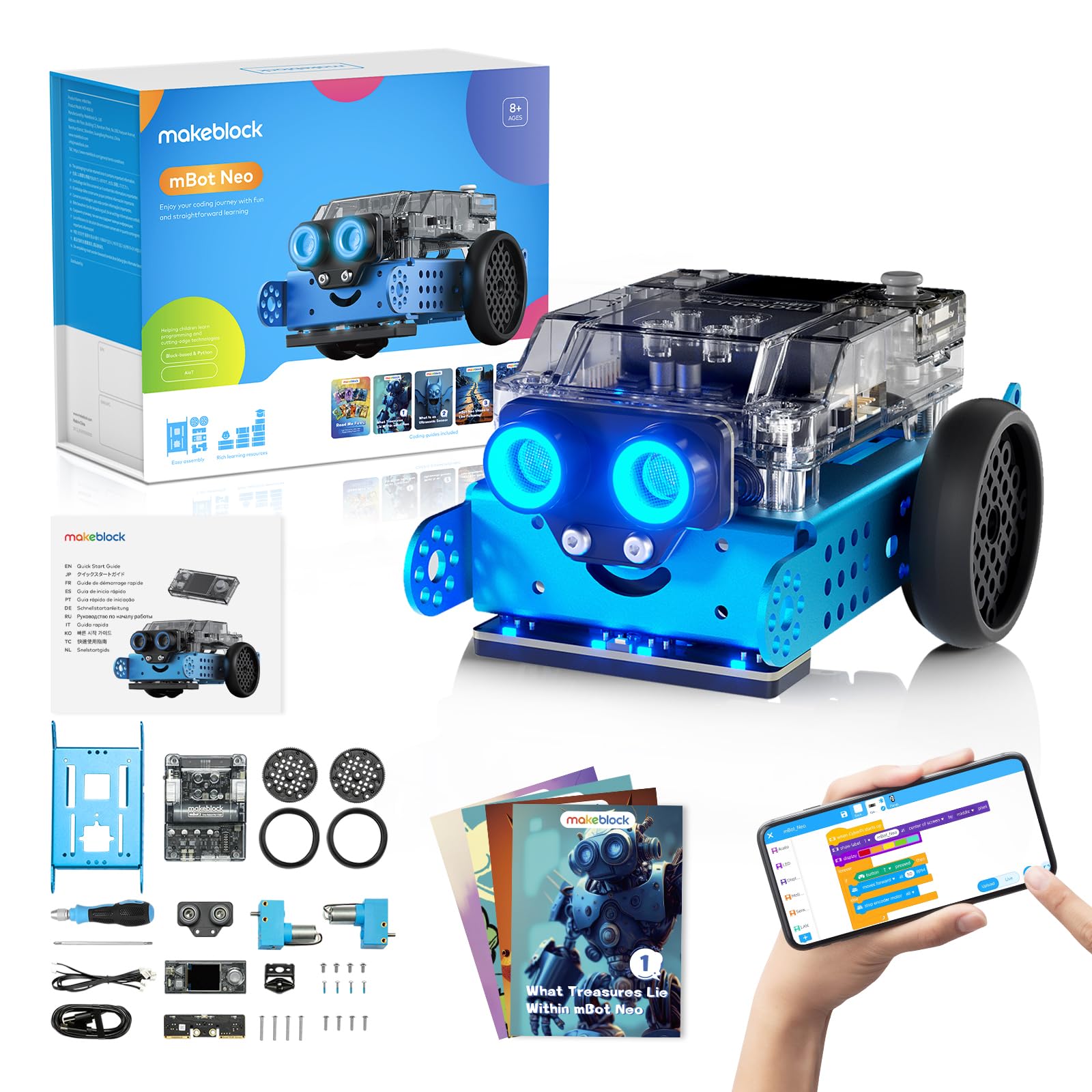
The mBot2 is the gold standard for a reason. Its blue anodized aluminum frame withstands classroom abuse, and the modular mBuild platform supports over thirty expansion modules including temperature sensors, LED matrices, and ultrasonic rangefinders. Assembly takes about thirty minutes, and the step-by-step printed guide makes the process genuinely educational rather than frustrating.
On the coding side, the robot ships with four project cards that teach block-based programming, but the real power lies in the mBlock software. Kids can transition from Scratch blocks to Python without changing hardware. The included Wi-Fi module enables multiple mBot2 units to share the same program simultaneously — a feature that makes it a favorite for after-school robotics clubs.
Voice commands work reliably even for non-readers, and the five-hour battery life means a full afternoon of play without hunting for a charger. The only minor drawback is that the basic kit does not include a Bluetooth controller, so remote-control fans should budget for that extra accessory.
Why it’s great
- Rugged aluminum build survives drops and classroom use.
- Scratch-to-Python transition without changing hardware.
- Five-hour battery and Wi-Fi for multi-unit coordination.
Good to know
- Bluetooth controller sold separately for remote driving.
- Python syntax may require adult help for absolute beginners.
2. Thames & Kosmos Kai Robot

Kai is a six-legged walker that genuinely teaches machine-learning concepts rather than just claiming to. The included app lets you train the robot to recognize specific gestures and sounds, then assign unique movement responses to each trigger. This is not a fixed library — the robot’s behavior changes based on what you teach it.
The 64-page full-color manual is the standout feature here. It walks through the history of AI in a comic-book format that makes concepts like neural networks and training data accessible to a ten-year-old. The building process involves metal screws and axles rather than snap-together plastic, which adds structural rigidity but demands patience — expect three to four hours for a careful first build.
The 2023 Specialty Toy of the Year award validates its educational pedigree. However, the assembly complexity means it is best suited for a parent-child project rather than independent play for younger kids. Fragile plastic gear housings require careful alignment during construction.
Why it’s great
- Real gesture and sound machine learning via companion app.
- Comic-style manual makes AI theory genuinely engaging.
- Award-winning design with robust educational framework.
Good to know
- Assembly takes 3–4 hours and almost always requires adult help.
- Small metal parts and fragile gears need careful handling.
3. Opmind 5in1 STEM AI Robot Set

The Opmind 5in1 set offers excellent value for families who want a long building project followed by robust coding play. The 478 pieces can be reconfigured into five different models — animal snails, AI robots, and engineering vehicles — each with its own remote and app-controlled behaviors. The instruction booklet is clear but does not hold your hand; some steps require interpreting exploded views that an eight-year-old will find challenging without supervision.
Once built, the app unlocks driving simulation, gravity gyroscope control, navigation path programming, and pet-traction modes that teach directional logic. The expressive snail model is a crowd-pleaser: its eyes display curiosity, excitement, and calmness, and a single mute button silences the sound effects for quieter play.
The rechargeable lithium-ion battery is included, which is a welcome relief in this mid-range price tier. Build quality is solid ABS plastic that holds up well to repeated reconfigurations, though the snap-fit joints can be tight and may require an adult’s stronger fingers to separate.
Why it’s great
- Five different builds from a single piece set boosts replay value.
- App features driving simulation and path programming for logic learning.
- Rechargeable battery included, no constant AA purchases.
Good to know
- Snap-fit joints can be tight; adult help needed for disassembly.
- Instructions assume basic building experience, not beginner-friendly.
4. EMOPET EMO Desk Robot

EMO is the closest thing to a sci-fi pet on this list. Its wide-angle camera and network-connected ChatGPT integration allow for conversations that go beyond scripted one-liners — ask it about the weather, tell it a joke, or just chat. The robot responds with context-aware personality that evolves over time through firmware updates.
The hardware sensors are equally impressive. EMO recognizes finger-gun gestures for a “shoot” game, reacts to being rubbed or shaken, and even simulates getting “sick” when the weather changes, encouraging a nurturing play pattern. The EMOPET app tracks an achievement system that records every dance move learned or birthday celebrated with the robot.
Reliability is the main concern. Voice recognition can struggle in noisy rooms, and some users report the robot ignoring commands after the first day. Battery life is moderate, and the charging cycle is slower than ideal. When it works, it is genuinely delightful; when it glitches, it can frustrate a child who expected a seamless experience.
Why it’s great
- ChatGPT conversation creates open-ended, evolving dialogue.
- Gesture recognition and touch sensors enable rich play patterns.
- Frequent firmware updates add new behaviors over time.
Good to know
- Voice recognition degrades in rooms with background noise.
- Battery drains faster than competitors; slow recharge.
5. VATOS Remote Control Robot Dog

The VATOS Robot Dog is a pure entertainment bot aimed at younger children ages three to eight. Its seventeen functions include automatic movement every five seconds when idle — the dog will perform tricks, dance to built-in music, and respond to chin touches with random reactions. The three infrared sensors allow it to follow the remote control’s signal, creating a chase game that toddlers adore.
Durability is a real strength here. Customer reports of the dog surviving falls off bunk beds and down stairs without broken parts suggest thick ABS plastic and a forgiving internal structure. The rechargeable battery keeps playtime going without constant battery swaps, and the lack of small assembly steps means it works right out of the box.
The limitations are predictable for this tier. The “programming” feature is really just a record-and-playback sequence of remote commands, not true coding. Sound quality is basic, and the plastic body, while tough, feels lightweight in hand. Older kids will exhaust the novelty after a few sessions.
Why it’s great
- Extremely durable build survives drops and rough play.
- Infrared follow mode creates engaging chase games.
- Ready to play immediately, no assembly needed.
Good to know
- Programming is simple playback, not real coding logic.
- Older children lose interest after a few sessions.
6. RIVGOT Drawing Robot

The RIVGOT Drawing Robot takes a completely different approach to AI: instead of building or coding, it guides a child step-by-step through the process of drawing. The robot reads the card you insert and then narrates each stroke — “draw a circle, now add two dots” — while the child follows along on the reusable drawing board.
The set includes 150 cards organized by theme, 12 colorful markers, 5 drawing pens, and a Type-C charging cable. The voice guidance is genuinely interactive: it pauses for the child to complete each step before moving to the next. Built-in music makes the sessions feel more like a game than a lesson, and the Montessori-style approach builds hand-eye coordination without forcing outcomes.
Markers dry out quickly if the caps are not replaced tightly, which is a common complaint. Battery life is moderate — expect around two hours of continuous use. The white plastic body is lightweight but not rugged, so it is best kept on a desk rather than dropped in a toy bin.
Why it’s great
- Voice-guided drawing builds fine motor skills and confidence.
- 150 themed cards offer months of varied content.
- Reusable board and included markers reduce consumable costs.
Good to know
- Markers dry out if caps are not immediately replaced.
- Battery life is moderate at roughly two hours per charge.
7. ENERGIZE LAB Eilik Pair

The Eilik pair is the most emotionally sophisticated entry on this list. Each small desktop bot has touch sensors on its head, belly, and back that trigger distinct emotional responses — petting the head makes it happy, tapping the back makes it grumpy. The real magic happens when two Eiliks meet: they chat, play mini-games, fight, and even throw a party with a larger group.
The hardware is pre-assembled and requires no app to function. This reduces screen dependency significantly — kids simply turn them on and interact. The firmware updates over Wi-Fi and adds new emotions and games. Build quality is excellent, with a soft-touch plastic exterior and bright OLED eyes that convey a surprising range of expressions.
The pair is sold as a set, which is the only way to unlock the social behaviors that make these toys compelling. A single Eilik is a cute but limited desk ornament; two create a dynamic relationship that children become genuinely invested in. Battery life is good at around four hours, and the charging dock keeps the units tidy.
Why it’s great
- Two units create emergent social play without any app.
- Touch sensors on multiple body zones enable nuanced interaction.
- Firmware updates keep adding emotions and mini-games.
Good to know
- Single unit is far less engaging; the pair is the real experience.
- Premium price tier may feel steep for a non-educational toy.
FAQ
At what age can a child start using a programming robot?
Does a ChatGPT-enabled robot require a constant internet connection?
How long do the batteries typically last on a robotic toy?
Can two different brand AI toys interact with each other?
Final Thoughts: The Verdict
For most users, the ai toys winner is the Makeblock mBot2 because it combines a rugged aluminum build, a genuine Scratch-to-Python learning path, and classroom-level durability at a mid-range price, making it the longest-lasting investment. If you want a toy that teaches machine-learning concepts through a guided building experience, grab the Thames & Kosmos Kai. And for a ready-to-play emotional companion that requires zero screen time, the ENERGIZE LAB Eilik pair delivers social interaction that captivates both children and adults.