
Our readers keep the lights on and the weekend projects moving. As an Amazon Associate, I earn from qualifying purchases.
The fundamental promise of an AI tracking gimbal is liberation from the screen. You want your camera to follow your movement, or the movement of a subject, without needing to pause and tap a smartphone display to re-center the frame. The gap between true, hands-free autonomy and a gimmicky lock-on that loses focus with the first quick turn is vast, defined entirely by the quality of the vision sensor and the sophistication of the tracking algorithm. This guide breaks down the hardware specs—from AI pixel density to motor torque—that determine whether a gimbal earns its tracking badge or just markets it.
I’m Rikta — the co-founder and writer behind FitlyFast. I’ve spent hours cross-referencing the technical specifications of nine distinct gimbals, analyzing payload limits, battery cells, and the real-world implications of their software-licensing models to find the units that actually deliver on the intelligence in their name.
This analysis focuses on units that genuinely free you from the smartphone tether, providing a curated list of the best ai tracking gimbal options for solo creators and dynamic shooting scenarios.
How To Choose The Best AI Tracking Gimbal
The AI tracking gimbal market has split into two distinct camps: units that require a proprietary app to activate tracking, and units with a dedicated hardware vision sensor that works with any app, or with no app at all. The hardware-native units are the only ones that truly deliver hands-free operation, as they lock onto a subject via a gesture and continue to track even if you switch to the native camera app for higher-bitrate recording. Do not confuse Bluetooth remote shutter control with AI tracking—one simply triggers the record button, while the other actively moves the motor to keep the subject framed.
Vision Sensor vs. Software Lock-On
The core differentiator is whether the gimbal carries its own camera sensor for tracking. Gimbals with a dedicated magnetic AI module (like those from Hohem and ZHIYUN) can initiate tracking with a simple hand gesture and do not depend on the host phone’s camera being active in a specific app. This matters because third-party camera apps like Filmic Pro or Blackmagic Cam often bypass the gimbal manufacturer’s tracking software entirely, rendering app-based tracking useless. Always check if the tracking works with the phone’s native camera application. A hardware sensor ensures that your footage avoids the compression artifacts often introduced by live-streaming data through the gimbal app.
Payload, Motor Torque, and Lens Compatibility
Adding weight shifts the center of gravity and stresses the motors, directly impacting tracking smoothness. A gimbal rated at 500 grams of payload will struggle to maintain a smooth follow when burdened by a large smartphone in a thick case plus a clip-on anamorphic lens. For creators who frequently attach modular accessories, look for a payload ceiling of at least 500 grams from the baseline. More torque translates to less motor whine and fewer recalibration beeps during rapid pans. The orthogonal motor designs found on prosumer gimbals keep the motors out of the wide-angle frame while offering the stiffness needed for 360° infinite rotation without drifting.
Battery Architecture and Charging Protocols
AI tracking modules draw a constant trickle of power. A unit that claims 13 hours of battery life under light use may drop to 6 hours if the AI sensor and the fill light are active simultaneously. Check whether the gimbal supports pass-through charging—the ability to power the gimbal while it is also charging the phone. This feature is critical for multi-hour live streams or vlogging marathons. Some gimbals now include a USB-C port that allows the gimbal itself to act as a power bank, which is a useful contingency for an ever-draining smartphone battery during a day-long shoot.
Software Ecosystem and Licensing
Many gimbal manufacturers have pulled their companion apps from certain app stores due to platform compatibility disputes. DJI, for example, no longer has the DJI Mimo app on Google Play. If the gimbal’s advanced features—like motion-lapse or panorama stitching—require a specific app, verify that the latest APK is easily sideloadable or available directly from the manufacturer’s website. Insta360, by contrast, has leaned into Apple’s DockKit protocol, allowing the gimbal to be recognized natively by over 200 iOS apps without needing the Insta360 app for basic tracking. Choose based on whether you prefer a closed, feature-rich app ecosystem or an open-hardware approach that prioritizes compatibility.
Quick Comparison
On smaller screens, swipe sideways to see the full table.
| Model | Category | Best For | Key Spec | Amazon |
|---|---|---|---|---|
| Hohem iSteady M7 | Premium | Solo creators needing a detachable touchscreen | 500g payload capacity | Amazon |
| Insta360 Flow 2 Pro | Mid-Range | iOS users wanting app-native tracking | Apple DockKit compatible | Amazon |
| DJI Osmo Mobile 8 | Mid-Range | Vloggers with built-in audio needs | Mic Mini Transmitter included | Amazon |
| ZHIYUN Smooth 5S AI Pro | Mid-Range | Low-light shooters needing fill light | 360° unlimited rotation | Amazon |
| FeiyuTech SCORP Mini-3-Pro | Premium | Multi-device shooters (camera + phone) | 18m AI tracking distance | Amazon |
| GoPro Fluid Pro AI | Premium | Action camera users | Interchangeable mounts | Amazon |
| DJI RS 4 Mini Combo | Premium | Mirrorless camera operators | 2kg payload capacity | Amazon |
| Hohem iSteady V3 | Entry-Level | Budget-conscious travelers | Magnetic AI tracker | Amazon |
| AKASO 360 | Niche | 360° action cam enthusiasts | 5.7K 360° video | Amazon |
In-Depth Reviews
1. Hohem iSteady M7

The Hohem iSteady M7 addresses the single biggest pain point for solo filmmakers: the inability to monitor the frame while positioned away from the gimbal. Its detachable 1.4-inch full-color touchscreen remote serves as a live viewfinder from up to 32 feet away, allowing you to double-tap the screen to lock tracking on a subject without touching the phone. This hardware-native remote bypasses the need for a second device or a constant app connection, making it a true production tool for one-person crews.
Under the hood, the M7 packs a 500-gram payload capacity with three expansion ports, meaning you can attach a shotgun microphone and an external LED without overwhelming the motors. The upgraded magnetic AI tracker uses a higher-density pixel array for lock-on, and it works with the phone’s native camera—not just the Hohem Joy app. The built-in aluminum extension rod extends to 7.6 inches, enabling overhead shots or ground-level pet footage without changing your posture.
The RGB/CCT fill light is a strategic advantage for event shooters who need to adapt to changing color temperatures. You can shift from cool white to candlelight warm without fumbling for gels. Users have noted that the motor can introduce a low-frequency rumble into the phone’s built-in microphone during heavy panning, so pairing this gimbal with an external Bluetooth mic is wise. The combination of a touchscreen remote, high payload, and app-free tracking justifies its place at the top of this list.
Why it’s great
- Detachable touchscreen remote with live AI tracking view from 10m.
- Robust 500g payload supports accessory-heavy rigs.
- RGB fill light with remote color/brightness control.
Good to know
- Motor whine can bleed into the phone’s internal mic.
- The remote is magnetic and can be dislodged if bumped.
2. Insta360 Flow 2 Pro

The Insta360 Flow 2 Pro takes a fundamentally different approach to AI tracking by leveraging Apple’s DockKit protocol. Instead of requiring its own app for tracking, the gimbal integrates directly into the iOS camera API, making it compatible with over 200 third-party apps including FaceTime, Zoom, and Filmic Pro. This is the only gimbal on this list that can track a subject during a live video call without any special software bridge, which is a game-changer for business users who stream live demos or webinars.
The hardware is equally impressive in its compactness. Unfolded, it offers a 360° infinite pan rotation, meaning you can spin continuously without hitting a mechanical stop. The magnetic phone clamp snaps on quickly, and the built-in tripod and selfie stick eliminate the need for separate accessories. The 10-hour battery capacity is standard for this class, but the unit also functions as a power bank for your phone, extending its usefulness during all-day shoots.
Where the Flow 2 Pro diverges from competitors is its commitment to video quality. It supports Dolby Vision and Apple ProRes recording natively, because the tracking does not compress the video stream through an intermediate app. The Active Zoom Tracking feature is a first for the industry—it can maintain subject lock even at 15x digital zoom, which is useful for stage performances or sports from a distance. The main trade-off is that the full feature set is iOS-centric, with Android users losing the DockKit integration and much of the third-party app compatibility.
Why it’s great
- Native Apple DockKit works with 200+ iOS apps without a gimbal app.
- 360° infinite pan with no rotation limit.
- Active Zoom Tracking maintains focus up to 15x zoom.
Good to know
- Android users miss out on the full DockKit feature set.
- No built-in USB-C audio passthrough on the clamp.
3. DJI Osmo Mobile 8
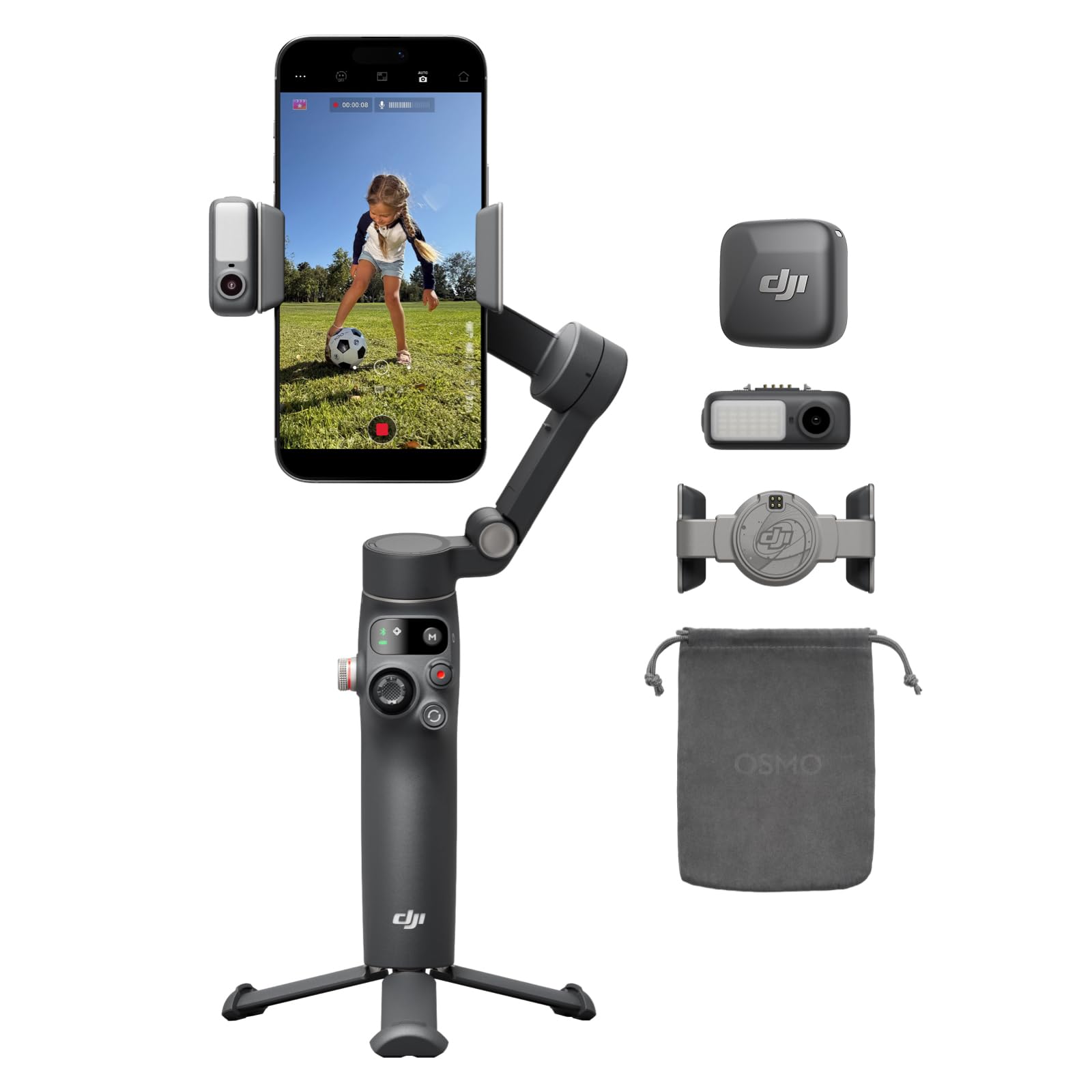
The DJI Osmo Mobile 8 Advanced Tracking Combo is the most ecosystem-integrated gimbal here, shipping with a Mic Mini Transmitter and a multifunctional module that combines audio reception and a fill light. DJI’s ActiveTrack 6.0 tracking algorithm is the benchmark for reliability—it maintains subject lock through occlusions and variable speeds without drifting. The gimbal’s native tracking with audio means the module houses a directional microphone array that follows the camera’s orientation, not the phone’s internal mic.
The 3-axis stabilization is paired with a built-in extension rod and tripod, allowing for low-angle tracking shots of pets or children without bending over. The 360° horizontal pan rotation is seamless, though the unit lacks true 360° infinite rotation—it will stop and reverse at the mechanical limit. The 10-hour battery supports phone charging via a dedicated USB-C port, so you can keep the phone powered during a live stream without carrying a separate battery pack.
The trade-off is the software dependency. The DJI Mimo app is required to access advanced features like ShotGuides and ActiveTrack, and the app is no longer available on Google Play, requiring a manual APK download for Android users. The magnetic phone mount is rated for phones up to 290 grams, which means a large phone with a heavy case may trigger the off-balance warning. If you are already invested in the DJI ecosystem, the Osmo Mobile 8 offers the smoothest integration with DJI Mimo’s editing templates and motion-lapse modes.
Why it’s great
- Includes a DJI Mic Mini Transmitter for professional audio.
- ActiveTrack 6.0 is the most reliable tracking algorithm in its class.
- Built-in tripod and extension rod for flexible shooting angles.
Good to know
- App not on Google Play; requires sideloading for Android.
- No 360° infinite rotation—mechanical stops at pan limit.
4. ZHIYUN Smooth 5S AI Pro
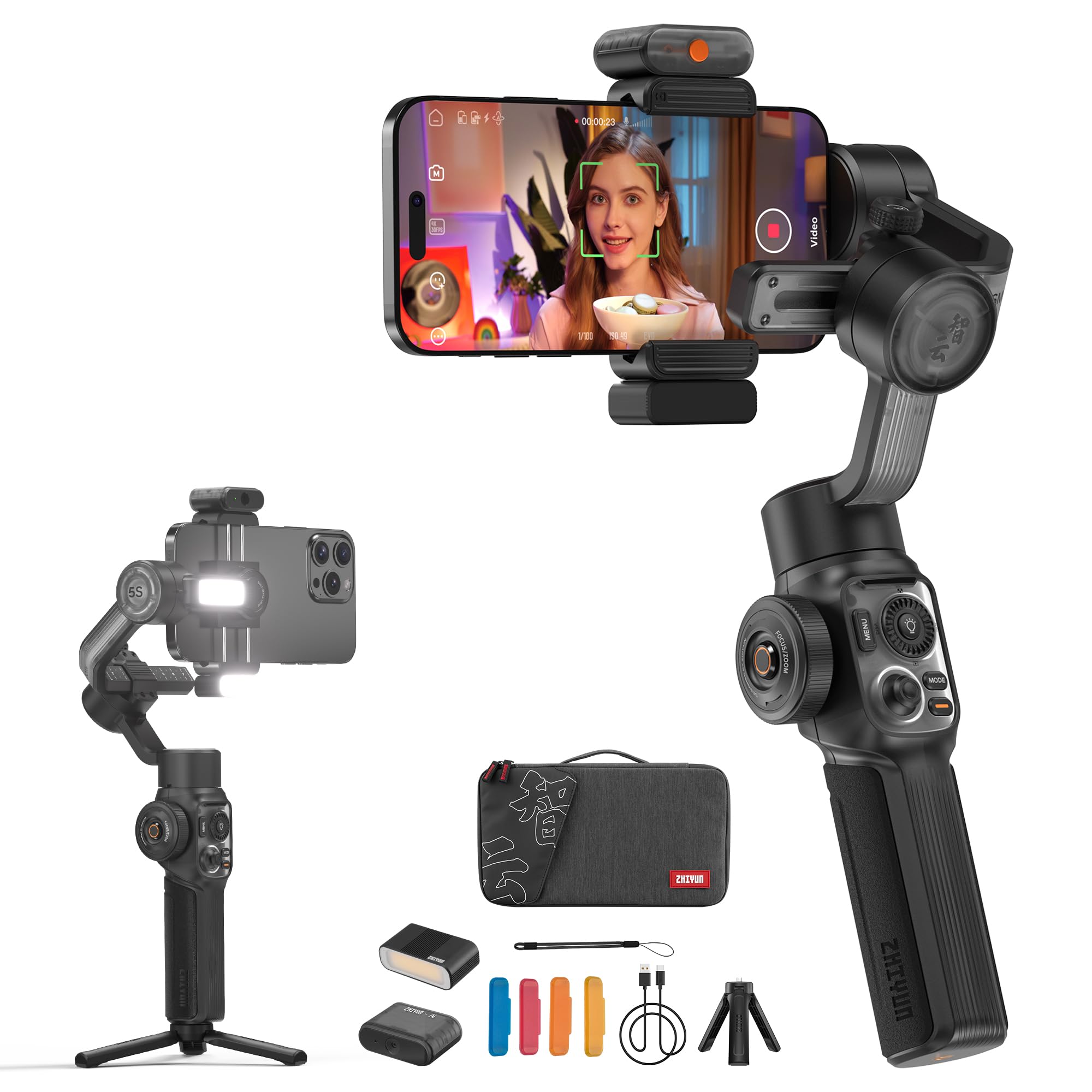
The ZHIYUN Smooth 5S AI Pro distinguishes itself with an orthogonal 3-axis motor structure borrowed from pro camera stabilizers—a design that keeps the motors out of the wide-angle frame while offering true 360° unlimited rotation without software restrictions. The AI tracking module sits separate from the phone clamp, meaning it can be activated with a hand gesture to lock onto a subject without requiring the ZHIYUN app. This app-free tracking is crucial for users who shoot with third-party video apps and cannot afford to have their footage processed through another layer of software.
The Pro package includes both a built-in high-power fill light and an additional magnetic fill light, along with four color filters, giving you versatile options for indoor event shooting or outdoor golden-hour portraiture. The full keyboard control panel on the handle allows direct adjustment of focus, zoom, and tracking mode without glancing at your phone screen. The 644-gram weight is heavier than competitors, but the trade-off is a more stable inertia for smoother tracking pans, particularly when using the dedicated AI module at maximum range.
Owner experiences are mixed on the AI module’s power efficiency—it draws from the same battery as the gimbal motors, reducing overall runtime compared to a standalone sensor. The maximum supported phone weight of 300 grams means you cannot use a large phablet with a filmmaking rig. For creators who prioritize app-free autonomy and high-quality onboard lighting, the Smooth 5S AI Pro delivers a robust feature set that competes directly with DJI and Hohem at a mid-range price point.
Why it’s great
- Orthogonal arm structure keeps motors out of frame during wide-angle shooting.
- True 360° unlimited rotation with no app-based restrictions.
- Dual fill lights with color filters for studio-quality illumination.
Good to know
- AI module shares battery with gimbal motors, reducing total runtime.
- 300g payload limit restricts use with heavier phone cases and lenses.
5. FeiyuTech SCORP Mini-3-Pro

The FeiyuTech SCORP Mini-3-Pro is the only gimbal on this list designed to accommodate four primary device types: mirrorless cameras, compact cameras, action cameras, and smartphones. Its 2-kilogram payload capacity means it can handle a Canon R50 with a standard zoom lens plus a microphone, while still leaving room for a smartphone mounted via the included adapter. This multi-device versatility makes it a single-purchase solution for creators who own both a phone and a dedicated camera.
The AI Tracking 4.0 system achieves a response time of 0.003 seconds, with a maximum tracking distance of 18 meters—the longest on this list. The 40% expanded tracking view is achieved through a specially designed wide-angle AI module that provides a broader field of capture before the motors need to move. The detachable remote handle can be used as a Bluetooth control from up to 10 meters away, enabling solo shots that include walking toward or away from the rig without losing frame composition.
The stabilization engine uses a 2025 quaternion algorithm that predicts motion vectors, resulting in exceptionally smooth footage during high-speed movements like running or skateboarding. The L-shaped fixing plate provides a larger contact area with the camera body, reducing micro-vibrations during walking shots. The learning curve is steeper than a smartphone-only gimbal—balancing a mirrorless camera takes practice, and the motor strength may struggle with heavy cinema lenses. For hybrid shooters who want one gimbal to rule them all, the SCORP Mini-3-Pro offers the most flexible balance of power and compatibility.
Why it’s great
- 4.4lb payload supports mirrorless cameras, action cams, and phones.
- 18m AI tracking range with 0.003s response time.
- Detachable remote handle for solo long-distance shooting.
Good to know
- Steep learning curve for balancing larger mirrorless camera rigs.
- Motor strength may be insufficient for heavy zoom lenses or external monitors.
6. GoPro Fluid Pro AI
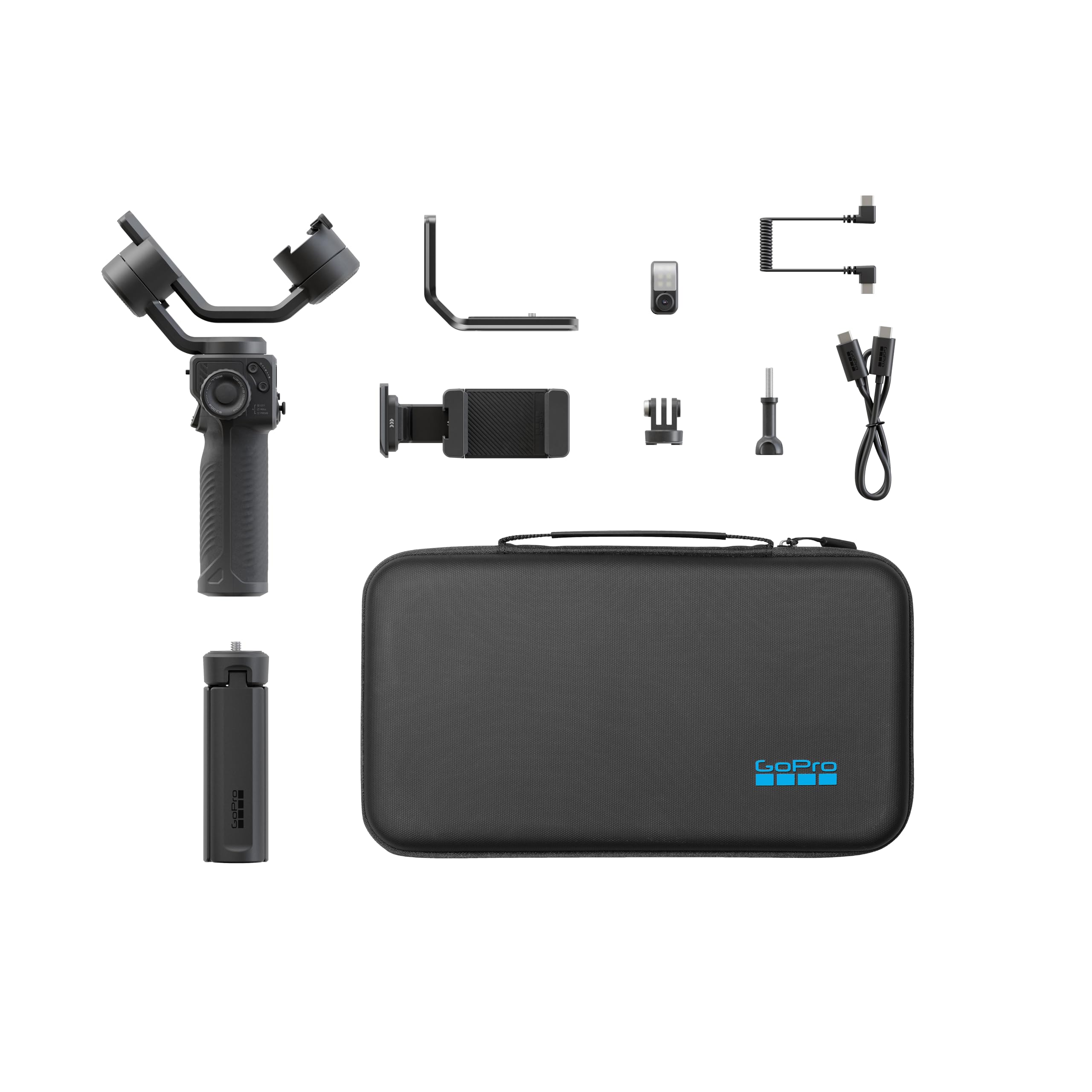
The GoPro Fluid Pro AI is purpose-built for the action camera user, shipping with dedicated mounting brackets for both GoPro cameras and smartphones. The AI tracking module can be oriented forward or rearward, allowing you to track yourself while biking or skateboarding, or track a moving subject from a stationary position. This dual-orientation capability is unique among gimbals and directly addresses the need for self-tracking during solo adventure filming.
The 3-axis gimbal provides professional stabilization, but the real value is in the ecosystem: it pairs quickly with GoPro HERO10 through HERO13 cameras via Bluetooth, enabling wireless camera control and AI tracking without needing a separate smartphone app for the tracking function. The integrated fill light balances exposure in high-contrast environments, and the included zippered case makes it easy to pack for outdoor shoots.
Payload restrictions are significant—the gimbal struggles with camera zoom lenses, and the GoPro media mod is the heaviest accessory it can handle before the motors lose stability. The lack of a printed manual means you rely on YouTube tutorials for setup, which is a hurdle for less experienced users. For GoPro owners who want a one-brand solution with reliable AI subject tracking and interchangeable mounts, the Fluid Pro AI eliminates the friction of calibrating third-party accessories.
Why it’s great
- Interchangeable mounts for GoPro cameras and smartphones.
- Forward- or rear-facing AI tracker for self-tracking during action shots.
- Quick Bluetooth pairing with GoPro HERO10 through HERO13.
Good to know
- Struggles with zooms and heavy media mods; not for large lenses.
- No printed manual—setup relies on online video tutorials.
7. DJI RS 4 Mini Combo

For creators who have moved beyond smartphone gimbals, the DJI RS 4 Mini Combo offers the same AI intelligent tracking module found in DJI’s larger Ronin gimbals but in a lightweight body that supports up to 2 kilograms of payload. This means you can mount a Sony a7 IV or Canon R5 with a standard zoom lens and maintain active tracking without the camera slipping off the motor. The auto axis locks are a critical time-saver—they automatically engage when power is cut, preventing the delicate balancing setup from falling apart during transit.
The RS Intelligent Tracking Module clips onto a cold shoe mount and tracks subjects with the same reliability as DJI’s full-size RS 4 Pro. The Responsive Follow Mode allows you to trigger instant pan-tilt reactions for high-speed orbit shots, which is useful for race events or skateboarding. The quick switch between horizontal and vertical orientation happens in under 10 seconds, making it feasible to shoot content for TikTok and YouTube in the same session without rebalancing.
The Combo includes a briefcase handle for low-angle tracking shots, and the gimbal itself charges via USB-C with a 13-hour battery life. The non-replaceable internal battery is a point of concern for long-term durability, and some units have been reported with handle-screw failures that risk dropping the camera. For videographers who need professional-level AI tracking with a mirrorless camera, the RS 4 Mini is the most capable option that still folds small enough for a backpack.
Why it’s great
- Auto axis locks save time during setup and transport.
- 2kg payload supports full-frame mirrorless cameras with lenses.
- Fast 10-second vertical orientation switch for mixed-platform content.
Good to know
- Non-replaceable battery limits long-term serviceability.
- Some units have reported weak handle-screws that risk equipment damage.
8. Hohem iSteady V3

The Hohem iSteady V3 brings down the entry barrier to AI tracking by offering a magnetic AI tracker with a built-in fill light for a price that undercuts most competitors by a significant margin. The AI vision sensor is gesture-activated, allowing you to start or stop tracking with a simple hand wave, and the tracking works with the native iPhone camera app—no app required. The detachable remote controller is a rarity at this tier, giving you wireless control over framing and zoom from a distance.
The 3-axis iSteady 8.0 anti-shake system provides smooth footage for walking shots and moderate movement, though it lacks the torque of the more expensive iSteady M7 for fast-action tracking. The built-in extendable rod reaches up to 8 inches, enabling selfie angles and low-angle pet shots without stooping. The magnetic fill light offers cold, warm, and natural light settings with smooth brightness adjustment from 4% to 100%, a feature usually reserved for gimbals costing much more.
The 13-hour battery life is the longest on this list, though this figure assumes moderate use without the fill light at full power. The foldable design fits into a pocket, making it a strong travel companion. The phone grip is not case-friendly—users with thick protective cases may need to remove the case for a secure fit. The magnetic light module can detach easily if jostled in a bag, and the base is lightweight enough to tip over when the extension rod is fully extended with a phone mounted. For budget-conscious creators, the iSteady V3 delivers the core AI tracking experience at the lowest cost of entry.
Why it’s great
- Magnetic AI tracker works with native camera, no app needed.
- Detachable remote controller and 8-inch extension rod included.
- Magnetic fill light with adjustable brightness and color temperature.
Good to know
- Phone grip is not case-friendly; thick cases may interfere.
- Lightweight base tips over easily when the extension rod is fully extended.
9. AKASO 360
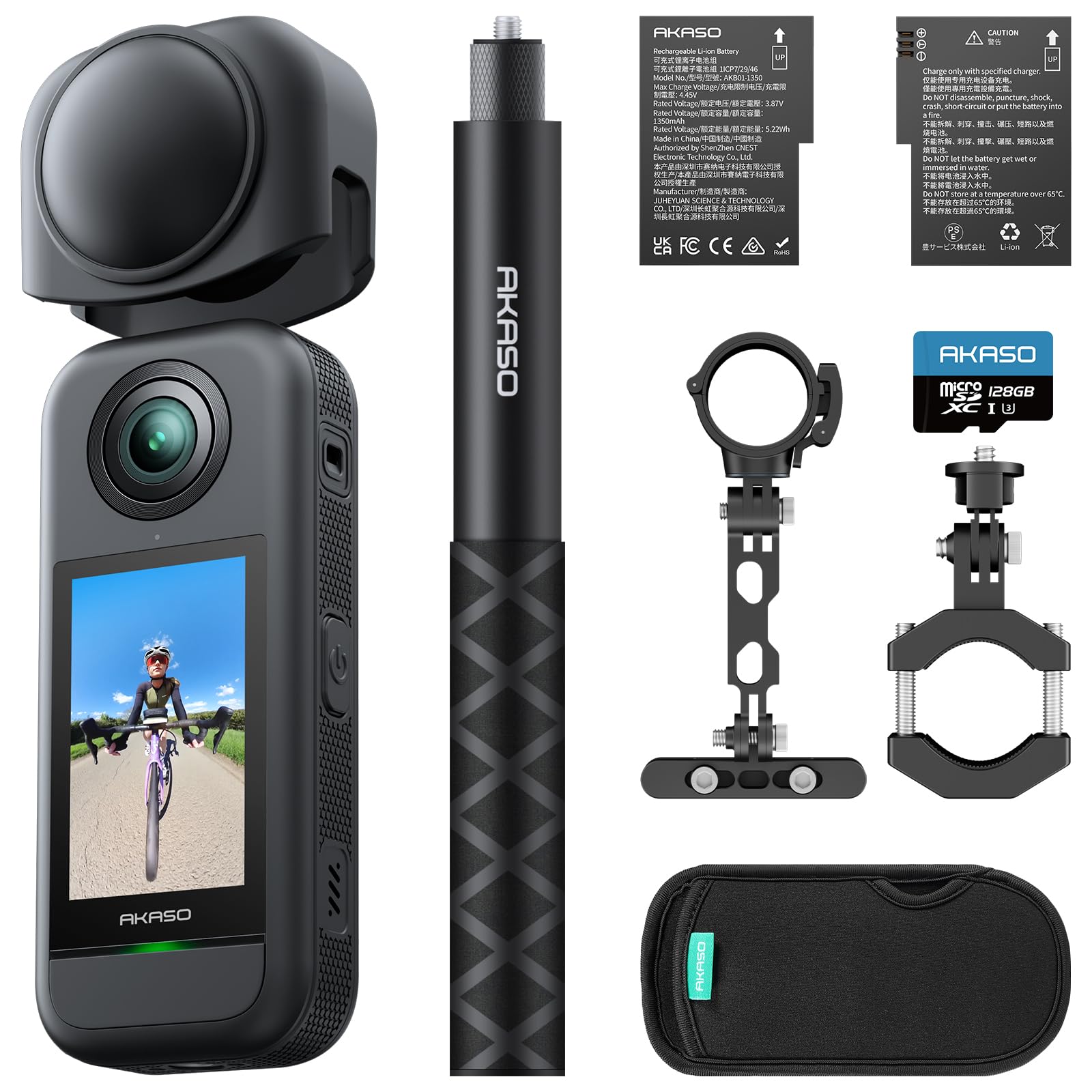
The AKASO 360 is not a gimbal in the traditional sense—it is a 360° action camera that embeds AI tracking post-capture through its companion app, as well as an invisible selfie stick effect that gives the illusion of a third-person shot. It earns a place here because its AI-powered subject detection automates the framing decision, letting you shoot first and choose the angle later. The dual 1/2-inch 48-megapixel sensors capture 5.7K video in a full 360° sphere, freeing you from the need to manually follow a subject at all.
The 360-SuperSmooth stabilization algorithm works without a physical gimbal, using digital gyroscopic correction to keep the horizon level even during rapid spins. The included 256GB microSD card is a welcome addition for long shoots, and the weatherproof housing allows rain or splash scenarios without a housing. The AI subject tracking in the AKASO 360 Studio app automatically detects people and re-centers them in your final export, turning the entire post-processing workflow into an editing chore rather than a filming technique.
The trade-off is that the AI tracking is not real-time—it is a software effect applied after you stop recording. The invisible selfie stick is not included, and the battery life tops out at roughly 54 minutes, which is short for a full day of cycling or hiking. Low-light performance falls off significantly due to the fixed f/2.25 aperture, and the app lacks transitions or text overlays for polished social cuts. For creators who value the unique reframing flexibility of 360° content and can live with software-based AI, the AKASO 360 offers a novel alternative to traditional motorized tracking.
Why it’s great
- 5.7K 360° capture with AI-powered post-capture subject reframing.
- 360-SuperSmooth stabilization eliminates need for a physical gimbal.
- Includes a 256GB microSD card for immediate use.
Good to know
- AI tracking is software-based, applied after recording in the app.
- ~54 minute battery life, and low-light image quality is poor.
FAQ
Does AI tracking work with the native camera app on my phone?
Why does my gimbal emit a beeping sound and stop tracking during use?
Can I use my gimbal for live streaming with AI tracking on Instagram or YouTube?
What is the difference between ActiveTrack and gesture-controlled AI tracking?
Final Thoughts: The Verdict
For most users, the best ai tracking gimbal winner is the Hohem iSteady M7 because it combines hardware-native AI tracking with a detachable touchscreen remote that gives solo creators unprecedented monitoring control without a second smartphone. If you want deep iOS application integration with over 200 apps, grab the Insta360 Flow 2 Pro. And for mirrorless camera users who need professional-grade AI tracking with a 2kg payload, nothing beats the DJI RS 4 Mini Combo.