
Our readers keep the lights on and the weekend projects moving. As an Amazon Associate, I earn from qualifying purchases.
That lingering sewer smell under your sink or the gurgling drain after a flush isn’t just unpleasant—it’s a sign your plumbing trap is being siphoned dry. An Air Admittance Valve (AAV) solves this by letting air into the drain system without needing a bulky roof vent, making it the go-to fix for islands, remodels, and tight spaces.
I’m Rikta — the co-founder and writer behind FitlyFast. I’ve spent hundreds of hours analyzing plumbing hardware specifications, comparing ASSE compliance data, and reading thousands of user reports to understand exactly what separates a valve that lasts a decade from one that fails in six months.
This guide breaks down the key specifications, real-world performance data, and compliance standards you need to confidently pick the best air admittance valve for your specific plumbing situation.
How To Choose The Best Air Admittance Valve
An AAV is a mechanical device that opens to let air into your drain pipes when water flows, then closes to trap sewer gas. Choosing the wrong one leads to odors, slow drains, or failed inspections. Here’s what matters most.
ASSE Compliance Level
ASSE 1050 covers standard performance for branch vents. ASSE 1051 adds a secondary seal for higher odor protection. Valves certified to both standards are tested for durability across thousands of cycles and extreme temperature swings. Always check for ASSE markings on the valve body.
DFU Capacity Matching
Drain Fixture Units (DFUs) measure the total load a valve can handle. A single bathroom sink is 1 DFU, a toilet is 3 DFU, and a bathtub is 2 DFU. Most compact AAVs handle 160 DFU on a branch (multiple fixtures sharing a pipe) or 24 DFU on a stack (vertical pipe). Oversizing is safe, but undersizing causes slow drainage and trap siphoning.
Connection Type and Pipe Material
AAVs come with adapters for ABS (black plastic) or PVC (white plastic) pipe. Solvent-weld connections are permanent and rigid, while threaded NPT connections allow easy removal for replacement or inspection. If you might need to swap the valve later, choose threaded. If space is extremely tight, solvent weld is more compact.
Quick Comparison
On smaller screens, swipe sideways to see the full table.
| Model | Category | Best For | Key Spec | Amazon |
|---|---|---|---|---|
| Studor 20341 | Premium | Reliable PVC installs | 160 DFU branch, 160°F rated | Amazon |
| Studor Redi-Vent 20381 | All-in-One | Finished-wall venting | Box+Valve+Grill combo | Amazon |
| Tuuber H2-020-AAV | Premium | Superior seal protection | 2″ NPT threads, dual seal | Amazon |
| Studor Mini-Vent 20340 | Premium | ABS pipe systems | 160 DFU branch, vermin guard | Amazon |
| Oatey 39019 Sure-Vent | Mid-Range | ABS plumbing upgrades | 160 Branch, 24 Stack DFU | Amazon |
| Oatey 39016 Sure-Vent | Mid-Range | PVC secondary vents | 160 Branch, 24 Stack DFU | Amazon |
| Studor 20380 Box & Grill | Accessory | Concealing existing AAV | 6.625″ x 8″ recessed box | Amazon |
In‑Depth Reviews
1. Studor 20341 Mini-Vent with PVC Adapter

The Studor 20341 is the gold standard for PVC plumbing systems, combining a compact body with a 160 DFU branch rating that handles everything from a single sink to a full bathroom group. Its gravity-close seal is reinforced by an exclusive vermin protection system that keeps debris and insects from compromising the diaphragm—a weak point on cheaper valves.
Users consistently report instant elimination of sewer smells after replacing failed budget valves with this unit. The -40°F to 150°F temperature tolerance means it performs reliably in unconditioned crawl spaces and attic chases without cracking or warping. Compliance with ANSI/ASSE 1050 and 1051 gives inspectors confidence.
While the barbed inlet requires a secure clamp or solvent-weld transition, the trade-off is a leak-proof connection that does not loosen over time. For anyone with existing PVC drain lines who wants a set-and-forget solution, this is the benchmark.
Why it’s great
- Trusted long-term reliability across thousands of installs
- Vermin guard prevents diaphragm blockages
- High temperature tolerance works in unconditioned spaces
Good to know
- Barb connection needs a clamp for secure fit
- Does not include a recessed box for finished walls
2. Studor 20381 Redi-Vent with Recessed Box & Grill

This is the only all-in-one solution in the lineup, combining a reliable Redi-Vent AAV with a recessed box and snap-on grill. The one-piece stud-mount flange installs directly into a stud bay with zero extra framing, saving hours on a kitchen island or basement bathroom remodel where access above is impossible.
Users highlight the clean, finished appearance—the white grill blends into walls and allows future valve service without cutting drywall. The included valve handles 1.5-inch or 2-inch piping via the same connection, and the box provides the required accessibility that many local codes demand for mechanical vents.
Some reviewers wished an adjustable mounting strap came included for odd stud spacing, but the rigid box works perfectly with standard 16-inch on-center framing. If you want a valve that looks like a deliberate design choice rather than an afterthought, this is the winner.
Why it’s great
- Valve, box, and grill included—no extra shopping
- Built-in flange eliminates need for framing modifications
- Concealed but serviceable through snap-on grill
Good to know
- No adjustable strap for non-standard stud spacing
- Larger footprint than a standalone valve
3. Tuuber 2-inch Vent 2X Superior Seal AAV

The Tuuber H2-020-AAV takes a different engineering approach with its dual-seal design and heavy-duty PVC body. Users consistently note that it feels significantly more solid than the Oatey Sure-Vent, with a tighter thread fit that seals perfectly even when installed at a slight angle—a common issue with threaded adapters in tight under-sink spaces.
Reviewers who had given up on budget valves after persistent smells found this unit solved the problem instantly. The 2-inch NPT threads connect directly to schedule 40 pipe without needing a reducer, and the included Teflon tape makes installation straightforward. ASSE 1050 and 1051 compliance means it passes inspection.
Its slightly higher positioning in the lineup reflects the cost per unit, but for anyone dealing with recurring odor failures on other valves, the superior seal construction often pays for itself in one installation. Best for ejector pump vents and high-moisture environments where seal integrity matters most.
Why it’s great
- Dual-seal diaphragm for maximum gas barrier
- Heavier PVC build vs. competing threaded models
- Seals reliably even at installation angles up to 3 degrees
Good to know
- Only available in 2-inch NPT thread
- Higher cost per unit than basic secondary vents
4. Studor 20340 Mini-Vent with ABS Adapter
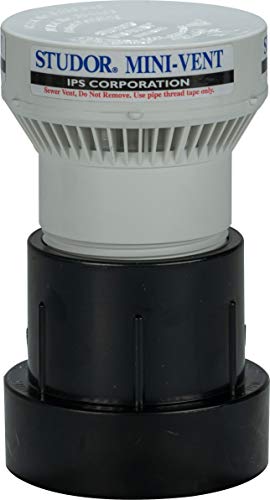
This is the ABS-specific sibling of the Studor 20341, built with the same gravity-close diaphragm mechanism but terminated in an ABS adapter for direct solvent welding to black ABS pipe. It handles the same 160 DFU branch capacity and 24 DFU stack capacity, making it the right choice for older homes with ABS drain systems or retrofit projects.
Reviewers who had previously bought generic off-brand valves report that the Studor unit fixed intermittent drainage issues that the cheaper valves never could. The vermin protection system is especially valuable in basement installations where insects can easily enter exposed pipe openings. The -40°F to 150°F range covers unheated spaces.
Since the ABS adapter is permanently bonded during installation, future valve replacement requires cutting the pipe. Plan the location so the valve remains accessible—many plumbers leave a threaded union above the AAV to simplify future swaps.
Why it’s great
- Purpose-built for ABS pipe systems
- Proven Studor diaphragm reliability
- Vermin protection keeps bugs out of system
Good to know
- Permanent solvent weld makes removal difficult
- Some users noted the black ABS adapter is loose until glued
5. Oatey 39019 Sure-Vent with ABS Adapter

Oatey’s 39019 Sure-Vent is the mid-range workhorse for ABS plumbing, offering the same 160 branch and 24 stack DFU ratings as the premium Studor units but at a more accessible price point. The protective sleeve doubles as a grip point during installation and keeps debris from fouling the diaphragm during construction.
User feedback is overwhelmingly positive, with many DIYers noting that the dual-threaded connection (2-inch male NPT threads plus a 2-inch female slip joint) makes it the most versatile option for connecting to existing ABS stacks. Some caution that the main product image shows a PVC adapter while the actual unit is ABS, so use transition cement when joining different plastics.
While a handful of users report the valve eventually stops sealing after several years, this is typical of mechanical AAVs and not specific to Oatey. The unit is 100% functionally tested at the factory, so defects are rare. Best for budget-conscious remodelers who work primarily in ABS pipe systems.
Why it’s great
- Versatile threaded connection for 1.5″ and 2″ pipes
- Protective sleeve keeps diaphragm free from debris
- Factory tested for immediate out-of-box reliability
Good to know
- ABS material requires transition glue for PVC pipes
- Diaphragm may fail after several years in heavy use
6. Oatey 39016 Sure-Vent with PVC Adapter

The Oatey 39016 is the PVC counterpart of the 39019, sharing the same 160 branch and 24 stack DFU rating but with a straight PVC Schedule 40 adapter. It is designed for use as a secondary vent—meaning it supplements an existing roof vent rather than replacing it entirely, though many users install it as a primary vent for isolated fixtures.
Experienced plumbers refer to this as the gold standard of inline vents for good reason: it simply works across thousands of residential and light commercial installations. The 1.5-inch to 2-inch diameter range covers most standard branch drain lines, and the ASSE 1050/1051 compliance makes inspectors happy.
Installation does require basic plumbing skills—you need PVC primer and cement, plus the ability to cut and dry-fit pipe. Some first-time DIYers find the permanent solvent-weld intimidating, but the result is a leak-free joint that never loosens. A capable option for homeowners who want proven reliability without chasing the absolute newest brand.
Why it’s great
- Industry-standard reliability across millions of installs
- Fits both 1.5″ and 2″ PVC with one adapter
- Compliant with both IPC and UPC plumbing codes
Good to know
- Requires PVC primer/cement and basic plumbing skills
- Not designed to replace a primary roof vent in all situations
7. Studor 20380 Recessed Box and Grill

This is not an AAV itself—it is the recessed box and grill that houses a separate Mini-Vent, Tec-Vent, or Redi-Vent valve. The one-piece ABS construction includes a built-in mounting flange that screws directly into a stud bay, creating a clean wall cavity for the valve without needing additional lumber or drywall cutting.
Users praise how the snap-on grill conceals the valve completely, making it ideal for finished basements, kitchen islands, and bathrooms where an exposed mechanical vent would ruin the aesthetic. The 6.625-inch by 8-inch dimension fits neatly between standard studs, and a single unit weighs only 9.6 ounces for easy handling.
Some confusion exists around whether the box fits 1.5-inch pipe—it does, because nominal pipe sizing means the actual fitting diameter is correct for standard 1.5-inch ABS or PVC. If you already own a compatible Studor valve and need a finished, inspection-friendly installation, this box is the missing piece.
Why it’s great
- Conceals valve for clean, finished-wall appearance
- One-piece flange eliminates need for extra framing
- Fits both 1.5″ and 2″ nominal ABS and PVC pipe
Good to know
- Valve not included—sold separately
- Rigid design requires accurately cut stud opening
FAQ
Can an Air Admittance Valve replace a roof vent entirely?
How long does an AAV diaphragm typically last?
Do I need a threaded or solvent-weld connection?
Final Thoughts: The Verdict
For most users, the best air admittance valve winner is the Studor 20341 Mini-Vent with PVC Adapter because it combines proven long-term reliability, a high 160 DFU branch rating, and the critical vermin protection system. If you need a finished-wall installation, grab the Studor Redi-Vent 20381 with the integrated box and grill. And for superior odor protection in challenging environments, nothing beats the Tuuber H2-020-AAV dual-seal valve.