
Our readers keep the lights on and the weekend projects moving. As an Amazon Associate, I earn from qualifying purchases.
Winterizing your irrigation system with compressed air is the only way to prevent burst pipes and cracked valves when temperatures drop. A machine that cannot maintain enough volume and pressure to clear every zone will leave water sitting in the lines, turning a simple blowout into a costly spring repair. The difference between success and failure comes down to two numbers: CFM at 90 PSI and total tank capacity.
I’m Rikta — the co-founder and writer behind FitlyFast. I’ve spent hundreds of hours analyzing compressor specs, reading field reports from irrigation pros, and cross-referencing real-world customer feedback to separate the machines that actually clear a 6-zone system from the ones that run out of air halfway through the second line.
This guide reviews the top models built for the task, covering tank size, portability, and noise level so you can confidently choose the right air compressor for blowing out sprinkler system without overbuying or undersizing.
How To Choose The Best Air Compressor For Blowing Out Sprinkler System
Selecting the right machine for winterizing your irrigation is not about the highest PSI on the box. Sprinkler blowout requires sustained airflow volume to push water out of long horizontal runs and through small emitter orifices. Prioritize CFM at 90 PSI, tank size, and portability features that match your property’s zone count.
CFM at 90 PSI — The Real Workhorse Metric
Max PSI numbers like 150 or 200 look impressive, but the compressor rarely operates at peak pressure during a blowout. The spec that matters is cubic feet per minute (CFM) at 90 PSI — this tells you how much air volume the pump can deliver steadily. For a typical residential system with 4 to 8 zones, look for at least 4.5 to 5 CFM at 90 PSI. Lower CFM units will struggle to maintain enough velocity to push water out of long ¾-inch lines.
Tank Capacity and Recovery Time
A larger tank stores more compressed air, giving you a longer burst before the pump kicks in to refill. For sprinkler blowout, a 6-gallon tank is the bare minimum for a small property; 10 to 13 gallons provides enough reserve to clear multiple zones in sequence. Recovery time — how fast the compressor refills the tank — determines whether you wait between zones or work continuously. Shorter recovery means faster work.
Portability and Noise Considerations
You will be moving the compressor from the garage or shed to the backflow preventer and potentially around the yard. Models with rubber wheels and a handle that folds or locks save your back. Noise level matters if you live in a tight neighborhood or have early-morning blowout sessions. Oil-free pumps run quieter than oil-lubricated models, and units rated at 68 to 73 dB are noticeably less disruptive than older compressors pushing 85 dB.
Quick Comparison
On smaller screens, swipe sideways to see the full table.
| Model | Category | Best For | Key Spec | Amazon |
|---|---|---|---|---|
| Metabo HPT EC711S | Pancake | Small residential systems | 2.8 CFM @ 90 PSI | Amazon |
| ECOMAX 6 Gallon | Pancake | Light farm use, small zones | 2.6 CFM @ 90 PSI | Amazon |
| Craftsman 3 Gallon | Hotdog | Quick inflation, tiny zones | 2.6 CFM @ 90 PSI | Amazon |
| DEWALT DWFP55130 | Compact | Quiet garage blowout | 3.0 CFM @ 90 PSI | Amazon |
| VEVOR 13-Gallon | Wheeled | Medium multi-zone systems | 4.6 CFM @ 90 PSI | Amazon |
| DEWALT D55146 | Wheeled | Pro-grade high-pressure clearing | 5.0 CFM @ 90 PSI | Amazon |
| Stealth 20 Gallon | Ultra Quiet | Large properties, silent operation | 5.0 CFM @ 90 PSI | Amazon |
In‑Depth Reviews
1. Metabo HPT EC711S
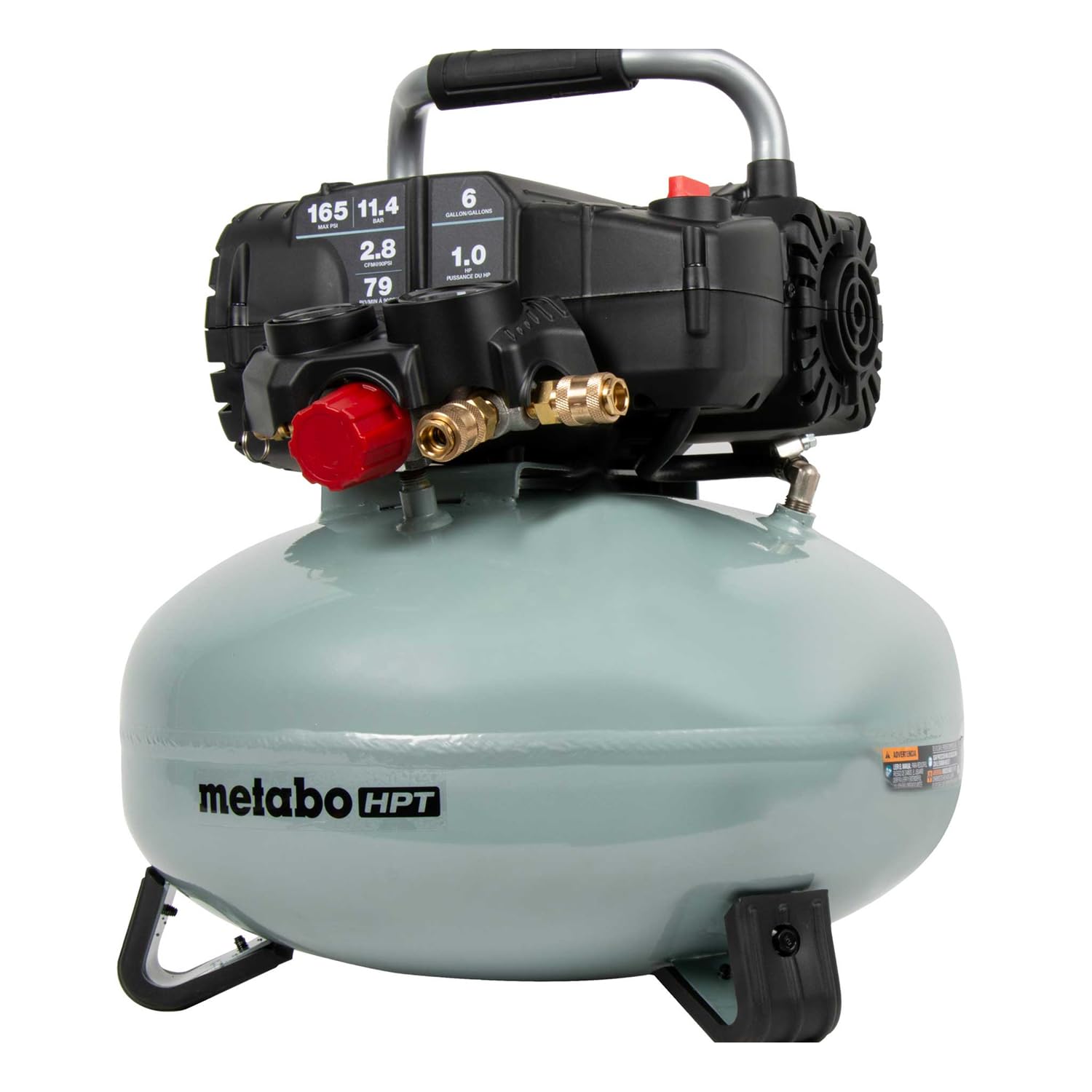
The Metabo HPT EC711S delivers 2.8 CFM at 90 PSI with a 6-gallon tank and a max pressure of 165 PSI, giving it the headroom to push air through several zones before the pump needs to catch up. The oil-free motor starts reliably in cold weather, which is critical when you are winterizing on a crisp November morning.
At 38.5 pounds and 73 dB during operation, it strikes a useful balance between portability and acceptable noise for a residential driveway. The dual universal quick couplers let you run a blow gun and a tire inflator simultaneously, and the steel roll cage protects the key components when you haul it over rough ground.
Some users report that the real-world noise level is closer to 85 dB at close range, and the CFM may dip slightly under sustained load compared to the spec sheet. For a small to medium property with 4 to 6 zones, though, this unit is a reliable mid-range workhorse that gets the job done without breaking your budget.
Why it’s great
- 165 PSI max provides strong reserve pressure for tough lines
- Lightweight pancake design is easy to carry to the backflow valve
- Cold-weather starting ensures winter blowout readiness
Good to know
- Noise level may be higher than the advertised 73 dB at close range
- CFM at 90 PSI is moderate, so larger systems require patience between zones
2. ECOMAX 6 Gallon

The ECOMAX 6 Gallon pancake compressor packs a solid Q235b alloy steel tank and rubber feet for stability, with 2.6 CFM at 90 PSI and a max pressure of 150 PSI. At just 27.6 pounds, it is one of the lightest options suitable for sprinkler blowout, making it a natural fit for smaller properties or farm use where you need to move the unit frequently.
The oil-free pump keeps maintenance to a minimum, and the dual quick couplers allow you to switch between a blow gun and a tire chuck without swapping hoses. Real-world feedback from buyers confirms it handles finish nailers with ease and has enough reserve to blow out water hoses on a farm.
Some owners noted that the factory thread sealant is thin, so a wrap of Teflon tape on the connections is a smart precaution before first use. The tank recovery is adequate for light use, but sustained blowout on a 6-zone system will push the pump to its duty cycle limit.
Why it’s great
- Extremely lightweight at 27.6 lbs, easiest to carry around the yard
- Steel tank construction adds durability for transport over rough ground
- Good value for light sprinkler blowout on small properties
Good to know
- CFM is on the lower end, so larger zones will deplete the tank quickly
- Thread sealant may need reinforcement with Teflon tape out of the box
3. Craftsman 3 Gallon

The Craftsman 3 Gallon hotdog compressor is the smallest and lightest unit in this lineup at 16 pounds, making it incredibly easy to grab and carry. It delivers 2.6 CFM at 90 PSI with a max of 155 PSI, powered by a 1.5 HP UMC motor. The oil-free pump reduces long-term maintenance chores.
For sprinkler blowout, the 3-gallon tank is best suited for very small systems with 2 or 3 zones, or for supplemental inflation work like clearing a single backflow line before the main event. The compact design fits easily on a shelf or in a vehicle trunk, so it works well as a secondary backup compressor.
Buyers consistently note that the unit is louder than expected for its size, and the plastic gauge panel feels less robust than the steel components. For serious multi-zone winterizing, the limited tank volume forces frequent pump cycling that slows down the overall blowout process.
Why it’s great
- Extremely portable at 16 lbs for quick trips to the backflow valve
- 155 PSI max gives decent reserve for short blowout bursts
- Makes an excellent secondary compressor for inflation and light tasks
Good to know
- 3-gallon tank is too small for multi-zone sprinkler systems
- Noise output is high for a unit this size, noticeable in quiet neighborhoods
4. DEWALT DWFP55130
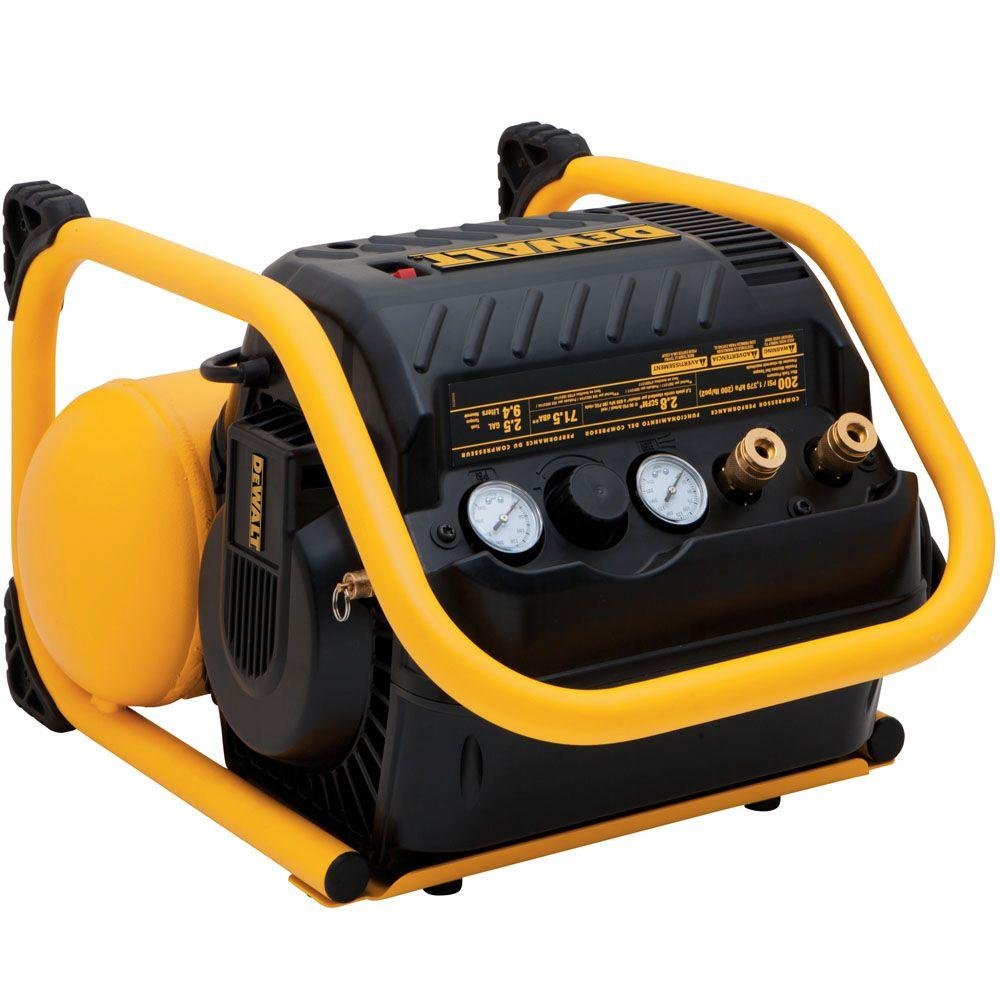
The DEWALT DWFP55130 is a 2.5-gallon compact compressor with a premium build, rated at 3.0 CFM at 90 PSI and a max pressure of 200 PSI. Despite the small tank, the high working pressure lets you store more usable air per gallon, and the 71.5 dBA noise rating makes it one of the quietest options for a blowout that happens close to the house.
At 36 pounds with a roll cage and integrated cord wrap, it is easy to move around the property. The dual quick couplers and ball valve drain are thoughtful touches for a machine built for intermittent high-demand tasks. Owners consistently praise how quiet it runs — compared to a pancake compressor — and how quickly it reaches the full 200 PSI.
The trade-off is the 2.5-gallon tank. For a large sprinkler system with 8 or more zones, you will need the pump to cycle frequently, which slows down the workflow. This unit shines for smaller properties or as a quiet backup that lives in the garage year-round.
Why it’s great
- 200 PSI max stores high usable air volume despite compact tank
- Very quiet operation (71.5 dBA) for early morning or close-to-house use
- Roll cage protects the compressor during transport over rough ground
Good to know
- 2.5-gallon tank limits continuous blowout time per zone
- Not ideal for large multi-zone systems without frequent pump cycling
5. VEVOR 13-Gallon

The VEVOR 13-Gallon compressor steps up the game with a 2 HP motor delivering 4.6 CFM at 90 PSI, a max pressure of 125 PSI, and a 13-gallon steel tank. The large capacity translates directly to longer blowout bursts — enough to clear a medium-sized system of 6 to 8 zones without pausing for the tank to recover between each line.
Noise is a standout feature here: the oil-free pump operates at a claimed 66 dB, making it one of the quietest units in this size class. Two 7-inch rubber wheels and a stable base make it easy to roll across grass or gravel, though at 71 pounds you will not want to lift it frequently.
Some users note that the unit draws a heavy startup current, so a dedicated 15-amp circuit or heavy-gauge extension cord is recommended. A few customers also report that the CFM rating feels slightly optimistic for sustained air tool use, but for blowout work at lower regulated pressure, the performance is solid.
Why it’s great
- 13-gallon tank provides long continuous blowout for medium systems
- Very quiet operation at 66 dB minimizes neighborhood disturbance
- 2-inch rubber wheels make rolling over grass and gravel effortless
Good to know
- Requires a heavy-gauge circuit or extension cord due to startup current draw
- At 71 pounds, lifting into a truck bed is difficult without help
6. DEWALT D55146

The DEWALT D55146 is a high-pressure wheeled unit with a 4.5-gallon tank, 225 PSI max pressure, and 5.0 CFM at 90 PSI. The extra pressure headroom is a genuine advantage for sprinkler blowout because it lets you store significantly more usable air per gallon than lower-pressure tanks, giving longer burst times before the pump kicks on.
Ten-inch pneumatic tires and a robust handle make this 88-pound machine roll like a piece of luggage across rough terrain. The oil-free pump is maintenance-free, and the metal console protects the gauges and regulator from bumps. Owners report that the compressor holds tank pressure above 150 PSI before the cut-in switch activates, meaning you have a long window of high-pressure output for clearing stubborn lines.
The 15-amp motor requires a dedicated circuit, and draining the tank requires tilting the unit 45 degrees due to the drain valve position. Some buyers also note that the regulated pressure maxes out around 150 PSI despite the higher tank pressure, but that is still well above the typical blowout requirement of 80 to 100 PSI.
Why it’s great
- 225 PSI tank pressure provides industry-leading usable air for persistent lines
- 5.0 CFM at 90 PSI delivers high volume for rapid zone clearing
- Large pneumatic tires roll smoothly across lawns and gravel driveways
Good to know
- Requires a dedicated 15-amp circuit, not suitable for shared outlets
- Heavy at 88 pounds and needs tilting to drain the tank properly
7. Stealth 20 Gallon

The Stealth 20 Gallon delivers serious air volume with 5.0 CFM at 90 PSI and a max pressure of 150 PSI, paired with a massive 20-gallon tank. For sprinkler blowout, this combination is overkill for most residential systems — you can clear a 10-zone property in a single pass without the pump ever cycling, making it the fastest option for heavy winterizing.
The ultra-quiet 68 dB oil-free motor is genuinely impressive for a 20-gallon unit, and the 8-inch rubber wheels handle the 121-pound weight well on flat ground. Build quality is strong, with a heavy-duty steel tank that holds air for days when not in use. Owners who use it for car detailing with a Tornador blowout gun confirm it keeps up without dropping pressure.
The main drawbacks are weight and size. Getting this into a truck bed alone is a major effort, and the price point is a serious investment for a seasonal task. A small number of users report issues with the pressure switch failing after light use, though the limited lifetime warranty covers the tank itself.
Why it’s great
- 20-gallon tank and 5.0 CFM deliver uninterrupted blowout for large systems
- 68 dB operation is exceptionally quiet for a unit this powerful
- Heavy-duty steel construction with limited lifetime warranty
Good to know
- Very heavy at 121 pounds, difficult to load into a vehicle
- Higher price point and potential pressure switch reliability concerns
FAQ
What PSI is needed to blow out a sprinkler system?
Is a 6-gallon compressor big enough for sprinkler blowout?
Can I use a pancake compressor to winterize my sprinklers?
How do I connect the air compressor to the sprinkler system?
Why does the compressor keep running without building pressure?
Final Thoughts: The Verdict
For most users, the air compressor for blowing out sprinkler system winner is the VEVOR 13-Gallon because it delivers 4.6 CFM at 90 PSI with a large tank and very quiet operation, making short work of medium-sized residential systems. If you want a lightweight unit that stores easily and handles a small property, grab the ECOMAX 6 Gallon. And for maximum uninterrupted power on a large property with 8 or more zones, nothing beats the Stealth 20 Gallon.