
Our readers keep the lights on and the weekend projects moving. As an Amazon Associate, I earn from qualifying purchases.
An HVLP gun demands consistent, clean air—a surge in pressure or a drop in CFM mid-spray ruins a finish instantly. The wrong compressor leaves you fighting sputtering guns, long recovery waits, and orange-peel texture that forces a sand-and-repeat cycle on every project.
I’m Rikta — the co-founder and writer behind FitlyFast. I spend my time deep in tool specs, comparing pump designs, tank capacity, and CFM curves to match compressors to HVLP systems so you get a glass-smooth laydown without guesswork.
Matching CFM output, tank volume, and pump recovery to your spray gun’s appetite is the only reliable way to avoid mid-coat interruptions, which is why this guide focuses purely on what makes a compressor truly work with a sprayer—the best air compressor for hvlp spray gun decisions that separate pro-grade finishes from frustrating re-dos.
How To Choose The Best Air Compressor For HVLP Spray Gun
Selecting an air compressor for HVLP work is about matching three critical specs: the gun’s CFM demand, the compressor’s tank volume, and the pump’s recovery rate. A mismatch causes the gun to starve for air or forces you to wait for the tank to refill every 60 seconds, which destroys the rhythm of a smooth paint pass.
CFM at 90 PSI — The Real Number That Matters
Every HVLP spray gun manufacturer publishes a CFM requirement, typically between 4 and 13 CFM at the pressure the gun operates (often 20-40 PSI at the inlet). The compressor’s CFM rating must meet or exceed that number. Many cheap compressors boast high max PSI but deliver low CFM at usable pressures, leaving the gun starving on every pull of the trigger.
Tank Capacity and Recovery Time
A larger tank—10 gallons or more—provides a buffer of stored air so you can spray an entire panel or drawer without the pump cycling. The recovery time (how long the pump takes to refill the tank) determines how long your next spraying window lasts. Small hobby compressors (2-3 gallons) are fine for touch-ups and miniature work, but full-sized furniture or automotive panels demand at least 4 gallons with recovery under 90 seconds.
Pump Type: Oil-Free vs. Oil-Lubricated
Oil-free pumps are maintenance-free, run cleaner for quick jobs, and are quieter, but they run hotter and have shorter lifespans under continuous spray loads. Oil-lubricated cast-iron pumps run cooler, last thousands of hours, and deliver more consistent air delivery for the extended spraying sessions typical with HVLP painting. For weekend warriors who spray a few times a month, oil-free is convenient. For daily-use shops, oil-lubricated is the durable choice.
Quick Comparison
On smaller screens, swipe sideways to see the full table.
| Model | Category | Best For | Key Spec | Amazon |
|---|---|---|---|---|
| DEWALT DWFP55130 | Mid-Range | Light HVLP & trim work | 3.0 SCFM @ 90 PSI | Amazon |
| DEWALT D55146 | Mid-Range | Framing & paint prep | 5.0 CFM @ 90 PSI | Amazon |
| Craftsman CMXECXA0201041 | Mid-Range | Small shop versatility | 4.0 CFM @ 90 PSI | Amazon |
| Timbertech AS186 | Budget | Detail & hobby airbrushing | 23 L/min (0.8 CFM) | Amazon |
| DeVilbiss 802343 Kit | Mid-Range | Budget HVLP complete set | Gravity feed, 1.3mm tip | Amazon |
| California Air Tools CAT-20020 | Premium | Pro-level continuous spray | 5.3 CFM @ 90 PSI | Amazon |
| Makita MAC5200 | Premium | Heavy-duty shop use | 6.5 CFM @ 90 PSI | Amazon |
| Fuji Spray 2203G | Premium | Air-assisted HVLP (turbine) | Two-stage turbine, 25ft hose | Amazon |
| Fuji Spray 2903-T70 | Premium | Pro cabinet & furniture finish | Three-stage, 6.5 PSI max | Amazon |
In‑Depth Reviews
1. DEWALT DWFP55130
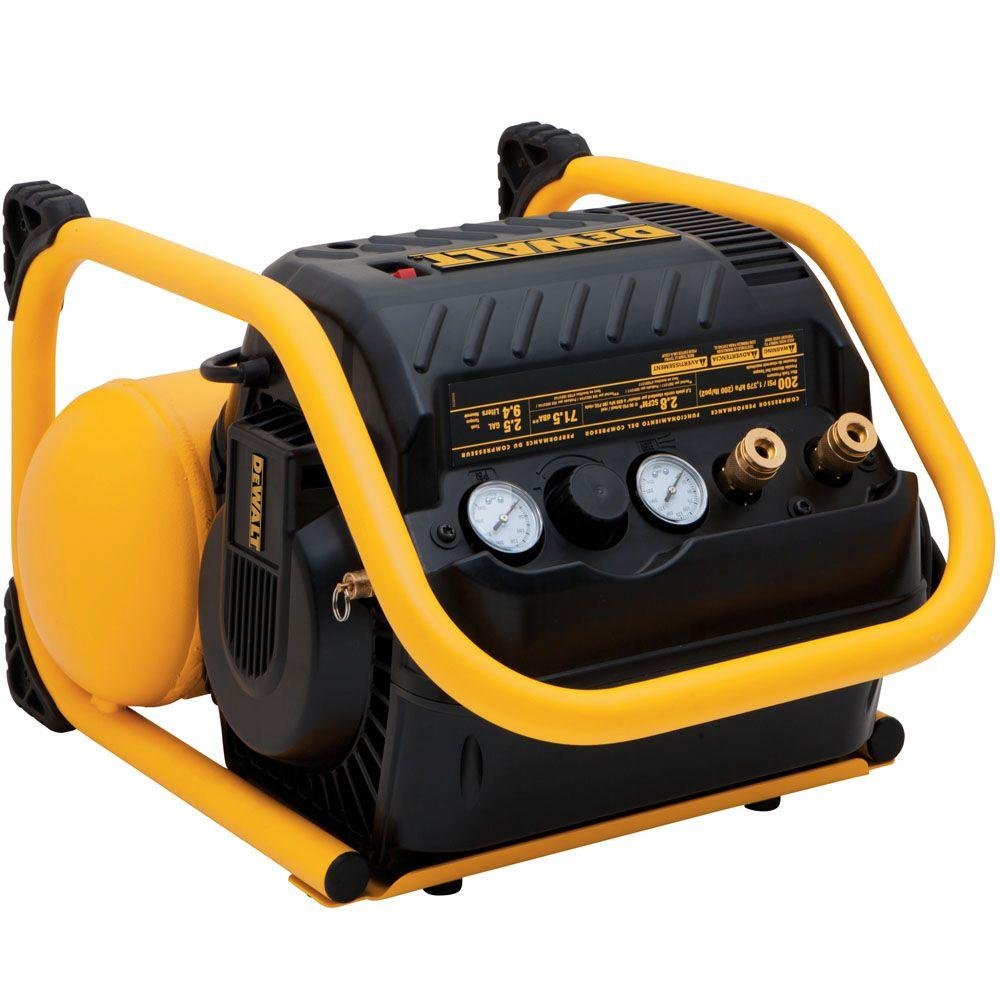
The DEWALT DWFP55130 strikes an excellent balance for the light HVLP user. Its oil-free pump delivers 3.0 SCFM at 90 PSI into a 2.5-gallon tank, which is enough for a touch-up spray gun or a small HVLP detail gun on furniture and trim. The 200 max PSI allows higher storage pressure, so you get a surprisingly long spray window before the pump kicks in.
Operating at 71.5 dBA, this unit is genuinely quiet—you can carry on a conversation nearby without shouting. The roll cage and fold-down handles protect the controls during transport, and the dual quick couplers let you run a spray gun and an air blower simultaneously. At 36 pounds, it moves easily between garage and jobsite.
The main limitation is the 2.5-gallon tank: for continuous spraying of large panels or automotive bodywork, the pump cycles every 45-60 seconds. This compressor works best for hobbyists and DIYers spraying cabinets, trim, or small accent pieces. For full-car resprays or high-output production, you will want more tank capacity.
Why it’s great
- Quiet 71.5 dBA operation reduces noise fatigue during extended spraying sessions
- 200 max PSI tank gives more usable air per fill than typical 150 PSI models
- Lightweight, roll cage design simplifies carrying up stairs and around a workshop
Good to know
- Small tank limits continuous spray time to about one minute on a detail gun before recovery
- Not suitable for production-level HVLP work with high-flow 1.8mm or larger tips
2. DEWALT D55146

The D55146 steps up to 5.0 CFM at 90 PSI and a 4.5-gallon tank with a 225 max PSI rating, making it the most powerful in DEWALT’s portable line. This unit feeds a full-size HVLP gun at 3-4 CFM draw without the pump cycling during a complete door or fender pass. The high pressure tank gives you a reserve of about seven minutes of continuous spraying before needing a recovery pause.
The 10-inch pneumatic tires roll smoothly over gravel and rough concrete, and the metal console protects the gauges and regulator from jobsite abuse. The oil-free pump requires no maintenance, but it does draw 15 amps—you need a dedicated circuit or a heavy-duty extension cord to avoid tripping breakers.
At 88 pounds and with a 5.0 CFM output, it qualifies as a semi-stationary unit. The three-in-one couplers work with most spray gun fittings, but you may need a high-flow coupler if you run a commercial HVLP gun with a large tip. This is the best compromise for someone who wants one compressor to handle both nailers and HVLP without sacrificing capacity.
Why it’s great
- 5.0 CFM at 90 PSI easily feeds standard HVLP guns without starving the tip
- 225 PSI tank provides a large buffer that extends spray time between pump cycles
- Durable steel roll cage and console protect controls during transport on jobsites
Good to know
- Heavy 88-pound weight makes it awkward for one-person loading into truck beds
- Requires a full 15-amp circuit; longer extension cords can cause startup issues
3. Craftsman CMXECXA0201041

The Craftsman 10-gallon model brings a 4.0 CFM at 90 PSI output with a massive 10-gallon tank that gives you extended spray windows for larger projects. This is one of the few mid-range compressors where the tank volume alone buys you the luxury of not hearing the pump kick on for several minutes of continuous HVLP work.
The oil-free pump runs relatively quiet, though not silent—user reports note around 95 dBA, which is still better than a loud traditional pancake compressor. The wheels and handle make movement easy around a shop, and the compact footprint (23.6 x 15.9 x 24.8 inches) fits under a workbench when not in use.
The trade-off is the CFM output: 4.0 CFM at 90 PSI is enough for light to moderate HVLP systems, but if you use a gun with a large 1.8mm or 2.0mm tip, the compressor will run continuously to keep up. It performs best for trim, cabinets, and furniture where you can match the gun’s air appetite to the compressor’s steady output.
Why it’s great
- 10-gallon tank provides long spray windows, reducing pump cycling noise during coats
- Wheels and compact dimensions make it easy to roll into position and store away
- Oil-free pump eliminates oil changes and oil mist in the air line for clean spraying
Good to know
- Not as quiet as claimed by the manufacturer—expect around 95 dBA in practice
- CFM output may not keep up with high-flow HVLP guns fitted with 1.8mm or larger tips
4. Timbertech AS186

The Timbertech AS186 is a miniature single-piston compressor with a 3-liter tank that outputs 20-23 L/min (approximately 0.8 CFM). This is purpose-built for airbrushes and detail HVLP guns with 0.2 to 0.8mm nozzles—think cake decoration, model painting, nail art, and tattoo work. At 47 dB, it is whisper-quiet and can sit on a workbench without disturbing anyone in the same room.
The built-in pressure regulator, moisture trap, and auto-stop at 4 bar ensure the air delivered to a micro-sprayer is clean and steady. The 3-liter tank smooths out the pulse from the single-piston pump, giving a constant flow that matches the demands of fine-detail airbrushing.
This unit is not built for full-size HVLP spraying of furniture or automotive panels—the tank is far too small and the CFM output is a fraction of what a standard gun needs. But for anyone working with miniature airbrushes in a hobby, cake decorating, or cosmetic setting, this is the quiet, compact, ready-to-run solution.
Why it’s great
- Extremely quiet operation at 47 dB for noise-sensitive indoor environments
- Integrated regulator and moisture trap deliver clean air for fine airbrush work
- Auto-start/stop cycle prevents continuous running, extending pump lifespan
Good to know
- Not suitable for standard HVLP spray guns used for automotive or furniture painting
- 3-liter tank provides only brief continuous spray—ideal for detail work, not panels
5. DeVilbiss StartingLine 802343

The DeVilbiss StartingLine kit bundles three gravity-feed HVLP guns (1.3mm, 1.5mm, and 1.8mm tips) in one package, making it a turnkey entry for someone who wants to spray primer, basecoat, and clearcoat with one purchase. The guns use traditional siphon-feed technology and require a compressor capable of delivering 26 PSI at the inlet with at least 5-6 CFM to maintain pattern consistency.
DIY automotive painters report professional results with 2K primers and urethane basecoats when paired with a mid-range or premium compressor. The 1.8mm tip sprays thick high-build primer well, while the 1.3mm tip handles thin clearcoats. The main downsides are the metal cup threading that can snap if over-tightened and the lack of a pattern adjustment knob on the primer gun.
This kit is a strong value for the hobbyist who already owns a capable compressor. The guns themselves are decent quality for the price point, but you need a compressor that can deliver consistent pressure—the kit will frustrate you if paired with a small oil-free unit that struggles to maintain 26 PSI under continuous flow.
Why it’s great
- Three-gun set covers primer, basecoat, and clearcoat with ready-to-spray needle sizes
- Gravity feed design effectively transfers paint with minimal waste and easy cleanup
- DeVilbiss brand reliability with good parts availability for future maintenance
Good to know
- Requires a compressor delivering 5+ CFM; small hobby compressors will struggle
- Metal cup fitting may crack on first use if over-tightened; handle carefully
6. California Air Tools CAT-20020
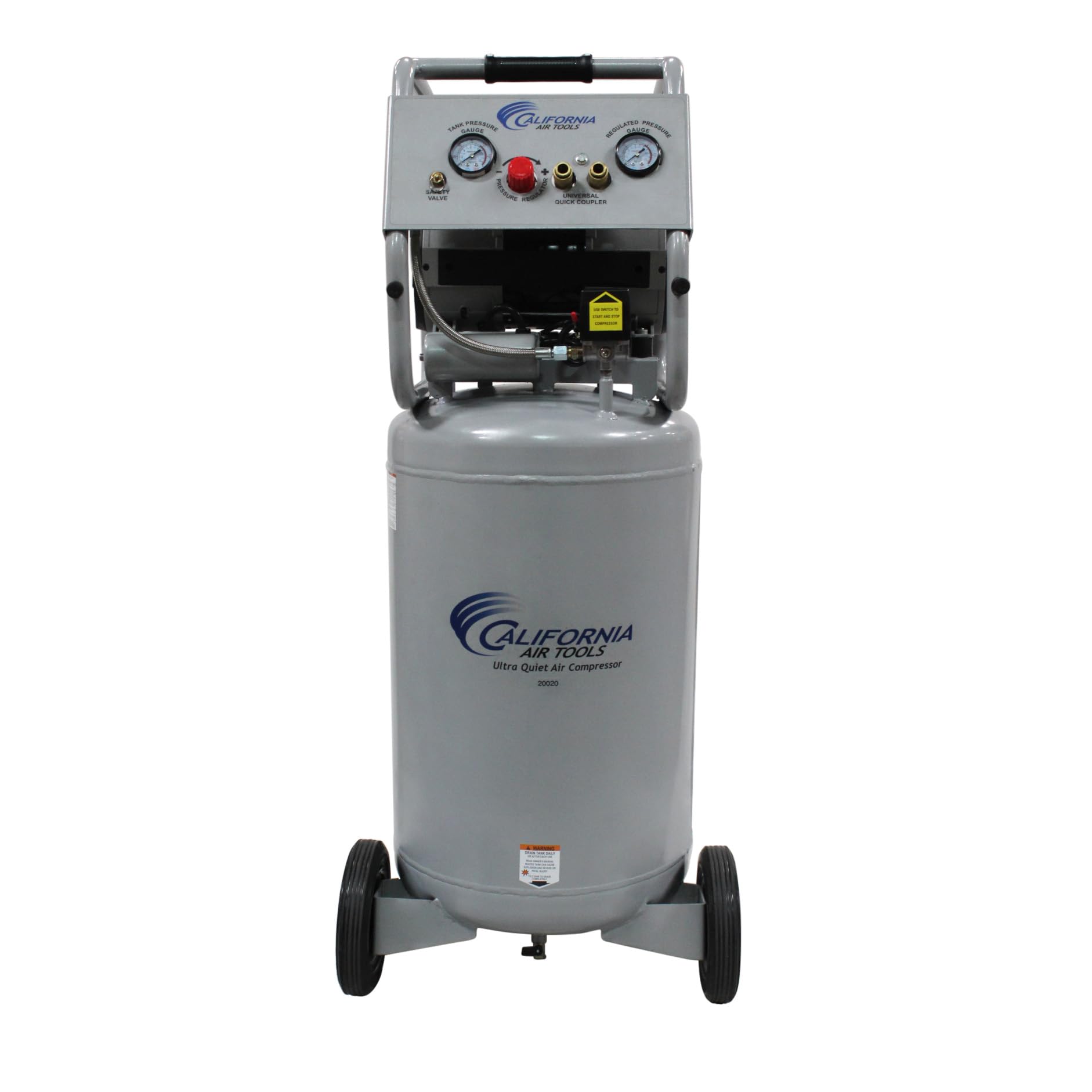
The CAT-20020 from California Air Tools is the largest 110-volt ultra-quiet compressor on the market, featuring a 20-gallon tank and 5.3 CFM at 90 PSI from its oil-free dual-piston pump. The 70 dBA noise level is genuinely quiet—roughly the volume of a normal conversation—allowing you to spray in a residential garage without disturbing neighbors.
The 1680 RPM motor reduces wear and heat buildup compared to higher-RPM compressors, giving this model a life cycle of over 3000 hours. The 20-gallon tank holds a substantial volume of air, providing a long continuous spray window for painting a full car door, cabinet, or fence section. The wheel base makes it easy to move around a shop despite the 114-pound weight.
The Achilles’ heel is the delivery system: the small orifice between the tank and the manifold restricts peak flow, meaning the compressor struggles with very high-demand tools like sandblasters. For HVLP spray guns drawing 4-5 CFM, it works fine, but you may want to upgrade the quick connects to high-flow Milton fittings. It is best for shops that prioritize quiet operation above all else.
Why it’s great
- Exceptionally quiet at 70 dBA, ideal for noise-sensitive residential and indoor workshops
- 20-gallon tank gives the longest continuous spray time of any unit in this guide
- Oil-free, 1680 RPM motor offers a 3000+ hour lifespan for daily-use shops
Good to know
- Restrictive internal manifold orifice may limit peak flow to high-demand spray guns
- Large and heavy (114 lbs) despite wheels; requires a dedicated floor spot
7. Makita MAC5200
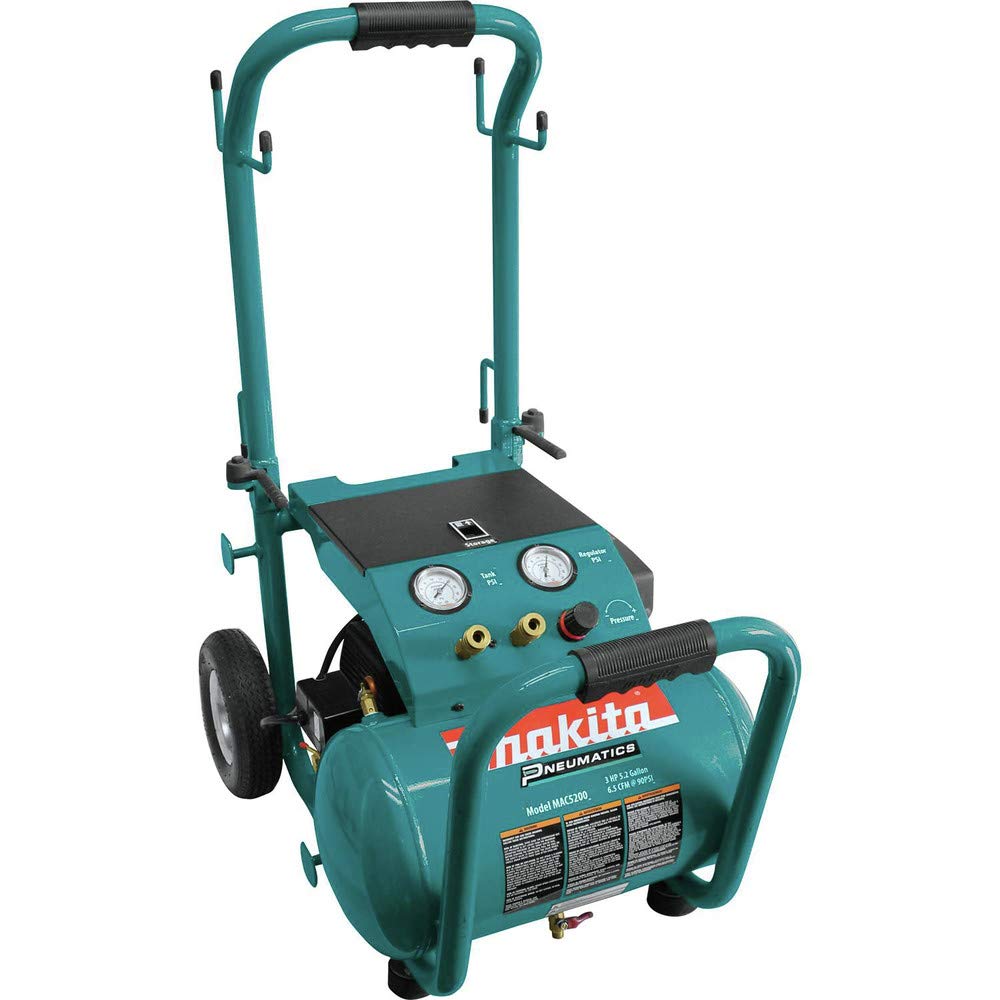
The Makita MAC5200 is the gold standard for oil-lubricated, cast-iron air compressors in the 5-gallon class. Its big bore cylinder and piston pump deliver 6.5 CFM at 90 PSI—the highest output in this guide—paired with a 5.2-gallon tank that charges from empty to 120 PSI in just over a minute. This pump can run an HVLP gun with a 1.8mm tip at full pattern without breaking a sweat.
The cast-iron cylinder runs cooler than aluminum pumps, extending the service life and allowing continuous operation during production spraying sessions. The oil bath lubricates the internal components, reducing wear even at high duty cycles. The folding handle and pneumatic wheels make it portable enough to move around a shop, though the 75-pound weight is significant for its size class.
This compressor requires regular oil changes (every 6-12 months depending on use) and delivers a lower tone than oil-free models—still loud enough to need hearing protection in the same room, but less piercing. It is the right choice for a professional shop or serious home garage where the extra CFM and pump durability justify the premium.
Why it’s great
- 6.5 CFM at 90 PSI easily powers the most demanding HVLP spray guns on the market
- Cast-iron pump runs cooler and lasts significantly longer than any oil-free alternative
- Fast recovery time—pumps back to pressure quickly, minimizing downtime between passes
Good to know
- Requires periodic oil changes; not a maintenance-free option for casual users
- Heavy enough that the wheels are essential—not a one-hand carry compressor
8. Fuji Spray 2203G Semi-PRO 2

The Fuji 2203G is a dedicated HVLP turbine system—it is not a traditional compressor with a tank. Instead, a two-stage turbine generates a constant high-volume, low-pressure air stream ideal for HVLP spraying without needing a tank for pulse dampening. The 25-foot hose includes an air control valve to reduce overspray and bounce back on tight spray patterns.
Installed with a 1.3mm air cap set and a 400cc gravity cup, this system is tuned for furniture finishing, cabinets, and clear coat application. Users report excellent results with clear varnishes and conversion varnishes, noting the turbine produces a pulsation-free airstream that lays down smooth coats with minimal orange peel.
The trade-off is noise: the two-stage turbine runs at around 92 dBA and cannot match the sheer air volume of a large tank compressor for wall-to-wall painting or high-build primer. You must also thin latex paints more than you would for a conventional compressor-fed gun. This system shines for fine finishing where consistency matters more than raw speed.
Why it’s great
- No tank needed—turbine provides constant air directly matched to HVLP gun demands
- Includes 25-foot hose with air control valve for precise pattern and overspray reduction
- Beginner-friendly setup with clear instructions and fine-tuning adjustments for novices
Good to know
- Requires significant thinning (10-20% water) for latex paints, which can affect final finish
- Turbine runs at 92 dBA—louder than the quiet oil-free compressors on this list
9. Fuji Spray 2903-T70 Mini-Mite 3 Platinum

The Fuji 2903-T70 is the top-tier turbine solution in this guide, featuring a three-stage Platinum turbine with a Heat Dissipation Chamber (HDC) that keeps the air stream cool and consistent during extended spraying sessions. The T-70 bottom-feed gun is lightweight, non-bleed, and features a side pattern control knob that lets you adjust the fan size without changing spray tips.
At 6.5 PSI max and three stages of compression, this turbine delivers the highest volume of warm, low-pressure air of any consumer HVLP system. It handles thick primers and waterborne paints with less thinning than two-stage models, and the 25-foot hose with built-in air control valve gives you a full range of motion around a car or furniture piece.
The main considerations are the price and the bottom-feed design: the T-70 gun uses a cup that cannot be checked as easily as a gravity-feed setup, and cleanup takes about 10 minutes with the proper brush set. This is the ultimate choice for a professional finisher who wants a standalone turbine system that does not require a separate air compressor purchase.
Why it’s great
- Three-stage turbine delivers higher air velocity for thicker paints and primers with less thinning
- Heat Dissipation Chamber ensures consistent air temperature for repeatable spray results
- Lightweight T-70 gun with side pattern control provides precise adjustment during use
Good to know
- Premium price point; this is an investment for dedicated finishing, not occasional use
- Bottom-feed cup design makes it harder to monitor paint level compared to gravity-feed guns
FAQ
What is the minimum CFM needed to run an HVLP spray gun?
Can I use a small pancake compressor for HVLP painting?
Should I buy an oil-free or oil-lubricated compressor for spray painting?
Final Thoughts: The Verdict
For most users, the best air compressor for hvlp spray gun winner is the DEWALT DWFP55130 because it delivers the quiet operation, oil-free maintenance, and balanced 3.0 SCFM output that matches the needs of the majority of HVLP hobbyists and DIY painters. If you want raw pumping power for production-level spraying with a high-flow gun, grab the Makita MAC5200. And for a dedicated turbine system that sidesteps the need for a tank and complex regulators, nothing beats the Fuji Spray 2903-T70 for consistent, professional-grade finishes on cabinets and furniture.