
Our readers keep the lights on and the weekend projects moving. As an Amazon Associate, I earn from qualifying purchases.
A dirty AC coil doesn’t just make your system work harder — it drives up your electric bill, reduces cooling output, and breeds the musty smells that linger in every room. The right cleaner needs to dissolve baked-on grime without corroding the thin aluminum fins or damaging the plastic drain pan your evaporator sits in.
I’m Rikta — the co-founder and writer behind FitlyFast. I’ve spent months researching chemical formulations, NSF ratings, foam dwell times, and customer feedback to separate the professional-grade solutions from the diluted ones that let you down after the first rinse. This guide gives you the hard specs you need to make a fast, informed purchase decision without wading through marketing fluff.
Whether you are a homeowner maintaining a mini-split or an HVAC tech servicing a rooftop unit, the right formula saves time and protects your equipment. Use the table and reviews below to find the best air conditioner coil cleaner for your specific grime level and budget.
How To Choose The Best Air Conditioner Coil Cleaner
Choosing a coil cleaner comes down to three factors: the type of grime, the metal your coils are made from, and your rinsing ability. A mismatch wastes money and can damage your evaporator or condenser.
Acid vs. Non-Acid vs. Alkaline Formulations
Acid-based cleaners (hydrochloric, phosphoric) are aggressive on thick carbon buildup but will eat through aluminum fins and copper tubing if left on too long. Non-acid and alkaline formulas are safer for microchannel coils and finned-tube condensers. Alkaline degreasers work by saponifying oils and grease, making them ideal for kitchen-adjacent outdoor units and restaurant HVAC.
Foam Dwell Time and Self-Rinsing
Foam cleaners cling to vertical coils and expand into the fin gaps, which is critical for mini-splits and tight evaporator boxes. Dwell time — the minutes the product stays active before drying — determines how well it dissolves tar and nicotine. Self-rinsing formulas break down and carry away debris without manual scrubbing, while concentrates require a pump sprayer and a garden hose rinse.
No-Rinse Enzyme vs. Concentrate Strength
Enzyme-based no-rinse formulas are the go-to for Dirty Sock Syndrome because they eat the bacteria causing the smell, not just the dirt. Concentrates (dilution ratios from 3:1 to 10:1) give you more cleaning power per dollar but require proper mixing and PPE due to higher alkalinity. For routine maintenance, a no-rinse aerosol is easier; for neglected units, a concentrate is the only way to restore airflow.
Quick Comparison
On smaller screens, swipe sideways to see the full table.
| Model | Category | Best For | Key Spec | Amazon |
|---|---|---|---|---|
| Refrigeration Technologies Viper Evap+ | Enzyme / No-Rinse | Dirty Sock Odor Removal | Non-toxic enzyme; 128 oz | Amazon |
| Rectorseal Clean-N-Safe | Non-Acid Foam Spray | Routine Condenser Cleaning | Biodegradable; 20 oz aerosol | Amazon |
| Coil King Heavy Duty Concentrate | Alkaline Concentrate | Heavy Grease / Carbon Buildup | Dilutable 3:1 to 10:1; 1 qt | Amazon |
| QwikProducts Foaming Coil Cleaner | Self-Rinsing Aerosol | Window AC / Light Buildup | Self-rinsing; lemon scent | Amazon |
| 3X:Chemistry Foaming Coil Cleaner | Organic Aerosol | Car AC / Tesla Filter Odor | Organic odor removal; 18 oz | Amazon |
| Nu-Calgon Evap Pow’r No Rinse | No-Rinse Liquid | Residential Evaporator Maintenance | No Rinse; safe on plastic | Amazon |
| RectorSeal Foam-A-Coil | Surfactant Foam | Commercial / Heavy-Duty Foam | Non-acid; 1 gallon concentrate | Amazon |
In‑Depth Reviews
1. Refrigeration Technologies Viper Evap+ Coil Cleaner

The Viper Evap+ uses a non-toxic enzyme approach to attack odor-causing bacteria at the source, making it the go-to product for mini-splits and wall units suffering from Dirty Sock Syndrome. Unlike alkaline concentrates that mask smells, the enzymes break down the organic film inside the coil and drain pan over 24 to 48 hours. Multiple HVAC techs and homeowners confirmed that one or two applications eliminated lingering musty odors that standard cleaners left behind.
At a full gallon of concentrate, the price per ounce is reasonable for a specialized no-rinse formula. The liquid form works best when applied with a pump sprayer at full strength, and you do not need to rinse after treatment — the enzymes continue working as the coil dries. Users reported that the product left no harsh chemical smell, with the treated coil smelling neutral after the enzyme cycle finished.
One caution: the enzyme action is biological, so it is most effective on organic buildup and less powerful on baked-on tar or heavy grease. A few users with severe mold or years of neglect found the smell returned within days, suggesting that a stronger alkaline cleaner was needed before the enzyme treatment. For routine maintenance and odor control on moderately dirty coils, this remains the most reliable option in its class.
Why it’s great
- Enzymes destroy bacteria causing Dirty Sock Syndrome, not just wash dirt away
- Truly non-toxic and safe for plastic drain pans on mini-splits
- No rinsing required — spray and walk away for 24 hours
Good to know
- Weak on heavy tar, grease, or thick carbon buildup
- May need two treatments for strong odors in severely neglected units
- Larger quantity is best for multiple units or annual maintenance
2. Rectorseal Clean-N-Safe Coil Cleaner

The Clean-N-Safe aerosol is a favorite among HVAC pros who need a cleaner that is safe on microchannel coils and still delivers thick foam that clings to vertical surfaces. It is formulated without acid, so it will not etch copper or aluminum, and the biodegradable base allows rinsing directly onto lawns or gardens without environmental concern. Users reported that it turned dirty grey condenser coils back to a bright silver finish after just one application.
Foam quality is what sets this apart — the surfactant system expands and pushes into the fin gaps, lifting dust, pollen, and light grease without the need for a brush. Rinsing is straightforward with a garden hose, and the can is compact enough to store in a service truck tool bag. Several reviewers noted that a single 20 oz can covers a standard 3.5-ton condenser but may run short on larger 32-inch commercial units, recommending a second can for big jobs.
On the downside, the foam works best on moderate dirt levels. Heavy carbon crust from years of neglect may require a pre-soak or a stronger concentrate. The product also requires a few seconds of shaking to activate the foam properly — if you skip this step, the liquid comes out runny. For homeowners doing a once-per-year clean, the convenience and safety profile make this a solid mid-range pick.
Why it’s great
- Non-acid and safe for microchannel coils, aluminum, and copper
- Thick foam expands into fin gaps for deep cleaning without scrubbing
- Biodegradable and environmentally safe for outdoor rinsing
Good to know
- One 20 oz can may not be enough for large 4-ton+ condensers
- Needs vigorous shaking before use for proper foam consistency
- Not strong enough for heavy carbon or grease without extra agitation
3. Coil King Heavy Duty Foaming Condenser Coil Cleaner
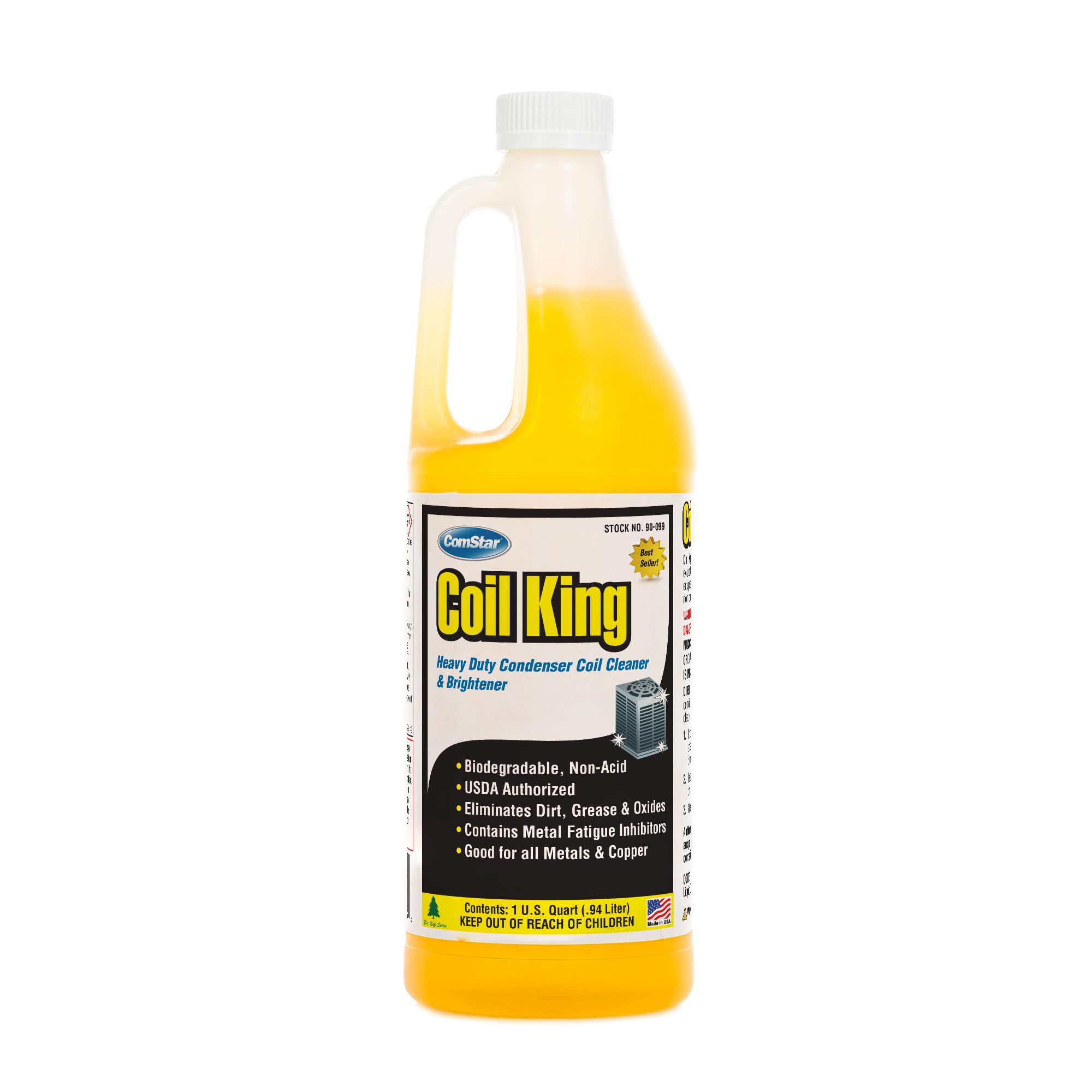
The Coil King concentrate delivers professional-strength alkaline cleaning at a price that undercuts most aerosol foams. Because it dilutes from 3:1 for heavy grime up to 10:1 for light maintenance, a single quart yields multiple gallons of ready-to-use cleaner. Users with outdoor condensers covered in decades of dirt and pollen reported that a 5:1 mix applied with a backpack sprayer restored airflow and visibly brightened the aluminum fins after a 15-minute dwell.
Safety is the trade-off — this is an alkaline solution that can irritate skin and lungs if inhaled. Multiple reviewers explicitly warned that you must wear latex gloves, long sleeves, and a respirator when spraying indoors or in enclosed spaces. The odor is strong but not acidic; it smells like a heavy-duty degreaser. The foaming action is excellent when mixed with warm water, and the product rinses clean without leaving a sticky residue that attracts future dust.
One downside from customer feedback: the quart bottle is small, and users who need to clean multiple large condensers or evaporator coils may run out fast at the 3:1 dilution ratio. Also, a few buyers noted that the bottle lacks a measuring cup or dilution guide printed on the label, so you need to know your ratios beforehand. For the price and cleaning power, this is the best budget-to-performance ratio for anyone tackling truly dirty coils.
Why it’s great
- Concentrated formula saves money — dilutes up to 10:1 for light cleaning
- Heavy-duty alkaline action dissolves baked-on grease and carbon
- Quick 15-minute dwell time restores airflow and cooling efficiency
Good to know
- Requires full PPE — gloves, mask, and eye protection are essential
- No dilution guide printed on the bottle; you must measure ratios yourself
- Small quart size runs out fast for multiple large units at strong dilution
4. QwikProducts Foaming Coil Cleaner

The QwikProducts foam cleaner stands out for its self-rinsing action — you spray it on, let the foam expand and break down the dirt, and the foam itself carries the debris away without requiring a high-pressure hose rinse. This makes it ideal for window AC units, refrigerator coils, and car evaporators where access is tight and you cannot blast water everywhere. Users reported that it cleaned CPU heatsinks and refrigerator coils as effectively as dedicated electronics cleaners.
The lemon scent is a welcome feature in a category dominated by chemical odors. The fragrance is mild and fades quickly, leaving a neutral smell rather than a perfumed cover-up. The formula is industrial-strength but alkaline-based, so it is safe on metal fins and plastic components when used as directed. Several window AC owners found that a single can cleaned both the evaporator and condenser of a small portable unit with foam left over.
The biggest limitation is that the self-rinsing action works best on light to moderate grime. For condensers with thick layers of road grime or restaurant grease, you may need to apply multiple cans or switch to a concentrate. A few users also mentioned that the nozzle can clog if not rinsed after use, which is a minor annoyance. For light-duty maintenance and odor neutralization, the convenience is hard to beat.
Why it’s great
- Self-rinsing foam removes dirt without high-pressure water rinsing
- Pleasant lemon scent neutralizes odors without harsh chemical smell
- Safe and effective on window AC, fridge coils, and car evaporators
Good to know
- Not strong enough for heavy carbon or thick grease buildup
- Small can may require multiple applications for larger condensers
- Nozzle can clog if not cleaned after use
5. 3X:Chemistry 46822 Foaming Coil Cleaner

The 3X:Chemistry foaming coil cleaner uses an organic-based formulation that removes odors without leaving harsh fumes behind, making it a popular choice for car AC and Tesla cabin air filter replacements. Users reported that spraying it into the fresh air intake or directly onto the evaporator eliminated musty smells that persisted after filter changes. The foam expands significantly, so a little goes a long way inside a vehicle’s HVAC box.
On indoor residential coils, the cleaner was effective on mold and dust but one user noted that aluminum fins can corrode if the foam is left to soak for longer than the recommended dwell time. The manufacturer suggests short contact time for annual use, which is fine for routine maintenance but may not cut through thick crust on neglected units. The aerosol can is easy to handle and the nozzle directs foam precisely where needed.
A few buyers reported using it on wall AC units and window units with good results, noting that the foam expanded into hard-to-reach areas. The organic labeling appeals to users who want to avoid heavy chemical exposure. The main drawback is the smaller 18 oz can size, which may not cover a large residential condenser and evaporator combination without buying multiple cans. For car interiors and small residential units, this is a premium specialty option.
Why it’s great
- Organic formulation with no harsh fumes, safe for car cabin air systems
- Foam expands to reach deep into tight evaporator boxes
- Effectively removes mold and musty odors from vehicle HVAC
Good to know
- Can cause aluminum corrosion if left soaking too long
- 18 oz can is small for large residential condenser coils
- Best suited for car AC and small indoor units, not heavy commercial use
6. Nu-Calgon 4168-08 Evap Pow’r No Rinse Coil Cleaner

The Nu-Calgon Evap Pow’r is a no-rinse liquid that HVAC technicians have trusted for decades for residential evaporator coil cleaning. Safe on plastic drain pans and aluminum fins, it works by penetrating the dirt and causing it to roll off the coil surface during normal condensation runoff. Users reported that after defrosting a frozen evaporator and applying the cleaner, black dirt and scum washed away completely, restoring airflow and heat exchange visibly.
The product has a natural scent that fades within an hour, leaving no chemical residue behind. It comes in a full gallon, which is plenty for multiple evaporator treatments or for cleaning other air-handling equipment. Several reviewers noted that it works well as a general maintenance cleaner — if your coil is already in decent shape, it will keep it running efficiently without aggressive chemicals. The no-rinse design means you simply spray or pour it on and let the AC’s own condensate do the rinsing.
The formula is not designed for heavy carbon or grease buildup on outdoor condensers. For those applications, users found it too gentle and needed a stronger alkaline cleaner first. The price per gallon places it in the mid to premium range, but the convenience of no-rinse application and the safety profile justify the cost for regular maintenance. It is a top choice for homeowners who want a gentle, reliable cleaner for annual evaporator care.
Why it’s great
- No-rinse formula relies on condensate runoff to self-clean
- Safe for plastic drain pans and aluminum evaporator fins
- Pleasant natural scent with no lingering chemical fumes
Good to know
- Not strong enough for heavy outdoor condenser carbon buildup
- Higher price per gallon compared to alkaline concentrates
- Best suited for routine evaporator maintenance, not deep cleaning
7. RectorSeal Foam-A-Coil 82632 Coil Cleaner

The RectorSeal Foam-A-Coil is a surfactant-aided foam concentrate designed for commercial and residential use where you need thick, clingy foam that lifts tar, grease, and dust off both condenser and evaporator coils. The surfactant system creates a stable foam that adheres to vertical surfaces without dripping, even on warm outdoor units. Users with rental properties and commercial kitchens reported that it removed years of mold and kitchen grease, leaving coils looking brand new after a simple rinse.
The formula is non-acid and safe for microchannel coils, which makes it a top choice for modern HVAC systems. It is also bio-friendly and non-flammable, allowing drain water to flow into standard runoff without special disposal. A few DIY homeowners found it easy to apply with a one-gallon pump sprayer, and the foam expanded enough to clean both the inside and outside of the condenser without extra brushing. The concentrate yields a large volume of ready-to-use cleaner, making it cost-effective for frequent use.
Some buyers did report inconsistent foam quality — a few cans produced very little foam even when mixed with warm water and applied with a high-pressure sprayer. The product performs best when you agitate the mixture and use warm water for dilution. Also, the gallon jug leaks during shipping if the cap is not tightened, so check packaging upon arrival. For heavy-duty cleaning with commercial-grade results, this is a top contender.
Why it’s great
- Thick surfactant foam clings to vertical coils and lifts heavy grease
- Non-acid and safe for microchannel and aluminum coils
- Bio-friendly and non-flammable for safe commercial drainage
Good to know
- Foam consistency varies — needs warm water and proper agitation
- Jug may leak during shipping if cap is loose
- Some users experienced no foaming action despite correct mixing
FAQ
Can I use an AC coil cleaner on a mini-split system?
How often should I clean my air conditioner coils?
What is the difference between a no-rinse and a self-rinsing coil cleaner?
Will an alkaline coil cleaner damage the aluminum fins on my evaporator?
Can coil cleaner help reduce my electricity bill?
Final Thoughts: The Verdict
For most users, the best air conditioner coil cleaner is the Refrigeration Technologies Viper Evap+ because it combines non-toxic enzyme odor control with a true no-rinse design that works on mini-splits, wall units, and full residential evaporators. If you need a heavy-duty alkaline concentrate to tackle greasy outdoor condensers, grab the Coil King Heavy Duty for its unbeatable price-to-strength ratio. And for a quick one-can foam clean of window AC, car evaporator, or refrigerator coils, nothing beats the convenience of the QwikProducts Foaming Coil Cleaner.