
Our readers keep the lights on and the weekend projects moving. As an Amazon Associate, I earn from qualifying purchases.
Waking up in a puddle of sweat inside your own RV is a fast way to ruin a trip. The difference between a refreshing escape and a miserable hot box often comes down to one choice: the air conditioner strapped to your roof. Rooftop units battle brutal sun exposure, thin insulation, and limited electrical capacity — a standard window box from the hardware store won’t cut it.
I’m Rikta — the co-founder and writer behind FitlyFast. I’ve spent years dissecting RV climate systems, comparing BTU ratings against real-world amp draws, and studying how inverter technology and heat pumps actually hold up under continuous boondocking use.
Below is my breakdown of the best rooftop, low-profile, and portable units available now, with a hard focus on real-world specs. This guide is built for anyone searching for a quiet, efficient, and durable air conditioner for rv that won’t leave them sweating through the night.
How To Choose The Best Air Conditioner For RV
Picking the wrong AC for your rig is an expensive mistake you feel every time the sun hits the roof. You need to consider BTU rating, power consumption, physical dimensions, and whether you need a heat pump for shoulder-season camping. Here are the three most critical factors to get right before you buy.
Match BTU to Your RV Size and Insulation
BTU (British Thermal Units) is the raw cooling power. A 13,500 BTU unit is the standard for most travel trailers and Class C motorhomes up to 30 feet, but if your RV has large windows or minimal insulation, you’ll want 15,000 BTU. For very large fifth wheels or coaches with poor roof shading, the 18,000 BTU class becomes necessary. Going too small means the AC runs nonstop without reaching the set temperature; too large leads to short cycling, which fails to dehumidify properly.
Understand Power Constraints: Amps, Generators, and Inverters
Most RV ACs run on 115V AC and draw significant startup amps — often exceeding 2,000 watts. Many older RVs only have a 30-amp service, meaning one AC unit plus a microwave can trip the breaker. Look for units with soft-start or inverter technology, which dramatically lower the startup surge (some drop from 25A to under 10A). If you plan to run on battery power, a dedicated 12V rooftop unit or a portable unit with an add-on battery is mandatory, as standard 115V units will drain a typical battery bank in under an hour.
Profile, Weight, and Ducting Compatibility
Standard rooftop units add 10 to 14 inches of height above your RV roof, which can be problematic for garage storage or low-clearance routes. Low-profile units (under 10 inches) reduce drag and improve fuel efficiency. Weight matters, too — older RVs with lighter roofs may not support 90+ pound units without reinforcement. Also, decide if you need ducted or non-ducted: ducted units push air through existing ceiling vents for even distribution over the entire living space, while non-ducted units dump air directly below the unit, which is simpler but can create hot spots.
Quick Comparison
On smaller screens, swipe sideways to see the full table.
| Model | Category | Best For | Key Spec | Amazon |
|---|---|---|---|---|
| TURBRO Inverter 13.5K | Inverter / Heat Pump | Energy efficiency & quiet operation | 13,500 BTU; 9 amp running draw | Amazon |
| TOSOT GO Cool 16K | High BTU / Heat Pump | Large RVs & all-weather use | 16,000 BTU; 43 dB quiet mode | Amazon |
| Furrion Chill Cube 18K | Variable Speed / High BTU | Maximum cooling with variable compressor | 18,000 BTU; 72.4 lbs | Amazon |
| RecPro 15K Ducted | Ducted / Heat Pump | Even cooling through ceiling vents | 15,000 BTU; 55.4 dB | Amazon |
| Dometic FreshJet 3 15K | Premium / Lightweight | Quiet upgrade with corrosion-resistant coils | 15,000 BTU; 64 lbs | Amazon |
| Coleman-Mach 15 Plus 15K | Mid-Range / Reliable | Reliable cooling for standard RVs | 15,000 BTU; Puron refrigerant | Amazon |
| Dometic FreshJet 3 13.5K | Mid-Range / Lightweight | Quiet plug-and-play replacement | 13,500 BTU; 21 SEER | Amazon |
| Coleman-Mach 15 Upper 15K | Upper Unit Only | Replacing existing Coleman upper unit | 15,000 BTU; Scroll compressor | Amazon |
| ASA Advent Air 13.5K | Budget / Reliable | Affordable Dometic replacement | 13,500 BTU; metal base pan | Amazon |
| Outequip 12V 10K BTU | 12V / Off-Grid | Battery-powered camping | 10,000 BTU; 45 lbs | Amazon |
| EF ECOFLOW WAVE 3 | Portable / Battery | Cordless cooling in any vehicle | 6,100 BTU; 8 hrs battery | Amazon |
In‑Depth Reviews
1. TURBRO Inverter 13.5K BTU RV Air Conditioner

This unit is the pinnacle of modern RV cooling technology. Its inverter compressor eliminates the hard-start amp surge (drawing just 1.6 amps at startup and around 9 amps while running), which means it works seamlessly with a 1500W inverter and a modest battery bank. Owners running off 600Ah LiPo batteries report over 13 hours of cooling in 95°F weather, consuming less than 60% of their battery capacity — a level of efficiency no standard rooftop unit can touch.
The low-profile design (10 inches thick) cuts wind resistance for better fuel economy, and the integrated heat pump delivers real warmth without firing up the propane furnace. The ceiling assembly includes a blue/yellow/white LED atmosphere lamp, and control is handled via a remote or a dedicated smartphone app. On noise, the inverter technology keeps the compressor running smoothly at variable speeds, which eliminates the on-off cycling roar of traditional units.
The included heat pump is a massive convenience for spring and fall camping, delivering up to four times the output of a standard electric resistance heater. The thermostat placement, however, can read 10-15°F low due to proximity to the cold air outlet, causing the unit to run harder than necessary. A Tuya-based workaround with an external sensor is possible but not elegant.
Why it’s great
- Ultra-low startup amps (about 1.6A) perfect for inverters and solar
- Efficient heat pump adds 4 seasons of comfort
- 10-inch low profile improves aerodynamics and looks
- Smart app control for temp and scheduling
Good to know
- Onboard thermostat can read 10-15°F low in some installations
- Supplied bolts may be too short for some ceiling thicknesses
- Not whisper-silent; described as “a little loud” by some users
2. TOSOT 16000 BTU GO Cool RV Air Conditioner

The TOSOT brings 16,000 BTU of cooling power, which is a meaningful step above the standard 13.5K and 15K units. That extra capacity makes a real difference in larger RVs (up to 24 feet) or rigs with poor roof insulation. In testing, owners kept their RVs at a comfortable 70°F even when outside temps hit 105°F, and the unit cools down a hot interior in minutes rather than the slow crawl you get from a lesser unit.
At 43 dB on low, it’s genuinely quiet — quieter than a normal conversation and 32% quieter than the average RV AC. The built-in 12,500 BTU heat pump works well in shoulder seasons, letting you skip the furnace on cool mornings. The Wi-Fi connectivity via the Gree+ app allows you to pre-cool the RV before you arrive at camp, a feature that adds real convenience for full-time travelers.
Installation is a straightforward DIY for anyone comfortable on a roof; the non-ducted design fits standard 14.25″ x 14.25″ openings. The 2-year warranty is a solid bonus, but be aware that long-term parts availability from TOSOT is still unproven compared to legacy brands like Dometic or Coleman. A few owners report difficulty reaching customer service after the first year.
Why it’s great
- High 16,000 BTU capacity handles extreme heat and larger RVs
- Whisper-quiet 43 dB low-speed operation
- Wi-Fi app for remote pre-cooling
- Effective heat pump for mild weather warmth
Good to know
- Brand longevity and parts supply still uncertain
- Customer service responsiveness can be inconsistent
- Non-ducted design may not suit ducted RVs without modification
3. Furrion Chill Cube 18K BTU Variable Speed RV Rooftop Air Conditioner

Furrion’s Chill Cube is the highest-BTU rooftop unit on this list at 18,000 BTU, and its variable-speed compressor is the star of the show. Instead of slamming on and off, the compressor ramps up and down to match the cooling demand, which eliminates the sudden amp spikes that trip breakers. Owners running it ducted through a 37-foot fifth wheel report it draws around 850 watts while maintaining 72°F in direct sun, making it viable on a solar and generator setup.
At 72.4 pounds, it’s about 10% lighter than many 15K competitors, and the aerodynamic rooftop shroud reduces drag during travel. The pre-installed gasket simplifies roof sealing, and installation is a bolt-on affair if you’re replacing an existing unit. Performance wise, the “turbo cool” mode pushes a massive volume of air quickly, but even in standard mode, the unit is notably quieter than a Dometic Brisk II — several owners say their tower fan on low is louder.
The Chill Cube runs on R32 refrigerant, which has a lower global warming potential than R410A. However, there is currently no heat strip or heat pump option available, so this is a cooling-only unit. A small number of users have reported a compressor vibration noise that resonated through the RV frame, though this appears to be an installation-dependent issue rather than a design flaw.
Why it’s great
- Highest cooling capacity (18K BTU) on the list
- Variable speed compressor eliminates hard starts and reduces amp draw
- Lightweight for its class at 72.4 lbs
- Extremely quiet operation, especially in ducted mode
Good to know
- No heat pump or heat strip; cooling only
- Some reports of compressor vibration in certain installations
- Requires separate ADB (air distribution box) purchase for some setups
4. RecPro RV Air Conditioner 15K Ducted or Non-Ducted

RecPro’s all-in-one unit offers a rare level of flexibility: it ships configured as a ducted model but can be converted to non-ducted, covering both common RV setups. The 15,000 BTU capacity is paired with a built-in heat pump that owners in cold climates praise for replacing the need for a propane furnace on cool mornings. The 55.4 dB noise rating is accurate — quieter than a conversation, though not as silent as the TOSOT or TURBRO units.
Build quality stands out here. The sleeved refrigerant pipes prevent the vibration-induced wear that plagues some Dometic units, and the UV-resistant plastic casing holds up well after years of direct sun exposure. The remote and LED touch controls allow you to switch between cool, dry, fan, sleep, and timer modes without needing a separate thermostat, which simplifies installation considerably.
At 80 pounds, it’s on the heavier side, but the weight is distributed well. Some owners have reported minor cosmetic cracks in the exterior shroud during shipping — not affecting performance but worth checking upon arrival. The unit is Australian-made and well-packaged, but replacement parts may be harder to source than for the major American brands.
Why it’s great
- Works as ducted or non-ducted — covers most RV configurations
- Effective heat pump adds four-season comfort
- Sturdy build with sleeved pipes to prevent vibration wear
- Touch controls and remote, no extra thermostat needed
Good to know
- Heavier than some competitors at 80 lbs
- Not the quietest; 55.4 dB is moderate
- Parts availability less established than Dometic/Coleman
5. Dometic FreshJet 3 Series, 15K BTU Black

Dometic’s FreshJet 3 Series is a premium upgrade that directly addresses two common pain points: weight and noise. At 64 pounds, it’s 14% lighter than Dometic’s own Brisk II, making it manageable for a two-person roof install. The e-coated evaporator coils are a standout feature — a flexible epoxy polymer coating that provides exceptional corrosion resistance for coastal or humid environments where salt air kills standard coils within a few seasons.
The 15K BTU model delivers 13% higher cooling capacity and 15% more airflow than the previous generation, while cutting noise by 4 dB. Owners consistently report it’s quiet enough to hold a phone conversation next to the unit. It’s backwards-compatible with existing Dometic and competitor air distribution boxes, which makes replacing a dead unit a plug-and-play job that takes under an hour.
This is a cool-only unit; there is no integrated heat pump. If you need heating, you’ll need to purchase the optional plug-in heat strip separately. Also, while the black finish looks polished, it can absorb more heat from the sun than white units, potentially affecting efficiency in direct sun. Shipping damage to the plastic shroud has been reported, so inspect the box immediately upon arrival.
Why it’s great
- Class-leading 64 lb weight for easier installation
- E-coated evaporator coils resist corrosion from salt and humidity
- Plug-and-play backwards compatibility with most ADBs
- Significantly quieter than older Dometic models
Good to know
- Cool-only; heat strip sold separately
- Black shroud may absorb more solar heat
- Shipping damage to plastic shroud is a known risk
6. Coleman-Mach 48204-069 Mach 15 Plus, 15,000 BTU

The Coleman-Mach name has been a staple in RV cooling for decades, and the Mach 15 Plus continues that legacy. Using Puron (R410A) refrigerant, this unit replaces older models that used phased-out R22, and it delivers a 30°F temperature differential in real-world testing — meaning if it’s 90°F outside, you can expect 60°F air coming out of the vents. That’s serious cooling power for a poorly insulated 40-foot RV.
Installation is simple if you already have a control module and ceiling assembly, because this is the upper unit only. The medium-profile shroud fits most standard roof openings, and the 1/3 HP fan motor pushes air efficiently without excessive noise. Owners in Texas say a single unit keeps their entire Ravcon comfortable even in triple-digit heat.
The biggest catch is that you must purchase the control module (with freeze sensor) separately — this unit will not run without it. Also, the packaging and shipping quality has been criticized; several units arrived with damaged outer casings. The unit runs and cools well despite cosmetic damage, but it’s frustrating for a premium-priced product.
Why it’s great
- Proven Coleman-Mach reliability and widespread parts availability
- 30°F temperature differential for powerful cooling
- Uses modern Puron (R410A) refrigerant
- Strong airflow from 1/3 HP fan motor
Good to know
- Upper unit only; requires separate control module with freeze sensor
- Packaging is poor; risk of cosmetic damage in shipping
- Medium profile adds height to the roof
7. Dometic FreshJet 3 Series, 13.5K BTU White

This FreshJet 3 is the smaller sibling of the 15K model, offering 13,500 BTU for smaller RVs and travel trailers, but it retains the same core engineering advantages: a 21 SEER efficiency rating (significantly higher than the industry average of 10-14 SEER), a 4 dB noise reduction over competitors, and a 14% weight reduction to just under 65 pounds. For a typical 25-foot travel trailer, this is the sweet spot of cooling power and electrical load.
User reports confirm it cools an 80°F interior down to 64°F in 30-45 minutes, and the startup draw is around 2000 watts with steady-state consumption at 1600-1700 watts. On a 30-amp service, that leaves headroom for lights and a fridge. The backwards compatibility with existing Dometic and competitor air distribution boxes makes it a straightforward replacement for any aging roof unit.
The premium price is justified by the energy savings and quiet operation, but some owners have experienced reliability issues. A small number of units have failed within months due to burnt compressor wires, and returns or replacements were difficult to process through Amazon. Inspect the unit thoroughly upon arrival and test it immediately if possible.
Why it’s great
- Excellent 21 SEER efficiency for lower power consumption
- Quieter than most competitor 13.5K units by 4 dB
- Lightweight and backwards compatible for easy swap
- Effective cooling for standard travel trailers
Good to know
- Some units have experienced premature compressor failure
- Packaging can be insufficient; risk of damage during shipping
- No control box or trim included; must use existing ADB
8. Coleman-Mach 08-0080 Mach 15 48204 Series Upper Unit, 15,000 BTU

This is the upper-only replacement unit for the Coleman-Mach 15 series, designed for owners who already have a functioning lower control box and ceiling assembly. At 80+ pounds, it’s heavy, but the weight indicates solid construction with a scroll compressor that runs smoother and with fewer vibrations than reciprocating types. The 2-piece shroud design is easier to handle than the older 3-piece style, simplifying roof work.
Performance is where this unit shines. In South Florida summer tests, a single unit kept a 33-foot Class A RV “frigid cold,” and the temperature drop is 15-20°F compared to a leaking older unit that only dropped 4-5°F. The pre-installed foam seal makes the roof penetration watertight without needing additional tape or caulk, and the wiring is standard hot/neutral/ground.
Understand that this is the upper unit only — no mounting hardware, screws, or lower control panel are included. You must have a compatible lower assembly already in place or purchase it separately. A small number of units have been reported as non-functional (fans spin but no cooling), likely due to refrigerant issues from shipping damage.
Why it’s great
- Powerful 15K BTU cooling with scroll compressor for quiet operation
- Pre-installed foam gasket ensures a watertight seal
- Direct fit for existing Coleman-Mach lower assemblies
- Proven performance in extreme heat conditions
Good to know
- Upper unit only; requires separate lower control module
- Heavy at 80+ lbs; needs two people for roof lift
- No heat function; cooling only
9. ASA Electronics ACM135 Advent Air 13,500 BTU Roof Top AC

The Advent Air from ASA Electronics is the budget-minded owner’s best friend. At a price point significantly lower than Dometic or Coleman equivalents, it delivers honest 13,500 BTU cooling that owners have successfully used to battle 115°F Arizona heat for entire summers. The rigid metal base pan is a notable feature at this price — many budget units use plastic bases that can warp over time, but the Advent Air stays flat and secure.
It’s a direct physical replacement for older Dometic upper units — the four hold-down bolts align perfectly with existing mounting holes — and it’s compatible with the Dometic lower control box. Three fan speeds give you control over airflow and noise, and an optional plug-in heat strip is available for those who need supplemental warmth. Owners consistently say the installation is straightforward, though you’ll need a helper to lift it onto the roof.
The biggest risk is that this listing is for the roof unit only — no ceiling assembly, no controls, no manual, and no mounting bracket. If your RV doesn’t already have a compatible lower unit, you’ll need to source one separately. Also, a minority of units have arrived with a damaged motor or dented shroud, so test it immediately upon delivery.
Why it’s great
- Best value for reliable 13.5K BTU cooling
- Rigid metal base pan outlasts plastic competitors
- Direct replacement for many Dometic units (plug-and-play)
- Three fan speeds for adjustable noise/airflow
Good to know
- Roof unit only; requires existing ceiling assembly and controls
- Packaging can be insufficient; risk of shipping damage
- Some units arrive with cosmetic defects
10. Outequip RV Air Conditioner, 12V 10,000 BTU
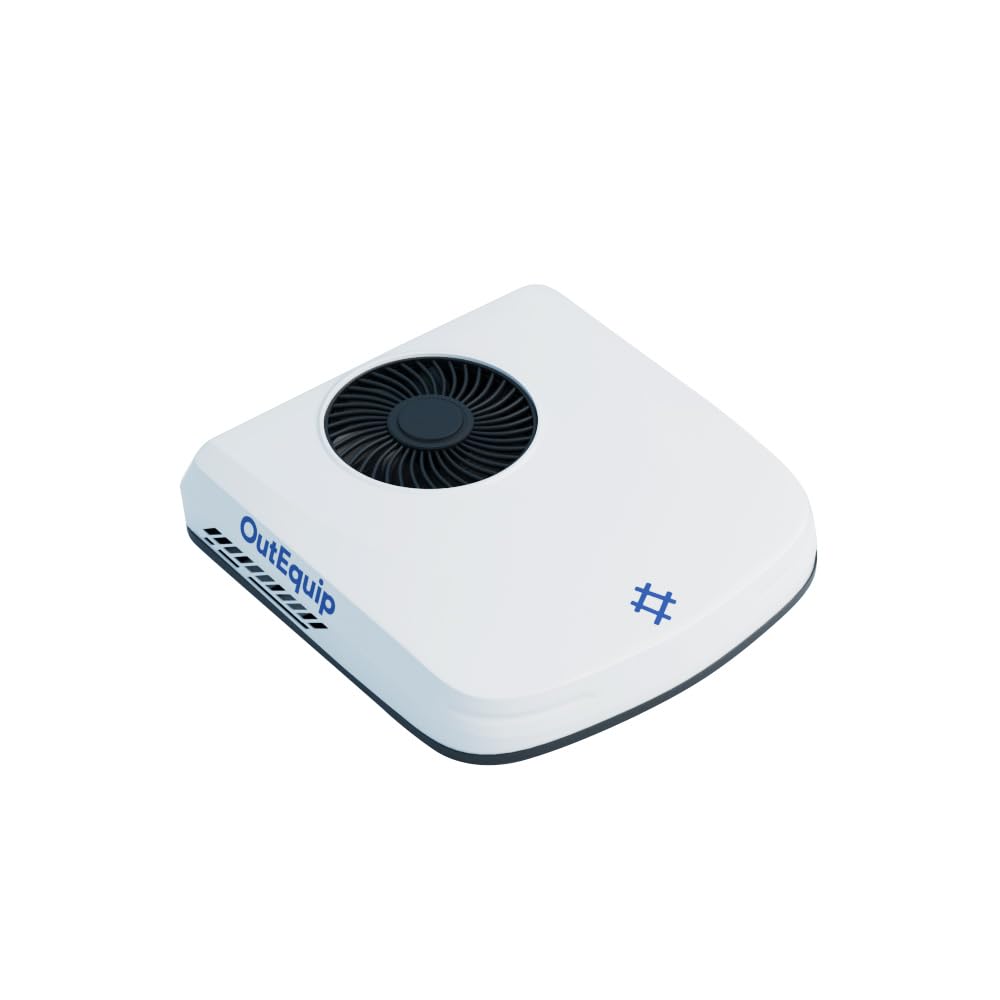
This is a specialty product that solves a specific problem: cooling an RV without shore power or a generator. Running on 12V DC from the vehicle’s battery bank, the Outequip 10,000 BTU unit can run for 6-7 hours on a 360Ah lithium battery in typical conditions, and up to 10 hours on a 600Ah bank. Owners of VW buses, Promaster vans, and pop-up campers report it makes dry camping in 88°F+ heat not just bearable but enjoyable.
The unit uses a brushless copper motor and a rotary scroll compressor to keep noise levels around 54 dB on high — quiet enough for a night’s sleep. It includes multiple modes (eco, sleep, turbo) and a remote control, plus a Bluetooth app for monitoring. It fits a standard 14″ x 14″ roof opening, and at 45 pounds, it’s very light compared to standard 115V units. Installation requires running 12V power, which is simpler than wiring a 115V circuit.
The trade-off is capacity: 10,000 BTU is fine for a small van or pop-up, but it won’t keep a large travel trailer comfortable. Also, the startup draw on high is 55 amps, which means you need a substantial battery and wiring to support it. Owners recommend sealing the condenser area to prevent water ingress during heavy rain, and note that the included mounting screws may not be long enough for all roof thicknesses.
Why it’s great
- Runs directly on 12V battery; no inverter or generator needed
- Lightweight (45 lbs) and compact for small RVs and vans
- Quiet operation with eco and sleep modes
- Bluetooth app and remote control included
Good to know
- Limited to 10,000 BTU; best for small spaces under 20 feet
- High startup draw (55A on high) requires substantial wiring
- Some need for additional waterproofing at the condenser area
11. EF ECOFLOW WAVE 3 Portable Air Conditioner with Add-on Battery

The EcoFlow Wave 3 is a category of its own: a portable AC unit with an integrated 1024Wh LFP battery that delivers up to 8 hours of cordless operation. At 6,100 BTU and 1,800W cooling power, it’s not going to cool a 35-foot motorhome, but for a teardrop camper, small RV, tent, truck sleeper, or as a spot cooler for a specific zone, it’s transformative. It drops the temperature 15°F in about 15 minutes under direct sun.
The 1,000W fast charging capability means you can refill the battery from empty to full in 75 minutes via AC power or an EcoFlow alternator charger. The smart app control lets you set timers and monitor power consumption, and the sleep mode runs at 44 dB — barely louder than a gentle fan. The unit also has a 2,000W heat pump for heating, making it a true 4-season climate solution. The R290 refrigerant is eco-friendly, reducing CO2 emissions by an estimated 4,500 pounds over 10 years compared to traditional refrigerants.
Real-world battery life varies wildly. In a well-insulated K-9 trailer, the battery lasted only 2 hours in daytime and 4 hours at night — far short of the 8-hour claim. In a smaller teardrop camper, it performed better. You must understand the limitations: this is a portable unit with a battery, not a replacement for a rooftop AC. It’s best as a supplementary or short-term cooling solution for off-grid scenarios.
Why it’s great
- Fully cordless operation with integrated 1024Wh battery
- Fast 75-minute recharge via AC or vehicle power
- Compact, luggage-style design with handle for portability
- Includes heat pump for 4-season utility
Good to know
- Only 6,100 BTU; insufficient for large RVs or extreme heat
- Battery life can be far shorter than 8 hours in real conditions
- Heavy with battery (32 lbs); venting required for exhaust heat
- Very expensive compared to BTU output
FAQ
Can I run an RV AC on a 15-amp household circuit?
How do I know if my RV roof can support a rooftop AC unit?
What is the difference between a heat pump and a heat strip in an RV AC?
Why does my RV AC trip the breaker after running for a while?
Final Thoughts: The Verdict
For most users, the air conditioner for rv winner is the TURBRO Inverter 13.5K because its inverter technology slashes power consumption and startup amps, while the integrated heat pump covers four-season comfort in a low-profile package. If you need maximum cooling capacity for a large or poorly insulated RV, grab the TOSOT 16K for its outstanding 16,000 BTU output and whisper-quiet 43 dB operation. And for off-grid boondocking without shore power, nothing beats the Outequip 12V 10K — it runs directly on battery power, letting you stay cool miles from the nearest electrical hookup.