
Our readers keep the lights on and the weekend projects moving. As an Amazon Associate, I earn from qualifying purchases.
A sweltering tent after a long hike doesn’t just ruin sleep—it can make the entire trip miserable. Standard battery-powered fans often just shuffle hot, humid air around, leaving campers desperate for real relief that only a true air conditioner can provide. The challenge is finding a unit compact enough for a tent, efficient enough to run on portable power, and powerful enough to actually drop the temperature.
I’m Rikta — the co-founder and writer behind FitlyFast. I’ve spent hundreds of hours analyzing portable cooling hardware, cross-referencing BTU ratings, battery capacities, and power station compatibility to separate the few effective camping ACs from the ineffective evaporative coolers. This guide is built entirely on that research.
Whether you’re car camping with a generator or building out a van with solar, finding the right unit means understanding specs like BTU, power draw, and venting requirements. This guide covers the nine models that deliver genuine cooling for your specific setup, ultimately helping you choose the best air conditioner for tent.
How To Choose The Best Air Conditioner For Tent
Not all portable cooling units deliver the same results inside a tent. A standard evaporative cooler adds humidity, while a true compressor-based AC removes moisture and genuinely drops the temperature. You need to match the unit to your power source, tent size, and tolerance for setup complexity.
Compressor vs. Evaporative Cooling
A compressor-based air conditioner works like your home unit: it uses refrigerant and a compressor to chill air and remove humidity. This is the only technology that actually cools a sealed tent. Evaporative coolers (swamp coolers) use water evaporation and a fan, which adds humidity and only works effectively in dry climates—they can make a tent feel muggy and uncomfortable in humid conditions.
BTU and Tent Size Matching
BTU (British Thermal Units) measures the cooling capacity. For a small 2-person tent (around 50 sq ft), 3,500 BTU is sufficient. For a larger family tent or truck camper (up to 200 sq ft), you need 5,000 BTU or more. Oversizing a unit for a small space is fine since you run it less, but undersizing means it never catches up during peak heat.
Power Source and Energy Consumption
True compressor ACs draw significant startup power (often 1,200W to 1,500W) then settle to 400W–600W while running. A portable power station with at least 500Wh is the bare minimum for a few hours—most campers use 1,000Wh+ stations or a 2,000W inverter generator. Battery-powered fans with misting functions won’t power a compressor, so know your energy source before buying.
Venting and Setup
Every compressor-based AC must vent hot exhaust air outside the tent. Most units include one or two exhaust hoses that you route through a window, zippered vent, or a custom cutout. If you can’t seal the tent’s hot air exit, the unit recirculates waste heat and the tent never gets cold. Lightweight ducting and adapter kits make this manageable for most tents.
Quick Comparison
On smaller screens, swipe sideways to see the full table.
| Model | Category | Best For | Key Spec | Amazon |
|---|---|---|---|---|
| BAYKUL 5000 BTU | True AC | Large tents & efficient cooling | 5000 BTU / 400W average | Amazon |
| OUTOHOME 5200 BTU | True AC | Energy-efficient tent cooling | 5200 BTU / 400W average | Amazon |
| OUTOHOME 5100 BTU | True AC | Larger tents & truck campers | 5100 BTU / 46 dB sleep mode | Amazon |
| Aspligo 3000 BTU (DC 24V) | True AC | 2-person tents & DC power setups | 3000 BTU / DC 24V compressor | Amazon |
| BougeRV PC35 3500 BTU | True AC | Small tents & app control | 3500 BTU / 18°F drop in 15 min | Amazon |
| Powdeom 15L Misting Fan | Fan/Mist | Open-air shade & RVs | 30000mAh / 15L water tank | Amazon |
| FODFINU Swamp Cooler | Swamp | Dry climate & garage cooling | 3.5 gallon / 650 CFM | Amazon |
| DREO TurboCool Misting Fan | Fan/Mist | RV & patio spot cooling | 5°F drop / 20 dB quiet | Amazon |
| OGERY Portable Camping Fan | Battery Fan | Budget tent air circulation | 30000mAh / 322h low speed | Amazon |
In‑Depth Reviews
1. BAYKUL 5000 BTU Portable Air Conditioner

With 5,000 BTU of cooling power and a premium GMCC compressor, the BAYKUL is one of the most powerful units in this roundup, rated to lower ambient temperature by 18°F in 5 minutes. It runs on a standard 110V outlet. The average power draw sits at just 400 watts, meaning many portable power stations can handle it.
This unit offers cooling, dehumidifying, sleep, and fan modes—all controllable from a remote, with a built-in 24-hour timer for automatic power-off. The compact design at 27.7 pounds and 46 dB noise level is built for use in small rooms, kitchens, campers, trucks, RVs, and vans, per the manufacturer’s listed specs.
This unit’s combination of rated cooling capacity and dehumidification makes it a strong pick for campers who want power without excess weight, based on its listed specifications.
Why it’s great
- Strong 5,000 BTU cooling capacity for larger tents and RVs
- Premium GMCC compressor rated for fast temperature drop
- Low 400W average power draw from a powerful unit
Good to know
- Cooling-only—no heating mode on this model
- As with any appliance, check current buyer ratings before purchase
2. OUTOHOME 5200 BTU Tent Air Conditioner
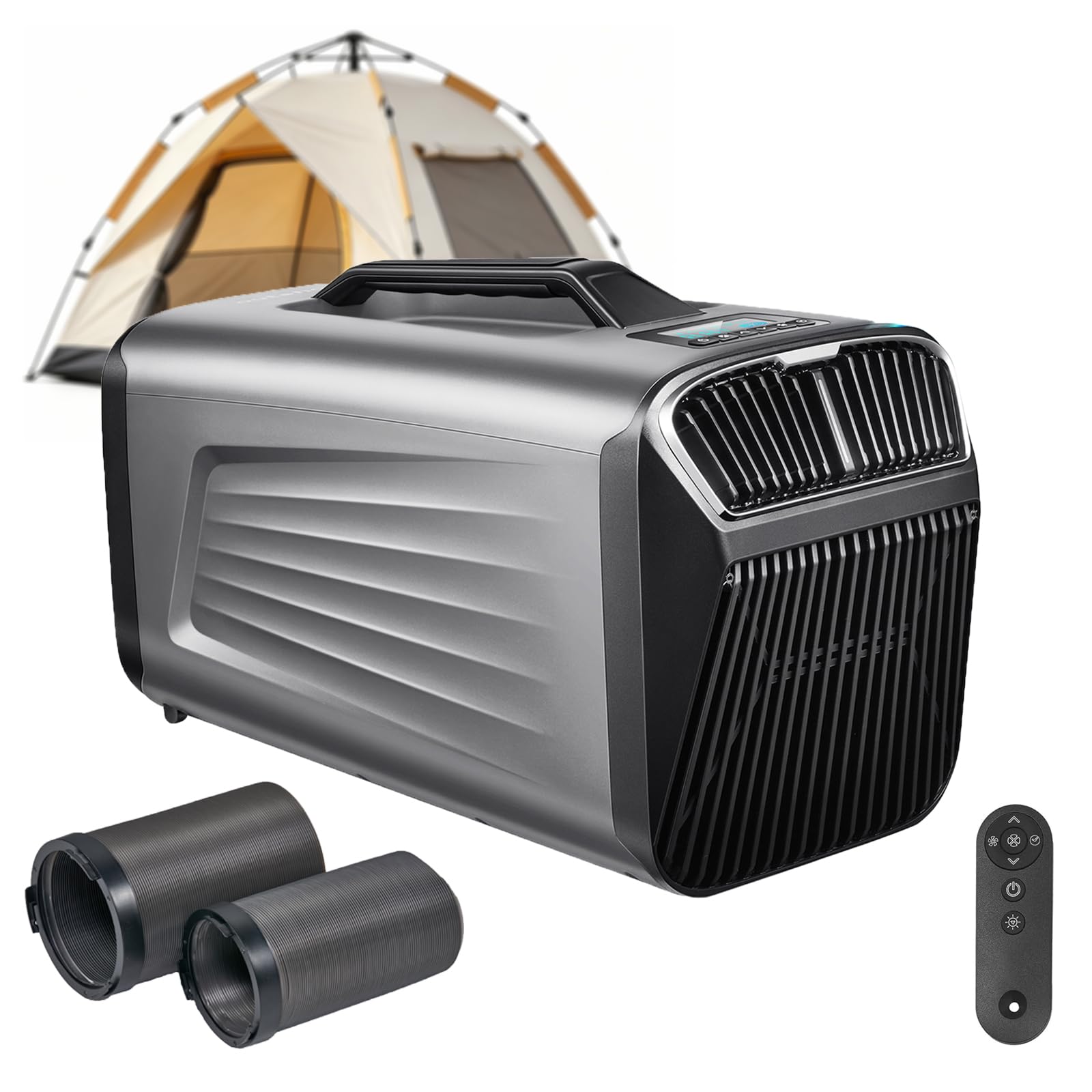
The OUTOHOME 5200 BTU model stands out for its remarkably low power consumption—averaging under 400 watts per hour while running. It uses a GMCC high-end compressor and can drop the temperature by 18°F in just 5 minutes. This makes it one of the most energy-efficient true compressor ACs available for tent use, and it’s light enough at 31 pounds to carry easily.
With four modes (Cool, Dry, Sleep, Fan) and a 24-hour timer, this unit is designed for overnight use. The drainless design works in most conditions below 70% humidity, and the built-in dehumidification function handles the rest. The dark silver metallic finish looks more premium than typical plastic ACs, and the compact dimensions (22.4 × 11.2 × 14.6 inches) fit well in a truck camper or tent corner.
Based on its listed specs, it should cool quickly and run quietly enough for sleep in a standard tent or small RV, though it is not rated for larger van conversions above its BTU capacity. The main limitation is that it needs a power hookup at the campground or a generator, as it’s not battery-powered.
Why it’s great
- Low 400W average power draw works with smaller generators
- Drainless in most humidities—no bucket emptying
- Lightweight 31 lbs with convenient handle
Good to know
- May not fully cool larger RVs above its BTU rating
- Compressor-based units can lose efficiency after long continuous runtimes—check current buyer feedback
3. OUTOHOME 5100 BTU Portable AC (2026)
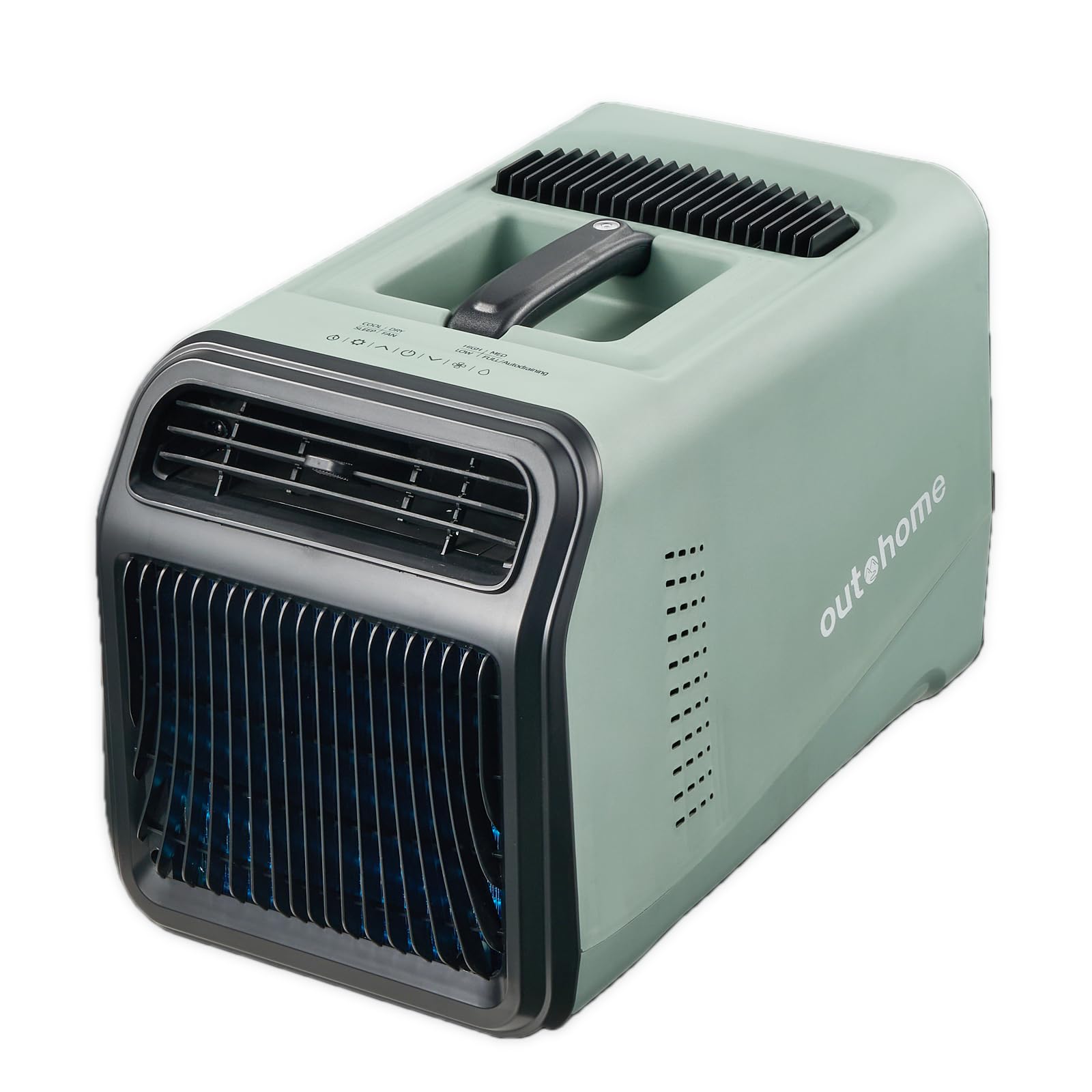
This OUTOHOME unit offers 5,100 BTU of cooling power and claims to cover spaces up to 200 square feet. It features a smart auto-evaporation system that recycles condensate to boost cooling efficiency, meaning no manual draining for most uses. The green design is visually distinct from the silver model, and it includes a built-in handle for easy transport.
The 4-in-1 functionality covers cooling, dehumidifying, fan, and sleep modes with precise temperature control and a 24-hour programmable timer. At 35 pounds and measuring 20.3 × 12 × 13.2 inches, it’s compact for its BTU range but requires a proper venting setup. The wide operating temperature range (60°F–86°F) ensures stable performance across climates and seasons.
Based on its listed specs, this unit is built for fast cooling in enclosed spaces. As with any compressor appliance, check current buyer ratings for quality-control feedback before purchase. This unit requires a powerful power station (at least 1,000Wh) due to startup surge, so confirm your generator or power station can handle the compressor’s starting wattage.
Why it’s great
- Covers up to 200 sq ft—good for larger family tents
- Auto-evaporation eliminates manual draining
- Fast temperature drop in enclosed spaces
Good to know
- Check current buyer ratings for build-quality feedback
- Requires a high-wattage power source for compressor startup
4. Aspligo 3000 BTU DC 24V Tent Air Conditioner

The Aspligo 3000 BTU unit targets the 2-person tent and vehicle-camping market, running on 24V DC battery power rather than a standard household outlet. It uses R-134A refrigerant and is rated for fast cooling with stable airflow, per the manufacturer’s listed specs. At 24.3 pounds, it’s one of the lighter true ACs available.
Because it runs on 24V DC rather than 110V AC, it’s built for direct battery or vehicle-power setups rather than a standard power station—confirm your power source is compatible before buying. It includes exhaust fittings and ducting for setup, a remote, and four working modes, with a listed noise level of 50 decibels.
The 700-watt rated consumption and DC-only power input are the key trade-offs versus 110V compressor units in this list. Check current buyer ratings for long-term reliability feedback before purchase.
Why it’s great
- True compressor cooling in a compact 24.3 lb unit
- Runs directly on 24V DC battery/vehicle power
- Includes ducting and exhaust fittings for setup
Good to know
- Requires 24V DC power source, not a standard 110V outlet or typical AC power station
- Check current buyer ratings for long-term reliability feedback
5. BougeRV PC35 3500 BTU Portable AC
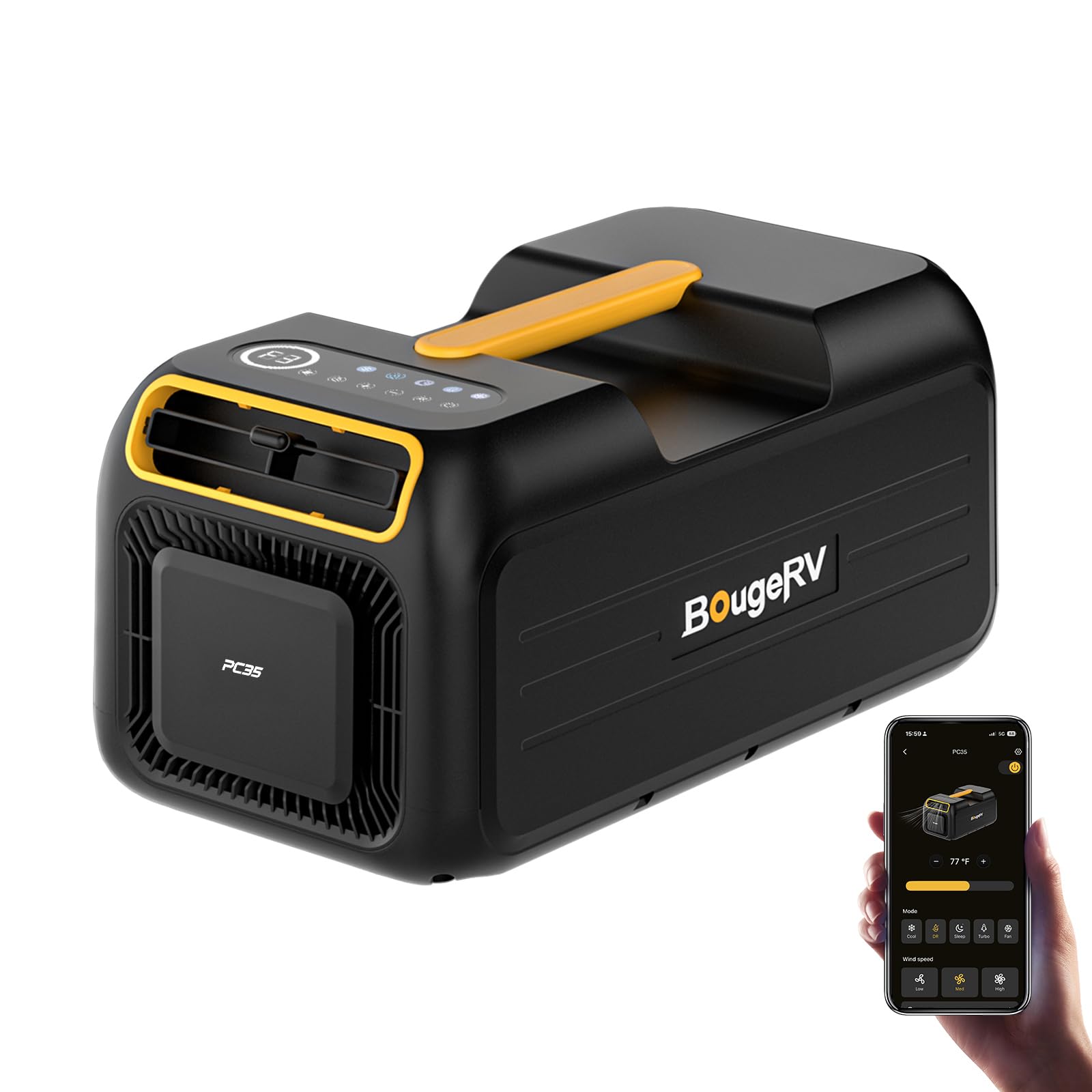
The BougeRV PC35 is a 3,500 BTU unit with the unique advantage of smartphone app control. This allows you to adjust temperature, modes, and timer settings from up to 33 feet away without leaving your sleeping bag. It cools spaces up to 64.58 sq ft and drops temperature by 18°F in 15 minutes on strong mode. The 5-in-1 functionality includes cooling, dehumidifying, fan, high power mode, and sleep mode.
Weighing 34.17 pounds with an ergonomic handle, this unit is designed for portability between the tent, RV, and indoor use. The 24-hour timer and temperature range of 61°F–90°F give you fine control over your comfort. It pairs well with a Jackery or EcoFlow power station when properly vented.
Manufacturer specs suggest it’s best suited for moderate climates or as a supplemental cooler rather than extreme heat, and the app-control feature is a convenience layer on top of the physical controls. The unit is heavy for backpacking but fine for car camping. As with any app-connected device, check current buyer ratings for software reliability feedback.
Why it’s great
- Smartphone app control adds convenience in the tent
- Fast 18°F drop in 15 minutes
- Pairs reliably with portable power stations
Good to know
- Not rated for extreme ambient heat—best for moderate climates
- Check current buyer ratings for app-reliability feedback
6. Powdeom 15L Bucket Misting Fan
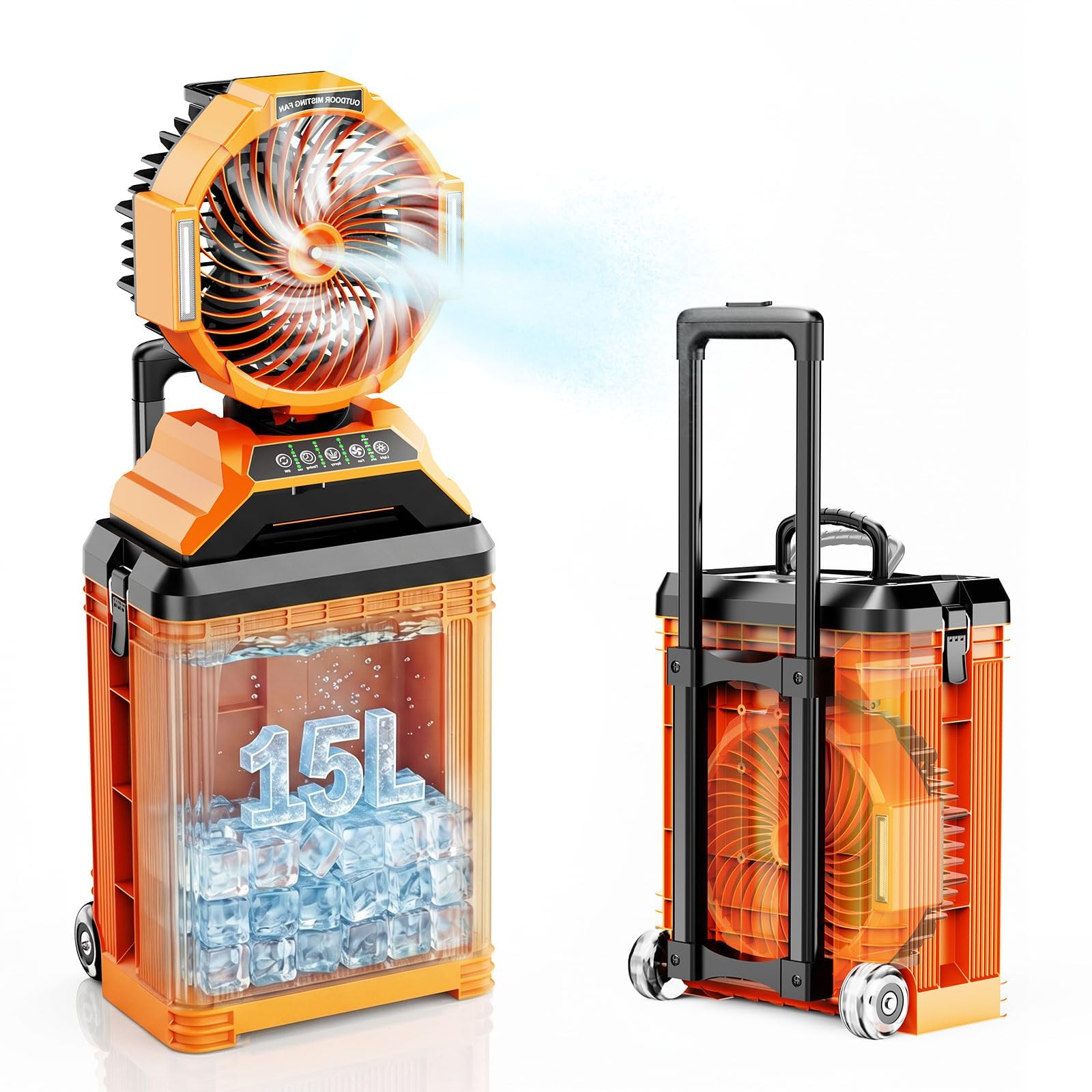
The Powdeom 15L Bucket Misting Fan is a hybrid solution: it combines a strong fan with a high-pressure misting system and a 15L water tank on wheels. The brushless motor offers 4 speeds and 4 spray volumes, with a spray distance of up to 6 meters. The built-in 30,000mAh battery delivers 6–8 hours of combined fan and mist operation, or 15–60 hours of fan-only use—more than enough for a full weekend of camping.
This isn’t a true AC, but the misting effect can lower the perceived temperature by 5°F–8°F in dry climates. The wheeled water bucket doubles as storage and a carrying case when not in use. The USB port lets you charge phones or small devices off the battery, and the oscillation (120°) ensures even coverage across a larger tent or shade area.
Misting fans like this deliver the most noticeable relief in dry climates. The plastic construction is a common trade-off in this product category—check current buyer ratings for durability feedback on the tank handle and fan-head attachment. The misting function requires clean water to prevent nozzle clogging, which is common for all evaporative devices.
Why it’s great
- Massive 30,000mAh battery for all-weekend use
- Wheeled bucket makes moving easy at camp
- Misting effect provides noticeable relief in dry heat
Good to know
- Plastic handle and fan attachment points are fragile
- Only effective in dry climates—adds humidity
7. FODFINU Portable Swamp Cooler
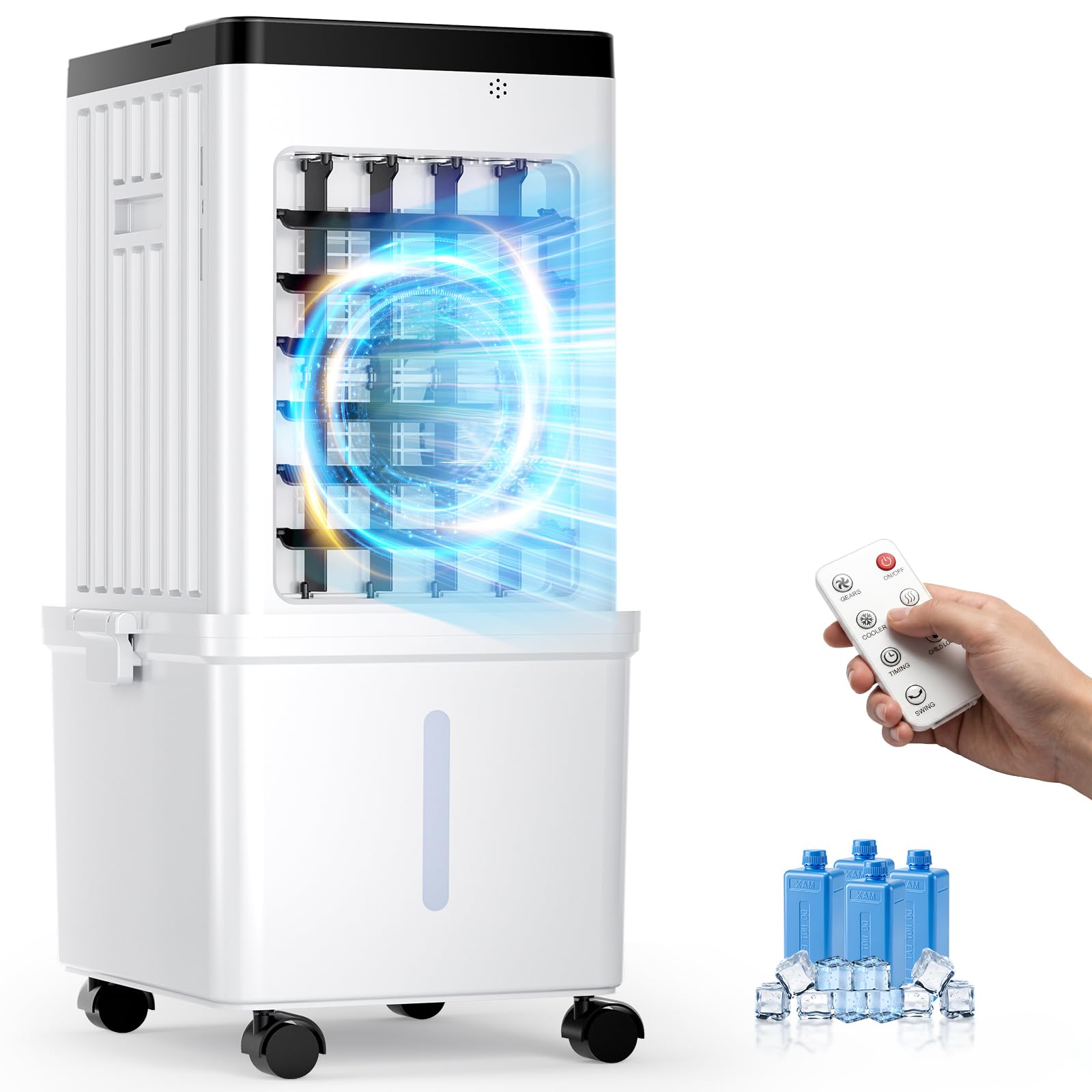
The FODFINU Swamp Cooler is an evaporative air cooler with a 3.5-gallon water tank that claims coverage up to 400 square feet. It uses four included ice packs and a 650 CFM fan to create a cool breeze through water evaporation. The 4-in-1 design works as a cooler, humidifier, fan, or aromatherapy diffuser, and the 120° oscillation distributes air evenly across the space.
At only 8 pounds on 360° swivel casters, this is the lightest option in the list and requires no complex venting because it doesn’t use a compressor. The remote and top touch controls make it easy to adjust, and the 45 dB noise level is quiet enough for sleep mode. It works best in dry climates where evaporation happens quickly and humidity stays low.
As an evaporative cooler, its effectiveness is inherently climate-dependent—it works best in dry conditions and provides little to no cooling benefit over a standard fan in humid areas. This is a budget-friendly entry point for dry-climate campers who want a simple cooler, but it cannot match true AC performance in humid areas. Check current buyer ratings for build-quality feedback on the plastic latches.
Why it’s great
- Ultra-light 8 lbs with wheels for easy moving
- Large 3.5-gallon tank runs 12 hours without refill
- No venting required—plug and play
Good to know
- Ineffective in high humidity—feels like a regular fan
- Cheap plastic construction prone to breakage
8. DREO TurboCool Misting Fan 516
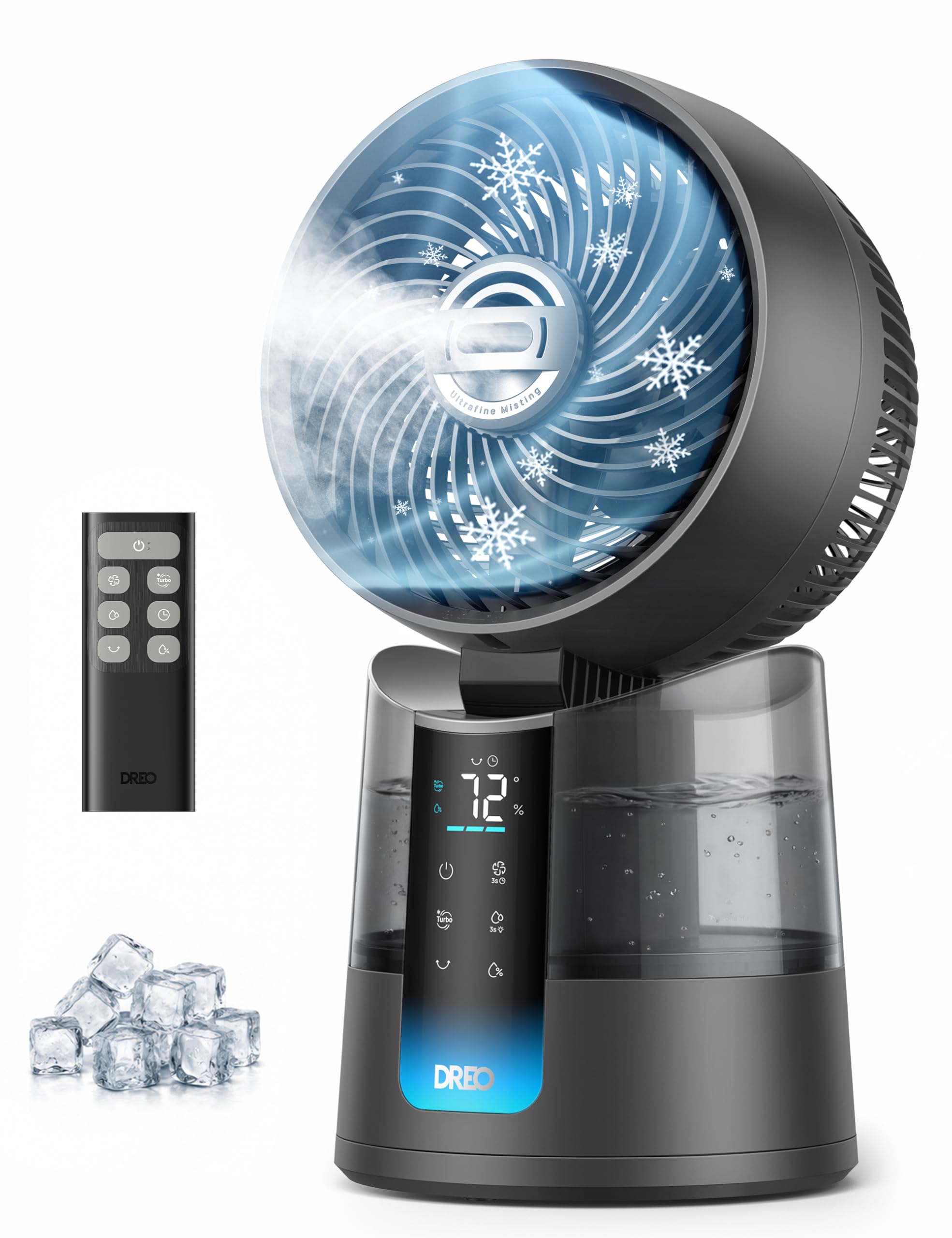
The DREO TurboCool Misting Fan uses 1.7 MHz ultrasonic technology to create an ultrafine mist that cools the air by up to 5°F without wetting surfaces or skin. It operates at just 20 dB, making it the quietest option in the entire list—perfect for light sleepers inside a tent. The 1.3L visible water tank provides up to 12 hours of misting, and the 512 CFM airflow delivers strong breeze even without mist.
The 150° horizontal and 30° vertical oscillation ensures generous coverage, and the remote control allows adjustments without reaching for the unit. At 4.84 pounds, it’s highly portable for car camping or RV use, and the standalone form factor fits on any table or nightstand. The included dust cover protects it during storage.
Its low decibel rating and ultrasonic misting design are aimed at small rooms and patios as an energy-efficient supplement to central AC. The misting function requires distilled water to prevent mineral buildup, and as with any water-tank device, check current buyer ratings for long-term leak feedback. It’s not a true AC, but for a quiet, mist-assisted fan, this is a strong option on paper.
Why it’s great
- Ultra-quiet 20 dB operation
- Ultrasonic mist doesn’t wet skin or surfaces
- 12-hour continuous misting from 1.3L tank
Good to know
- Check current buyer ratings for long-term leak feedback
- Requires distilled water to prevent nozzle clogs
9. OGERY Portable Camping Fan with Tripod
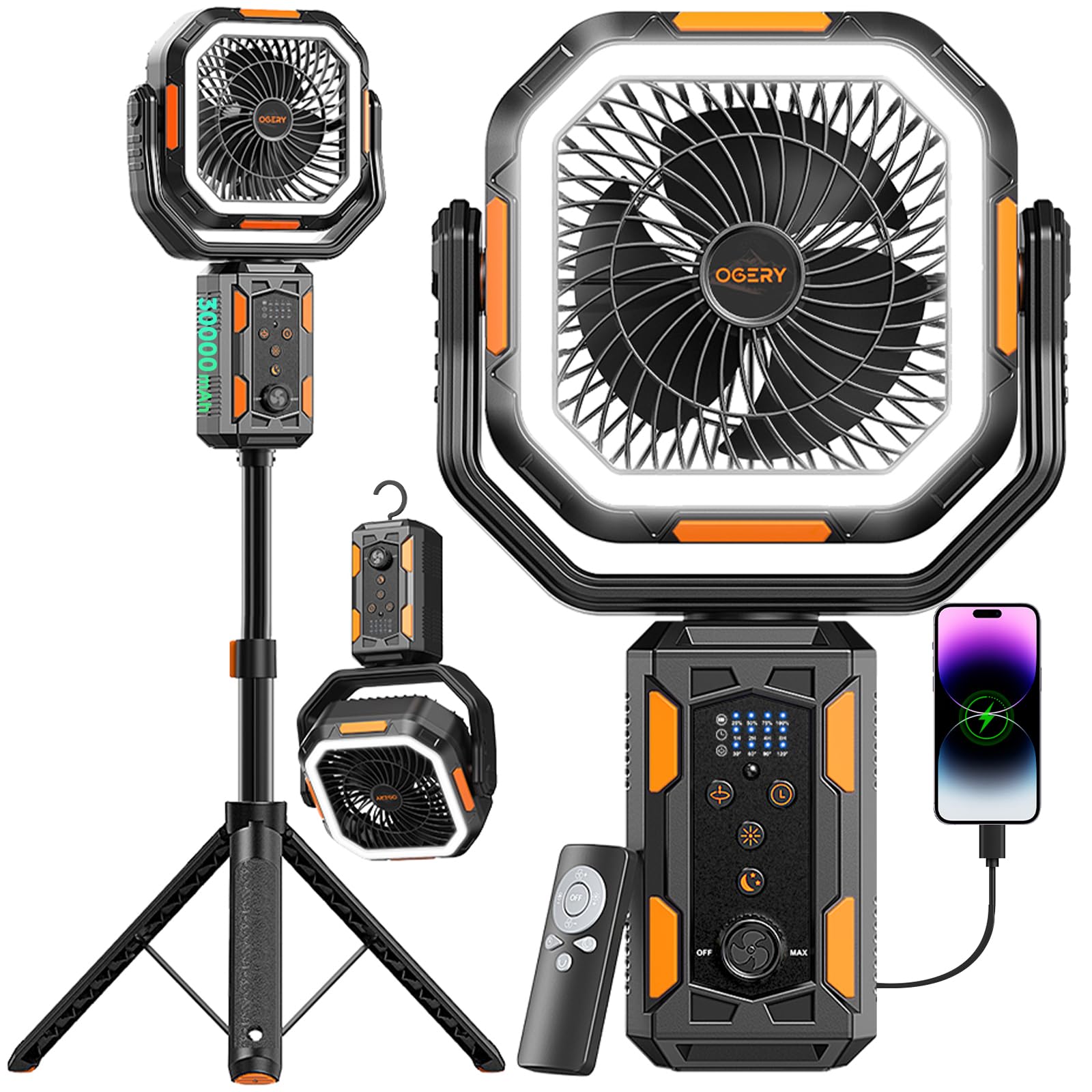
The OGERY Portable Camping Fan is a battery-powered fan, not a true air conditioner, but it offers the best battery life in the list with up to 322 hours on low speed. The 30,000mAh battery runs the fan and built-in LED lantern for extended camping trips. The stepless speed control lets you dial in the perfect airflow, from a silent nighttime breeze to strong daytime cooling at 5.0 m/s.
The 2-in-1 tripod design allows it to function as a floor fan when extended to 3.7 ft or as a compact desk fan when collapsed. The 30°/60°/90°/120° automatic oscillation and 270° vertical adjustment ensure broad coverage across the tent. Additional features include a 22.5W power bank for charging phones, a 3-level LED lantern, a remote control, and a 1/2/4/8H timer for automated operation.
Its listed specs (long battery life, quiet operation, tripod versatility, built-in light, and phone charging) make this a strong option for anyone who needs air circulation without compressor noise, but it won’t lower the temperature like a real AC.
Why it’s great
- Incredible 322-hour battery on low speed
- Adjustable tripod stand for floor or desk use
- Versatile with oscillation, LED light, and power bank
Good to know
- Only circulates air—does not cool the tent temperature
- Tripod stakes needed for windy conditions
FAQ
Can I run a tent AC on a Jackery 500?
Will a misting fan work in a humid climate?
How do I vent a tent air conditioner?
Is a 5,200 BTU AC too much for a small tent?
Final Thoughts: The Verdict
For most users, the best air conditioner for tent is the OUTOHOME 5200 BTU because it balances powerful cooling, ultra-low 400W power draw, and a lightweight 31-pound build that’s easy to carry. If you want strong cooling for larger tents with a premium GMCC compressor, grab the BAYKUL 5000 BTU. And if your setup runs on 24V DC battery or vehicle power rather than a standard outlet, consider the Aspligo 3000 BTU DC unit for 2-person tents and vans.