
Our readers keep the lights on and the weekend projects moving. As an Amazon Associate, I earn from qualifying purchases.
Whether you are dealing with a sweltering master suite, a shop floor that refuses to hold a stable temperature, or a multi-room home built without ductwork, the decision between a single-zone mini-split and a multi-zone heat pump comes down to matching raw capacity to the actual heat load of each space. Oversizing invites short cycling and humidity problems; undersizing means the compressor runs nonstop without ever reaching the set point. The right unit balances tonnage, SEER2 efficiency, and the number of indoor heads against your square footage and climate demands.
I’m Rikta — the co-founder and writer behind FitlyFast. I’ve spent hundreds of hours analyzing manufacturer spec sheets, decoding seasonal efficiency ratings for inverter-driven scroll compressors, and cross-referencing real-world BTU capacities against customer-reported coverage areas for ductless and central split systems.
This guide distills everything into a focused comparison of seven models so you can confidently select the right air conditioning system for your home, workshop, or light commercial space without getting buried in marketing jargon.
How To Choose The Best Air Conditioning System
Picking an air conditioning system isn’t about picking the biggest BTU number you can find. The key is matching the unit’s cooling capacity and efficiency rating to the physical characteristics of your space — insulation quality, ceiling height, sun exposure, and the number of rooms you need to cover. Getting this wrong leads to a system that either runs constantly without satisfying the thermostat or cycles on and off so fast it never dehumidifies the air.
Match Tonnage to Heat Load, Not Just Square Footage
A 24,000 BTU unit roughly covers 1,000 to 1,200 square feet in a well-insulated home, but that number drops if you have vaulted ceilings, large windows facing west, or a metal building without insulation. Overbuying capacity sounds safe, but an oversized system removes humidity poorly and shortens compressor life. Undersizing forces the compressor to run at full speed continuously, driving up electric bills. Calculate your heat load using Manual J principles if you can, or at least factor in ceiling height and window area before picking a tonnage.
SEER2 vs. SEER — What Changed
Starting in 2023, the Department of Energy switched from SEER to SEER2 for split systems. SEER2 uses a different test procedure that accounts for the static pressure of the duct system, making it roughly 4–5 points lower than the old SEER number for the same hardware. A unit labeled 19.5 SEER2 is actually very efficient — roughly equivalent to a 24 SEER under the old test. Don’t compare SEER2 directly to SEER; the two scales are not interchangeable.
Single-Zone vs. Multi-Zone vs. Central Split
Single-zone mini-splits pair one outdoor condenser with one indoor wall unit — they’re ideal for a single large room, a garage conversion, or a bonus room without ductwork. Multi-zone systems let you connect two to four indoor units to a single outdoor condenser, giving you independent temperature control in each zone. A central split system (air handler plus condenser) replaces a traditional furnace-and-coil setup and works with existing ductwork, but it requires a professional to modify or build the duct system.
Quick Comparison
On smaller screens, swipe sideways to see the full table.
| Model | Category | Best For | Key Spec | Amazon |
|---|---|---|---|---|
| Senville 36K | Central Split | Whole-home with existing ductwork | 16 SEER2 / 36,000 BTU | Amazon |
| Cooper & Hunter Quad | 4-Zone Mini | Multi-room no-duct homes | 24 SEER2 / 36,000 BTU | Amazon |
| MRCOOL 24K | Single-Zone Mini | DIY garage or workshop | 24,000 BTU / 1,050 sq ft | Amazon |
| Cooper & Hunter 36K | Single-Zone Mini | Large open space or light commercial | 19.5 SEER2 / 36,000 BTU | Amazon |
| C&H 2-Zone 18K | 2-Zone Mini | Two-room zoning without ducts | 25 SEER2 / 18,000 BTU | Amazon |
| Goodman 3 Ton | Ducted Central | Standard forced-air replacement | 14.5 SEER2 / 36,000 BTU | Amazon |
| Airtek AC-Dual | Auto Recovery | Automotive AC service shop | R134a & 1234yf Recovery | Amazon |
In‑Depth Reviews
1. Senville 36,000 BTU Central Air Conditioner Heat Pump Split System
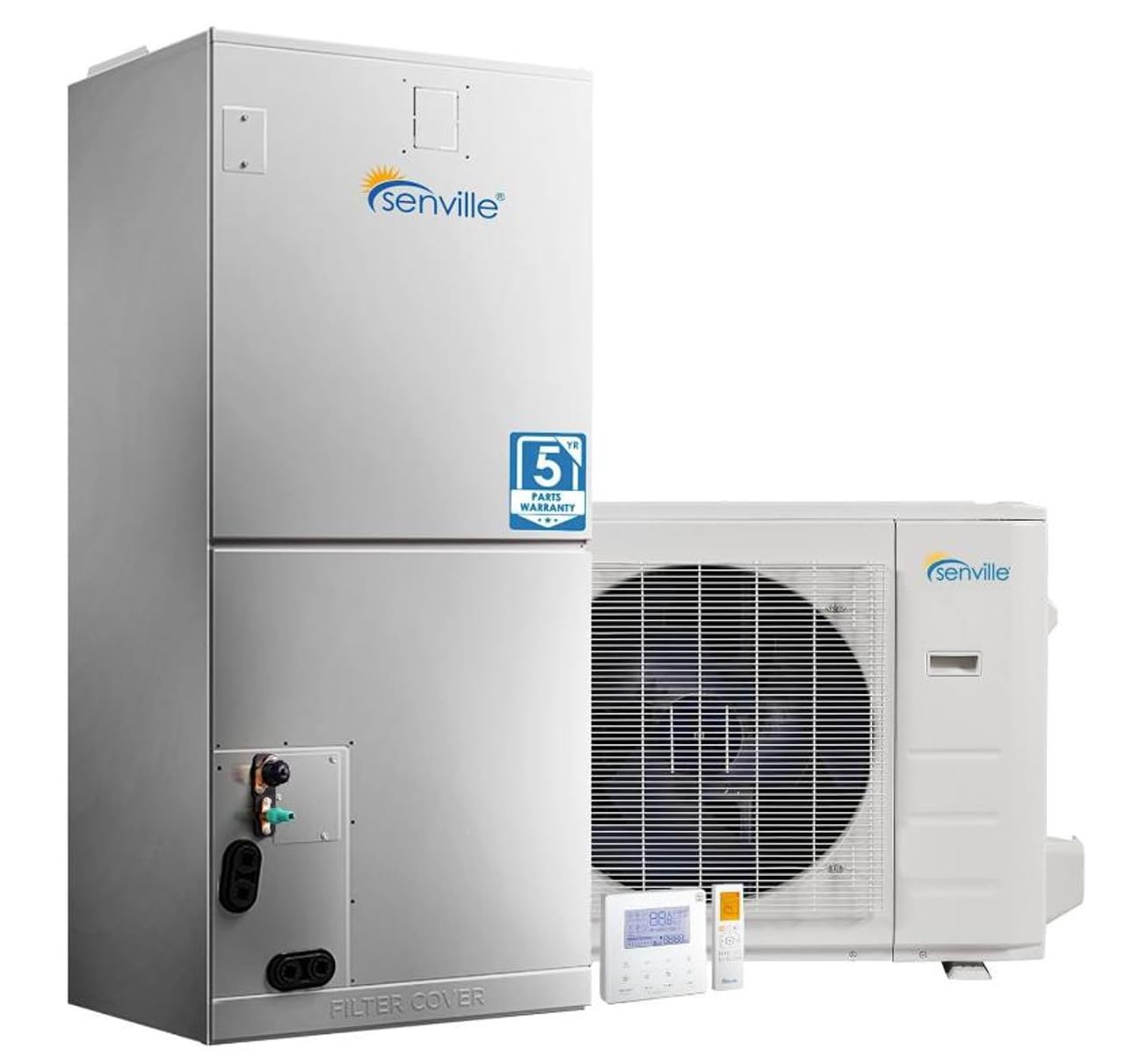
The Senville 36K bridges the gap between a traditional central AC and a modern inverter-driven mini-split by using a variable-speed scroll compressor that modulates its output instead of cycling on and off. Rated at 16 SEER2, it covers up to 2,000 square feet and includes a heat pump that delivers useful warmth down to -22°F. That cold-climate capability makes it a viable year-round solution for homes in northern zones that still want to use existing ductwork.
Real-world feedback from HVAC pros confirms the unit is whisper-quiet compared to a single-stage condenser, and the inverter holds set temperature without the blast-and-coast pattern of a standard system. One installer reported a 1,700 kWh reduction in the first month after swapping out an old 10 SEER unit. The outdoor chassis is notably large, so confirm your pad or bracket can accommodate its footprint before committing.
The manuals are notoriously sparse — even seasoned techs found them confusing. Communication between the indoor air handler and outdoor unit runs on S1/S2 wires, and the controller uses HA/HB terminals that aren’t common in standard thermostat wiring. Professional installation is mandatory, and you will need two separate 230V circuits. Senville’s tech support was rated helpful once reached, but initial hold times can be long.
Why it’s great
- Variable-speed inverter holds temp without cycling
- Heating down to -22°F for true four-season use
- Significant monthly energy savings over older units
Good to know
- Manuals are confusing even for experienced techs
- Requires two separate 230V circuits
- Outdoor unit is physically large
2. MRCOOL 24,000 BTU Ductless Inverter Mini Split AC & Heat Pump
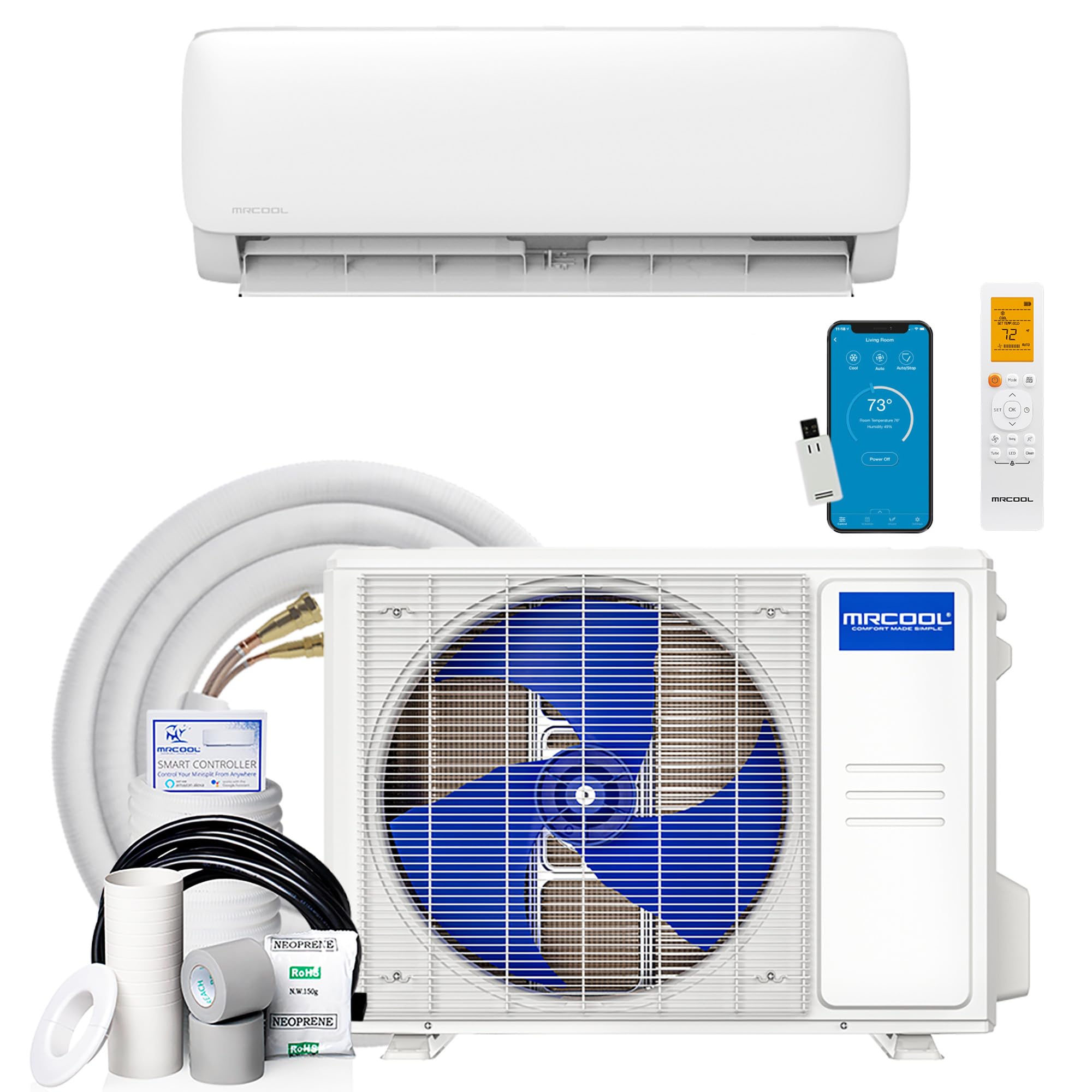
The MRCOOL 24K Easy Pro Series is one of the few ductless systems marketed explicitly toward DIY installation. The pre-charged line set eliminates the need for a vacuum pump and manifold gauges on a standard install, though you still need basic electrical knowledge to run the 230V disconnect and connect the communication wires. It covers up to 1,050 square feet and provides both heating and cooling through a wall-mounted indoor unit.
Buyers who succeeded with the install consistently note that the unit kept a large garage or family room comfortable through both summer peaks and winter chills, and they reported significant electric bill savings compared to window units or baseboard heat. The compressor arrived damaged from shipping in several cases, but the units still ran fine after minor sheet-metal adjustments — a testament to robust internal design.
Packaging quality is a recurring complaint: the box often arrives with damage, missing tools like the hole saw and wrenches that are supposed to be included. The included remote works, but the WiFi/USB controller has been unreliable for several users. If you are not comfortable bending sheet metal back into shape or sourcing your own install tools, hiring a pro is safer.
Why it’s great
- Pre-charged line set simplifies DIY installation
- Effective cooling for garages and large rooms
- Cost significantly less than equivalent big-box units
Good to know
- Box often arrives with missing tools and cosmetic damage
- WiFi controller reported as unreliable
- Packaging offers poor protection during shipping
3. Cooper & Hunter 36,000 BTU Single-Zone Mini Split AC/Heating System

This 36,000 BTU single-zone unit from Cooper & Hunter packs 19.5 SEER2 efficiency into a system designed for large open spaces up to around 1,500 square feet. The included smart kit allows app-based control from anywhere, and the pre-charged outdoor condenser ships with a 16-foot installation kit that includes insulated copper lines, communication cable, and drainage hose. The heat pump operates down to -13°F ambient, making it a genuine four-season option.
Users cooling insulated shops in 90–100°F weather report the unit pulls the temperature down to the mid-70s without strain, and the power bill increase was roughly half of what they expected with a traditional AC. The variable-speed inverter keeps the indoor fan running continuously at low speed, which improves humidity removal and prevents the stale-air feeling common with on-off systems. The remote control and app interface are both rated as intuitive.
This is not a DIY system. Professional installation is required, and the manual lacks crucial details — for example, the indoor unit hissing sound during defrost cycles is normal, but the manual doesn’t mention it. The unit does not work with GFCI breakers; you need a standard 230V breaker. The 16-foot line set may be too short for some layouts, and the wall sleeve included is flimsy enough that experienced installers replace it with PVC.
Why it’s great
- Excellent humidity control with continuous low-speed fan
- App and remote control are simple to use
- Heating capability down to -13°F
Good to know
- Requires standard breaker — does not work with GFCI
- Manual lacks detail on normal operating sounds
- Not a DIY-friendly system
4. Cooper & Hunter 18,000 BTU 2-Zone Ductless Mini Split AC & Heat Pump
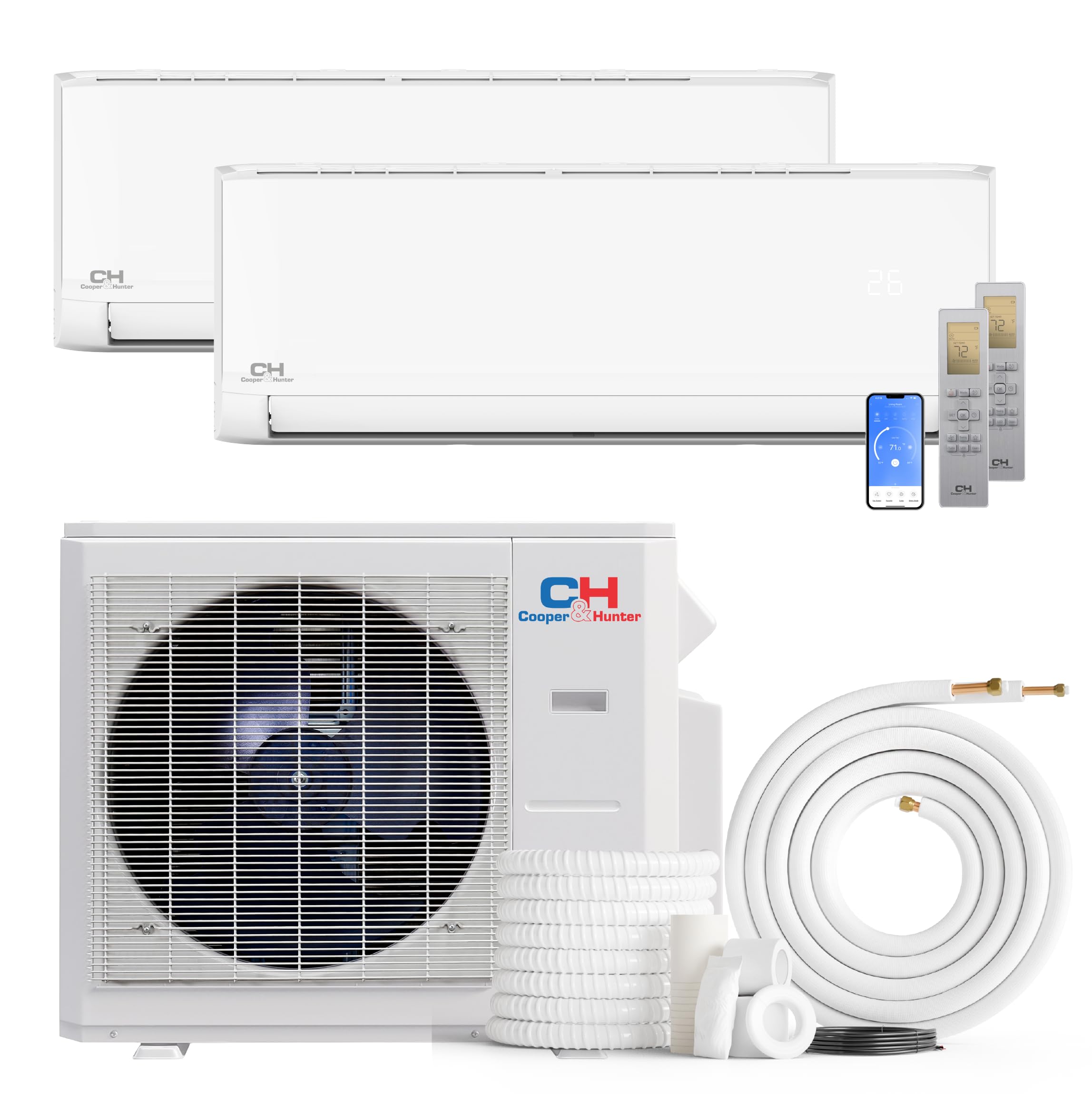
With a 25 SEER2 rating, this two-zone system is the most efficient unit in this roundup. It pairs a single 18,000 BTU outdoor condenser with two wall-mounted indoor units (6,000 BTU + 12,000 BTU) that can be independently controlled from a smartphone or remote. The two 25-foot installation kits include insulated copper lines, communication cables, and drainage extensions — enough length to reach separate rooms without splicing.
Professional HVAC technicians who installed these units report that they kept spaces at 73°F on 40°F mornings in heat mode and that the build quality is comparable to major Japanese brands. The variable-speed inverter compressor modulates its output smoothly, so neither zone experiences temperature overshoot. The included smart kits provide full app control for scheduling, temperature adjustments, and mode changes.
The system cannot heat one zone while cooling the other simultaneously. Attempting to use AUTO mode for both cooling and heating on different heads throws an error code. The line set shipped has chemistry issues — the 1/2-inch and 1/4-inch supplied lines may not match the evaporator stubs (which are 3/8-inch and 1/4-inch), requiring field-fabricated adapters. The copper quality is also thinner than premium brands, so careful flaring is essential.
Why it’s great
- Highest efficiency in the comparison at 25 SEER2
- Two independently controlled zones from one condenser
- Two full 25-foot install kits included
Good to know
- Cannot heat one zone and cool the other simultaneously
- Line set sizes may not match evaporator stubs
- Copper quality is thinner than premium competitors
5. Cooper & Hunter 36,000 BTU Quad 4-Zone Ductless Mini Split AC & Heat Pump
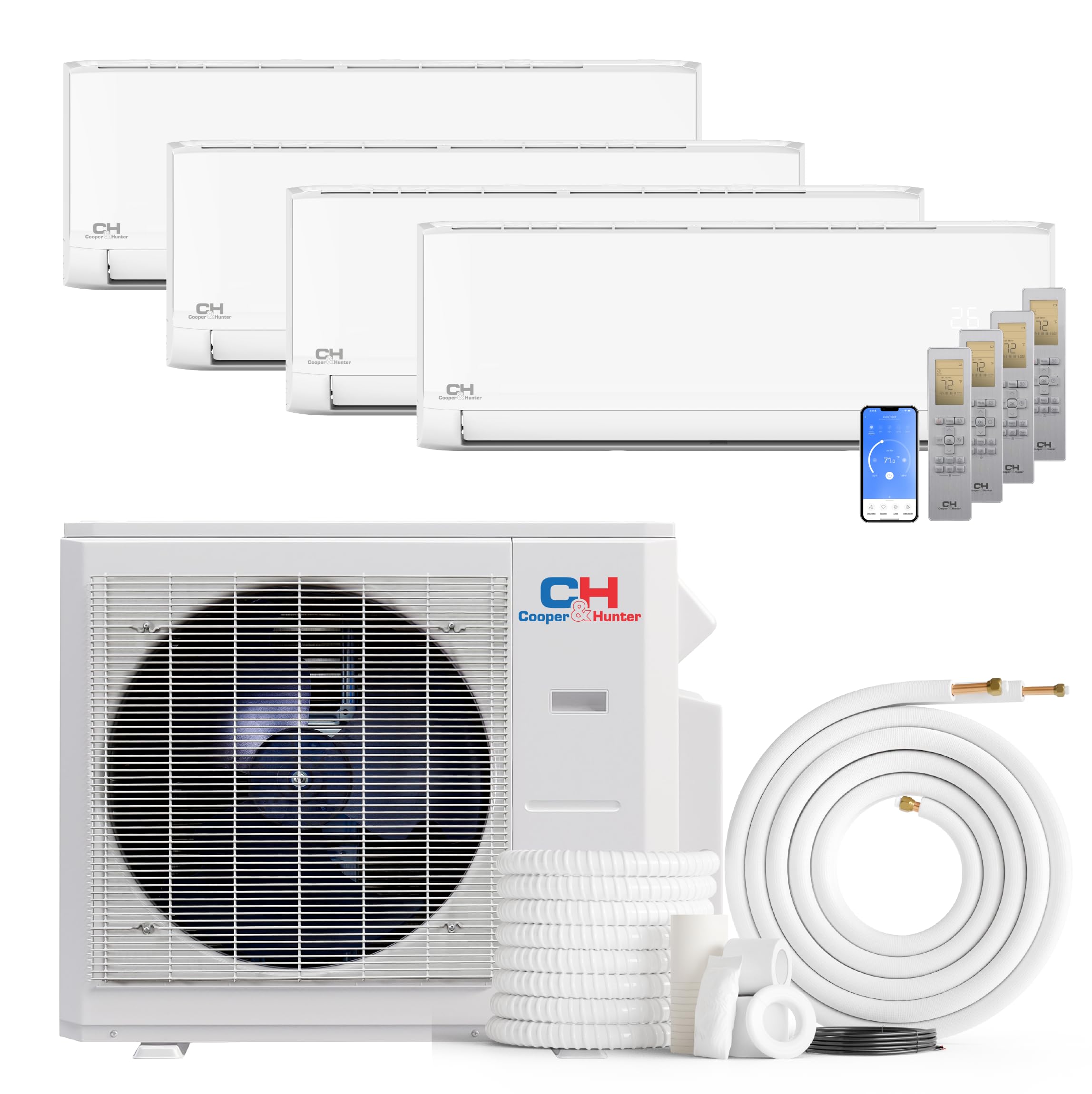
The quad-zone Cooper & Hunter combines a 36,000 BTU outdoor condenser with four wall-mounted indoor heads — 9,000 + 9,000 + 12,000 + 18,000 BTU — making it the only unit here that can independently condition four separate rooms from a single outdoor unit. It carries a 24 SEER2 rating, includes four smart kits for app control, and ships with four 25-foot installation kits. This configuration is ideal for homes, rental units, or light commercial spaces where running ductwork is impossible.
Self-installers report that the system is significantly quieter than a traditional central AC, both indoors and outdoors, and that the remote control interface is straightforward. The ability to assign different temperatures to different zones means unused rooms can be set to an energy-saving mode while the main living area stays comfortable. Buyers in the southern US found the heat pump adequate for winter warmth without backup heat.
This system struggles as a primary heat source in climates where temperatures regularly drop below 40°F. Several northern buyers reported the heat pump could not keep up in freezing weather and had to supplement with gas heat. The warranty process has been flagged as difficult — multiple users reported that after a few months of trouble-free operation, the factory refused service claims. Professional installation is mandatory and strongly advised despite the DIY-friendly appearance.
Why it’s great
- Four independent zones from one outdoor condenser
- Very quiet operation at both indoor and outdoor units
- Four full 25-foot install kits included
Good to know
- Heat pump insufficient below 40°F ambient
- Warranty service reported as difficult to invoke
- Professional installation required
6. Goodman 3 Ton 14.5 SEER2 Condenser with Multi-Positional Air Handler
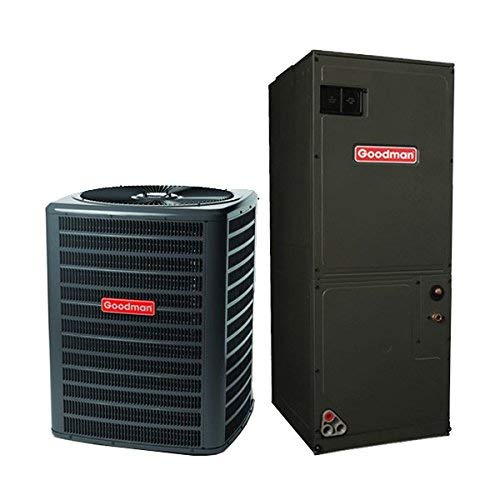
The Goodman 3 Ton (36,000 BTU) system is a traditional ducted central AC — not a mini-split. The combination of the GLXS4BA3610 condenser and AMST36CU1300 air handler uses R-32 refrigerant and produces 14.5 SEER2 efficiency. The air handler features a factory-installed thermal expansion valve and a 9-speed ECM blower motor that matches airflow to system demand. This is a cooling-only system; you must add an HKTS series heat kit for heating, or choose a different model entirely.
Owners in hot climates like south Louisiana report that the system cools a 2,000-square-foot two-story home easily even during oppressive summer heat, and they describe the operation as extremely quiet compared to older piston-driven units. The all-aluminum evaporator coil resists corrosion, a known failure point on older copper-coil designs. The 10-year parts warranty (when registered within 60 days by a qualified installer) provides solid long-term protection.
This system does not include a heat pump — if you need heating, you must buy a separate heat kit. The warranty covers parts but not labor or refrigerant, meaning an in-warranty coil leak still costs hundreds in refrigerant and labor. The condenser uses a single-stage scroll compressor, so it operates at full capacity whenever the thermostat calls for cooling — no inverter modulation. Professional installation is required and strongly recommended due to the complexity of matching the air handler and line set.
Why it’s great
- Extremely quiet single-stage scroll compressor
- Corrosion-resistant aluminum evaporator coil
- 10-year parts warranty when registered
Good to know
- Cooling only — no heat pump or heating function
- In-warranty repair still costs for refrigerant and labor
- Single-stage operation means full on/off cycling
7. Airtek AC-Dual Fully Automatic Automotive AC Recovery & Recharge Machine

The Airtek AC-Dual is not a home air conditioning system — it is a fully automatic recovery, recycle, and recharge machine designed for automotive AC service shops that work with both R134a and HFO-1234yf refrigerants. Switching between the two refrigerant types takes roughly 10 minutes, and the machine includes two empty tanks so you don’t need to swap bottles mid-job. The recovery rate is rated at 95%, which keeps the shop in compliance with EPA venting regulations.
Shop owners who run busy service bays report the cycle times are faster than a comparable Robinair unit, and the automated process means technicians can enter the vehicle info and walk away while the machine handles evacuation and recharge. The heavy-duty construction (275 pounds) holds up to daily commercial use — one reviewer reported flawless operation over 30+ cycles with no leaks. The oil injection system is software-controlled, preventing accidental cross-contamination between refrigerant types.
The shipping cost disclaimer is misleading: despite “free shipping” in the listing, the carrier charges extra fees that the seller does not cover. One unit arrived with an internal fault that caused smoke and failed to recover refrigerant, and the manufacturer’s support process was difficult to navigate. The 110V power requirement limits placement flexibility in shops wired for 220V. This machine serves a very specific audience — automotive AC professionals — and is not relevant for residential HVAC installation.
Why it’s great
- Dual refrigerant support with fast switchover time
- Fully automatic cycle saves technician labor
- Software-controlled oil injection prevents errors
Good to know
- Shipping cost and carrier fees not as advertised
- 110V only — may not suit all shop layouts
- Customer support can be difficult to reach
FAQ
Can a single 36,000 BTU outdoor condenser serve four rooms?
Do I need a licensed contractor for a pre-charged mini-split?
Why does the SEER2 number on a new unit look lower than the old SEER rating?
Can an inverter heat pump replace a gas furnace in a cold climate?
Final Thoughts: The Verdict
For most users, the air conditioning system winner is the Senville 36,000 BTU Central Split because its variable-speed inverter compressor delivers quiet, efficient cooling and heating down to -22°F, making it the most versatile solution for whole-home ducted installations. If you want a DIY-friendly single-zone setup for a workshop or garage, grab the MRCOOL 24K Easy Pro. And for a ductless multi-room home where running ductwork is impractical, nothing beats the Cooper & Hunter Quad 4-Zone for independent temperature control across four separate spaces.