
Our readers keep the lights on and the weekend projects moving. As an Amazon Associate, I earn from qualifying purchases.
Mold spores don’t just trigger allergies—they silently colonize your home’s air, often multiplying in unseen damp corners while you breathe them in every night. Standard dust-trapping filters let these microscopic particles slip right through, making a targeted defense essential for anyone dealing with musty basements, humid bathrooms, or recent water damage. The right air purifier for this fight needs a medical-grade seal against particles as small as 0.3 microns, plus a carbon stage to tackle the musty VOCs that signal active mold colonies.
I’m Rikta — the co-founder and writer behind FitlyFast. My research for this guide involved cross-referencing CADR (Clean Air Delivery Rate) scores, HEPA efficiency grades, filter replacement costs, and real-world customer feedback from over 400 verified reviews to identify which machines actually arrest mold spore circulation.
Whether you’re dealing with a post-renovation dust storm or persistent basement humidity, the goal is a unit that runs quietly, circulates room volumes multiple times per hour, and traps particles that standard filters miss. This breakdown of the best air filter for mold spores compares nine top-performing models across mid-range and premium tiers to help you clear the air for good.
How To Choose The Best Air Filter For Mold Spores
Selecting a purifier for mold spore removal goes beyond basic dust capture. The spore size, the volume of air the unit can process, and the type of filter media all determine whether your machine actually reduces airborne mold counts or just recirculates them.
True HEPA vs. HEPA-Type Filtration
True HEPA filters are lab-tested to capture 99.97% of particles at 0.3 microns—the most penetrating particle size. Mold spores typically range from 1 to 5 microns, so a True HEPA filter stops them efficiently. Some units advertise “HEPA-type” or “HEPA-grade” filters, which often lack independent certification and may let smaller spore fragments pass. For mold defense, insist on a filter labeled True HEPA or one with a published third-party test report at the 0.3-micron standard.
CADR Ratings and Room Volume Turnover
Clean Air Delivery Rate (CADR) measures how many cubic feet of clean air a unit delivers per minute for smoke, dust, and pollen. A higher CADR means the purifier cycles the room’s air more times per hour—critical for preventing mold spores from settling on surfaces. For a 300-square-foot room, aim for a CADR of at least 200 CFM for dust. The unit should refresh the room at least four times per hour to maintain spore control.
Carbon Filtration for Mold VOCs
Active mold colonies release microbial volatile organic compounds (mVOCs)—the chemicals that cause that musty, earthy smell. A standard HEPA filter can’t remove gases and odors. Look for a purifier with a substantial activated carbon layer, ideally pellet-based rather than a thin mesh, to adsorb these mVOCs. This is the difference between cleaning the air and masking the problem.
Pre-Filter and Maintenance Cycle
Mold spores are sticky and can clog a HEPA filter quickly. A washable pre-filter captures larger particles (dust, pet hair, large spore clumps) before they reach the main HEPA cartridge, extending filter life and reducing replacement costs. Models with permanent, washable filters eliminate recurring expenses altogether, though they may require more frequent cleaning. Check the manufacturer’s recommended filter change interval—every 6 to 12 months is typical for HEPA + carbon combos.
Quick Comparison
On smaller screens, swipe sideways to see the full table.
| Model | Category | Best For | Key Spec | Amazon |
|---|---|---|---|---|
| Levoit Core 300-P | Mid-Range | Bedroom allergy relief | 143 CFM CADR (Smoke) | Amazon |
| Levoit Core 200S-P | Mid-Range | Compact smart control | 27 dB Sleep Mode | Amazon |
| ECOSELF HAP603 | Mid-Range | Large room coverage | 2,400 ft² coverage | Amazon |
| Winix 5520 | Mid-Range | Odor & VOC control | True HEPA, 0.01 micron | Amazon |
| Homedics 5-in-1 | Mid-Range | Multi-function (UV + scent) | 1,593 ft² coverage | Amazon |
| Coway Airmega 250 | Premium | Sustained high-volume spore capture | 1,860 ft² in 1 hour | Amazon |
| Nuwave Forever | Premium | Zero filter replacement cost | 100% capture down to 0.1 micron | Amazon |
| BlueDri Air Shield 550 | Premium | Remediation & restoration | 550 CFM airflow | Amazon |
| AirDoctor AD3500 | Premium | Hospital-grade spore elimination | 99.99% at 0.003 microns | Amazon |
In‑Depth Reviews
1. Levoit Core 300-P

The Levoit Core 300-P punches well above its mid-range price point with a 56W high-torque motor that delivers 143 CFM CADR for smoke—meaning it can cycle a 222-square-foot room nearly five times per hour. For mold spore capture, the 3-in-1 filter includes a HEPA-grade main layer tested to 99.97% efficiency at 0.3 microns, which covers the full spore size spectrum. The AHAM VERIFIDE seal confirms the CADR claims, so you’re not guessing whether the unit actually moves that volume of air.
Sleep Mode drops noise to 24 dB—basically a whisper—making it ideal for overnight use in a bedroom where mold concerns keep you awake. The timer (2/4/6/8 hours) and dimmable display let you run it without light pollution. Multiple filter options (Toxin Absorber for VOCs, Smoke Remover for wildfire particulates, Pet Allergy for dander) let you tailor the carbon layer to your specific mold situation—useful if musty odors are a primary trigger.
Note that replacement filters add recurring cost, and the unit lacks smart-home integration. However, the compact 8.7-inch diameter footprint fits easily on a nightstand or desk, and the CARB compliance ensures it’s safe for California’s strict indoor air standards. For a room-level mold spore defense with verified performance, this is the balanced choice.
Why it’s great
- AHAM VERIFIDE CADR certification removes guesswork on air movement
- Sleep Mode at 24 dB is near-silent for overnight filtration
- Multiple specialized filter cartridges target mold VOCs
Good to know
- No Wi-Fi or voice control
- Replacement filters are a continuing expense
2. Levoit Core 200S-P

The Core 200S-P shrinks the footprint to 8 x 8 inches while adding voice and app control—handy for adjusting fan speeds or checking filter life without walking across the room. It uses the same 3-in-1 filter platform (nylon pre-filter, activated carbon, HEPA main) and captures 99.97% of particles at 0.3 microns. For a dorm room, nursery, or small bedroom where mold spores may be concentrated, this unit refreshes a 140-square-foot space 4.8 times per hour.
Noise levels bottom out at 27 dB in Sleep Mode, marginally louder than the Core 300-P but still quiet enough for a light sleeper. The 360° air intake pulls from all directions, which helps capture spores that might be settling near baseboards or corners. The app lets you schedule operation—run it on high for an hour before bed, then drop to Sleep Mode overnight—without manual button presses.
The trade-off is a smaller floor-area rating (1,073 square feet once per hour), meaning it’s not a whole-home solution. It also lacks the filter-type variety of the Core 300-P. For targeted spore defense in a single room with the convenience of smart scheduling, this is a clean option.
Why it’s great
- Compact design fits tight spaces
- App and voice control for remote operation
- Quiet enough for nursery or bedroom
Good to know
- Only one filter type available
- Not suitable for rooms over 200 sq ft for spore density
3. ECOSELF HAP603
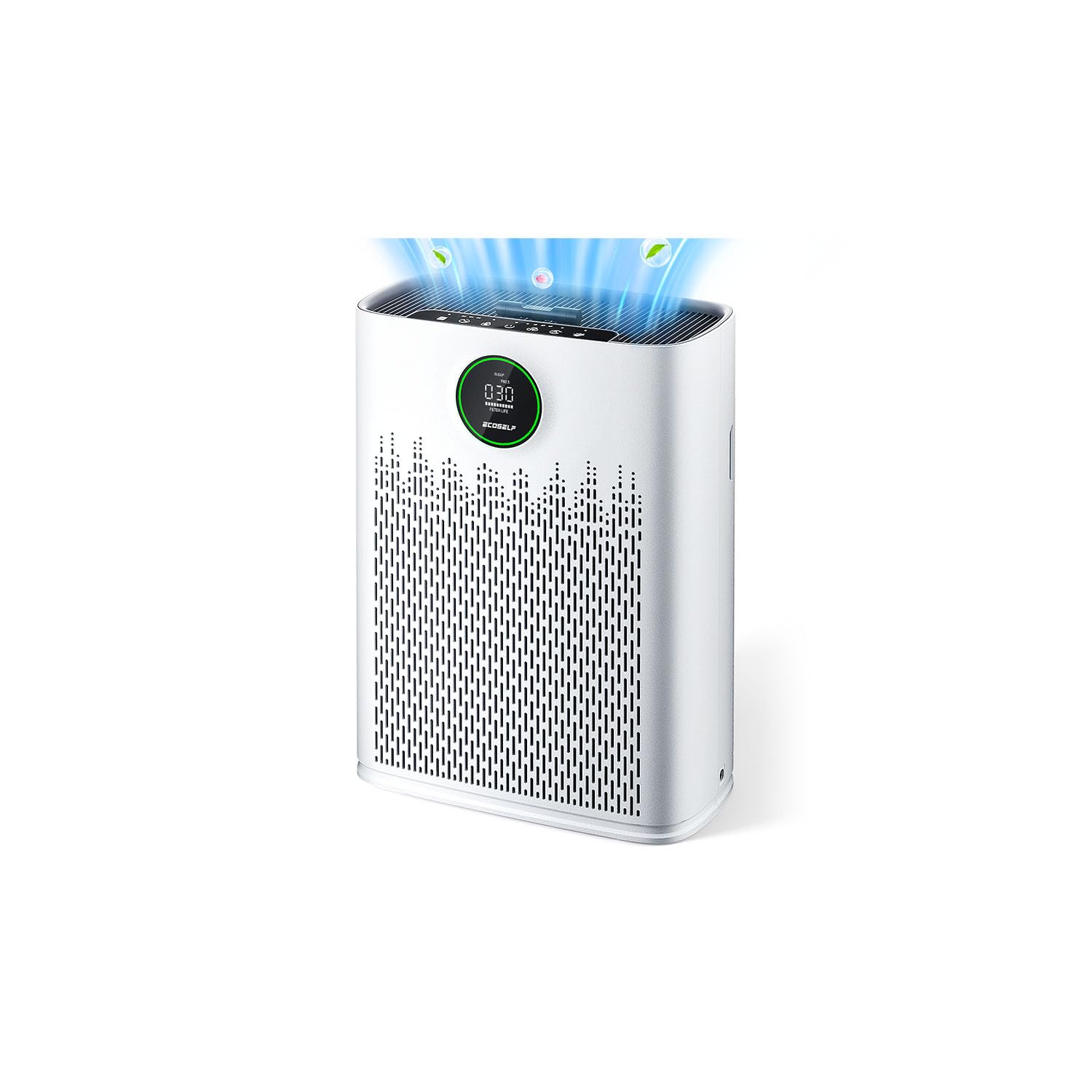
The ECOSELF HAP603 tackles large open-concept spaces with a claimed 2,400-square-foot coverage and dual-filtration power that cycles the air twice per hour in large living areas. The 2X-Power Filtration system pairs a True HEPA layer (99.97% at 0.3 microns) with an activated carbon filter for VOC and odor adsorption. The built-in PM2.5 infrared sensor displays real-time air quality, so you can see when mold spore concentrations spike—useful after cleaning a damp area or running a dehumidifier.
Smart Mode automatically adjusts fan speed based on the sensor reading, ramping up when it detects particulate spikes. Sleep Mode drops to 22 dB, which is genuinely silent; the aromatherapy tray lets you add essential oils, though the scent output is mild. The unit is ETL, FCC, EPA, CARB, and DOE certified, meeting strict safety and efficiency standards.
At 6.7 pounds, it’s surprisingly light for its coverage claims. The included filter life indicator takes the guesswork out of maintenance, though you must use official ECOSELF replacement filters to avoid damage. Some users reported the aromatherapy function was too subtle. Nonetheless, for large-room mold spore defense with real-time feedback, this is a strong mid-range contender.
Why it’s great
- Real-time PM2.5 display for spore awareness
- Very quiet at 22 dB in Sleep Mode
- Covers large open spaces effectively
Good to know
- Aromatherapy function is subtle
- Requires proprietary replacement filters
4. Winix 5520
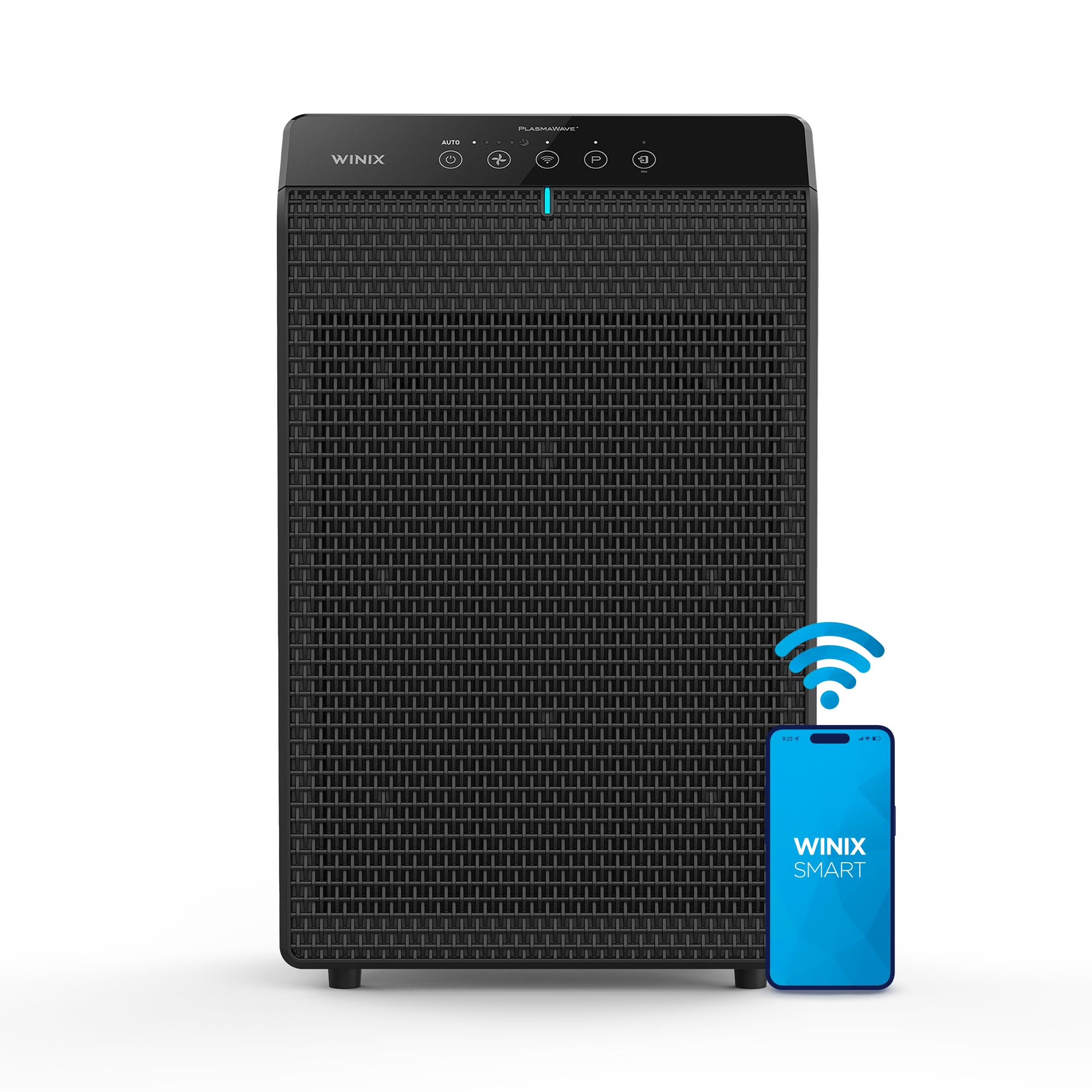
The Winix 5520 stands out in the mid-range with a four-stage filtration system: a washable fine mesh pre-filter, an AOC carbon filter for odors, a True HEPA filter capturing 99.99% of particles as small as 0.01 microns—10 times smaller than the standard HEPA threshold—and a Plasmawave ionizer that helps clump and settle airborne particles. For mold spore defense, the sub-0.3-micron capture is a significant advantage, as it also traps spore fragments and bacterial colonies that can accompany mold growth.
The unit is AHAM VERIFIDE at 392 square feet and can clean up to 1,882 square feet in one hour, meaning it cycles large basements or living rooms efficiently. Noise bottoms out at 23.5 dB on the slowest speed—nearly silent—and the light-automated sleep mode dims the display and reduces fan speed when the room darkens. The Winix Smart App adds remote control and monitoring, though some users noted Alexa integration requires setup through a separate app.
Filter replacement costs are reasonable, with OEM filters lasting roughly one year and aftermarket options available. The Plasmawave feature produces a small amount of ozone, which some sensitive individuals may notice, though it remains CARB compliant. For aggressive spore capture at a reasonable price point, this is a top-tier value.
Why it’s great
- Captures 99.99% of particles at 0.01 microns
- Washable pre-filter extends HEPA life
- Auto sleep mode dims lights and slows fan
Good to know
- Plasmawave produces trace ozone
- Alexa integration requires separate app setup
5. Homedics 5-in-1 UV-C

Homedics’ 5-in-1 approach adds UV-C light to the typical HEPA + carbon + pre-filter stack—a feature that can neutralize mold spores and bacteria on the filter surface, preventing them from colonizing the media. The HEPA-type filter (not True HEPA) captures 99.97% of airborne particles, though without independent AHAM certification of the CADR. The built-in carbon layer reduces musty odors, and the optional ionizer enhances particle clumping. Coverage is rated up to 1,593 square feet.
Five speed settings and a 12-hour auto-off timer give flexibility, and the included remote control is handy for adjusting from across the room. The essential oil tray with three included pads lets you introduce antimicrobial oils like tea tree or eucalyptus, which some users find helpful alongside mechanical filtration. The tower design is tall and slim, fitting into corners without dominating the room.
Reviews consistently note noticeable dust reduction within days, and the UV-C light provides an extra layer of spore control that standard filter-only units lack. The main drawback is the filter type—it’s HEPA-type rather than certified True HEPA, which may not satisfy buyers seeking the highest spore-capture standard. For those who want a multi-tool approach with UV sterilization, this delivers versatility at a competitive mid-range price.
Why it’s great
- UV-C light neutralizes spores on the filter
- Essential oil tray adds custom scent options
- Remote control for easy adjustment
Good to know
- HEPA-type filter lacks independent CADR certification
- Ionizer may produce trace ozone
6. Coway Airmega 250

The Coway Airmega 250 is engineered for sustained high-volume air scrubbing, covering up to 1,860 square feet in 60 minutes with its HyperCaptive filtration system—a dynamic combo of washable pre-filter, activated carbon, and a HEPA filter that’s been independently tested to capture 99.97% of 0.3-micron particles. It also reduces 99% of VOCs including the microbial compounds released by mold colonies. The 20.5-pound chassis houses a larger filter surface area, meaning it can run for longer between replacements.
The built-in air quality indicator uses color-coded LEDs (blue for good, orange for moderate, red for poor) and adjusts fan speed automatically in Smart Mode. Rapid Mode kicks in at maximum power when the sensor detects a spike—useful after running a shower or opening a damp basement window. The pre-filter is washable, reducing annual filter costs, and the main HEPA cartridge lasts roughly one year with normal use. Users report that the unit effectively cleared smoke from Canadian wildfires and cooking fumes, demonstrating its particulate-handling capacity.
Missing Wi-Fi connectivity may be a dealbreaker for smart-home enthusiasts, but the trade-off is a simpler, more reliable set-and-forget design. The warm gray finish and low-profile shape (19.7 inches tall, 18.5 inches wide) integrate well into living spaces. For sustained mold spore defense in a large home, the Airmega 250 offers premium performance without the premium price of a full hospital-grade system.
Why it’s great
- HyperCaptive filtration reduces 99% of VOCs
- Washable pre-filter saves on replacement costs
- Auto Mode with Rapid response for spore spikes
Good to know
- No Wi-Fi or app control
- Heavy at 20.5 pounds for moving between rooms
7. Nuwave Forever Smart

The Nuwave Forever eliminates the single biggest recurring cost of air purification: replacement filters. Its seven-stage filtration system uses washable stainless-steel pre-filters, Bio-Guard antimicrobial filters, and an ozone removal layer—all designed to be rinsed and reused repeatedly. The Bio-Guard 360 filter traps particles down to 0.1 microns, and Intertek Lab certification confirms 100% capture of particles in that range, including mold spores. The unit covers up to 2,002 square feet per hour.
Smart features include auto mode, a Wi-Fi app for remote control, and a sensitive air quality sensor that adjusts fan speed in response to odors and particulate changes. Noise levels are quiet up to fan speed three, with higher settings producing sound comparable to a stove vent fan. Users with heavy-pet households reported eliminating wet dog smell completely within days, and the washable filters simply required a hot-water rinse that revealed substantial captured debris after just one week.
The initial investment is higher than disposable-filter models, but over several years the total cost of ownership can be lower if you’re disciplined about cleaning the filters every 2-4 weeks. The units are heavy (21.85 pounds) and the electrostatic component requires a 24-hour drying time after washing. For mold spore defense without ongoing filter subscriptions, this is a future-proof choice.
Why it’s great
- Zero ongoing filter replacement costs
- 100% capture certified down to 0.1 microns
- Wi-Fi app for remote monitoring
Good to know
- Filters require 24-hour drying after washing
- High fan speeds are noisy
8. BlueDri Air Shield 550

The BlueDri Air Shield 550 is a commercial-grade HEPA air scrubber built for water damage restoration, mold remediation, and construction sites—not a decorative home appliance. It delivers at least 550 CFM of airflow, roughly 40% more than competing scrubbers in its class, and uses a three-stage filtration system: a pre-filter for large debris, a True HEPA filter (99.97% at 0.3 microns) for spore capture, and an optional carbon filter slot for odor removal. The daisy-chain capability lets you link multiple units for large-scale containment.
At 39 pounds with a 15 x 24 x 23-inch frame, this is a unit you wheel into a room rather than place on a nightstand. Users report it cleared black demolition dust from a 3,900-square-foot space in 20 minutes, and multiple reviews confirm it effectively removed mold spores from the air during active remediation. The standard HEPA filter size (20 x 20 x 1.25 inches) is widely available and can be cleaned with compressed air to extend its life. The housing is single-piece molded, which improves durability on job sites.
It’s not designed for quiet nighttime use—even at its lowest setting, it moves enough air to create noticeable white noise. The carbon filter is sold separately. For homeowners facing active mold remediation or major renovations, this unit provides the raw air-moving power needed to prevent spore cross-contamination. For daily living-room use, it’s overkill unless you’re in an active remediation zone.
Why it’s great
- 550 CFM airflow for rapid spore removal
- Standard size HEPA filters are easy to source
- Durable single-piece housing for job sites
Good to know
- Very loud compared to home air purifiers
- Carbon filter sold separately
9. AirDoctor AD3500
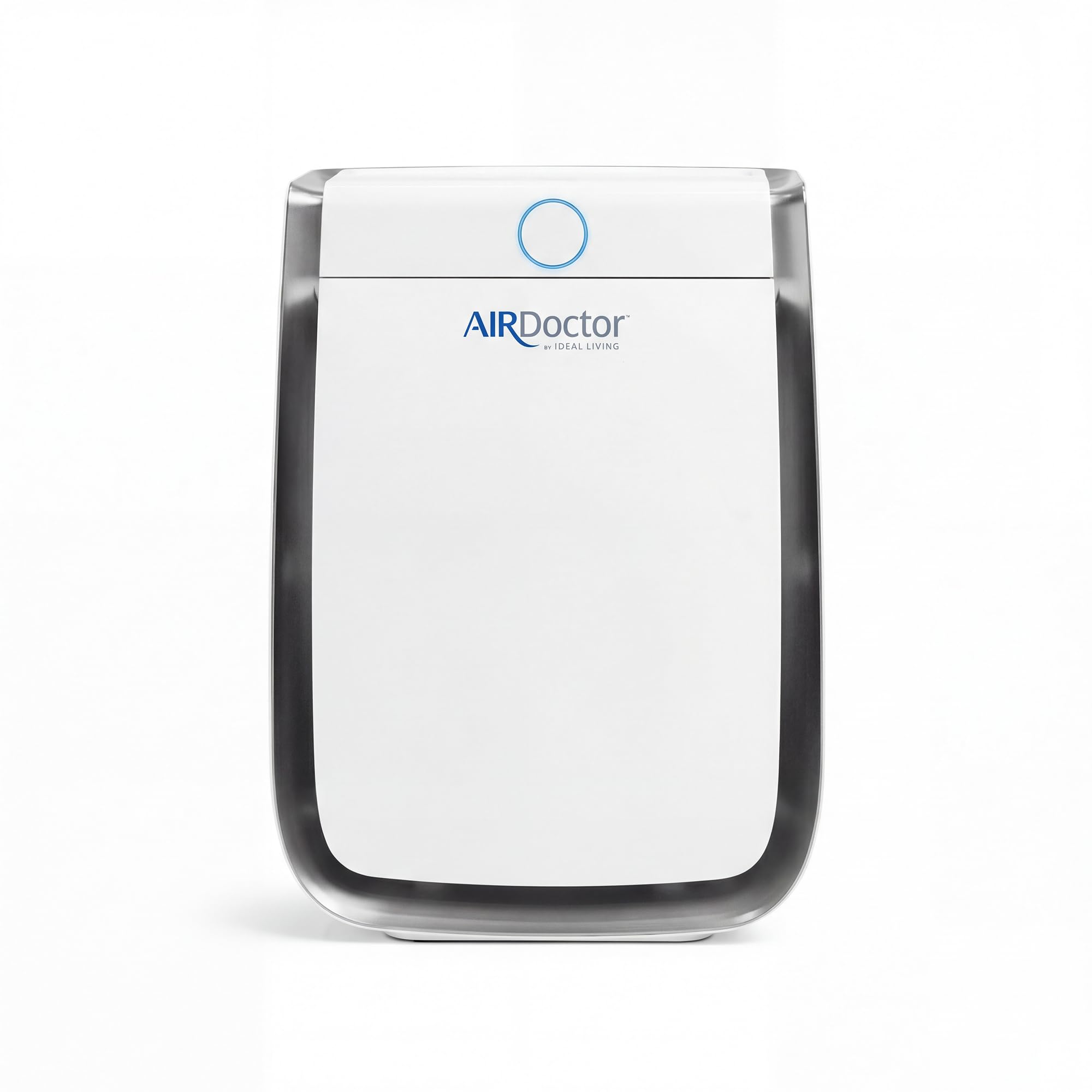
The AirDoctor AD3500 sits at the top of the home-purifier food chain with its UltraHEPA filtration, which captures 99.99% of airborne particles at 0.003 microns—100 times smaller than the standard HEPA threshold. Mold spores (1-5 microns) are easily trapped, but the real advantage is also removing spore fragments, bacterial endotoxins, and ultrafine particulates that standard filters miss. The three-stage system includes a pre-filter, a premium activated carbon filter infused with potassium permanganate for VOC and gas reduction, and the UltraHEPA medium.
Coverage is substantial—up to 2,520 square feet in one hour, or 630 square feet in 15 minutes. The built-in PM2.5 sensor powers Auto Mode, which adjusts fan speed based on real-time air quality and changes the Halo LED color (blue for good, yellow for moderate, red for poor) so you can visually confirm when spore levels drop. Four fan speeds plus a Boost mode handle everything from silent overnight operation to aggressive midday scrubbing. The unit weighs 24 pounds and measures roughly 20 x 27 x 12 inches, so it occupies significant floor space.
Replacement filters are expensive—carbon every six months, UltraHEPA annually—but users consistently report dramatic improvements in morning stuffiness, allergen symptoms, and cooking odor reduction. FSA/HSA eligibility helps offset the cost. For those with confirmed mold sensitivity, asthma, or compromised immune systems, the AD3500’s filtration depth provides a level of protection few home units can match. It’s a premium investment for premium spore defense.
Why it’s great
- Captures 99.99% of particles at 0.003 microns
- Potassium permanganate carbon filter for aggressive VOC reduction
- Real-time PM2.5 display with color-coded Halo
Good to know
- High initial and filter replacement cost
- Large footprint requires dedicated floor space
FAQ
Can an air purifier actually remove mold spores from the air?
What CADR rating do I need for mold spore control?
How often should I change the filter when dealing with mold?
Is a HEPA-type filter sufficient for mold spores, or do I need True HEPA?
Final Thoughts: The Verdict
For most users, the air filter for mold spores winner is the Levoit Core 300-P because it delivers verified AHAM CADR performance, True HEPA filtration, and whisper-quiet operation at a price that doesn’t require a second mortgage. If you want washable filters that eliminate ongoing cartridge costs, grab the Nuwave Forever Smart. And for hospital-grade spore elimination with UltraHEPA capture, nothing beats the AirDoctor AD3500.