
Our readers keep the lights on and the weekend projects moving. As an Amazon Associate, I earn from qualifying purchases.
Mold, warped wood, cracked guitar necks, and freezer-burned food all share one culprit — unchecked humidity. A reliable air humidity monitor spots the creep long before your drywall or vintage wine collection pays the price. But choosing the wrong one leaves you with phantom readings, dead batteries in a month, or a sensor that refuses to talk to your smart home hub.
I’m Rikta — the co-founder and writer behind FitlyFast. I’ve spent many hours dissecting sensor accuracy, connectivity standards, battery life claims, and real-world data logging performance across the current humidity monitor market to deliver this guide.
Whether you are safeguarding a wine cellar, fine-tuning a greenhouse, or simply trying to keep your bedroom comfortable, finding the best air humidity monitor means balancing reading precision, smart home compatibility, and long-term reliability without overpaying for features you never need.
How To Choose The Best Air Humidity Monitor
Not all humidity monitors are built the same. An entry-level LCD puck might work fine for a bedroom, but it will fail you in a greenhouse or wine cellar where you need trend data and remote alerts. Here is what separates a reliable long-term investment from a frustrating paperweight.
Sensor Type & Accuracy
The core component is the sensor itself. Look for monitors using branded sensors from manufacturers like Sensirion or Texas Instruments, which typically deliver accuracy within ±3% relative humidity (RH). Cheaper sensors drift over time, giving you readings that look fine while your basement silently collects condensation. For critical applications like cigar humidors or reptile enclosures, target ±2% RH or better.
Connectivity & Smart Home Ecosystem
Decide if you need real-time remote monitoring. Bluetooth-only sensors (like SensorPush) are reliable within 100-330 feet and work well for a single room or fridge, but require a WiFi gateway for out-of-home access. WiFi sensors (like GoveeLife) connect directly to your router but demand a stable 2.4GHz network. Zigbee sensors (like Aqara) need a dedicated hub but offer lower power consumption and mesh networking for whole-home coverage across multiple rooms.
Data Logging & Alerts
A humidity monitor that only shows the current number is nearly useless for spotting trends. Look for models that store historical data — at least 20 days onboard or unlimited in-app storage. Programmable high/low alerts, push notifications, and CSV export features are essential if you are monitoring sensitive spaces like a wine cellar, guitar case, or grow tent where conditions change slowly and silently.
Quick Comparison
On smaller screens, swipe sideways to see the full table.
| Model | Category | Best For | Key Spec | Amazon |
|---|---|---|---|---|
| SensorPush HTP.xw | Bluetooth Smart Sensor | Premium monitoring & data export | ±0.1°F / ±0.02% RH accuracy | Amazon |
| GoveeLife 2.0 WiFi 3-Pack | WiFi Multi-Sensor | Whole-home WiFi monitoring | ±0.3°C / ±3% RH accuracy | Amazon |
| 16-in-1 Air Quality Monitor | All-in-One AQI Display | Visual air quality dashboard | 7-inch display, 9 AQI parameters | Amazon |
| Aqara Zigbee 3-Pack | Zigbee Smart Sensor | HomeKit / Alexa integration | ±0.3°C / ±3% RH, 5s response | Amazon |
| Protmex PT6508 | Handheld HVAC Meter | Portable spot-checking & HVAC | 0-100% RH, dew point & wet bulb | Amazon |
In‑Depth Reviews
1. SensorPush HTP.xw

The SensorPush HTP.xw is the gold standard for anyone who needs lab-grade precision and robust data logging without a subscription. At 0.01 kg and powered by a CR2477 battery lasting 1-2 years in typical conditions, this tiny sensor continuously records temperature, relative humidity, heat index, barometric pressure, dew point, and VPD. The free app stores unlimited data and exports CSV files, making it indispensable for cigar humidors, greenhouses, and freezer monitoring where a single failure costs hundreds.
Setup takes seconds — no WiFi passwords, no account creation required. The Bluetooth range reaches roughly 100 meters line-of-sight, and a separate G1 WiFi gateway unlocks remote cloud access and alerts. Real-world reviews confirm the HTP.xw matches calibrated professional instruments within 0.02% RH and survives environments as cold as -4°F, earning its status as the go-to sensor for serious hobbyists and professionals alike.
Barometric pressure tracking is a rare bonus at this size, allowing you to cross-reference weather trends. Customer support is famously responsive, and the company is US-based, so replacements and troubleshooting are painless. The only trade-off is the extra gateway cost for out-of-home monitoring.
Why it’s great
- Exceptional sensor accuracy (within 1°F, 0.02% RH)
- Measures heat index, dew point, VPD, barometric pressure
- Unlimited in-app data storage with CSV export
Good to know
- WiFi gateway sold separately for remote access
- Bluetooth does not work through thick masonry walls
2. GoveeLife 2.0 WiFi 3-Pack
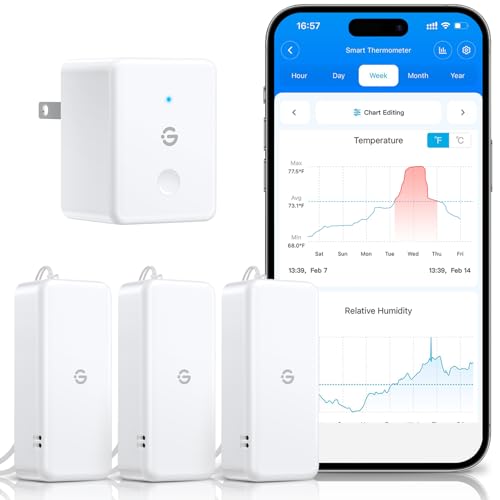
The GoveeLife 2.0 system delivers the best balance of multi-room coverage, app intelligence, and price-per-sensor value. This pack bundles one WiFi gateway and three compact sensors, each powered by two AAA batteries with an advertised 2-year lifespan. The Swiss-made sensor chip reports temperature within ±0.3°C and humidity within ±3% RH, refreshing every 2 seconds — fast enough for a wine cellar or server closet where conditions shift suddenly.
App functionality is where Govee shines. You get 20-day trend charts on the app, 2-year exportable data, and customizable low/high alerts via push notification and email. The gateway supports up to 10 sensors total, so you can expand to cover every room, the basement, and the garage without buying a new hub. Reviewers consistently praise the intuitive Govee Home app and reliable alerts, calling it a lifesaver for homes in extreme temperature regions.
The only catch is WiFi compatibility — the gateway strictly requires a 2.4GHz network, so users with mesh systems that combine bands may need a temporary switch during setup. Startup instructions are minimal, but customer support responds quickly to onboarding questions. For most households, this three-pack is the most practical entry into smart humidity tracking.
Why it’s great
- Three sensors included with one WiFi gateway
- Swiss sensor chip with 2-second refresh rate
- 2-year data export and customizable app alerts
Good to know
- Requires 2.4GHz WiFi only
- Manual could be clearer for initial setup
3. 16 in 1 Air Quality Monitor
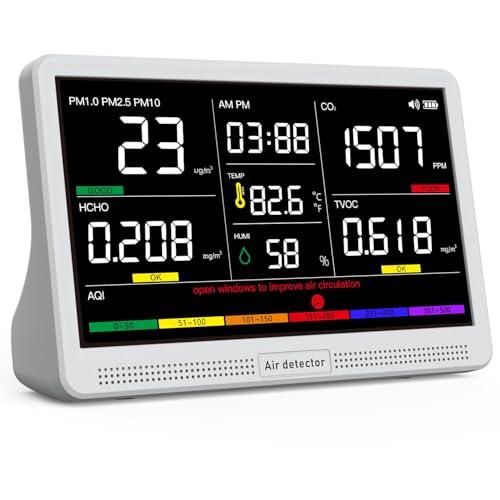
If you want a single, wall-mountable display that shows both humidity and a full air quality picture simultaneously, this all-in-one monitor delivers. The 7-inch LED screen presents CO2, PM2.5/1.0/10, TVOC, formaldehyde (HCHO), temperature, and humidity numbers at a glance — no app needed. The external high-precision sensors claim 0.001 accuracy increments, and the built-in 2500mAh battery allows up to 8 hours of cordless use for spot-checking around the house.
It shines in post-remodel monitoring, nurseries, and home offices where you need both humidity and pollutant data. Real-world user reports confirm it detects cooking fumes, candle smoke, and even hairspray within seconds, making your invisible air quality visible. The brightness adjustment handles both bright bedrooms and dim nurseries well.
Accuracy does have limits — some users note that strong chemical odors did not trigger immediate TVOC or HCHO spikes, suggesting the sensors prioritize particulate matter over ultra-fast gas detection. It also requires a charged battery or constant USB-C power, so it is not a set-and-forget device for a remote basement. For a centralized visual dashboard, however, it is unmatched in this price tier.
Why it’s great
- Large 7-inch display shows 9 parameters at once
- No app needed for instant readings
- Battery-powered for portable spot checking
Good to know
- TVOC and HCHO response may lag on low-level gases
- Not designed for permanent wall power-free installation
4. Aqara Zigbee Temperature and Humidity Sensor 3-Pack

Aqara’s 3-pack is the best option for Apple HomeKit and Alexa users who already run a Zigbee hub (M2, M1S, E1, or Camera Hub G3). Each sensor measures temperature, humidity, and atmospheric pressure using a Sensirion sensor — the same brand found in premium weather stations. The 5-second response time is snappy enough for most home automation triggers, like turning on a dehumidifier when the basement crosses 65% RH.
Zigbee’s mesh networking is a clear advantage over WiFi in larger homes: as you add more Aqara sensors and repeaters, the network strengthens, and each sensor sips power long enough to run 2+ years on a single CR2450 battery. Real-world users report stellar reliability in attics, crawl spaces, and garages after initial pairing. The compact 1.42-inch diameter puck mounts nearly anywhere via the included sticker.
The catch is mandatory hub dependency — you cannot pair these directly to a phone or a third-party Zigbee stick without caveats. Some units arrive with depleted batteries from shelf storage, and the pairing process occasionally drops sensors from the network, requiring a reset. For users already committed to the Aqara ecosystem, this is the most accurate and responsive sensor available. For newcomers, the hub requirement adds upfront cost and complexity.
Why it’s great
- High-quality Sensirion sensor with 5-second response
- Zigbee mesh network for whole-home coverage
- Compact, wall-mountable design with long battery life
Good to know
- Aqara hub required (sold separately)
- Occasional pairing instability and dead battery units reported
5. Protmex PT6508

The Protmex PT6508 is a rugged, professional-grade handheld psychrometer designed for HVAC technicians, building inspectors, and paranormal investigators who need instant, portable spot readings. Unlike smart sensors that log data over time, this tool gives you large dual LCD readouts of humidity, temperature, dew point, and wet bulb temperature right now. The 0-100% RH range and -20°C to 60°C temperature range cover virtually any indoor environment.
Multiple professionals in the field confirm this unit matches far more expensive meters in accuracy. The data hold, min/max memory, and backlit display make it easy to read in crawl spaces and dark attics. It ships with four AAA batteries and a soft carrying case, plus it has an auto-shutdown after 30 minutes to conserve power. For HVAC diagnostics, it proved reliable enough to identify that condensation was caused by dew point, not a cooler leak, saving thousands in unnecessary repairs.
The PT6508 has zero smart home capability — no Bluetooth, no WiFi, no app. It is a purpose-built instrument for technicians who need a calibrated spotometer, not a continuous monitor. The response time is not instant; it takes about two minutes to stabilize in a new environment. If you need a permanent, connected sensor for ongoing monitoring, look elsewhere. For on-the-go accuracy, it is an incredible value.
Why it’s great
- Measures dew point and wet bulb for HVAC diagnostics
- Professional build quality with carrying case included
- Dual display and min/max memory functions
Good to know
- No smart home connectivity or data logging
- Requires up to 2 minutes to stabilize readings
FAQ
Can I use a Bluetooth humidity monitor without a smartphone?
Does a humidity monitor need a subscription to store data?
Will a humidity monitor work in my freezer or greenhouse?
Why does my humidity monitor show different readings from my thermostat?
Final Thoughts: The Verdict
For most users, the best air humidity monitor winner is the GoveeLife 2.0 WiFi 3-Pack because it delivers multi-room coverage, reliable WiFi alerts, and Swiss sensor accuracy at a price-per-sensor that undercuts the competition. If you demand professional-grade precision and unlimited data logging for a single critical space, grab the SensorPush HTP.xw and optionally add the WiFi gateway for remote access. And for a complete visual air quality dashboard showing CO2 and particulates alongside humidity, nothing beats the 16 in 1 Air Quality Monitor.