
Our readers keep the lights on and the weekend projects moving. As an Amazon Associate, I earn from qualifying purchases.
A hospital bed without a dedicated pressure redistribution surface forces the body’s bony prominences — the sacrum, heels, and shoulders — into constant contact against a flat, unforgiving plane. Within hours, capillary blood flow gets occluded, triggering the cascade of tissue ischemia that leads to crushing, painful pressure ulcers. The right surface breaks this cycle mechanically, either through alternating inflation cycles that shift load every few minutes or through zoned foam geometries that cradle weight away from high-risk zones. The decision between these two engineering philosophies defines whether a loved one experiences healing or continued skin breakdown.
I’m Rikta — the co-founder and writer behind FitlyFast. I have spent hundreds of hours analyzing patient lift schedules, pump decibel ratings, foam density values, and clinical pressure mapping data to isolate which air mattress platforms actually deliver measurable tissue offloading rather than simple marketing claims.
Whether you are caring for a post-surgery patient at home or managing long-term hospice needs, identifying the right pressure redistribution system is critical for preventing skin breakdown. This guide breaks down the top contenders for the best air mattress for hospital bed, comparing alternating pressure pumps against zoned therapeutic foam designs to match your specific care scenario.
How To Choose The Best Air Mattress For Hospital Bed
Selecting a pressure redistribution surface for a hospital bed involves more than picking the cheapest pad. The wrong choice leads to persistent redness, full-thickness ulcers, and avoidable suffering. Focus on these three decision-influencing factors.
Alternating Pressure vs. Zoned Foam: The Core Therapy Trade-Off
Alternating pressure mattresses use a pump to inflate and deflate air cells in cycles, typically every six to twelve minutes, shifting weight continuously so no single area experiences sustained occlusion. This active approach suits patients who are completely immobile or who already show Stage 1 or Stage 2 skin breakdown. Zoned foam mattresses rely on cut-out geometries — fortress-shaped cells or multi-tiered foam layers — to statically redistribute load. These work well for patients who can self-reposition occasionally or who need a firmer, more stable surface for transfers. Evaluate the patient’s ability to shift weight naturally before deciding which therapy architecture belongs in the room.
Pump Acoustics and Patient Sleep Disruption
An alternating pressure pump that hums, clicks, or cycles audibly throughout the night destroys sleep continuity for both the patient and anyone sleeping nearby. Look for pumps rated at or below 28 dBA — quieter than a library whisper. The quietest units operate around 22 dBA, delivering the therapeutic cycle without the mechanical intrusion. If the patient is already experiencing insomnia, anxiety, or cognitive decline, pump noise moves from an inconvenience to a direct contributor to agitation and poor healing outcomes.
Waterproof Integrity and Fluid-Resistant Barriers
Hospital bed surfaces face constant exposure to sweat, incontinence, and spillage. A mattress that absorbs moisture becomes a breeding ground for bacteria and accelerates skin maceration, which directly worsens pressure ulcer risk. Alternating pressure pads typically use heat-sealed medical-grade PVC or vinyl that can be wiped clean instantly. Foam mattresses must include a fully removable, waterproof cover with welded or sealed zippers — not simply sewn ones that leak through the thread holes. Check that the cover material is also low-shear to prevent friction injuries when the patient is repositioned.
Quick Comparison
On smaller screens, swipe sideways to see the full table.
| Model | Category | Best For | Key Spec | Amazon |
|---|---|---|---|---|
| Invacare Solace | Foam / Premium | Multi-zone support & pressure relief | Three-zone IFD: 35.4–40.5 | Amazon |
| ProHeal Memory Foam | Foam / Premium | High-weight capacity & heel offloading | 1000 lb capacity; sloped heel | Amazon |
| Invacare 5-Cell Foam | Foam / Mid-Range | Medical-grade foam replacement | 1.8 lb density / 34 IFD | Amazon |
| Lunderg Alternating Pad | Air / Mid-Range | Static mode for sitting support | 23 dBA pump; static mode | Amazon |
| Vive Alternating Pad | Air / Mid-Range | Ultra-quiet 130-cell therapy | 22 dBA pump; 130 air cells | Amazon |
| Kekoy Alternating Pad | Air / Budget-Friendly | Entry-level pressure care | 28 dBA pump; 5 pressure modes | Amazon |
| Alcedo Alternating Pad | Air / Budget-Friendly | Affordable sore prevention | 75″ x 35″ inflated area | Amazon |
In‑Depth Reviews
1. Invacare Solace Hospital Bed Mattress
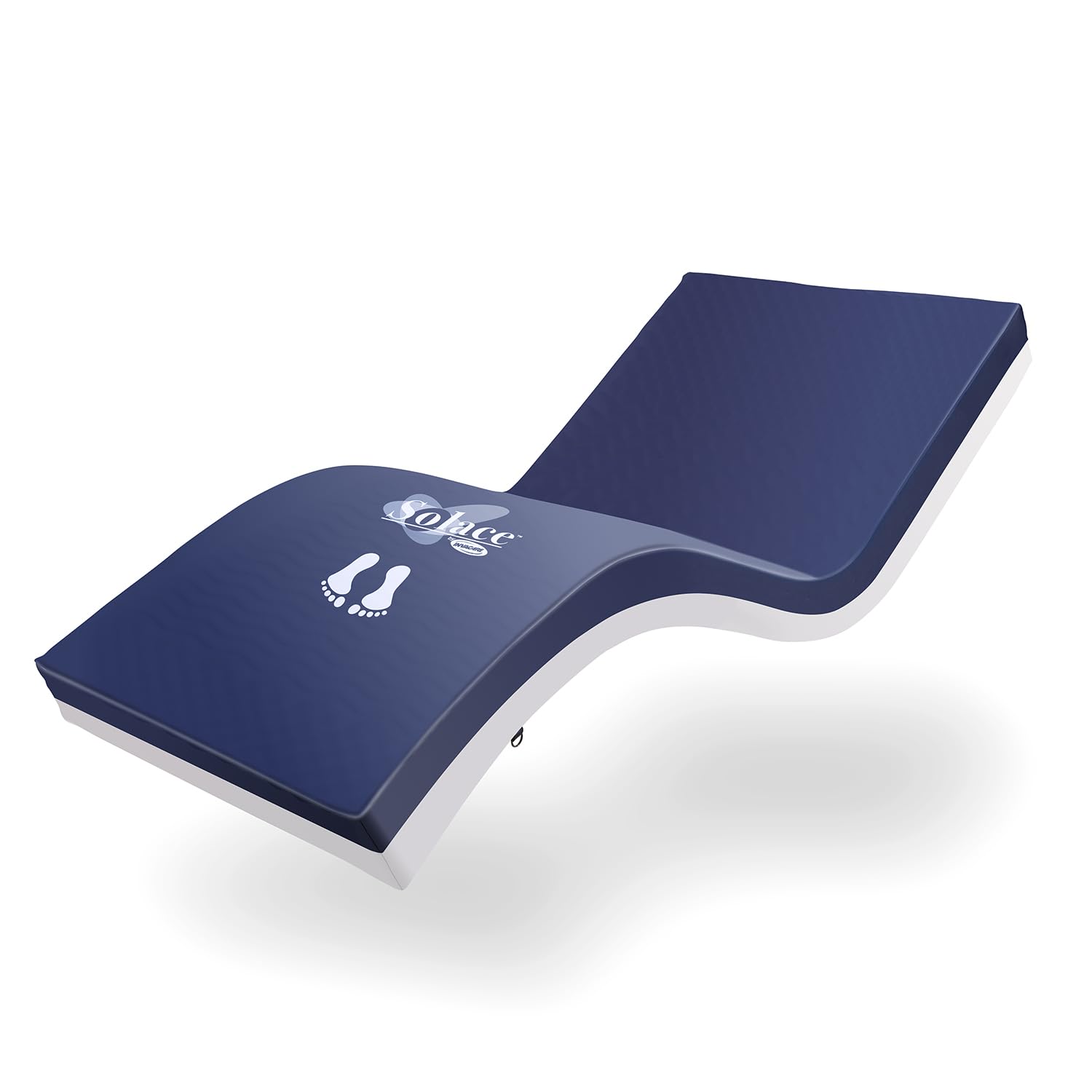
The Invacare Solace represents a genuine engineering departure from standard flat foam slabs. Its deep fortress-cut castellation cells create significantly deeper channels than typical egg-crate designs, allowing 360-degree airflow around the patient while the foam columns move independently during repositioning, reducing friction shear at the skin interface. The three-zone IFD mapping — medium-firm 36.2 for the head and neck, firm 40.5 for the lumbar and hip bridge, and a lighter 35.4 for the heel zone — directly addresses the pressure gradient that causes sacral and heel ulcers in supine patients.
The dual-layer construction pairs a high-density support base with a plush therapeutic immersion top layer, producing what users describe as a floating sensation that eliminates the bottoming-out pain common with standard hospital mattress overlays. The waterproof cover uses fully welded zippers rather than sewn ones, creating a genuine fluid barrier that resists incontinence seepage and makes surface cleaning straightforward. Integrated side handles simplify mattress repositioning and patient transfers, while bottom anchor straps secure the unit to any 84-inch hospital bed frame without shifting during head-of-bed elevation changes.
Caregivers report visible reduction in tailbone pain and pressure mark frequency within the first month of use, with the zoned foam proving particularly effective for patients who cannot tolerate the constant motion sensation of alternating air pads. The Solace is American-made, latex-free, and DHEP-free, making it suitable for patients with environmental sensitivities or chemical intolerances common in long-term care settings.
Why it’s great
- Three distinct firmness zones precisely match anatomy to reduce pressure on heels and sacrum
- Deep fortress-cut cells enhance airflow and reduce moisture accumulation compared to standard foam
- Welded waterproof zipper prevents fluid ingress better than sewn cover alternatives
- Side handles and anchor straps simplify caregiving logistics during transfers and bed adjustments
Good to know
- Premium pricing reflects medical-grade construction rather than entry-level affordability
- Not an alternating pressure system so patients who cannot self-reposition may still need scheduled turning
2. ProHeal Hospital Bed Mattress 36x80x6

The ProHeal mattress tackles two often-overlooked failure points in pressure care: heel offloading and bariatric weight capacity. Its sloped heel section uses an internal wedge geometry that transfers load from the vulnerable calcaneus to the less injury-prone lower leg, directly addressing the most common pressure ulcer location among bedridden patients. The multi-tiered foam construction deploys high-density die-cut foam in the torso and head zones while reserving open-cell memory foam exclusively for the heel section, creating a material gradient tailored to the specific tissue compliance needs of each body region.
With a rated capacity of 1000 pounds, this mattress dramatically outperforms the 300-pound limits of alternating air pads, making it the only viable option for bariatric patients requiring pressure redistribution. The cover system uses a 360-degree zipper with a protective flap that prevents water ingress through the zipper track, paired with a triple-laminate vinyl bottom layer that provides fluid resistance and fire retardancy. The top cover material is vapor-permeable and cooling, reducing the perspiration buildup that accelerates skin maceration in immobile patients.
The 28 ILD firmness rating places it in the medium-firm range, which users consistently describe as supportive without being punishing. The 7-year non-prorated core warranty combined with a 2-year cover warranty reflects manufacturer confidence in the multi-tiered foam architecture. Users transitioning from standard hospital bed mattresses report dramatic improvements in sleep continuity and morning pain levels, particularly those with arthritis-related back pain who previously woke multiple times per night.
Why it’s great
- Sloped heel section actively offloads the calcaneus to prevent the most common type of pressure ulcer
- 1000-pound weight capacity accommodates bariatric patients that alternating air pads cannot support
- Multi-tiered foam with open-cell memory foam heel reduces interface pressure at the highest-risk area
- 7-year core warranty provides long-term protection for a significant investment
Good to know
- Six-inch thickness may require adjusting existing bed rail height for proper fit
- Foam expands fully over 48 hours so immediate use yields slightly different feel than settled mattress
3. Invacare 5-Cell Hospital Bed Mattress

The Invacare 5-Cell mattress strips away complexity and focuses on what a medical-grade foam replacement mattress should do: provide consistent, predictable pressure redistribution without pump noise, maintenance, or mechanical failure risk. Its five fortress-shaped cells are cut directly into the foam core to create dedicated pressure relief channels at the torso, hips, and heels, reducing skin stress without requiring electrical power or cycling mechanisms. The 1.8-pound density foam with 34 IFD firmness delivers the support-to-comfort ratio that clinicians expect from a therapeutic surface — firm enough to prevent hammocking but with enough give to cradle bony prominences.
The cover system uses a tough-coated polyurethane material that is fluid-resistant, latex-free, and washable, with a flat concealed zipper to prevent snagging during bed adjustments. The full anti-slip bottom surface extends across the entire mattress underside, unlike competitor covers that only offer partial grip strips, ensuring the mattress stays anchored during head and foot elevation cycles. Constructed in the USA with a built-in fire-protective layer, this mattress meets institutional safety standards while remaining accessible for home care use.
Users consistently note that the mattress feels firm yet somehow soft simultaneously — the 34 IFD rating provides the structural integrity needed for safe patient transfers while the fortress cells create localized pressure relief points. The 6-inch thickness provides adequate clearance above the bed frame to prevent the patient from feeling the metal structure beneath, even during side-lying positioning. The cover material wipes clean easily and resists staining from incontinence episodes, reducing the workload for caregivers managing multiple daily cleanings.
Why it’s great
- 34 IFD density foam provides reliable pressure redistribution without pump noise or electrical dependency
- Full anti-slip bottom surface keeps mattress positioned correctly during bed adjustments
- Fluid-resistant cover with concealed zipper resists incontinence damage and simplifies cleaning
- American-made construction with fire-protective layer meets institutional safety standards
Good to know
- Actual thickness measures slightly above 5 inches rather than the full 6 inches after expansion
- Patients requiring active alternating therapy will need a separate pump-based overlay on top
4. Lunderg Alternating Air Pressure Mattress Pad
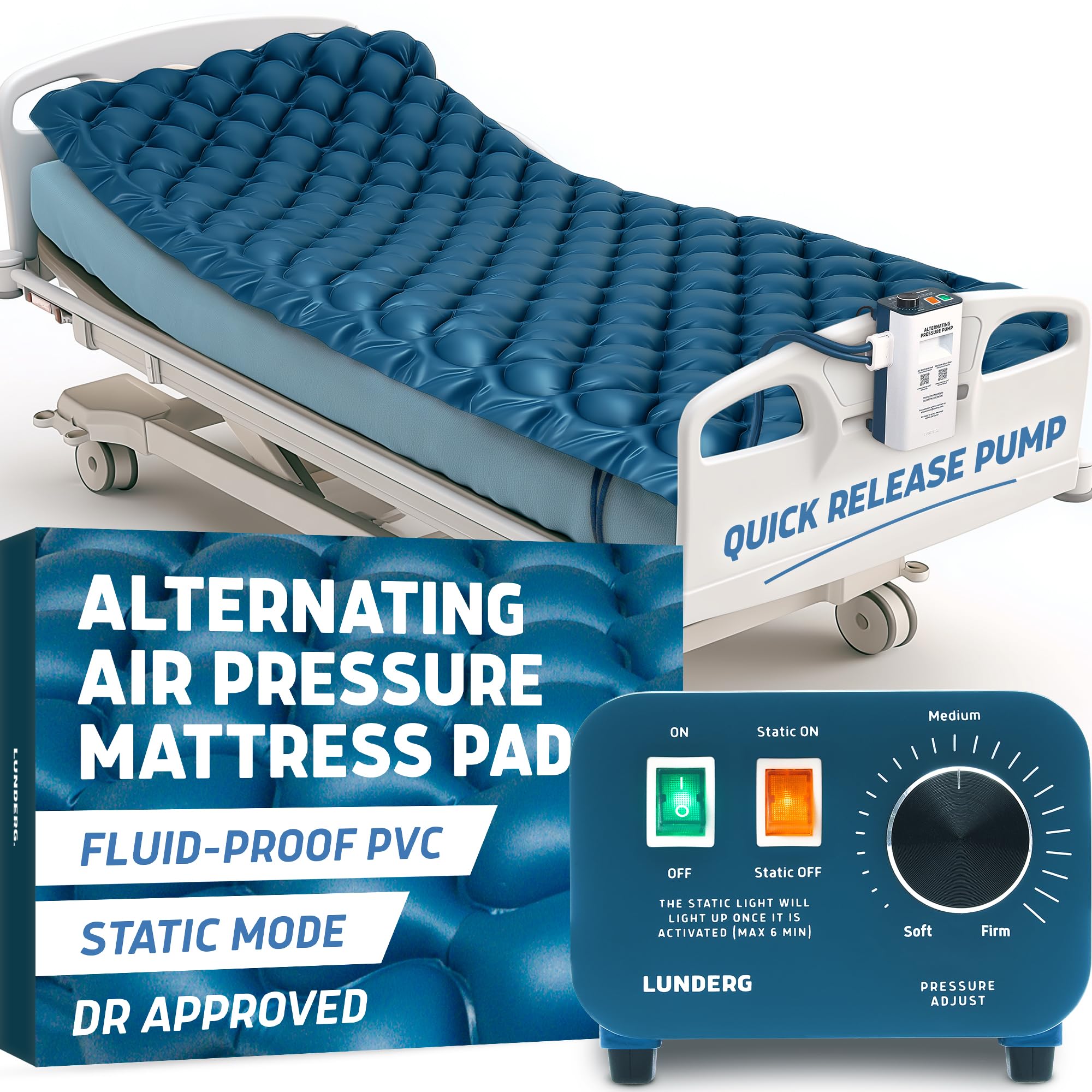
The Lunderg pad introduces a feature rarely seen in this price bracket: a dedicated static mode that holds all air cells fully inflated, creating a stable surface ideal for sitting upright in bed or for patients who find the alternating motion unsettling. This dual-mode capability makes it uniquely versatile for patients who alternate between resting and sitting throughout the day, as the static mode provides the firm base needed for safe transfers while the alternating mode delivers therapeutic pressure redistribution during sleep. The whisper-quiet pump operates at just 23 dBA — nearly silent in a typical bedroom — eliminating the mechanical drone that disrupts sleep for light-sensitive patients.
The air cell geometry uses individual cell construction rather than continuous tube rows, which means a puncture in one cell does not deflate the entire row, maintaining therapy integrity even if minor damage occurs. The quick-connector system simplifies pump attachment and removal, making it practical for caregivers who need to move the pump between pad and storage. The 20-minute initial inflation time runs through three full cycles before the surface is ready for patient use, and the pressure knob allows fine adjustment from soft to firm based on body weight and comfort preference.
Paraplegic and tetraplegic users report that the Lunderg pad outperforms popular medical-grade brands costing significantly more, with no red marks developing after a full month of continuous use. The 300-pound weight capacity matches industry standard for alternating pads, and the waterproof PVC construction handles incontinence episodes without absorbing moisture or odors. The six-minute alternating cycle provides a gentle, pleasant massage sensation that many users find relaxing enough to fall asleep during the afternoon testing phase.
Why it’s great
- Static mode provides a stable platform for sitting and transfers when alternating therapy is not needed
- Individual air cell construction prevents full-row deflation if a single cell is punctured
- 23 dBA pump noise is nearly silent, preserving sleep quality for sensitive patients
- Quick-connector design simplifies pump installation and removal for caregivers
Good to know
- Inflated queen-size pad measures 52×72 inches, which is smaller than a standard queen mattress
- Pump must remain plugged in continuously as the pad deflates when power is disconnected
5. Vive Alternating Air Pressure Mattress Pad
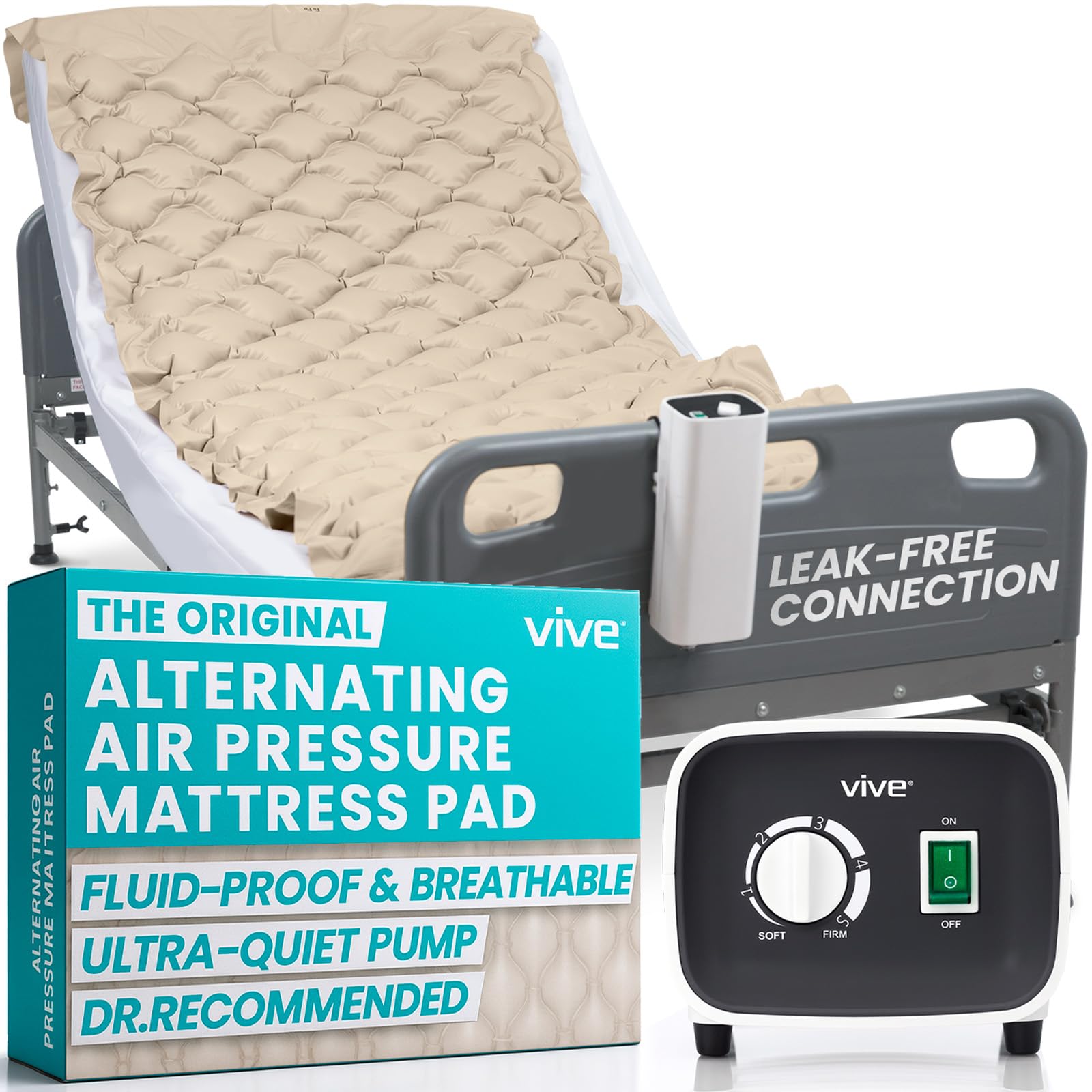
The Vive pad holds a rare distinction in the alternating pressure category: it is the quietest pump currently available at 22 dBA, quieter than a whisper and nearly indistinguishable from ambient room noise. This acoustic advantage transforms the caregiving experience, as patients with dementia, anxiety, or hyperacusis are not disturbed by mechanical cycling sounds that trigger agitation or sleep disruption.
The proprietary alternating algorithm cycles pressure every six minutes, providing more frequent load redistribution than the standard ten-to-twelve-minute cycle used by many competitors. This faster cadence is clinically relevant for patients with existing Stage 1 or Stage 2 ulcers, as it reduces the duration any single tissue area remains under compression. The pump offers multiple pressure levels that adjust from gentle support to a rock-hard maximum setting, accommodating body weights up to 300 pounds while maintaining the alternating therapy pattern.
The vinyl construction includes top and bottom flaps that tuck between the mattress and frame to prevent sliding during bed adjustments, eliminating the need for additional strapping or non-slip pads. The included repair patches allow caregivers to address small punctures without replacing the entire unit, extending the service life beyond the one-year guarantee period. Users report visible improvement in existing bedsores within days of switching to the Vive pad, with the micro air vents helping maintain skin dryness that supports wound healing.
Why it’s great
- 22 dBA pump is the quietest available, essential for patients with noise sensitivity or sleep disorders
- 130 individually sealed air cells create finer pressure redistribution than lower-cell-count alternatives
- Six-minute alternating cycle provides more frequent pressure relief than standard ten-minute timers
- Included repair patches extend product lifespan and reduce replacement costs for caregivers
Good to know
- Vinyl surface may feel slick against bare skin without a fitted sheet overlay
- Pet claws or sharp objects on the bed can puncture cells despite included repair kit
6. Kekoy Alternating Air Pressure Mattress Pad
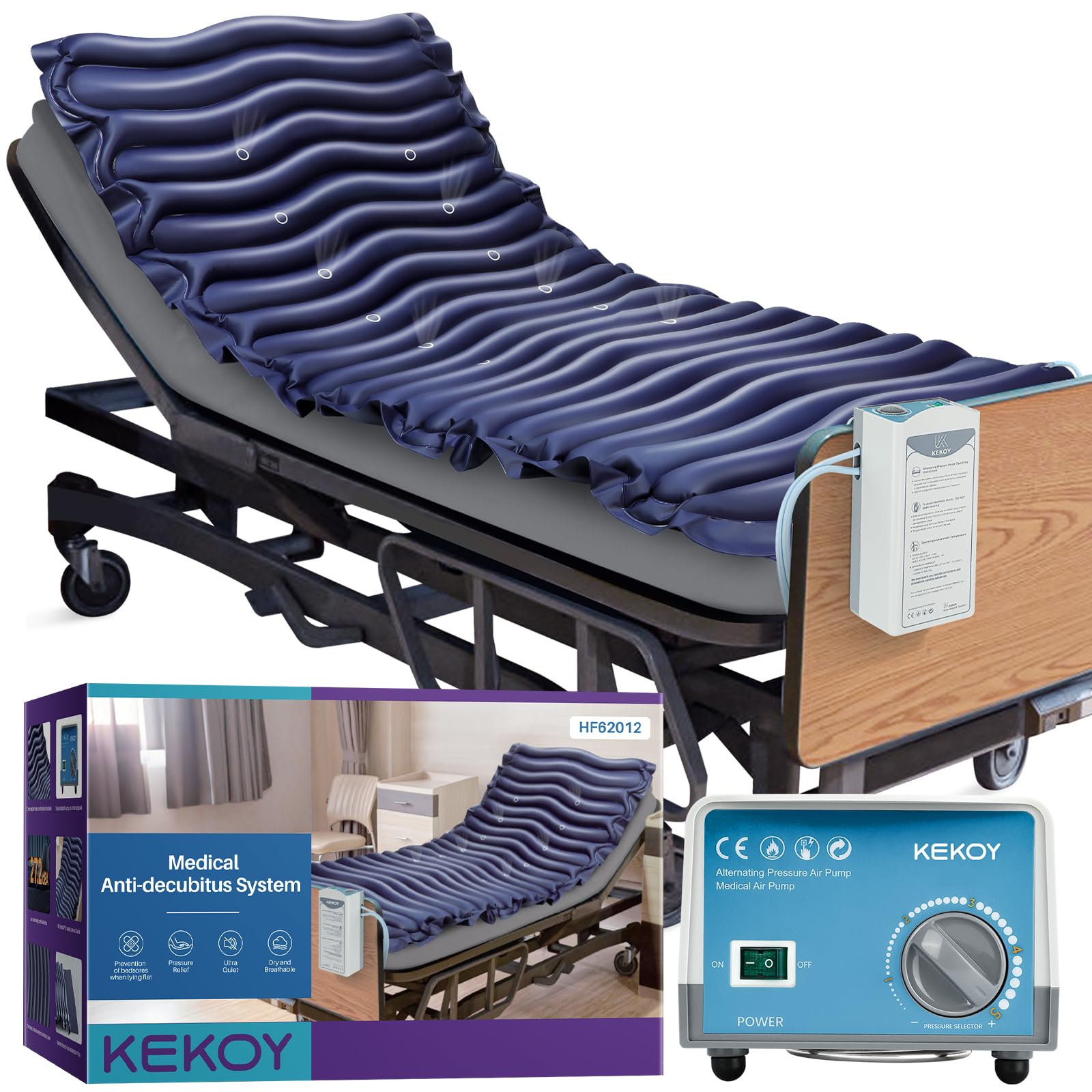
The Kekoy pad serves as an accessible entry point into alternating pressure therapy without omitting the core clinical features. Its combination of alternating pressure cycles every ten to twelve minutes with low air loss micro-vent technology addresses both the mechanical pressure redistribution and the moisture management that skin integrity depends on. The wider tube-style air chambers create smoother pressure transitions than the smaller bubble-style cells found on ultra-budget pads, reducing the jarring sensation of air moving abruptly beneath the patient.
The upgraded aluminum pump operates at 28 dBA, which, while not as silent as premium units, represents a 30% noise reduction compared to standard plastic-body pumps and remains below the threshold of typical bedroom ambient sound. Five adjustable pressure modes allow customization based on patient weight and comfort preference, with initial inflation set to maximum followed by gradual reduction to the ideal support level. The medical-grade PVC surface is heat-sealed at high frequency for durability and air retention, and the waterproof construction handles incontinence cleaning without degradation.
The uninflated dimensions are 95 by 38 inches, with the pad shrinking to 75 by 36 inches once fully inflated — a distinction that matters when fitting the pad onto a mattress foundation. Users report significant relief for back pain, hip discomfort, and existing pressure sores, with the adjustable pump allowing fine-tuning for patients up to 300 pounds. The pad is FSA and HSA eligible, making it accessible through healthcare spending accounts for families managing care at home.
Why it’s great
- Low air loss technology actively vents moisture to reduce skin maceration during extended bed rest
- Wider tube air chambers provide smoother pressure transitions than bubble-cell alternative designs
- 28 dBA pump noise is quieter than typical household fans and acceptable for most bedroom environments
- FSA/HSA eligible for families using healthcare spending accounts to manage care costs
Good to know
- Pump must remain plugged in continuously as the pad deflates immediately when power is disconnected
- User reports indicate a zippered mattress cover is needed to keep the pad from migrating on smooth mattresses
7. Alcedo Alternating Air Pressure Mattress Pad
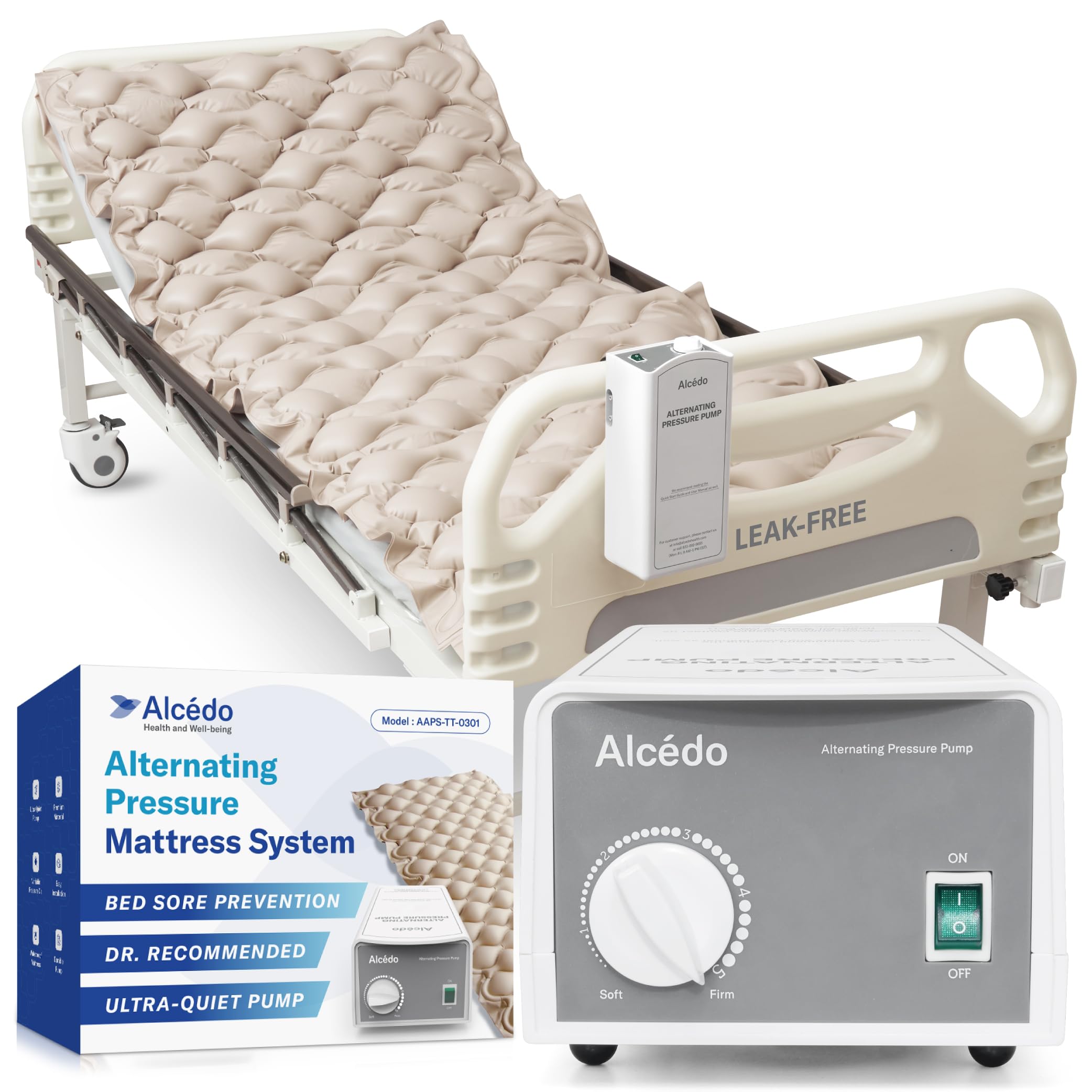
The Alcedo pad strips away unnecessary complexity and delivers the fundamental alternating pressure therapy mechanism at a price point that makes pressure care accessible for families with limited budgets. Its alternating pressure technology cycles inflation and deflation across the air cells to redistribute body weight away from bony prominences, improving circulation and reducing the risk of skin breakdown for bedridden patients with limited mobility. The reinforced seams and high-density material construction provide the durability needed for continuous 24-hour operation without air loss or structural fatigue.
The pump features built-in metal hooks that allow secure attachment to the bed frame or headboard, preventing the pump from being knocked off during bed adjustments. Five adjustable pressure settings accommodate different body weights and comfort preferences, with the maximum setting providing sufficient firmness for patients up to 300 pounds. The inflated bubble area measures 75 by 35 inches, fitting standard hospital beds, homecare beds, and most twin-size frames, with the uninflated end flaps designed to be tucked securely beneath the mattress.
The beige vinyl surface is breathable and waterproof, supporting easy cleaning and maintaining a hygienic environment for patients with incontinence. Setup is straightforward: unroll the pad, connect the air hoses to the pump valves, plug in the unit, and adjust the pressure knob to the desired setting. Users recovering from hip surgery and those caring for elderly parents report that the pad effectively relieves pressure on the buttocks and sacrum, with the alternating air pillows releasing pressure points that would otherwise cause pain during extended bed rest.
Why it’s great
- Reinforced seams and high-density materials provide reliable durability for continuous 24-hour operation
- Built-in metal hooks secure the pump to the bed frame, preventing accidental dislodgment
- Breathable waterproof vinyl surface supports easy cleaning and maintains hygiene for incontinent patients
- FSA and HSA eligibility makes the purchase accessible through healthcare spending accounts
Good to know
- Pad tends to slide down on deep mattresses if the end flaps are not fully tucked beneath the mattress
- 60-day warranty period is shorter than the one-year guarantee offered by mid-range competitors
FAQ
Can an alternating pressure mattress pad be used on a regular home bed frame?
How do I clean a waterproof hospital bed air mattress pad?
What is the difference between alternating pressure and low air loss therapy?
Will a six-inch hospital bed mattress fit my existing bed rails?
How long does it take for a foam hospital bed mattress to fully expand?
Final Thoughts: The Verdict
For most users, the air mattress for hospital bed winner is the Invacare Solace because its three-zone IFD foam construction provides targeted pressure relief for the head, lumbar, and heels without pump noise or mechanical complexity. If you need alternating pressure therapy to manage existing Stage 1 or Stage 2 ulcers, grab the Vive Alternating Pad for its whisper-quiet 22 dBA pump and fast six-minute cycle. And for bariatric patients requiring a 1000-pound capacity surface with dedicated heel offloading, nothing beats the ProHeal Memory Foam Mattress.