
Our readers keep the lights on and the weekend projects moving. As an Amazon Associate, I earn from qualifying purchases.
You’re researching a major appliance for your home—something that runs 24/7 to strip dust, pollen, smoke, and pet dander from every room. The wrong choice leaves you with a noisy box that barely moves air, while the right one quietly transforms your indoor environment over years of service.
I’m Rikta — the co-founder and writer behind FitlyFast. I’ve spent hundreds of hours analyzing CADR ratings, filtration stages, noise profiles, and filter replacement economics to separate the residential workhorses from the overpriced decor.
Whether you need whole-house coverage, whisper-quiet sleep mode, or a system that never requires new filters, this guide cuts through the marketing to help you choose the right air purification system for residential use.
How To Choose The Best Air Purification System For Residential Use
Residential air purifiers are not one-size-fits-all appliances. The right unit depends on room size, the specific pollutants you’re targeting, your tolerance for noise, and how much you’re willing to spend on replacement filters over the life of the unit. Here are the key factors to evaluate before buying.
Match CADR to Your Room Dimensions
CADR (Clean Air Delivery Rate) measures cubic feet per minute of purified air for smoke, dust, and pollen. A common rule of thumb: multiply your room’s square footage by two to find the minimum CADR rating you need. An unit rated for 500 sq. ft. will struggle to clean a 1,000 sq. ft. open-concept living area. Always check the manufacturer’s stated coverage area, but favor units that exceed your room size by 20–30% for faster turnover.
Filter Technology Dictates Long-Term Costs
True HEPA filters capture 99.97% of particles down to 0.3 microns, but those cartridges need replacement every 6–12 months, adding recurring expense. Some units combine pre-filters, activated carbon layers, and UV-C light for broader contaminant removal. Washable or permanent filter systems eliminate replacement costs but require regular cleaning to maintain efficiency. Calculate total cost over 3–5 years—not just the sticker price.
Noise Level Is a Lifestyle Decision
A purifier in the bedroom must operate below 30 dB on low speed to avoid disturbing sleep. Living-room units can tolerate higher fan noise, especially during daytime hours. Look for sleep modes that dim display lights and drop to whisper-quiet operation. Units with separate auto and manual fan controls give you flexibility to balance noise against cleaning speed.
Smart Features vs. Simplicity
WiFi-connected purifiers let you monitor air quality, adjust fan speed, and set schedules from your phone. Real-time PM2.5 sensors and auto modes that react to pollution spikes add convenience. But smart features add cost and complexity—if you just want clean air without an app, a well-built mechanical unit with manual controls may serve you better.
Quick Comparison
On smaller screens, swipe sideways to see the full table.
| Model | Category | Best For | Key Spec | Amazon |
|---|---|---|---|---|
| Blueair Blue 311i | Smart HEPA | Large open-plan homes | HEPASilent: 23 dB low speed | Amazon |
| Air Oasis iAdapt 2.0 | Medical-Grade | Biotoxin & mold control | 706 CFM CADR | Amazon |
| Dyson BP03 | Premium HEPA | Formaldehyde detection | HEPA H13, projects air 32 ft | Amazon |
| Nuwave Forever | Washable Filter | Zero filter replacement cost | 7-stage permanent filter | Amazon |
| Winix 9800 | Smart HEPA | WiFi control & value | 500 sq ft coverage | Amazon |
| Sans HEPA | UV-C HEPA | Pet households & odors | 1,854 sq ft coverage | Amazon |
| PuroAir 400 | Budget HEPA | Allergy symptom relief | 2,000 sq ft coverage | Amazon |
| EcoSELF HAP609 | Compact HEPA | Small-medium rooms | 360° intake, 20 dB sleep | Amazon |
| Austin Air HealthMate Plus | Heavy Carbon | Smoke & VOC elimination | 15 lbs activated carbon | Amazon |
In‑Depth Reviews
1. Blueair Blue 311i
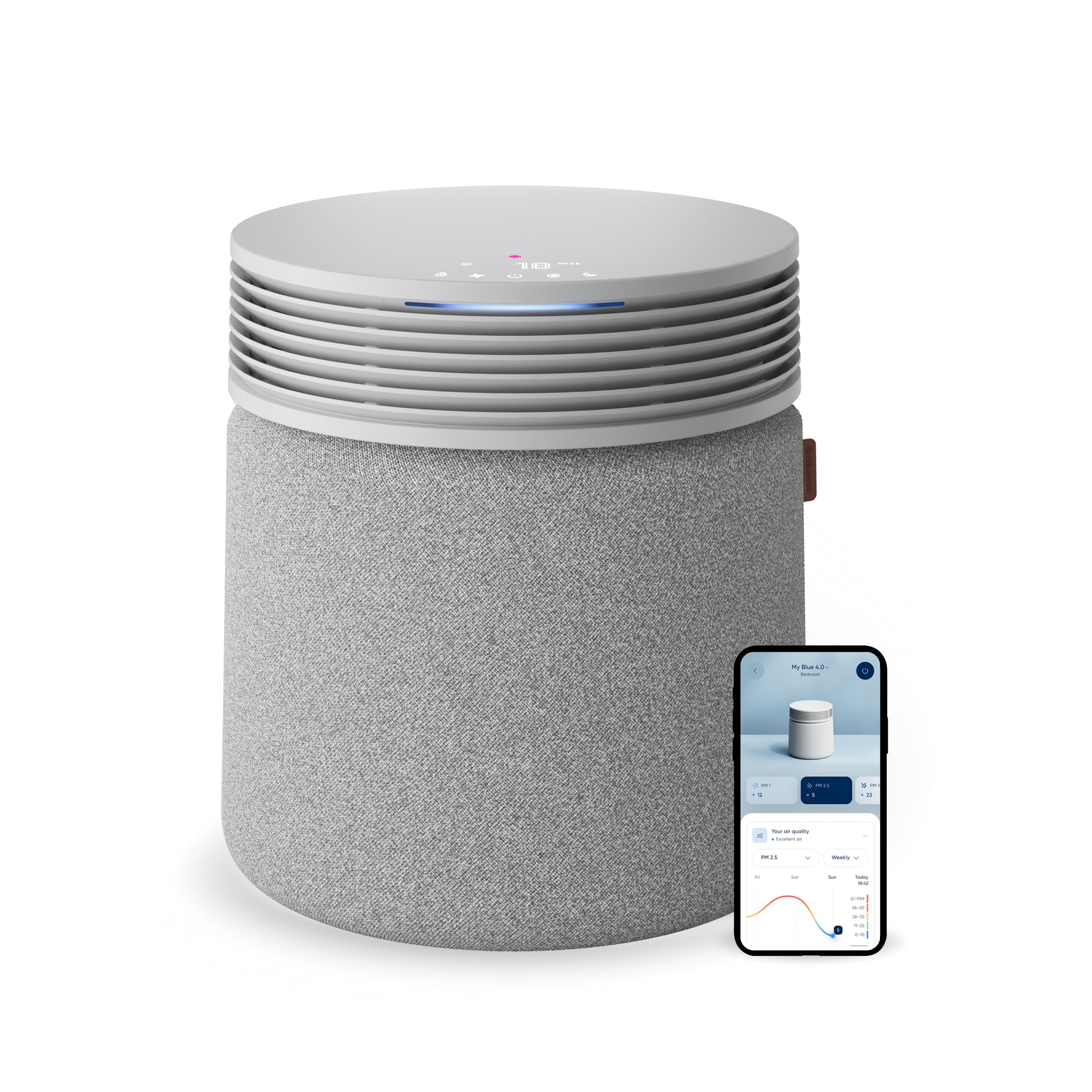
The Blueair Blue 311i uses a proprietary 7-stage HEPASilent filtration system that captures 99.97% of airborne particles down to 0.1 microns while operating as quietly as 23 dB on low speed. It covers rooms up to 705 square feet in just 12.5 minutes and can cycle an entire 3,385-square-foot space every hour, making it one of the fastest residential systems for open floor plans.
The OdorFence technology actively breaks down VOCs, cooking smells, and pet odors, though early adopters note the thin carbon layer saturates after roughly two weeks of heavy odor exposure. The unit doubles as a stylish side table with interchangeable fabric pre-filters in multiple colors, and the MyDyson-grade app provides real-time air quality monitoring, scheduling, and auto mode that reacts to pollution spikes from cooking or opening windows.
Weighing just 13.2 pounds with a top carrying handle, it’s easy to move between rooms. Replacement HEPA filters last roughly 9–12 months and cost around 0.25 per day of operation. The CADR rating for smoke, dust, and pollen exceeds 300 CFM, placing it among the strongest performers in its size class.
Why it’s great
- Whisper-quiet 23 dB low-speed operation
- Furniture-grade design doubles as a side table
- Auto mode with real-time PM sensor
Good to know
- Carbon layer saturates quickly with heavy odors
- Uses ionization which may deposit light dust on surfaces
2. Air Oasis iAdapt 2.0

The Air Oasis iAdapt 2.0 delivers a massive 706 CFM CADR, the highest raw airflow in this lineup, covering 5,474 square feet in one hour with a single unit. Its five-stage filtration combines an H13 medical-grade HEPA filter, activated carbon, silver ion antimicrobial coating, cold ionization, and a UV-C light layer that reduces mold, bacteria, and viruses by up to 99% in lab testing.
Healthcare practitioners recommend this unit for biotoxin illnesses because of the comprehensive sterilization approach. The washable pre-filter catches large particles, extending the main HEPA filter’s lifespan to roughly two years between changes—an unusually long service interval that drops the annual operating cost well below most premium competitors. The 38-pound tower stands 45 inches tall and pulls air through 360-degree intake grilles.
Real-world feedback highlights near-silent operation on lower speeds and immediate clearing of cooking smoke and pet odors. The onboard Wi-Fi module uses an older 802.11n chip, so it’s best isolated on a dedicated IoT network. The app interface is functional but not as polished as Dyson’s or Blueair’s offerings.
Why it’s great
- Industry-leading 706 CFM CADR for whole-house coverage
- Two-year filter replacement interval
- UV-C and silver ion antimicrobial treatment
Good to know
- Outdated Wi-Fi 5 module requires IoT VLAN
- Mobile app interface lacks polish
3. Dyson Purifier Big+Quiet BP03

The Dyson BP03 is engineered for large, open-concept spaces with high ceilings. It uses a HEPA H13 filter that is 3.8 times larger than previous Dyson generations and projects purified air over 32 feet, ensuring consistent turnover even in awkward layouts. A dedicated formaldehyde sensor detects and permanently destroys the gas using a catalytic filter that never needs replacement—a differentiator vs. carbon-only competitors that saturate.
The MyDyson app provides real-time metrics for PM2.5, PM10, NOx, VOCs, humidity, and temperature. Breeze mode oscillates airflow to mimic natural wind rather than a constant jet. The 26-pound unit rolls on integrated casters, making it easy to reposition across rooms. Fan speeds 1 through 3 are virtually silent in a quiet room, and even max speed is less intrusive than most tower fans.
Replacement filters break down to about annually for the HEPA (every 5 years) and annually for the carbon (every 2 years). Owners consistently highlight the DP03’s ability to normalize air quality spikes from cooking or off-gassing twice as fast as their previous units due to superior air circulation dynamics.
Why it’s great
- Permanent catalytic filter destroys formaldehyde
- Projects air 32 feet for open-floor coverage
- Comprehensive real-time air quality dashboard
Good to know
- Large footprint dominates a corner
- HEPA filter is expensive at per 5-year cycle
4. Nuwave Forever

The Nuwave Forever completely eliminates the recurring cost of replacement filters by using a 7-stage system where every component is washable and reusable. The first stage uses stainless-steel pre-filters to capture large particles; subsequent Bio-Guard and electrostatic layers trap micropollutants down to 0.1 microns without needing chemical bonding agents or disposable media.
Intertek lab certification confirms 100% capture of particles down to 0.1 microns, and the unit reduces ozone output to just 1 ppb—well below CARB compliance thresholds. The 22-pound tower covers up to 2,002 square feet in one hour, making it suitable for large basements, living rooms, or open-plan spaces. Fan noise is unobtrusive through speed 3; speeds 4 and above produce audible airflow similar to a desk fan.
Owners consistently report noticeable air quality improvements for pets and allergy sufferers. The disassembly and wash process takes about 30 minutes every three months, and filters must dry completely for 24 hours before reinstallation. The companion WiFi app provides real-time AQI data and auto-mode responsiveness.
Why it’s great
- No filter replacement costs—ever
- Zero ozone output verified by Intertek
- Covers 2,002 sq ft per hour
Good to know
- Washable filters require 24-hour drying time
- Noisy above fan speed 3
5. Winix 9800
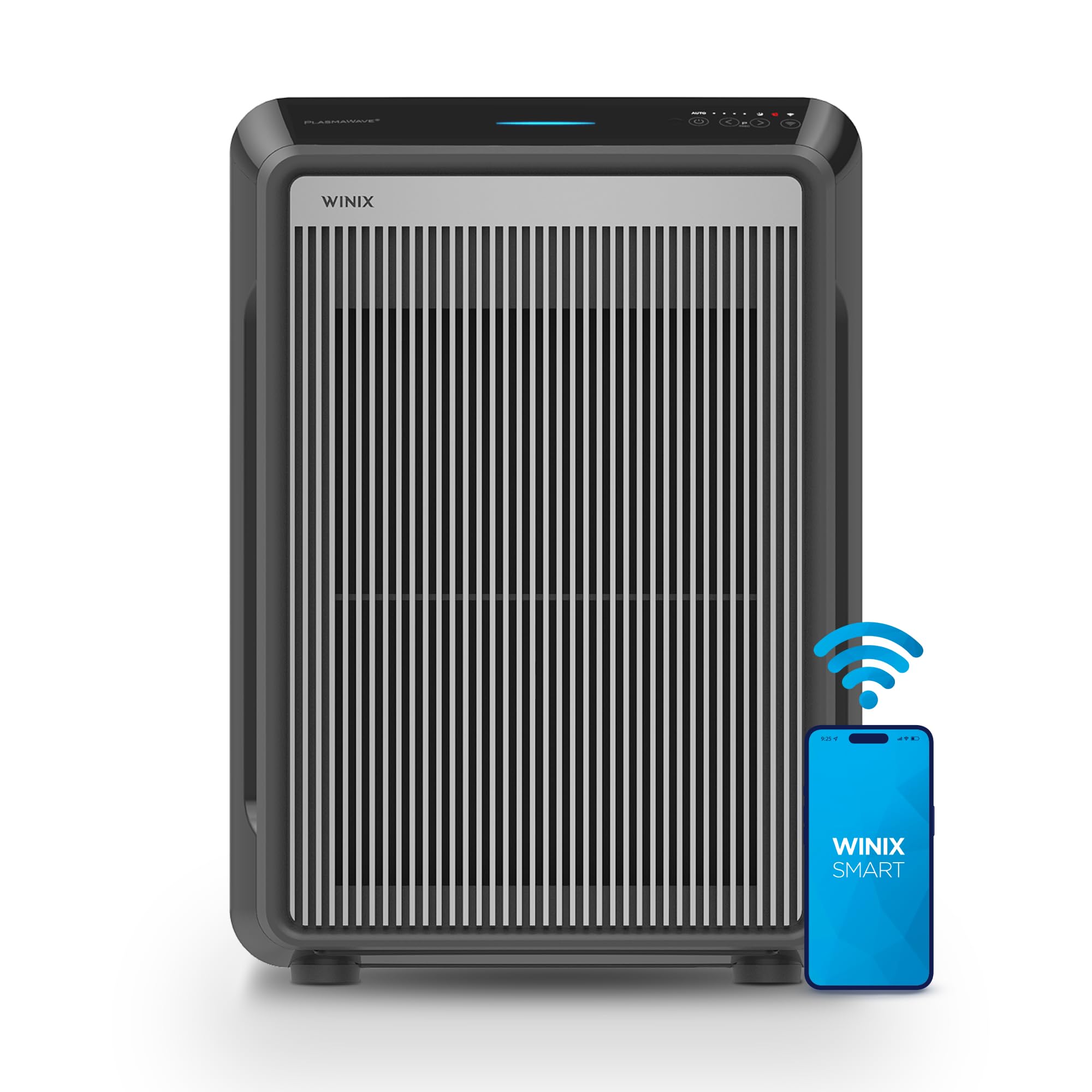
The Winix 9800 is a 4-stage True HEPA purifier with WiFi connectivity, AHAM-verified for 500 square feet. It uses a washable fine mesh pre-filter, a carbon pellet filter for VOCs and odors, a True HEPA layer capturing 99.99% of particles down to 0.003 microns, and PlasmaWave technology that provides an additional antimicrobial step without generating harmful ozone in normal operation.
Dual smart sensors monitor real-time air quality and adjust fan speed automatically. Sleep mode triggers when the room darkens, dropping to a nearly silent 26.2 dB while dimming all indicator lights. The Winix Smart App lets you control the unit from anywhere, set schedules, and view filter life. The 19-pound unit comes with one HEPA filter (good for 12 months) and four charcoal pre-filters (each lasting 3 months).
Consistent feedback from owners praises the 9800 for effectively eliminating cooking odors, pet smells, and musty basement air within 30 minutes of running on auto mode. The lowest fan setting produces a faint hum audible in a dead-silent bedroom, but speeds 1 and 2 are still sleep-friendly at distances beyond 4 feet.
Why it’s great
- Captures particles down to 0.003 microns
- Automatic sleep mode with light sensor
- WiFi app with full scheduling control
Good to know
- Carbon filters need replacement every 3 months
- Larger footprint requires 12-inch wall clearance
6. Sans HEPA (Midnight)

The Sans HEPA system uses a medical-grade True HEPA filter with an integrated UV-C light layer and a heavy-duty activated carbon section to tackle both particles and odors. It covers up to 1,854 square feet—enough for most large living rooms or combined kitchen-dining areas. The 3-in-1 filtration captures 99.9% of particles down to 0.1 microns, including pet dander, pollen, smoke, and mold spores.
The smart auto mode uses a built-in PM sensor to detect pollution spikes from cooking, shower steam, or pet activity, automatically ramping fan speed and then settling back to silent operation. Sleep mode dims all lights and drops to a barely audible whisper. The onboard filter indicator lights up when replacement is due, and swapping filters takes under 60 seconds with no tools required.
Real-world reviews from multi-pet households report that the Sans unit eliminated wet dog smell and lingering cooking odors within an hour of activation. Several users with unexplained respiratory issues noted significant symptom reduction after running the unit continuously for several weeks. The 5-year warranty provides peace of mind for a mid-investment appliance.
Why it’s great
- UV-C light adds antimicrobial layer
- Covers 1,854 sq ft for large rooms
- 5-year warranty included
Good to know
- Filter replacements required every 6–12 months
- Auto mode can be aggressive on initial detection
7. PuroAir 400
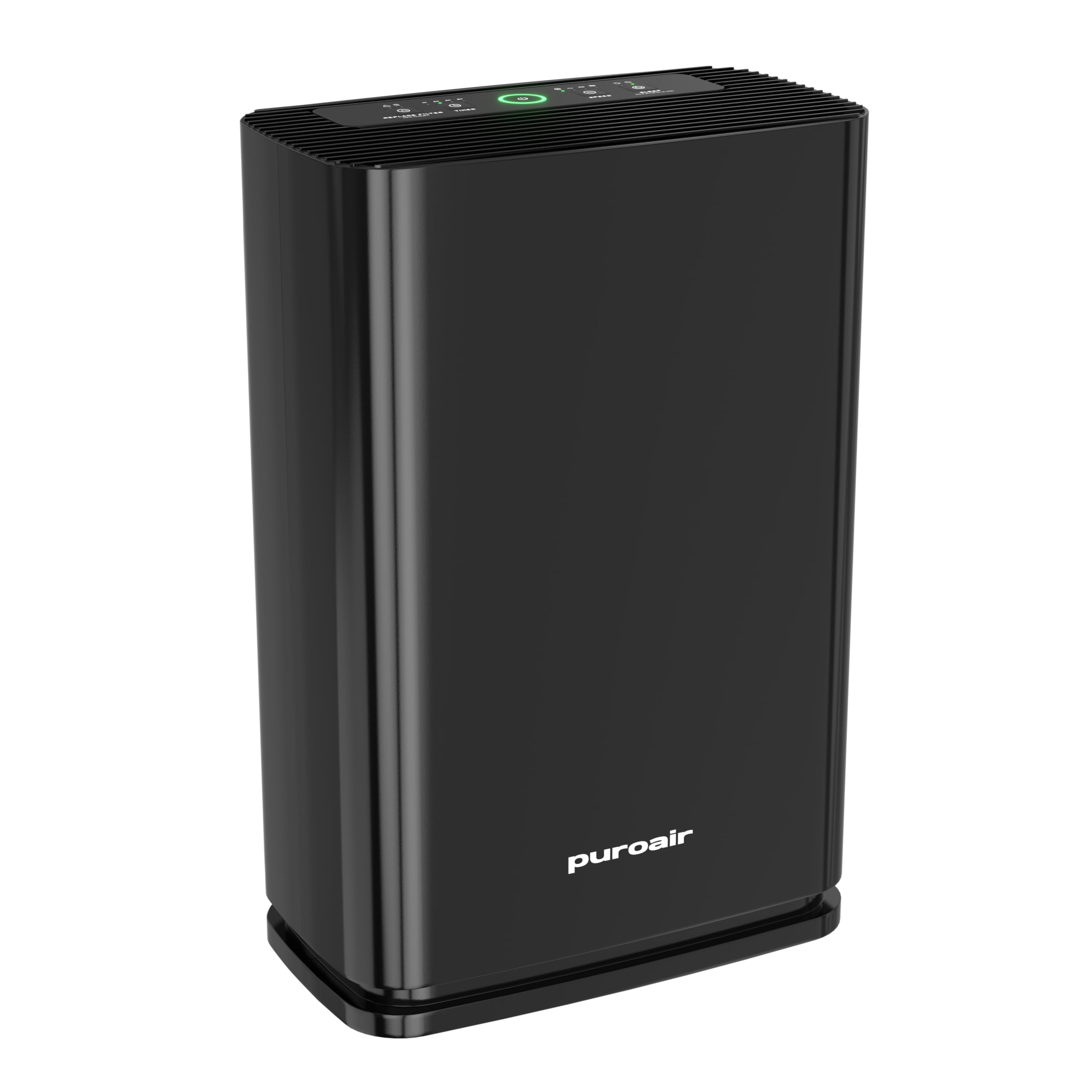
The PuroAir 400 combines a 3-layer filtration system—pre-filter, True HEPA, and activated carbon—into a compact unit that covers up to 2,000 square feet in one hour. Laboratory testing in an ISO 17025 certified facility shows it filters 99.9% of particles including dust, pollen, smoke, pet dander, and VOCs, with the ability to capture particles 700 times smaller than the width of a human hair.
The built-in particle sensor monitors air quality and automatically adjusts fan speed through auto mode. Sleep mode reduces noise to near-silent levels and dims all indicator lights. Weighing under 15 pounds with a 10.6 by 12.5-inch footprint, it fits on nightstands or end tables without dominating the room. The PuroAir team offers a 2-year risk-free warranty and replacement filters at competitive ongoing costs.
Owners consistently report a dramatic reduction in allergy symptoms—runny nose, itchy eyes, congestion—within two to three weeks of continuous 24/7 operation. The auto sensor reacts quickly to smoke from cooking or outdoor pollution, turning the display from green to amber to red as air quality shifts.
Why it’s great
- Compact footprint for tight spaces
- 3-stage CarbonTech filters VOCs effectively
- 2-year risk-free warranty
Good to know
- Can be slightly loud for light sleepers on auto mode
- Room may heat up slightly if door is closed
8. EcoSELF HAP609
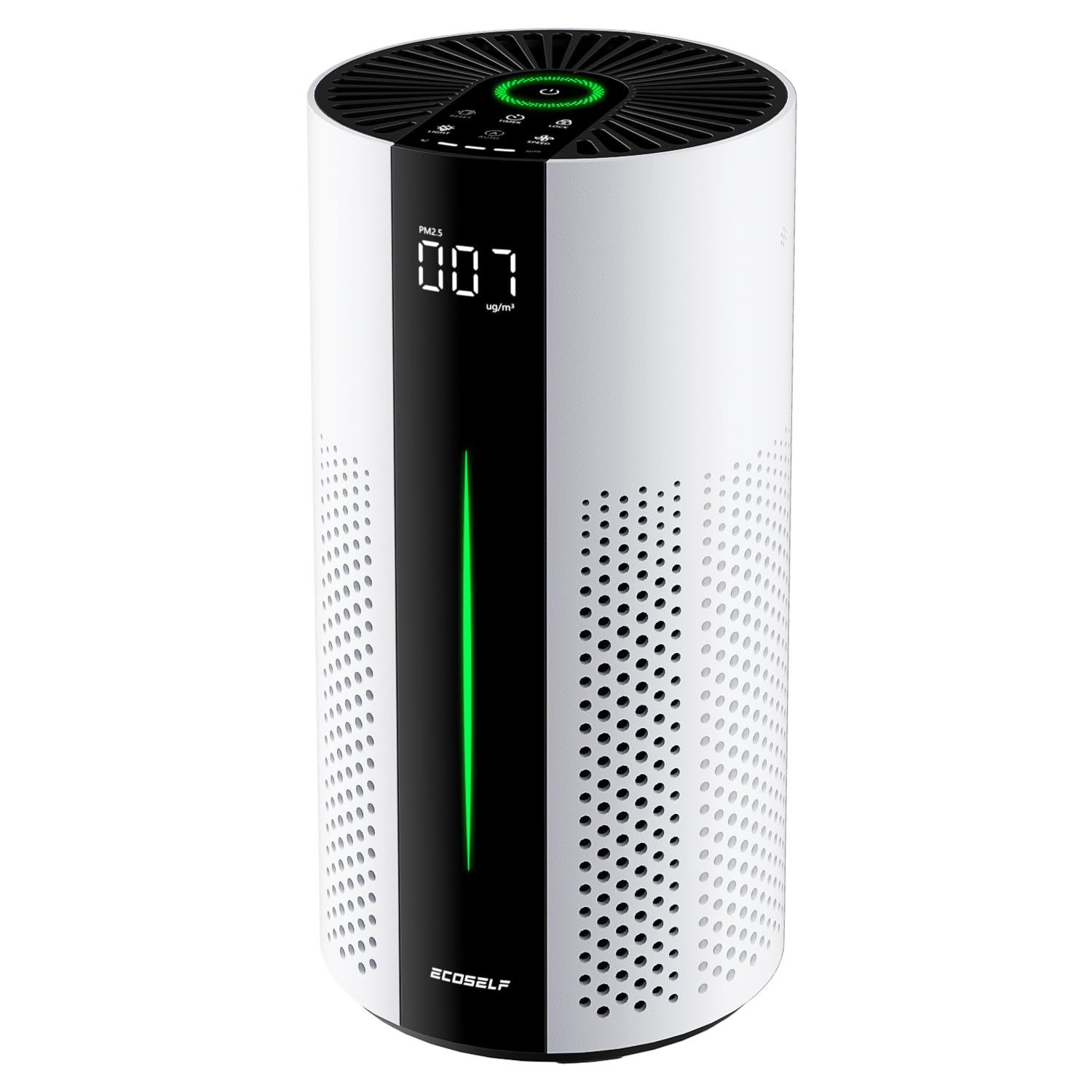
The EcoSELF HAP609 uses a 360-degree air intake design that pulls air from all directions simultaneously, enabling faster room refresh rates than single-intake units of similar size. It covers spaces up to 1,800 square feet with a compact body measuring just 7.2 inches square and weighing under 4 pounds, making it the most portable unit in this list.
The built-in PM2.5 sensor provides real-time air quality readings displayed on a color ring that shifts from green (clean) to amber to red (polluted). Auto mode automatically adjusts fan speed based on detected pollution, and sleep mode drops to a whisper-quiet 20 dB with all lights turned off. The 1-to-24-hour programmable timer gives you precise control over operating windows.
Owner feedback consistently mentions effective smoke removal from cooking and noticeable dust reduction in bedrooms. The ultralight construction makes it easy to move between rooms, though the light weight means it can be knocked over in high-traffic areas if not placed on a stable surface.
Why it’s great
- Ultra-quiet 20 dB sleep mode
- Compact 3.8-pound design for portability
- Real-time PM2.5 color ring display
Good to know
- Lightweight build can tip if bumped
- No WiFi or smart app controls
9. Austin Air HealthMate Plus B450

The Austin Air HealthMate Plus is a beast built for heavy-duty contaminant removal. Its 4-stage filtration includes a large pre-filter, a medium particle interceptor, a military-grade carbon/zeolite blend weighing 15 pounds, and a True HEPA filter. The carbon mass is what truly sets it apart—most residential units use thin carbon sheets that saturate quickly, while the HealthMate’s deep bed handles smoke, VOCs, and chemical off-gassing for years.
The unit covers up to 1,500 square feet and the filters are rated to last up to 5 years in normal residential use. At 47 pounds with a 14.5-inch square footprint, it’s floor-anchored and not meant to be moved daily. Low-speed operation is barely audible; high-speed produces a low hum comparable to a small vacuum cleaner—some owners actually use it as a white noise machine for sleep.
Hundreds of verified reviews highlight the HealthMate’s unmatched ability to eliminate cigarette and marijuana smoke seeping through walls in multi-unit housing. Several owners reported that cheaper units from major brands failed to handle neighbor smoke while the Austin Air cleared 90% of it within hours. The trade-off is a high up-front investment and expensive replacement filters, but the 5-year service interval makes the annual operating cost comparable to mid-range competitors.
Why it’s great
- 15-pound carbon/zeolite filter for smoke & VOCs
- 5-year filter life minimizes maintenance
- Proven effectiveness against neighbor smoke intrusion
Good to know
- Very heavy at 47 pounds—not portable
- Loud on max fan speed
FAQ
What CADR rating do I need for a 600-square-foot living room?
Can a washable filter purifier handle smoke as well as a disposable HEPA unit?
How often should I replace filters in a residential air purifier?
Is UV-C light necessary in a home air purifier?
Will an air purifier eliminate pet odors permanently?
Final Thoughts: The Verdict
For most users, the air purification system for residential use winner is the Blueair Blue 311i because it combines whisper-quiet HEPASilent filtration, smart app control, and stylish furniture-grade design into a package that covers large rooms without dominating your decor. If you want zero ongoing filter costs and don’t mind periodic washing, grab the Nuwave Forever. And for heavy smoke infiltration or serious VOC concerns, nothing beats the Austin Air HealthMate Plus with its 15-pound carbon bed that keeps working when lesser units saturate.