
Our readers keep the lights on and the weekend projects moving. As an Amazon Associate, I earn from qualifying purchases.
Asbestos fibers are microscopic, sharp, and permanently airborne once disturbed. A standard box fan or a flimsy “air purifier” with a washable filter will not capture them—it will simply recirculate a known carcinogen through your living space. The difference between a machine that traps these fibers and one that fails comes down to a single, measurable spec: the filter media’s ability to capture particles at 0.3 microns with 99.97% efficiency or better. Any device that cannot meet that standard is a liability, not a solution.
I’m Rikta — the co-founder and writer behind FitlyFast. The analysis behind this guide began by mapping every current HEPA filtration standard against the known aerodynamic diameter of asbestos fibers to determine which real-world CADR ratings and filter grades actually provide a safety margin.
This guide narrows the field to the nine machines that can genuinely handle the challenge of airborne asbestos, giving you the technical clarity needed to choose a reliable air purifier for asbestos without falling for marketing hype.
How To Choose The Best Air Purifier For Asbestos
Choosing a machine for asbestos is fundamentally different from selecting a unit for pollen or pet dander. The wrong filter choice creates a false sense of safety while microscopic fibers continue to circulate. Every decision must be anchored to the filter’s proven ability to stop particles in the 0.1 to 1.0 micron range.
True HEPA Grade: H13 or H14 Is Non-Negotiable
Asbestos fibers measure between 0.1 and 10 microns, with the most dangerous respirable fraction averaging around 0.3 microns. A True HEPA H13 filter captures 99.95% of particles at 0.3 microns, while H14 captures 99.995%. Anything labeled “HEPA-type” or “HEPA-like” lacks the certification and the physical density to stop fibers at this scale. If the product listing does not explicitly state “True HEPA H13” or “H14,” move on immediately.
Airflow Volume and Room Sealing Strategy
For an asbestos-related scenario—whether post-renovation or in an older home with deteriorating insulation—you need a machine that can cycle the entire room volume at least four times per hour. This is expressed in CADR (Clean Air Delivery Rate) for smoke or dust particles. For large spaces, a higher CADR means the unit can handle higher fiber loads before the filter media becomes saturated. Industrial-grade “negative air machines” are designed to run continuous high CFM and are often sealed more tightly than consumer models, making them the safer choice for active abatement.
Sealed Construction and Gasket Integrity
Even a HEPA H13 filter is useless if unfiltered air can bypass the filter through gaps in the housing, the filter frame, or the access door. Look for machines that use continuous foam gaskets around the filter compartment and rigid framing that prevents the filter from bowing under high static pressure. Consumer units with snap-fit plastic housings are more prone to leakage over time, especially when running at maximum fan speed for extended periods.
Multi-Stage Filtration: Pre-Filter and Carbon for Real-World Load
While the HEPA element does the heavy lifting against asbestos, a pre-filter (MERV-10 or better) traps larger construction debris, prolonging the life of the expensive HEPA filter. An activated carbon layer is not essential for asbestos removal, but it absorbs VOCs from paints, sealants, and adhesives often used alongside asbestos abatement. Machines with a washable or replaceable pre-filter reduce long-term operating costs significantly during heavy use.
Quick Comparison
On smaller screens, swipe sideways to see the full table.
| Model | Category | Best For | Key Spec | Amazon |
|---|---|---|---|---|
| VEVOR Air Scrubber 3-Stage | Mid-Range | Construction & Remediation | 550 CFM, H13 HEPA | Amazon |
| BlueDri Air Shield 550 | Mid-Range | Heavy Renovation | 550 CFM, HEPA | Amazon |
| Air Oasis iAdaptAir 2.0 | Premium | Whole-Home & Biotoxin | 530 CFM, H13 HEPA | Amazon |
| Austin Air HealthMate Standard | Premium | Long-Term VOC & Dust | 700 sq ft, 4-Stage Filtration | Amazon |
| Dyson Purifier Big+Quiet BP03 | Premium | Large Open Spaces | HEPA H13, 32ft Projection | Amazon |
| Rabbit Air A3 SPA-1000N | Premium | Ultra-Quiet Bedroom Use | 1,070 sq ft, 20.3 dBA | Amazon |
| Sans True HEPA Air Purifier | Mid-Range | Pet & Allergy Households | 1,854 sq ft, Medical HEPA | Amazon |
| PuroAir 240 HEPA | Mid-Range | Bedroom & Small Office | 1,000 sq ft, 99.9% Filtration | Amazon |
| Honeywell HPA-250 Bluetooth | Mid-Range | Daily Allergen Control | 310 sq ft, True HEPA | Amazon |
In‑Depth Reviews
1. VEVOR Air Scrubber with 3-Stage Filtration

The VEVOR Air Scrubber is engineered specifically for the kind of high-fiber-load environments where asbestos remediation is a concern. Its three-stage filtration begins with a MERV-10 pre-filter to capture large debris, followed by a carbon layer for odor absorption, and finishes with an H13 HEPA filter rated for 99.97% efficiency at 0.3 microns. The 550 CFM motor moves enough air to create negative pressure in a contained workspace, which is the standard protocol for preventing fiber migration beyond the abatement zone.
The stacked design and foldable handle make it portable enough to move between rooms during a phased renovation. The unit includes a resettable timer and a circuit breaker for overheat protection, both critical when running a scrubber continuously for days. Reviewer reports confirm that the pre-filter captures visible construction dust effectively, extending the HEPA filter’s lifespan by a significant margin.
At 35 pounds, this is not a desktop machine—it belongs in a basement, workshop, or remediation site. The foam gasket around the filter compartment is adequate for HEPA sealing, though some users note the plug cover is poorly designed. For the airflow and filter grade provided, the VEVOR occupies a unique position between consumer air purifiers and full industrial negative air machines.
Why it’s great
- Industrial 550 CFM airflow suitable for negative pressure containment
- True H13 HEPA filter combined with MERV-10 pre-filter for load management
- Daisy-chain capability for running multiple units in larger spaces
Good to know
- Large and heavy at 35 pounds, requiring dedicated floor space
- Variable speed controller is inexpensive and can cause inconsistent fan speed
2. BlueDri Air Shield 550 HEPA Air Scrubber

The BlueDri Air Shield 550 is built around a single-piece housing that delivers at least 40% more CFM than many competitor units in the same class, according to the manufacturer. This matters for asbestos work because higher airflow volume at a given filter density means the room air gets scrubbed faster, reducing the concentration of airborne fibers more quickly after a disturbance. The pre-filter stage catches bulk particles—drywall dust, insulation debris—while the main HEPA element handles the sub-micron fraction.
Users working on demolition and ceiling texture removal report that this unit cleared visibly black, dust-laden air within 20 minutes, a strong indicator that the airflow path and filter seal are functioning correctly. The standard 15 x 24 x 23-inch filter size is widely available from third-party suppliers, which lowers future replacement costs and eliminates the risk of proprietary filter shortages.
The BlueDri lacks a built-in carbon layer, but the option for a separate carbon filter allows you to add VOC control only when needed, keeping static pressure low when you are running purely for particulate removal. The 39-pound weight and handle design make it transportable, though it is clearly intended for job-site rather than bedside use. The 1-year warranty on electronics with a 5-year housing guarantee provides reasonable protection for a machine that may sit idle between projects.
Why it’s great
- High CFM output suitable for rapid air exchange during active demolition
- Standard filter size ensures easy, affordable replacement
- Durable single-piece housing with 5-year warranty on the chassis
Good to know
- Carbon filter is sold separately, adding cost if VOC control is needed
- Seal around the filter compartment could be tighter, per some user feedback
3. Air Oasis iAdaptAir 2.0 H13 HEPA

The Air Oasis iAdaptAir 2.0 combines a medical-grade H13 HEPA filter with a 5-stage purification system that includes a silver ion screen, bi-polar ionization, and UV light. While the ionization and UV stages target biological contaminants like mold and bacteria, the H13 HEPA media is the only stage relevant to asbestos capture. The critical spec here is the 530 CFM clean air delivery rate, which gives this unit one of the highest air exchange rates in its size class.
The automatic air quality sensor adjusts fan speed in real time, a useful feature when asbestos disturbance is intermittent—such as during a multi-day renovation where work stops and starts. The filter life is rated at up to two years under 24/7 operation, which reduces the frequency of handling potentially contaminated media. The Wi-Fi chip is removable for users concerned with EMF exposure, a thoughtful addition for health-conscious buyers.
Users report that the unit is virtually silent on low speed while still moving noticeable air volume, and that it eliminates mold odors and VOCs within hours. The main drawback is that the Wi-Fi module uses an older protocol with known security vulnerabilities, requiring a separate IoT network for secure integration. At 20 pounds, it is lighter than the industrial scrubbers but tall at 37 inches, demanding vertical clearance.
Why it’s great
- Very high 530 CFM CADR for rapid room cycling in large spaces
- Long 2-year filter life reduces contaminated media handling
- Removable Wi-Fi chip for users who want to reduce EMF exposure
Good to know
- Wi-Fi module uses outdated security, requiring a separate IoT VLAN
- App interface is mediocre and lacks advanced scheduling features
4. Austin Air HealthMate Standard B400

The Austin Air HealthMate Standard B400 is defined by its massive 4-stage filter assembly, which integrates 15 pounds of activated carbon and zeolite behind a True HEPA element. For asbestos applications, the carbon-zeolite bed has no direct effect on fiber capture, but it does absorb the chemical off-gassing from older insulation materials and sealing compounds often used in abatement work. The HEPA element itself is rated at 99.97% efficiency at 0.3 microns.
The 360-degree intake design draws air from all directions, eliminating the need for precise placement in the room. The filter lifespan is up to five years under normal conditions, an industry-leading interval that dramatically reduces the number of times you must open the machine and handle potentially contaminated media. The steel housing and low-EMF design appeal to buyers who run the unit continuously in occupied living spaces.
The chief trade-off is noise. On high speed, the healthmate is loud—reviewers describe it as “intrusive” and unsuitable for a bedroom unless operated on low, where airflow is significantly reduced. The unit is also heavy at 45 pounds and lacks any smart features or remote control. It is a brute-force, no-frills machine that prioritizes filter mass and durability over user convenience.
Why it’s great
- Massive 15-pound carbon/zeolite bed for superior VOC and odor absorption
- 5-year filter life minimizes handling of potentially contaminated media
- Steel housing and low-EMF design for health-conscious users
Good to know
- Noisy on higher speeds, limiting placement to common areas rather than bedrooms
- No smart features, app connectivity, or remote control
5. Dyson Purifier Big+Quiet Formaldehyde BP03

The Dyson BP03 uses a HEPA H13 filter that is 3.8 times larger than the previous Dyson generation, paired with a unique Air Multiplier technology that projects purified air over 32 feet. For asbestos control in a large, open-concept home, this projection ability means the machine can circulate the entire room volume without relying on ceiling fans or central HVAC to distribute the filtered stream. The H13 filter captures 99.95% of particles at 0.3 microns.
The MyDyson app provides real-time data for PM2.5, PM10, nitrogen oxides, VOCs, and formaldehyde, giving you granular visibility into air quality changes. The breeze mode recreates a natural airflow sensation, which makes the unit more comfortable to sit near for extended periods. The HEPA filter is rated for up to 5 years, while the carbon filter lasts 2 years, with combined annual replacement costs that are competitive for the premium tier.
The unit is heavy at 26.2 pounds, but built-in wheels make it easy to roll between rooms. The main limitation is that the Dyson is not designed as a sealed negative air machine—it lacks the gasket integrity of a dedicated scrubber and is best suited for post-abatement cleanup and ongoing air quality maintenance rather than active fiber containment during demolition.
Why it’s great
- Long-range air projection ensures even circulation in large, open spaces
- Comprehensive real-time air quality monitoring through the MyDyson app
- Long filter life with 5-year HEPA and 2-year carbon intervals
Good to know
- Not designed for active negative pressure containment during demolition work
- Premium-tier investment with correspondingly higher upfront cost
6. Rabbit Air A3 SPA-1000N

The Rabbit Air A3 operates at just 20.3 dBA on its lowest setting, making it the quietest unit in this guide and a strong candidate for continuous overnight operation in a bedroom or nursery where asbestos concerns exist. The 6-stage filtration system includes a pre-filter, a medium filter, a True HEPA filter, and an activated carbon filter, with the option to swap in a specialty filter (Toxin Absorber, Odor Remover, Pet Allergy, or Germ Defense) at the final stage.
For asbestos use, the standard True HEPA element captures 99.97% of 0.3-micron particles, and the Toxin Absorber or Odor Remover cartridges add an extra layer of chemical adsorption for sealants and paints. The unit covers up to 1,070 square feet, cycled at 8,560 cubic feet every 30 minutes. The wall-mountable design frees up floor space, a useful feature in tight rooms where a floor-standing scrubber would be obstructive.
The main trade-off is airflow volume. The Rabbit Air A3 moves fewer cubic feet per minute than the industrial scrubbers, meaning it cannot create the negative pressure differential required for active containment during asbestos abatement. It is a long-term air quality maintenance device, not a remediation tool. The 12-month filter life is standard, and the NFC filter tracking via the Rabbit Air app simplifies replacement scheduling.
Why it’s great
- Exceptionally quiet operation at 20.3 dBA for undisturbed sleep during use
- Wall-mountable design saves floor space in tight rooms
- Customizable specialty filter cartridges for targeted chemical or odor removal
Good to know
- Lower CFM output makes it unsuitable for active negative pressure containment
- 12-month filter life is standard, not extended for heavy particulate loads
7. Sans True HEPA Air Purifier

The Sans True HEPA Air Purifier covers up to 1,854 square feet in a single pass, making it one of the broadest-coverage consumer units suitable for post-abatement air polishing. Its 3-in-1 filtration system layers a pre-filter, a medical-grade True HEPA filter, and an activated carbon element. The True HEPA filter captures 99.9% of particles down to 0.1 microns—exceeding the standard 0.3-micron benchmark and providing a wider safety margin for the finer asbestos fibers.
The UV-C light layer is a biological control feature that targets bacteria and viruses but does not contribute to asbestos removal. The smart auto mode uses real-time air quality sensors to adjust fan speed, and the sleep mode drops noise to a whisper while dimming all display lights. Users report that the unit effectively eliminates cooking odors and pet dander, and that the dust accumulation in their homes dropped noticeably within weeks.
Filter replacement is tool-less and takes under 60 seconds, with an indicator light alerting the user when the media is due. The 5-year manufacturer warranty is a strong confidence signal for a machine designed to run 24/7. The chief limitation is that the Sans unit, like other consumer models, lacks the sealed gasket system and high static pressure of an industrial scrubber, so it should not be the primary device during active fiber disturbance.
Why it’s great
- Medical-grade HEPA captures 99.9% of particles down to 0.1 microns
- Very wide coverage area of 1,854 sq ft for one-hour room cycling
- 5-year manufacturer warranty and simple, tool-less filter changes
Good to know
- UV-C light adds no value for asbestos particulate removal
- Consumer-level housing seal is not rated for negative pressure containment
8. PuroAir 240 HEPA Air Purifier
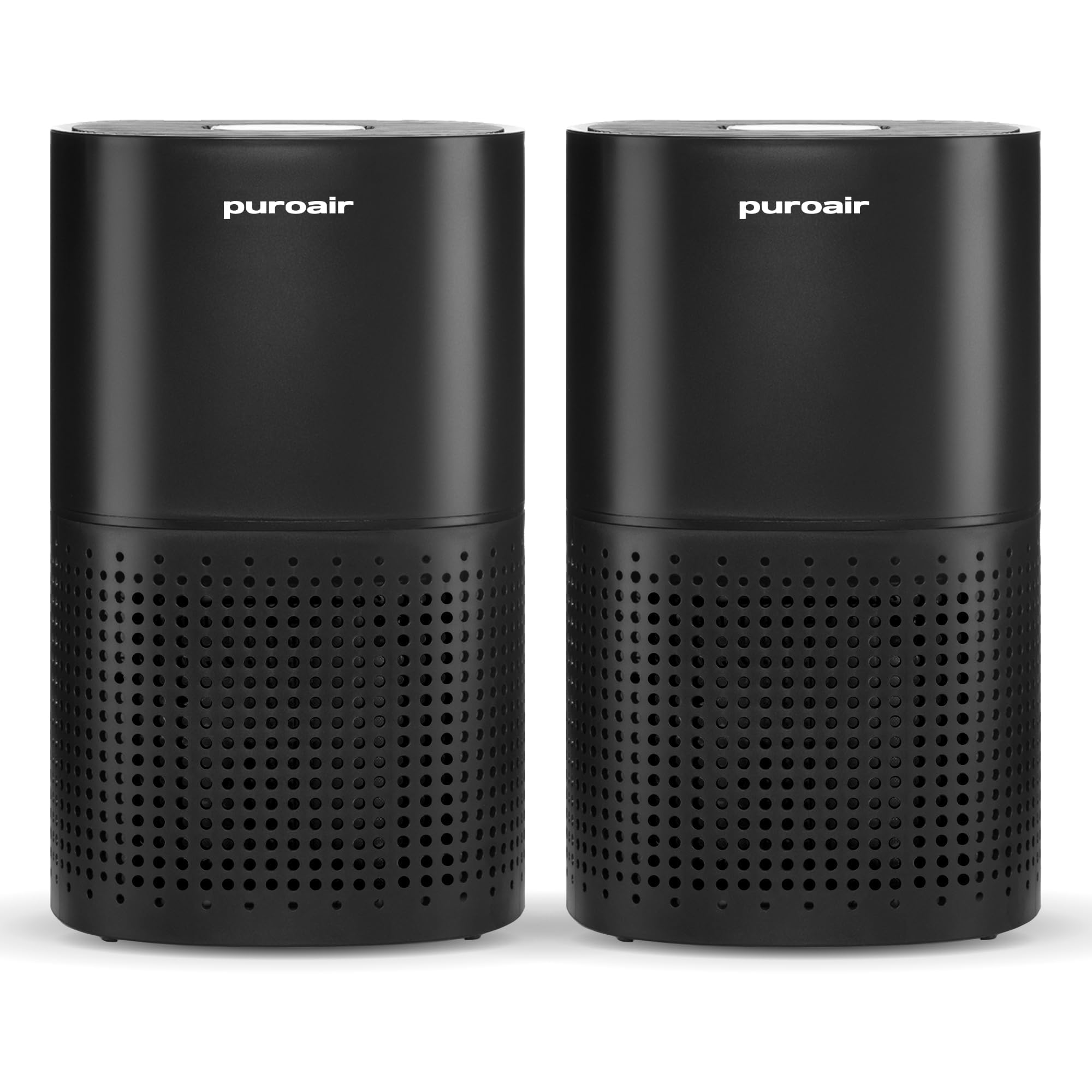
The PuroAir 240 uses a 3-layer filtration system with a pre-filter, True HEPA filter, and activated carbon layer that captures 99.9% of pollutants including dust, pollen, smoke, and pet dander. The HEPA element is certified to capture particles 700 times smaller than a human hair, though asbestos fibers at the sub-micron scale still require the 0.3-micron efficiency rating to be confirmed—PuroAir’s marketing language does not explicitly state H13 or H14 certification, but the “True HEPA” claim typically aligns with the 99.97% standard.
The unit covers up to 1,000 square feet in one hour, making it suitable for a large master bedroom or a combined living-dining space. The smart particle sensor monitors air quality and automatically increases fan speed when pollution is detected, a useful feature if asbestos dust is intermittently disturbed. The sleep mode is genuinely quiet, with multiple reviewers noting they could not hear the machine running at low speed.
The PuroAir is compact at 7.3 pounds and 20.47 inches tall, making it one of the easiest units to reposition based on where work is happening. The 2-year risk-free warranty covers performance issues. The limitation is the lack of explicit H13/H14 labeling, which means buyers relying on this unit for asbestos control should verify the filter specification with the manufacturer before assuming it meets abatement-grade standards.
Why it’s great
- Compact, lightweight design (7.3 lbs) for easy repositioning during renovation
- Smart auto mode with real-time particle sensor for automatic speed adjustment
- Very quiet sleep mode suitable for continuous overnight operation
Good to know
- Filter certification (H13/H14) not explicitly stated in product literature
- Coverage area is based on one air exchange per hour, which may be insufficient for high-load scenarios
9. Honeywell HPA-250 Bluetooth Smart True HEPA

The Honeywell HPA-250 uses a True HEPA filter and an activated carbon pre-filter to capture 99.97% of airborne particles at 0.3 microns, meeting the standard required for asbestos capture in residential settings. It is AHAM Verifide to circulate and filter room air up to 4.8 times per hour in a 310-square-foot room, which is adequate for a bedroom or small home office where asbestos fiber concentration is expected to be low and intermittent.
The VOC sensor provides real-time feedback on indoor air quality and adjusts cleaning levels automatically—an unusual feature in this price tier. The Bluetooth app connectivity allows remote control and scheduling, though users report that the app has been removed from the Apple App Store as of late 2026, making this feature unreliable for iOS users. On low speed, the unit is very quiet at 27 watts, making it suitable for nighttime operation.
The 310-square-foot coverage limit is the smallest in this guide, which means the HPA-250 is best used as a supplement to a larger scrubber rather than the primary defense during active renovation. The filter replacement interval is standard, and the unit has been available for many years, so replacement filter availability is excellent. The biggest risk is using this machine alone in a large space where asbestos fibers may be present, as the low airflow volume cannot achieve the air exchange rate needed for safe containment.
Why it’s great
- True HEPA captures 99.97% of particles at 0.3 microns, sufficient for asbestos
- VOC sensor provides real-time air quality feedback and auto-adjusts speed
- Very quiet at 27 watts on low speed for uninterrupted sleep
Good to know
- Small 310 sq ft coverage is inadequate for large, open spaces
- Bluetooth app is no longer supported on iOS as of late 2026
FAQ
What is the difference between True HEPA and HEPA-type filters for asbestos?
Can a single air purifier handle asbestos in the whole house?
Will an air purifier with activated carbon capture asbestos fibers?
Final Thoughts: The Verdict
For most users, the air purifier for asbestos winner is the VEVOR Air Scrubber with 3-Stage Filtration because it delivers the industrial-grade 550 CFM airflow and H13 HEPA filtration needed for actual fiber containment at a mid-range investment. If you need a quieter, more compact option for ongoing air quality maintenance after the abatement is complete, grab the PuroAir 240 HEPA. And for heavy-duty remediation work where you are actively disturbing suspect materials, nothing beats the BlueDri Air Shield 550 for its high CFM output and standard-sized replacement filters that keep long-term costs predictable.