
Our readers keep the lights on and the weekend projects moving. As an Amazon Associate, I earn from qualifying purchases.
Finishing a seam should feel like the final, satisfying brushstroke on a garment, not a wrestling match with tangled thread and squinting eyes. The entire appeal of an air threading serger is to bypass the most hated ritual in sewing: manual looper threading. That one feature—a burst of air that shoots thread through the needle’s eye—transforms the serging experience from a test of patience into a fluid, creative process.
I’m Rikta — the co-founder and writer behind FitlyFast. For this guide, I’ve analyzed the mechanics and real-world performance data of nine of the most talked-about air threading sergers, weighing everything from the precision of their differential feed systems to the durability of their internal metal components.
After hundreds of hours spent researching user feedback and technical specs, the verdict is clear: the best air threading serger for most homes is the one that combines this core technology with reliable stitch construction and a forgiving learning curve, all without breaking your sewing room budget.
How To Choose The Best Air Threading Serger
An air serger is a long-term investment. Choosing the right one means looking past the marketing and focusing on three pillars: the threading system’s reliability, the mechanical foundation for stitch quality, and the included features that match your sewing habits.
Air Threading Mechanics: Jet vs. Automatic
Not all “air threading” systems are equal. Some models, like the Brother AIR1800, use a dedicated air compressor and tubing to blast thread through the lower looper, while others, like the Bernette B64 Airlock, use a pneumatic pump built into the machine. The key difference is reliability: dedicated air systems are less prone to clogging and offer a consistent threading experience. Budget-friendly models may only automate the lower looper, leaving the upper looper manual, so check the specifications for which loopers are air-threaded.
Build Quality and Internal Components
Air sergers generate significant vibration. A machine with a metal internal frame and aluminum components, such as the Juki MO-1000, will maintain stitch consistency at higher speeds (1300 SPM) and resist tension drift over years of use. Lighter machines with plastic casings and internal parts may be more portable but can sacrifice durability. Look for models that specify a metal body or aluminum armature for professional-level longevity.
Stitch Versatility and Differential Feed
Your serger must match your fabric. A 2-3-4 thread convertible machine offers the versatility to handle everything from rolled hems on chiffon (2-thread) to durable seams on denim (4-thread). The differential feed ratio is the critical spec here: a ratio adjustable from 0.5 to 2.0 allows you to tame stretching on knits and prevent puckering on wovens. Entry-level models may have a narrower range, limiting their effectiveness on problematic fabrics like jersey or spandex.
Quick Comparison
On smaller screens, swipe sideways to see the full table.
| Model | Category | Best For | Key Spec | Amazon |
|---|---|---|---|---|
| Brother AIR1800 | Air Threading | Jet air threading ease | 2/3/4 Thread, Air Jet Looper | Amazon |
| Brother Airflow 3000 | Air Threading | Premium air threading + feet set | Air Threading, 3 Included Feet | Amazon |
| Bernette B64 Airlock | Air Threading | Luxury air threading + 5 LEDs | Auto Air Threader, 5 LED Lights | Amazon |
| Juki MO-1000 | Air Threading | Industrial-grade stitch quality | Push Button Jet Air Looper | Amazon |
| Bernette B48 Funlock | Air Threading | Coverstitch + serger combo | 23 Stitches, 1300 SPM | Amazon |
| Juki MO-50E | Air Threading | Automatic lower looper threader | Auto Lower Looper Threader | Amazon |
| Janome MOD-8933 | Air Threading | Lay-in threading system | Lay-In Threading, 3/4 Thread | Amazon |
| Janome 8002D | Air Threading | Color-coded threading guidance | 1300 SPM, Color-Coded Paths | Amazon |
| SINGER S14-78 | Air Threading | Entry-level versatility | 1200 SPM, 2/3/4 Thread | Amazon |
In‑Depth Reviews
1. Brother AIR1800 Air Serger

The Brother AIR1800 is the purest expression of the air threading promise. It uses a dedicated internal air compressor with tubes connected to the loopers—press a button and a gust of air sends the thread through. This system eliminates the single most frustrating step of serger setup, making color changes almost effortless. The machine handles 2, 3, and 4-thread configurations, so you can go from a delicate rolled hem to a sturdy overlock on heavy knits without missing a beat.
At 21.5 pounds, it feels substantial and solid on the work surface. Users consistently report it runs quietly and with minimal vibration, a testament to its build quality. The color-coded thread guides keep the upper path organized, and the LED-lit work area is notably bright, reducing eye strain on dark fabrics. This is a machine designed for sewists who want to spend their time creating, not fighting with thread tension or re-threading.
One consistent note from the user community is the absence of included accessories—the machine arrives without a catch tray, extra feet, or a manual printed in the box. This is a minor inconvenience compared to the threading revolution it offers. Pair it with the Brother Airflow 3000 if you need a full accessory set, but for sheer air-threading reliability and stitch quality, the AIR1800 is the top contender.
Why it’s great
- Jet air threading system makes re-threading fast and frustration-free
- Runs quietly with minimal vibration at high speeds
- Excellent stitch quality on stretchy and fine knit fabrics
Good to know
- No accessories like a catch tray or extra feet included
- Printed manual is not provided; you’ll need to download the PDF
2. Brother Innov-ís Airflow 3000 Air Serger

The Airflow 3000 takes the core air threading technology of its Brother sibling and adds the accessories and included features that the AIR1800 lacks. It comes with a Gathering Foot, Blind Stitch Foot, and Piping Foot, turning it into a more complete package for garment construction. The auto needle threader and air-threaded loopers work in concert to reduce setup time to nearly zero, a boon for sewists with arthritis or hand fatigue.
Structurally, the Airflow 3000 is heavier than the AIR1800, weighing about 22.6 pounds, and users note it sits solidly on the table with minimal vibration. It handles a wide variety of fabrics—from lightweight knits to heavier wovens like denim—without tension adjustments drifting. The differential feed is precise, allowing for clean rolled hems and stable flatlock seams. The stitch quality is consistent across all modes, making it a reliable workhorse for daily use.
The primary risk with this model is the air threading system’s air pipes, which a small number of users report can become clogged, requiring professional servicing to repair. This is a low-probability issue but a costly one if it occurs. For most users, though, the convenience of automatic threading and the comprehensive foot set make the Airflow 3000 a strong premium choice.
Why it’s great
- Comes with Gathering, Blind Stitch, and Piping feet
- Air and auto needle threaders work together for full automation
- Stable, consistent stitches on a wide range of fabric weights
Good to know
- Air pipes can become clogged, requiring professional repair service
- Limited manual instructions; video tutorials advised for setup
3. Bernette B64 Airlock Overlocker

The Bernette B64 Airlock is built for the sewist who values workspace visibility as much as thread automation. It features an expansive 130mm working area to the right of the needle, giving you room to handle large quilting projects or bulky seams without the fabric bunching against the machine. The automatic air threader works on the loopers with a single push, and the built-in micro thread control (MTC) allows for fine-tuned tension adjustments that hold their setting through long sewing sessions.
With five bright LED lights arranged around the needle area, the B64 Airlock makes working on dark fabrics or intricate rolled hems much easier on the eyes. The machine is constructed with an aluminum body, contributing to its stability and reduced vibration at the 1300 SPM top speed. The free arm is also well-designed, making it practical for cuffs and sleeves. The learning curve is minimal, especially for beginners coming from a standard sewing machine.
The biggest concern with the B64 is warranty coverage. Several users have reported that Bernette’s warranty requires purchase from an authorized dealer, and buying from Amazon does not always qualify. If the machine fails, you may be left with only the third-party extended warranty. This makes it a riskier investment compared to models with clear, dealer-agnostic support, despite otherwise excellent performance.
Why it’s great
- 130mm work area provides generous space for large projects
- Five LED lights illuminate the stitching area exceptionally well
- Aluminum body reduces vibration and supports heavy fabrics
Good to know
- Warranty may be void if purchased from a non-authorized Amazon seller
- Does not include a physical manual; PDF download only
4. Juki MO-1000 Serger

The Juki MO-1000 is the choice for the serious garment sewist who needs a machine that can churn out miles of perfect seams under heavy production conditions. Its push-button jet air looper threader works on both upper and lower loopers, making color changes between costumes or bulk runs fast and reliable. Experienced users with high-volume projects report it handles 3, 4, or even 5 float costumes with zero downtime, a testament to its build and reliability.
What sets the MO-1000 apart is its near-complete absence of vibration. At 1,300 stitches per minute, the machine runs steady and quiet, allowing for precise control even on intricate seam paths. The stitch quality is consistently described as “perfect” across a wide variety of settings—rolled hems, flatlock, and standard overlock all perform with equal precision. The air threading mechanism on this Juki is particularly robust, with fewer user reports of clogging compared to other air systems.
The needle threading, despite the air looper, remains a manual process that some users find tricky. The included automatic needle threader is finicky and may require practice to use effectively. Also, the foot can be difficult to snap into place correctly—misalignment can lead to needle breakage. If you can master the needle side, this is the most durable and reliable air serger on the market.
Why it’s great
- Robust air threading for both loopers with low risk of clogging
- Runs with minimal vibration, delivering near-professional stitch consistency
- Exceptional for high-volume or production-level garment sewing
Good to know
- Needle threading is manual and the included threader can be tricky
- Foot pressure can be difficult to snap in; misalignment risks broken needles
5. Bernette B48 Funlock Serger
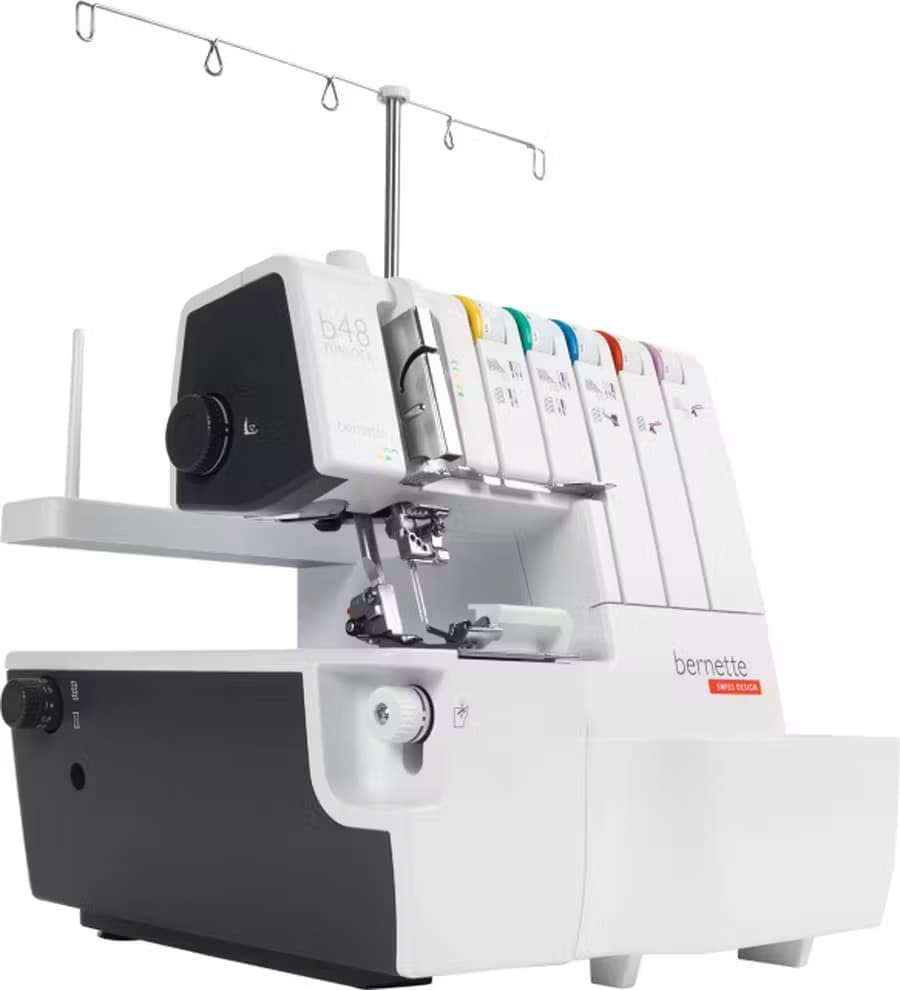
The Bernette B48 Funlock is a hybrid machine that functions as both an overlock serger and a coverstitch machine, making it a space-saving powerhouse for sewists who need both capabilities. With 23 built-in stitches, including chain stitch, coverstitch, and combo options, it handles hemming T-shirts, neckbands, and decorative topstitching without needing a separate machine. The 1,300 SPM motor is powerful enough for heavy-duty quilting and denim layers.
Users frequently praise how quiet this machine runs—an important factor if you do long sewing sessions in a shared living space. The built-in LED light illuminates the work area well, and the adjustable presser foot pressure helps manage thick fabric transitions. The serger+coverstitch combination is a genuine time-saver, allowing you to serge a seam and coverstitch the hem without swapping machines.
The threading and tension adjustments are not beginner-friendly, as several experienced users note it takes practice to change needles and adjust tensions efficiently. Additionally, some units have arrived missing needed needles, and the lack of a physical manual can be frustrating. This is best suited for intermediate to advanced sewists who want the versatility of two machines in one footprint.
Why it’s great
- Combines serger and coverstitch in one machine, saving space
- 23 stitch options for versatile garment finishing
- Quiet operation suitable for home sewing environments
Good to know
- Threading and tension adjustments require practice and skill
- Some units arrive missing needles or have incomplete accessory sets
6. Juki MO-50E Serger

The Juki MO-50E is the first step into the Juki air-threading ecosystem, offering an automatic lower looper threader that simplifies the most difficult threading step. The machine uses Juki’s lay-in tension system, where you drop the thread into a slot instead of manually threading a small hole—a feature that saves time and reduces fumbling. It operates smoothly on light to medium-weight fabrics, producing neat rolled hems and clean overlock stitches right out of the box.
At 16 pounds with an aluminum body, the MO-50E feels more solid than its price tier suggests. The adjustable differential feed is precise, preventing puckering on slippery materials and stretching on knits. The thread tensions are color-coded and clearly marked, making it easier for beginners to understand the relationship between tension and stitch quality. The built-in rolled hem is a standout feature, converting with a simple adjustment.
The main drawback is the learning curve for threading the upper looper and needles, which is still manual. Some users, particularly those with less patience, found the threading process to take hours during initial setup. The machine also has no automatic needle threader, so those with dexterity issues may find it taxing. It’s an excellent foundation serger, but not a full automation solution.
Why it’s great
- Automatic lower looper threader saves the hardest threading step
- Lay-in tension system is intuitive and easy to adjust
- Built-in rolled hem works beautifully for delicate fabrics
Good to know
- Upper looper and needle threading are still manual processes
- Primarily designed for light to medium-weight fabrics
7. Janome MOD-8933 Serger

The Janome MOD-8933 is built around the concept of simplifying the threading path through a lay-in system and color-coded guides, making it a strong candidate for beginners who want to avoid the frustration of traditional serger threading. You simply lay the thread into a slot rather than threading it through a small eyelet, and the path is clearly marked by color. The machine operates with a 3 and 4-thread convertible system and includes a quick-change rolled hem.
Users consistently note that the machine sews beautifully and that tensions are often correct right out of the box, meaning you can start serging immediately. The adjustable presser foot pressure is a practical feature for handling both thin and thick fabric layers. The internal mechanical components are mostly metal, which gives it a solid feel and durability beyond what you’d expect at this level. The differential feed prevents puckering and stretching effectively.
On the downside, this model lacks a free arm, which makes sewing cuffs and sleeves more awkward. Users also report that the upper knife requires a firm push to engage, and the machine can be noisy at higher speeds. The included dust cover is thin and the accessory storage is non-existent. If you need a free arm for garment making, this may not be the best fit.
Why it’s great
- Lay-in threading system with color-coded guides is beginner-friendly
- Tensions are often correctly set out of the box, minimal adjustment needed
- Internal metal components provide good long-term durability
Good to know
- No free arm for sewing sleeves or cuffs
- Can be noisy at high speeds and lacks accessory storage space
8. Janome 8002D Overlock Machine

The Janome 8002D is a mechanical, tried-and-true serger that simplifies the threading process through clearly marked color-coded tension dials and a printed threading path directly on the machine. While it doesn’t have an air threading system, its clear visual guidance makes it one of the easier manual-thread sergers to set up. It runs at 1,300 stitches per minute, offering fast seam finishing for a wide variety of projects.
The machine comes pre-threaded from the factory, and many users report sewing perfect stitches immediately upon unpacking. The adjustable differential feed system is efficient on both lightweight wovens and stretch knits, preventing the common issues of puckering or wavy seams. At 19 pounds, the all-metal internal construction gives it a sturdiness that resists vibration even at top speed. It’s a favorite among sewists with arthritis or failing eyesight because of the clear markings and straightforward controls.
Threading the upper looper remains a manual process, and while the diagrams help, it’s still a challenge compared to air systems. The machine is notably louder at high speed than more modern models. Some users also note that the thread spools that come with it have limited yardage, requiring replacement after just a few projects. It’s an excellent value for its price, but lacks the automation of a true air threading serger.
Why it’s great
- Color-coded threading path and tension dials make setup easier
- Comes pre-threaded; sews perfectly out of the box for many users
- All-metal internal construction provides excellent stability
Good to know
- Threading the upper looper remains manual and can be tricky
- Noisier at high speeds compared to newer air-threading models
9. SINGER S14-78 Serger

The SINGER S14-78 is the most accessible air-threading-style serger on this list, offering a 2-3-4 thread stitch capability and a free arm for cuffs and sleeves at a budget-conscious price point. It features color-coded thread guide markings and an on-deck guide that helps you understand the order of threading, making it less intimidating for first-time serger owners. The machine runs at 1,200 stitches per minute, which is adequate for home sewing and small projects.
The differential feed on this model is a genuine asset, working effectively to prevent puckering on thin fabrics and stretching on knits. Users have reported it sews very well out of the box, producing clean, professional stitches on everything from jersey to woven cotton. The included accessory kit comes with tweezers, a needle set, and a two-thread looper converter, covering the essentials for getting started. The suction cup feet help keep it stable on the table.
The primary limitation is that the threading itself is not air-assisted—it’s a manual threading system with color-coded help. Some users find it slightly challenging to thread the lower looper, requiring YouTube tutorials. The machine is also constructed with more plastic components than higher-end models, which may raise questions about long-term durability. It’s a fantastic entry point for the price, but not a true air threading serger.
Why it’s great
- Offers 2-3-4 thread versatility with a free arm for cuffs
- Color-coded guides and on-deck threading help reduce confusion
- Differential feed works effectively on delicate and stretch fabrics
Good to know
- Threading is manual, not air-assisted, despite color-coded guides
- Heavy use of plastic components may affect long-term durability
FAQ
What exactly is air threading in a serger?
Is a machine with air threading worth the extra cost?
Final Thoughts: The Verdict
For most users, the best air threading serger winner is the Brother AIR1800 because it delivers the most reliable jet air threading system at a premium price that is justified by the pure convenience of color change. If you want a complete accessory kit and automatic needle threading, grab the Brother Airflow 3000. And for heavy-duty production sewing that demands industrial-grade durability, nothing beats the Juki MO-1000.