
Our readers keep the lights on and the weekend projects moving. As an Amazon Associate, I earn from qualifying purchases.
That sinking feeling at 2 AM — the hiss, the deflation, the cold ground digging into your hip — is the hallmark of a bad camping airbed. The difference between a ruined trip and waking refreshed comes down to a handful of specs: foam density, R-value for insulation, pump reliability, and the construction of the internal support system. Most campers pick the wrong one because they treat airbeds like a commodity, ignoring how these specific engineering choices map directly to the terrain and temperature they sleep on.
I’m Rikta — the co-founder and writer behind FitlyFast. I pore over hundreds of product specifications, customer longevity reports, and field-test analyses to separate marketing fluff from the real engineering that keeps you off the ground.
Whether you need extreme cold-weather insulation for winter camping or a budget-friendly queen for family car-camping trips, the best airbed for camping combines thickness, support architecture, and packable weight without sacrificing durability.
How To Choose The Best Airbed For Camping
Selecting the right camping airbed means weighing insulation, support structure, and portability against your specific camping style — car camping vs. backpacking vs. guest use in a cabin. Here are the critical factors.
Insulation and R-Value
R-value measures thermal resistance. An R-value of 4-6 is adequate for three-season camping. Ratings above 7, like those in premium foam pads, are built for winter conditions below freezing. If you sleep cold or camp in shoulder seasons, do not sacrifice insulation for packability.
Internal Support System: Foam vs. Air Coils
Traditional airbeds rely on internal air columns or coil beams, which can feel bouncy and transfer cold from the ground. Foam-core pads, whether self-inflating or foam-and-air hybrids, provide consistent support, reduce motion transfer, and insulate naturally. The trade-off is weight and packed volume — foam pads are bulkier than pure air models.
Pump and Inflation Mechanism
Built-in AC pumps are fast and convenient for car camping but require a power source. Self-inflating foam pads use an open-cell core that expands when the valve opens, needing just a few top-up breaths. Pump sacks are lightweight and manual, ideal for backpacking where every ounce counts. Match the inflation method to your primary use scenario.
Quick Comparison
On smaller screens, swipe sideways to see the full table.
| Model | Category | Best For | Key Spec | Amazon |
|---|---|---|---|---|
| Therm-a-Rest MondoKing 3D | Foam Self-Inflating | Extreme cold / luxury car camping | R-Value 7.0 / 4.25″ thick | Amazon |
| SoundAsleep Dream Series | Inflatable Air Mattress | Home guest / car camping | ComfortCoil Technology / 19″ height | Amazon |
| Therm-a-Rest LuxuryMap | Foam Self-Inflating | 3-season camping / pressure relief | R-Value 6.0 / 3″ thick | Amazon |
| Acacia 4″ Self-Inflating Pad | Foam Self-Inflating | Car camping / side sleepers | R-Value 6.0 / Y-shaped foam core | Amazon |
| Hikenture Comfort Plus | Foam & Air Hybrid | 4-season car camping / cold sleepers | R-Value 9.5 / memory foam layer | Amazon |
| Dr. air Queen Air Mattress | Inflatable Air Mattress | Budget guest / family camping | Honeycomb pillar support / 800 lb cap | Amazon |
| Intex Dura-Beam Comfort Plush | Inflatable Air Mattress | Entry-level / casual camping | Fiber-Tech beams / 22″ height | Amazon |
In‑Depth Reviews
1. Therm-a-Rest MondoKing 3D

With a 4.25-inch thickness and an R-value of 7.0, the MondoKing 3D is built for campers who refuse to let cold ground or rocky terrain ruin their sleep. The StrataCore construction combines a continuous thermal foam layer with alternating ridges of air and foam, eliminating the cold spots that plague standard air mattresses. The 3D vertical sidewalls maximize usable surface area, so you don’t roll off the edge in the middle of the night.
The TwinLock valve system separates inflation and deflation into dedicated ports, making setup and breakdown noticeably faster than single-valve competitors. The included pump sack doubles as a stuff sack, and the PFAS-free DWR coating protects the outer fabric. At 5.5 pounds and a rolled size of 31×10.3 inches, it is bulky for backpacking but ideal for car campers who prioritize sleep quality over pack weight.
Customer feedback consistently highlights zero need for re-inflation overnight and the ability to support sleepers over 300 pounds without bottoming out. The limited lifetime warranty and USA manufacturing add confidence, though the size is best suited for solo sleepers — it works well on a cot or wide tent pad.
Why it’s great
- Best-in-class R-Value 7.0 for winter camping.
- 4.25″ foam core eliminates ground feel.
- Durable USA-made build with lifetime warranty.
Good to know
- Too bulky and heavy for backpacking.
- Single-person design only — no couple option.
2. SoundAsleep Dream Series Luxury Air Mattress
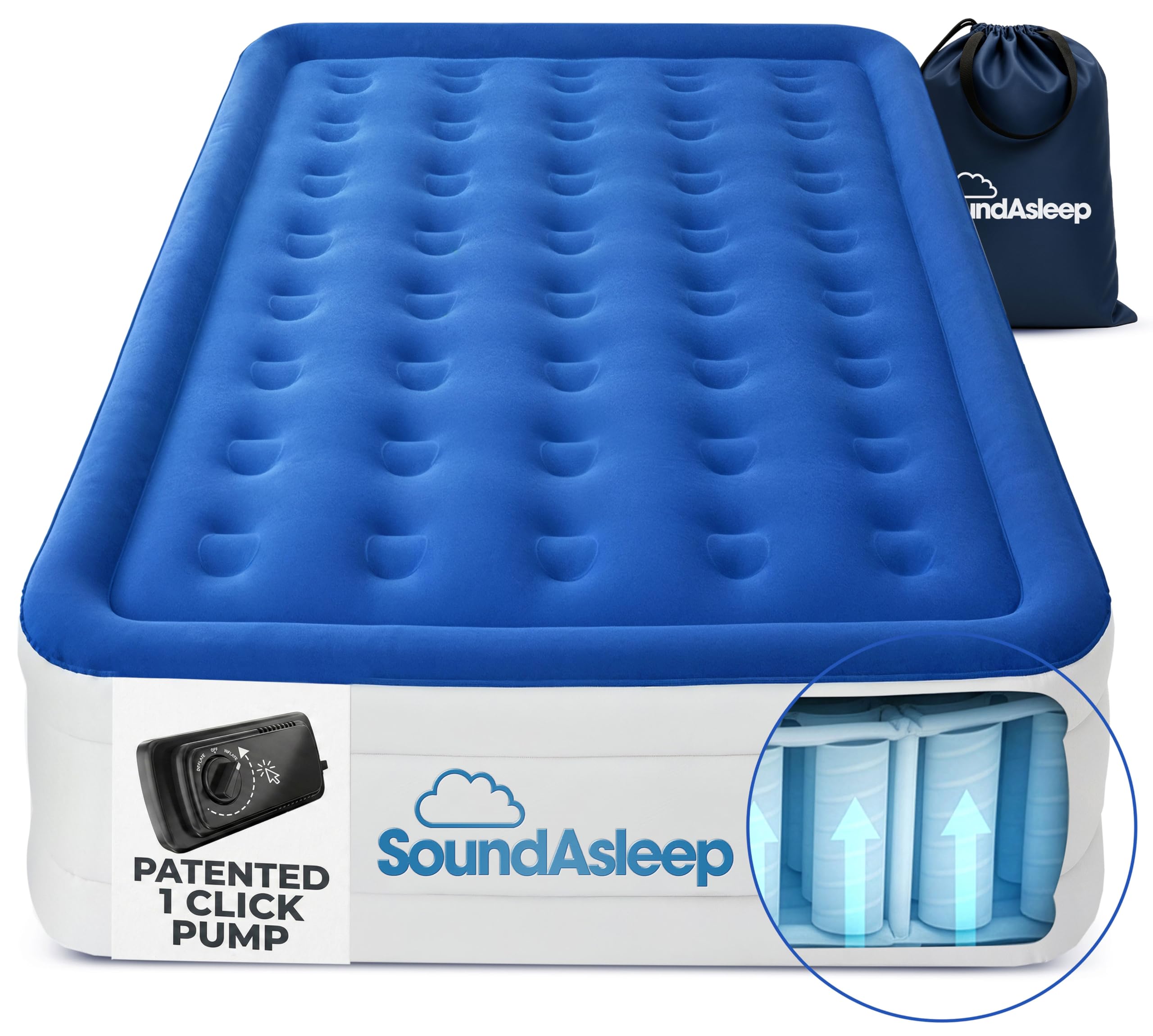
Wirecutter’s #1 rated air mattress for nine consecutive years, the Dream Series uses ComfortCoil Technology — internal air coils that provide uniform support and reduce the sagging that plagues cheaper inflatables. The double-height design reaches 19 inches, matching a standard bed height, making it especially accessible for older guests or those recovering from injury. The SureGrip bottom prevents sliding on smooth tent floors.
The patented one-click internal pump inflates the Full size in under four minutes. The extra-thick, waterproof flocked top resists punctures and stays quiet during movement — no crinkling sounds. Over 50,000 reviews and a one-year US-based warranty back the build quality. While the motor is audible during inflation, the cycle is short enough that it rarely disturbs sleepers in adjacent tents.
Owners report the bed holds air for days after the initial stretch period, and the customer support team is responsive with replacements when defects occur. The included carry bag is functional but requires careful rolling to fit. This is the top choice for campers who want a familiar bed feel without switching to a foam pad.
Why it’s great
- ComfortCoil support structure prevents sagging.
- Quick built-in pump inflates in under 4 minutes.
- Non-slip SureGrip bottom for tent use.
Good to know
- Requires AC power — not for backcountry.
- Motor noise during inflation and deflation.
3. Therm-a-Rest LuxuryMap Self-Inflating Pad

Therm-a-Rest’s pressure mapping technology creates a foam core that is softer in the shoulder and hip zones while maintaining support in the lumbar area — a targeted approach that side sleepers will notice immediately. The Large size offers 25 inches of width and 77 inches of length with an R-value of 6.0, making it a reliable three-season pad that handles temperatures down to about 20°F without noticeable cold transfer.
The TwinLock valve system uses separate ports for inflation and deflation, eliminating the guesswork of single-valve pads. The pad self-inflates in about 30 minutes and requires only a few breaths for final firmness. At 4 pounds 3 ounces, it is lighter than the MondoKing but still too heavy for ultralight backpacking — it excels in car camping, RV use, or on a cot.
Some buyers note that the actual foam sleeping area is slightly narrower than the fabric dimensions suggest, so the XX-Large variant may be a better fit for broad-shouldered sleepers. The PFAS-free DWR stuff sack is a thoughtful environmental touch, and the made-in-USA build quality is evident in the seam integrity.
Why it’s great
- Pressure-mapped foam relieves hip and shoulder pressure.
- Dual-valve system for quick inflation and deflation.
- Solid 3-season R-Value of 6.0.
Good to know
- Foam area slightly narrower than fabric.
- Heavy for backpacking, best for car camping.
4. Acacia 4″ Self-Inflating Sleeping Pad

The Acacia pad stands out with its Y-shaped telescopic foam structure that reduces packed volume by up to 60% compared to traditional foam pads. Despite this compressibility, it delivers 4.3 inches of loft and an R-value of 6.0, matching the ThermalMap for insulation while offering a noticeably softer feel. The 220-pound weight limit is lower than many competitors, but side sleepers under that threshold report excellent pressure relief and no bottoming out.
The two-way valve handles most inflation automatically, and the included pump sack allows fine-tuning of firmness without extra gear. The 30D elastic fabric with TPU coating resists abrasion, and heat-molded seams keep air locked in. Side buckles let you connect two pads together for couples — a rare feature in this price tier.
Some users note a learning curve with the inflation bag, and the pad needs to be stored inflated to maintain foam performance long-term. At 5.3 pounds, it is a middle-ground option between ultralight pads and heavy luxury models. It shines in car camping and glamping scenarios where weight is secondary to comfort.
Why it’s great
- Y-shaped foam core reduces packed volume by 60%.
- 4.3″ thickness with R-Value 6.0.
- Connectable side buckles for couples.
Good to know
- 220 lb weight limit — not for larger sleepers.
- Inflation bag requires practice to use effectively.
5. Hikenture Comfort Plus 4″ Self Inflating Sleeping Pad

With an R-value of 9.5, the Hikenture Comfort Plus is the highest-insulation pad in this roundup, designed specifically for winter camping and sub-freezing temperatures. The memory foam layer sits inside a 4-inch thick profile, combining the conforming comfort of foam with the adjustable firmness of an air chamber. The 80×28-inch dimensions are generous enough to fit taller sleepers without their feet hanging off.
The patented two-way valve makes self-inflation straightforward: open the valve, let the foam expand for a few minutes, then use the pump sack for final firmness. The valve also features a one-way deflation mode that prevents air from re-entering during packing. The polyester surface is quiet and soft, with minimal crinkling even during active sleep.
Weighing 6.5 pounds, this is definitely a car-camping or RV pad — not for backpackers. The included carry bag has a wide opening for easy stuffing, though the rolled size is still substantial. A few initial defect reports were resolved quickly by responsive customer service. If you camp in below-freezing conditions, this pad is your warmest option outside of an expedition-grade insulated mattress.
Why it’s great
- R-Value 9.5 — best cold-weather insulation here.
- Memory foam layer for pressure relief.
- Generous 80×28″ size for tall sleepers.
Good to know
- Too heavy for backpacking.
- Rolled size is large, requires bulky storage.
6. Dr. air Queen Air Mattress
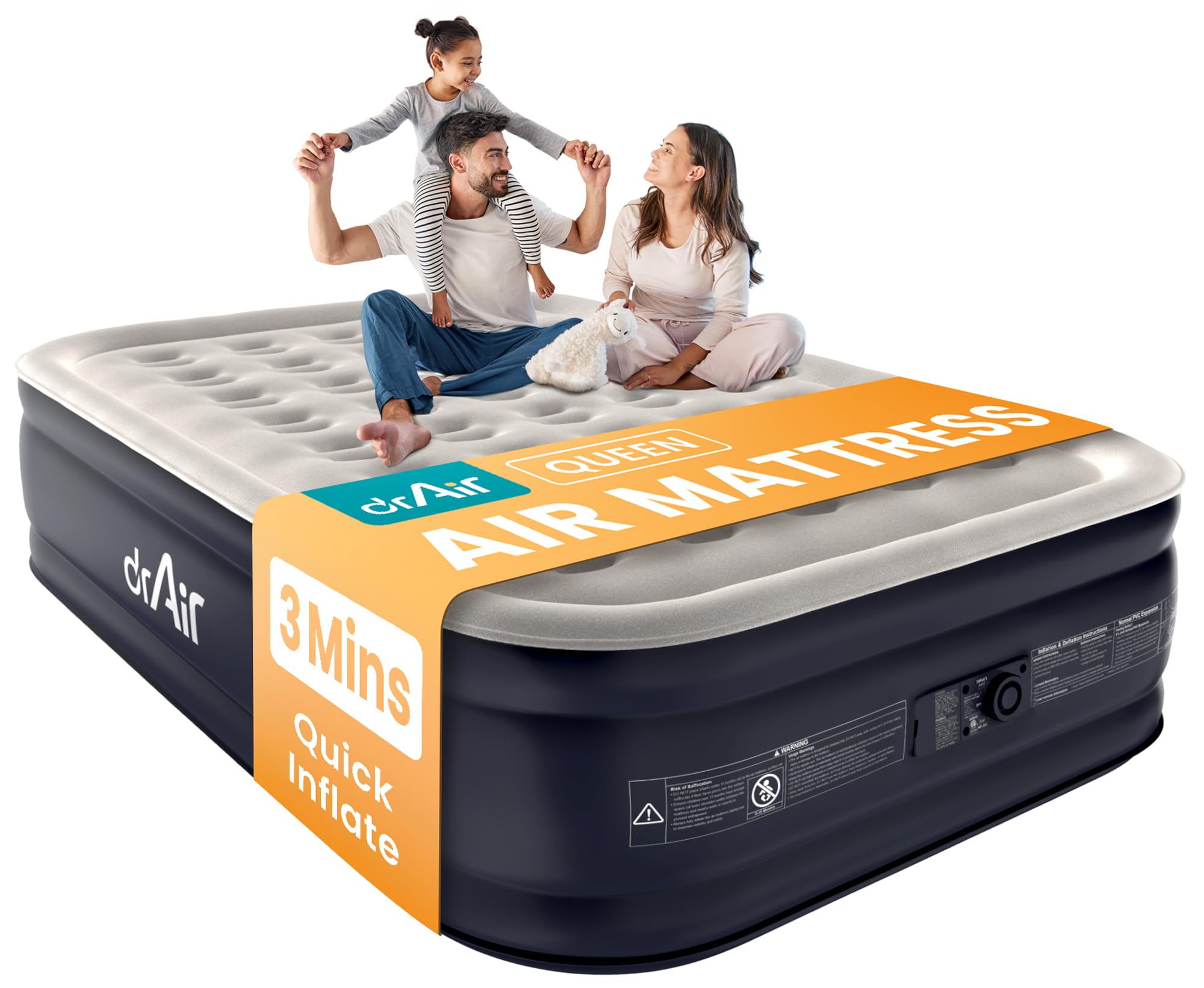
The Dr. air mattress uses a honeycomb pillar internal support system that adapts to body contours while minimizing motion transfer — a feature that couples camping together will appreciate. The 18-inch raised height and 800-pound weight capacity accommodate two average-sized adults without sagging. The built-in pump inflates the queen in roughly three minutes and runs quieter than the Intex unit.
The velvety flocked top grips sheets firmly and feels soft against bare skin. The PVC base is 34% thicker than standard inflatable mattresses, with reinforced seams that resist punctures from tent debris. The 48-hour leak-proof test mentioned in the specs aligns with owner reports that the bed holds air well for multi-night trips without needing top-offs.
Some users find the control interface hard to read in low light, and the deflation process can be tricky until you learn the valve sequence. The storage bag is snug — expect to practice rolling technique. At this price, it competes directly with the Intex Dura-Beam but offers a higher weight capacity and quieter pump.
Why it’s great
- 800 lb weight capacity for two adults.
- Honeycomb pillars reduce motion transfer.
- Thicker, puncture-resistant PVC material.
Good to know
- Valve controls are hard to read in low light.
- Deflation and re-packing require practice.
7. Intex Dura-Beam Comfort Plush High-Rise Air Mattress

The Intex Dura-Beam Comfort Plush is the tallest airbed in this guide at 22 inches, making it feel like a real bed and easy to get in and out of — a real plus for anyone with mobility concerns. The Fiber-Tech construction uses thousands of high-strength polyester fibers instead of traditional coil beams, resulting in a bed that is 100% more durable and 35% more supportive than a standard air mattress, all while being 15% lighter.
The built-in AC electric pump inflates the queen in about 4.75 minutes. The dual-layer air pocket system with horizontally positioned Dura-Beams provides 50% greater individual strand count for lumbar support. The flocked top is velvety and resists punctures, though it is not insulated — expect cold transfer in low temperatures. At 600 pounds capacity, it supports most solo or couple setups without issue.
First-time users should note that the material stretches during the first few nights, causing a sensation of air loss that is just the bed settling. A simple re-inflation after the first night resolves this. The included carry bag is functional but tight. This is the best entry-level choice for casual car campers on a tighter budget who still want a high-rise sleeping surface.
Why it’s great
- 22″ bed height — easiest to get in and out of.
- Fiber-Tech construction is lighter and more durable.
- Velvety flocked top resists punctures.
Good to know
- No insulation — cold ground transfers easily.
- Initial stretch period feels like a leak.
FAQ
What R-value do I need for winter camping on an airbed?
Can I use a regular electric air mattress for camping?
How do I repair a puncture in my camping airbed?
Are self-inflating foam pads worth the extra weight for car camping?
Final Thoughts: The Verdict
For most users, the best airbed for camping winner is the Therm-a-Rest MondoKing 3D because its 4.25-inch foam core, R-Value 7.0 insulation, and TwinLock valve system deliver unmatched comfort in cold weather without sacrificing durability. If you want the convenience of a built-in pump and a traditional bed feel for car camping, grab the SoundAsleep Dream Series. And for budget-conscious campers who still want a high-rise sleeping surface, nothing beats the Intex Dura-Beam Comfort Plush.