
Our readers keep the lights on and the weekend projects moving. As an Amazon Associate, I earn from qualifying purchases.
Walking into a paint aisle and seeing the price tags on an airless sprayer can make you second-guess every DIY plan. The mess from a roller, the hours of brush work, the uneven coats — those pains drive you to research, but the sheer volume of models with conflicting specs makes picking one feel like a gamble. The most reliable airless handheld paint sprayers deliver factory-smooth results without thinning paint or cleaning for an hour.
I’m Rikta — the founder and writer behind FitlyFast. I’ve spent years analyzing power tool specifications, customer failure patterns, and real-world application data to separate marketing claims from genuine performance in the sprayer market.
After comparing motor wattage, maximum PSI, tip technology, and cleanup speed across the top contenders, I built this guide to help you find the absolute best airless handheld paint sprayer for your specific project size and skill level.
How To Choose The Best Airless Handheld Paint Sprayer
Every sprayer in this category claims to save time, but the difference between a smooth weekend project and a drippy disaster comes down to a few measurable specs. Understanding motor power, tip technology, and material handling will save you from buying twice.
Motor Wattage and Maximum PSI
The motor is the heart of any airless sprayer. A unit rated below 700 watts often struggles to push thick latex paint through the nozzle without thinning, leading to clogging and an inconsistent pattern. Models delivering 780 to 800 watts offer enough torque to maintain steady pressure at the tip. Maximum PSI ratings around 3000 indicate the pump can atomize paint into fine droplets, which translates to a smooth finish with minimal orange peel texture. PSI numbers alone do not tell the whole story, but when paired with a reputable pump design, they separate capable tools from toys.
Spray Tip Design and Reversibility
The spray tip is where engineering meets application. A reversible tip allows you to rotate it 180 degrees to clear clogs without disassembling anything, which keeps your workflow moving when a piece of debris hits the nozzle. The orifice size, typically coded with a number like 515 or 517, determines how much paint flows per minute. Smaller orifices (0.015 inches) suit thinners stains and sealers, while larger ones handle heavy latex without spitting. Brass or hardened stainless steel tips last longer than plastic alternatives, especially when spraying abrasive primers.
Cleanup Speed and System Design
Cleaning an airless sprayer can take anywhere from five minutes to an hour depending on the design. Integrated quick-rinse valves let you flush water or solvent through the pump without removing the hose. Detachable pump bodies and pull-out suction tubes simplify access to internal parts. Models with fewer removable pieces tend to be faster to clean, but they also trap paint in hard-to-reach crevices if not flushed immediately. Look for units that include a cleaning brush and a needle for nozzle maintenance, because dried paint in the tip is the most common cause of failure.
Hose Length and Project Reach
A short hose forces you to carry the entire unit up ladders or across scaffolding, which adds fatigue and risk. Premium handheld sprayers often come with 25-foot hoses that let you leave the pump on the ground while you move freely around ceilings, fences, or exterior walls. Stand-mounted units with longer hoses (7.6 meters or more) offer even greater flexibility for large-scale work. A hose that retains coil memory, however, can be frustrating to manage — thicker rubber or braided jackets resist kinking better than budget PVC hoses.
Quick Comparison
On smaller screens, swipe sideways to see the full table.
| Model | Category | Best For | Key Spec | Amazon |
|---|---|---|---|---|
| PHALANX RP8620 | Airless Stand | Whole-house interior painting | 780W motor, 3000 PSI, 25ft hose | Amazon |
| MaXpray M1 | Airless Handheld | DIY projects up to 10 gallons | 3000 PSI, AtoMax 515 tip, 25ft hose | Amazon |
| VEVOR 750W | Stand Airless | Large fencing and deck staining | 3000 PSI, 1.2 LPM flow, metal frame | Amazon |
| Wagner Control Painter 520008 | HVLP Handheld | Furniture and medium-sized projects | 1.5qt hopper, adjustable flow control | Amazon |
| Graco EVO HVLP | HVLP Stain | Fences, sheds, and decks | Brass nozzles, 3 spray patterns, PowerFlush cleanup | Amazon |
| Tilswall Shark 800 | HVLP Handheld | Side-feed convenience for furniture | 800W motor, 4 brass nozzles, 2.5m hose | Amazon |
| BATAVIA BSG0181 | HVLP Split | Entry-level versatile projects | 700W motor, 4 nozzles, anti-backflow | Amazon |
In‑Depth Reviews
1. PHALANX RP8620 Airless Paint Sprayer

The PHALANX RP8620 strikes the hardest balance between motor output and system engineering. Its 780-watt motor pushes unthinned latex and oil-based paints through a reversible spray tip at 3000 PSI, which means you can pull paint straight from a five-gallon bucket and cover walls with a factory-smooth finish. The fully adjustable pressure and flow control knob lets you dial in the fan pattern precisely, eliminating the tailing and wasted paint that frustrates users of less refined airless units.
Cleanup is where this model separates itself from the mid-tier pack. The integrated quick-rinse system flushes remaining paint with water or solvent in under ten minutes, and the reversible tip clears clogs with a 180-degree rotation mid-project. The 25-foot hose provides enough reach to paint ceilings and high walls without moving the pump base constantly. According to the manufacturer, the sprayer achieves a factory-smooth finish up to 12x faster than manual methods, with no brush marks and minimal overspray when the pressure is set correctly.
ETL certification and a one-year warranty back the build, and the metal spray gun with reinforced connections eliminates the leaking issues common in cheaper plastic designs. For anyone painting an entire house interior or tackling large-scale exterior work, this unit delivers professional-grade results without requiring a contractor’s budget.
Why it’s great
- Sprays unthinned latex straight from the can
- Quick-rinse system makes cleanup fast
- Reversible tip clears clogs instantly
Good to know
- Setup and priming take longer than using a roller
- Pressure control knob can dislodge if not fully seated
2. MaXpray M1 Airless Paint Sprayer

The MaXpray M1 targets the serious DIYer who wants near-professional results without the premium price tag of industrial brands. Its high-performance motor delivers 3000 PSI through the proprietary AtoMax spray tip, which produces a fine, even fan pattern with minimal overspray. The system is designed to draw directly from a full five-gallon bucket of unthinned paint, letting you cover house exteriors and interior rooms without stopping to refill a hopper.
What makes this model stand out is the accessory package and ease of use. The 12-inch tip extension reduces back strain when spraying ceilings or high siding, and the Flush-Ease valve allows you to clean the system in roughly ten minutes. The 360-degree swivel joint on the spray gun gives you precise movement without fighting hose torque. The laminated quick-start guide and extensive YouTube tutorial library make this a solid pick for first-time airless users who want to avoid guesswork.
The 25-foot premium hose is built to resist kinking better than budget alternatives, though the hose can retain some coil memory fresh out of the packaging. The reversible tip clears clogs easily, and the overall build quality from InoKraft is backed by a 1-year warranty (extendable to 2 years) plus a support team that aims to respond within 24 working hours. For projects up to ten gallons, this unit delivers impressive value.
Why it’s great
- Sprays unthinned paint with zero issues
- Flush-Ease valve cuts cleanup time dramatically
- Swivel joint provides excellent maneuverability
Good to know
- Hose retains coil memory from packaging
- Spray pattern takes some practice to perfect
3. VEVOR 750W Stand Airless Paint Sprayer

The VEVOR 750W delivers airless power with a stand-mounted design that prioritizes high-volume output for large-scale projects. The 750-watt motor generates 3000 PSI with a flow rate of 1.2 liters per minute, which means it can cover hundreds of feet of fencing or exterior siding in under two hours. The full metal frame adds durability and stability, and the 7.6-meter rubber hose provides generous reach around yards and exterior perimeters.
This unit features fan-shaped atomization technology that produces a fine, even coat with reduced overspray compared to cheaper airless units. The detachable pump body simplifies cleaning, and the included cleaning brush reaches crevices that would otherwise trap dried paint. For large-scale fencing or exterior siding jobs, the combination of a 200-gallon-rated tank capacity and full-metal frame is built to hold up to sustained, high-volume use better than a one-off rental unit.
Infinite speed control lets you reduce paint consumption when working on detailed surfaces, and the extension pole accessory makes ground-level spraying more comfortable. Some users note the spray pattern consistency suffers unless the unit is run at full pressure, so fine adjustment requires careful attention. For the user tackling large decks, fences, or barns, this unit offers a compelling combination of power and affordability.
Why it’s great
- High flow rate covers large areas rapidly
- Metal frame provides long-term durability
- Detachable pump simplifies maintenance
Good to know
- Spray consistency varies at lower pressure settings
- Cleanup can be messy without care
4. Wagner Control Painter 520008 HVLP

Wagner’s Control Painter 520008 sits firmly in the HVLP category, but its performance with thinned paints and stains makes it a favorite for medium-sized residential projects. The handheld unit features a 1.5-quart hopper that provides enough capacity for continuous spraying on basement walls, fences, or furniture without constant refills. Adjustable material flow, spray width, and horizontal or vertical pattern control give you precision that pure airless units often lack at this price point.
Cleanup is straightforward with only four removable parts, all of which rinse clean with soap and water when you use water-based materials. According to Wagner, the sprayer applies coatings 5x faster than a brush, with the ability to cover an 8′ x 10′ area in under two minutes and a smooth finish free of brush marks. The hopper can feel heavy when fully loaded, but the ergonomic grip helps distribute the weight.
The unit handles thinned latex paint, sealers, and semi-transparent stains effectively, but it does require thinning for thicker latex materials. Windy conditions can cause significant overspray, so indoor or sheltered application is recommended. For the user who wants a reliable handheld sprayer for weekend projects without investing in a full airless system, this is a proven workhorse.
Why it’s great
- Quick cleanup with only a few removable parts
- Adjustable spray width and material flow
- Sprays an 8′ x 10′ area in under 2 minutes
Good to know
- Thinning required for thick latex paints
- Overspray significant in outdoor wind
5. Graco EVO HVLP Handheld Paint and Stain Sprayer
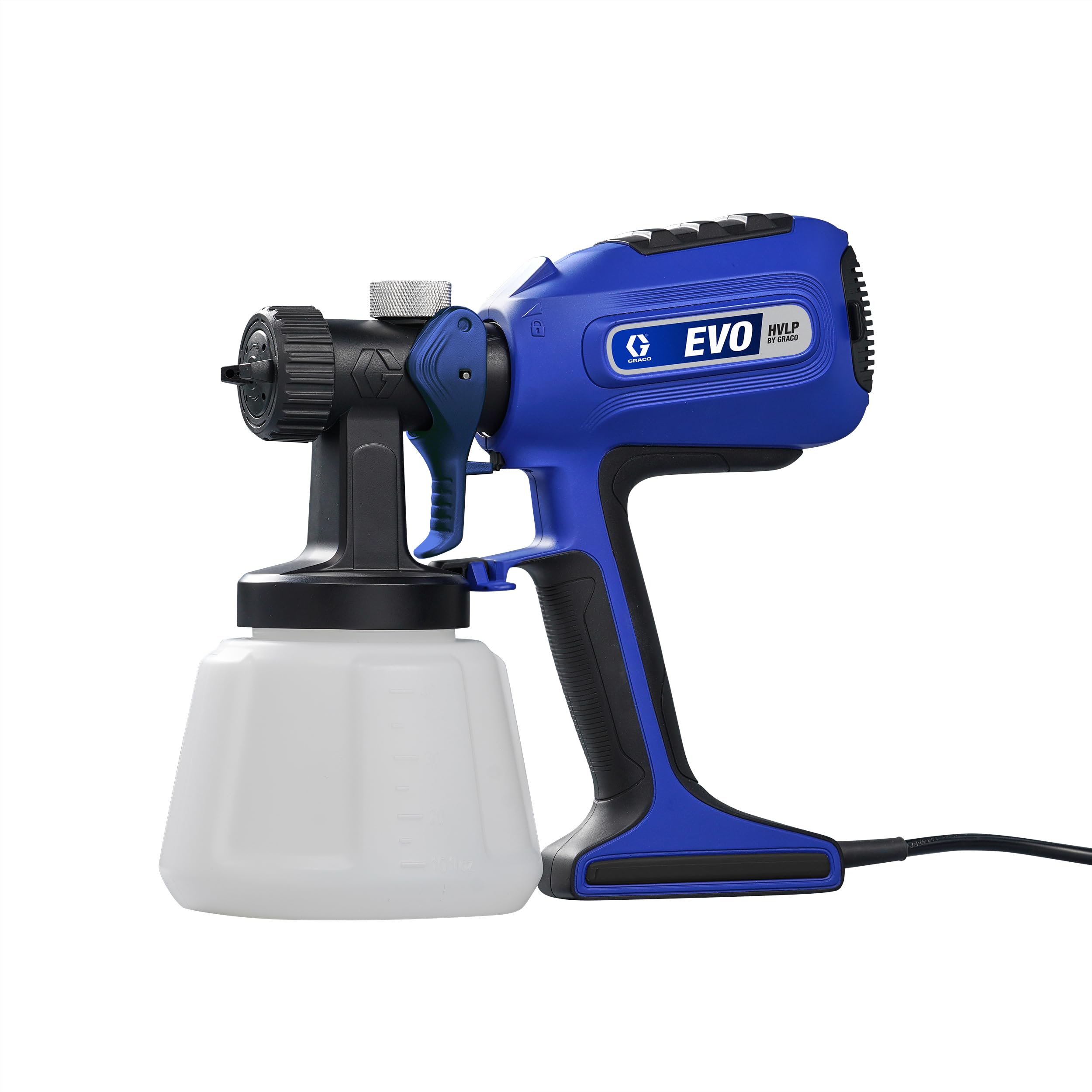
The Graco EVO HVLP is built specifically for staining and painting medium-scale outdoor projects, including fences, decks, sheds, and garages. Graco’s brass nozzles (included in 1mm and 3mm sizes) are designed to provide unmatched finish quality, and the compact 6.1″ x 11″ form factor makes it easy to maneuver around posts and railings. Three adjustable spray patterns give you the ability to dial in the right coverage for transparent, semi-transparent, and solid stains.
According to Graco, the EVO is designed for pour-and-paint use with no need to thin paint, and the included HVLP Powerflush Adaptor and cleaning kit are built for fast, easy clean-up between coats or projects. The simple control layout keeps the learning curve short for first-time sprayer users.
The 40oz cup requires more frequent refills on larger projects, which can slow down momentum. As with most HVLP units, expect some overspray, so covering nearby surfaces is essential. The manufacturer backs the EVO with a 12-month warranty. For staining a new fence or refreshing a garage door quickly, this is a capable and approachable tool from an established spray-equipment brand.
Why it’s great
- Brass nozzles for durable, consistent finish
- Compact and lightweight for maneuverability
- PowerFlush system simplifies cleanup
Good to know
- Small 40oz cup requires frequent refills
- Overspray requires generous masking
6. Tilswall Shark 800 HVLP Paint Sprayer

The Tilswall Shark 800 offers an 800-watt motor and a unique side-feed design that lets you add paint without turning the can over, reducing waste and mess. This HVLP sprayer comes with four brass nozzles ranging from 1mm to 3mm, giving you the flexibility to switch between thin sealers and thicker latex paints. The split head and main body design, paired with an 8.2-foot air hose and a shoulder strap, keeps the handpiece lightweight at roughly one pound for extended use.
The side-feed mechanism is designed for furniture and cabinet projects, where precision and minimal drips matter. The 800-watt motor provides enough pressure to handle high-viscosity materials up to 120 din-s, including oil-based paints and stains. Assembly requires some effort due to the numerous included seals and O-rings, but once assembled, the sprayer delivers even coverage with three adjustable spray patterns.
The cleaning kit includes a viscosity cup, a needle, and a brush, which help maintain the nozzles between uses. The manufacturer recommends cleaning the sprayer within 15 minutes of use to prevent clogging and extend its service life. For the budget-conscious DIYer who wants 800 watts of power along with a versatile nozzle set, this unit delivers strong performance for the investment.
Why it’s great
- Side-feed design reduces paint waste
- 800W motor handles high-viscosity materials
- Includes four brass nozzles for versatility
Good to know
- Assembly requires careful attention to seals
- Body housing is plastic, not metal
7. BATAVIA BSG0181 HVLP Paint Sprayer

The BATAVIA BSG0181 enters the market with a 700-watt motor and a unique split design that separates the motor body from the spray gun. This HVLP system includes four nozzle sizes (1mm, 1.5mm, 2mm, and 3mm) and three spray patterns, making it adaptable for projects ranging from furniture to walls and fences. The detachable handheld gun weighs only one pound, keeping arm fatigue low during extended painting sessions.
The 360-degree anti-backflow design prevents clogs by allowing paint to circulate without settling in the feed line. The manufacturer states it’s compatible with undiluted latex paints along with chalk paint, lacquers, milk paint, enamels, primers, clear sealer, polyurethane, and stain, up to a maximum viscosity of 120 din-s, though the spray mist is not as fine as premium airless units. The ETL certification adds confidence for safety when spraying these materials.
Cleanup requires the included brush and needle, and the plastic nozzles may not withstand years of heavy use. The turbine can heat up during continuous operation, so periodic breaks are advisable. BATAVIA backs the unit with a 24-month warranty and offers customer service support. For a first-time sprayer user on a tight budget, this unit offers a functional introduction to HVLP spraying without a steep financial commitment.
Why it’s great
- Lightweight 1-pound handpiece reduces fatigue
- Anti-backflow design prevents clogs
- Works with undiluted latex paints
Good to know
- Plastic nozzles may wear over time
- Turbine heats up and needs rest periods
FAQ
Can an airless handheld paint sprayer spray unthinned latex paint?
How long does it take to clean an airless handheld sprayer?
What size nozzle should I use for exterior house paint?
Is a stand-mounted airless sprayer better than a handheld model?
Final Thoughts: The Verdict
For most users, the best airless handheld paint sprayer winner is the PHALANX RP8620 because it combines a 780W motor, a reversible tip, and a quick-rinse system into one reliable package that handles unthinned latex without fuss. If you want a dedicated DIY tool with a swivel joint and excellent tutorial support, grab the MaXpray M1. And for large-scale fencing or deck staining where raw flow rate matters most, nothing beats the VEVOR 750W Stand Airless.