
Our readers keep the lights on and the weekend projects moving. As an Amazon Associate, I earn from qualifying purchases.
Throwing away a battery that still has life is a quiet waste, but guessing by dropping it on the counter is worse. An alkaline battery tester removes the guesswork by measuring actual voltage under a specific load, so you know precisely which cells are truly dead and which can power another cycle of TV remotes, toys, or wall clocks. Unlike a simple voltmeter, a proper tester applies a drain that mimics real device use, revealing the hidden power your eyes cannot see.
I’m Rikta — the co-founder and writer behind FitlyFast. I’ve spent years analyzing consumer electronics hardware, comparing circuit-level specs like internal resistance measurement and discharge load resistors to find the devices that deliver repeatable, trustworthy readings.
Whether you manage a household drawer of loose AAs or maintain a stockpile of 9V cells for smoke alarms, finding a reliable device is essential. This guide walks you through the features that matter and reviews the top contenders so you can confidently choose the best alkaline battery tester for your needs.
How To Choose The Best Alkaline Battery Tester
Not all testers are built the same. The difference between a device that tells you voltage and one that tells you usable power comes down to a few core factors. Focus on these specs to avoid buying a tool that only confirms what you already guessed.
Load Testing vs. Open-Circuit Voltage
A battery at rest often shows a voltage near its nominal rating even when it is nearly empty. A load tester applies a resistor that draws current — typically 75 mA for an AA cell — and reads voltage under that strain. This is the only way to simulate real device usage. Avoid testers that only report open-circuit voltage; they will tell you a dying battery looks “good.”
Battery Type and Size Compatibility
Check that the tester covers the chemistries and form factors you actually use. Household alkaline cells (AA, AAA, C, D, 9V) are standard, but if you use rechargeable Ni-MH, coin cells like CR2032, or lithium-ion 18650s, you need a tester with dedicated slots or voltage ranges for each. Some premium models also measure internal resistance, which is critical for spotting failing rechargeables.
Display Clarity and Readability
A backlit LCD screen with a clear status indicator (Good/Weak/Poor) saves time, especially in a dim basement or garage. Some testers have severely angle-dependent displays or tiny selector labels. Check reviews for complaints about screen readability before you buy.
Quick Comparison
On smaller screens, swipe sideways to see the full table.
| Model | Category | Best For | Key Spec | Amazon |
|---|---|---|---|---|
| Dlyfull Universal Battery Tester | Premium | Enthusiasts needing internal resistance data | Internal resistance range: 0-1000 mΩ | Amazon |
| KKEANIC SL-049 | Mid-Range | Accurate load testing for household cells | Load resistors: 20Ω (AA) / 30Ω (rechargeable) | Amazon |
| Dlypow DB1 | Premium | Magnetic hold and USB-C rechargeable convenience | Rechargeable via USB-C, magnetic buckle | Amazon |
| Tenergy T-333 | Mid-Range | Value-driven, long-lasting household tester | Tests button cells plus AA/AAA/C/D/9V | Amazon |
| Gardner Bender GK-5 | Mid-Range | Multi-tool kit for electrical and battery diagnostics | Kit includes GFCI and non-contact voltage testers | Amazon |
| TopDiag BT300 | Budget | Vehicle battery and alternator diagnostics | CCA range: 20-2000 | Amazon |
| OBDResource BR502 | Budget | Quick automotive battery health check | Accuracy claimed >99.6%, 6V/12V/24V | Amazon |
In‑Depth Reviews
1. Dlyfull Universal Battery Tester
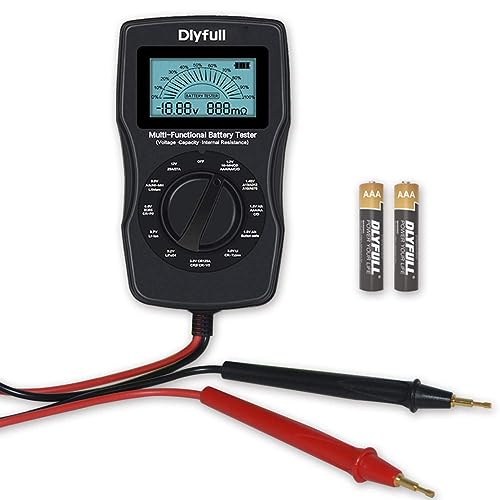
This tester stands apart by reporting internal resistance alongside voltage, a spec that reveals a battery’s internal degradation before voltage alone drops. It covers A, AA, AAA, AAAA, C, SC, D, 9V, and a wide range of lithium-ion and coin cells via test leads rather than fixed slots, making it highly versatile for anyone who handles multiple chemistries.
The large LCD shows battery capacity percentage, voltage, and resistance, but it lacks a backlight and the display is strongly angle-dependent — you must look straight on to read it clearly. The probe wires are stiff PVC, which can cause the lightweight unit to slide around the workbench, a minor annoyance when testing several batteries in sequence.
For users who want to compare rechargeable cells and track their health over time, the internal resistance reading is invaluable. It uses two pre-installed AAA batteries for power and includes an 18-month warranty, reflecting a design aimed at data-driven users rather than quick household checks.
Why it’s great
- Measures internal resistance (0-1000 mΩ) for deep battery health analysis
- Test-lead design fits unusual cell sizes and button batteries
- Lifetime technical support and 18-month warranty
Good to know
- Display has no backlight and is hard to read at an angle
- Stiff probe wires and light body make it slide on smooth surfaces
- Selector dial labels are extremely small
2. KKEANIC SL-049

This model uses real load resistors — 20Ω for AA/AAA cells and 30Ω for rechargeables — so the voltage reading reflects actual device draw, not idle surface charge. Dedicated slots for AA, AAA, AAAA, C, D, N, 9V, CR2, CR123A, and a wide range of coin cells make it a no-fuss tool for sorting mixed battery bins.
The clear LCD reports exact voltage alongside a colored bar that shows Good, Weak, or Poor status. The tester is powered by a single AAA battery (not included) and has no power switch — it auto-powers when a battery above 0.7V is inserted and auto-shuts off after 3 seconds of inactivity, though some users suggest removing the internal battery during storage to prevent parasitic drain.
Reviews consistently highlight its accuracy under load and the convenience of spring-loaded contacts that hold cells firmly. A 1-year warranty and CE, FCC, and RoHS certifications support its build quality. For pure household battery management with proper load testing, this is a top contender.
Why it’s great
- Applies real discharge load for accurate battery status
- Dedicated slots for AA, AAA, C, D, 9V, and many coin cells
- Auto power-on and auto shut-off for convenience
Good to know
- No backlight on the LCD display
- No on/off switch; remove internal battery for long-term storage
- Does not test lithium-ion cylindrical cells like 18650
3. Dlypow DB1
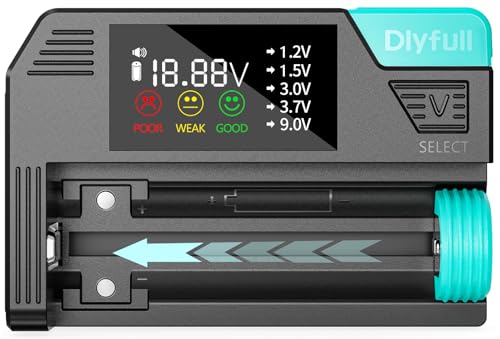
A built-in rechargeable battery with USB-C charging sets this tester apart — no more buying AAA cells to power your checker. The DB1 covers 1.2V Ni-MH, 1.5V alkaline, 3.0V lithium, 3.7V Li-ion, and 9V batteries, with a magnetic buckle that holds the battery securely during testing, a small ergonomic improvement over push-in slots.
Operation is straightforward: press SELECT to choose the voltage range, insert the battery with correct polarity, and the backlit LCD shows both voltage and a status face (green smile for good, yellow flat for weak, red frown for replace). The screen is readable in low light, and the unit is compact enough for a kitchen drawer, though some find it a bit large for pocket travel.
It uses an open-circuit test method, so it draws no power from the battery under test — ideal for frequent checks of your gear batteries without draining them. A 12-month guarantee and a USB-C cable in the box make this a modern, low-maintenance choice for households that value convenience.
Why it’s great
- Rechargeable via USB-C, eliminating disposable battery waste
- Backlit LCD with intuitive status icons
- Magnetic buckle holds battery securely during test
Good to know
- Open-circuit test does not simulate actual device load
- Bulky for EDC or pocket carry
- Limited to button cell, AA, AAA, C, D, 9V, and 18650 sizes
4. Tenergy T-333

The T-333 has proven its longevity over years of use, with many owners reporting it still works flawlessly after half a decade. It tests AA, AAA, C, D, 9V, CR123A, CR2, CRV3, 2CR5, and a wide range of button cells, making it one of the most format-friendly testers at its price tier.
The LCD metering screen shows a simple Poor, Weak, or Good status, though it does not provide a numeric voltage readout — a deliberate simplification that speeds up sorting. It runs on a single AAA battery (included) that powers both the display and the load circuit, ensuring accuracy by using its own power source rather than the test battery’s residual charge.
Build quality is sturdy, the design is lead-free, and the unit has no switches — just insert the battery and the reading appears instantly. For a straightforward, durable tester that covers nearly every household cell, the T-333 remains a reliable benchmark.
Why it’s great
- Proven durability, many units still working after 5+ years
- Covers button cells and uncommon formats like CRV3 and 2CR5
- Self-powered for consistent, accurate readings
Good to know
- No numeric voltage display — only Good/Weak/Poor status
- Does not include 18650 or other lithium-ion cylindrical support
- Requires one AAA battery for its own operation
5. Gardner Bender GK-5

This is not dedicated solely to batteries — the GK-5 bundles a battery tester with a non-contact voltage sensor, a GFCI outlet tester, and a USB port tester. The battery tester itself uses simple audible and visual indicators rather than a scale, making it best for quick pass/fail checks rather than detailed capacity analysis.
The kit’s real value is in home electrical troubleshooting. Users report finding open grounds in circuits that had been miswired for decades, and the USB tester can identify ports that do not deliver full power. The battery tester is the most basic component, but it saves good alkaline cells from the trash by confirming they still have useful voltage.
If you need a single kit for household diagnostics and basic battery sorting, this is a practical choice. But if your primary need is to analyze battery health with precision, a dedicated tester from the options above will serve better.
Why it’s great
- Four testers in one kit for broad home electrical diagnostics
- Battery tester uses audible/visual cues for quick sorting
- GFCI tester found real wiring faults in user homes
Good to know
- Battery tester is basic — no numeric readout or load test
- Does not support coin cell or rechargeable batteries
- Kit does not include the required AAA battery for the tester
6. TopDiag BT300

This automotive-focused load tester is designed for 12V and 24V starter batteries — flooded, AGM, and gel — not household alkaline cells. It measures CCA, SOH, SOC, and impedance, and performs cranking and charging system tests to diagnose alternator issues alongside battery health.
The clear backlit LCD and one-button menu make it accessible for DIYers and professionals alike. It is not rechargeable; it draws power directly from the vehicle’s battery during testing, and the USB port is only for software updates. It supports multiple languages and CCA standards including JIS, DIN, SAE, and EN.
If you need a dedicated automotive battery and charging system analyzer, the BT300 delivers accurate results in about 10 seconds per test. For household battery sorting, however, its lack of support for AA/AAA/9V cells means it fills a different role entirely.
Why it’s great
- Performs cranking and charging system diagnoses
- Covers multiple CCA standards (JIS, DIN, SAE, EN, etc.)
- Easy one-button operation with clear results
Good to know
- Not compatible with 6V or lithium batteries
- Does not test household alkaline cells (AA, AAA, 9V)
- No internal battery — must connect to a vehicle to power on
7. OBDResource BR502

The BR502 is another automotive-grade tester that supports 6V, 12V, and 24V batteries — flooded, AGM, and gel — with a claimed accuracy above 99.6%. It delivers voltage, resistance, CCA, SOC, and SOH readings on a 1.8-inch HD screen in under two seconds.
Operation is plug-and-play: connect the clips to the battery, and the intelligent microprocessor handles the rest. Polarity reverse protection ensures the unit won’t be damaged by incorrect connections. The tester is self-powered from the test battery, and its flexible cables work in cold engine bays without stiffening.
Like the TopDiag, this is not a household alkaline tester. Its 100 CCA minimum threshold is too high for small UPS or gadget batteries, and it lacks slots for AA/AAA cells. For car battery diagnostics on a budget, it is a solid performer; for checking remotes and toys, look elsewhere.
Why it’s great
- Fast results in under 2 seconds with claimed >99.6% accuracy
- Plug-and-play with no menu navigation required
- Polarity reverse protection for safe use
Good to know
- Not suitable for testing household alkaline cells
- Minimum CCA of 100A is too high for small UPS batteries
- Flexible cables but no internal battery for standalone use
FAQ
Can an alkaline battery tester measure rechargeable Ni-MH cells?
What is the difference between open-circuit voltage and load testing?
Why does my battery tester show different results than my multimeter?
Final Thoughts: The Verdict
For most users, the best alkaline battery tester winner is the KKEANIC SL-049 because it combines proper load testing with dedicated slots for the widest range of household cells, all at a practical price. If you want to measure internal resistance for a deeper analysis of rechargeable health, grab the Dlyfull. And for a rechargeable, backlit, and magnetic tester that eliminates battery waste, nothing beats the Dlypow DB1.