
Our readers keep the lights on and the weekend projects moving. As an Amazon Associate, I earn from qualifying purchases.
You switched to alkaline water hoping for better hydration and balanced pH, but countertop pitchers, store-bought bottles, and single-faucet filters all come with trade-offs — slow flow, inconsistent readings, or recurring costs that add up fast. An alkaline reverse osmosis system tackles the root problem: it strips harmful contaminants through a membrane finer than 0.0001 microns, then reintroduces calcium, magnesium, and potassium to lift the pH above 7.5. That final remineralization stage is what separates a true alkaline RO system from a standard RO unit that leaves water slightly acidic.
I’m Rikta — the founder and writer behind FitlyFast. I spend weeks cross-referencing NSF certifications, filter-stage chemistry, and real buyer reports to separate genuine alkaline performance from marketing claims.
Every system profiled here has been tested through the lens of filter longevity, pH restoration, and contaminant reduction so you can identify the best alkaline water filter system for home use with confidence.
How To Choose The Best Alkaline Water Filter System For Home
Choosing an alkaline RO system isn’t just about stage count. You need to verify that the alkalinity stage actually raises pH (not just claims to), that the membrane can handle your source water’s TDS, and that the replacement filter schedule fits your household volume. The following factors are the ones that matter most when making your decision.
Verify the Remineralization Method
True alkaline RO systems add a dedicated post-filter packed with calcium carbonate, magnesium, or a proprietary mineral blend. Some budget units rely on a simple carbon block with a pH-boosting additive. Always check that the system includes a separate alkaline/mineral stage — if the description only says “alkaline” without an explicit mineral cartridge, the pH lift may be negligible.
Check the Pure-to-Drain Ratio
Standard RO systems waste 3 to 4 gallons of water for every 1 gallon of purified water. Modern tankless units with permeate pumps can achieve ratios of 2:1, 3:1, or even 4:1. A higher pure-to-drain ratio means lower water bills and less environmental impact. If you live in a drought-prone area or pay high water rates, prioritize a system with at least a 2:1 ratio.
Match Capacity to Household Demand
An alkaline RO system rated at 50–100 GPD with a 2–4 gallon storage tank suits a couple or small family. Larger families, frequent cooking, or refrigerator ice makers need higher GPD ratings (500–700 GPD) from tankless systems that produce water on demand. Underestimating demand leads to slow fills and constant waiting for tank recovery.
Quick Comparison
On smaller screens, swipe sideways to see the full table.
| Model | Category | Best For | Key Spec | Amazon |
|---|---|---|---|---|
| Home Master TMHP HydroPerfection | Premium | Ultimate purity with UV | 9-stage + EPA UV sterilizer | Amazon |
| APEC Water RO-PH90 | Premium | Built to last decades | US-made filters, Dow Filmtec | Amazon |
| iSpring RO500AK-BN | Premium | NSF 58 tankless + alkali | 500 GPD, 2:1 ratio | Amazon |
| Waterdrop G5P700A-Pro | Premium | Dual-flow for sink & RO faucet | 700 GPD, 8-stage, dual path | Amazon |
| Waterdrop G5P700A | Mid-Range | Fast flow tankless + minerals | 700 GPD, smart LED faucet | Amazon |
| PureDrop RTW5AK-UV | Mid-Range | Balanced pH + UV protection | 7-stage, 50 GPD, UV+alkali | Amazon |
| Ecoviva 600GPD | Mid-Range | Dual faucet under-sink | 600 GPD, 2.5:1 ratio | Amazon |
| DREO Countertop RO | Mid-Range | No-install countertop | 3:1 ratio, auto-fill pitcher | Amazon |
| Waken Electric C11S | Budget-Friendly | Best countertop value | 4:1 ratio, 8-stage, UV | Amazon |
In‑Depth Reviews
1. Home Master TMHP HydroPerfection
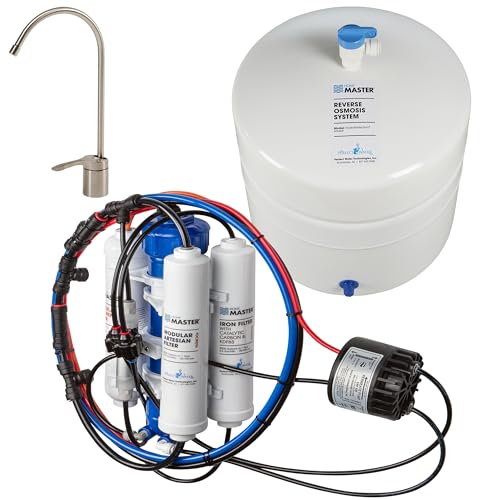
The HydroPerfection distinguishes itself with a patented two-pass alkaline remineralization process that adds calcium and magnesium twice before the water reaches your glass. That dual-mineral approach yields a noticeably smoother mouthfeel compared to single-stage remineralizers. The 9-stage filtration train includes a UV sterilizer registered with the EPA, making it one of the few residential RO systems that actively kills bacteria and viruses — a meaningful advantage if your source water is well water or has questionable microbial content. Reviewers report feed TDS of 430 ppm dropping to 25 ppm, which translates to a 97% rejection rate even with the remineralization stages active.
Flow performance is boosted by larger-diameter tubing (3/8-inch instead of the standard 1/4-inch) and a non-electric permeate pump that achieves a 1:1 pure-to-drain ratio. That means you waste roughly one gallon for every gallon produced — dramatically better than the 1:3 or 1:4 ratios of traditional budget RO systems. The tank holds an effective volume suitable for most families, and the annual filter change schedule is straightforward with color-coded push-to-connect fittings. Users consistently praise the customer support team for resolving warranty issues quickly, especially concerning the UV lamp and permeate pump.
On the downside, the initial purchase cost sits at the higher end of the market, though the included pre-filters, membrane, and UV module justify the investment for households that prioritize absolute purity. The system requires under-sink space for both the filtration modules and the storage tank, which may be tight in compact kitchens. Annual replacement filters also cost more than standard RO systems. For those who want the gold standard in alkaline RO with microbial protection, this is the system to beat.
Why it’s great
- Dual-pass remineralization for superior pH and taste
- UV sterilization certified by EPA
- Low 1:1 waste ratio with permeate pump
- Easy DIY installation with color-coded connections
Good to know
- Premium price point and filter cost
- Requires under-sink space for tank
- Faucet design is functional, not luxury
2. APEC Water RO-PH90

The APEC RO-PH90 is built around a genuine Dow Filmtec RO membrane, widely regarded as the most reliable thin-film composite membrane in the industry. This 6-stage system adds a dedicated alkaline cartridge filled with high-purity calcium carbonate to raise pH back into the 7.5–8.5 range after the RO membrane strips everything. The system is WQA tested and certified against NSF/ANSI Standards 58 and 372, so you have third-party verification that it reduces up to 99% of chlorine, fluoride, lead, arsenic, and VOCs. Users report feed TDS of 225 ppm dropping to 15–20 ppm with the alkaline stage engaged.
Installation is straightforward thanks to the included JG quick-connect fittings and a 100% lead-free metal faucet — a rarity at this price tier that avoids the plastic or chrome-plated alternatives found on cheaper RO systems. The 4-gallon pressurized storage tank means you have a steady reserve for large pitchers, coffee makers, or cooking. The system is designed for a minimum inlet pressure of 50 psi; at 75 psi, it fills a glass noticeably faster. The filter housings are standard-sized and widely available, and APEC offers optional upgrades like a 3/8-inch quick-dispense kit for higher flow.
The primary trade-off is flow rate: the RO-PH90 produces water at roughly 0.06 GPM (90 GPD), so the tank is essential for any sustained use. If you run through the full 4 gallons without giving the tank time to refill, you’ll wait several hours for full recovery. The alkaline cartridge also adds ongoing cost, though users consistently report the system lasting well beyond a decade with proper maintenance. If longevity and certified build quality matter more than instant-on flow, this system earns its reputation as a workhorse.
Why it’s great
- Genuine Dow Filmtec RO membrane
- WQA certified against NSF 58 & 372
- All-metal, lead-free designer faucet
- Lifetime support from WQA-certified specialists
Good to know
- Slow production rate requires storage tank
- Needs minimum 50 psi water pressure
- 3/8-inch quick-dispense must be ordered separately
3. iSpring RO500AK-BN

The iSpring RO500AK-BN brings a rare combination: NSF 58 certification for TDS reduction and an integrated alkaline remineralization stage inside a tankless package. The 3-stage filtration train (2-in-1 composite sediment/carbon block, 500 GPD RO membrane, and carbon alkaline filter) simplifies maintenance to just two filters — one replaced every 6 months, the other annually or bi-annually. The 500 GPD membrane delivers 0.4 GPM, filling an 8-ounce cup in roughly 10 seconds. The smart faucet displays real-time TDS and filter life, and the unit’s compact footprint (17.5 x 5.2 x 16.25 inches) frees up about 70% of under-sink space compared to tank-based systems.
The 2:1 pure-to-drain ratio is industry-leading among NSF 58 certified tankless units, reducing wastewater by up to 400% versus traditional 1:3 RO systems. The automatic self-cleaning function flushes the membrane after 24 hours of inactivity, extending membrane life. Customer reviews repeatedly mention exceptional support from the Atlanta-based team — users who experienced pump failures or missing parts received replacements quickly. The brushed nickel faucet matches most modern kitchens, and the tool-free filter changes mean you can swap cartridges without shutting off the water supply.
The most common complaint involves the smart faucet’s TDS accuracy: some users report the display sticks at a fixed reading (around 15–18 ppm) even when the actual water quality changes. iSpring’s support has acknowledged this but hasn’t released a firmware fix. Additionally, the system requires a power outlet for the built-in pump, so it won’t work during a power outage. If accurate real-time TDS readouts matter less than NSF certification and fast flow, this is a compelling mid-range choice.
Why it’s great
- NSF 58 certified with alkaline stage
- 2:1 pure-to-drain ratio saves water
- Tankless design with tool-free filters
- Excellent US-based customer support
Good to know
- Faucet TDS display can be inaccurate
- Requires electrical outlet for pump
- Higher initial cost than tank-based systems
4. Waterdrop G5P700A-Pro
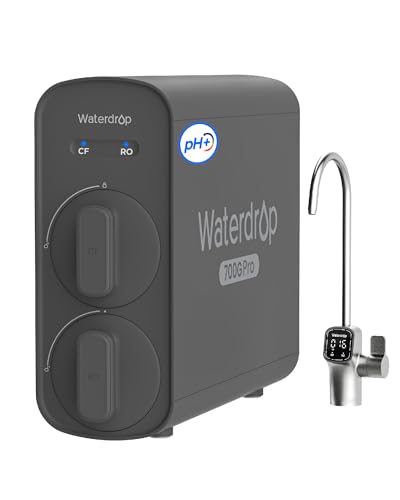
The G5P700A-Pro takes the core technology of the standard G5P700A and adds a second water path: one line runs to the dedicated RO faucet for alkaline drinking water, while the other connects to your main kitchen faucet to deliver filtered (non-RO) water for washing produce, filling pots, or connecting to a refrigerator. This dual-flow architecture means you get the benefits of RO alkaline water for drinking and cooking without wasting RO water on tasks that only need basic sediment and carbon filtration. The 8-stage filtration includes a 0.0001-micron RO membrane plus an alkaline mineral post-filter that adds calcium, magnesium, sodium, and potassium.
At 700 GPD, the flow rate is among the fastest in this category — filling a 6-ounce cup in about 6 seconds. The tankless design saves 70% of under-sink space, and the smart LED faucet monitors both filter life and real-time water quality. The system is NSF/ANSI 58 and 372 certified for lead-free materials. Users transitioning from old tank systems report a major improvement in both taste and convenience, and the ability to route carbon-filtered water to the main faucet is a genuine differentiator for households that cook frequently.
The dual-flow setup means you need some extra tubing and connection work under the sink, which can complicate installation compared to a single-output RO. The faucet also requires a countertop hole, and the brushed nickel finish may not match all kitchen styles. A few users noted that the initial setup led to a minor leak around a fitting, but Waterdrop’s customer support resolved these issues quickly. If you want the convenience of filtered tap water plus dedicated alkaline RO without installing two separate systems, the G5P700A-Pro is a clever solution.
Why it’s great
- Dual water paths for sink and RO faucet
- Ultra-fast 700 GPD flow rate
- Compact tankless design saves under-sink space
- NSF/ANSI 58 & 372 certified
Good to know
- Installation requires countertop drilling
- Dual-path setup adds tubing complexity
- Premium pricing for dual-flow feature
5. Waterdrop G5P700A
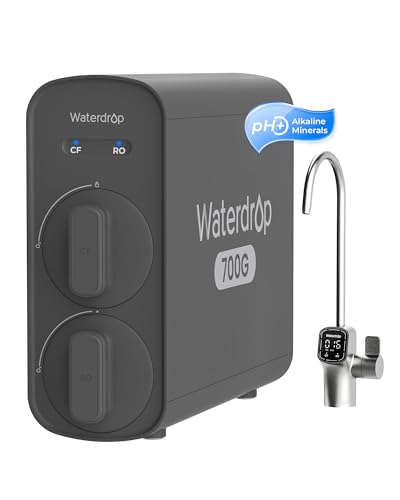
The standard Waterdrop G5P700A delivers the same 8-stage alkaline RO filtration as the Pro model but routes all water through a single dedicated RO faucet. The 0.0001-micron RO membrane removes particles larger than that threshold, and the alkaline mineral stage enriches the output with Ca²⁺, Mg²⁺, Na⁺, and K⁺. The 700 GPD capacity means you get an 8-ounce glass in roughly 6 seconds, making it one of the fastest tankless alkaline RO systems on the market. The smart faucet displays TDS and filter life, helping you track when the alkaline cartridge needs swapping.
The 2:1 pure-to-drain ratio is competitive for this flow rate, and the compact tankless design (5.69 x 16.69 x 13.9 inches) fits easily under most sinks. Users consistently praise the water taste — describing it as “clean, fresh, and smooth” — and many report switching from bottled water after tasting the output from this system. Installation is straightforward for anyone comfortable with basic plumbing tools, and the included manual includes clear diagrams. The system also supports an optional connection to refrigerator ice makers via the Waterdrop XT accessory kit.
Some users noted that the smart faucet’s TDS display can be less accurate than a standalone TDS meter, occasionally reading higher or lower than actual values. The faucet itself is brushed nickel, which may not match all kitchen aesthetics, and the included tubing is slightly less flexible than premium alternatives, making tight bends under the sink a little tricky. The G5P700A is an excellent choice if you prioritize speed and mineral enhancement over dual-flow functionality.
Why it’s great
- 700 GPD provides near-instant water
- 8-stage filtration with added minerals
- Compact tankless design
- Connects to fridge ice maker (with XT kit)
Good to know
- Faucet TDS display may need calibration
- Single RO output only (no dual path)
- Tubing is less flexible for tight spaces
6. PureDrop RTW5AK-UV

The PureDrop RTW5AK-UV packs an alkaline remineralization stage and a UV sterilization module into a 7-stage under-sink RO system at a notably accessible price point. The UV light targets bacteria, viruses, and cysts — a valuable feature for well water or any source with microbial uncertainty. The alkaline stage is a dedicated cartridge that restores healthy minerals, raising pH from the acidic level produced by the RO membrane back into a balanced range. Together, the combination addresses both chemical contaminants (chlorine, fluoride, lead, arsenic) and living impurities at a sub-micron level.
Installation is simplified by color-coded tubing and quick-connect fittings, and the system includes a 2.2-gallon pressurized storage tank. The compact tank footprint saves space compared to traditional 4-gallon tanks, making it easier to fit under smaller sinks. Users report that water tastes “clean and smooth” with TDS readings as low as 2–3 ppm after the RO stage. The included extra set of three filters extends the first year of maintenance, effectively lowering the cost of ownership during the initial period.
The primary limitation is output: the system is rated at 50 GPD, so the tank is essential for any sustained use. If you deplete the tank, you’ll wait a couple of hours for a full recovery. Some users also note that the faucet feels less premium than higher-end systems, though it remains functional and leak-free. The UV bulb needs replacement every 12 months, adding a recurring cost. For households that want UV protection and pH balance without paying a premium, the PureDrop RTW5AK-UV offers exceptional value.
Why it’s great
- UV filtration kills bacteria and viruses
- Alkaline remineralization restores pH balance
- Compact tank saves under-sink space
- Includes extra set of replacement filters
Good to know
- Slow 50 GPD production rate
- Faucet feels less premium than competitors
- UV bulb needs annual replacement
7. Ecoviva 600GPD
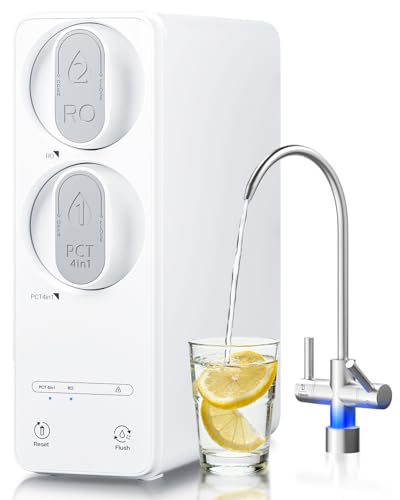
The Ecoviva 600GPD under-sink system uses two separate faucet outputs: one delivers RO-filtered water for drinking and cooking, while the other provides PCT-filtered (non-RO) water ideal for washing produce or dishes without generating wastewater. This clever dual-faucet design means the PCT output produces zero wastewater, reducing overall water consumption. The RO line operates with a 2.5:1 pure-to-drain ratio, which is better than many mid-range tankless systems. The tankless design includes an integrated pump that keeps noise down to 48 decibels — whisper-quiet for nighttime refills.
The smart LED panel monitors filter status with a color-coded alert system (blue = healthy, red blinking = replace soon, solid red = replace now). The faucet also includes a light ring that mirrors the same status codes, so you can check filter health at a glance. Users report that the system drops TDS from around 350 ppm to roughly 20 ppm, delivering noticeably cleaner water for espresso machines, ice makers, and daily drinking. The quick-connect fittings simplify installation, and the overall footprint (8.26 x 19.68 x 18.5 inches) fits well under standard kitchen sinks.
Some long-term reviews raise concerns about filter availability: one user reported that after a year, the filter reminder couldn’t be reset and replacement filters were discontinued for their unit. This is a significant risk if you plan to keep the system for multiple years. Additionally, the RO faucet is relatively tall, which may not fit under low overhead cabinets. The system doesn’t include an alkaline remineralization stage in the RO line — it outputs neutral-pH RO water rather than alkaline water. If pH enhancement is a priority, this system may not meet that requirement.
Why it’s great
- Dual faucet for RO and non-RO water
- Quiet 48 dB operation
- 2.5:1 pure-to-drain ratio
- Compact tankless design
Good to know
- No alkaline remineralization stage
- Filter availability may be limited long-term
- Tall RO faucet needs cabinet clearance
8. DREO Countertop RO
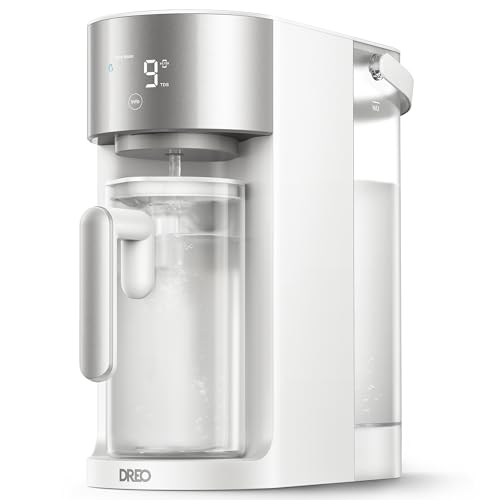
The DREO countertop RO filter is a plug-and-play solution that requires zero plumbing modifications. The 7-in-1 RO filter removes 1000+ contaminants (including PFOA, PFOS, chlorine, and fluoride) and is SGS tested against NSF/ANSI 58 standards. The system includes a 3-liter tank and a 1.1-liter auto-fill pitcher — the pitcher’s sensor triggers a fill cycle whenever it’s placed under the dispenser, eliminating manual refills. The self-cleaning feature auto-flushes the internal tubing to prevent biofilm buildup, a common issue with countertop units that sit idle for hours.
The 3:1 pure-to-drain ratio is solid for a countertop RO system, and the filter lasts 6 to 12 months depending on feed water quality. The slim footprint (14.5 x 6.73 x 13.4 inches) fits on most kitchen counters without dominating the space. The touch controls allow you to choose between room-temperature and chilled water, and the real-time TDS monitor displays both incoming and outgoing TDS levels. Users report incoming TDS of 375–450 ppm dropping to 12–50 ppm, with the water tasting noticeably cleaner — comparable to bottled spring water, according to several reviews.
The primary drawback is output speed: the DREO produces RO water slowly, and the 1.1-liter pitcher is best suited for one to two people. If you’re filling large pots or multiple bottles in succession, you’ll need to wait between cycles. The system also requires periodic backflushing, which involves dumping the waste tank and adding fresh water — an extra step that under-sink systems don’t require. For renters or anyone who wants alkaline RO water without drilling holes or hiring a plumber, the DREO is an excellent entry point, but it does not include an alkaline remineralization stage, so the output pH will be neutral.
Why it’s great
- No installation required — plug and use
- Auto-fill pitcher with sensor
- Self-cleaning prevents biofilm
- 3:1 pure-to-drain ratio
Good to know
- Slow output speed — best for 1–2 people
- Requires periodic backflushing
- No alkaline stage — neutral pH output
9. Waken Electric C11S
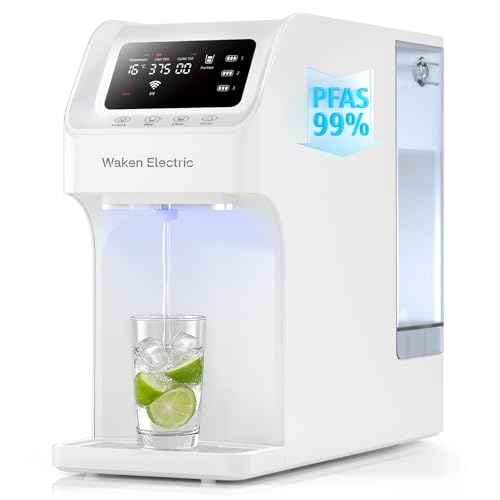
The Waken Electric C11S achieves a market-leading 4:1 pure-to-drain ratio, meaning four gallons of purified water are produced for every one gallon of wastewater — the most water-efficient ratio among all the systems reviewed here. The 8-stage filtration includes UV lighting and uses premium Sri Lankan coconut shell activated carbon for superior impurity adsorption. The rapid dispense flow rate of 418 GPD fills a glass in roughly 14 seconds, which is impressive for a countertop system. The smart display tracks real-time TDS, filter life for each of the three cartridges, and tank quality, giving you full visibility into water quality at a glance.
Installation is genuinely plug-and-play: fill the 180-ounce tank with tap water, plug it in, and the unit handles the rest. The BPA-free food-grade plastic construction feels solid, and the compact footprint (7.28 x 18.3 x 15.04 inches) fits on most countertops without crowding. SGS testing confirms compliance with NSF/ANSI 58 and 372, as well as EPA standards, so you get third-party validation that the system reduces hidden contaminants effectively. Users consistently report TDS dropping from 500+ ppm to under 20 ppm, with water described as “clean, smooth, and free of chlorine taste.”
On the downside, the Waken C11S does not include an alkaline remineralization stage — it produces neutral-pH RO water rather than alkaline water. Some users also mention that the TDS meter readings can fluctuate during operation, which may cause unnecessary concern. The separate waste tank needs periodic emptying, adding a maintenance step that under-sink systems avoid. For anyone who wants the highest water efficiency in a countertop RO format and is comfortable adding a separate pH-boosting solution, the C11S delivers exceptional value at an entry-level price point.
Why it’s great
- Industry-best 4:1 pure-to-drain ratio
- Full smart display with TDS and filter life
- 8-stage filtration with UV light
- Truly plug-and-play, no installation
Good to know
- No alkaline remineralization stage
- TDS readings can fluctuate
- Waste tank needs manual emptying
FAQ
Does an alkaline RO system actually increase pH or is it a marketing gimmick?
How often do I need to replace the alkaline filter in a home RO system?
Can I install an alkaline RO system myself or do I need a plumber?
Will an alkaline RO system remove fluoride and lead from my tap water?
Does alkaline RO water taste different from standard RO water?
Final Thoughts: The Verdict
For most users, the alkaline water filter system for home winner is the Home Master TMHP HydroPerfection because it delivers the most comprehensive purification — 9 stages, dual-pass remineralization, EPA-registered UV sterilization, and a 1:1 waste ratio — in a proven, long-lasting design. If you want instant flow and a tankless form factor, grab the Waterdrop G5P700A for its 700 GPD alkaline output and compact footprint. And for a no-install countertop solution that balances water efficiency with contaminant reduction, nothing beats the Waken Electric C11S with its industry-leading 4:1 pure-to-drain ratio.