
Our readers keep the lights on and the weekend projects moving. As an Amazon Associate, I earn from qualifying purchases.
Separating a solid HiFi system from a mediocre one comes down to the primary source you value most—vinyl purity, CD clarity, or streaming convenience—and whether one box can deliver all three without audible compromise. A truly capable all-in-one system must balance amplifier headroom, speaker sensitivity, and source handling to create a listening experience that feels intentional, not like a compromise.
I’m Rikta — the co-founder and writer behind FitlyFast. I’ve spent years analyzing audio hardware specifications, decoding amplifier topologies, and mapping the real-world performance of integrated systems across every price tier to help buyers cut through the marketing noise.
Whether you are resurrecting a CD collection, diving into vinyl, or building a wireless streaming hub, choosing the right best all in one hifi system means prioritizing the single source you use most without sacrificing the others.
How To Choose The Best All In One HiFi System
An integrated HiFi system must bridge multiple source types—vinyl, CD, radio, streaming—without introducing noise, distortion, or operational friction. The best units do this by pairing a quality amplifier stage with speakers that match the room size and by keeping the signal path clean regardless of which input you select. Understanding these foundational elements will prevent you from overpaying for features you do not need or undershooting on the performance that actually matters.
Amplifier power and speaker sensitivity
Rated wattage tells an incomplete story. A system quoted at 15 watts RMS per channel paired with high-sensitivity speakers (above 88 dB) can fill a medium room louder and cleaner than a 50-watt system driving inefficient bookshelf speakers. Look for RMS (continuous) power figures rather than peak numbers, and match the system’s output to your room size—larger open-plan spaces benefit from at least 30 watts RMS per channel with decent speaker sensitivity.
Source priority and signal routing
Your primary source dictates the system’s required feature set. Vinyl enthusiasts should prioritize models with an adjustable counterweight tonearm and a switchable phono preamp, as these allow future cartridge upgrades and external speaker connections. CD and radio listeners should focus on loading speed, FM antenna quality, and digital display readability. Streaming-first users must confirm the system supports their preferred protocol—Wi-Fi with Spotify Connect or TIDAL offers higher bitrate stability than Bluetooth alone, with less compression.
Build quality, isolation, and thermal management
Mechanical resonance is the enemy of HiFi clarity. Turntable units benefit from a heavy platter and a chassis isolated from the speaker cavities. For amplifier-based systems, a metal or thick wood enclosure dissipates heat better than thin plastic, prolonging component life. Pay attention to the presence of bass-reflex ports on the speakers—these extend low-frequency response but require careful placement away from walls to avoid boomy or muddy bass.
Quick Comparison
On smaller screens, swipe sideways to see the full table.
| Model | Category | Best For | Key Spec | Amazon |
|---|---|---|---|---|
| Philips TAM8905/37 | Wi-Fi & CD | Streaming & CD hybrid | 100W, 5.25” woofers, bass-reflex | Amazon |
| WiiM Amp Ultra | Streaming Amp | Audiophile streaming hub | 100W, ESS DAC, RoomFit EQ | Amazon |
| ONE-Q All-in-One | Vinyl & Streaming | Versatile vinyl playback | AT-3600L, 4 speakers, anti-resonance | Amazon |
| DIGITNOW HiFi Turntable | Vinyl + Bookshelf | Vinyl with external speaker option | 36W speakers, adjustable counterweight | Amazon |
| JBL Bar 2.0 | Soundbar | TV audio upgrade | Dolby Digital, 2.0 channel, slim | Amazon |
| FEKTIK M508 | 10-in-1 Turntable | Multi-format retro setup | Cassette, CD, 3-speed turntable | Amazon |
| WISCENT Bluetooth Stereo | Micro CD System | Compact CD & radio | 15W RMS, top-load CD, 5 EQ | Amazon |
| Sonos Sub 4 | Wireless Subwoofer | Sonos deep bass extension | Force-canceling, ported enclosure | Amazon |
| Sony BRAVIA Theater Quad | Wireless Surround | High-end home theater | 16 speakers, 360 Spatial Sound | Amazon |
In‑Depth Reviews
1. Philips TAM8905/37

The Philips TAM8905/37 is the rare all-in-one that genuinely serves both streaming and physical media with equal seriousness. Its 100 watts of total power drive dedicated 5.25-inch woofers and dome tweeters inside wooden speaker cabinets, producing bass extension down to 50 Hz that fills a lounge or open-plan living area without strain. The matte aluminum central unit houses a CD player, FM/internet radio, and Wi-Fi with Spotify Connect, giving you lossless streaming stability far beyond Bluetooth.
Setup is genuinely straightforward—speakers connect to the receiver via supplied cables, the remote and FM antenna are included, and the color display shows album art along with artist and track info. The system supports USB playback, aux-in, and a headphone jack, covering every scenario from a quiet late-night session to a party playlist. Multiple EQ presets let you tailor the sound signature to hip-hop, classical, or rock without requiring a separate equalizer.
Where this unit truly shines is in its refusal to compromise on the core audio path: the wooden cabinets reduce coloration, the bass-reflex ports extend low-end response cleanly, and the digital tuner delivers clear FM reception. Some users note that Bluetooth streaming can sound slightly less refined than Wi-Fi or aux-in, but that is a trade-off inherent to the codec, not the hardware. For a clean, capable hub that handles CDs, radio, and streaming with authority, this is the most balanced option in the mid-range tier.
Why it’s great
- 100W total power with wooden speaker cabinets for warm, accurate sound.
- Wi-Fi with Spotify Connect for high-bitrate streaming beyond Bluetooth.
- Color display shows album art and track info for easy navigation.
Good to know
- Bluetooth audio quality trails Wi-Fi and aux-in by a noticeable margin.
- Speaker-to-receiver connection requires spring-clip terminals, not 5-way binding posts.
2. WiiM Amp Ultra

The WiiM Amp Ultra is a streaming amplifier that redefines what an all-in-one can be for the discerning listener. Inside its unibody aluminum chassis lies an ESS SABRE ES9039Q2M DAC paired with dual TI TPA3255 amplifiers, delivering 100 watts per channel with total harmonic distortion plus noise measured at -106 dB. This is reference-grade transparency that rivals separates costing twice as much. The built-in RoomFit room correction auto-calibrates the sound to your specific space and speakers, eliminating guesswork from placement and EQ.
Connectivity is comprehensive: HDMI ARC for TV integration, optical and RCA inputs, Wi-Fi 6, Bluetooth 5.3 with LE Audio, and a 3.5-inch glass-covered touchscreen that shows album art and system settings. Streaming support spans Spotify, TIDAL, Qobuz, Amazon Music, Chromecast, and Roon Ready at up to 24-bit/192 kHz. The included voice remote and multi-room sync with other WiiM, Alexa, and Google devices make this a true control hub for a whole-home audio setup.
The main caveat is that this is an amplifier, not a full system with speakers—you supply your own passive speakers (and optionally a subwoofer via the dedicated output). Some users report a brief delay when switching to Bluetooth source, and AirPlay is not supported. For anyone who already owns quality speakers or wants to build a system incrementally, the WiiM Amp Ultra offers sonic purity and software polish that few all-in-ones can match.
Why it’s great
- ESS SABRE DAC and dual TPA3255 amps for ultra-low distortion sound.
- RoomFit calibration auto-tunes frequency response to your room.
- Wi-Fi 6, HDMI ARC, and Roon Ready for future-proof connectivity.
Good to know
- Requires separate passive speakers—no built-in drivers.
- No AirPlay support; Bluetooth switching can cause a brief audio gap.
3. ONE-Q All-in-One Turntable
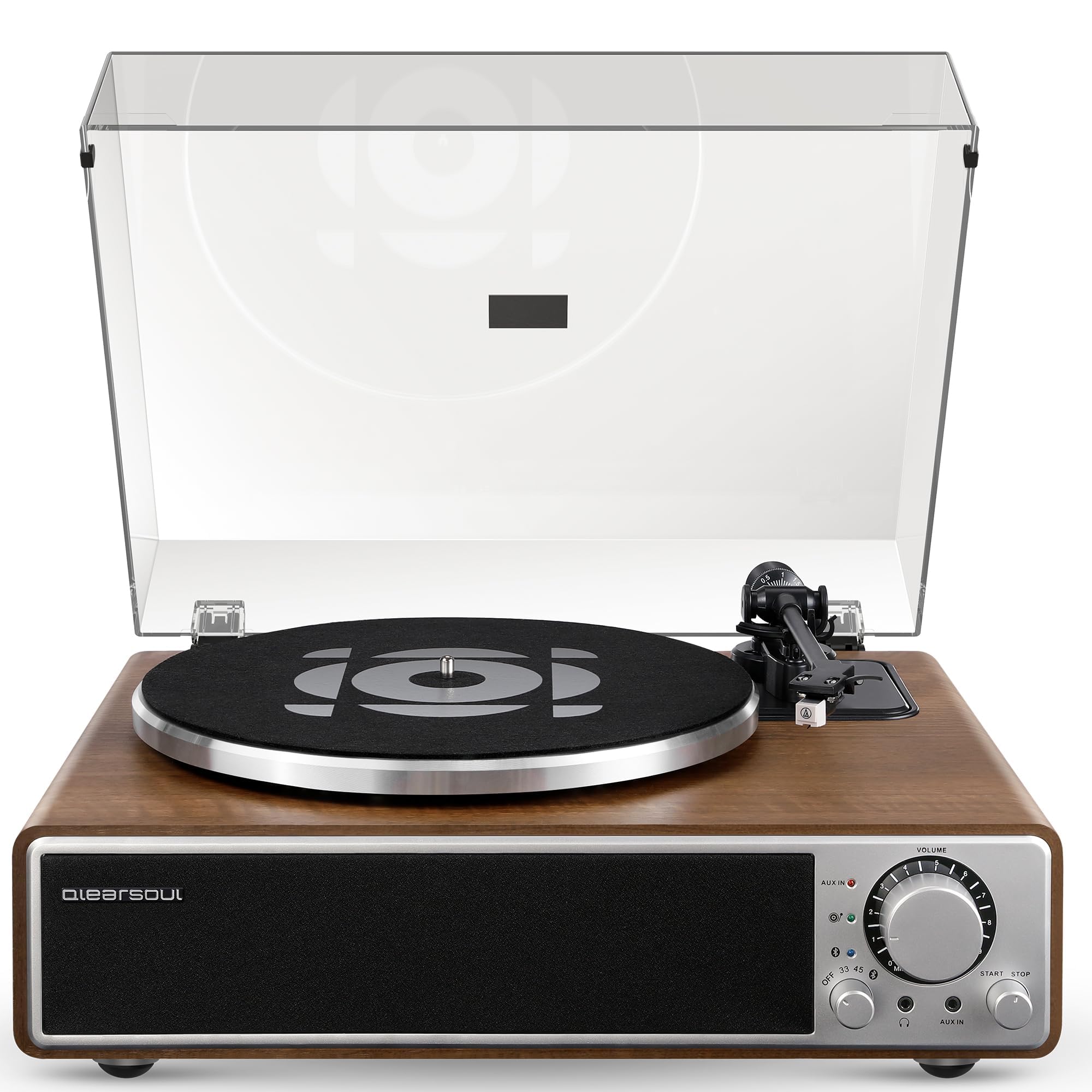
The ONE-Q distinguishes itself in the crowded entry-to-mid vinyl market by pairing a legitimate Audio-Technica AT-3600L cartridge with an adjustable counterweight tonearm—components that allow precise tracking force adjustment for reduced record wear and cleaner playback. Four full-frequency speakers with crossover technology and a 3-point anti-resonance platform isolate the turntable from the speaker cavity, minimizing feedback and preserving the analog signal’s integrity. The result is sound that rivals far pricier separate-component setups when played through the built-in drivers.
Bluetooth 5.4 input lets you stream from any smart device directly through the system’s speakers, and a switchable phono preamp gives the flexibility to connect external powered speakers or a receiver later. The aluminum front panel houses all controls—mode, volume, start—alongside aux-in and headphone jacks for private listening. Users consistently report that the break-in period of a few hours at mid-volume reveals richer bass and clearer highs as the drivers loosen up.
Where the ONE-Q falls short is the lack of an auto-stop feature—the record will spin indefinitely once the side ends unless you lift the tonearm manually. The Bluetooth implementation is input-only, so you cannot wirelessly stream vinyl to external Bluetooth speakers. For a beginner or returning enthusiast who wants genuine HiFi potential in a single box, this is the most musically capable all-in-one turntable available.
Why it’s great
- Adjustable counterweight with genuine AT-3600L cartridge for accurate tracking.
- Anti-resonance platform isolates turntable from speakers for cleaner analog sound.
- Bluetooth 5.4 input and phono preamp allow external speaker upgrades.
Good to know
- No auto-stop; record continues spinning after the side ends.
- Bluetooth is input-only—cannot stream vinyl wirelessly to external speakers.
4. DIGITNOW HiFi Turntable
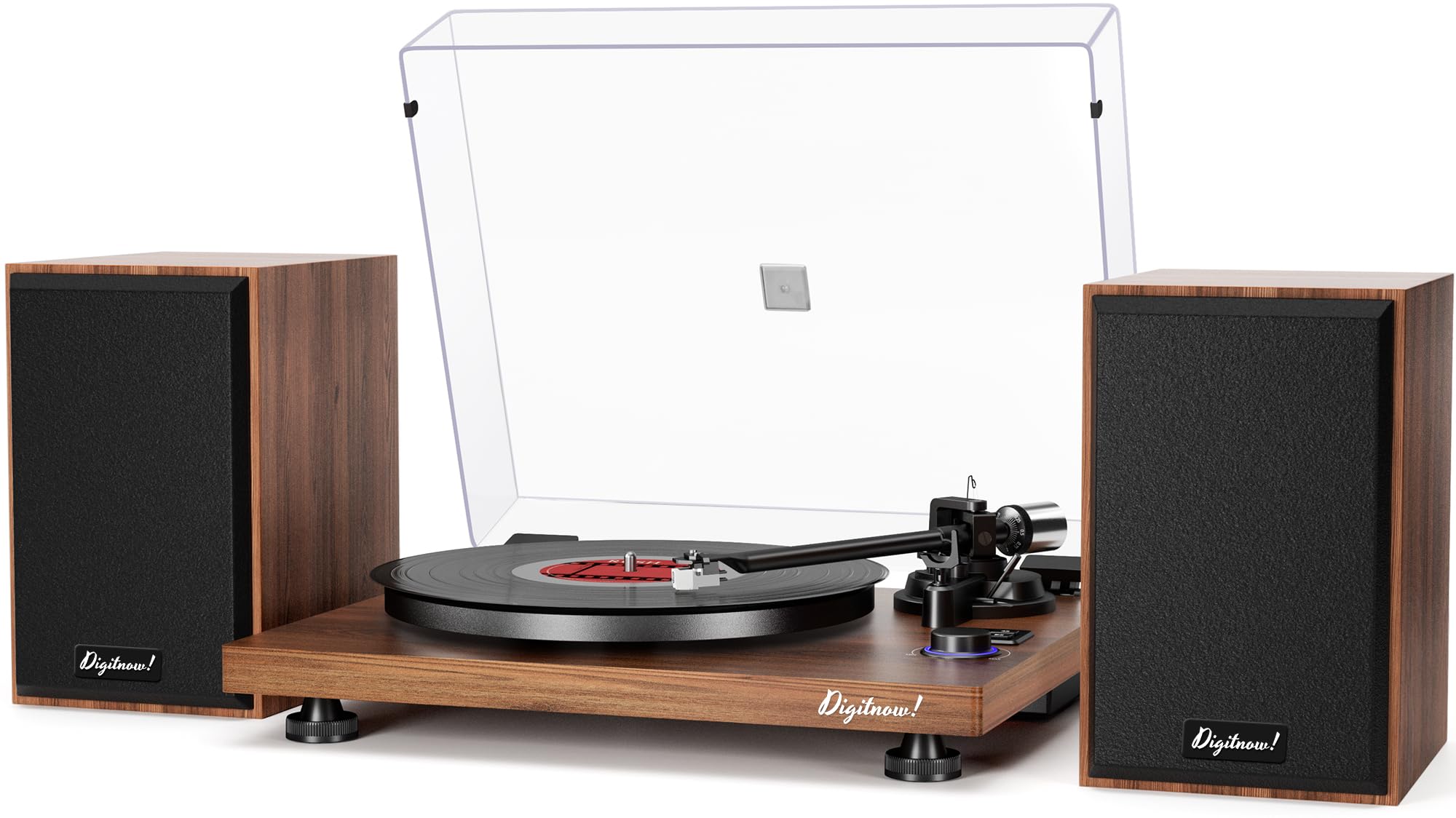
The DIGITNOW HiFi Turntable takes a different approach from the ONE-Q by including a pair of dedicated bookshelf speakers rather than embedding drivers into the turntable chassis. This separation reduces mechanical feedback and allows the 1.5 kg solid iron platter to spin with stable inertia for consistent pitch. The adjustable counterweight and anti-skating weight work with the AT-3600L cartridge to keep the stylus in the groove during dynamic musical peaks, reducing distortion and skipping.
Each bookshelf speaker is rated at 36 watts total, enough to fill a medium room with clear, balanced sound. The system includes a switchable phono line and dual RCA outputs, so you can bypass the included speakers entirely and connect to a separate amplifier or powered monitors. A USB port enables direct vinyl-to-MP3 recording on a Mac or PC, making this a practical choice for digitizing a collection. Bluetooth input allows streaming from your phone, though the turntable cannot output wirelessly.
The biggest trade-off is the build quality of the turntable mechanism itself: some users report occasional Bluetooth pairing hiccups and a chassis that feels less substantial than premium options. The included speakers deliver solid performance for the price but lack the low-end extension of larger cabinets. For someone who wants a complete, upgradeable vinyl setup without buying components individually, this package offers genuine performance and flexibility.
Why it’s great
- Dedicated bookshelf speakers reduce resonance compared to all-in-one chassis designs.
- 1.5 kg iron platter provides stable rotational inertia for consistent playback speed.
- USB output for direct vinyl-to-MP3 recording on a computer.
Good to know
- Occasional Bluetooth pairing instability reported by several users.
- Chassis and tonearm materials feel less refined than higher-priced turntables.
5. JBL Bar 2.0 All-in-One (MK2)

The JBL Bar 2.0 is a streamlined soundbar that prioritizes simplicity and vocal clarity for TV and movie use. Its low-profile design fits beneath most televisions without blocking the screen’s bottom edge, and the single HDMI ARC connection carries both audio and control signals so the soundbar powers on and off with the TV. Dolby Digital decoding provides a noticeable step up from built-in TV speakers in dynamic range and dialogue intelligibility, especially for action scenes and sports broadcasts.
Bluetooth streaming from a phone or tablet is straightforward, and the 2.0-channel configuration delivers solid stereo separation for music playback. The JBL brand carries a reputation for longevity—users report units lasting a decade or more without component failure. Setup is genuinely plug-and-play: connect the HDMI cable, power on, and the soundbar handles the rest. The included remote adds volume and input control without needing the TV’s own interface.
The critical limitation is the absence of a separate subwoofer output and any adjustable EQ—bass and treble are fixed, which may frustrate listeners who want to tailor the sound signature. In larger rooms, the single 2.0 channel cannot produce the immersive surround effect of multi-speaker systems. For upgrading a secondary TV or a bedroom setup where space is at a premium, the JBL Bar 2.0 delivers reliable performance without complexity.
Why it’s great
- Dolby Digital decoding dramatically improves dialogue clarity over TV speakers.
- Ultra-compact profile fits under nearly any TV without obstruction.
- JBL build reliability with many units reported lasting over a decade.
Good to know
- No subwoofer output or EQ adjustment for sound customization.
- Limited to 2.0 stereo—no virtual or physical surround channels.
6. FEKTIK M508 10-in-1
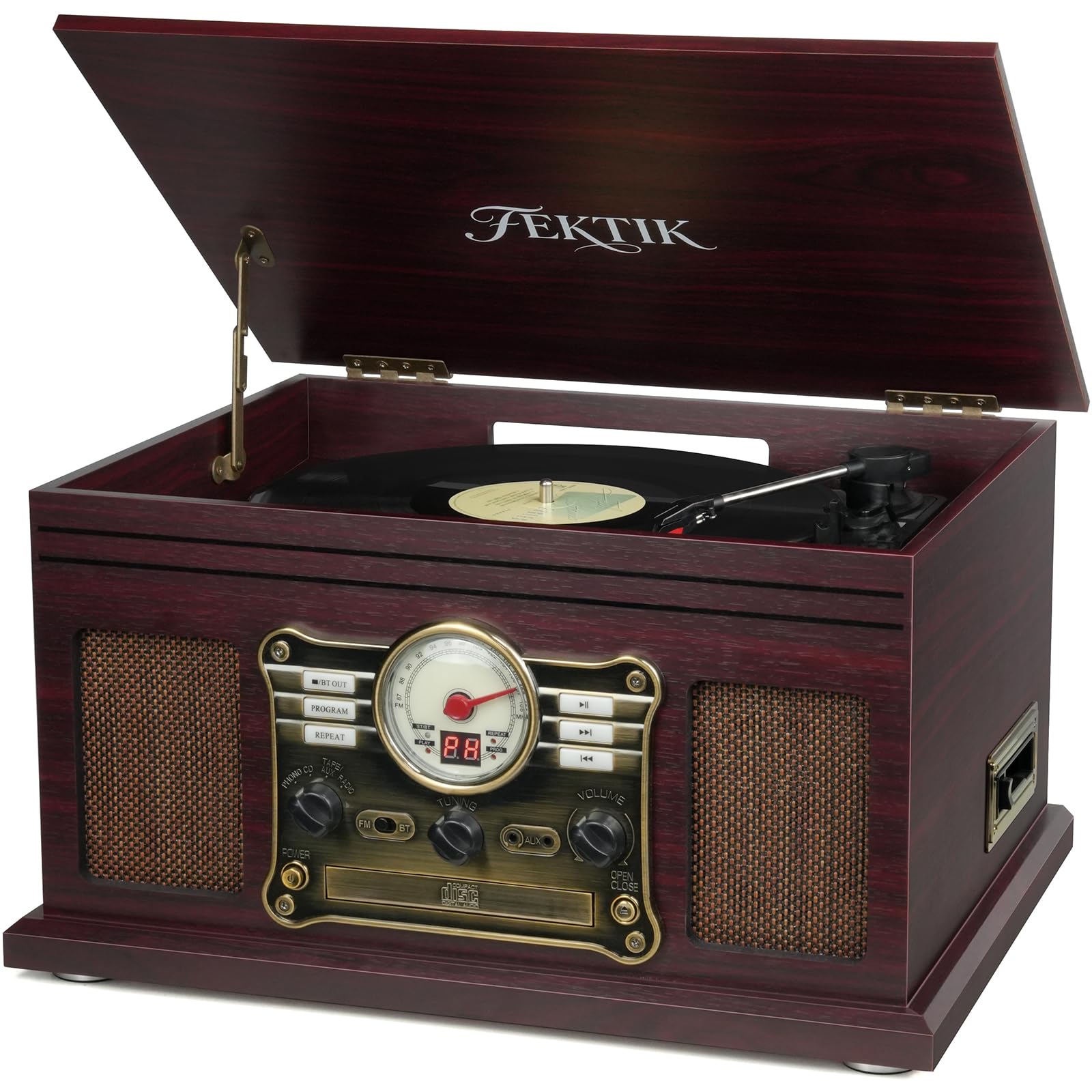
The FEKTIK M508 is the ultimate multi-format machine for anyone with a mixed media collection spanning vinyl, cassettes, CDs, and FM radio. The 3-speed belt-drive turntable handles 33⅓, 45, and 78 RPM records at sizes from 7 to 12 inches, and a Bluetooth output function lets you wirelessly stream vinyl audio to separate speakers or headphones—a rare feature at this level. The integrated cassette deck adds playback capability for tapes, making this a true archival hub for physical media.
The built-in speakers produce acceptable sound for casual listening in a small room, though they lack the bass extension and clarity of dedicated HiFi speakers. The mahogany wood finish gives the unit a retro aesthetic that fits living rooms, dens, or bedrooms. Remote control and intuitive front-panel buttons (record, delete, mode switch, FM presets) keep operation straightforward even for less tech-savvy users.
Build quality is the primary concern: the mechanism feels fragile, and a few users have reported alignment issues causing the rubber belt to spin incorrectly. The sound quality, while adequate, does not approach HiFi standards—midrange can feel muddy at higher volumes, and the included speakers are the system’s weakest link. For nostalgic collectors who want a single device to play everything, the FEKTIK offers unmatched format support, but serious listening demands external speakers.
Why it’s great
- Plays vinyl, cassettes, CDs, and FM radio from one unit for total format coverage.
- Bluetooth output streams vinyl wirelessly to external speakers or headphones.
- 3-speed turntable supports 78 RPM records, including vintage shellac.
Good to know
- Built-in speakers lack HiFi clarity and bass extension at higher volumes.
- Turntable mechanism can suffer from belt misalignment over time.
7. WISCENT Bluetooth Stereo
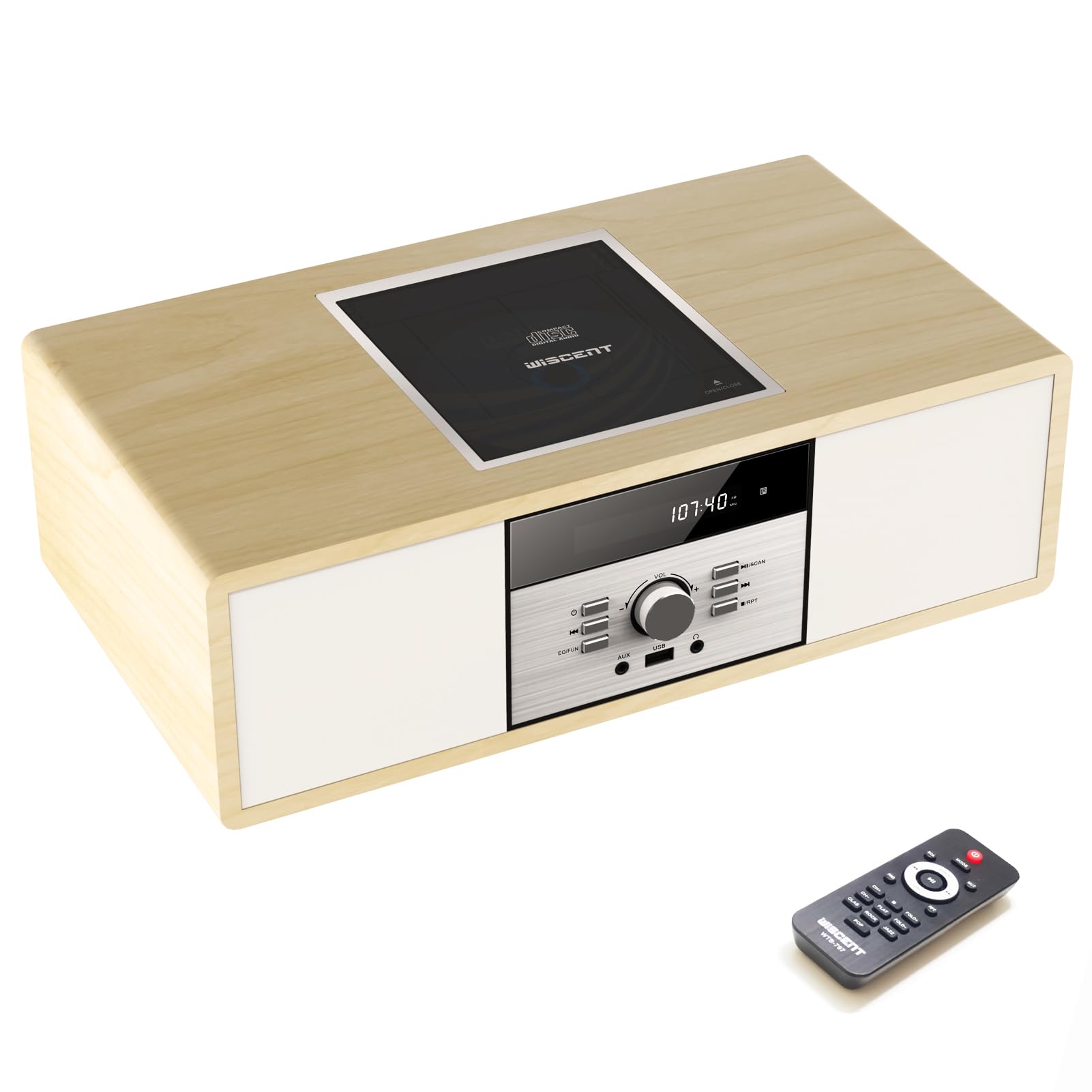
The WISCENT Bluetooth Stereo System is a compact, wood-finished micro shelf system built around a top-loading CD mechanism that supports CD, CD-R/RW, and MP3 discs with three repeat modes and five EQ presets (flat, classic, rock, pop, jazz). The two 3-inch full-range drivers deliver 15 watts RMS per channel, which translates to clear, articulate midrange and reasonable upper bass for a bedroom, office, or small living room. The FM radio includes auto-scan and 30-station presets, though reception depends heavily on the included soft antenna placement.
Bluetooth streaming works cleanly, and USB and aux-in ports expand playback options. The included remote control (batteries not included) simplifies daily use, and the wood-look finish gives the unit a warm aesthetic that complements bookshelf or credenza placement. Users consistently praise the sound quality relative to the unit’s size—mid-volume levels sound crisp and well-defined without distortion.
The primary downside is the remote control quality: multiple users report it failing within weeks due to a burnt terminal or button malfunction. Replacement universal remotes are inexpensive, but it is an inconvenience at this price point. The CD mechanism requires gentle handling—jamming or forcing the disc tray can damage the loading mechanism. For a focused CD and radio listener who wants a small footprint, the WISCENT delivers dependable performance.
Why it’s great
- Clear, articulate midrange sound with five EQ modes for different music genres.
- Compact top-loading CD player fits easily on a shelf or nightstand without depth constraints.
- FM radio with auto-scan and 30-station presets for easy channel access.
Good to know
- Included remote control has a high reported failure rate within the first few months.
- CD mechanism is delicate and requires gentle operation to avoid damage.
8. Sonos Sub 4

The Sonos Sub 4 is a dedicated wireless subwoofer designed to integrate seamlessly with the Sonos ecosystem, adding deep, controlled bass to any compatible soundbar or Sonos speaker. Its force-canceling acoustic architecture uses dual drivers facing inward to virtually eliminate cabinet buzz and rattle, even at high output levels. The ported enclosure extends low-frequency response significantly, producing room-filling bass that transforms movies, music, and games with physical depth and slam.
Setup is genuinely minimalist: plug in the power cable, run the Sonos app, and the Sub 4 connects wirelessly to your existing Sonos system. It can be placed upright or laid on its side—even hidden under a sofa—without compromising performance. Pairing two Sub 4 units with an Arc Ultra or Arc creates a stereo bass configuration that delivers next-level immersion, with each driver handling left and right channel low frequencies independently.
The obvious limitation is ecosystem lock-in: the Sub 4 only works with Sonos products, making it a non-starter for users with non-Sonos soundbars or amplifiers. It also lacks a wired input for traditional HiFi setups. The price places it firmly in premium territory, and budget-conscious buyers may find more value in a passive subwoofer with a separate amplifier. For anyone building or expanding a Sonos home theater system, the Sub 4 is the definitive bass upgrade.
Why it’s great
- Force-canceling drivers eliminate cabinet vibration and distortion at high volumes.
- Wireless Wi-Fi connection to Sonos systems for clutter-free placement anywhere in the room.
- Can be paired in stereo with two units for immersive left-right bass separation.
Good to know
- Exclusive to Sonos ecosystem—does not work with non-Sonos soundbars or amps.
- No wired RCA or LFE input for traditional HiFi system integration.
9. Sony BRAVIA Theater Quad

The Sony BRAVIA Theater Quad is a premium 16-driver wireless home theater system that uses 360 Spatial Sound Mapping to create phantom surround channels and a convincing overhead soundstage without any ceiling speakers. The four slim wireless satellites can be placed virtually anywhere in the room—stand-mounted or wall-mounted—and the system auto-calibrates to your specific room dimensions using Sound Field Optimization. Dolby Atmos, DTS:X, and IMAX Enhanced decoding ensure compatibility with the latest cinema mixes.
Setup is straightforward despite the system’s complexity: each speaker connects wirelessly to the control box, and the included HDMI cable carries both audio and video from your TV or source. The BRAVIA Connect app allows detailed control over volume, sound profiles, and advanced settings from a smartphone. For gaming, HDMI 2.1 features like 4K120, VRR, and ALLM mean the system handles the latest consoles without latency or compromise.
The primary drawbacks are price and bass performance. The system lacks low-end punch below 30 Hz without an optional Sony subwoofer (SW3 or SW5), and the software can be buggy—some users report Wi-Fi congestion causing dropouts, which is solved by switching to a wired LAN connection. The virtual center channel is impressive but not identical to a physical center speaker. For anyone seeking a genuinely wireless, room-optimized Dolby Atmos solution without cutting holes in the ceiling, the Quad is the most sophisticated option available.
Why it’s great
- 16 independent drivers create convincing overhead and surround channels without ceiling speakers.
- Wireless satellite placement with auto-calibration adapts sound to any room shape.
- HDMI 2.1 inputs support 4K120, VRR, and ALLM for high-end gaming.
Good to know
- Requires an optional Sony subwoofer for substantial low-end bass extension.
- Software and Wi-Fi stability can require troubleshooting (LAN cable recommended).
FAQ
Can an all-in-one turntable damage my vinyl records over time?
Do I need a separate subwoofer with a HiFi system?
Is Bluetooth good enough for HiFi streaming or should I use Wi-Fi?
Final Thoughts: The Verdict
For most users, the best all in one hifi system winner is the Philips TAM8905/37 because it combines 100 watts of clean power, wooden speaker cabinets, and Wi-Fi streaming with Spotify Connect into a single elegant package that handles CDs, radio, and streaming audio with equal authority. If you want audiophile-grade amplifier performance and room correction without built-in speakers, grab the WiiM Amp Ultra. And for a versatile vinyl-first experience with upgrade potential, nothing beats the ONE-Q All-in-One Turntable.