
Our readers keep the lights on and the weekend projects moving. As an Amazon Associate, I earn from qualifying purchases.
Specs are compiled from manufacturer listings and verified buyer reviews and can change over time — please confirm the key details on the product page before buying.
The short version first: if your morning coffee involves hot water touching plastic somewhere along the way, you are not getting the cleanest cup possible. An all-metal coffee maker ditches that plastic entirely—every surface your brew touches is stainless steel. The catch is that the truly metal-built options are a tiny niche: most “stainless” machines still have plastic in the water tank or filter basket. That is exactly why this guide exists.
I’m Rikta — the founder and writer behind FitlyFast. This guide is built by comparing the manufacturers’ published specifications and the patterns across verified customer reviews, so you get each pick’s real strengths and trade-offs instead of marketing spin.
Hot, rich coffee without plastic touching your brew — that is what an all-metal coffee maker delivers. These three models (one stovetop classic and two plug-in percolators) keep every water path and brew chamber metal, so you avoid any plastic leaching into your cup.
Quick Picks
- Presto 02811 Stainless Steel Electric Coffee Percolator – 12-Cups — Best Overall
- Farberware Electric Coffee Percolator, Stainless Steel Basket, 8 Cup — Compact & Quick
- Lindy’s Stainless Steel 10 Cup Drip Coffee Maker, Stovetop — Timeless Design
How To Choose The Best All-Metal Coffee Maker
An all-metal coffee maker is not a single category—it splits into two distinct brewing styles: electric percolators and stovetop drip pots. Each delivers a different cup, so knowing the difference is the first step.
Percolator vs. Stovetop Drip: Which Brew Style Fits You?
An electric percolator circuls boiling water up through a basket and over the grounds repeatedly. The result is a very hot, strong cup with a thicker body—closer to what you get from a French press but without the grit. A stovetop drip maker, like the Lindy’s, works more like a pour-over: you heat water in the bottom chamber, it rises through a tube, and drips once over the grounds. That single pass gives a cleaner, lighter flavor. If you want bold and hot, go percolator. If you want a bright, tea-like drip, go stovetop.
Metal Contact Points: The Real “All-Metal” Test
Many machines that look all-metal use plastic for the water tank lid, the filter basket, or the tube that carries hot water. A genuine all-metal coffee maker has stainless steel for every part that touches the water or coffee—no polypropylene, no silicone seals near the hot zone. Check the specs for “stainless steel basket” and “metal interior tube.” Both Farberware and Presto pass this test with a stainless steel basket and a metal perk tube; the Lindy’s uses 18/10 surgical stainless for the entire pot.
Capacity and Footprint: Match to Your Morning
Percolators are typically measured in cups, but a “cup” is usually 5 oz, not the 8-12 oz mug you actually drink from. An 8-cup percolator yields about two large mugs; a 12-cup model gives four. Stovetop drip makers follow the same 5 oz convention. Also, an electric percolator is a single appliance you plug in, while a stovetop pot needs a burner and takes up burner space.
Quick Comparison
| Model | Best For | Type | Capacity | Dimensions (DxWxH) | Amazon |
|---|---|---|---|---|---|
| Presto 02811 | Larger households, bold coffee | Electric Percolator | 12 cups | 9.7″ x 13.1″ x 6.2″ | Amazon |
| Farberware FCP280 | Quick small-batch mornings | Electric Percolator | 8 cups | 7″ x 8.75″ x 11″ | Amazon |
| Lindy’s 10 Cup | Stovetop drip fans, no plastic | Stovetop Drip | 10 cups | 12″ x 6″ x 12″ | Amazon |
In‑Depth Reviews
1. Presto 02811 Stainless Steel Electric Coffee Percolator – 12-Cups
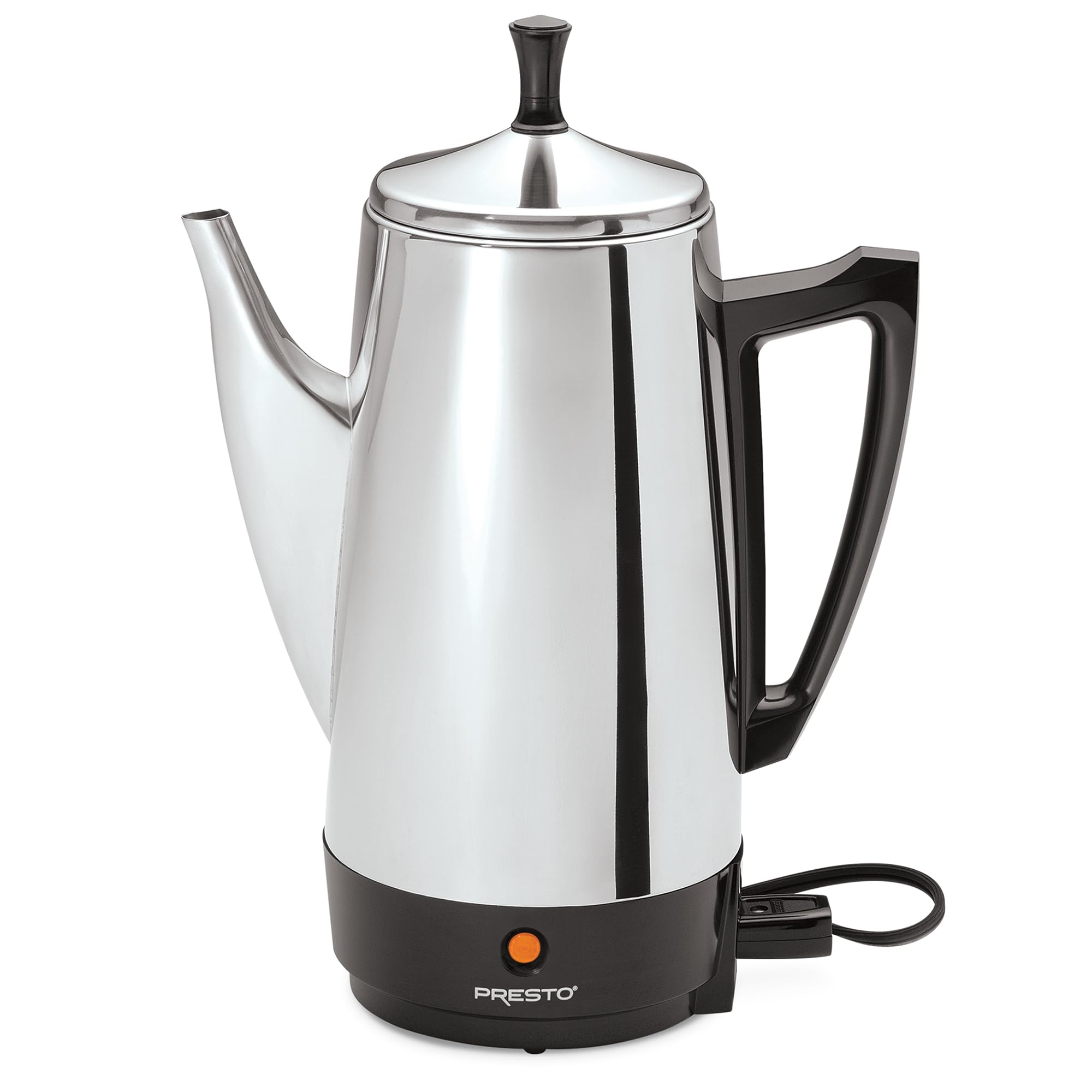
The Presto brews a bold, piping-hot pot in 6-8 minutes using nothing but stainless steel inside.
This is the percolator for anyone who wants a single machine that can handle a full morning routine without refilling. Buyers report it “brews 6 cups in 6-8 min, stays hot,” and the automatic temperature control keeps it at serving temperature without constant babysitting.
The entire water path is stainless steel: the basket, the perk tube, and the carafe. No plastic touches your hot water, which fans of “toxin-free metal-only brewing” consistently mention as the reason they chose this over drip machines. The stay-cool handle and easy-pour spout make serving simple, and the signal light tells you when brewing is done.
The trade-off is that you must let it cool before a second brew, and the cord is user-replaceable—one long-term owner noted the screws rusted after about four years but that the unit itself kept going. There is no brew-interrupt or timer, so this is a set-and-wait machine. For a simple, all-metal design that delivers on flavor and heat, it is the strongest all-rounder in the lineup.
Why It Wins
- 12-cup capacity versus the Farberware’s 8 cups
- All-stainless water path with no plastic contact
- Automatic keep-warm with signal light
- Buyers praise rich, non-bitter flavor
Known Limitations
- No timer or brew-interrupt feature
- Must cool before brewing a second pot
- Cord may need replacement over years of use
Who it serves: Households that want a large, all-metal percolator with hot coffee on demand and no plastic in the water path.
Real trade-off: You cannot program or interrupt the brew—plug it in, wait, and pour.
2. Farberware Electric Coffee Percolator, Stainless Steel Basket, 8 Cup

The Farberware delivers a fast, hot cup in under 10 minutes with a footprint that fits small counters.
If you only need one or two mugs at a time, this 8-cup percolator (about two standard mugs) is the more compact alternative to the Presto. It stands 11″ tall and is 7″ deep—noticeably smaller than the Presto’s wider base—so it tucks easily under cabinets. Owners mention that it brews “strong, flavorful coffee in under 10 minutes” and that the automatic keep-warm function holds the temperature for hours without scorching.
The body and basket are stainless steel, giving you the all-metal build you want. The no-drip spout is a real time-saver, and the detachable cord makes serving easier—no wrestling the machine across the counter. Unlike the Presto, the Farberware has no indicator light, so you have to listen for the perking to slow down. A few customers note the 18″ cord is very short, which may limit outlet placement, and that there is no plastic heat guard behind the handle, so you have to be careful pouring.
Reliability is the bigger question: one reviewer noted that after 6 months, the “cord sparked and snapped (bare wire).” The same buyer said the unit stopped working at 8 months. That is not universal—other reviews describe years of regular use—but it is worth knowing before buying. For a compact, all-metal option that makes a quick cup, it is a solid pick if you are comfortable with the cord risk.
What Stands Out
- Compact size (7″D x 8.75″W) for small counters
- Brews a cup per minute, hot and flavorful
- Detachable cord for easy serving
- No-drip spout keeps cleanup minimal
Watch Out For
- Very short 18″ power cord
- No indicator light to show brewing is done
- Some units had cord failures after months of use
Best for: Solo drinkers or couples who want a small, fast percolator that fits tight spaces.
Proceed with caution if: You want a longer power cord or a proven track record—some units had electrical issues.
3. Lindy’s Stainless Steel 10 Cup Drip Coffee Maker, Stovetop

The Lindy’s makes a clean, bright drip coffee without a single cord or circuit board.
This is the stovetop alternative: no electricity, no heating element, no electronics at all. You fill the bottom chamber with water, add grounds to the filter basket, and place it on a low-to-medium burner. The water rises through a tube and drips once over the grounds—the same classic drip method your grandparents likely used. The result is a cleaner, lighter cup than the bold brew from a percolator. Buyers describe it as “less strong than a French press” but with a “cleaner flavor.”
The build is 18/10 surgical stainless steel for the entire pot, with cool-touch plastic handles on the top knob and side handle. It holds 10 cups (still the 5 oz coffee cup measure), so it lands between the Farberware and Presto in capacity. Unlike the electric percolators, you control the brew temperature entirely by adjusting your stove burner, which means you can dial in the exact heat you want.
The main practical hitch: the drip holes are large, so some owners say it “drains too fast” and recommend using a paper filter inside the basket to keep grounds out of your cup. And a few buyers reported the unit developed a leak under the pour spout after months of use—one mentioned “leaks under pour spout after 9 months,” though the seller Orchard Farms replaced the whole unit. If you want a no-plastic, no-cord option and do not mind a small learning curve with filters, this is a durable, rewarding choice.
Why Choose This
- 100% metal brew path — no plastic touches hot water
- No electricity needed, works on any stove burner
- Classic drip flavor — clean, bright, not heavy
- Durable 18/10 stainless steel build
Consider Before
- Drip holes are large — expect to use a paper filter
- No cup markings on the pot
- Some units developed leaks near the spout over time
Perfect for: Minimalists and off-grid brewers who want a stainless stovetop maker with a light, clean drip profile.
Heads-up: You will need a paper insert to avoid grounds, and the spout seam may need attention over extended use.
Understanding the Specs
Percolator vs. Drip
An electric percolator (like the Presto and Farberware) cycles boiling water repeatedly over the grounds, producing a strong, very hot cup with a heavier mouthfeel. A stovetop drip maker (like the Lindy’s) sends water through the grounds once, giving a lighter, cleaner cup closer to a pour-over. Your preference between bold and bright determines which style to choose.
12 Cups vs. 8 Cups vs. 10 Cups
In coffee maker spec sheets, a “cup” is 5 oz, not the 8-12 oz mug you drink from. A 12-cup machine yields about 60 oz of coffee—roughly four standard mugs. An 8-cup model gives about 40 oz (two to three mugs). The Lindy’s 10 cups is 50 oz, or around three mugs. Match the capacity to how many people you brew for in one go.
Stainless Steel Grade and Construction
“Stainless steel” is not one material. The Lindy’s uses 18/10 surgical stainless, which means 18% chromium and 10% nickel—resists rust and staining better than lower grades. The Presto and Farberware use stainless steel for the basket and exterior, but the internal heating element is metal too. For all-metal purity, everything the water touches should be stainless, not plastic or aluminum.
Automatic Keep-Warm vs. Manual Heat Control
Electric percolators have a heating element that switches to a lower “keep warm” setting after brewing finishes. This keeps the coffee hot for hours but can over-extract if left too long. Stovetop drip makers have no thermostat—you control the burner. Once the water has risen and dripped through, remove it from heat to avoid a bitter taste.
FAQ
Will these coffee makers fit under a standard kitchen cabinet?
Can I use paper filters with a stainless steel percolator?
Do these coffee makers have any plastic parts touching the hot water?
How do I clean a stainless steel percolator or stovetop drip pot?
What is the difference between a percolator and a drip coffee maker?
Can I make less than the full capacity in these coffee makers?
How long do all-metal coffee makers typically last?
Why does my percolator coffee taste bitter?
Can I use these stovetop drip coffee makers on an induction cooktop?
What is the best way to prevent grounds in my cup when using a percolator?
Final Thoughts: The Verdict
For most people, the best all-metal coffee maker is the Presto 02811 because it combines a 12-cup all-stainless build, a fast 6-8 minute brew, and automatic keep-warm — all at a reasonable price. If you want a compact percolator for two and do not mind a short cord, the Farberware FCP280 is your pick. And if you prefer a stovetop drip with zero electronics and a classic design, the Lindy’s 10 Cup gives you a clean, bright cup and decades of potential use.
How We Picked
We do not accept paid placement. Every pick is matched to a real buyer and a real use-case; we do not hands-on test units.
Sources & Methodology
Specifications: manufacturer listings and product documentation. Review insights: verified customer reviews, as of July 2026. Pricing: not shown on this page (it changes often); check the current price via the retailer link.
As an Amazon Associate, FitlyFast earns from qualifying purchases. This does not affect which products we feature.