
Our readers keep the lights on and the weekend projects moving. As an Amazon Associate, I earn from qualifying purchases.
You can water, prune, and talk to your plants all you want — but if the nutrient mix hitting their roots is off, they’ll stay pale, lanky, or stubbornly bloom-free. The difference between a garden that struggles and one that overflows is rarely sunlight or luck; it’s the specific ratio of nitrogen, phosphorus, and potassium you deliver, and whether those nutrients come in a form the soil biology can actually process. An all-purpose fertilizer that balances immediate green-up with steady root and flower development separates a hobby from a harvest.
I’m Rikta — the co-founder and writer behind FitlyFast. My approach to this guide was built on hours of cross-referencing NPK ratios, ingredient sourcing (synthetic salts versus organic meals), and real-world feedback from gardeners pushing these products through extreme heat, heavy feeders, and finicky seedlings.
The right choice depends on whether you need a quick synthetic boost for container plants or a slow-release organic meal that builds soil over time. This guide breaks down the top contenders for the title of best all-purpose fertilizer across different growing styles and garden sizes.
How To Choose The Best All-Purpose Fertilizer
A bottle or bag of all-purpose fertilizer is not a magic potion — it’s a precise blend of macronutrients and optional trace elements. The wrong ratio can push a tomato plant into all leaves and no fruit, or burn the roots of a delicate orchid. Here are the key factors to weigh before you buy.
NPK Ratio: What Those Three Numbers Actually Mean
The first number (Nitrogen) drives leaf and stem growth — high N is great for lawns and leafy greens but can stunt flowering. The second (Phosphorus) supports root development and blooms; the third (Potassium) bolsters overall plant health, disease resistance, and fruit quality. A balanced 20-20-20 is a fast-acting synthetic that works for quick green-up in houseplants, while a low-and-slow 4-6-2 or 3-4-4 organic blend better suits vegetables and perennials where you want sustained nutrition without salt burn.
Form: Water-Soluble Crystals vs. Granular Meals
Water-soluble powders (like 20-20-20) dissolve instantly, making nutrients available to the plant within hours — ideal for container plants and correcting mid-season deficiencies. Granular organics (fish bone meal, feather meal, kelp) must be broken down by soil microbes, releasing nutrients over weeks or months. That delayed release builds long-term soil structure but requires warm, active soil biology. Choose solubility when you need speed; choose granules when you want steady, gentle feeding for an entire season.
OMRI Listing and Organic Certification
If you’re growing food, an OMRI-listed (Organic Materials Review Institute) fertilizer ensures the ingredients meet organic production standards without synthetic chemicals or sewage sludge. Products like Down To Earth and Espoma carry this certification, which matters for your soil’s microbiome and your dinner plate. Non-organic synthetics have their place for ornamental flowers or short-season containers, but for edible gardens the organic label is a hard requirement for many growers.
Quick Comparison
On smaller screens, swipe sideways to see the full table.
| Model | Category | Best For | Key Spec | Amazon |
|---|---|---|---|---|
| Jobe’s Organics 4-4-4 | Granular Organic | Long-term soil building | 16 lb bag, 4-4-4 NPK | Amazon |
| Great Big Roses Liquid | Liquid Organic Booster | Blooms on ornamentals | 70+ trace minerals per oz | Amazon |
| Down To Earth 4-6-2 | Granular Organic | Tomatoes and heavy feeders | 5 lb, OMRI-listed | Amazon |
| Fertilome 20-20-20 | Water Soluble Synthetic | Quick green-up and blooms | 3 lb, 20-20-20 NPK | Amazon |
| Peters Professional 20-20-20 | Water Soluble Synthetic | Controlled feeding schedules | 2 lb, with micronutrients | Amazon |
| Espoma Garden-tone 3-4-4 | Granular Organic | Edible vegetable gardens | 3-4-4 NPK, pack of 2 | Amazon |
In‑Depth Reviews
1. Jobe’s Organics Granular All Purpose Fertilizer

The Jobe’s 4-4-4 formula represents the goldilocks zone for organic all-purpose feeding: a balanced ratio that won’t burn tender roots, a 16-pound bag that covers an entire vegetable patch for a season, and OMRI listing that keeps your kitchen garden organic. Gardeners report it works equally well as a dry top-dress for shrubs and as a liquid feed by steeping a cup in a gallon of dechlorinated water for 24 hours, with flowers opening within 48 hours of the weekly liquid application.
The granules have a mild, earthy smell (far less pungent than raw manure) and spread easily through a hand-crank spreader or by hand. The slow-release nature means you apply every 2-3 weeks during the growing season, but that’s a small trade-off for the sustained, dense growth it produces — one reviewer’s squash and cucumber yields were so heavy they had to give away produce to neighbors.
No synthetic chemicals, no dust clouds when spreading, and a resealable bag design that keeps the granules dry between uses. The 4-4-4 ratio is slightly lower in phosphorus than some bloom-specific mixes, so if you’re pushing for maximum flower count on ornamentals, you may want to supplement with bone meal. For an all-purpose workhorse that feeds soil biology first and plants second, this bag earns its top spot.
Why it’s great
- Massive 16-pound bag provides season-long coverage for large gardens without repurchasing.
- Versatile dry or liquid application method adapts to both soil feeding and foliar schedules.
- OMRI-listed organic ingredients build lasting soil structure, not just plant tissue.
Good to know
- Relatively low phosphorus compared to bloom-specific organic formulas like 4-6-2.
- The steeping method for liquid feed requires pre-planning 24 hours ahead.
2. Great Big Roses and Flowers Liquid Fertilizer Booster
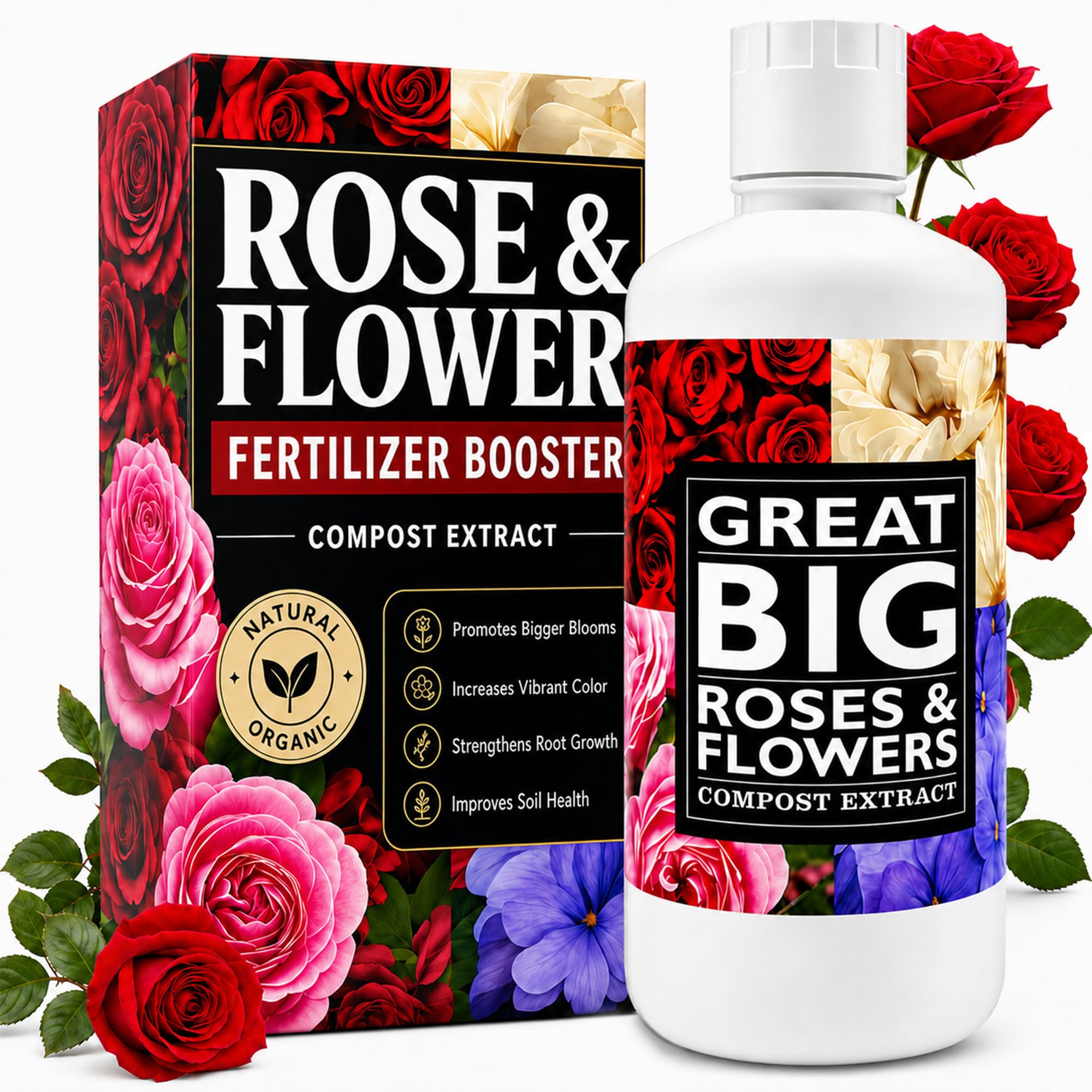
This liquid concentrate is less a standalone fertilizer and more a soil activator that amplifies whatever else you’re already feeding. The secret is its proprietary blend of humic acids, seaweed, and over 70 chelated trace minerals — micronutrients that convert locked-up elements in your existing garden soil into forms roots can actually absorb. Customers have reported rose bushes that hadn’t bloomed in years producing big flowers within weeks of the first application, and hydrangeas going “crazy” after a single dose.
The mixing ratio is economical — 4 ounces per gallon of water, and one 32-ounce bottle makes 8 gallons of feed, covering an entire growing season for a typical home garden. It works alongside organic fertilizers, fish emulsion, bone meal, and worm castings, so you don’t have to abandon your current regimen. The liquid form is ideal for container plants where granular top-dressing is messy, and it penetrates the root zone without disturbing the soil surface.
The flip side: the plastic jug design has a wide mouth that some reviewers find prone to spilling when measuring into a watering can, and the price per bottle is higher than any other product on this list. But for targeted bloom production on roses, citrus, and perennials, the mineral diversity this liquid delivers is unmatched by simple NPK salts.
Why it’s great
- 70+ chelated trace minerals and humic acids unlock nutrients already in your garden soil.
- Works synergistically with any existing organic fertilizer — no need to switch brands.
- Economical mixing ratio: a single bottle covers an entire growing season for most gardens.
Good to know
- Jug design makes measuring without spilling tricky — a measuring cup with a spout helps.
- Higher price per ounce than granular organic options; best as a specialized booster.
3. Down To Earth All Natural Organic All Purpose Tomato & Vegetable Mix

The 4-6-2 ratio here skews higher in phosphorus than a standard all-purpose blend, which makes this box especially effective for fruiting crops — tomatoes, peppers, squash, melons — that need that mid-number boost for flower set and fruit development. Made from fish bone meal, blood meal, feather meal, rock phosphate, and kelp meal, the ingredient list reads like a soil-building cookbook rather than a chemical factory. One reviewer noted that pale, flimsy tomato plants recovered fully within two weeks of application.
OMRI-listed for organic production, so it’s safe for edible gardens and won’t introduce synthetic salts into your soil food web. The 5-pound box is smaller than Jobe’s 16-pound bag but still covers a medium vegetable garden for several months when used as a side-dress or worked into the top inch of soil at planting time. The granules have an earthy, organic aroma that dissipates after a few days in the soil.
Given its targeted phosphorus level, this works less well for leafy greens or lawns that prefer higher nitrogen. Also, the granular form requires active soil microbes to break down the meals, so it’s slower to show results in cold or compacted soil than a water-soluble synthetic. But for an organic all-purpose that prioritizes fruit production, this is a top contender.
Why it’s great
- Higher phosphorus (6) is purpose-built for flowering and fruiting vegetables like tomatoes and peppers.
- Premium organic meals (fish bone, blood, feather, kelp) feed both plant and soil microbes.
- OMRI-listed and safe for certified organic vegetable production.
Good to know
- Lower nitrogen means it’s not ideal for leafy greens or lawns needing a quick green-up.
- Granular organic requires warm, active soil biology for full release — slower in cold soil.
4. Fertilome All Purpose Water Soluble Plant Food 20-20-20

Where organic meals work slowly through soil biology, Fertilome’s 20-20-20 is pure synthetic speed — fully water-soluble salts that hit the root zone within minutes of application. The label says it all: “increases flower size, quantity and vibrance of color,” and reviewers confirm it revives dying hibiscus bushes in Florida heat after just two root drenches over 20 days. The 20-20-20 ratio is perfectly balanced, making it a one-bag solution for both leaves and flowers.
It’s versatile enough for soil drenching (1-2 tsp per gallon) and foliar feeding (1/4-1 tsp per gallon), giving you two delivery methods depending on whether you’re targeting roots or leaves. The 3-pound bag goes a long way because the mixing rates are low — reviewers note that it’s “potent stuff” and warn against over-application. It works on geraniums, petunias, impatiens, annuals, perennials, and hanging baskets both indoors and out.
Because it’s a synthetic salt, it can burn roots if over-mixed, and it won’t build organic matter in your soil. It’s best treated as a quick corrective feed or a maintenance schedule for container plants that drain quickly, rather than a soil-building program. If you want instant results and don’t mind replenishing often, this is the most reliable synthetic pick.
Why it’s great
- Immediate nutrient availability corrects deficiencies within days — ideal for yellowing plants.
- Dual-application method as soil drench or foliar spray covers both root and leaf uptake.
- Low mixing rate (1-2 tsp per gallon) means a 3 lb bag stretches across many applications.
Good to know
- Synthetic salt formula can burn roots if over-applied — follow mixing instructions precisely.
- Does not contribute to long-term soil organic matter or microbial health.
5. Peter’s Professional 20-20-20 General Purpose Water Soluble Fertilizer

Peter’s Professional has been a staple among serious indoor and greenhouse growers for decades, and the 20-20-20 formulation is a textbook balanced synthetic — but the edge here is the included micronutrient package that’s often missing from cheaper all-purpose salts. The specific blend of trace elements supports healthy root development and prevents microdeficiencies that show up as interveinal chlorosis or stunted new growth, especially in Orchids and Bromeliads.
Reviewers consistently mention how well this outperforms popular blue-branded alternatives, using slightly less product for the same or better results. One detailed houseplant schedule suggests 0.5 tbsp per gallon every 1-2 months for general maintenance, and cannabis growers have built entire feeding cycles around the 1 tbsp per gallon weekly rate for vegetative growth. The powder dissolves cleanly without clogging sprayers, and the 2-pound bag is a manageable size for apartment gardeners with limited storage.
The main consideration is the same as with any synthetic — salt accumulation in containers over time, which can necessitate occasional flushing to prevent root burn. And while it’s excellent for vegetative growth, the 1:1:1 ratio isn’t optimized for heavy flowering or fruiting, where a bloom booster with higher phosphorus would be more effective. For a precise, predictable synthetic feed with proven results, this is a classic for a reason.
Why it’s great
- Includes a chelated micronutrient blend that prevents common deficiencies in houseplants and orchids.
- Decades-long reputation for consistency — dissolves fully and doesn’t leave residue in sprayers.
- Proven multi-species utility from African violets to cannabis with clearly documented mixing schedules.
Good to know
- Synthetic salt requires periodic flushing of containers to prevent nutrient buildup and root burn.
- Balanced 1:1:1 ratio is not ideal for the bloom phase of flowering plants without a separate booster.
6. Espoma Organic Garden-tone 3-4-4 Fertilizer

Espoma’s Garden-tone is a three-number formula that feels almost custom-designed for the edible garden: 3-4-4 with 5% calcium. The lower nitrogen avoids excessive leafy growth at the expense of fruit, while the calcium is a direct hedge against blossom-end rot in tomatoes and peppers. The exclusive Bio-tone blend of beneficial microbes further enhances nutrient cycling, and the formula is approved for organic production.
You get two 4-pound bags per order, which together offer strong coverage for a moderate vegetable garden throughout the growing season. Monthly application is straightforward — sprinkle around the drip line and water in — which is simpler than mixing and measuring liquid concentrates. One long-time gardener called Espoma a “game changer” after switching from generic fertilizers, noting markedly better growth, blooms, and overall plant health.
The organic ingredients produce a distinct smell (reviewers describe it as “a little hot” initially), but this fades quickly after watering in. The 3-4-4 ratio is purposely mild and non-burning, which also means it’s not a heavy feeder for fast-growing crops in poor soil — you may need to supplement with a side-dress of compost or a liquid feed for nutrient-hungry plants like corn or heavy squash. For an organic entry point that treats your soil with respect, this is a solid choice.
Why it’s great
- Contains 5% calcium to actively prevent blossom-end rot in tomatoes, peppers, and squash.
- Bio-tone microbial blend enhances soil biology and nutrient cycling for sustained fertility.
- Mild 3-4-4 ratio is nearly impossible to over-apply — forgiving for beginners.
Good to know
- Lower overall NPK numbers mean it may not satisfy very hungry crops in depleted soil without supplementation.
- Organic smell is noticeable before the first watering — it’s the natural ingredients, not a defect.
FAQ
Can I use a 20-20-20 synthetic on my vegetable garden?
How often should I apply granular organic fertilizer to my garden?
What does the OMRI label actually guarantee for my fertilizer?
Final Thoughts: The Verdict
For most users, the best all-purpose fertilizer winner is the Jobe’s Organics 4-4-4 because it combines a balanced NPK ratio, a massive 16-pound bag that lasts a full season, and OMRI-listed organic ingredients that build soil health rather than deplete it. If you want immediate results for container plants and don’t need organic certification, grab the Fertilome 20-20-20 for its fast-acting synthetic boost and versatile soil/foliar application. And for bloom-heavy ornamentals like roses and hydrangeas, nothing beats the Great Big Roses Liquid Booster with its 70-plus trace minerals and humic acid activation.