
Our readers keep the lights on and the weekend projects moving. As an Amazon Associate, I earn from qualifying purchases.
That burning sensation rising in your chest after a meal isn’t just discomfort—it’s your esophagus lining crying out for relief. Most people reach for chalky tablets or prescription pills that mask the symptom, but the real target is healing the inflamed tissue itself. Aloe vera gel delivers a concentrated dose of mucopolysaccharides that physically coat and soothe the digestive tract, offering a natural pathway to calm that fire without drug side effects.
I’m Rikta — the co-founder and writer behind FitlyFast. I’ve spent countless hours dissecting the molecular weight of aloe polysaccharides, the purity of inner-leaf filtration methods, and the bioavailability of commercial aloe formulations to separate true healing products from overpriced water.
This guide ranks the most potent, least-processed bottles on the market and helps you avoid the diluted imitations that won’t touch your reflux. Here is my analysis of the best aloe vera juice for acid reflux.
How To Choose The Best Aloe Vera Juice For Acid Reflux
Not every bottle of green liquid will calm your burning throat. The real mechanism is mucopolysaccharide concentration—long-chain sugars from the inner-leaf gel that form a protective film over your esophageal lining. A product with less than 5,000 mg/L of these polysaccharides is essentially colored water when it comes to reflux relief. Look for brands that explicitly advertise their polysaccharide content or those backed by customer reports of significant heartburn reduction.
Inner-Leaf vs. Whole-Leaf: The Critical Distinction
Whole-leaf aloe includes the outer rind, which contains aloin—a bitter latex compound that acts as a laxative and can actually worsen stomach irritation. Inner-leaf juice, made only from the clear gel inside the plant, delivers the soothing polysaccharides without the gastrointestinal drama. Any bottle that doesn’t specify “inner-leaf” on the label may trigger unexpected bathroom trips alongside your heartburn relief.
The Aloin Removal Process Matters More Than You Think
Some manufacturers use charcoal filtration to strip aloin, but this aggressive process also strips away a significant portion of the beneficial polysaccharides. The best brands use low-temperature pressing or proprietary filtration that removes only the bitter compounds while preserving the molecular weight of the healing gel. Products that are described as “bitter-free” or “tastes like water” have already solved this challenge without sacrificing potency.
Organic Certification Isn’t Optional—It’s Your Safety Net
Aloe is a porous plant that absorbs whatever is in its soil, including pesticides and synthetic fertilizers. When you’re drinking a concentrated juice to heal your digestive tract, you are also consuming every chemical the plant absorbed. USDA Organic certification from a body like ECOCERT ensures the fields were free of synthetics for at least three years. Third-party lab testing for heavy metals is an extra layer of trust that premium brands provide.
Quick Comparison
On smaller screens, swipe sideways to see the full table.
| Model | Category | Best For | Key Spec | Amazon |
|---|---|---|---|---|
| George’s Always Active Aloe Vera | Premium | Zero-taste daily hydration | Distilled, no aloin bitterness | Amazon |
| Lily of the Desert Stomach Formula | Premium | Multi-herb acid relief | Aloesorb polysaccharide complex | Amazon |
| Nature’s Sunshine Aloe Vera Juice | Mid-Range | Highest polysaccharide count | 7,000 mg/L mucopolysaccharides | Amazon |
| Lily of the Desert Vera Juice (128 oz) | Mid-Range | High-volume value gallon | Aloesorb-enhanced whole-leaf | Amazon |
| Aloe 80 Organics Stomach Formula | Mid-Range | Immediate burn relief taste | Fresh mint flavor formula | Amazon |
| AloeCure USDA Organic Lemon Flavor | Entry-Level | Budget organic entry point | 98% inner-gel, 12-hour harvest | Amazon |
| Lakewood Organic Aloe Vera Gel Juice | Budget | Budget full-gel potency | 32 oz full-strength thick gel | Amazon |
In‑Depth Reviews
1. George’s Always Active Aloe Vera – 128 fl oz

George’s solves the single biggest complaint about aloe juice: the taste. This is a distilled liquid made from 100% aloe vera that tastes exactly like water—no bitterness, no slimy texture, no herbal funk. For acid reflux sufferers who gag at the thought of swallowing thick green gel, this is the gateway product that makes daily compliance effortless. The distillation process removes aloin without charcoal filtration, preserving the molecular structure of the healing polysaccharides while eliminating the laxative component that can upset sensitive stomachs.
The 128-ounce gallon jug is a value play for anyone committed to a daily 2-ounce morning and evening routine—you get nearly two months of consistent dosing. Real customer reports confirm this product eliminated chronic acid reflux after years of prescription reliance, and the taste neutrality means you can mix it into any beverage without ruining your morning coffee or tea. It is gluten-free, vegan, and non-GMO, requiring no refrigeration.
Where it falls short is the sheer volume of the packaging. The gallon jug is unwieldy for travel or small kitchen cabinets, and once opened, you need to use it within about a month for peak freshness. The price per ounce is excellent, but the upfront commitment is about double that of a standard 32-ounce bottle. Users seeking a small trial size should look elsewhere first.
Why it’s great
- Completely neutral water-like taste eliminates compliance barriers
- Distillation preserves polysaccharides without stripping them via charcoal
- Gallon size delivers exceptional value for daily users
Good to know
- Large gallon jug is bulky for storage or travel
- No polycharide concentration listed on label
2. Lily of the Desert Stomach Formula – 32 oz (Pack of 2)

Lily of the Desert’s Stomach Formula is not just aloe juice—it’s a four-herb therapeutic cocktail designed specifically for acid reflux and heartburn relief. Beyond the base of organic aloe vera, this formula adds slippery elm (which forms additional mucilage coating), chamomile (a mild anti-inflammatory), peppermint (a natural digestive relaxant), and ginger (a nausea-fighting carminative). Each of these herbs individually supports digestive healing, and combined they create a synergistic effect that outperforms straight aloe for symptomatic reflux cases.
The Aloesorb ingredient is the key differentiator here—it’s a patent-pending concentration of the highest molecular weight polysaccharides naturally found in the aloe plant. Standard aloe juices contain a mix of small and large polysaccharide chains; Aloesorb enriches the fraction that adheres best to the esophageal and gastric mucosa. Users with gastritis and ulcer histories report that this formula allowed them to stop their prescription acid reducers entirely after consistent use.
Two significant trade-offs: the taste is not good. The herbal blend creates a complex, somewhat medicinal flavor that reviewers describe as tolerable but far from pleasant. Additionally, the peppermint content is a concern for some individuals—peppermint can relax the lower esophageal sphincter in certain people, potentially worsening reflux for a minority of users. Those with hiatal hernias should test cautiously.
Why it’s great
- Four targeted herbs complement the aloe for comprehensive reflux relief
- Aloesorb polysaccharide complex provides higher molecular-weight adhesion
- Pack of two bottles offers extended supply for committed users
Good to know
- Peppermint may relax the LES in some individuals
- Herbal taste is medicinal and not universally liked
3. Nature’s Sunshine Aloe Vera Juice – 32 fl oz

Nature’s Sunshine doesn’t hide behind vague marketing—it puts the number right on the bottle: 7,000 mg of mucopolysaccharides per liter. That is the highest explicitly stated polysaccharide count in this roundup, and it translates to a significantly thicker, more viscous juice that coats the esophagus with every swallow. The inner-leaf concentrate is minimally processed to retain the full spectrum of the plant’s naturally occurring compounds, including salicylates and prostaglandins that support anti-inflammatory activity in the digestive tract.
Founded in 1972, Nature’s Sunshine has been formulating herbal supplements for five decades. Their aloe juice uses a proprietary pressing technique that removes the harsh cleansing components (aloin) while preserving the therapeutic polysaccharides. Users with chronic acid hypersecretion who failed on prescription PPIs found consistent relief with this product, often reporting that a single capful morning and night eliminated the burning sensation they lived with for years.
The taste is the barrier—reviewers consistently describe it as “acceptable” or “not bad,” which is code for getting used to something that isn’t pleasant but is worth it. The product contains no flavor additives, so the natural aloe bitterness remains. At 32 ounces, the bottle size is moderate, but the effective dose is smaller than other brands due to the higher potency, making this a solid mid-range option that out-performs cheaper competitors in actual symptom relief.
Why it’s great
- 7,000 mg/L of mucopolysaccharides—highest labeled potency available
- Minimal processing preserves natural salicylates and prostaglandins
- Small effective dose stretches the bottle further
Good to know
- Natural bitter flavor requires palate adjustment
- No flavor additives or masking agents
4. Lily of the Desert Vera Juice (Whole Leaf, 128 oz)

Lily of the Desert’s whole-leaf filtered aloe juice is the volume king of this list at 128 fluid ounces—a full gallon of bio-active aloe enhanced with the proprietary Aloesorb polysaccharide complex. Unlike many whole-leaf products that use the entire plant including the outer rind, Lily of the Desert employs a filtration process that removes the harsh aloin while retaining the beneficial compounds from the whole leaf. The result is a product with a broader amino acid and enzyme profile than inner-leaf-only juices.
The Aloesorb enrichment is the real draw—it concentrates the highest molecular-weight polysaccharides that are most effective at adhering to mucosal tissues. Users report that this juice helps with not just acid reflux but also eczema, joint pain from workouts, and overall hydration. The neutral flavor (reviewers call it “clean” or “mild”) makes it easy to incorporate into morning smoothies, green tea, or simply mixed with water. The company’s commitment to organic farming since 1971 adds a layer of trust to the sourcing.
The whole-leaf nature means this product contains more plant fiber than inner-leaf alternatives, which can cause mild bloating in sensitive individuals during the first week. The taste is better than straight whole-leaf products but still has an earthy note that some users find unpleasant. The gallon size is excellent for committed users but requires significant refrigerator space and must be used within a window of about 45 days for optimal freshness.
Why it’s great
- Gallon size delivers the lowest cost per ounce among premium entries
- Aloesorb complex provides higher molecular-weight polysaccharides
- Broad amino acid and enzyme profile from whole-leaf filtration
Good to know
- Whole-leaf fiber may cause initial mild bloating
- Needs refrigerator space and 45-day consumption window
5. Aloe 80 Organics Stomach Formula – 32 Ounce
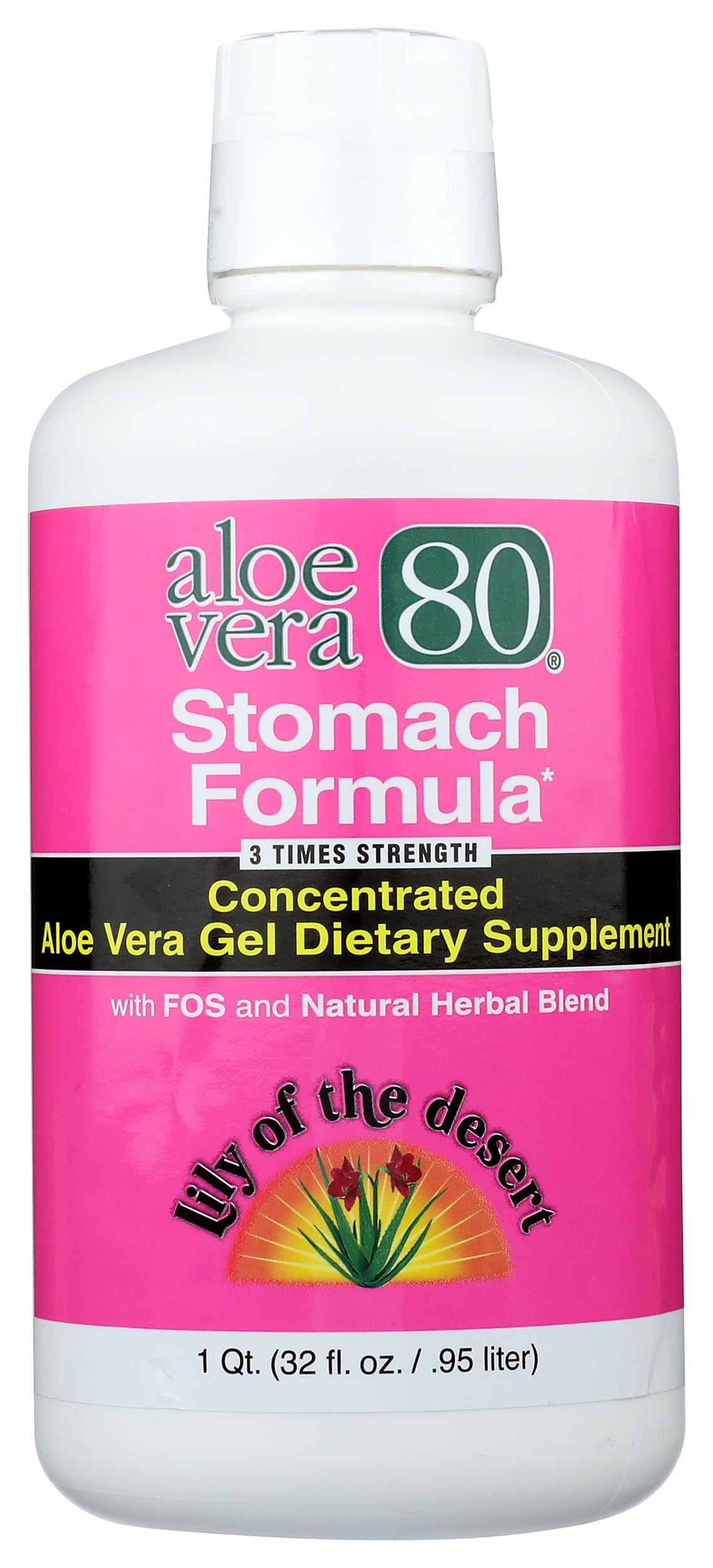
Aloe 80 Organics aims straight at the acid reflux market with a Stomach Formula that includes fresh mint flavoring to make the daily dosage more tolerable. The mint is not just a taste mask—it has carminative properties that help relax the digestive tract and reduce gas pressure, which can indirectly lower reflux episodes. This product is manufactured by Lily of the Desert, so it benefits from the same 50+ years of aloe expertise, but the mint formulation is unique to this SKU.
Customer reports from users with severe gastritis and H. pylori infections indicate that this formula provided relief where prescription PPIs and H2 blockers like Zantac or Pepcid failed. The minty flavor makes it palatable in hot water or tea, and the 32-ounce bottle size is manageable for countertop storage. Users note that a single capful taken morning and night eliminated the constant burping and burning associated with reflux.
The downside is significant for a subset of users: peppermint can relax the lower esophageal sphincter, and for those with pre-existing sphincter weakness, this can paradoxically worsen reflux. Multiple customer reviews explicitly warn that the peppermint aggravated their symptoms, and the product lacks a peppermint-free alternative. Anyone with a hiatal hernia or known LES laxity should test this with extreme caution or avoid it entirely.
Why it’s great
- Mint flavor improves palatability compared to plain aloe
- Proven effective for H. pylori and severe gastritis cases
- Manufactured by Lily of the Desert with 50+ years of expertise
Good to know
- Peppermint can worsen reflux for those with weak LES
- Taste still described as “terrible” by some reviewers
6. AloeCure USDA Organic Aloe Vera Juice (Lemon) – 16.7 oz
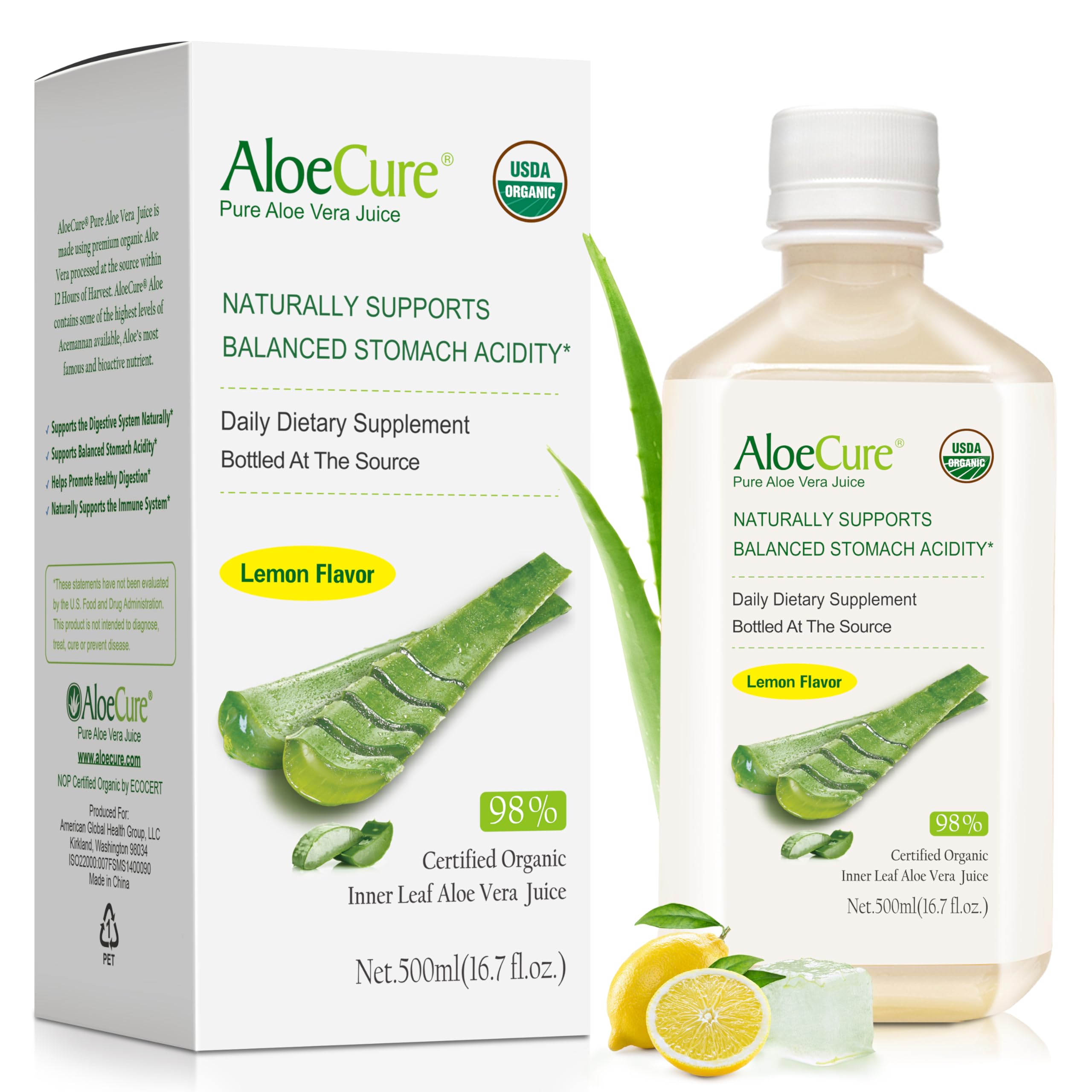
AloeCure delivers a compelling entry-level proposition: USDA Organic inner-leaf gel processed within 12 hours of harvest, with zero charcoal filtration, chemicals, or fractional distillation. The 16.7-ounce bottle is smaller than most entries on this list, which makes it a perfect trial size for newcomers unsure whether aloe juice will work for their specific reflux pattern. The added organic lemon extract provides a pleasant citrus twist that masks the natural bitterness of raw aloe.
The proprietary low-temperature processing is the standout spec here—by avoiding charcoal filtration, AloeCure retains a higher proportion of the natural polysaccharide chains that are responsible for esophageal coating. The company (American Global Health Group) owns its farms and processing facilities, allowing full control from field to bottle. ECOCERT certification (both USDA and European Union organic) provides an independent verification layer that budget brands often skip.
The small bottle size works against anyone hoping for a long-term solution—at the recommended 2-ounce serving twice daily, this 16.7-ounce bottle lasts less than five days. The plastic bottle is another concern for buyers who prefer glass to avoid potential leaching over extended storage. The lemon flavor is pleasant but introduces citric acid, which can be a trigger for some reflux sufferers with extreme sensitivity to acidic foods.
Why it’s great
- Low-temperature processing preserves full polysaccharide spectrum
- Organic lemon flavor improves taste over plain aloe
- Family-owned farms with full vertical integration
Good to know
- Small 16.7 oz bottle requires frequent reordering for daily use
- Lemon citric acid may trigger some sensitive reflux cases
7. Lakewood Organic Aloe Vera Gel Juice – 32 oz

Lakewood offers the most affordable organic entry on this list without sacrificing the core requirement: it’s a full-strength gel juice, not a diluted drink. The product is pressed, pasteurized, bottled, and vacuum-sealed in certified organic facilities with no added preservatives or synthetic compounds. Lakewood explicitly states that this is a natural full-strength product, meaning you’re getting the raw gel consistency that provides the thick, coating effect most effective for acid reflux relief.
The texture is notably thicker than standard aloe juices—reviewers describe it as gelatinous when chilled—which indicates a higher concentration of the mucopolysaccharides that form the protective film over esophageal tissue. Users report that mixing 2-4 ounces in water, tea, or juice provides significant relief from stomach pain and digestive discomfort. The sour natural taste is authentic and unadulterated, which is the trade-off for the absence of flavor additives.
The lack of preservatives means this bottle must be refrigerated after opening and consumed within a reasonable window—the thick gel consistency also makes pouring slightly more challenging than watery alternatives. Lakewood uses citric acid as a pH stabilizer, which is a minimal addition but worth noting for anyone following a strict low-acid diet. The 32-ounce glass bottle is recyclable and avoids the plastic concerns of some competitors.
Why it’s great
- Full-strength gel delivers maximum polysaccharide concentration per ounce
- Certified organic with no preservatives or synthetic additives
- Glass bottle avoids plastic leaching concerns
Good to know
- Thick gelatinous texture may be off-putting to some users
- Requires refrigeration after opening
FAQ
How quickly does aloe vera juice work for acid reflux?
Should I drink aloe vera juice on an empty stomach or with meals?
Can aloe vera juice interact with my acid reflux medications?
Why does some aloe juice taste terrible and some taste like water?
How much aloe vera juice should I drink daily for acid reflux?
Final Thoughts: The Verdict
For most users, the aloe vera juice for acid reflux winner is the George’s Always Active Aloe Vera because it eliminates the taste barrier entirely, making daily compliance effortless while delivering distilled potent aloe gel suitable for sensitive stomachs. If you want the highest measurable polysaccharide concentration for severe reflux cases, grab the Nature’s Sunshine Aloe Vera Juice. And for a multi-herb synergistic approach that combines aloe with slippery elm, chamomile, and ginger, nothing beats the Lily of the Desert Stomach Formula.