
The best alphabet learning toys don’t just shout letters—they build the neurological bridges between a symbol, a sound, and a real-world object. A child who hears the “M” sound while holding a magnetic wooden train car that sticks to the next letter is forming a closed-loop sensory memory that flash-card drills alone cannot replicate.
I’m Rikta — the co-founder and writer behind FitlyFast. I analyze hundreds of developmental toy specs each quarter, looking at the tactile feedback, phonic accuracy, and safety standards that separate a keeper from clutter.
After sorting through hands-on activities that prioritize fine-motor engagement over passive lights, the best alphabet learning toys reward children with physical feedback that makes letter recognition a genuine discovery, not a rote repetition.
How To Choose The Best Alphabet Learning Toys
Alphabet toys vary wildly in how they teach. Some rely on passive audio repetition—press a key, hear a sound—while others require the child to physically match, sequence, or trace each letter. For long-term retention, you want the second kind. Below are the three filters that matter most when sorting through the options.
Physical Manipulation vs. Digital Interaction
A toy that requires the child to pick up, rotate, snap, or connect a letter engages proprioception and bilateral coordination—both crucial for later handwriting readiness. Magnetic trains, mystery boxes, and chunky puzzles force the hand to work with the eye. Pure button-press devices, while entertaining, deliver less sensory reinforcement for letter shape memory.
Progressive Difficulty Structure
The best sets scaffold naturally: first letter recognition, then initial sound matching, then CVC word building, and finally independent spelling. If a toy only offers a single mode (press A, hear “A”), the child will outgrow it within weeks. Look for multi-stage play—cards that progress from matching to spelling, or devices that layer coding challenges over basic letter drills.
Material Safety & Durability Under Toddler Stress
Wooden toys should carry ASTM F963 certification for paint and splinter resistance. Plastic pieces need to be large enough to pose no choking hazard (≥1.25 inches in diameter for under-3s) and free of BPA. Check that magnetic components are fully encased—loose magnets create ingestion risks. A toy that survives being dropped, thrown, and chewed will deliver far more learning value than one that breaks on day two.
Quick Comparison
On smaller screens, swipe sideways to see the full table.
| Model | Category | Best For | Key Spec | Amazon |
|---|---|---|---|---|
| Vanmor Magnetic Wooden Alphabet Train | Wooden Train | Kinesthetic learners, building CVC words | 27 wooden cars + 42 flash cards | Amazon |
| Torlam Alphabet Pocket Chart | Wall Chart | Letter-of-the-week classroom or homeschool | 104 word cards + tracing surface | Amazon |
| LeapFrog ABC & 123 Laptop | Digital Laptop | Intro to keyboards, coding basics | 11 activities + QWERTY layout | Amazon |
| JoyCat Mystery Alphabet Box | Sensory Bin | Speech therapy, initial sound matching | 26 miniature objects per letter | Amazon |
| TOYVENTIVE Educational Books & Flash Cards | Card Set | Screen-free travel kit for ages 1–4 | 4 books + 2 flash card sets + puzzle | Amazon |
| Learning Resources Snap-n-Learn ABC Elephants | Snap-Together | Fine motor + letter sequencing for age 2+ | 26 snap-together elephant halves | Amazon |
| Aigybobo Spin & Sing Alphabet Zoo | Electronic Spinner | Early exposure for ages 1–3 with lights | 4 learning modes + adjustable volume | Amazon |
In‑Depth Reviews
1. Vanmor Magnetic Wooden Alphabet Train Set

The 27-piece hardwood train set delivers the strongest kinesthetic feedback in this category. Each letter car measures roughly 3 inches—sized perfectly for small palms—and the embedded magnets create an audible click when connected in the correct sequence. If a child tries to attach the cars backward, the polarity physically repels, teaching left-to-right directionality without parental correction.
The 42 included flash cards scaffold through letter-to-image matching, three-letter CVC words (cat, sun, dog), and early sight words. Children can self-correct by comparing their train spelling against the card, fostering independent problem-solving. The included canvas storage bag makes this a viable travel toy, and the hardness of the wood (ASTM F963-certified paint) resists the chipping that cheaper lacquered sets develop after a month of play.
Some parents note that the letter cars can be separated under moderate toddler pull force, which is actually a safety feature—the magnets are strong enough to pull a multi-car train but release under force to eliminate pinch hazards. This train set earns the top spot because it builds phonemic awareness, hand-eye coordination, and spatial reasoning simultaneously, and it will still look good when a younger sibling inherits it.
Why it’s great
- Magnetic polarity feedback reinforces left-to-right reading direction
- 42 scaffolded flash cards support independent CVC word building
- Hardwood construction with ASTM F963-certified water-based paint
Good to know
- Some younger toddlers may need help aligning the magnets initially
- Canvas storage bag is functional but not rigid enough for stacking on a shelf
2. Torlam Alphabet Learning Pocket Chart

This is the most comprehensive letter-of-the-week tool for classrooms or structured homeschool environments. The chart includes 104 word cards, 26 letter cards, 26 laminated tracing cards, and 26 alphabet chants. Each card’s dry-erase surface allows children to trace uppercase and lowercase letters repeatedly, then wipe clean for the next session—a feature that bridges letter recognition with handwriting practice.
The four over-the-door hooks make installation simple, though the chart is substantial enough that standard thumbtacks won’t hold it. The transparent PVC pockets on each side resist tearing better than the thin plastic found on budget classroom charts, and the bottom three storage pockets keep the 182 pieces organized. The chants are particularly effective: children sing the rhymes throughout the day, reinforcing phoneme awareness without screen time.
Several parents report that children aged 2–4 enjoy the daily letter routine but may lose interest after completing the alphabet cycle a few times. To extend engagement, rotate the order of activity—start with tracing, then do the chant, then search for matching word cards. The chart’s write-and-wipe surface leaves no ghost marks, and the card stock is thick enough to survive repeated handling without curling at the edges.
Why it’s great
- Dry-erase tracing cards allow unlimited handwriting practice per letter
- 26 alphabet chants build phonemic memory through melody and repetition
- Three bottom storage pockets keep the 182 pieces organized
Good to know
- Chart size is roughly half a door; best for dedicated learning walls
- Older preschoolers may cycle through the content and need supplementary activities
3. LeapFrog ABC and 123 Laptop

The LeapFrog laptop stands apart from typical button-based alphabet toys because it uses a full QWERTY keyboard arranged exactly like a real computer, plus a movable character named Pixel whose digital face animates, speaks, sings, and dances. The 11 activities span letter identification, number recognition, spelling puzzles, and even basic coding—children can create simple programs to make Pixel clean up or cuddle.
One of its strongest features for older preschoolers (ages 4–7) is the text-message simulation between Pixel and his friend Chip. This gamified communication forces children to read short written exchanges, building early literacy in a context that feels like “grown-up” technology rather than a baby toy. The auto-shutoff timer preserves battery life, and the durable plastic body survives the drops that inevitably happen when a toddler carries a laptop around the house.
Parents report that nonverbal children sometimes use the laptop as an AAC-style communication tool, pressing keys to trigger responses. The 4 AA batteries included are strictly for demo use—fresh batteries are recommended for regular play. The laptop is heavier than a child’s tablet (1.6 pounds), but the weight gives it a solid feel on a lap or desk without sliding around.
Why it’s great
- Full QWERTY keyboard prepares children for typing on a real computer
- 11 activities with progressive difficulty including basic coding tasks
- Simulated text messages build reading comprehension in a fun context
Good to know
- Demo batteries included; replace with fresh ones immediately for full use
- Best suited for ages 4+ in bilingual or non-native English households
4. JoyCat Mystery Alphabet Box

The Mystery Alphabet Box transforms letter learning into a tactile guessing game. Children reach inside the box, pull out a miniature object (apple for A, zebra for Z), and match it to the corresponding letter on the double-sided game board that shows both uppercase and lowercase forms. The 26 plastic figures measure approximately 2 inches each—large enough to prevent swallowing but small enough to hide inside a fist for the reveal moment.
Speech therapists frequently use this set because the object-to-sound connection reinforces initial phoneme isolation. When a child pulls out a cat figure and says “C, cat, /k/,” they are practicing the three-part phonemic loop that drives early reading. The double-sided board folds for storage, but frequent folding can create creases that eventually tear—laminating the board extends its life significantly.
The whistle shaped like a letter may contain a small pellet choking hazard, so parents should supervise or remove that piece for children under three. Aside from that concern, the plastic is sturdy and the images are bright and vivid. The set works equally well for whole-group circle time (students take turns pulling) and independent center work, making it a flexible classroom tool.
Why it’s great
- Tactile pull-from-box format creates high engagement for speech therapy and group play
- Double-sided board teaches both uppercase and lowercase recognition
- 26 themed objects (apple, zebra) build vocabulary alongside letter sounds
Good to know
- Whistle piece has a small pellet; supervise children under 3 years
- Folding game board may develop crease tears with heavy daily use
5. TOYVENTIVE Educational Books, Flash Cards, and Puzzles

This smart-box set packs four board books, two sets of flash cards, a two-sided puzzle, two matching boards, and a pair of play glasses into a compact cardboard box. The books use realistic photographic images rather than cartoons, which helps toddlers transfer object recognition from the page to the real world. The ABC book covers A–Z with one image per letter, while the 123 book does the same for numbers 1–20.
The two-sided puzzle shows the alphabet on one side and numbers on the reverse, giving double the use in a single piece. Matching boards ask children to pair a flash card image with the corresponding letter or number, building categorization skills. Parents report that the play glasses are a hit for costume play but don’t contribute directly to literacy—they’re a bonus engagement tool that makes the “learning” feel like dress-up.
Some buyers feel the set could include more interactive pieces (sensory cards, stacking components) to increase replay value. For the price, the contents skew toward traditional print media rather than manipulatives, making this kit best for screen-free families who value reading together over independent play. The Mom-Owned Business badge adds confidence in material safety, and the cardboard construction holds up well against gentle toddler handling.
Why it’s great
- Realistic photographic images improve object-to-real-world transfer for toddlers
- Two-sided puzzle covers both alphabet and numbers in a single piece
- Compact box format is easy to pack for restaurants, car trips, or travel
Good to know
- Limited interactive pieces; primarily print-based with two matching boards
- Play glasses are fun but not educational—they are a costume novelty
6. Learning Resources Snap-n-Learn ABC Elephants

Each elephant in this set is split into two halves: the headpiece displays a lowercase letter and the tailpiece shows the corresponding uppercase letter. Children must snap the correct head to the correct tail to form a complete elephant, reinforcing letter case matching through a satisfying mechanical click. The 26 elephants also link together like a chain, allowing toddlers to spell short words by connecting the letters in order.
At roughly 3.5 inches per assembled elephant, the pieces are large enough for children as young as 18 months to handle safely. The plastic is thick and resists cracking when dropped, and the included storage tub with a handle keeps the set organized. Because the elephants are solid and chunky, they double as counting objects and color-sorting items—a single toy that supports multiple early learning domains.
A small number of units have shipped with a missing letter, so inspect the set immediately upon opening and contact Learning Resources for a replacement if anything is absent. The age rating (18 months to 5 years) is accurate: younger children enjoy the snap action and color matching, while older preschoolers can use the elephants to build consonant-vowel-consonant words by linking them train-style.
Why it’s great
- Snap-together halves teach uppercase-to-lowercase letter case matching
- Large elephant size is safe and easy for children aged 18 months and up
- Doubles as color-sorting and counting toy for multi-domain learning
Good to know
- Inspect immediately; a few units have arrived with a missing letter half
- Elephant shapes add playfulness but can distract from pure letter focus
7. Aigybobo Spin & Sing Alphabet Zoo
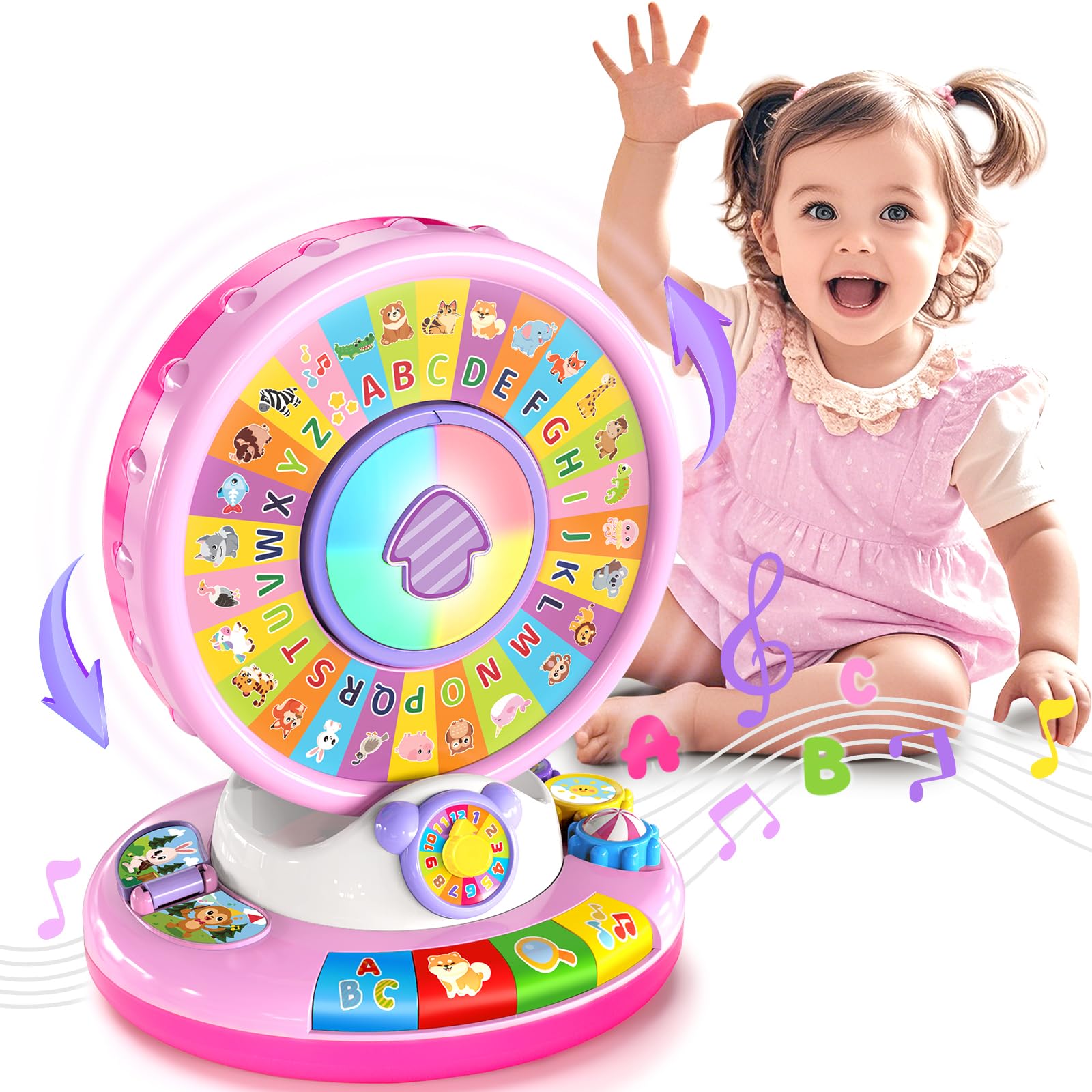
This Ferris-wheel-shaped spinner combines light and sound with a 360-degree rotating mechanism. Each turn of the wheel lands on a new letter and its corresponding animal, triggering a voice that says the letter name and the animal sound. The four progressive modes start with simple letter identification and move through animal naming to question-and-answer challenges that require the child to spin to the correct answer.
The musical mode plays four different songs (piano and violin tracks) when children turn the page of the attached book, and the gear blades on the side produce six unique sound effects when moved. The adjustable volume control is a practical feature for parents who want the stimulation without the headache-level loudness typical of many battery-operated toys. The pink color scheme is cheerful but also limits gender-neutral appeal.
Some adults find the voice slightly grating after repeated play, which is a common complaint with any talking toy. The battery compartment requires no batteries—the unit works on included demo batteries that should be replaced with fresh ones immediately. For babies and toddlers aged 6 to 24 months, this toy provides valuable early exposure to letter sounds and animal names, but older preschoolers will outgrow the limited depth of activities relatively quickly.
Why it’s great
- Four progressive modes scaffold from letter naming to quiz-style challenges
- Adjustable volume control prevents the noise from overwhelming parents
- Gear blades and page-turn book add fine-motor and musical exploration
Good to know
- Voice quality is functional but some adults find it annoying after repeated play
- Best for ages 6–24 months; older preschoolers will outgrow the depth quickly
FAQ
What age should I introduce an alphabet learning toy?
How do I know if a toy is safe for a toddler under 3 years?
Should I buy a screen-based or physical alphabet toy?
Final Thoughts: The Verdict
For most users, the best alphabet learning toys winner is the Vanmor Magnetic Wooden Alphabet Train Set because it combines strong kinesthetic feedback (magnetic polarity), progressive literacy scaffolding (42 flash cards), and heirloom-quality hardwood construction that survives years of play. If you want a comprehensive week-by-week learning station for a homeschool or classroom wall, grab the Torlam Alphabet Pocket Chart. And for an older preschooler who is fascinated by grown-up technology, nothing beats the LeapFrog ABC and 123 Laptop for building keyboard familiarity and early coding logic alongside alphabet mastery.