
Our readers keep the lights on and the weekend projects moving. As an Amazon Associate, I earn from qualifying purchases.
Specs are compiled from manufacturer listings and verified buyer reviews and can change over time — please confirm the key details on the product page before buying.
When the central furnace quits or the power grid drops mid-blizzard, an alternative heat source is what stands between you and a freezing house. The right pick for you depends on one question: do you need to heat a single bedroom quietly, or a drafty 1,500-square-foot workshop that has no electricity at all? This guide breaks down nine very different heaters — from whisper-quiet ceramic fans to propane units that need zero outlets — so you can match the machine to the room, the fuel, and your budget.
I’m Rikta — the founder and writer behind FitlyFast. This guide is built by comparing the manufacturers’ published specifications and the patterns across verified customer reviews, so you get each pick’s real strengths and trade-offs instead of marketing spin.
You need heat that works when your main system doesn’t, and the right alternative heat source depends on your space and safety needs. This breakdown covers plug-in ceramic fans for bedrooms and propane or gas units for garages and job sites, so you can match the right one to your situation.
Our Picks at a Glance


How To Choose The Best Alternative Heat Source
Choosing an alternative heat source starts with one honest answer: will you have electricity when you need the heat? If yes, a plug-in ceramic fan heater is the simplest, cheapest, and safest route. If you need warmth during a power outage, you must move to propane or natural gas, which generate heat without any electrical hookup for the core heating function.
Match the heat output to the room size
Every heater in this list carries a coverage number in square feet, and that figure is your reality check. A 1500-watt electric heater covers roughly 200-250 square feet — perfect for a bedroom or small office. Propane and gas units jump dramatically: an 18,000 BTU radiant heater manages up to 450 square feet, while a 60,000 BTU forced-air unit blasts through up to 1,500 square feet. Oversizing is a waste of fuel; undersizing leaves you shivering.
Know your fuel type and its catch
Electric heaters are zero-fuss but depend on the grid. Propane heaters like the Remington and Gasland units need a 20-pound tank you buy separately, and they burn through fuel at different rates depending on the BTU setting. The Mr. Heater natural-gas models connect to your home’s gas line, which keeps fuel costs low but requires professional installation and a gas line tap. Propane and gas units that run indoors must be rated “vent-free” or “indoor safe” — never assume a garage unit is safe inside a bedroom.
Check the safety stack before you buy
The non-negotiables are tip-over shutoff, overheat protection, and flame-retardant housing — features nearly every product here carries. Radiant propane heaters add a low-oxygen shutoff that kills the flame if the air in the room gets too depleted, which matters when you run them inside. Forced-air electric heaters run cooler to the touch but still demand a fire-safe gap from curtains and bedding. Buyers repeatedly warn against plugging high-wattage electric heaters into surge protectors or extension cords, so plan for a direct wall outlet.
Quick Comparison
| Model | Best For | Heat Output | Heating Coverage | Fuel Type | Amazon |
|---|---|---|---|---|---|
| DREO Atom One★ Best Overall | Bedrooms & small offices | 1500W | 200 sq.ft | Electric | Amazon |
| AUBKN PTC-SL2403Best Value | Compact personal warmth | 1500W | 200 sq.ft | Electric | Amazon |
| BREEZOMETop Performer | Larger single rooms | 1500W | 250 sq.ft | Electric | Amazon |
| Sunnote KW-CH05 | Small rooms on a budget | 1500W | — | Electric | Amazon |
| DREO Whole Room | Whole-room circulation | 1500W | 161-269 ft² | Electric | Amazon |
| Remington LP Forced Air | Garages & worksites | 60,000 BTU | 1,500 sq ft | Propane | Amazon |
| Gasland MHA18BN | Quiet radiant warmth | 18,000 BTU | 450 sq ft | Propane | Amazon |
| Mr. Heater Blue Flame | Power-outage home heating | 20,000 BTU | 700 sq. ft | Natural Gas | Amazon |
| Mr. Heater 80,000 BTU | Shops, barns & large garages | 80,000 BTU | 2,667 sq ft | Natural Gas | Amazon |
In-Depth Reviews
1. DREO Atom One Space Heater
Our pick — over 4.5★ from 28,500+ verified ratings; the strongest balance of quality and price.
The nightstand-friendly tower that pumps balmy 1500W heat without waking a soul.
DREO’s Atom One is the crowd favorite — and with good reason. The 1500W PTC ceramic element (a heating core that warms up fast and stays efficient) pushes air through 9 aerodynamic blades that cut the noise down to 37.5 dB, which owners describe as white-noise level. That means you can run it five feet from your bed all night and never notice the hum, which is exactly where buyers report they park it.
The 70° wide-angle oscillation sweeps heat across a 200 sq.ft zone, and owners confirm it handles a whole 10’x12′ office or heats a bathroom in minutes. ECO Mode acts like a reverse air conditioner — it automatically adjusts the heat to hit your target temperature while keeping the energy bill flat, which several buyers highlight as the reason they ditched their old heater. The remote works from 12 feet away, and the digital thermostat fine-tunes from 41 to 95°F in 1°F steps.
Safety is a full-barrier affair: an ETL-listed Shield360° system covers tip-over and overheat protection, plus a flame-retardant UL94 V-0 housing. The one hard rule buyers repeat: do not plug this into a surge protector or extension cord, because the draw overheats the outlet. Keep it on a direct wall socket and it is the easiest, most versatile pick here.
Why it wins the room
- Whisper-quiet 37.5 dB operation suits bedrooms and offices
- ECO Mode adjusts output automatically to save on the bill
- 70° oscillation plus remote control from 12 feet away
Read the fine print
- Must plug into a wall outlet, never a surge protector
- Best for small-to-medium rooms around 200 sq.ft
Your pick if: you want one dependable heater that quietly warms a bedroom or office, with remote control and energy-saving smarts.
Think twice if: you need to warm a large open-plan area or a space with no wall outlet nearby.
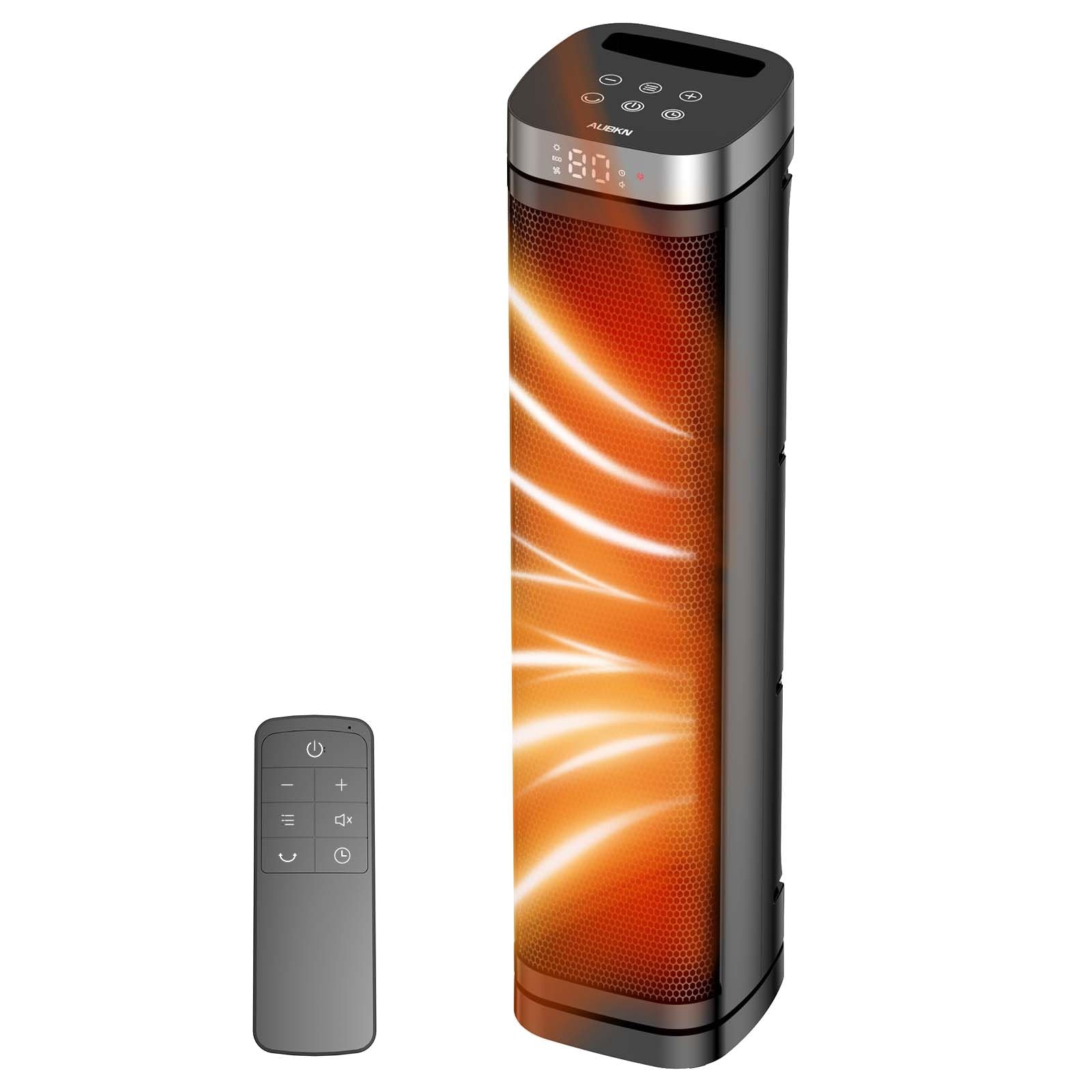
2. AUBKN Portable Ceramic Heater
A slim tower that turns a cold corner of the room warm in about three seconds.
If you want quick warmth without spending much, the AUBKN heater delivers: its PTC ceramic element (a fast-warming ceramic block that heats air directly) starts working in just 3 seconds, and buyers confirm it warms a 12×12 basement office in roughly 10 minutes. At 23.09 inches tall and just 5.51 inches deep, it is noticeably slimmer than the DREO’s 10.31-inch height, so it tucks into tighter spots without dominating the room.
The controls cover the essentials: 3 heating modes, a 1-12 hour timer, and a remote that needs 2 AAA batteries (not included). Owners appreciate that the display lights are dim enough not to disturb sleep, and a 24-hour auto power-off adds a layer of don’t-worry-about-it safety. It is ETL-certified with a flame-retardant 2-prong plug and a sturdy 6-foot flat power cord that owners mention runs cool.
The honest catch is on the unit itself: the onboard buttons are hard to press, so the remote is effectively mandatory. Don’t lose it. For the price, though, owners call it a reliable workhorse — one reviewer even ran it all winter to supplement a faulty apartment heater.
Smart budget warmth: this is the heater to buy when you want proven 1500W performance and quiet operation without paying for extra frills. The slim profile and dim display make it an easy bedroom fit.
Best suited for: budget buyers who want a quiet, compact heater for a single room and don’t mind relying on the remote.
Look elsewhere if: you dislike remotes and want sturdy physical buttons on the machine itself.
3. BREEZOME Space Heater
The tower that covers 250 sq.ft versus the DREO’s 200 sq.ft, all at under 35dB.
Need to heat a room that’s a bit bigger than a bedroom? The BREEZOME covers more ground: its 1500W PTC ceramic element warms up to 250 sq.ft, while the DREO Atom One covers 200 sq.ft. A cross-flow fan platform delivers warmth in just 2 seconds, according to the maker, and owners confirm it heats a 20×30 shed without complaint.
You get more control than most units: three modes (Power Heat, ECO, and Fan-only) plus 3 adjustable heat levels, and a 90° oscillation sweeps warmth to every corner — the widest sweep on any electric unit here, beating the AUBKN’s 70°. It runs under 35dB, quieter than the DREO’s 37.5 dB, so it earns its keep in bedrooms. The ECO mode uses a precise temperature sensor to hold your setting anywhere from 59 to 95°F while trimming the power draw.
The catch is reliability: review data shows a mixed pattern, with some units stopping after a few weeks. It is the one electric pick here where you should buy knowing there is a small chance of an early failure — the heat output is what owners praise most, but longevity is the trade-off for that performance at this price.
The coverage king
- 250 sq.ft coverage beats the 200 sq.ft standard
- Under 35dB – quieter than the DREO’s 37.5 dB
- 90° oscillation plus a portable carry handle
What to weigh
- Reliability is mixed — some units fail after a few weeks
- Sticker residue on the body can be hard to remove
Reach for this if: you need the widest electric coverage and the quietest hum for a bedroom or small living area.
Proceed with care if: you want a heater you never think about — the early-failure reports make it a slightly riskier long-haul bet.
4. Sunnote Space Heater
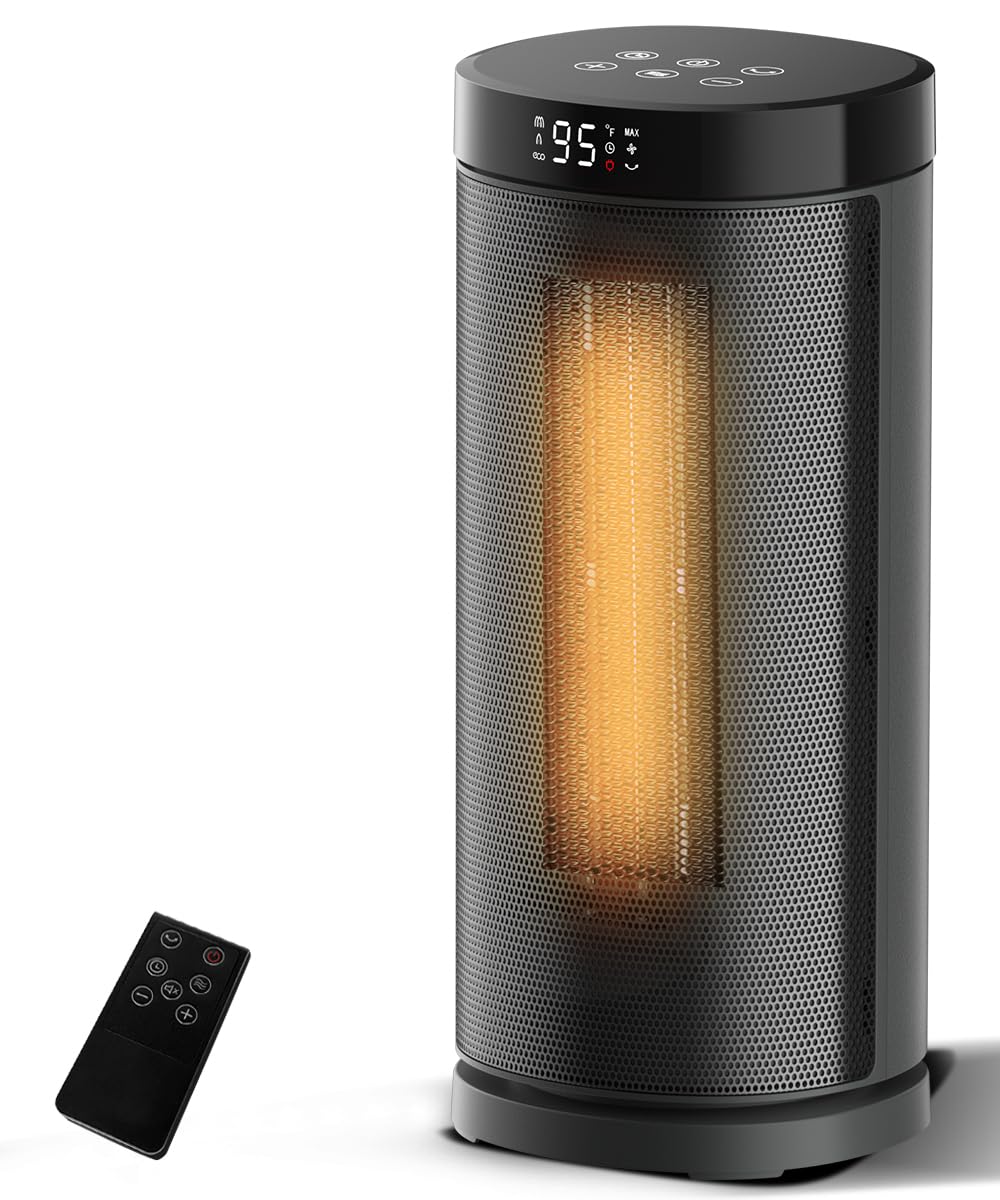
A small tower with a 3,000 rpm wind wheel that packs a serious punch for its footprint.
If you want heat that moves fast, the Sunnote heater relies on raw airflow. A 1500W PTC element paired with a 3,000 rpm/min wind wheel — that’s the spinning fan that pushes the hot air out — sends heat across the room in seconds, and owners call it “a small space heater that packs a punch.” The compact size makes it perfect for bedrooms, and the 80° wide-angle oscillation spreads warmth instead of blasting one spot.
Touch-screen controls, a 24-hour timer, and a remote give you full command from the couch. The digital thermostat adjusts from 41 to 99°F in ±1°F increments — the widest top range on any electric unit here, topping the DREO Atom One’s 95°F ceiling. Safety is covered by ETL-certified overheat and tip-over protection plus a V0 flame-retardant 2-prong plug.
The recurring complaint is the noise: some owners find it super quiet, but others report it gets really noisy over time. If you run a heater nightly in a bedroom, that inconsistency is worth knowing. For a small room where you want fast, even heat and a wide temperature range, it delivers.
Small but mighty: the compact frame and strong airflow win buyers over, and the 99°F max setting gives you more heat on demand than most electric rivals.
Choose this for: a small bedroom or office where you want a compact heater that heats fast and rotates to spread the warmth.
Keep scrolling if: you are extremely sensitive to fan noise and need a guarantee of silence.
5. DREO Whole Room Heater
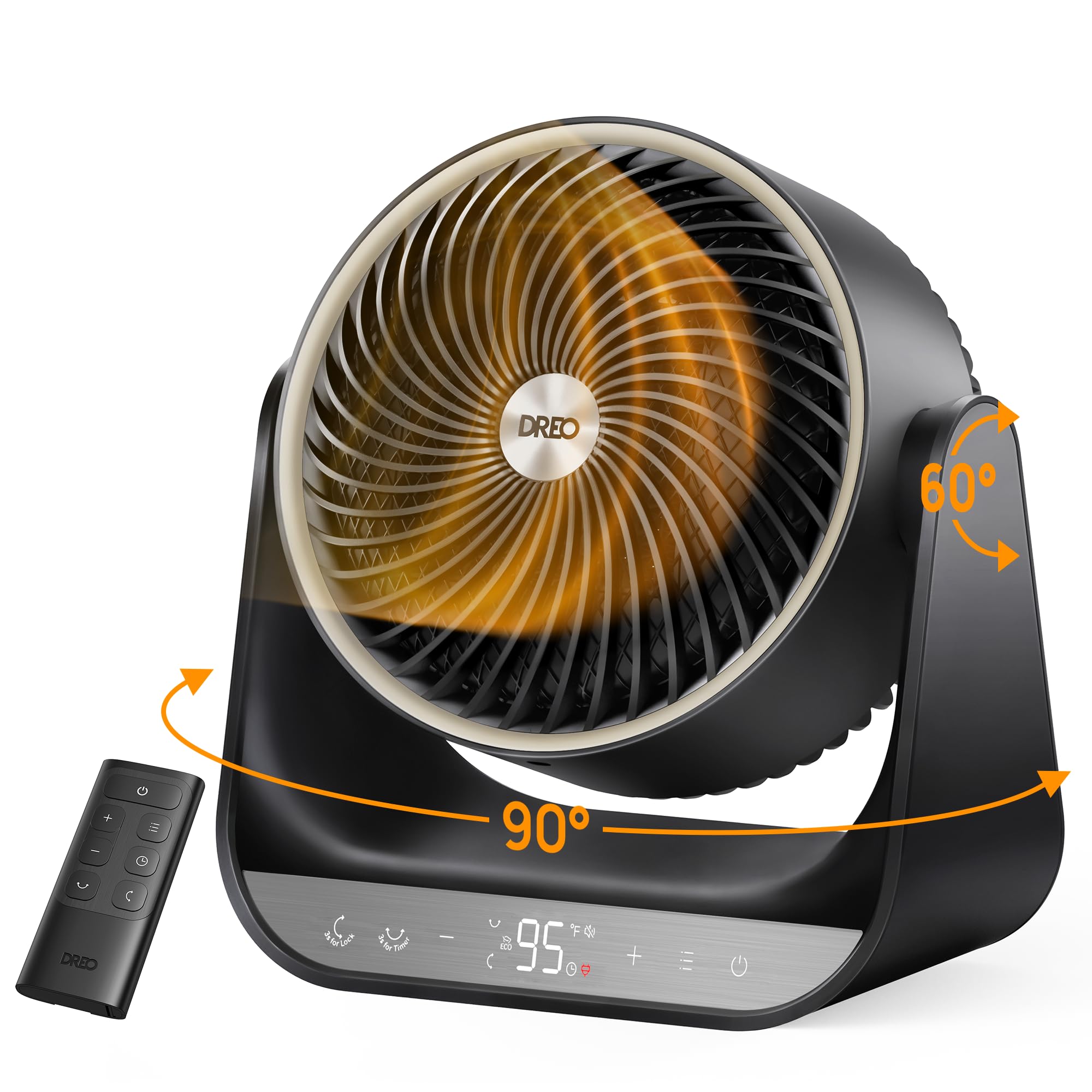
The only electric here that swings both up-and-down and side-to-side to flood the whole room.
For even heat in a larger room, the DREO Whole Room heater uses 3D oscillation: 60° vertical and 90° horizontal sweeps push 120 CFM of warm air (that’s cubic feet per minute — the volume of air moved) through a room at 12 ft/s. Owners say the dual-axis motion distributes heat evenly in a way no single-direction heater can, with one RV owner calling it the best of six or seven heaters they had tried over nine years.
The 1500W PTC element delivers that claimed 2-second instant warmth, and the brushless DC motor with an upgraded Bionic Blade design keeps noise at a whisper-quiet 34dB — the quietest figure on any pick in this guide. The ECO Mode holds your temperature from 41 to 95°F in 1°F increments while cutting power draw, and a 12-hour timer lets you schedule comfort.
It is heavier than the other electrics at 6.5 pounds, which owners actually read as sturdy build quality rather than a flaw. The one gap: there is no smart-app control on this model, so you cannot switch it on from your phone. If you want remote oscillation in two directions without the app, this is the electric heater to beat.
Why the 3D motion matters
- Up-and-down plus side-to-side oscillation spreads heat evenly
- Quietest in the guide at 34dB
- 120 CFM airflow for a strong, even throw
Before you buy
- No smart-app or phone scheduling
- Heavier than other electrics at 6.5 pounds
Grab this if: you want the most even whole-room warmth available from an electric unit, especially for a drafty basement or large bedroom.
Pass on it if: controlling the heater from your phone while away is a must-have feature for you.
6. Remington LP Forced Air Heater
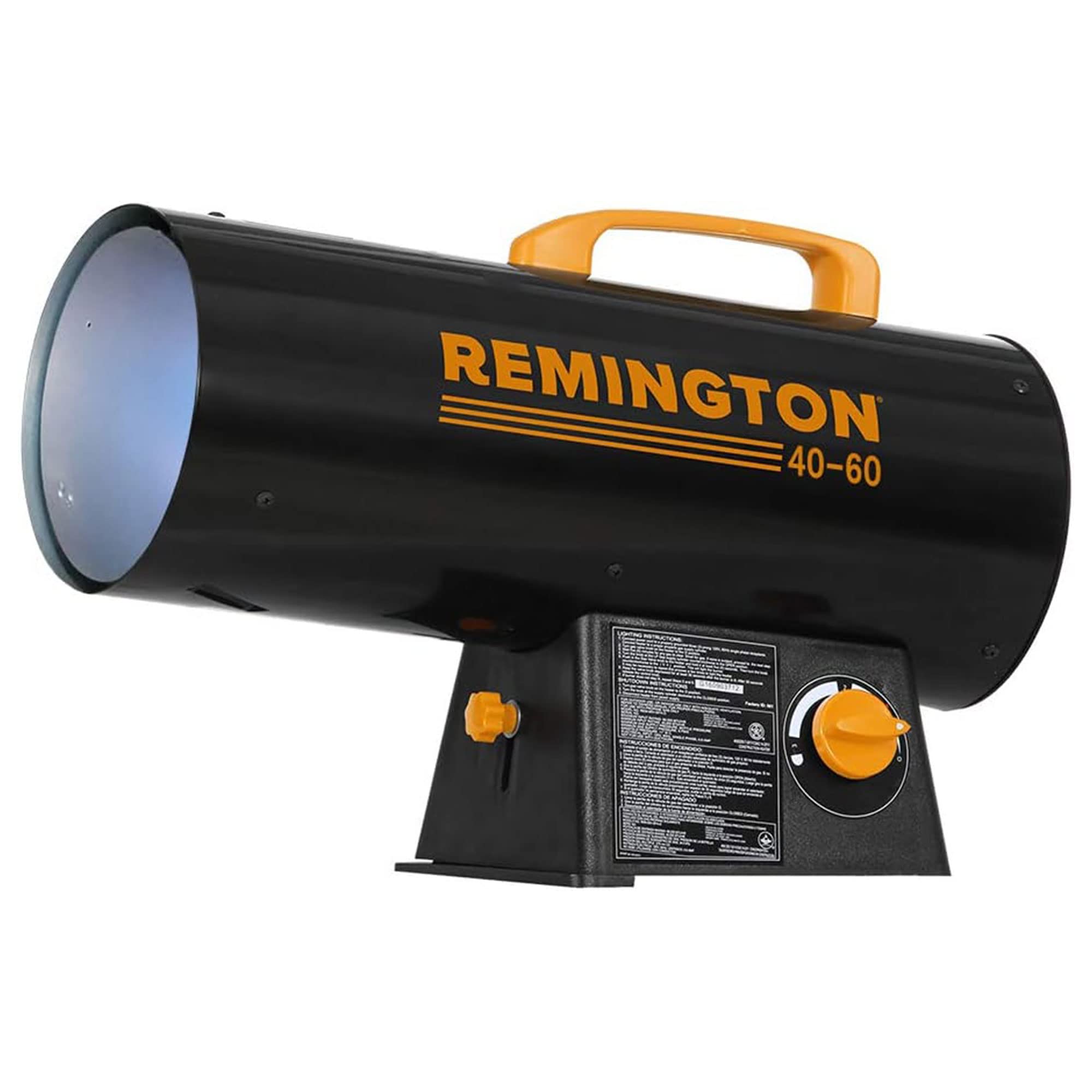
A propane bruiser that turns an unheated 1,500-square-foot shop into a worksite in minutes.
When the job site has no power, the Remington LP Forced Air heater is the answer. It cranks 60,000 BTUs (British thermal units — the standard measure of heat energy) through a forced-air fan to warm spaces up to 1,500 square feet, and customers note it can heat an insulated two-car garage in under 10 minutes. At just 11 pounds of heavy-duty steel, it is easy to haul from barn to garage to construction site.
Variable heat settings let you dial the output, and an adjustable height aim the warmth where you work. Electronic ignition gives a quick start, and the included 10-foot LP cylinder hose and regulator connect to a standard 20-pound propane tank (sold separately). Safety features include a thermocouple, a high-temperature limit shut-off, and a flame-out fuel cut-off — a thermocouple being a sensor that detects if the pilot flame goes out and shuts the gas flow down.
The trade-off is unmistakable: this unit is genuinely loud, which owners flag as its biggest downside. It is also rated for outdoor use, so treat it as a garage and worksite tool, not a bedroom heater. And the power cord is very short — under a foot — so you will need the propane tank and heater positioned close together. If you need brutal, fast heat for a big unheated space and do not mind the roar, this is the machine.
Built for big cold spaces
- 60,000 BTU heats up to 1,500 sq ft fast
- 11-pound steel body is portable for sites
- Triple safety: thermocouple, high-temp shut-off, flame-out cut-off
Know the noise
- Very loud — owners returned it partly for the roar
- Very short power cord under 1 foot
Reach for this if: you need portable, powerful heat for a garage, barn, or construction site with no electrical hookup.
Look elsewhere if: you want a quiet heater or anything rated safe for inside a living space.
7. Gasland MHA18BN Propane Radiant Heater

A rolling radiant cabinet that pours gentle heat without the forced-air roar.
Gasland’s MHA18BN takes a completely different approach from the Remington: instead of a loud fan, it uses radiant heat — infrared energy that warms objects and people directly, not the air around them. That makes it ultra-quiet, with owners describing a “gentle hum” rather than a blower. The 18,000 BTU output covers up to 450 square feet, and reviewers point out it heats an open-concept room in about an hour.
The design is genuinely clever: a 20-pound propane tank hides inside the cabinet, keeping it out of sight and making the unit easy to roll from room to room on built-in wheels with an easy-carry handle. Three heating modes — High, Medium, and Low — let you dial the output, and the whole thing runs with no electricity at all, so it keeps working through a power outage. Safety comes from tip-over shutoff and a low-oxygen shutoff that kills the flame if the room air gets too depleted.
The honest cautions are real-world: the radiant front gets hot enough to singe fur or clothes, so keep kids and pets away, and there can be fumes when the tank runs low. It is rated for outdoor use, so ventilate if you run it in a garage. For quiet, portable warmth that shrugs off blackouts, this is the pick.
Silent and self-contained
- Ultra-quiet radiant heat, no fan noise
- No electricity needed, works in outages
- Rolling wheels and hidden tank for easy moving
Handle with care
- Radiant front can burn skin, fur, or clothes on contact
- Fumes may appear when the tank runs low
Pick this if: you want quiet, movable heat for a garage, barn, or workshop and want it to keep working when the power goes out.
skip it if: small children or pets will be unsupervised near a red-hot radiant panel.
8. Mr. Heater Vent Free Blue Flame
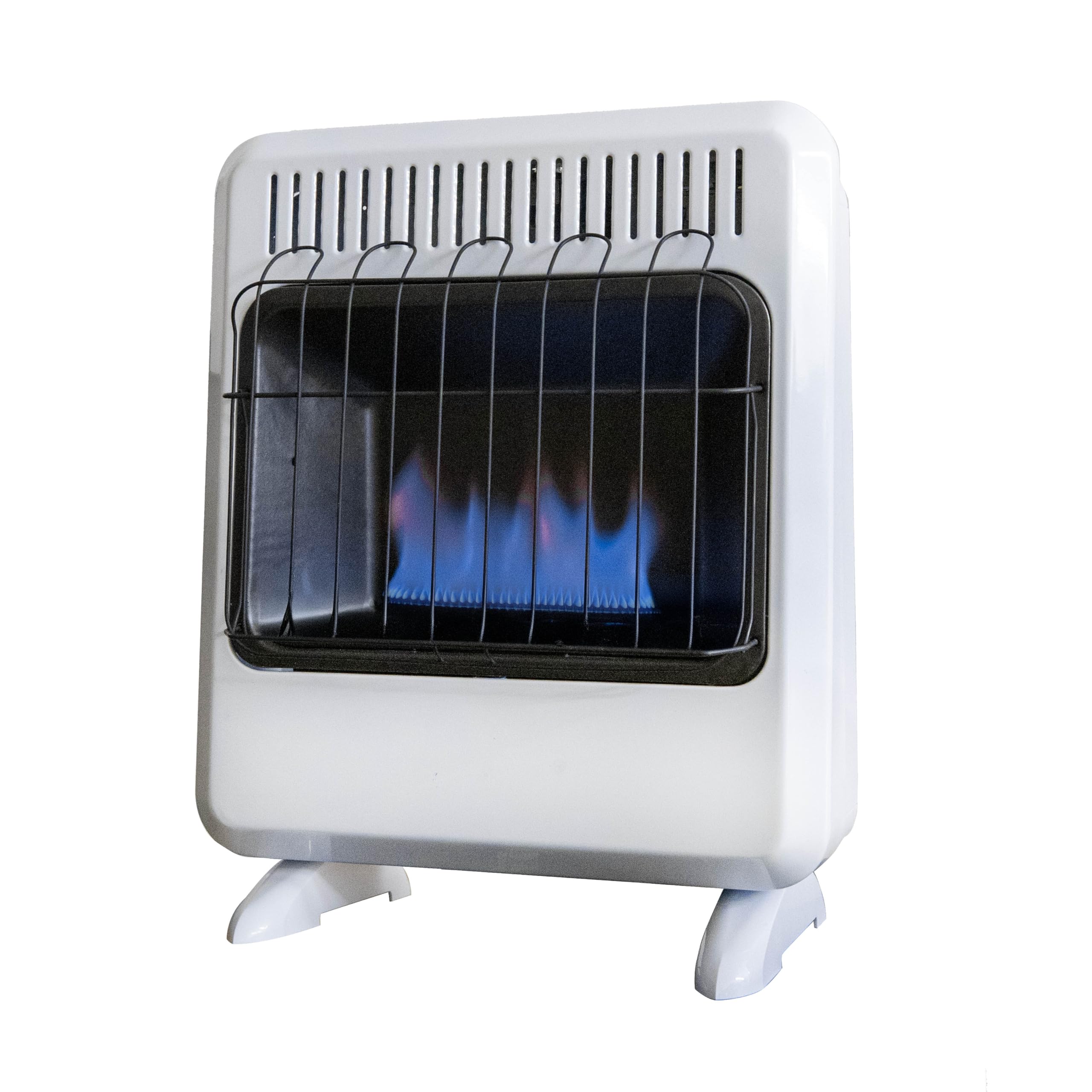
A wall-mounted gas panel that heats up to 700 square feet with zero electricity required.
If you want heat that works even when the power goes out, Mr. Heater’s Blue Flame runs entirely on natural gas from your home’s line, needs no electricity at all, and requires no venting outdoors — the blue-flame burner converts gas into even convection heat that rises and circulates. A battery-operated electronic ignition uses a single AA battery (included) to fire it up, which means it keeps pumping heat through a power outage when every electric unit in this guide goes dark.
The 20,000 BTU output warms up to 700 square feet, and a built-in adjustable thermostat cycles the unit on and off to hold your temperature. Shoppers say it cut their heating bill in half, though the actual gas-line installation is the real project — one buyer paid to have a gas line tapped and the heater hooked up. Once installed, buyers report a 30-minute swap-in procedure and a yellow Teflon tape seal get it running with an all-blue, silent flame.
The nuances are worth knowing: the heat vents upward rather than forward, so it works best with some airflow help, and there is a slight smell when it fires up that fades after a few minutes. It is rated indoor-safe and vent-free, but a CO detector is a wise companion for any gas appliance. This is the long-term, low-fuel-cost answer for a home that needs to stay warm no matter what the grid does.
The outage-proof choice
- No electricity and no venting required
- 20,000 BTU heats up to 700 sq ft
- Built-in thermostat cycles on and off to save gas
Plan the install
- Needs a natural gas line — professional hookup costs extra
- Slight odor when it first fires up
Choose this for: a permanent, low-fuel-cost heating solution that keeps a home warm through blackouts, but only if you already have a natural gas line.
Not for you if: you rent, or you do not have gas plumbing available and cannot justify the installation cost.
9. Mr. Heater 80,000 BTU Forced-Air Unit
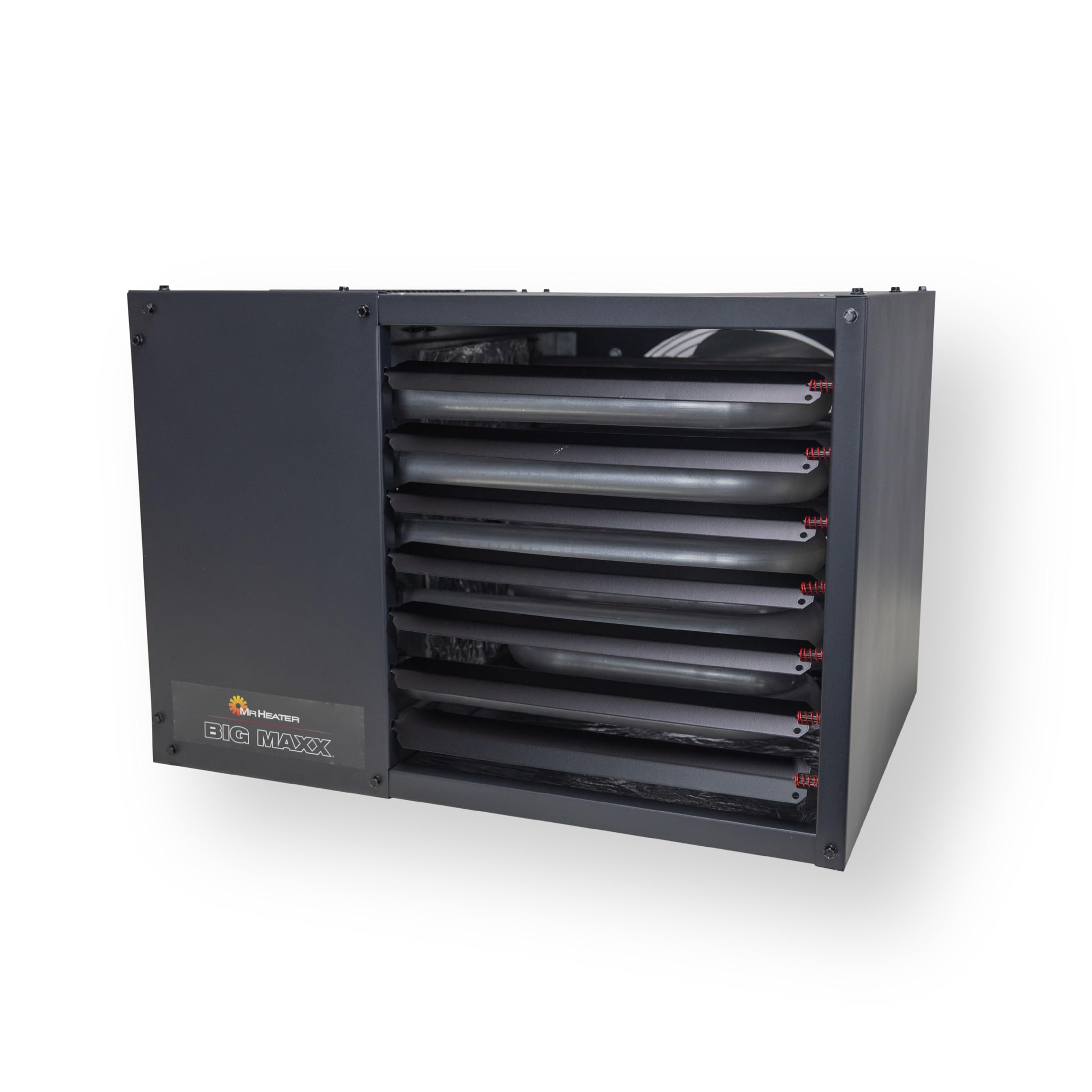
A ceiling-mounted giant that converts an entire unheated shop into a warm workspace.
For the biggest spaces, Mr. Heater’s 80,000 BTU forced-air unit — a ceiling-mounted furnace that blasts warm air from overhead — heats up to 2,667 square feet, making it the most powerful pick in this guide by a wide margin. Owners mention it warms a 37×27 building with 18-foot ceilings, maintaining 40°F and jumping to 60°F in 15 minutes via a Wi-Fi thermostat (sold separately).
It runs on either propane or natural gas — the box ships with an NG-to-LP conversion kit — and requires a 10-foot minimum ceiling height with 8 feet of clearance from the base to the floor. The low-profile design mounts flush to the ceiling with two included angle brackets, and safety features include a high-temperature shut-off switch and a flame sensor that cuts the gas if the flame goes out. Buyers call it quiet and efficient, with one noting it draws only 2.3 amps of power to run the fan.
The real cost is in installation: customers note venting and full professional install can approach, and you must confirm the kit arrived with the box — one unit shipped missing the propane conversion kit, though Mr. Heater replaced it quickly. There is also the noise reality: some find it quiet, others loud, so acoustics vary by mounting. For a workshop, barn, or oversized garage where you want one unit to handle everything, this is the final answer.
King of coverage
- 80,000 BTU heats up to 2,667 sq ft — the biggest here
- Runs on propane or natural gas with conversion kit included
- Compatible with smart Wi-Fi thermostats
Budget for setup
- Professional install and venting can cost hundreds extra
- Needs 10 ft ceiling height minimum
Buy this if: you have a large shop, barn, or garage and want one powerful unit that handles the whole space.
Pick something else if: your ceiling is under 10 feet or you cannot budget for professional installation.
Understanding the Specs
Watts vs. BTUs
Electric heaters are rated in watts — the standard 1500W figure is what a typical wall outlet can safely supply, and it covers about 200-250 square feet. Gas and propane heaters are rated in BTUs, the actual heat energy produced, and the numbers jump fast: 18,000 BTU covers 450 sq ft, 60,000 BTU covers 1,500 sq ft. More BTUs mean more heat but also more fuel burned, so match the number to the room rather than buying the biggest figure.
Heating Coverage
Coverage in square feet is the manufacturer’s estimate of the space a heater can meaningfully warm. For electric units it is a hard ceiling — a 200 sq.ft heater will struggle in a 300 sq.ft open room. For propane forced-air units, coverage is more forgiving because the heat output is so much higher, but insulation and ceiling height still shift the real number. Use coverage as a “do not exceed” guideline, not a guarantee.
Forced Air vs. Radiant Heat
Forced-air heaters use a fan to blow hot air out, which warms a room fast but makes noise. Radiant heaters emit infrared energy that warms people and objects directly, which is silent but slower to raise the overall air temperature. Choose forced air for quick warmth in a room you are actively using, and radiant for quiet, steady heat where the hum would bother you.
Safety Certifications
ETL certification means an independent lab tested the unit for electrical safety. Tip-over protection shuts the heater off if it falls, overheat protection kills it if internal temperatures spike, and flame-retardant housing resists catching fire. On propane radiant units, a low-oxygen shutoff sensors the air and cuts the flame if oxygen drops too low for safe indoor use. These are the features that separate a safe heater from a hazard.
FAQ
Is it safe to run a propane heater inside my garage?
What is the difference between watts and BTUs for heaters?
Will an electric space heater work during a power outage?
Can I plug a 1500W heater into a power strip or extension cord?
How much space does a 60,000 BTU propane heater cover?
What does “vent-free” mean on a gas heater?
Is radiant heat or forced air better for a quiet room?
How do I choose between propane and natural gas for a big workshop?
What safety features should every space heater have?
Can I install the Mr. Heater 80,000 BTU unit myself?
Final Thoughts: The Verdict
For the majority of shoppers, the best alternative heat source is the DREO Atom One because it pairs whisper-quiet 37.5 dB operation with easy 1500W warmth and remote control — the complete package for a bedroom or office. If you want the widest electric coverage or backup heat that survives a power outage, reach for a propane or gas unit like the Remington LP Forced Air or the Mr. Heater Blue Flame. And if a large workshop is the target, the Mr. Heater 80,000 BTU is the one to call. The crowd favorite — 4.6 stars across 28,000+ owners — is the DREO, and that popularity is earned: it simply does everything most people need, quietly and safely.
How We Picked
We do not accept paid placement. Every pick is matched to a real buyer and a real use-case; we do not hands-on test units.
Sources & Methodology
Specifications: manufacturer listings and product documentation. Review insights: verified customer reviews, as of August 2026. Pricing: not shown on this page (it changes often); check the current price via the retailer link.
As an Amazon Associate, FitlyFast earns from qualifying purchases. This does not affect which products we feature.