
Our readers keep the lights on and the weekend projects moving. As an Amazon Associate, I earn from qualifying purchases.
Caring for someone with Alzheimer’s means facing the daily reality of wandering, sundowning anxiety, and the constant need for calm engagement. The right tools — from bed alarms that prevent falls to sensory aids that soothe restless hands — can transform a caregiver’s ability to provide safety and comfort without burning out. This guide cuts through the noise to find the specific devices that deliver measurable peace of mind.
I’m Rikta — the co-founder and writer behind FitlyFast. I spent hundreds of hours analyzing caregiver feedback, sensor reliability data, and safety specifications to build this guide around what actually reduces risk and improves daily life for Alzheimer’s patients and their families.
Whether you need a motion sensor to catch a midnight exit or a fidget blanket to calm sundowning anxiety, this is your focused review of the best alzheimer’s products tested by real caregivers like you.
How To Choose The Best Alzheimer’s Products
Selecting equipment for an Alzheimer’s patient is different from general safety shopping. You need to balance sensitivity — avoiding loud noises that trigger agitation — with reliability, because a missed alert can mean a fall or a lost loved one. The three pillars are fall prevention, wandering deterrence, and sensory regulation.
Motion Sensors vs. Pressure Pads for Fall Prevention
Pressure pads — the classic bed mats — suffer from false alarms triggered by diapers shifting or patients rolling over. Motion sensors placed under the bed frame detect when legs swing toward the floor, offering a cleaner trigger point. For night use, look for a sensor with an adjustable alarm that plays in the caregiver’s room, not the patient’s, to avoid startling the person getting up.
Reality Orientation Clocks: Display Size and Dimming Matter
Dementia patients often lose track of time and day, increasing confusion and agitation. A good orientation clock displays the date, day, and AM/PM in bold type readable from across the room. Auto-dimming is non-negotiable — a screen that stays bright at 7 PM will disrupt sleep and worsen sundowning. Voice announcement for the time is a bonus for those with vision decline.
Sensory Products: Fidget Blankets vs. Stuffed Animals
Restless hands are a hallmark of Alzheimer’s. Fidget blankets offer multiple textures, zippers, and Velcro tasks that keep fingers busy and lower anxiety. Stuffed animals with a soft fur coat that can be “petted” provide a calming, familiar comfort object — especially for patients who respond to tactile warmth. Choose based on the patient’s remaining dexterity and what soothes them most.
Quick Comparison
On smaller screens, swipe sideways to see the full table.
| Model | Category | Best For | Key Spec | Amazon |
|---|---|---|---|---|
| Smart Caregiver Bed Exit Alarm | Fall Prevention | Pro-level bed monitoring | 300 ft range, vibrate + sound | Amazon |
| Nesthao Upgraded Bed Sensor Alarm | Fall Prevention | Budget bed exit alert | 918 ft max range, LED + sound | Amazon |
| YisTech Caregiver Pager | Wandering Alert | Multi-door wandering prevention | 58 ringtones, 110 dB max volume | Amazon |
| Mitoart Digital Dementia Clock | Reality Orientation | Time/day orientation aid | 7″ auto-dimming display, voice announcement | Amazon |
| VonNova Fidget Blanket | Sensory Engagement | Portable lap fidget with photo album | Zippered pouch, medical card slot | Amazon |
| Odoxia Fidget Book | Sensory Engagement | Fidget blanket with varied textures | Felt book, multiple difficulty levels | Amazon |
| SOFWO Fidget Muff Dog | Sensory Engagement | Stroking comfort for dog lovers | Velvet plush, detachable blanket | Amazon |
In‑Depth Reviews
1. Smart Caregiver Bed Exit Alarm with Wireless Pager
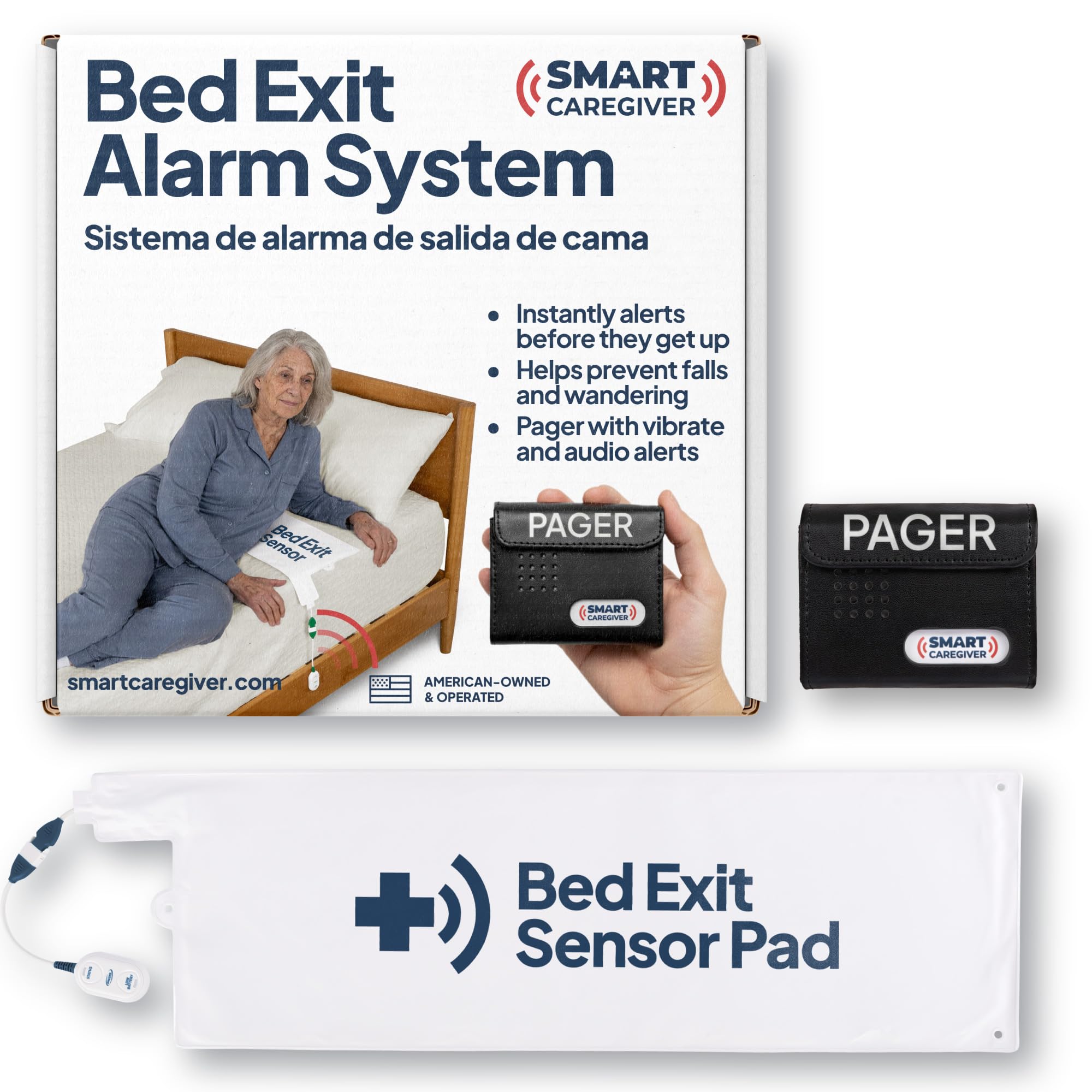
This bed exit alarm is the gold standard for fall prevention in Alzheimer’s care. Unlike motion-based sensors that detect leg swing, this system uses a 10-by-30-inch pressure pad with full-coverage weight sensing. Place it under the patient’s shoulders — the instant they start to sit up, pressure is released and the pager alerts you. The system is engineered to reduce false alarms from rolling or diaper shifts, a common frustration with cheaper pads.
The included pager offers both vibrate and 70-decibel sound options. Caregivers consistently prefer the vibrate mode at night to avoid waking the household. The unit supports up to six Smart Caregiver sensors, so you can expand to monitor a bed, chair, and doorway all from one receiver. Maximum wireless range is 300 feet in open space, more than enough for most homes.
Smart Caregiver is a U.S.-based company with three decades of experience in fall prevention. The pad is thin enough to stay unobtrusive under a fitted sheet, and it wipes clean easily. Some users note the alarm tone is fixed (like a doorbell) with no selection options, and the pad can shift slightly overnight — checking placement is important. For reliability and customer support, this is the premium pick.
Why it’s great
- Vibrate mode for silent caregiver alerts at night
- Reduced false alarms from full-coverage pressure sensor
- Expandable to six sensors for complete home monitoring
- Trusted U.S. company with strong warranty support
Good to know
- Alarm tone is fixed with no ringtone selection
- Pad can shift under the sheet; requires periodic re-checking
- Premium price-point compared to motion sensors
2. YisTech Caregiver Pager Door Alarms (Three Sensor Two Receiver)

Wandering is one of the most dangerous behaviors in Alzheimer’s, especially during sundowning hours. This system from YisTech comes with three magnetic door sensors and two plug-in receivers, making it a comprehensive setup for securing multiple exits. Each sensor sticks to any door or window with double-sided tape, and the receiver plugs into a standard outlet. No wiring, no smartphone app — just immediate alerts the moment a door opens.
The receiver boasts 58 ringtones and 5 adjustable volume levels from 0 dB up to 110 dB. For hearing-impaired caregivers, the built-in LED indicator flashes in sync with the chime. The wireless range is advertised at 260 feet in open space, so you’ll hear the alert even from the backyard or basement. Each receiver can pair with up to 20 sensors, and each sensor can trigger a different ringtone, letting you know which door is opening by sound alone.
Caregivers report that this system provides real peace of mind — one reviewer noted it caught an 85-year-old mother leaving the apartment at 3 a.m. The door sensors require a special 12-volt battery that needs periodic checking; some users experienced a transponder failure after about 18 months. For the price point, this is a high-value wandering solution.
Why it’s great
- Three sensors cover multiple exits for complete wandering protection
- 58 ringtones let you identify which door is triggered by sound
- 110 dB max volume with LED flash for hearing-impaired caregivers
- Battery-powered sensors with 260-foot range, no hardwiring needed
Good to know
- Ringtone selection may reset to default unexpectedly
- Sensor batteries are a less common 12-volt type
- Some units experienced failure after 18-24 months
3. Nesthao Upgraded Bed Sensor Alarm and Fall Prevention

Unlike pressure pads that sit on the mattress, this system uses a wireless motion sensor placed on the floor under the bed. It detects when the patient’s legs swing toward the ground — a more precise fall-prevention trigger that avoids false alarms from incontinence or the patient shifting in their sleep. This is a smart alternative when pressure pads give too many nuisance alerts.
The kit includes one caregiver pager receiver and one motion sensor, both running on AA and AAA batteries (included). The maximum wireless range is a generous 918 feet in open area, meaning the pager stays connected even in sprawling homes or across a yard. A built-in LED flashing light accompanies the sound, and five volume levels let you find the right balance between alerting and startling. The alarm plays only in the caregiver’s room, keeping the patient’s space quiet.
Users highlight the easy setup — just place the sensor on the floor, turn it on, and let the 20-second self-test complete. Some find the detection beam very wide, suggesting a simple DIY blind helps narrow the field. A few reviewers note the sensor unit can be fragile; handling with care is recommended. For the price, this is a smart motion-based alternative to pressure pads.
Why it’s great
- Motion-based detection avoids false alarms from incontinence or pad shifts
- 918-foot range is best-in-class for wireless caregiver pagers
- Alarm sounds only in caregiver’s room, not patient’s room
- LED flash aids hearing-impaired caregivers
Good to know
- Wide detection beam may need DIY blinds to narrow field
- Sensor unit has some fragility; handle carefully
- Lowest volume setting may still be too loud for some
4. Mitoart Digital Alarm Clock with Date and Day of Week
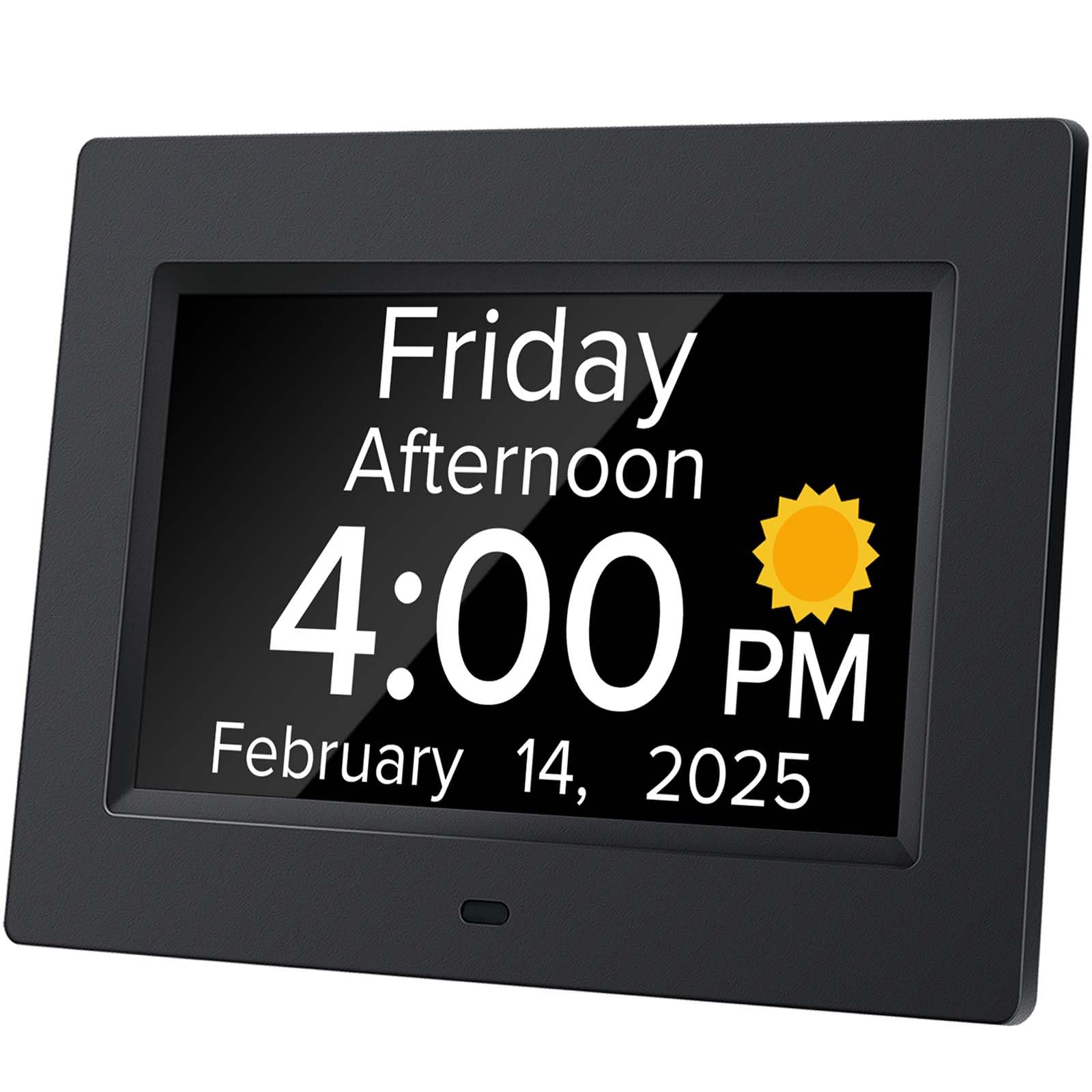
Disorientation about time and day is a core symptom of dementia that feeds sundowning anxiety. This Mitoart clock directly addresses that with a 7-inch digital display that shows the day of the week, month, date, and AM/PM in large, bold letters — no confusing abbreviations. The display auto-dims at 7 PM to a soft 50 cd/㎡ and brightens to 250 cd/㎡ at 7 AM, preventing bright light from disrupting sleep cycles.
Beyond display, this clock includes a voice-announcement feature: press a button on the back or use the remote to hear the current time spoken aloud in one of nine languages. This is invaluable for patients with vision decline. It also supports multiple alarms with reminders, so caregivers can program pill schedules or daily routines directly into the clock.
Setup is intentionally simple — one-button time adjustment and no complex menus. Caregivers describe it as “set it and forget it,” with the automatic DST adjustment saving a headache twice a year. The aesthetic is utilitarian (plain black frame), but the function is hard to beat. A few users wished the font was even larger, but most report readability from across the room is excellent.
Why it’s great
- Auto-dimming prevents bright screen from disrupting night sleep
- Voice announcement of time aids visually impaired patients
- Multiple alarms for medication and routine reminders
- Automatic DST adjustment eliminates manual fuss
Good to know
- Design is utilitarian, may not match every decor
- Some users desire even larger font options
- Units may rely on non-standard backup battery
5. VonNova Fidget Blanket for Adults with Dementia

Restless hands in Alzheimer’s patients can escalate to agitation or repetitive picking. This fidget blanket from VonNova channels that energy into engagement with a zippered pouch, multiple textures, and a unique double-sided photo album page where caregivers can insert family pictures. The familiar faces help with emotional grounding during anxious moments.
The blanket is lightweight — about 11 inches square — and features a soft plush cover. A zipper closure turns it into a portable bag with handles, making it easy to carry to appointments or keep in a car. It includes an emergency medical card slot, a practical safety touch. The product also arrives with a complementary fidget toy.
Caregivers report the photo sleeves work well for patients who still recognize family, but some advanced-stage patients may not identify the faces. Durability is generally strong, though one user noted a button fell off, creating a potential choking hazard — removing loose accessories is an easy precaution. The lace and ribbons are popular for patients who love tactile stimulation. Overall, the design is thoughtful for mid-stage dementia.
Why it’s great
- Photo album page helps with emotional grounding and connection
- Zippered pouch with handles acts as a portable activity bag
- Includes medical card slot for emergency ID
- Lightweight and easy to bring on car rides or to doctor visits
Good to know
- Photo recognition may not work in late-stage dementia
- Some buttons may detach; check for loose pieces
- Best for patients who can still manipulate small items
6. Odoxia Fidget Book for Elderly with Dementia

This fidget book is built like a felt activity board in book form — roughly 10 inches square and weighing under a pound — making it easy to rest on the patient’s lap. The pages contain a variety of sensory tasks: zippers, Velcro apples to “pick,” braided ribbons, sequin patches, and a finger-trap ring. The mix of difficulty levels means it can grow with the patient or be used across different stages of dementia.
Durability is a strong point — caregivers report no page tearing after months of daily use. The felt construction is soft and safe, without hard edges. The book format is also easy to store upright or slip into a bag for shared use in nursing homes. The range of textures (fur, smooth, rough, crinkly) keeps the sensory input fresh over repeated sessions.
The Velcro pieces are glued on and can be pulled off by determined hands, so periodic supervision is wise. Patients with severe arthritis may find the tasks too dexterous, as the buttons and zippers require fine motor control. The initial Velcro grip can be too strong, requiring a caregiver to loosen it slightly for the patient. For mid-stage dementia, this is a high-quality, versatile sensory tool.
Why it’s great
- Variety of tasks (Velcro, zippers, ribbons, sequins) prevents boredom
- Felt construction is quiet, safe, and durable for daily use
- Multiple difficulty levels suitable for different dementia stages
- Book format is easy to store and share in care facilities
Good to know
- Requires fine motor skills; not ideal for severe arthritis
- Velcro pieces are glued on and may be pulled off
- Initial Velcro grip may need loosening by caregiver
7. SOFWO Fidget Blanket and Muff Dog for Adults with Dementia

Not every Alzheimer’s patient responds to structured fidget tasks. Some find deeper comfort in simple, repetitive stroking. This SOFWO plush dog combines a soft velvet body with a detachable base blanket that can be removed, washed, or used separately. The concept is elegant: provide a warm, huggable “pet” that also offers a lap blanket for added comfort.
The muff design allows the patient to slip their hands inside for warmth while petting the puppy through the fabric. Small fidget activities are sewn into the jacket — a pocket to hide a ball, a zipper, and tags to tug. The 7-by-16-inch size is substantial enough to feel like a real companion. Most caregivers report the patient naming the dog and taking it everywhere, which is a powerful emotional anchor.
One Spanish-language reviewer mentioned the price felt high for the function, which is a fair note — this is a premium sensory toy rather than a multi-task device. Cleaning is spot-clean only, and the accessories are hand-sewn, so rough handling could risk detachment. For patients who crave the comfort of a pet but can no longer care for one, this is a compassionate alternative.
Why it’s great
- Stroking the plush fur provides deep calming comfort for sundowning
- Detachable blanket adds lap warmth and sensory options
- Patients often bond emotionally, naming their dog companion
- Muff design keeps hands warm while engaging the senses
Good to know
- Spot-clean only for the plush body
- Hand-sewn accessories may detach with aggressive use
- Primarily a comfort object, not a multi-activity fidget board
FAQ
Will a motion sensor under the bed work if the floor is carpeted?
Can these products be used for someone with both dementia and hearing loss?
How do I prevent the patient from removing a fidget blanket or alarm sensor?
Is it safe to leave a fidget blanket unsupervised with a late-stage dementia patient?
Final Thoughts: The Verdict
For most users, the alzheimer’s products winner is the Smart Caregiver Bed Exit Alarm because its pressure-pad reliability, vibrate pager, and expandability to six sensors provide the most complete fall-prevention system for both safety and caregiver peace of mind. If you want a reality orientation clock that reduces daily confusion, grab the Mitoart Digital Dementia Clock for its auto-dimming display and voice announcement. And for calming sundowning anxiety with tactile comfort, nothing beats the SOFWO Fidget Muff Dog — its plush stroking companion brings genuine emotional relief to wandering hands.