
Our readers keep the lights on and the weekend projects moving. As an Amazon Associate, I earn from qualifying purchases.
Struggling to read the tiny numbers on a standard alarm clock or feeling disoriented about whether it’s morning or night is a daily frustration that a poorly designed clock radio creates. The wrong device adds confusion through complicated menus, dim displays, and tiny text, while the right one offers instant clarity, gentle reminders, and a calming presence in the bedroom.
I’m Rikta — the co-founder and writer behind FitlyFast. My deep research into assistive technologies and product durability helps me identify which clock radios genuinely reduce confusion and which simply add another layer of complexity.
After analyzing display sizes, dimming ranges, alarm volume controls, and ease of setup across dozens of models, I have narrowed the field to the very best options. This guide covers everything you need to find the perfect am/fm clock radio for seniors.
How To Choose The Best AM/FM Clock Radio For Seniors
Selecting a clock radio for a senior requires focusing on accessibility over aesthetics. The priority is reading the time and date instantly — often without glasses — and operating the device with minimal dexterity or vision. Here are the key decision points.
Display Size, Color, and Dimming Control
A 7-inch or larger digital display with high-contrast letters makes reading easy from across the room. Red LEDs are often gentler on aging eyes at night than blue or white, and an auto-dimming function that adjusts brightness based on ambient light prevents glare while preserving readability. Manual control over brightness is essential.
Alarm Volume and Sound Options
Seniors with hearing loss need an alarm that can get genuinely loud — upwards of 80 decibels — without being harsh. Models offering a choice between a buzzer, a gradual tone, or the radio allow the user to choose a wake-up sound that is effective yet gentle. Visual alarm indicators on the display are a helpful secondary cue.
Ease of Setup and Daily Operation
Complex menus on small buttons are a serious barrier. Look for units with labeled tactile buttons, a remote control for distant changes, or voice-announcement features that read the time aloud. Preset radio buttons reduce the need for manual tuning, and automatic DST adjustment eliminates a twice-yearly hassle.
Quick Comparison
On smaller screens, swipe sideways to see the full table.
| Model | Category | Best For | Key Spec | Amazon |
|---|---|---|---|---|
| Sharp Digital Alarm Clock | Premium | Ultra-large readable display | 8.9″ LED with 3″ tall numbers | Amazon |
| American Lifetime Dementia Clock | Premium | Memory support with full day/date | 8″ display with auto-dimming | Amazon |
| Magnasonic Projection Alarm Clock | Premium | Ceiling/wall time projection | 180° swivel projection lens | Amazon |
| Pastigio 7″ Digital Clock | Mid-Range | Time-of-day orientation & 5 visual phases | 7″ IPS screen with 1024×600 resolution | Amazon |
| Mitoart Dementia Clock | Mid-Range | Voice time announcement & multiple alarms | Auto-dimming 50cd/㎡ to 250cd/㎡ | Amazon |
| Sonnet Alarm Clock Charging Station | Mid-Range | Very loud alarm for hearing impaired | 110dB maximum buzzer volume | Amazon |
| uscce Dual Alarm Clock Radio | Budget | Compact size with 0-100% dimmer control | 3.4″ LCD with full-range dimmer | Amazon |
In‑Depth Reviews
1. Sharp Digital Alarm Clock (8.9″ Display)

The Sharp Digital Alarm Clock dominates the field with its 8.9-inch LED panel showing numbers that are 3 inches tall — nearly double the size of most competitors. This makes it the most readable model on this list for seniors with significant vision loss. The tilt-and-swivel display lets you angle the screen perfectly toward your bedside vantage, eliminating glare and viewing angle issues that plague fixed-position clocks.
The AccuSet auto-time feature pre-programs the clock with the correct time based on your time zone, so setup is a one-step process of plugging it in and selecting your zone. A built-in FM radio stores up to ten stations with decent sound quality, and the dual-alarm system works well for couples or separate weekday/weekend schedules. The 3-level brightness control can be set to low, high, or completely off.
Some users have reported that the auto-time setting does not update for Daylight Saving Time automatically, requiring a manual switch. The display is bright even on the lowest setting, and the 2-amp USB port charges devices but lacks a second port. For pure readability, however, this clock is unmatched.
Why it’s great
- 8.9″ display with 3″ red numbers is exceptionally easy to read
- AccuSet automatically configures time on plug-in
- Tilt and swivel display reduces annoying glare
Good to know
- Does not automatically update for DST on some units
- Lowest brightness setting still casts noticeable light
- Single USB charging port only
2. American Lifetime Dementia Clock

The American Lifetime clock was purpose-built for seniors experiencing memory loss or cognitive decline, and its design decisions reflect that focus. The 8-inch display spells out the full day of the week, month, and date in large clear letters with no confusing abbreviations — a detail that eliminates the disorientation of seeing “Wed, 3/12” when you need to know “Wednesday, March 12.” The high-contrast white text on a black background is readable from across the room.
Five customizable alarms function as medication and appointment reminders, and the auto-dimming feature adjusts brightness smoothly between daytime viewing and nighttime comfort. The built-in battery backup preserves both the time and alarm settings through a power outage, which is critical for medical reminder reliability. The compact 8×6-inch footprint fits neatly on a nightstand or can be wall-mounted using the included slots.
This model does not include a built-in AM/FM radio — it focuses exclusively on clarity and memory support. The packaging deliberately excludes the words “dementia” or “Alzheimer’s,” making it a sensitive gift option. Some users find the display slightly smaller than Amazon images suggest, and the remote control is sold separately.
Why it’s great
- Full spelled-out day/date reduces time-of-day confusion
- Five reminder alarms support medication scheduling
- Auto-dimming adjusts to room light levels
Good to know
- No AM/FM radio built in
- Remote control sold separately
- Display is smaller than product photos suggest
3. Magnasonic Projection Alarm Clock

The Magnasonic EAAC601 solves the problem of having to roll over to check the time by projecting bright red digits onto the ceiling or wall. The 180-degree swivel projection head lets you direct the time exactly where your eyes naturally fall, and you can toggle between showing the time and the indoor temperature. The display itself is a 3.6-inch blue LCD with adjustable dimming.
Its SelfSet technology automatically sets the correct time and date based on your location and compensates for Daylight Saving Time without any button pressing — a huge convenience for seniors who find clock resets confusing. Dual alarms with weekday/weekend cancellation allow separate schedules, and the alarm can wake you to the radio, buzzer, or the projection itself. A built-in lithium battery preserves settings during power loss.
The bright blue LCD display can still be quite luminous even on the lowest dim setting, acting almost like a nightlight. The external antennas for AM/FM reception are thin and require careful positioning for best results. Some users note that it does not offer nature sounds, only buzzer or radio.
Why it’s great
- Ceiling projection shows time without rolling over
- SelfSet automatically adjusts for time zone and DST
- Dual alarms with flexible day-of-week scheduling
Good to know
- Blue LCD remains bright even on lowest dim setting
- External antennas require careful placement
- No nature sounds or gradual wake tones
4. Pastigio 7″ Digital Dementia Clock
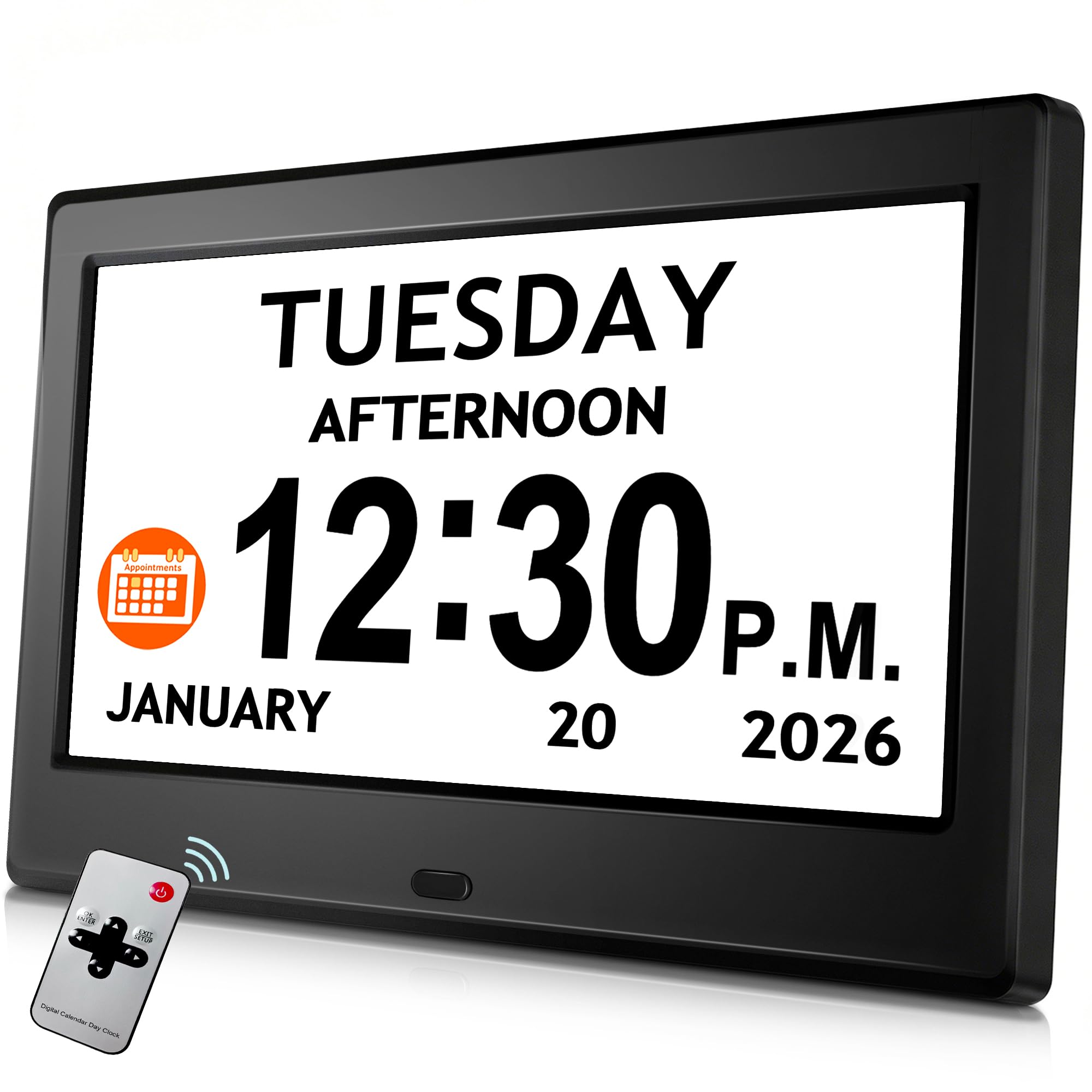
The Pastigio 7-inch model goes beyond simple time display by dividing the day into five visual phases: Before Dawn, Morning, Afternoon, Evening, and Night. This single feature is transformative for seniors who frequently wake up disoriented and cannot tell whether it is 3 AM or 3 PM. The 1024×600 IPS screen provides wide-angle visibility, and the display can be personalized with five color themes and eight languages.
Six custom alarms and ten daily reminders with visual icons help track medication, hydration, and sleep schedules. The auto-dimming adjusts to room lighting, and automatic DST updates eliminate manual resets. The included remote control allows adjustments from across the room, and the clock can sit on a desk or be wall-mounted for flexible placement.
A small number of users have reported the unit stopping working after a few months, which raises a durability concern. The clock must remain plugged into the original power adapter at all times and does not run on batteries. Despite these points, the time-of-day orientation system is uniquely helpful for cognitive support.
Why it’s great
- Five time-of-day phases help prevent disorientation
- 10 daily reminders with visual icons for medication tracking
- Remote control included for easy adjustments
Good to know
- Some users experienced the unit failing after a few months
- Must stay plugged in at all times
- No battery backup option
5. Mitoart Dementia Clock with Voice Announcement
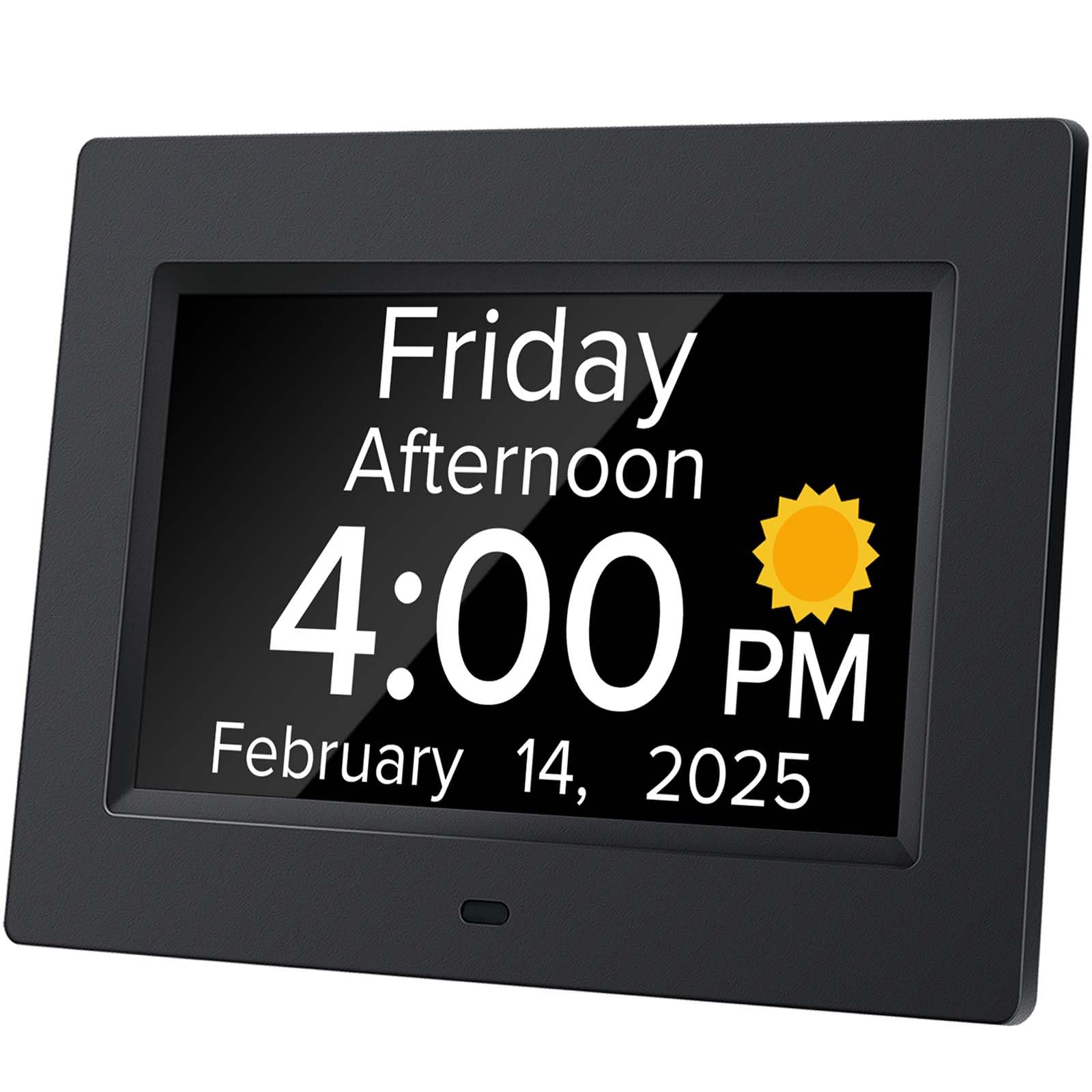
The Mitoart clock distinguishes itself with a voice announcement function that speaks the current time aloud when you press the large OK button on the back or remote. For seniors with severe vision impairment who struggle to read even large numbers, this auditory cue provides instant clarity without needing to find glasses. The voice supports nine languages including English, Spanish, French, and German.
The 7-inch display shows the week, month, and date in large bold letters with no abbreviations, and the auto-dimming feature drops to a soft 50cd/㎡ at 7 PM, rising to a bright 250cd/㎡ at 7 AM. Multiple alarms can be set for medication and schedule reminders, and the interface is deliberately simple with intuitive buttons and a remote control for distant operation.
The voice quality is clear but has a synthesized tone that some may find robotic. The clock uses a non-standard battery for backup, which can be harder to replace. A few users noted that the remote has a limited range, but in a bedroom setting this is rarely an issue.
Why it’s great
- Voice announcement reads time aloud in 9 languages
- 7″ display with auto day/night dimming cycle
- Multiple alarms with medication reminder function
Good to know
- Voice sounds slightly synthesized
- Non-standard backup battery is harder to source
- Remote control has limited range
6. Sonnet Alarm Clock Charging Station
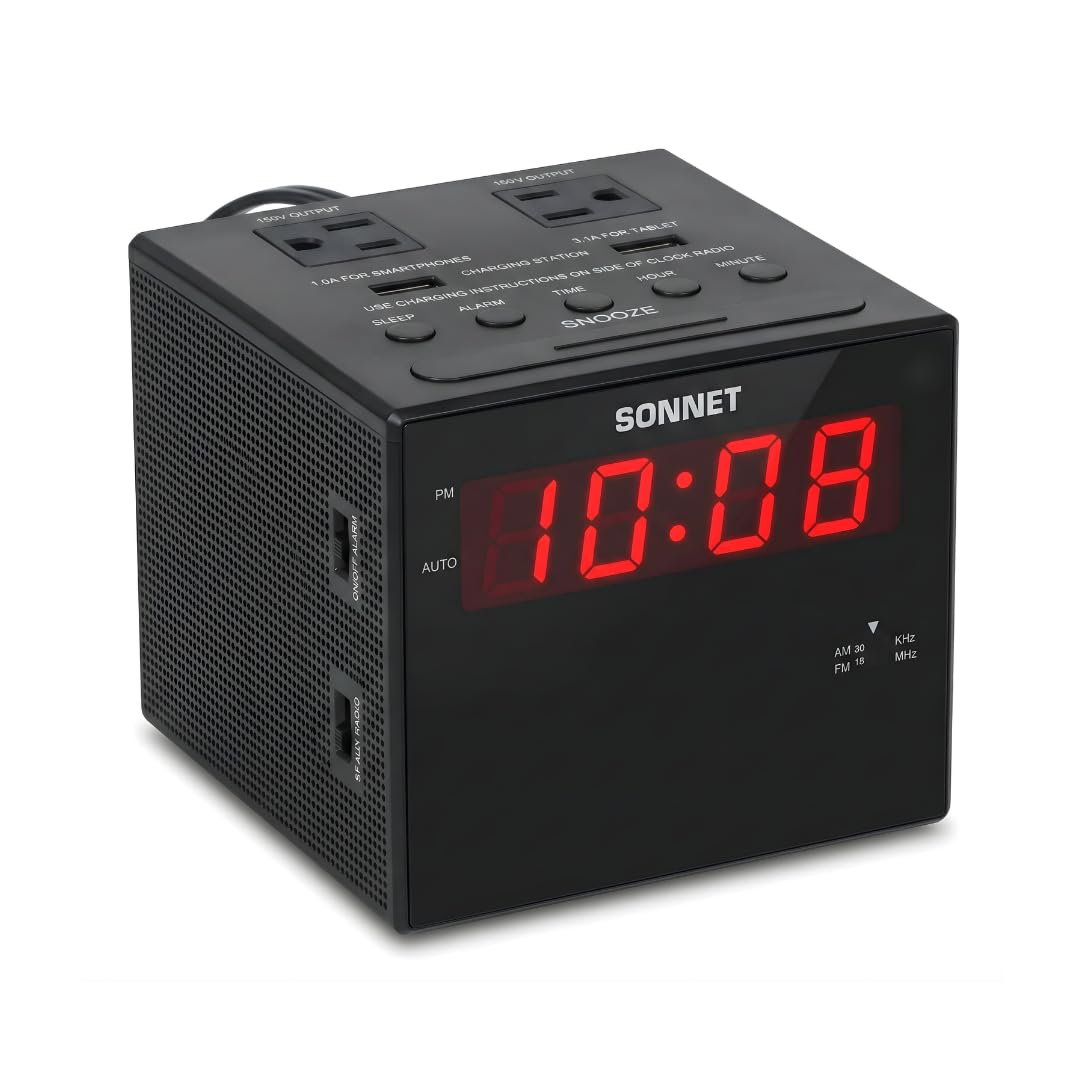
The Sonnet is the right choice for seniors with significant hearing loss who need a genuinely jarring wake-up call. Its backup buzzer reaches 110 decibels — comparable to a rock concert — ensuring even deep sleepers and those who remove hearing aids at night will be woken. The AM/FM radio offers a gentler alternative for mornings when a softer start is preferred.
This unit doubles as a charging station with two USB ports and two standard AC outlets built into its rear panel. This eliminates the need for a separate power strip on an already crowded nightstand, and the 0.9-inch red LED digits are easy to read from across the room. The large snooze bar on top makes fumbling for the right button unnecessary.
Reliability is a concern: a notable portion of users report the unit failing after 4-5 weeks, with alarms ceasing to sound and USB ports stopping charging. The setup process can be confusing without the manual, and the radio reception is adequate but not outstanding. For pure alarm loudness and bedside charging, however, few match it.
Why it’s great
- 110dB buzzer is one of the loudest available
- Includes both dual USB and dual AC power outlets
- 0.9″ large red numbers visible across the room
Good to know
- Some units fail after a few weeks of use
- Setup can be confusing without the manual
- Radio reception is only average
7. uscce Dual Alarm Clock Radio

The uscce is the most space-efficient option on this list, with a 3.4-inch LCD footprint that fits easily on the smallest nightstand. Its standout feature is the 0-100% dial-controlled dimmer, which allows you to go from casting no glow at all to full daytime brightness — a rare level of control that helps seniors who are sensitive to ambient light at night. The FM radio saves up to 40 stations.
Dual alarms with separate weekday/weekend/all-7-day modes accommodate couples or varying weekly schedules, and the alarm volume gradually increases from gentle to a user-set level between 1 and 15. The 3.5mm headphone jack lets you listen to the radio without disturbing a partner, and the two USB ports charge devices while you sleep.
The compact size makes the numbers smaller than those on the 7-9 inch models, so it is better suited for seniors who sit close to their nightstand or have only mild vision loss. The dimmer knob feels a bit cheap according to some users, and the screen can scratch easily. For a budget-friendly, highly adjustable bedside companion for those with space constraints, it works well.
Why it’s great
- 0-100% dimmer provides full night-light control
- Dual alarms with separate weekday/weekend modes
- Compact 3.4″ footprint fits tight nightstands
Good to know
- Small display is harder to read from across the room
- Dimmer knob feels less durable than the rest of the unit
- LCD screen can scratch easily
FAQ
Is a projection clock better than a standard display for seniors?
What decibel level is loud enough for a senior with hearing loss?
Why do dementia-specific clocks spell out the day and date fully?
Final Thoughts: The Verdict
For most users, the am/fm clock radio for seniors winner is the Sharp Digital Alarm Clock because its 8.9-inch display with 3-inch tall red numbers provides unmatched readability for aging eyes. If you want ceiling projection for easy nighttime viewing, grab the Magnasonic Projection Alarm Clock. And for dedicated memory support with full day/date text and multiple medication reminders, nothing beats the American Lifetime Dementia Clock.