
Our readers keep the lights on and the weekend projects moving. As an Amazon Associate, I earn from qualifying purchases.
Stepping into the world of aerial photography used to mean spending a fortune on complex, fragile equipment. Today, a new generation of sub-250-gram drones delivers 4K video, intelligent GPS tracking, and extended flight times at a fraction of the cost. The challenge isn’t finding a drone—it’s sorting through dozens of near-identical listings to find one that actually holds a stable hover, returns home when the battery runs low, and captures footage you’d be proud to share.
I’m Rikta — the co-founder and writer behind FitlyFast. I’ve spent countless hours analyzing the specifications, reading through real customer feedback, and mapping the technological landscape of this rapidly evolving category to help you make a confident purchase.
This guide cuts through the noise by comparing proven hardware specs like transmission range, flight time per battery cycle, and camera stabilization methods to help you find the ideal amateur drone for your skill level and budget.
How To Choose The Best Amateur Drone
Picking your first real drone is about matching the correct level of GPS intelligence, camera quality, and battery capacity to your specific goals. A drone that lacks a GPS module is a toy subject to the wind, while one with sophisticated obstacle avoidance might be overkill for a beginner learning the basics. The key is to focus on the core systems that determine reliability and image quality, not flashy marketing numbers.
GPS Technology and Auto Return
The single most important safety net for any new pilot is a robust GPS module that enables automatic return-to-home. When your drone loses signal or the battery hits a critical level, it should fly itself back to the takeoff point without any input. Look for models that support multiple satellite constellations (GPS, GLONASS, Galileo) for faster lock times and greater positional accuracy.
Camera Quality and Stabilization
An amateur drone’s camera is defined by two things: sensor resolution and stabilization method. A 4K label means little without electronic image stabilization (EIS) or a physical gimbal to smooth out vibrations. EIS crops the frame to steady the footage, which works well in good light, while a 2-axis or 3-axis gimbal provides superior mechanical smoothing that maintains the full field of view. For entry-level video, EIS is sufficient; for cleaner landscape shots, a gimbal is preferable.
Flight Time and Battery Chemistry
Advertised flight times are almost always measured in ideal indoor conditions with no wind. Real-world flight times in GPS mode on a breezy day typically land at 60-70% of the advertised number. Two batteries are the minimum for a satisfying session, giving you 30–45 minutes of total usable flight time. Pay attention to battery voltage—7.6V or 7.7V packs deliver more consistent power than 3.7V cells, especially for brushless motors.
Weight Class and Portability
Drones weighing under 249 grams offer a massive practical advantage: they require no FAA registration or Remote ID module in most jurisdictions. This makes them the go-to choice for travelers and casual fliers. The trade-off is that lighter drones are inherently less wind-resistant and may lack the camera payload capacity for a full-sized gimbal. Always confirm the actual takeoff weight includes the battery and propellers.
Controller and FPV Experience
Dedicated remote controllers with built-in screens are gaining popularity because they eliminate the need for a smartphone—no dropped calls, no bright-screen glare, no app failures. Traditional controllers rely on your phone for the FPV feed, which can introduce latency and connection drops. For reliability, look for 5G WiFi transmission or a dedicated digital feed like PixSync that maintains a stable video stream out to at least 0.6 miles (approx 1,000 meters).
Quick Comparison
On smaller screens, swipe sideways to see the full table.
| Model | Category | Best For | Key Spec | Amazon |
|---|---|---|---|---|
| Holy Stone HS600 | Premium | Serious beginners wanting gimbal footage | 2-Axis Gimbal + EIS | Amazon |
| Potensic ATOM LT | Premium | Long flight time and 4KM range | 2x 3000mAh batteries | Amazon |
| PLEGBLE 4K Screen Model | Premium | Controller with 5-inch built-in screen | 70 Mins Flight Time | Amazon |
| REDRIE HK33 Premium | Mid-Range | Level 5 wind resistance | 2x 1800mAh batteries | Amazon |
| Oddire HK11 | Mid-Range | 48-minute total flight time | 7.7V 1800mAh batteries | Amazon |
| REDRIE HK33 Standard | Mid-Range | 2-Axis gimbal under | Physical Vibration Reduction | Amazon |
| PLEGBLE PL-715 | Value | Longest advertised flight time | 46 Mins (2x 2700mAh) | Amazon |
| WeFone WF30 | Value | Best bang for the buck GPS drone | Optical Flow Positioning | Amazon |
| Mcokoe Screen Drone | Value | Controller with 5.9-inch screen | 720P Camera | Amazon |
In‑Depth Reviews
1. Holy Stone HS600

The Holy Stone HS600 stands apart from the crowd by pairing a genuine 2-axis mechanical gimbal with electronic image stabilization (EIS) for footage that stays usable even in gusty conditions. While most sub-249-gram drones rely solely on EIS, this mechanical approach delivers smoother horizons and reduces the jello effect that plagues cameras mounted on lightweight airframes. The Sony sensor captures 4K footage at 30 frames per second, and the 20,000-foot transmission range (via WiFi repeater built into the controller) is among the highest in this class.
Built-in Remote ID means the HS600 complies with FAA regulations out of the box—no extra modules or stickers required. The brushless motors push it to Level 6 wind resistance, giving you confidence flying along coastlines or during light breezes where many sub-250g drones would struggle. The dedicated controller uses a single USB-C cable to your phone for live FPV, which avoids the latency and signal drops common with WiFi-only connections.
At 541 grams, this drone falls outside the sub-249g weight class, meaning FAA registration is required. That is the trade-off for the gimbal and larger battery. However, for the pilot who wants the cleanest possible footage without jumping to DJI pricing, this is the most capable option on this list. The included carrying case and extra propeller set add to the out-of-box value.
Why it’s great
- 2-axis mechanical gimbal eliminates jello
- Level 6 wind resistance
- Built-in Remote ID—no extra module
Good to know
- 541g weight requires FAA registration
- Single battery included (approx 28 min real flight)
- No RAW photo mode
2. Potensic ATOM LT

The Potensic ATOM LT redefines what an amateur drone can do at the sub-249g weight limit, primarily through its PixSync 2.0 transmission system that maintains a stable HD video feed up to 4 kilometers away. That is more than triple the range of most entry-level GPS drones, making it practical for exploring open landscapes without losing signal. The twin 3000mAh batteries are the largest capacity on this list, delivering a legit 40 minutes per pack in ideal conditions, or roughly 70 minutes of combined usable flight time.
Instead of chasing 4K resolution, Potensic focused on stabilization: the 2.5K camera uses ShakeVanish 2.0 EIS and a Sony sensor to produce clean, smooth footage that holds up well in post-production. The camera tilts 90° downward for direct overhead shots, and the 118° field of view captures wide scenery without fish-eye distortion. The ATOM LT supports four GNSS satellite systems (GPS, GLONASS, Galileo, BeiDou), which means faster satellite locks and more reliable position hold than single-system drones.
The trade-off for the exceptional range and battery life is a slightly longer wait for GPS lock before each flight, and the drone must be flown exclusively in GPS mode—no indoor or GPS-denied flying. The controller is excellent, with adapter cables for both Lightning and USB-C phones. This is the drone to buy if your primary concern is covering distance and staying aloft, rather than capturing the absolute highest video resolution.
Why it’s great
- 4KM video transmission range
- 80 minutes combined flight time
- Quad GNSS support for fast lock
Good to know
- 2.5K camera, not true 4K
- GPS mode only—no indoor flying
- Needs open area for satellite lock
3. PLEGBLE 4K Screen Drone
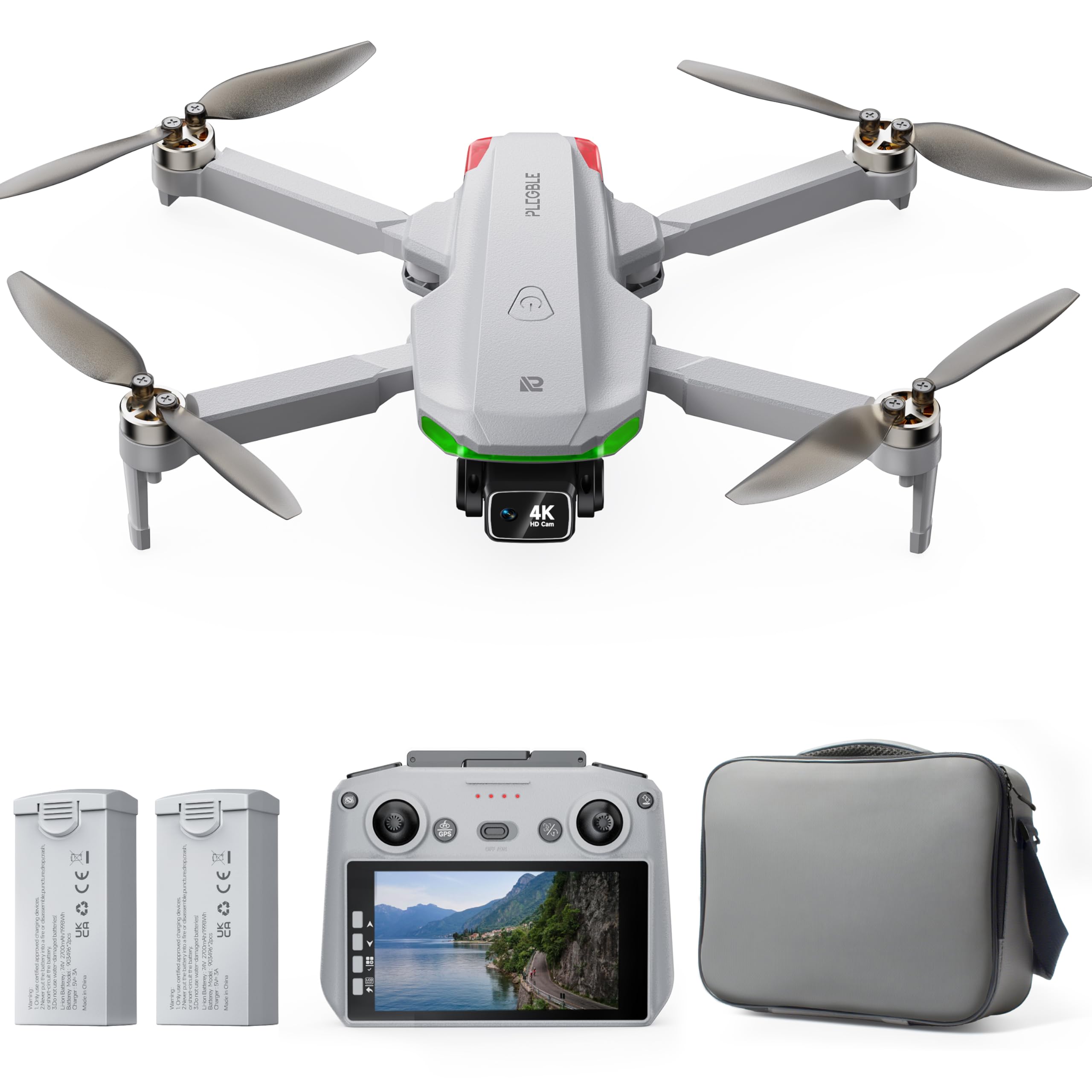
This PLEGBLE drone eliminates the biggest frustration with FPV flying: unreliable phone connections. The remote controller has a built-in 5-inch HD screen that displays the 4K camera feed in real time with zero app setup, zero glare issues, and zero dropped WiFi calls from your phone. You can preview recorded footage, format the SD card, and adjust camera settings directly from the controller—a workflow that feels closer to a professional cinema drone than a beginner toy. The 130° wide-angle lens with 90° tilt gives you flexible framing options.
Advanced EIS stabilization works alongside optical flow positioning to keep the footage smooth even when hovering in moderate wind. The two 2700mAh batteries deliver a total of 70 minutes of flight time, and they charge via USB-C fast charging with overcharge protection built into the battery management system. GPS features are comprehensive: smart return-to-home on signal loss, low battery return, position lock, and compass calibration that is straightforward for beginners.
One minor note: the fast mode on this drone is not exceptionally fast—it tracks slightly faster than a running pace, which limits its use for chasing bikes or fast-moving subjects. For leisurely flights, landscape photography, and learning to fly with zero technical friction, this is the most beginner-friendly package on the list. The SD card is included, which is a thoughtful touch that saves a separate purchase.
Why it’s great
- No phone needed for FPV flying
- USB-C fast charging
- SD card included
Good to know
- Fast mode is slower than expected
- Manual states 600m max range
- Charging can take several hours
4. REDRIE HK33 Premium
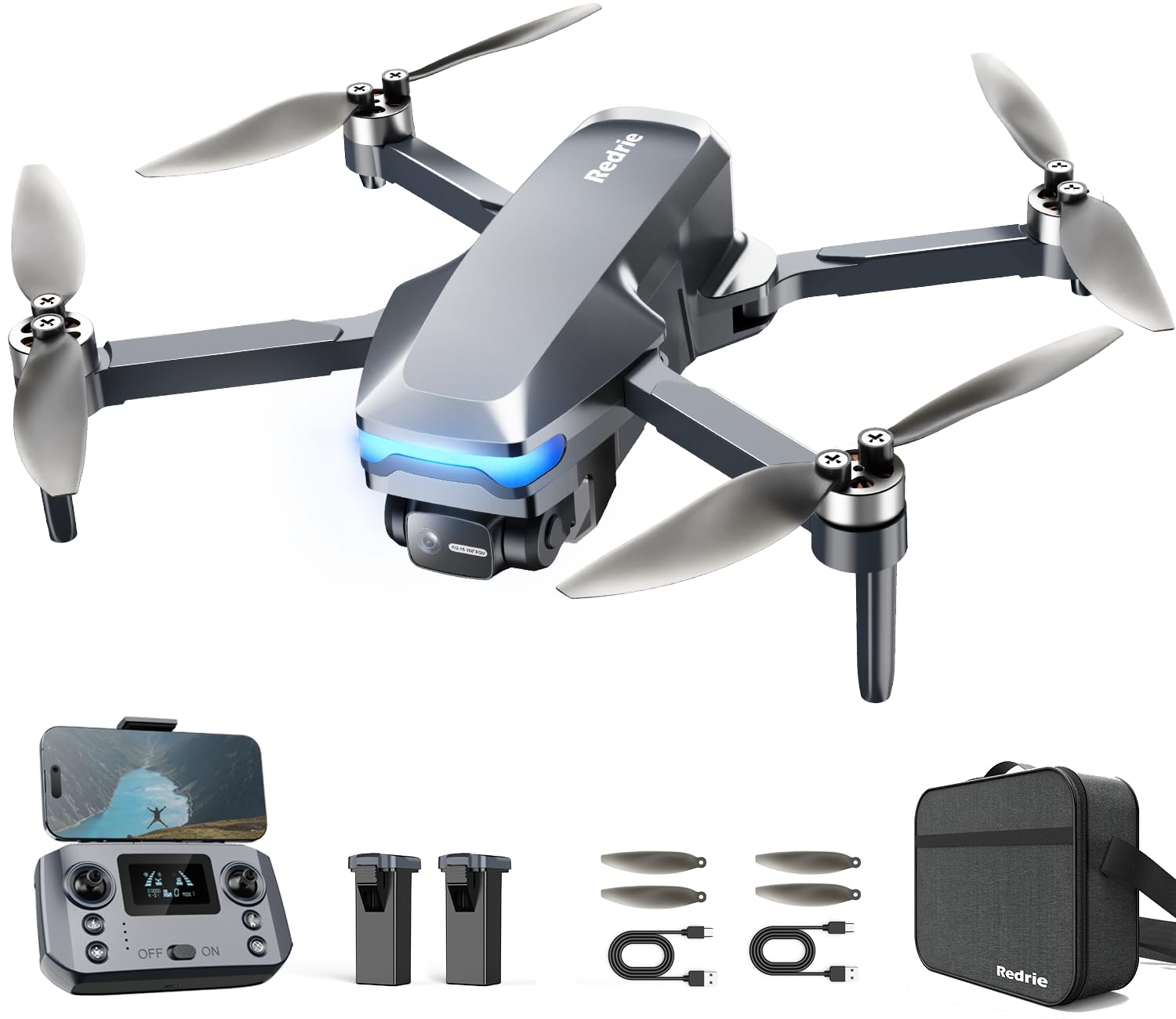
The HK33 Premium version from REDRIE (Product 6) is essentially the same excellent airframe as the standard HK33 but with a refined feature set that prioritizes wind performance. The brushless motors are rated for Level 5 wind resistance, meaning this drone can maintain a stable hover and capture usable footage in winds up to roughly 25-30 mph. The physical vibration reduction—a mechanical dampener mounted between the camera and the frame—reduces high-frequency shaking better than pure EIS alone.
GPS functionality is solid: auto return on signal loss, follow me, route planning, and circle fly all work reliably when you have at least 9 GPS satellites locked. The 5G WiFi transmission maintains a stable FPV feed out to 300 meters (985 feet) standard, with an additional signal repeater extending control range to 500 meters (1640 feet). The 1800mAh batteries provide about 18-20 minutes of real flight time each, giving you roughly 40 minutes of total flight per session.
The carrying case fits everything including the extra props and screwdriver, making it easy to pack. Reviews consistently mention the drone’s durability—surviving multiple crashes into trees and walls without damage. The cell phone holder on the controller is somewhat flimsy, and video quality, while rated 4K, benefits from good lighting conditions. For new pilots who expect to bump into things while learning, this is the most crash-tolerant package available.
Why it’s great
- Level 5 wind resistance
- Physical vibration reduction
- Very crash durable
Good to know
- Video quality drops in low light
- Flimsy phone holder on controller
- Standard range only 300m
5. Oddire HK11

The Oddire HK11 is built around a clever battery engineering choice: 7.7V lithium-polymer packs instead of the more common 3.7V or 7.4V cells. Higher voltage means the brushless motors draw less current for the same thrust output, increasing efficiency and reducing internal heating during flights. Real-world results land at roughly 22 minutes per battery, giving you a combined 44–48 minutes of flight time depending on wind and flying style. The battery indicator on the remote is accurate enough to plan landings.
The 4K camera (4096x3072P stills, 2048x1088P video) uses an F2.15 aperture and 110° wide-angle lens with 90° adjustable tilt. Video files can be stored on a MicroSD card or synced directly to the app. The XDRONE GO app offers built-in filters and background music for quick social sharing, and gesture control allows you to snap photos by waving at the camera—a fun feature for group shots. GPS functions include waypoint flight, orbit mode, and gravity control where the drone mirrors your phone’s tilt.
The main drawbacks are the need for compass and accelerator calibration before every flight, and the fact that the app store listing can be confusing (the working app is XDRONE GO, not the similarly-named alternative). The drone also has a max effective range of about 300 meters, not the advertised 500 meters. For pilots willing to do a quick calibration pre-flight and who appreciate the higher-voltage battery advantage, the HK11 is a capable and affordable entry point.
Why it’s great
- 7.7V batteries for efficient power
- Gesture photo control
- In-app filters and music for sharing
Good to know
- Requires calibration before each flight
- Effective range ~300m
- App store listing can be confusing
6. REDRIE HK33 Standard
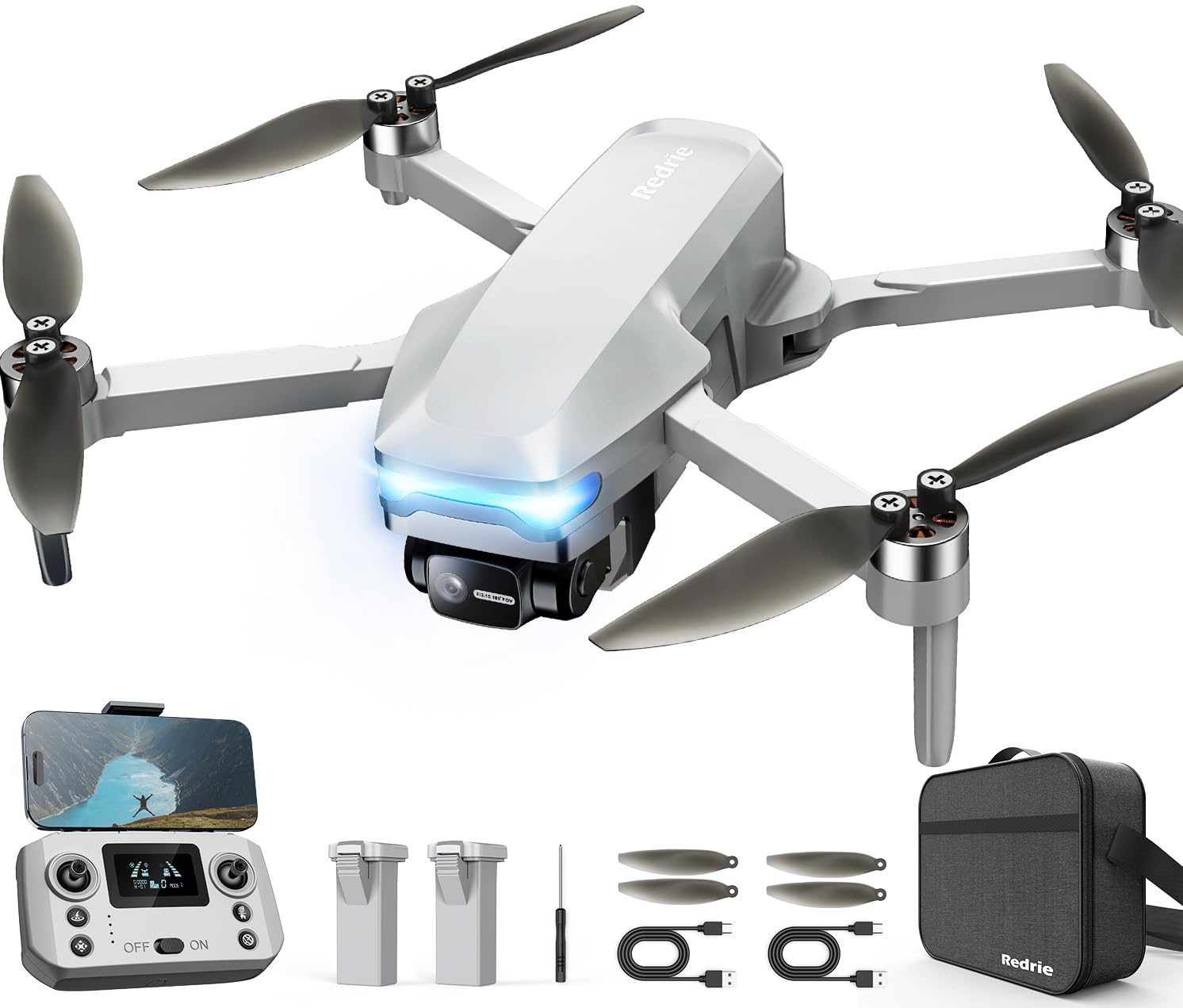
The standard REDRIE HK33 (Product 3) is notable for being the most affordable drone on this list to include a 2-axis gimbal. While the premium version uses physical vibration reduction, this model has a fully articulated mechanical gimbal that actively counters camera shake across pitch and roll axes. This makes a visible difference in video smoothness compared to drones that rely solely on EIS, especially when yawing or flying through gentle gusts. The F2.15 aperture and 110° ultra-wide lens capture a broad landscape without needing to pan.
Flight time with the two included 1800mAh batteries totals 40–45 minutes, which is competitive for this price point. The 5G WiFi transmission maintains a stable FPV feed at 300 meters, with the signal repeater extending control to 500 meters. GPS features—follow me, route planning, fly around—are all present and work well when at least 9 satellites are locked. The lightweight design (under 249g) means no FAA registration is needed, and the foldable arms make it easy to stash in a backpack.
A few buyers noted the video quality is not as sharp as true 4K footage from DJI drones—the sensor does a better job at 2K resolution. The gimbal itself is somewhat exposed on the front of the drone, so landing on rough surfaces could potentially damage the mechanism. For the pilot who wants gimbal-stabilized footage on a tight budget, this is an excellent entry point that skips the toy-grade experience.
Why it’s great
- Included 2-axis mechanical gimbal
- Under 249g—no FAA registration
- Excellent value for stabilized footage
Good to know
- Sensor is sharper at 2K than 4K
- Gimbal is exposed on landing
- Battery life average—20 min each
7. PLEGBLE PL-715
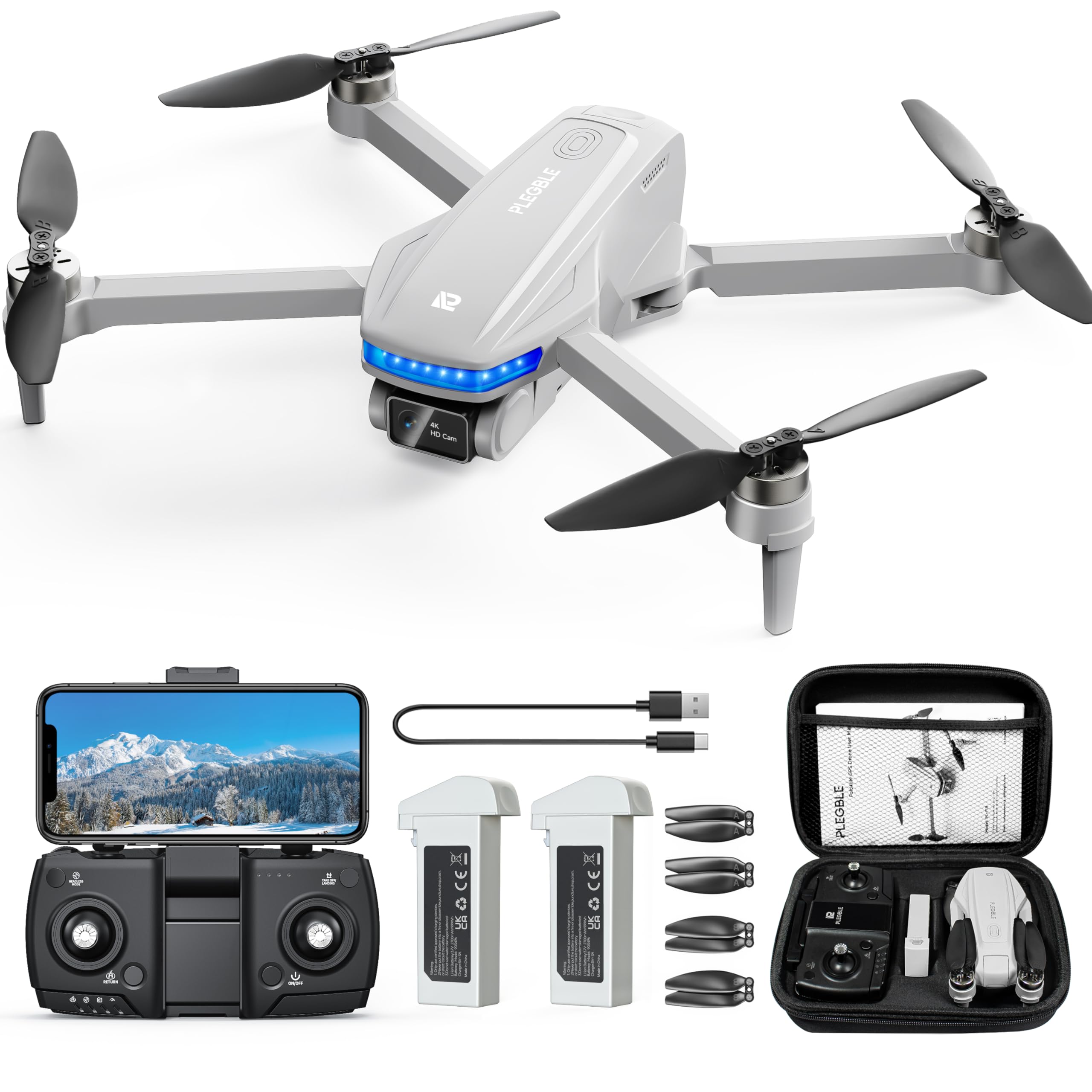
The PLEGBLE PL-715 focuses on doing one thing exceptionally well: maximizing flight time. The two 2700mAh intelligent batteries are the largest capacity cells on any sub- drone in this comparison, and real-world tests confirm around 20 minutes per battery with vigorous flying—closer to 23 minutes in calm conditions with gentle throttle. That puts total flight time near the advertised 46-minute mark, which is rare for budget drones where marketing numbers often exceed reality by 40% or more.
The 4K camera with a 120° wide-angle lens and 90° adjustable tilt provides a solid image quality for the price, and the 5G FPV transmission is smooth at close range. GPS functions are comprehensive: auto return on signal loss, follow me, waypoint flight, and circle fly. The beginner mode restricts the flight radius to 30 meters, giving new pilots a safe learning bubble before graduating to full range. Weighing under 249g, it requires no FAA registration.
The drone’s build quality feels solid for the price, though the controller layout takes a flight or two to become intuitive. Some users reported that the app connection can be finicky on first setup, requiring a phone restart or app reinstall to establish a steady FPV feed. For the budget-conscious pilot who wants the longest possible airtime per dollar, the PL-715 is hard to beat.
Why it’s great
- Top battery capacity in budget class
- Beginner mode for safe learning
- Under 249g—no FAA registration
Good to know
- App connection can be finicky initially
- Controller layout takes practice
- Max range ~1,968 ft (600m)
8. WeFone WF30

The WeFone WF30 is the most affordable GPS drone on this list, and it manages to pack in almost all the essential features a beginner needs: GPS return-to-home, optical flow positioning for stable indoor hover, brushless motors, and a 4K camera with 90° electrically adjustable tilt. The optical flow sensor is a rare inclusion at this price point—it uses a downward-facing camera to lock position when GPS is unavailable, which makes indoor flying significantly more stable than drones that rely solely on altitude sensors.
The two modular 1600mAh batteries deliver roughly 15 minutes of flight time each, totaling 30 minutes per session. While that is lower than the advertised 40 minutes, it is still enough for multiple short flights during a single outing. The 5G transmission works well out to 300 meters, and the foldable design with the included carrying case makes it easy to transport. The drone weighs under 249 grams, freeing you from FAA registration requirements.
The downside is the build quality feels a bit plasticky, and the emergency return-to-home function can cause an uncontrolled ascent if triggered at low battery—a known behavior that pilots should plan for by manually returning before the auto trigger. Also, the drone uses an open WiFi signal that some users flagged as a potential privacy concern. For the absolute lowest entry price into GPS-assisted flight, this is a capable starter that teaches the basics without a big commitment.
Why it’s great
- Optical flow for indoor stability
- Brushless motors at entry price
- Foldable with carrying case
Good to know
- Battery life lower than advertised
- Open WiFi signal (privacy concern)
- Build feels a bit plastic
9. Mcokoe Screen Drone
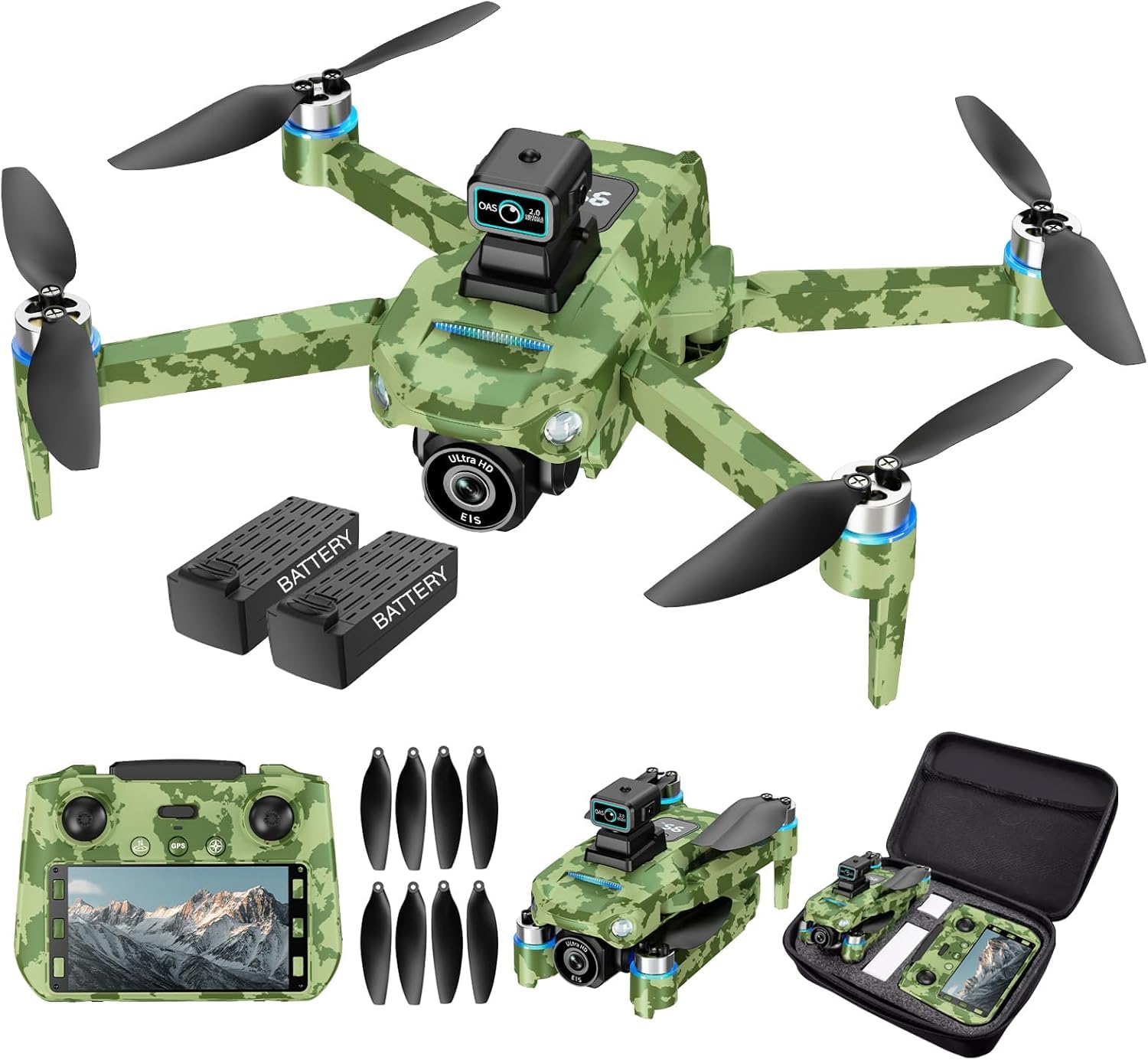
The Mcokoe drone positions itself as the most affordable way to get a dedicated controller screen, featuring a 5.9-inch display built directly into the remote. This removes the need for a phone mount and the unstable app connections that plague many budget drones. The 720P HD camera with a 120° wide-angle lens is not going to win any photography awards—this is clearly a step down in resolution from the 4K models—but it is adequate for casual flying videos and social media clips. Gesture control works better than expected, triggering the shutter when you hold up a hand.
The two 2200mAh batteries deliver around 20 minutes each, totaling 40 minutes of flight time. The brushless motors keep things quiet and efficient, and the beginner mode restricts the flight radius to 30 meters for safe learning. GPS features include auto return on signal loss and low battery, along with follow me and waypoint flying. The controller itself is comfortable to hold, with responsive joysticks and a clear screen that is readable in moderate sunlight.
The major caveat is the camera quality: 720P resolution means noticeably less detail than 4K models, and there is no mechanical stabilization—only basic altitude hold. This drone is best suited for absolute beginners and children who want to experience FPV flying with zero technical friction. For anyone interested in photography or learning GPS flight features before upgrading, the investment in a 4K model with EIS is strongly recommended.
Why it’s great
- Built-in 5.9-inch screen—no phone needed
- Intuitive gesture control
- Beginner mode for safe learning
Good to know
- 720P camera only—low resolution
- No EIS or gimbal stabilization
- Not ideal for photography
FAQ
Do I need an FAA license to fly a sub-249g amateur drone?
Why is my drone’s flight time much shorter than advertised?
What does “optical flow positioning” do for an amateur drone?
Can I fly an amateur drone in windy conditions?
Final Thoughts: The Verdict
For most users, the amateur drone winner is the Holy Stone HS600 because the 2-axis mechanical gimbal and Level 6 wind resistance deliver the smoothest, most reliable footage for the price. If you want the longest flight time and extreme transmission range for exploring open landscapes, grab the Potensic ATOM LT. And for a completely phone-free FPV experience that just works out of the box, nothing beats the PLEGBLE 4K Screen Drone.