
Our readers keep the lights on and the weekend projects moving. As an Amazon Associate, I earn from qualifying purchases.
Every serious amateur astronomer starts the same way—with a shaky tripod, a blurry Jupiter, and the sinking feeling they bought the wrong scope. The difference between a first night of frustration and a lifelong passion comes down to aperture, mount stability, and optical coatings that actually hold up past sunset. This guide cuts through the marketing haze and identifies the telescopes that deliver real planetary detail and lunar clarity, not just empty magnification numbers.
I’m Rikta — the co-founder and writer behind FitlyFast. I’ve spent hundreds of hours analyzing optical specifications, customer review patterns, and build quality benchmarks across the amateur telescope market to separate genuine performance from plastic-and-promise setups.
Whether you’re chasing Saturn’s rings from your backyard or taking your first real look at the Orion Nebula, finding the right amateur telescope means prioritizing aperture size, mount stability, and fully multi-coated optics over flashy accessory bundles that don’t survive the first trip out.
How To Choose The Best Amateur Telescope
Selecting your first real telescope isn’t about the highest magnification number on the box—it’s about optical clarity, mount stability, and how much light the objective lens or mirror can gather. Beginners often over-prioritize magnification and under-prioritize aperture, ending up with dim, shaky views. Here’s what actually matters.
Aperture: The True Light Bucket
Aperture diameter determines how much light your telescope collects. For refractors, 80mm to 90mm is the entry-level sweet spot for seeing Jupiter’s cloud bands and Saturn’s rings with meaningful detail. Reflectors like the 130mm (5.1-inch) class gather significantly more light, making them better for faint deep-sky objects like nebulae and galaxies—but they require occasional collimation (mirror alignment) that refractors don’t.
Optical Coatings: Why FMC Matters
Fully multi-coated (FMC) optics reduce light loss at each glass-air surface, delivering brighter, higher-contrast images. A telescope with FMC lenses can outperform a larger-aperture scope with uncoated or single-coated glass, especially under less-than-perfect suburban skies. Always check the coating spec—if it’s not listed, assume it’s basic.
Mount Stability Over Magnification
A sturdy mount is non-negotiable. An alt-azimuth (AZ) mount with slow-motion controls offers intuitive up-down, left-right tracking ideal for beginners. Equatorial (EQ) mounts, once aligned with the polar axis, let you track celestial objects with a single axis of movement—essential for astrophotography but steeper to learn. Avoid any telescope whose tripod feels flimsy; vibration at 120x magnification ruins the view.
Quick Comparison
On smaller screens, swipe sideways to see the full table.
| Model | Category | Best For | Key Spec | Amazon |
|---|---|---|---|---|
| Celestron AstroMaster 102AZ | Refractor | Bright, wide-field views | 102mm aperture / 380mm f/l | Amazon |
| Gskyer 130EQ | Reflector | Deep-sky & planetary | 130mm aperture / 650mm f/l | Amazon |
| Celestron StarSense Explorer LT 80AZ | Refractor | App-guided sky navigation | 80mm aperture / 400mm f/l | Amazon |
| Hawkko 90mm | Refractor | Detailed lunar & planetary | 90mm aperture / 900mm f/l | Amazon |
| Gskyer 600x90mm | Refractor | Versatile starter kit | 90mm aperture / 600mm f/l | Amazon |
| MEEZAA 90mm | Refractor | Portable backyard use | 90mm aperture / 800mm f/l | Amazon |
| Dianfan 90mm | Refractor | Terrestrial & lunar dual-use | 90mm aperture / 800mm f/l | Amazon |
| Koolpte 90mm | Refractor | Smooth tracking on a budget | 90mm aperture / 700mm f/l | Amazon |
| Celticbird 80mm | Refractor | Budget planetary starter | 80mm aperture / 900mm f/l | Amazon |
In‑Depth Reviews
1. Celestron AstroMaster 102AZ

The Celestron AstroMaster 102AZ stands apart from the crowded field of 80mm and 90mm refractors by offering a true 102mm (4-inch) aperture at a sensible entry-level price point. That extra 12mm of light-gathering diameter translates directly into brighter, more detailed views of Jupiter’s cloud bands and Saturn’s ring separation—views that simply aren’t achievable on smaller scopes under the same suburban sky conditions. Its 380mm short-tube design gives a wide 8.1-degree field of view, making it ideal for scanning the Milky Way and locating large deep-sky targets like the Andromeda Galaxy.
Setup is genuinely tool-free, with the mount and tripod arriving preassembled. The alt-azimuth mount uses a panhandle control for smooth, intuitive movement. The included 20mm and 10mm eyepieces cover 19x and 38x magnification, and the erect-image diagonal means the scope doubles as a capable terrestrial spotting scope for daytime wildlife or landscape viewing—a versatility many dedicated astronomy refractors lack.
Two caveats: the included red-dot finderscope is functional but feels inexpensive, and several users report it detaching after repeated use (a simple adhesive fix resolves it). The tripod, while adequate, benefits from a slight weight addition for vibration damping at higher magnifications. Still, for a beginner who wants to see Saturn’s rings on the first night and not feel outgrown within three months, this is the most capable package in the category.
Why it’s great
- True 102mm aperture gathers noticeably more light than 80mm/90mm scopes
- Wide-field short-tube design excellent for star clusters and terrestrial use
- Tool-free setup with preassembled mount saves first-night frustration
Good to know
- Red-dot finder detaches easily; secure with adhesive for reliability
- Short focal length limits high-magnification planetary detail compared to longer refractors
2. Gskyer 130EQ Professional Reflector

The Gskyer 130EQ is a Newtonian reflector, which means it uses a 130mm (5.1-inch) parabolic mirror instead of a glass lens to gather light. That mirror collects roughly 2.6 times more light than an 80mm refractor, making this the strongest performer in this guide for faint deep-sky objects—the Orion Nebula shows visible greenish-gray structure, and globular clusters resolve into individual stars at the edges. The fast f/5 focal ratio also makes the 130EQ a solid platform for beginning astrophotographers who want to attempt short-exposure shots of brighter deep-sky targets.
The equatorial mount, once polar-aligned, tracks the sky’s rotation by moving on a single axis. This is a significant advantage over alt-az mounts when observing at high magnification—you’re not constantly re-centering a drifting planet. The bundle includes three eyepieces, a 3x Barlow lens giving 48x to 390x, and a wireless Bluetooth remote for smartphone captures through the included phone adapter. The toothless focusing base is a welcome upgrade over rack-and-pinion designs, providing smoother focus without backlash.
Counterpoints: the 30-pound total weight makes this less portable than any refractor in the list, and the equatorial mount’s slow-motion cables are functional but not as refined as premium German EQ mounts. The instruction manual is poorly translated, and first-time collimation (mirror alignment) can be intimidating without a YouTube tutorial. This is not a grab-and-go scope—it rewards the user willing to invest an evening learning the mount and collimation process.
Why it’s great
- 130mm mirror captures deep-sky objects invisible to small refractors
- Equatorial mount enables true sidereal tracking after alignment
- Toothless focuser provides smooth, backlash-free focusing
Good to know
- Heavy at 30 pounds; not ideal for frequent travel
- Requires learning collimation and equatorial alignment for best results
3. Celestron StarSense Explorer LT 80AZ

The StarSense Explorer LT 80AZ solves the single biggest barrier for new astronomers: finding objects in the night sky. Its patented StarSense technology uses your smartphone’s camera to analyze star patterns and calculate the telescope’s exact orientation. The app then displays on-screen arrows guiding you to celestial targets—when the bullseye turns green, the object is centered in the eyepiece. This is vastly different from generic star-map apps that don’t account for your scope’s position.
The 80mm aperture with fully coated glass delivers sharp views of the Moon’s Tycho crater and the four Galilean moons of Jupiter. Saturn’s rings are clearly visible as an oval shape, though the 400mm short focal length limits the detail compared to a longer 900mm refractor at the same aperture. The included 2x Barlow lens pushes the 10mm eyepiece to effectively 80x magnification, which is the practical ceiling for this scope given its aperture. The mount features altitude slow-motion via a sliding rod, and the preassembled tripod makes first-night setup a matter of minutes.
The trade-off: you are tethered to the app experience. Without the phone dock and StarSense app, the scope is a standard 80mm alt-az refractor with modest specs. The built-in StarPointer red-dot finder helps, but the real magic is app-guided navigation. For families or casual users who want to see highlights without learning the sky first, this is the best onboarding tool available. More serious amateurs will eventually outgrow the 80mm aperture and want a larger scope, but the StarSense dock can be transferred to Celestron’s larger StarSense-compatible scopes.
Why it’s great
- App-guided navigation eliminates the biggest frustration for beginners
- Lightweight and portable; quick tool-free assembly
- Celestron’s 2-year warranty and US-based support
Good to know
- 80mm aperture limits deep-sky performance compared to larger scopes
- App dependency means a dead phone battery ends the session
4. Hawkko 90mm Aperture 900mm Refractor

The Hawkko 90mm refractor combines the coveted 90mm aperture with a long 900mm focal length, creating an f/10 system that inherently reduces chromatic aberration and produces high-contrast planetary views. This focal ratio is ideal for lunar and planetary observing—the Moon’s Alpine Valley and Jupiter’s Great Red Spot (when facing Earth) show sharp detail that shorter-focal-length scopes struggle to match. The professional-grade fully multi-coated (FMC) optics improve light transmission by a stated 73% over standard coatings, which translates to visibly brighter, more contrast-rich images at dusk and under moonlit skies.
The stainless steel AZ mount with a full 360-degree rotation and a pair of slow-motion control cables provides smooth tracking at 135x and 270x magnification (via the included 3x Barlow). The 25mm eyepiece offers 36x with a 1.39-degree field, excellent for framing the full Moon or scanning the Pleiades. The carry bag holds the entire kit including the phone adapter, making this a viable grab-and-go setup for dark-sky trips.
However, at 5 kilograms (11 pounds) for the tube and mount, it is heavier than typical 90mm travel refractors, and the long tube can feel front-heavy when pointed near zenith. A few users reported slower-than-expected shipping rather than product issues. For the amateur whose priority is lunar crater detail and planetary surface features rather than faint fuzzies, the Hawkko’s long-focus FMC design delivers more resolving power per dollar than any equal-price competitor in this aperture class.
Why it’s great
- Long 900mm focal length delivers high magnification for lunar and planetary detail
- Fully multi-coated optics produce exceptional contrast at the eyepiece
- Smooth AZ mount with slow-motion controls tracks at high power
Good to know
- Longer tube feels front-heavy at high elevation angles
- Shipping delays reported by some customers
5. Gskyer 600x90mm AZ Refractor

The Gskyer 600x90mm is one of the most recognizable entry-level refractors on the market, and for good reason: it pairs a 90mm fully coated aperture with a 600mm focal length and a triple-eyepiece kit that provides four magnification steps (24x, 60x, 120x, and 180x with the 3x Barlow). This makes it one of the most flexible starter kits for users who want to experiment with different magnifications without immediately buying additional eyepieces. The optical tube delivers bright, color-correct views of the Moon and brighter planets typical of this aperture class.
The adjustable aluminum tripod extends from 31.5 to 49 inches, accommodating both seated and standing observers. Setup requires no tools, and the included finderscope, while basic, is functional for initial target acquisition. Several users report that the scope paired with a sturdier photography tripod yields even better high-magnification stability, suggesting the included tripod is the component most worth upgrading first.
Two common user complaints: the alt-az mount has noticeable backlash in the altitude axis, which can make fine adjustments at 180x frustrating, and the focusing mechanism requires a clockwise turn to tighten the thumbscrew for backlash-free operation. Tall users note the tripod legs need to be fully extended, which reduces stability. These are manageable compromises at this tier, and for a beginner who wants to see lunar detail and identify the Galilean moons without breaking the bank, the Gskyer 600x90mm remains a solid, widely-used entry point into the hobby.
Why it’s great
- Three eyepieces plus 3x Barlow provide flexible magnification range out of the box
- Good 90mm aperture significantly outperforms 60mm and 70mm budget scopes
- Long-established product with extensive user community support
Good to know
- Alt-az mount has noticeable backlash affecting fine adjustments
- Included tripod is adequate but benefits from reinforcement at high powers
6. MEEZAA 90mm Aperture 800mm Refractor

The MEEZAA 90mm refractor offers an 800mm focal length at f/8.88, placing it in the mid-long focus category that provides a good balance between wide-field scanning and planetary detail. The fully multi-coated optics deliver bright, sharp images of the Moon’s surface, and the 90mm aperture gathers enough light to reveal Jupiter’s equatorial bands and Saturn’s ring tilt. The stainless steel tripod, adjustable from 28 to 46 inches, provides a stable platform that resists the transmission of ground vibrations better than aluminum alternatives at this price point.
The accessory package includes 10mm (80x) and 25mm (32x) Kellner eyepieces, a 3x Barlow lens pushing magnification up to 240x, a phone adapter, and a carry bag. The kit is practical and well-organized—users report consistent 10-minute assembly times. The straight-through finderscope is basic but functional, and the manual focus provides smooth travel across the focus range without significant image shift.
Telescope purists note that the 3x Barlow, when combined with the 10mm eyepiece, pushes magnification beyond the 2x-per-millimeter-of-aperture rule of thumb, meaning views at 240x will be dim and atmospheric conditions will limit detail. For real-world use, the 80x and 32x eyepieces deliver the most satisfying views. The low chromatic aberration reported by users is a strong point for this price tier. For the amateur who wants a competent 90mm setup with a stable tripod and minimal setup friction, the MEEZAA delivers consistent performance without surprises.
Why it’s great
- Stainless steel tripod provides excellent vibration damping for stable high-power views
- Low chromatic aberration gives clean color rendition on bright targets
- Consistent 10-minute assembly with clear instructions
Good to know
- 3x Barlow pushes magnification beyond useful limit for this aperture
- Straight-through finder is awkward for objects near zenith
7. Dianfan 90mm Aperture 800mm Refractor

The Dianfan 90mm refractor distinguishes itself with a 45-degree erect-image diagonal, which orients the view correctly for both astronomical and terrestrial observation. This makes it one of the few scopes in this guide that practices just as well as a daytime spotting scope for birdwatching or landscape—the 32x to 240x magnification range works effectively for distant wildlife when the sun is up. The fully coated 90mm objective lens provides sufficient light gathering for both contexts without requiring accessory changes.
The stainless steel tripod is sturdy, and users consistently praise the quick 10- to 15-minute assembly time. The 800mm focal length yields 32x with the 25mm eyepiece and 80x with the 10mm. With the 3x Barlow, magnification reaches 240x, though atmospheric turbulence on most nights limits sharp detail beyond 160x. The phone adapter works reliably for capturing lunar images, and the included carry bag keeps everything organized for transport to a darker observation site.
One limitation: the 90mm aperture, while excellent at this price point, will not reveal the full structure of faint deep-sky objects like the Whirlpool Galaxy—expect a small faint patch rather than photographic detail. The straight-through finderscope also requires a flexible neck to use comfortably on high-angle targets. For the user who wants a single optical instrument that handles daytime nature observation and nighttime stargazing without compromise, the Dianfan’s dual-use diagonal makes it the most practical choice in this aperture class.
Why it’s great
- 45-degree erect-image diagonal enables comfortable daytime and nighttime use
- Rock-solid stainless steel tripod provides excellent stability
- Fast 15-minute assembly with high-quality packaging
Good to know
- 90mm aperture limits faint deep-sky performance
- Straight-through finder is uncomfortable for overhead targeting
8. Koolpte 90mm Aperture 700mm with Vertisteel AZ Mount
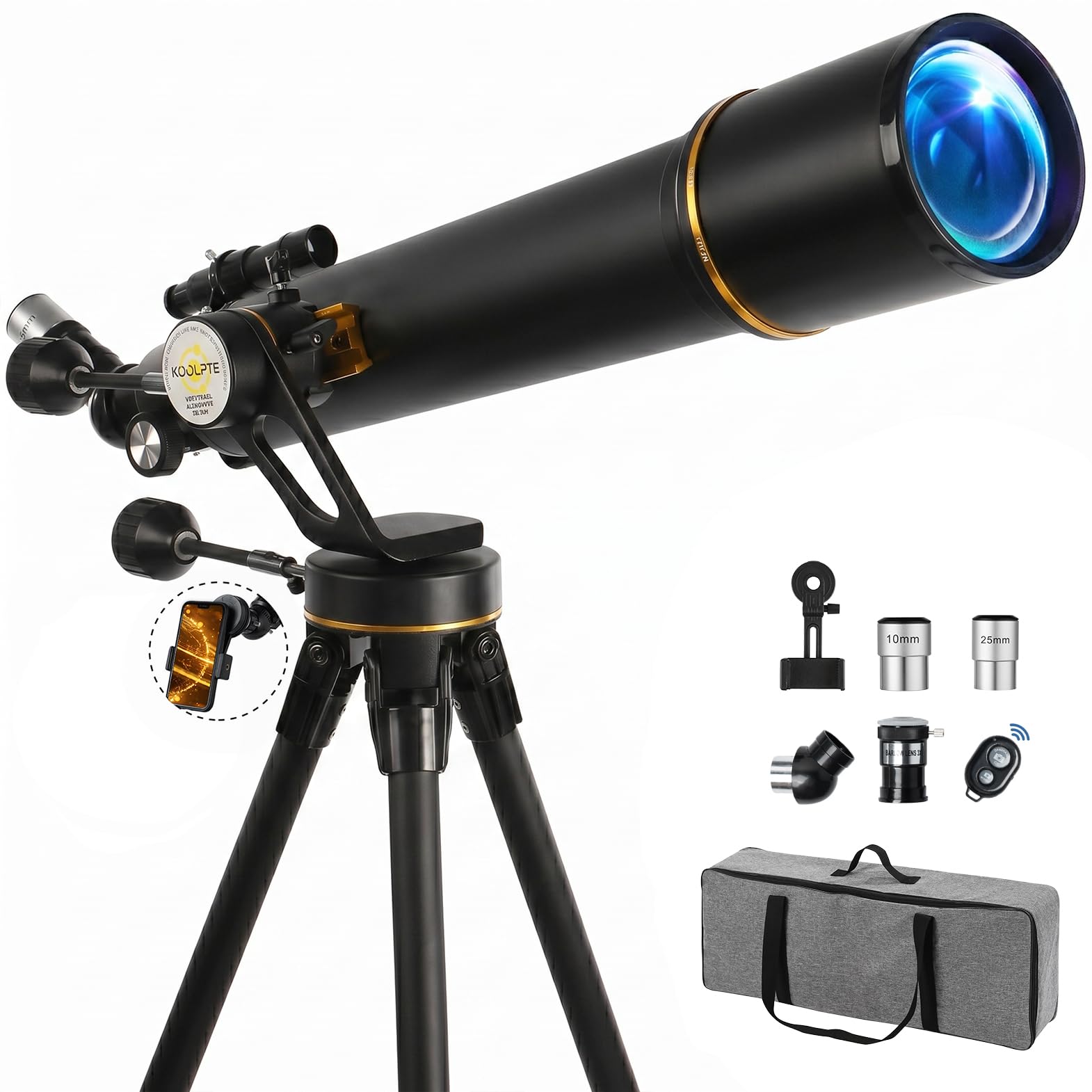
The Koolpte 90mm refractor features the exclusive Vertisteel AZ slow-motion mount, which uses a “follow and stop” damping mechanism to eliminate the overshooting and wobble that plague many budget alt-az mounts. This makes a tangible difference at 140x or 210x—finding and tracking Jupiter or Saturn becomes a controlled, precise experience rather than a battle against springy vibration. The 90mm fully multi-coated aperture with 700mm focal length produces images that are bright and contrasty, with the 99% light transmission coating performing as advertised under moderate light pollution.
The kit includes K10mm and K25mm eyepieces and a 3x Barlow, covering 28x to 210x. The wireless remote and phone adapter work well for capturing Moon shots and sharing views with family. The carry bag fits all components including the stainless steel tripod. Several users specifically note the 90mm aperture provides noticeably better planetary detail than their previous 70mm scopes—Jupiter’s bands and Saturn’s rings are readily identifiable, not just suggestive.
Not all reports are glowing: one user experienced an internal part loosening after a single session, and the tripod leg adjustment can feel stiff. The 700mm focal length at f/7.8 produces good but not excellent chromatic aberration control—bright objects show a slight purple fringe at the edge of the field. For the amateur who values smooth, precise mount action over sheer aperture size, the Koolpte’s Vertisteel mount is a standout feature that directly improves the observing experience at medium to high power.
Why it’s great
- Vertisteel slow-motion mount eliminates overshoot and wobble during tracking
- Good planetary detail achievable at 140x with the 10mm eyepiece
- Wireless remote enables easy group viewing and photos
Good to know
- Occasional quality control issues reported by a small number of users
- Moderate chromatic aberration visible on very bright objects
9. Celticbird 80mm Aperture 900mm Refractor

The Celticbird 80mm refractor takes a smart approach to budget-friendly astronomy: instead of a generic 60mm starter, it offers an 80mm aperture in a long 900mm f/11.25 configuration. The f/11 focal ratio is inherently forgiving of chromatic aberration, producing crisp, color-correct lunar and planetary images that rival more expensive scopes of equal aperture. The fully coated optics and high-transmission lens coatings deliver bright images that hold up well under suburban light pollution, and the 22.22-degree apparent field of view is generous for the price point.
The kit includes 20mm (45x) and 10mm (90x) wide-angle Kellner eyepieces, a reflex finderscope for easy target acquisition, a phone adapter for snapshots, and a carry bag that fits the entire setup. Users consistently report seeing Jupiter’s four moons and Saturn’s ring shape on the first night. The included alt-azimuth tripod extends from 20 to 45 inches and provides adequate stability for the lightweight 80mm optical tube. Setup takes roughly five minutes without tools.
Limitations: the 80mm aperture is a hard ceiling for deep-sky observing—nebulae and galaxies appear as faint gray smudges rather than structured objects. A few units have shipped with dust on the objective lens (easily cleaned with a lens brush). The tripod, while functional, is the weakest link in the system and will exhibit vibration at 90x if not weighted down. For the absolute beginner who wants the lowest-cost path to seeing Saturn’s rings and lunar craters with real clarity, the Celticbird 80mm delivers the best planetary value in the budget tier.
Why it’s great
- Long f/11 focal ratio virtually eliminates chromatic aberration
- Shows Jupiter’s moons and Saturn’s ring shape on the first night
- Complete kit with bag, phone adapter, and tool-free assembly
Good to know
- 80mm aperture limits deep-sky visibility to brightest objects only
- Included tripod benefits from added weight for vibration control
FAQ
Why is 90mm aperture often recommended for a first amateur telescope?
What is the difference between a refractor and a reflector telescope for amateur use?
Why do some telescopes advertise extremely high magnification like 600x that is not achievable in practice?
Can I use an amateur telescope for daytime birdwatching or nature observation?
How long does it take to set up and break down an amateur telescope for a typical backyard session?
Final Thoughts: The Verdict
For most users, the amateur telescope winner is the Celestron AstroMaster 102AZ because its 102mm aperture provides noticeably brighter planetary and lunar views than typical 90mm starters, with tool-free setup and reliable Celestron build quality. If you want app-guided navigation that lets you find deep-sky objects without a star atlas, grab the Celestron StarSense Explorer LT 80AZ. And for deep-sky performance on a budget, nothing beats the light-gathering power of the Gskyer 130EQ reflector for revealing nebulae and star clusters that smaller apertures simply cannot reach.