
Our readers keep the lights on and the weekend projects moving. As an Amazon Associate, I earn from qualifying purchases.
A great headphone setup hinges on two separate components: converting digital audio files into an analog waveform (the DAC) and then amplifying that signal cleanly without adding noise or distortion (the amp). An all-in-one Amp and DAC bundle removes the guesswork of pairing separate boxes, saving desk space and often lowering the overall cost. The challenge is sifting through chipset specs, power ratings, and connectivity options to find the unit that matches your headphones or IEMs without breaking your budget.
I’m Rikta — the co-founder and writer behind FitlyFast. I’ve spent hundreds of hours analyzing market data, decoding real-world customer experiences, and comparing technical specifications across the most talked-about desktop and portable Amp and DAC units to build this guide.
Whether you are driving sensitive in-ear monitors or hungry planar magnetic headphones, choosing a amp and dac that offers the correct power output, connectivity, and sound signature for your gear is the single most important decision you will make for your listening pleasure.
How To Choose The Best Amp And DAC
Selecting the right unit involves understanding your headphones’ impedance and sensitivity, deciding between a portable dongle or a desktop stack, and confirming which inputs and outputs your sources require. The following factors will guide you through the most common buying decisions.
Power Output: The Match with Your Headphones
The most critical spec is output power measured in milliwatts (mW) at a given impedance (ohms). High-impedance headphones (150Ω–600Ω) like the Sennheiser HD 600 series need higher voltage swing — look for units offering at least 100mW @ 300Ω. Low-impedance headphones and IEMs (16Ω–80Ω) benefit from current; a DAC/amp with over 500mW @ 32Ω will have plenty of headroom. Avoid a mismatch: too much power with sensitive IEMs can cause hiss, while too little power with high-impedance headphones results in a thin, lifeless sound.
Connectivity: Balanced vs. Single-Ended
A 4.4mm Pentaconn or 2.5mm TRRS balanced output doubles the voltage swing compared to a standard 3.5mm or 6.35mm single-ended output. This translates to roughly 4x the power and better channel separation, which reduces crosstalk. If your headphones have a balanced cable, prioritize a unit with a 4.4mm output. For IEMs, a properly implemented single-ended output with low output impedance (under 1Ω) is often sufficient and more convenient.
DAC Chipset and Digital Filters
The DAC chip (ESS Sabre, AKM Velvet Sound, or Cirrus Logic) largely determines the noise floor and dynamic range. Premium chips like the ES9039Q2M and AK4493S offer ultra-low distortion and high signal-to-noise ratios (>120dB). Modern units also include selectable digital filters — minimum phase for a natural decay, linear phase for tight bass, or fast roll-off for a sharper transient response. Experimenting with filters can fine-tune the sound signature to your preference.
Essential Extras: PEQ, LDAC, and Volume Control
A 10-band parametric equalizer (PEQ) lets you apply precise correction curves (like Harman target) directly on the device, bypassing software EQ on your computer. LDAC Bluetooth support offers near-lossless wireless streaming from your phone. A physical volume knob is always preferable to digital volume control in software, as it prevents accidental loud blasts and allows fine-grained adjustments.
Quick Comparison
On smaller screens, swipe sideways to see the full table.
| Model | Category | Best For | Key Spec | Amazon |
|---|---|---|---|---|
| CHORD ELECTRONICS Mojo 2 | Portable | Critical Listening, HD800S | 2x 3.5mm output, UHD DSP | Amazon |
| TOPPING DX5 II | Desktop | Desktop Streaming, Balanced | 7600mW x2 @32Ω balanced | Amazon |
| iFi xDSD Gryphon | Portable | Travel, Bluetooth LDAC | 1000mW, XBass/XSpace | Amazon |
| FiiO K11 | Desktop | Entry Desktop, Home Audio | 1400mW @32Ω balanced | Amazon |
| FiiO KA15 | Portable Dongle | Mobile HiFi, PEQ Tuning | 560mW+560mW balanced | Amazon |
| S.M.S.L DS100 | Desktop Mini | MQA, Small Desk | THD 0.00017%, CK-03 clock | Amazon |
| Topping DX1 | Desktop Entry | PC Gaming, IEMs | 280mW x2 @32Ω, AK4493S | Amazon |
| Protocol Max | Portable Dongle | Universal USB-C, PEQ | 600mW @32Ω balanced | Amazon |
| Douk Audio K5 | Desktop Entry | Budget, Bass/Treble Tuning | 560mW @32Ω, ESS9038Q2M | Amazon |
In‑Depth Reviews
1. CHORD ELECTRONICS Mojo 2

The Mojo 2 is a benchmark in portable DAC/amp design from Chord Electronics, built around their proprietary FPGA architecture rather than off-the-shelf DAC chips. It delivers a meticulously analytical and detailed sound that reveals micro-details in recordings, with a particularly deep and wide soundstage. The UHD DSP allows lossless EQ adjustments, enabling you to fine-tune bass and treble without degrading the signal quality.
Its dual 3.5mm headphone outputs are ideal for sharing a listening session, and the 8-hour battery life is sufficient for a full day of travel. The build is a tank-like aluminum enclosure that feels dense and durable. The retro ball-and-color interface has a learning curve, but once mastered, the controls become second nature. It supports full MQA decoding and native DSD playback up to DSD512 via its coaxial input.
There are genuine trade-offs: the Mojo 2 lacks Bluetooth, does not have a balanced output, and its micro-USB charging port feels dated. It also has known compatibility quirks with some Apple devices and may require a powered USB hub. For the enthusiast who values absolute sound purity over convenience, the Mojo 2 remains a top-tier choice.
Why it’s great
- Exceptional clarity and detail retrieval
- Lossless UHD DSP for custom tuning
- Tank-like build quality
Good to know
- No Bluetooth or balanced output
- Steep learning curve for controls
2. TOPPING DX5 II
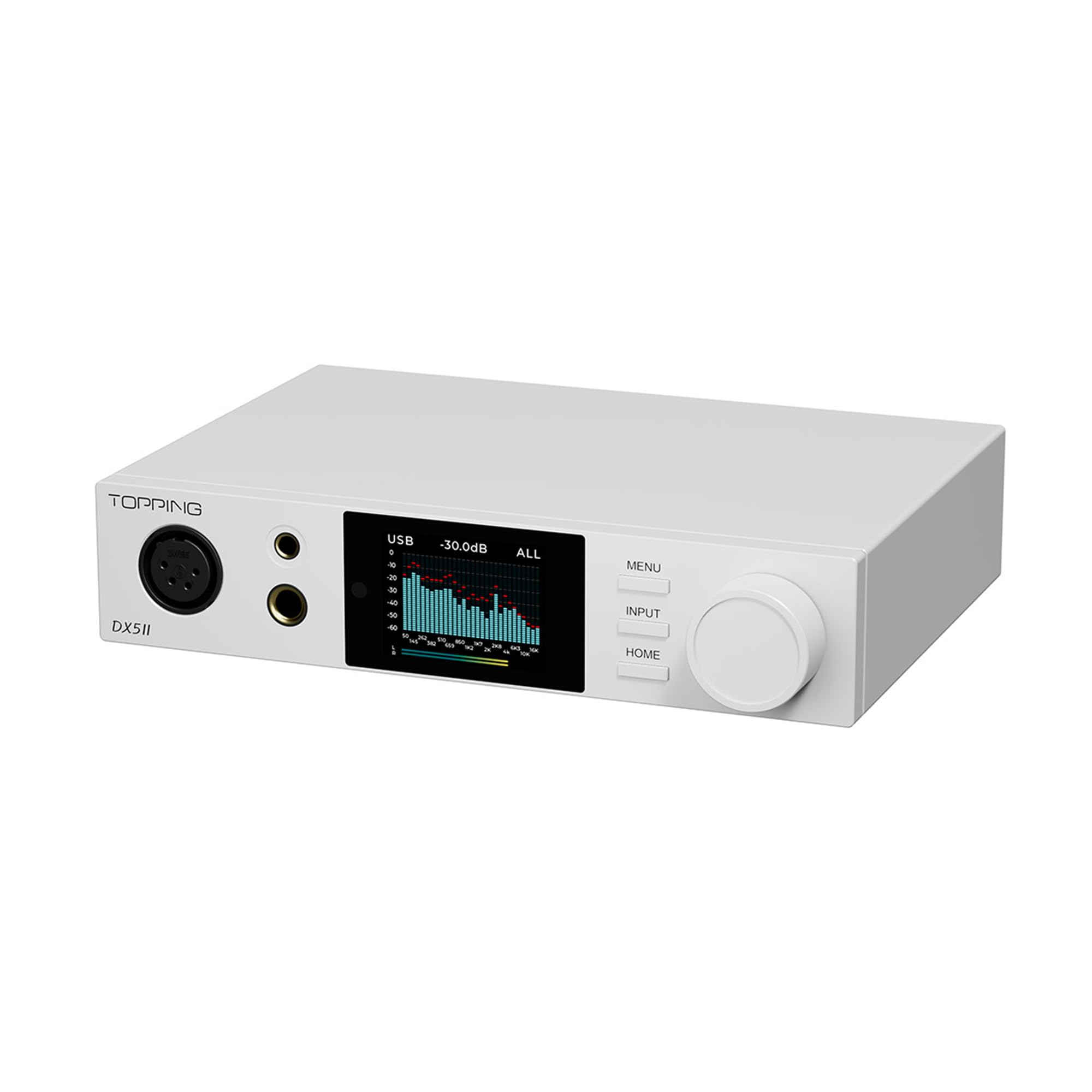
The DX5 II is a desktop all-in-one that combines dual ESS ES9039Q2M DAC chips with a powerful X-Hybrid balanced amplifier stage. Its balanced output specced at 7600mW per channel into 32Ω means it can drive even the most demanding planar headphones with ease. The 10-band parametric EQ is fully adjustable via the unit interface, allowing precise correction curves to be saved directly.
LDAC Bluetooth 5.1 with the QCC5125 chipset ensures near-lossless wireless streaming from your phone, and the 2.0-inch color Aurora UI display is vibrant and responsive. The pressable volume knob feels smooth and premium. Inputs include USB, optical, coaxial, and SPDIF, and the 12V trigger allows seamless integration with a separate speaker amplifier system.
Some users report that the headphone jacks lack physical protection, and hot-swapping cables can occasionally cause clipping. The bundled remote is compatible only with the DX5 II, not older Topping units. For the price, the DX5 II offers an unbeatable combination of raw power, PEQ flexibility, and wireless connectivity — making it the strongest overall desktop choice.
Why it’s great
- 7600mW balanced output drives any headphone
- 10-band PEQ and LDAC Bluetooth
- Full-color display with intuitive UI
Good to know
- Headphone jacks not protected
- New remote is model-specific
3. iFi xDSD Gryphon

The xDSD Gryphon is iFi’s flagship portable DAC/amp, designed for serious on-the-go listening. It features a 16-core XMOS processor that handles full MQA decoding and native DSD512 via USB, alongside LDAC Bluetooth for wireless convenience. The amplifier stage delivers 1000mW into balanced outputs, enough to power full-size headphones like the Hifiman Arya at moderate volumes.
The PureWave balanced circuit and OptimaLoop feedback system produce a warm, detailed, and engaging sound signature. XBass and XSpace filters allow analog-style bass boost and soundstage expansion without digital artifacts. The military-grade aluminum chassis feels sturdy, and the SilentLine OLED display provides clear feedback on format and volume.
The 8-hour battery is adequate for a day out, and the unit can serve as a preamp for active speakers via its line-out mode. The volume knob is continuous (not stepped), which can feel imprecise at low levels. The absence of a Power Match switch (found on the hip dac 3) means some listeners may find the gain a bit high for sensitive IEMs, requiring careful volume adjustment.
Why it’s great
- Warm, engaging sound with XBass/XSpace
- LDAC and wired USB-C connectivity
- Drives full-size headphones on the go
Good to know
- Continuous volume knob lacks precision
- No Power Match gain adjustment
4. FiiO K11

The FiiO K11 is a compact desktop DAC/amp that punches well above its weight class. It provides up to 1400mW of power into a balanced 4.4mm output, making it capable of driving most headphones up to 350Ω with authority. The minimalist design features a metal chassis and a high-contrast VA display that shows volume, gain, and sampling rate at a glance.
Input support covers USB-C, coaxial, and optical, while outputs include 4.4mm balanced, 6.35mm single-ended, line-out RCA, and coaxial digital out — giving you a lot of routing flexibility. The sound signature is neutral and detailed, with good stereo separation and a clean noise floor that works well with both dynamic headphones and sensitive IEMs.
The K11 operates best via USB-C to USB-C on some Linux systems; USB-A connections can occasionally cause power errors. Its digital filters range from bright to dark, with Filter 6 (bypass) sounding the most natural. For the price, the K11 delivers a mature, versatile desktop experience without the bulk of larger stacks.
Why it’s great
- 1400mW balanced output for high-impedance headphones
- Neutral, detailed sound with low noise
- Compact metal build with clear display
Good to know
- USB-A cable may cause power errors on Linux
- LED design feels gamer-centric
5. FiiO KA15

The FiiO KA15 is a portable dongle that pairs dual Cirrus Logic CS43198 DAC chips with dual SG Micro SGM8262 op-amps inside a chassis that mimics a retro tape recorder. Its standout feature is a 10-band high-precision lossless PEQ that can be configured via the FiiO Control app or a web interface, allowing you to perfectly tune your IEMs or headphones.
In desktop mode (patented), the balanced output reaches 560mW per channel — a 207% increase over the previous KA5. The 0.96-inch IPS color LCD shows a retro dynamic UI, and the unit also doubles as a coaxial SPDIF output for connecting to external decoders. Microphone support on the 3.5mm jack (CTIA standard) lets you use in-line controls.
Despite its innovation, the KA15 has quirks: the stiff included USB cable can strain phone ports, volume fluctuations occur on some Android devices, and the track skip buttons are occasionally unresponsive. Some users report an audio delay at the start of playback, which can be frustrating for non-music audio like Discord. For mobile listeners who want full PEQ control, the KA15 is hard to beat.
Why it’s great
- 10-band lossless PEQ for custom tuning
- 560mW balanced output in desktop mode
- Unique retro design with color screen
Good to know
- Stiff cable can damage phone ports
- Track skip buttons occasionally unresponsive
6. S.M.S.L DS100

The SMSL DS100 is a tiny desktop DAC/amp that measures just 3.5 inches square, making it one of the most space-efficient units available. It uses the Cirrus Logic CS43131 chip paired with the XMOS XU-316 USB controller to support MQA and MQA-CD decoding, PCM up to 32-bit/768kHz, and DSD256. The CK-03 clock processing circuit significantly reduces jitter.
The DS100 provides both 6.35mm and 4.4mm headphone outputs, with a line-out mode for connecting to external amplifiers or active speakers. The output voltage reaches 7Vrms into 600Ω, making it suitable for high-impedance headphones. The CNC-machined aluminum body with gold-plated connectors feels high-quality for such a small device.
Windows users must install a separate driver from the SMSL website, and the USB-C power input shares the data port, so a splitter may be needed for dedicated power. The volume knob is tiny but works well. With its minuscule footprint, MQA support, and balanced output, the DS100 is an excellent featherweight desktop companion.
Why it’s great
- Ultra-compact 3.5-inch square footprint
- Full MQA decoding via XMOS XU-316
- 7Vrms into 600Ω for high-impedance cans
Good to know
- Driver installation required for Windows
- USB-C combines data and power
7. Topping DX1
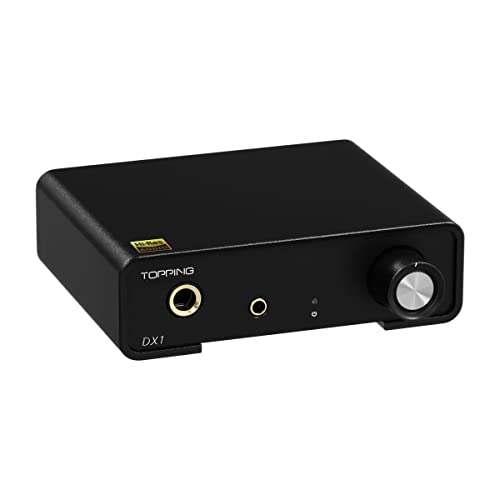
The Topping DX1 is an entry-level USB-powered DAC/amp that uses AKM’s Velvet Sound AK4493S chip, a proven sub-flagship DAC. It outputs 280mW per channel into 32Ω and 51mW into 300Ω — enough power for most dynamic headphones up to 250Ω, though it may struggle with high-impedance models like the HD 600 series at full listening levels.
Its discrete LNRD circuit filters out USB power noise, keeping the noise floor below 1.0µV on the amp side — virtually silent even with sensitive IEMs. The unit features both 6.35mm and 3.5mm outputs with two-stage gain switching, and a dedicated line-out with fixed volume for use as a pure DAC with an external amplifier.
Plug-and-play operation on Windows, Mac, and Linux is a major convenience, though ASIO applications may require driver installation. Some Windows applications may not detect the 32-bit/384kHz mode, requiring a quick adjustment in the sound settings. For the price, the DX1 offers a clean, neutral sound and a huge step up from motherboard audio.
Why it’s great
- Ultra-low noise floor for IEMs
- AK4493S Velvet Sound chip
- Plug-and-play on all major OS
Good to know
- Underpowered for >250Ω headphones
- No power button
8. Protocol Max
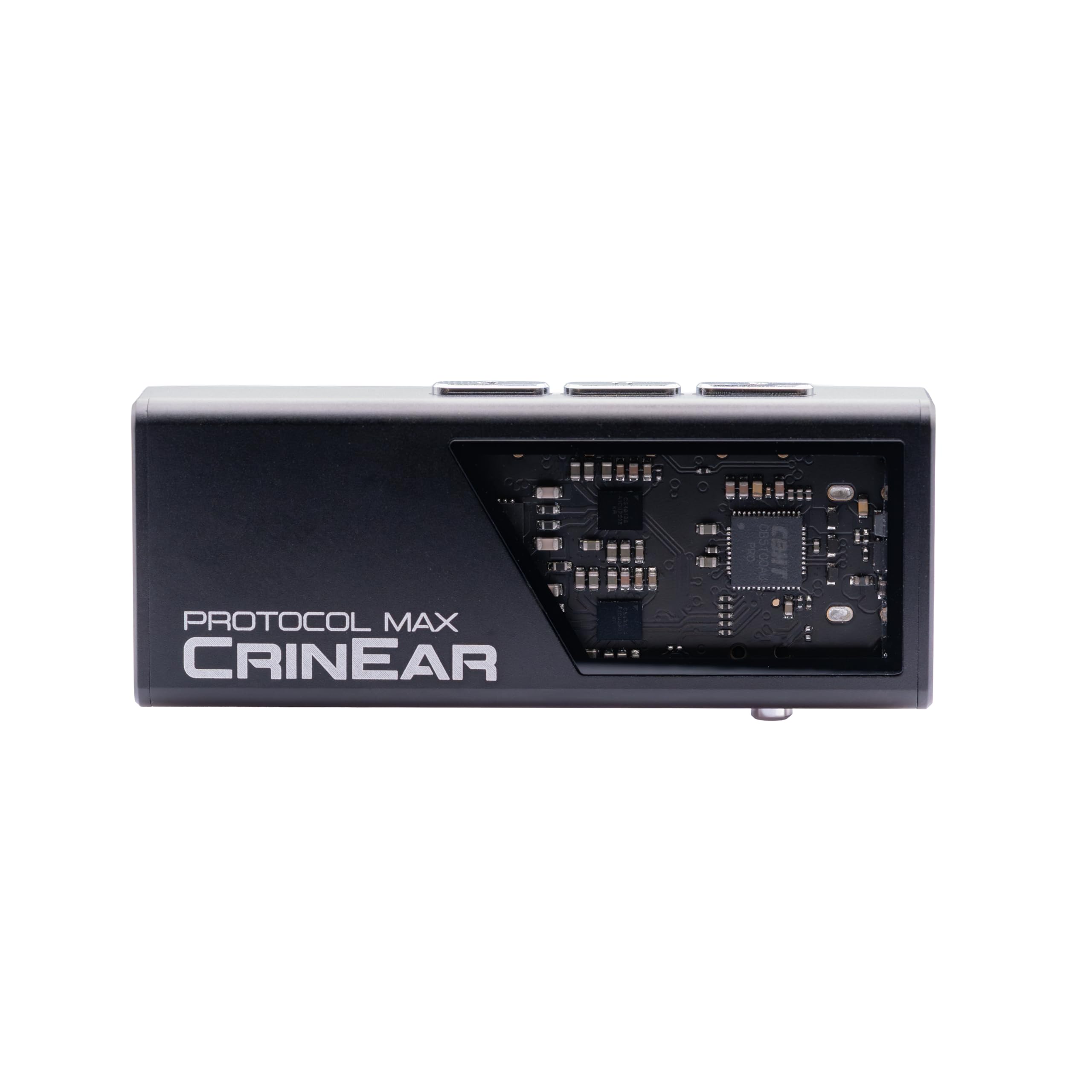
The Protocol Max is a portable DAC/amp dongle from CrinEar that offers a unique browser-based 10-band parametric EQ, allowing you to save custom profiles directly to the device without installing any app. It uses dual Cirrus Logic CS43198 DAC chips and dual SG Micro SGM8262 op-amps for clean, high-resolution audio conversion.
The balanced 4.4mm output delivers up to 600mW at 32Ω, which provides plenty of headroom for full-size headphones like the Sennheiser HD 600 series. The unit includes eco and boost power modes to balance battery drain versus output performance. Both 4.4mm balanced and 3.5mm single-ended outputs are available, with low output impedance for wide compatibility.
The initial batch had quality control issues — some units arrived with channel imbalance or buzzing after a few weeks. The EQ profile can only be set via a desktop web browser, which is less convenient than a mobile app. Documentation is sparse, and the difference between Eco and Boost modes is not clearly explained. When working correctly, the Protocol Max provides excellent sound and powerful, customizable EQ.
Why it’s great
- Browser-based PEQ saves directly to device
- 600mW balanced output for demanding cans
- Dual CS43198 DAC chips for clean sound
Good to know
- History of quality control issues
- EQ config requires desktop browser
9. Douk Audio K5

The Douk Audio K5 is an affordable all-in-one USB DAC and headphone amplifier that punches above its price point with the ESS9038Q2M DAC chip. It supports PCM up to 32-bit/384kHz and DSD256, with a signal-to-noise ratio above 121dB and THD of just 0.0007%. The unit provides 560mW per channel at 32Ω, which is sufficient for most headphones under 300Ω.
A unique feature at this price tier is the tone control section with separate bass and treble knobs that have a center detent for neutral positioning. A bypass switch (PURE mode) removes all tone adjustments for a direct signal path. The K5 accepts USB, optical, and coaxial inputs, and outputs via 6.35mm, 3.5mm, RCA, and optical — making it a versatile hub for a desktop setup.
The aluminum chassis is smaller than most entry-level units, and the volume knob doubles as the power button. Some users reported a defective 3.5mm jack, so check the included 6.35mm output works out of the box. For a budget entry point into high-resolution audio, the K5 offers remarkable value with its balanced tone controls and clean sound.
Why it’s great
- ESS9038Q2M chip at an accessible price
- Physical bass/treble controls with bypass
- Multiple inputs and outputs for flexibility
Good to know
- Reported QC issues with 3.5mm jack
- Not powerful enough for high-impedance planars
FAQ
Can I use a portable DAC/amp with my phone and also my laptop?
How much power do I need for 300-ohm headphones like the Sennheiser HD 600?
What is the difference between a DAC and an amplifier in an all-in-one?
Does a balanced cable always sound better than single-ended?
Final Thoughts: The Verdict
For most users, the amp and dac winner is the TOPPING DX5 II because it combines immense balanced power, a 10-band PEQ, LDAC Bluetooth, and a vibrant display into a single desktop unit that drives virtually any headphone. If you want genuine lossless PEQ tuning from your phone, grab the FiiO KA15. And for the ultimate in portable analytical sound with build quality that will outlast your headphones, nothing beats the CHORD ELECTRONICS Mojo 2.