
Our readers keep the lights on and the weekend projects moving. As an Amazon Associate, I earn from qualifying purchases.
Choosing your first dedicated headphone amplifier and digital-to-analog converter combo marks a turning point in how you hear music. Motherboard audio and basic dongles introduce noise, lack the current to drive high-impedance headphones, and smear the stereo image that reveals a recording’s depth. An integrated DAC/Amp unit replaces that chain with a single box engineered for clean power delivery and accurate signal conversion, turning a flat track into a textured soundstage with defined instrument separation and a black-silent background.
I’m Rikta — the co-founder and writer behind FitlyFast. I’ve spent countless hours cross-referencing chipset specifications, measured power output figures, and real-world user feedback on dozens of desktop DAC/Amp combos to isolate the units that deliver genuine audible improvements at their respective price tiers.
Whether you’re upgrading from a budget dongle or building your first dedicated listening station, finding the right amp dac combo depends on matching power output to your headphone impedance and understanding which connectivity options your setup actually needs.
How To Choose The Best AMP DAC Combo
Desktop DAC/Amp combos are a mature category where performance scales predictably with design quality rather than marketing claims. Before looking at any specific model, identify the impedance range of your primary headphones — this single number dictates how much voltage swing and current your amp section must deliver. High-impedance headphones like the Sennheiser HD6XX (300Ω) require higher voltage, while low-impedance planar magnetics like the Hifiman Edition XS need substantial current. A combo that excels with IEMs may sound anemic on full-size planars, and a powerful unit may reveal background hiss with sensitive multi-driver earphones.
DAC Chipset vs. Implementation
The AK4493SEQ in the FiiO K7 and the ES9039Q2M in the Topping DX5 II are both capable of flagship-level measured performance, but the surrounding analog stage — op-amp selection, power supply filtering, and PCB layout — determines how much of that theoretical performance reaches your ears. A well-implemented mid-tier chip like the CS43131 or AK4493S often sounds cleaner than a poorly executed flagship ESS chip because the latter’s higher noise floor can introduce grain in the treble region. Prioritize combos with discrete low-noise voltage regulators (LNRD or CK-03 circuits) and dual-DAC configurations for improved channel separation.
Connectivity and Preamp Functionality
Decide whether the combo will serve as a dedicated headphone amplifier, a preamp for powered monitors, or both. Units with fixed line outputs (Topping DX1) are best for pure headphone listening. Combos with variable preamp outputs, balanced XLR jacks, and a 12V trigger (Topping DX5 II, Fosi Audio ZD3) integrate seamlessly into a desktop speaker system. Optical and coaxial inputs allow connection to CD players or TVs, while HDMI ARC support in the Fosi ZD3 simplifies TV audio. USB input is mandatory for modern computers — check whether the combo uses the XMOS XU-316 controller for native DSD256 support and low driver latency.
Power Delivery and Thermal Management
Power output figures are commonly quoted at 32Ω (low impedance) or 300Ω (high impedance). A combo delivering 2000mW balanced at 32Ω is overkill for most IEMs but necessary for current-hungry planars running EQ boosts. USB-powered units like the Topping DX1 and SMSL DS100 are limited to about 280mW at 32Ω and may struggle with 300Ω loads at high volumes. Desktop units with an external DC adapter (FiiO K11, FiiO K7, Topping DX5 II) provide higher voltage rails and sustained power without overheating. Check whether the chassis uses vented metal or closed aluminum — sustained high-power playback in a sealed case accelerates thermal degradation of electrolytic capacitors.
Quick Comparison
On smaller screens, swipe sideways to see the full table.
| Model | Category | Best For | Key Spec | Amazon |
|---|---|---|---|---|
| Topping DX5 II | Dual-DAC | Audiophile tuning with PEQ | 7600mW balanced, dual ES9039Q2M | Amazon |
| FiiO K7 | THX Amp | Neutral reference listenin | 2000mW balanced, dual AK4493SEQ | Amazon |
| FiiO K11 | VA Display | Compact desk with visual feedback | 1400mW balanced, 4.4mm+6.35mm+line out | Amazon |
| Fosi Audio ZD3 | DAC Preamp | TV ARC and speaker integration | HDMI ARC, XLR out, ES9039Q2M | Amazon |
| HIFIMAN EF499 | R2R DAC | Warm organic sound signature | 4.35W balanced, R2R architecture | Amazon |
| AIYIMA A80 | Amp & DAC | Powered speaker system | 300Wx2 class D, ES9038Q2M, VU meter | Amazon |
| Fosi Audio SK02 | USB-C | Portable desktop with balanced | 1100mW balanced, ES9038Q2M | Amazon |
| Topping DX1 | USB-Powered | Entry-level high impedance | 280mW x2, AK4493S, LNRD | Amazon |
| SMSL DS100 | MQA Decoder | Compact desk with MQA support | 7Vrms @600Ω, CS43131, CK-03 | Amazon |
In‑Depth Reviews
1. Topping DX5 II
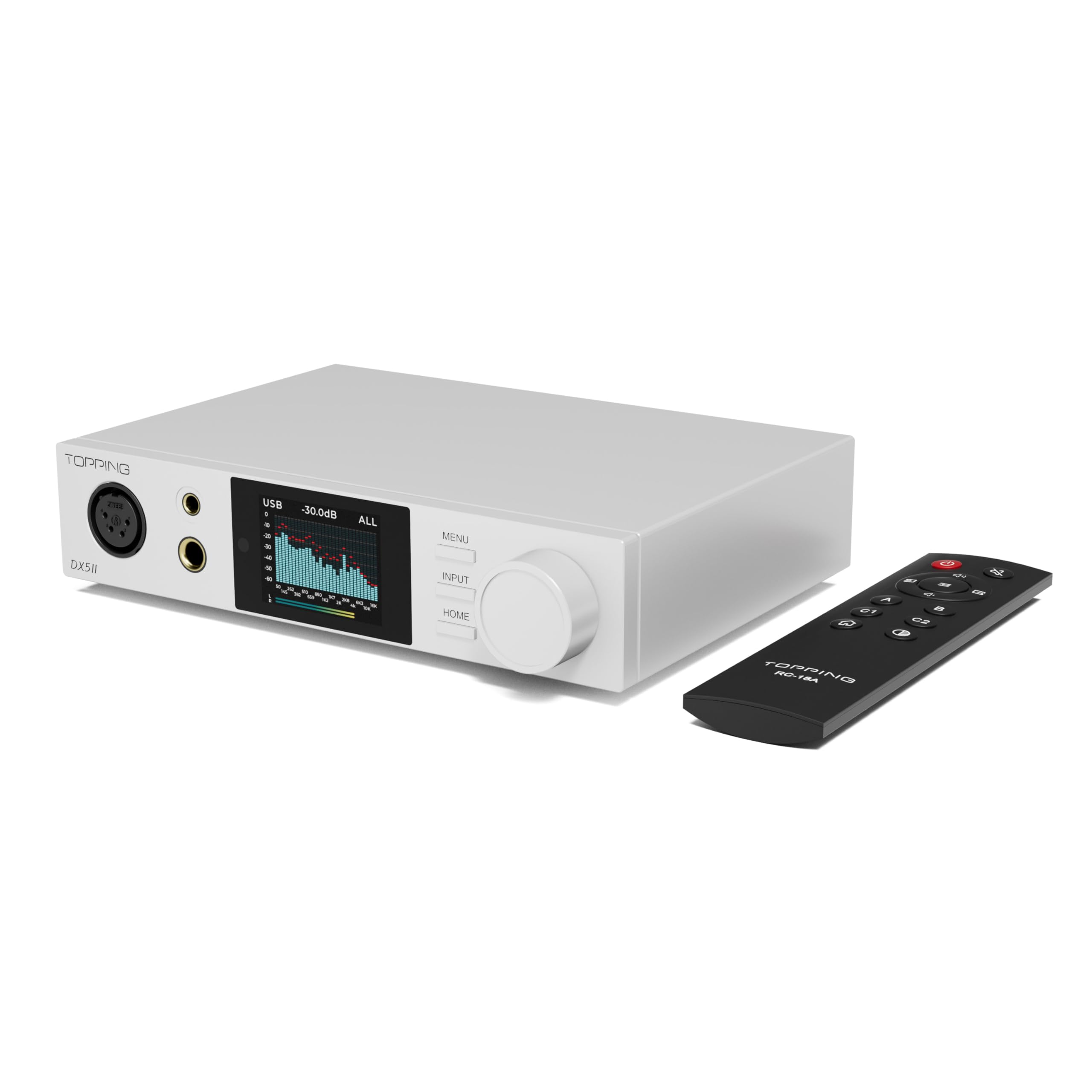
The Topping DX5 II sets a new performance ceiling for sub- combos by pairing dual flagship ESS ES9039Q2M DAC chips with a fully balanced X-Hybrid amplifier section that outputs a staggering 7600mW per channel into 32Ω over the 4.4mm balanced jack. That headroom ensures even low-sensitivity planar magnetic headphones like the Hifiman Arya or Audeze LCD-X play cleanly with room for EQ boost without clipping. The 10-band high-precision parametric EQ is implemented digitally without degrading the analog signal path, allowing you to tame treble peaks or inject sub-bass shelf filters directly within the unit — no software plugin required.
The Aurora UI 2.0-inch color display renders nine customizable themes and real-time sample rate information, controlled via a pressable aluminum knob. LDAC Bluetooth 5.1 with the QCC5125 chipset streams near-lossless wireless audio from Android phones, while USB, coaxial, and optical inputs cover legacy sources. The preamp mode with 12V trigger input lets the DX5 II integrate into a powered monitor setup, switching audio chains with a single remote press.
Build quality is solid metal with a moderate footprint, though the included remote uses slim plastic construction. Some early firmware units required a USB drive flash to address the language-default bug — ensure yours ships with the latest firmware or update it immediately. For listeners who want a single box that drives any headphone while offering extensive EQ tuning, the DX5 II is the most complete package in the category.
Why it’s great
- Massive balanced output handles all headphone types
- 10-band PEQ allows precise in-unit tone shaping
- LDAC Bluetooth ensures high-res wireless streaming
Good to know
- Firmware issues may require manual update
- Remote control feels less premium than the device
2. FiiO K7

The FiiO K7 delivers a transparent, neutral sound profile that reveals exactly what the recording engineer intended — no warmth added, no treble artificially extended, just clean gain with a black background. Dual AK4493SEQ DAC chips feed into dual THX AAA 788+ amplifier modules, producing 2000mW balanced output at 32Ω with total harmonic distortion below 0.0002%. That measured performance translates to an almost three-dimensional soundstage when paired with open-back headphones like the Sennheiser HD800S, where vocal imaging and instrument placement feel precisely located beyond the ear cups.
Input flexibility covers USB, optical, coaxial, and an auxiliary line-in, while outputs include 4.4mm balanced, 6.35mm single-ended, and 3.5mm single-ended. The six-stage audio circuit architecture — normally found on FiiO’s flagship K9 series — keeps the power supply noise isolated from the DAC section, preventing the channel crosstalk that plagues cheaper all-in-one units. RGB indicator lights differentiate sample rates at a glance, and the two gain levels accommodate both sensitive IEMs and high-impedance full-size cans.
The USB-powered design draws up to 12V via the included adapter, yet the chassis stays cool even after extended high-gain listening sessions. Some users note that the balanced 4.4mm jack provides a tangible improvement in soundstage width over the 6.35mm output, so budget for balanced cables if you want the full K7 performance envelope. It lacks Bluetooth, so wireless listeners should look at the DX5 II or K11 instead.
Why it’s great
- Neutral, low-noise presentation ideal for critical listening
- THX amp delivers clean power without distortion
- Compact footprint with robust aluminum build
Good to know
- No Bluetooth connectivity
- Requires balanced cable for best soundstage performance
3. HIFIMAN EF499

The HIFIMAN EF499 breaks from the delta-sigma chip consensus by using a resistor-ladder (R2R) architecture that produces a naturally warm, full-range sound closely resembling the company’s flagship Hymalaya DACs. The R2R conversion method avoids the metallic glare and digital harshness that some listeners perceive in ESS-based designs, rendering string textures with a liquid smoothness and vocal sibilance with natural decay. Balanced output reaches 4.35W into 32Ω via the 4-pin XLR jack, providing ample current for HIFIMAN’s own planar-magnetic headphones like the Sundara or Edition XS without breaking a sweat.
The vertical chassis design doubles as a headphone stand, saving desk space while maintaining a heavy, vibration-resistant build that weighs over three kilograms. Front-panel controls include a four-level function switch that toggles between high/low gain and NOS (Non-Over-Sampling) or OS modes — NOS mode preserves the R2R’s natural transient response at the expense of slightly elevated out-of-band noise, while OS mode cleans up the ultrasonic band for a more conventional presentation. Rear connections include USB-B, USB-C, coaxial, XLR and RCA outputs, plus a network port that enables direct NAS streaming without a computer.
The EF499 runs genuinely warm to the touch during operation due to the R2R ladder’s constant current draw, so adequate ventilation is essential. The included documentation omits explanation of the NOS/OS modes, and the line output does not automatically mute when headphones are plugged in — you must manually switch outputs. For listeners who prioritize vocal texture and harmonic richness over clinical precision, the EF499 offers a unique flavor that no delta-sigma combo in this price bracket can match.
Why it’s great
- R2R architecture produces a warm, organic sound signature
- Vertical stand design saves desk space
- NAS streaming capability without a PC
Good to know
- Runs hot during extended use
- Line out does not auto-mute with headphone connection
4. AIYIMA A80
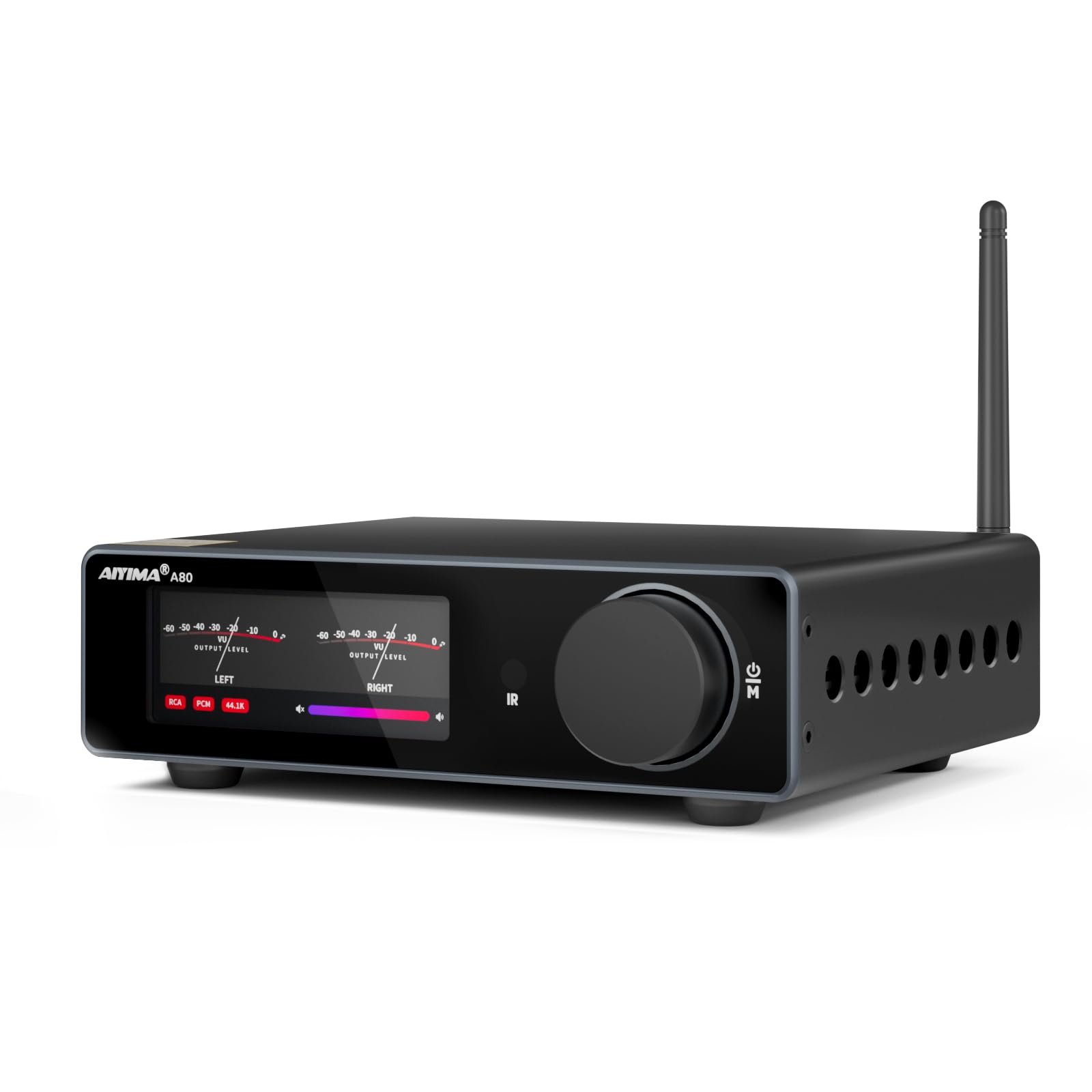
The AIYIMA A80 is best understood as a hybrid unit that combines a capable desktop DAC with a full Class-D power amplifier capable of driving passive speakers — not just headphones. The ES9038Q2M DAC chip feeds into a TPA3255 power stage with PFFB (Post-Filter Feedback) circuitry, which corrects phase and frequency response anomalies caused by the output inductor filter. Measured THD lands at 0.006% with a SINAD of 109dB, figures that rival much more expensive integrated amplifiers. The digital VU meter adds a tactile retro element that displays real-time input status and volume level in multiple display modes.
Connectivity is unusually broad for this price tier: USB, optical, coaxial and TRS balanced inputs feed the DAC, while 3.5mm AUX and RCA outputs allow flexible integration with subwoofers or secondary amplifiers. The A80 includes tone control knobs for bass and treble shelf filters, which is rare in the otherwise purist desktop audio world. Bluetooth 5.0 with LDAC support streams near-lossless audio from mobile devices, and the GaN 48V 5A power adapter runs cool even when the A80 delivers its claimed 300W per channel into 4Ω loads.
Buyers should be aware that the A80’s 300W rating is peak dynamic output — continuous power is closer to 120W per channel into 4Ω, which is still sufficient for moderately efficient bookshelf speakers in a near-field setup. The amplifier runs hot when pushing low-sensitivity speakers like the KEF Q150 to high volumes, and the small chassis relies on convection cooling. If your primary use is headphone listening, a dedicated headphone amp combo like the FiiO K7 or Topping DX5 II is a better fit; the A80 excels when you want a single box that powers both headphones and desktop speakers.
Why it’s great
- Drives passive speakers and headphones from one unit
- ES9038Q2M DAC yields excellent measured performance
- Retro VU meter and tone controls add practical customization
Good to know
- Continuous power rating lower than peak claim
- Runs hot with low-sensitivity speakers at high output
5. Fosi Audio ZD3

The Fosi Audio ZD3 is a fully balanced desktop DAC preamp that prioritizes connectivity breadth and system integration over headphone amplification power — it is not a headphone amp, but a line-level source controller designed to feed powered monitors, active speakers, or external amplifiers. The chipset combines an XMOS XU316 controller with an ES9039Q2M DAC and QCC3031 Bluetooth module, supporting PCM up to 32-bit/768kHz and DSD512. Balanced XLR outputs deliver a clean signal path that eliminates ground loop hum — a common complaint from PC audio chains where cheap USB DACs pick up electrical noise from the motherboard.
The HDMI ARC input is the ZD3’s standout feature, allowing direct connection to a TV so that streaming app audio passes through the DAC’s superior conversion stage before hitting studio monitors or an amplifier like Fosi’s own ZA3. The 1.5-inch OLED display, remote control, and 12V trigger in/out simplify system automation — the DAC powers on and switches input automatically when the TV turns on. User-swappable op-amps let owners fine-tune the sound signature: the stock LME49720 is clean and detailed, while Sparkos SS3602 or NJR MUSES02 op-amps warm up the midrange and deepen bass impact.
Because the ZD3 lacks a headphone amplifier section, you must connect it to a separate headphone amp or active speakers to hear sound. The HDMI ARC is not eARC compatible, so multi-channel audio from Blu-rays will not pass through — it strips to two-channel PCM. If your setup revolves around powered monitors and you want a single clean DAC with HDMI TV integration, the ZD3 is a strong match.
Why it’s great
- HDMI ARC enables high-quality TV audio from a single input
- Balanced XLR output eliminates ground loop noise
- Swappable op-amps allow customizable sound tuning
Good to know
- No headphone amplifier built in
- HDMI input is not eARC compatible for surround formats
6. FiiO K11

The FiiO K11 brings balanced output and a crisp VA display to the sub- segment, territories typically dominated by utilitarian boxes with single-ended only. Balanced output via 4.4mm delivers 1400mW at 32Ω, which comfortably drives most full-size headphones up to 350Ω including the Sennheiser HD660S2 and Beyerdynamic DT 1990 Pro. The VA screen provides real-time feedback on volume, gain, output mode, and sample rate — a feature missing from similarly priced competitors like the Topping DX1 and SMSL DS100 — making operation intuitive without a separate app or driver panel.
Connectivity includes USB, optical, and coaxial inputs, with headphone outputs on 4.4mm balanced and 6.35mm single-ended. The rear panel also offers RCA line-out and coaxial digital output, allowing the K11 to function as a pure DAC feeding an external amplifier. Five digital filters allow subtle adjustments to the reconstruction filter’s roll-off behavior — Filter 6 (brickwall slow) sounds most natural, while later filters introduce slight compression or a bright edge. USB-C power input is convenient for cable management, though some users needed to switch to a USB-C to USB-C cable to resolve a power detection error on certain motherboards.
Compared to the higher-end FiiO K7, the K11 has slightly narrower soundstage depth and less resolving power in the upper treble, but those differences are only apparent in direct A/B testing with high-end headphones. The volume knob feels smooth with satisfying detent action, and the aluminum chassis stays cool during extended use. For a balanced desktop combo with a helpful display at an approachable price, the K11 is a sensible choice.
Why it’s great
- Balanced output and informative VA display at a low price
- Drives up to 350Ω headphones cleanly
- RCA line-out enables flexible system expansion
Good to know
- USB-C cable compatibility requires a specific cable type on some PCs
- Soundstage width falls slightly behind the K7 in critical listening
7. Fosi Audio SK02

The Fosi Audio SK02 packs an ESS Sabre ES9038Q2M DAC — a chip typically found in + combos — into a compact USB-C powered enclosure that outputs an impressive 1100mW balanced at 32Ω via the 4.4mm jack. This power density is unusual for a bus-powered device, as most USB-powered combos top out around 300mW. The SK02 drives the 300Ω Sennheiser HD6XX to loud volumes without audible distortion, a feat that eludes many similarly priced units. The 3.5mm single-ended output remains clean for IEMs with a noise floor measured at only 3.7µV, ensuring no hiss with sensitive multi-BA earphones.
Input options include USB and optical, covering computer and TV sources. The multifunction knob handles power on/off, play/pause, and volume control, while physical buttons switch high/low gain and input mode without needing to open a software panel. Colored indicator lights identify the current sample rate — helpful for confirming you are getting bit-perfect playback from a streaming service. The aluminum alloy chassis is CNC-machined and sandblasted, giving a durable feel that belies the sub- price bracket.
The SK02 lacks a pure DAC line-out mode — the headphone output and preamp output are the same circuit, so you cannot use it as a fixed-level DAC for powered monitors without manual volume matching. The single LED volume indicator offers only a vague approximation of output level, and some users reported that a 0-99 numerical display would be more practical. For a pure headphone desktop solution that doesn’t require wall power and delivers balanced output, the SK02 is the strongest choice in the budget zone.
Why it’s great
- Unusually high balanced output for a USB-powered device
- Drives 300Ω headphones cleanly without external power
- Compact CNC aluminum build with physical gain switch
Good to know
- No fixed line-out mode for use as a pure DAC preamp
- Volume indicator uses single LED rather than numerical display
8. Topping DX1

The Topping DX1 is the archetype of a clean, purposeful entry-level combo: it omits extraneous features, uses a proven AK4493S DAC chip, and focuses on delivering a silent noise floor for sensitive IEMs. The Discrete LNRD circuit filters USB bus noise down to below 2.0µV on the DAC side and 1.0µV on the amp side, which means even ultra-sensitive 16Ω IEMs play back with zero audible hiss — a rare trait at this price point. Balanced output is absent, but the 6.35mm and 3.5mm jacks provide 280mW x2 at 32Ω, which is adequate for headphones up to about 250Ω like the Beyerdynamic DT 990 Pro or Audio-Technica ATH-M40x.
Plug-and-play compatibility spans Windows, macOS, Linux, iOS, and Android without driver installation, making the DX1 a reliable travel companion for laptop use. The two-stage gain switch toggles between a quiet low-gain setting for IEMs and a higher gain for full-size cans. A line-out with fixed volume allows the DX1 to serve as a pure DAC when connected to a separate amplifier, though the line-out level is locked at maximum with no attenuation. The metal chassis is compact enough to slip into a bag, and the USB-C port accepts common cables.
The DX1’s USB bus power limits its ability to drive 300Ω loads at satisfying volumes — the HD6XX requires high gain and near-maximum volume for moderate listening levels, leaving no headroom for dynamic peaks. If your primary headphones are above 250Ω, a wall-powered unit like the FiiO K11 or Topping DX5 II will sound more authoritative. The lack of a power switch means the device is always on when plugged in, which some users find inconvenient for desk cleanliness.
Why it’s great
- Ultra-low noise floor makes it ideal for high-sensitivity IEMs
- Plug-and-play across all major operating systems
- Compact metal build is easily transportable
Good to know
- USB power limits output with headphones above 250Ω
- No power switch — always on when connected to USB power
9. SMSL DS100

The SMSL DS100 occupies a specific niche for listeners who want full MQA decoding in a compact, bus-powered chassis. The Cirrus Logic CS43131 DAC chip handles MQA and MQA-CD unfolding, rendering Tidal Master tracks with the full three-stage decode that extracts the extended frequency response and transient detail encoded in MQA files. The CK-03 clock processing circuit reduces jitter to inaudible levels, and the distortion floor of 0.00017% (-115dB) is among the lowest in the sub- category. The 6.35mm output delivers 7Vrms into 600Ω loads, which gives the DS100 an advantage with high-impedance headphones over the Topping DX1’s 280mW ceiling.
The 3.5-inch square aluminum block weighs only 6.24 ounces but feels dense due to the CNC-machined enclosure and gold-plated terminals. Four LED indicators around the volume knob display current input source and relative volume level. Coaxial and optical inputs support DoP64, broadening compatibility with CD transports and TV optical outputs beyond the standard USB input. The XMOS XU-316 controller manages PCM up to 32-bit/768kHz and DSD256, matching the capabilities of desktop units three times the price.
Windows users must install a driver from the SMSL website before the DS100 is recognized, which adds a setup step missing from plug-and-play competitors like the Topping DX1. The 4.4mm balanced output expects a balanced cable, and the single-ended 6.35mm output draws from the same amplification circuit — there is no independent single-ended driver. If you primarily listen to MQA-encoded music or own high-impedance headphones that benefit from voltage swing, the DS100 is an excellent match; otherwise, the broader feature set of the Fosi SK02 or Fiio K11 may serve you better.
Why it’s great
- Full MQA unfolding for Tidal Master subscribers
- High voltage output suits 600Ω headphones well
- Extremely low distortion and jitter from CK-03 circuit
Good to know
- Windows driver install required before use
- Single-ended and balanced outputs are not independently optimized
FAQ
Do I need a balanced cable to hear a difference from a balanced output?
Is a more expensive DAC chip guaranteed to sound better than a cheaper one?
Can an AMP DAC Combo improve the sound quality of lossy streaming services like Spotify?
Final Thoughts: The Verdict
For most users, the amp dac combo winner is the Topping DX5 II because its dual ES9039Q2M chips, massive balanced power, and 10-band PEQ cover every headphone type and listening preference in a single box with no external amplifier needed. If you want the most transparent and neutral reference sound for critical mixing or analytical listening sessions, grab the FiiO K7 with its THX AAA amplifier and dual AK4493SEQ DAC chips. And for a warm, organic sound signature that makes vocals feel tactile and instruments sound natural without digital edge, nothing beats the HIFIMAN EF499 with its R2R ladder architecture and integrated NAS streaming capability.