
Our readers keep the lights on and the weekend projects moving. As an Amazon Associate, I earn from qualifying purchases.
The problem with standard headphones isn’t the volume — it’s that they amplify everything equally, burying the soft-spoken dialogue in a sea of background noise. For anyone with mild hearing loss, noisy environments, or a need for crystal-clear TV audio, the real fix lies in a dedicated circuit designed to boost signals without distorting speech or draining the battery in an hour.
I’m Rikta — the co-founder and writer behind FitlyFast. I spend my days poring over spec sheets, decoding customer feedback, and comparing gain structures, connectivity options, and battery endurance to separate the genuinely useful amplifiers from the ones that just make static louder.
After evaluating dozens of models across every meaningful price tier, I’ve narrowed the field to seven that actually deliver on their promise. This guide cuts through the static to help you find the best amplified headphones for your specific listening environment and hearing needs.
How To Choose The Best Amplified Headphones
Not all amplified headphones work the same way. Some use a rechargeable belt-pack to drive high-impedance monitors on stage, while others sit on a charging dock next to your TV and boost dialogue with a dedicated voice mode. Your choice depends on where you use them, what you need to hear, and how much bulk you are willing to tolerate.
Understanding Gain vs. Volume
Gain controls the input sensitivity — how aggressively the amplifier boosts the incoming signal before it reaches your ears. A model with 50dB of gain can make a whisper audible, but too much gain also amplifies circuit noise (the hiss between sounds). A well-designed amplifier balances gain with a low noise floor so you hear more signal and less static.
Frequency Shaping and Voice Clarity
Amplifying every frequency equally makes speech sound muddy. Better units include a three-position frequency selector (high, medium, low) that isolates the vocal range or a dedicated Clear Voice mode that boosts the mid-range where dialogue lives. For TV use, look for a Clear Voice toggle or an EQ switch that sharpens consonants and reduces sibilance.
Connectivity and Latency
Wired amplifiers (XLR/TRS) offer zero latency and reliable signal for musicians on stage. Wireless TV headphones need a low-latency codec — under 40ms — to keep lip movements synced with audio. Optical (TOSLINK) input is best for TV because it delivers untouched digital audio, while AUX and RCA are fine for older sets. Avoid Bluetooth-only TV amps unless they support aptX Low Latency.
Quick Comparison
On smaller screens, swipe sideways to see the full table.
| Model | Category | Best For | Key Spec | Amazon |
|---|---|---|---|---|
| Avantree HT5009 Plus | Wireless TV | Dialogue clarity at home | 60-hour battery, Clear Voice mode | Amazon |
| Mutbam TV Headphones | Wireless TV | Seniors & long listening sessions | 65-hour battery, <40ms latency | Amazon |
| SuperEar SE9000HP | Pocket Amplifier | Ambient sound boosting up to 50dB | 107dB max output, 3-frequency selector | Amazon |
| Donner EM1 | IEM Amplifier | Musicians on stage | 12-hour battery, XLR/TRS input | Amazon |
| BOSS KATANA:GO | Instrument Amp | Guitar & bass silent practice | 85+ effects, 3D spatial audio | Amazon |
| Reizen Mighty Loud Ear | Pocket Amplifier | Quick, affordable hearing boost | 120dB sensitivity, 100-ft range | Amazon |
| Flaygo Hearing Aids | Digital Hearing Aid | Mild-to-moderate hearing loss | 16-channel DSP, CIC invisible fit | Amazon |
In‑Depth Reviews
1. Avantree HT5009 Plus
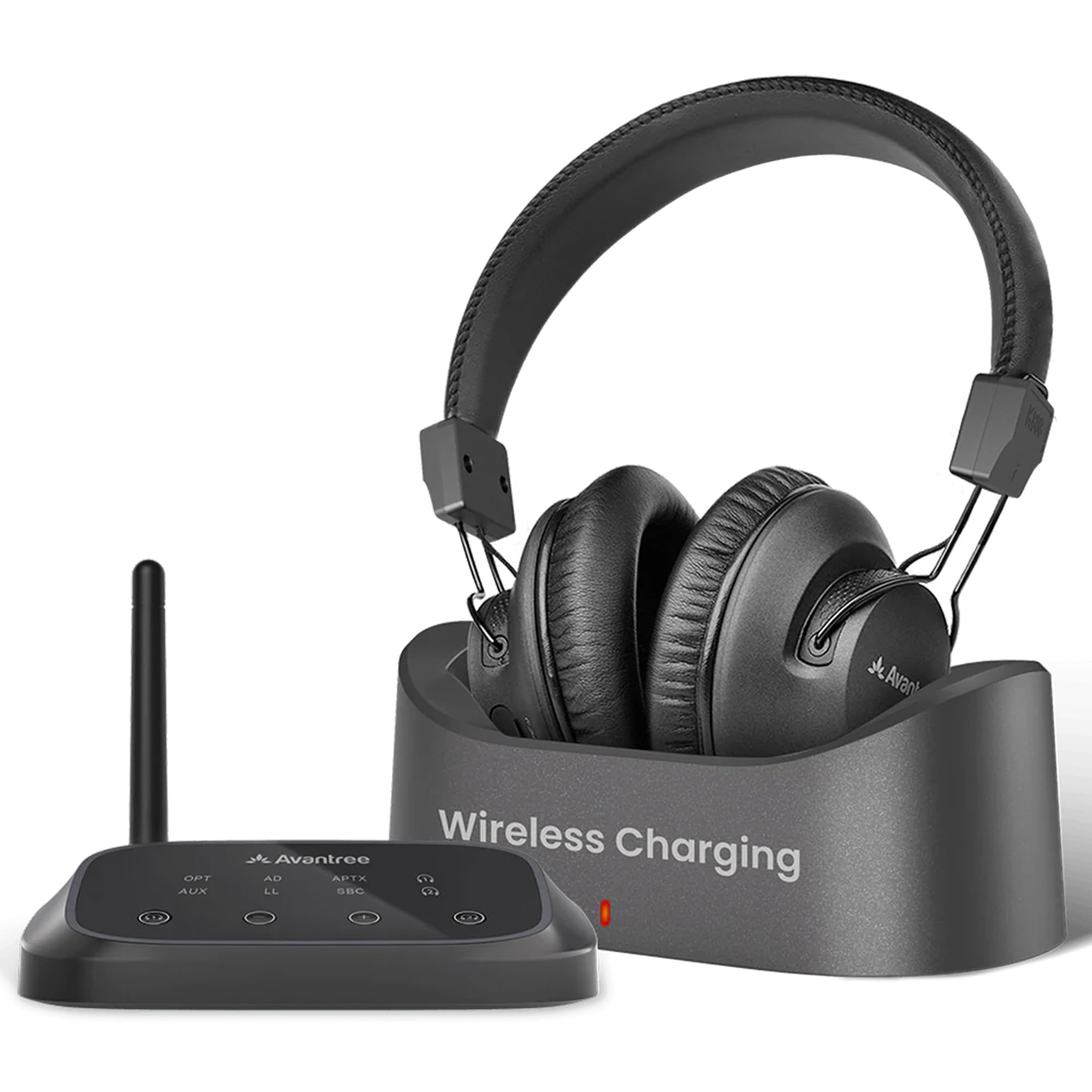
The Avantree HT5009 Plus is the only TV headphone system in this roundup with a dedicated Clear Voice toggle that actively pushes dialogue frequencies forward without altering the rest of the mix. Its optical input extracts pure digital audio from your TV, bypassing any set-top box compression, and the aptX Adaptive codec keeps latency below 40ms for synchronized speech. The over-ear design uses soft, replaceable earpads that remain comfortable during movie-length sessions, and the charging dock eliminates the hunt for cables.
Customer reports confirm it pairs well with hearing aids in “Music” mode to avoid automatic gain fluctuation, and users with severe hearing loss describe it as a “godsend” for understanding conversation at doctor visits and family gatherings. The wireless range stretches roughly 150 feet through walls, which is exceptional for a home-audio system. The one caveat is that it cannot be used while charging, and opening the charging cover requires a small tool — minor tradeoffs for the overall reliability.
For anyone who watches TV at a comfortable volume while keeping the room quiet — or needs help hearing dialogue without medical-grade amplification — this is the most complete, foolproof solution on the list. The build quality, battery endurance, and customer service reputation make it a safe long-term investment.
Why it’s great
- Clear Voice mode sharpens dialogue without boosting noise
- Optical input delivers uncompressed digital audio
- Comfortable over-ear pads for extended wear
Good to know
- Cannot be used while docked and charging
- Not designed for hearing-aid-level amplification
2. Mutbam TV Headphones

The Mutbam TV Headphones deliver 65 hours of continuous playback — the highest battery endurance in this review — and a sub-40ms latency that keeps on-screen lip movements perfectly aligned. They come pre-paired with the included charging dock, so setup is literally plug-and-play: connect the optical or AUX cable to your TV, place the headphones on the dock, and start listening. The over-ear cushions are soft enough for all-evening wear, and multiple users confirm the sound is “clear balanced” with an “easy dialogue” profile.
Buyers with hearing aids report that the Mutbam works both over the aids and without them, making it a flexible option for seniors who may not wear amplification all day. The transmitter base supports multiple source types (optical, RCA, AUX, Bluetooth), so it works with virtually any TV, cable box, or streaming stick. The only missing feature is a dedicated voice-boost toggle — the sound is naturally mid-forward but lacks the active dialogue enhancement found on more premium models.
If you want a reliable, high-endurance TV headphone system that doesn’t require frequent recharging or complex pairing, the Mutbam offers the best battery-to-price ratio in this category. It is a thoughtful gift for grandparents or anyone who watches hours of television nightly.
Why it’s great
- Exceptional 65-hour battery life reduces charging frequency
- Factory-paired dock eliminates Bluetooth pairing hassles
- Comfortable ear cups suited for long TV sessions
Good to know
- No dedicated Clear Voice or EQ mode
- Lacks a carrying case for travel
3. SuperEar SE9000HP
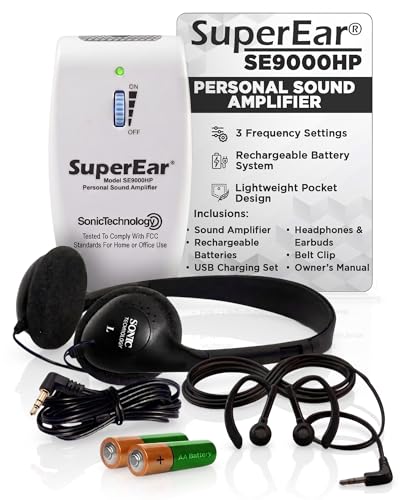
The SuperEar SE9000HP is a pocket-sized personal sound amplifier that delivers up to 50dB of additional gain with a total output of 107dB — powerful enough to make ambient conversation audible for users who struggle with standard listening devices. It stands out for its three-position frequency selector (high, medium, low), which lets you tailor the amplification to the specific sound profile you need: high for bird-watching, medium for general conversation, low for filtering background hum. The belt clip makes it genuinely hands-free, and the included rechargeable Ni-MH batteries reduce ongoing costs.
Customer experiences are consistently positive for users with moderate to severe hearing loss. One 92-year-old found it made doctor visits comprehensible for the first time; others describe the sound as “loud and clear” after failing with multiple hearing aids. The unit also acts as a backup or temporary solution while awaiting prescription hearing aids. The bundled headphones, however, are too large for smaller heads even at minimum adjustment, and the wiring can feel cumbersome. Many buyers swap them for their own third-party over-ear headphones via the 3.5mm jack.
If you need an affordable, versatile amplifier that works for TV, conversation, or outdoor use — and you don’t mind the slightly clinical industrial design — the SuperEar SE9000HP is a proven workhorse. It is not a replacement for prescription digital hearing aids, but it consistently outperforms cheaper personal sound amplifiers in clarity and gain consistency.
Why it’s great
- Three frequency settings isolate the range you need
- Rechargeable batteries included, with USB charging
- Hands-free belt clip for on-the-go use
Good to know
- Stock headphones are oversized for small heads
- Wiring can feel clunky during movement
4. Donner EM1
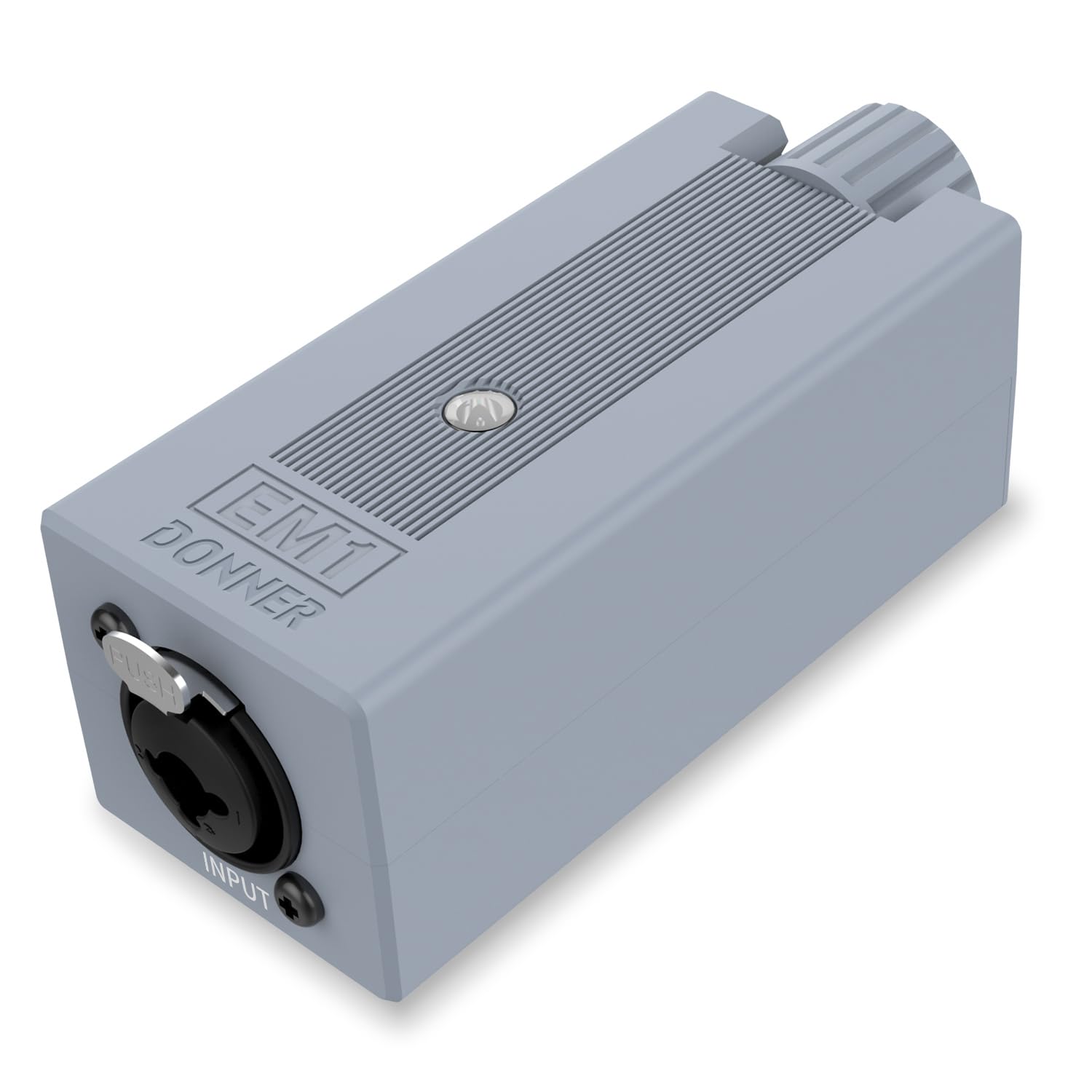
The Donner EM1 is a rechargeable in-ear monitor amplifier built for musicians who need to hear themselves clearly on a loud stage or during practice. It accepts both XLR and TRS inputs with locking connectors, so it stays plugged in during active performance, and the stereo/mono source switch ensures you get signal in both ears regardless of the console’s output configuration. The 12-hour battery is enough for multi-set gigs, and the belt-pack clip is solid metal — no plastic clips that snap mid-show.
Users consistently note the “low white noise” floor; the circuit is quiet even at high gain levels, which is critical when driving sensitive balanced-armature IEMs. The amplifier is compact enough to clip onto a guitar strap or belt without adding noticeable weight. The main limitation is that it relies on a proprietary USB-A to C charging cable — USB-C to C cables will not charge it, so you must keep track of the included cable. Also, the volume knob is exposed and can be accidentally bumped during play, though that is a common design tradeoff for quick on-the-fly adjustments.
For drummers, bassists, and front-of-house engineers running wired IEM setups, the Donner EM1 is a affordable, clean-sounding alternative to pricier rack-mount systems. It delivers reliable headroom and clarity without introducing audible hiss into your monitor mix.
Why it’s great
- Low noise floor stays quiet even at high gain
- Locking XLR/TRS inputs stay secure on stage
- Metal belt clip and compact chassis are tour-durable
Good to know
- Proprietary USB-A to C cable required for charging
- Volume knob is exposed and can be bumped accidentally
5. BOSS KATANA:GO

The BOSS KATANA:GO is not a general-purpose hearing amplifier — it is a dedicated guitar and bass headphone amp that packs the full Katana amp modeling into a device smaller than a pack of cards. It offers 10 amp types and over 85 effects for guitar, plus three amp types and over 65 effects for bass, all controllable via the BOSS Tone Studio smartphone app. The advanced spatial technology creates a wide 3D soundstage that makes silent practice feel like you are standing in front of a live cabinet, making it a joy to use for late-night jamming.
Guitarists praise the authentic “Katana sound” squeezed into this portable format, noting that the clean channel retains crystal clarity even with effects stacked. The Bluetooth integration streams backing tracks from your phone directly into the mix, and the Session Mode lets you play along with practice loops. Battery life is good for several practice sessions, and the USB-C charging is quick. The unit works best with low-impedance headphones (50–80 ohms) — higher-impedance studio cans may not reach satisfying volume levels.
If you are a guitarist or bassist who needs a silent practice rig that sounds genuinely inspiring, the KATANA:GO is the most capable headphone amplifier in its class. It also doubles as a high-quality Bluetooth receiver for standard wired headphones, adding versatility beyond instrument use.
Why it’s great
- Katana amp modeling in a pocket-sized form factor
- 3D spatial audio creates an immersive practice experience
- Bluetooth streaming for backing tracks and tone editing
Good to know
- Limited driving power for high-impedance headphones
- Requires app for full tone customization
6. Reizen Mighty Loud Ear

The Reizen Mighty Loud Ear offers a 120dB sensitivity rating and claims to pick up sound from up to 100 feet away, all for a entry-level price that makes it accessible to anyone curious about personal sound amplification. It runs on two standard AAA batteries — no proprietary charging cables or docks — and includes a dual-earphone set and belt clip right in the box. For users who need a quick test before investing in a more expensive solution, this is the easiest way to see if amplification helps.
Real-world experiences are split. Many buyers find it immediately effective: one describes plugging in batteries and having their mother hear clearly “without issue” after years of struggling. Others report persistent static, a fragile plastic clip, and an on/off switch that doesn’t stay in the off position. The sound quality is widely described as “tinny” even with high-quality earbuds, and the microphone picks up even the slightest fabric rustle, which can be distracting. The unit works best when paired with over-ear headphones via the 3.5mm jack rather than the included earbuds.
If you need a no-commitment starting point or a backup amplifier for occasional use, the Reizen is functional. But if you require consistent clarity, reliable build quality, and a low noise floor, the extra investment in the SuperEar SE9000HP or a dedicated TV system is worthwhile.
Why it’s great
- Very low entry price for testing amplification needs
- Standard AAA batteries are easy to replace
- Long range for picking up distant sounds
Good to know
- Sound is tinny even with quality earbuds
- On/off switch and plastic clip are prone to failure
7. Flaygo Rechargeable Hearing Aids

The Flaygo is a digital hearing aid, not a personal sound amplifier — and that distinction matters. It uses a 16-channel digital signal processor with adaptive filtering algorithms that distinguish speech from background noise in real time, rather than simply boosting everything louder. The CIC (completely-in-canal) form factor is molded to the ear’s ergonomic curve, making it nearly invisible when worn. The medical-grade silicone tips come in multiple sizes, and the automatic feedback suppression prevents the whistling that plagues lesser amplifiers.
Users with mild-to-moderate hearing loss report “natural sound” that improves conversation clarity in restaurants and group settings, with four volume levels accessible via a simple control. The battery lasts 16 hours on a single charge, and the portable charging case extends total usage to roughly seven days of moderate use. The auto on/off feature (15-second delay after insertion) removes the need to fumble with switches. The main tradeoff is that these are not designed for TV-specific use — they lack a direct audio input or wireless streaming — and they require proper ear tip sizing to prevent feedback.
If you need an affordable, unobtrusive solution for daily conversation and mild hearing loss, the Flaygo outperforms every non-digital amplifier in this review. It is a legitimate alternative to expensive prescription aids for users who cannot or do not want to see an audiologist.
Why it’s great
- 16-channel DSP intelligently suppresses background noise
- Nearly invisible CIC design is discreet and comfortable
- Long battery life with week-long charging case
Good to know
- No direct audio input for TV or phone streaming
- Requires careful ear tip selection to avoid feedback
FAQ
What is the difference between a personal sound amplifier and a hearing aid?
Can I use amplified headphones with a hearing aid?
Why does my amplifier make a hissing sound when nothing is playing?
How do I connect amplified headphones to a TV without optical output?
Final Thoughts: The Verdict
For most users, the best amplified headphones winner is the Avantree HT5009 Plus because it combines a dedicated Clear Voice mode, zero-latency optical connection, and 60-hour battery life in a package that is comfortable enough for all-day TV watching. If you want a budget-friendly option for occasional use or outdoor ambient sound, grab the SuperEar SE9000HP. And for musicians practicing silently at home, nothing beats the BOSS KATANA:GO for authentic amp modeling and immersive 3D spatial audio.