
Our readers keep the lights on and the weekend projects moving. As an Amazon Associate, I earn from qualifying purchases.
Dropping cable was the easy part. The hard part is finding an amplified indoor TV antenna that actually holds a signal through brick walls, interference from appliances, and the chaos of UHF versus VHF frequencies without requiring you to climb onto the roof every time the wind shifts. You need a unit that marries real amplifier gain with a multi-directional pickup pattern, because in the real world, broadcast towers are never all pointing the same way from your living room.
I’m Rikta — the co-founder and writer behind FitlyFast. I’ve spent hundreds of hours analyzing signal-to-noise ratios, amplifier IC chip generations, and reception patterns across dozens of indoor antennas to separate marketing range claims from actual usable channel counts. I look at the real specs: impedance matching, coax cable shielding quality, and whether the amplifier actually helps or just adds noise.
This guide breaks down the top contenders for the best amplified indoor tv antenna by focusing on real-world reception, build quality, and the specific placement flexibility that determines whether you get 15 channels or 60.
How To Choose The Best Amplified Indoor TV Antenna
Before you buy, you need to match your specific location challenges to the antenna’s core specs — amplifier quality, frequency support, and physical design. The wrong pick will leave you with pixelation or zero channels even if the box says 5000 miles.
Amplifier Quality Over Advertised Range
The built-in amplifier is the heart of any amplified antenna. A well-designed amplifier with a smart IC chip filters out cellular and FM interference while boosting only the broadcast TV frequencies. Cheaper designs amplify everything, including noise, which degrades picture quality. Look for units that specify “smart IC chip” or “advanced filtering” rather than vague “signal booster” claims.
Frequency Support: VHF vs UHF
Many indoor antennas are UHF-only, but depending on your local broadcast towers, you may need VHF-Hi support (channels 7-13) for major networks like ABC and CBS. An antenna that explicitly lists “Hi-VHF” or “VHF + UHF” in its description will serve you better than one that only mentions UHF. The Mohu Leaf Amplified and Winegard FlatWave are examples of units that handle both bands.
Placement Flexibility and Coax Cable Length
Your antenna’s position relative to a window — and away from metal appliances and concrete walls — can make or break reception. A shorter coax cable limits where you can place the antenna. Models that include 38-foot cables give you far more freedom to test corners, shelves, and windowsills. A flat panel design with adhesive strips also opens up wall and window mounting options without permanent hardware.
Quick Comparison
On smaller screens, swipe sideways to see the full table.
| Model | Category | Best For | Key Spec | Amazon |
|---|---|---|---|---|
| Arrasolt Melas AN-5004 | Amplified | Maximum channel count | 80 Ohm impedance | Amazon |
| Mohu Leaf Amplified | Amplified | VHF + UHF reception | Jolt Switch amp, 75 Ohm | Amazon |
| Winegard FL5500A | Amplified | Urban/suburban reliability | 50-mile U.S. design | Amazon |
| Ntcunie CS8558 | Amplified | Compact tabletop placement | Smart IC chip, 75 Ohm | Amazon |
| Merpersom Antenna | Amplified | Weatherproof outdoor placement | High-strength plastic housing | Amazon |
| Nelapsano HD011 | Amplified | Indoor/outdoor versatility | 90 Ohm impedance | Amazon |
| Five Star Flat Panel | Amplified | Budget entry-level pick | 0.02-inch ultra-thin design | Amazon |
In‑Depth Reviews
1. Arrasolt Melas AN-5004
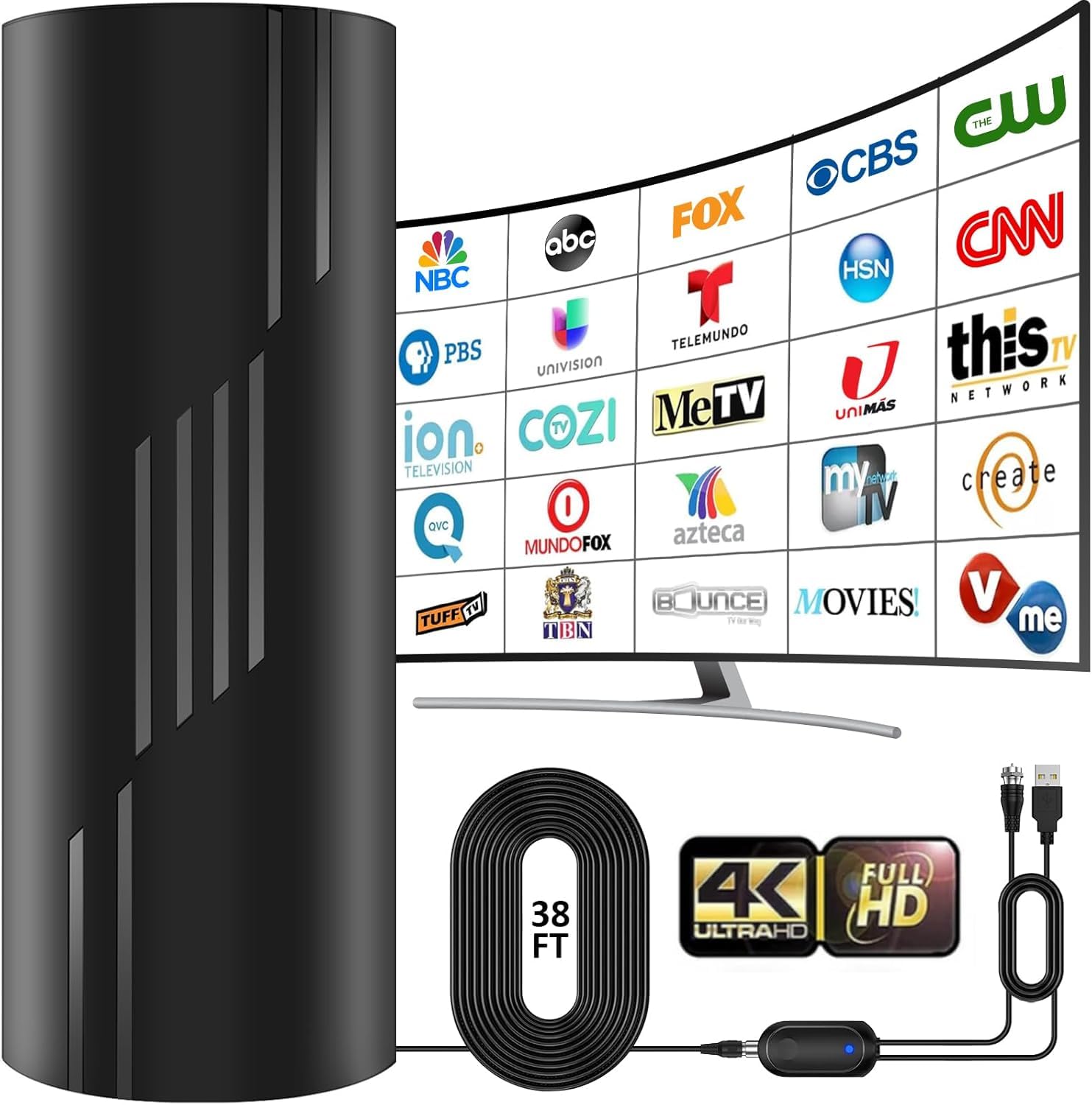
The Arrasolt Melas AN-5004 is the best-in-class amplified indoor TV antenna because it uses a smart IC chip amplifier that actively filters cellular and FM interference — a critical real-world advantage over basic boosters. With an 80 Ohm impedance and a 38-foot coaxial cable, it offers both electrical stability and placement flexibility that most mid-range units lack.
User reviews consistently report channel counts in the 50-80 range from suburban and exurban locations, including consistent reception of major networks like ABC and NBC. The 360° reception design means you don’t have to point the antenna toward a specific tower, which simplifies installation in rooms with limited window exposure. The 48-month warranty also signals confidence in the amplifier’s longevity.
The compact black box sits cleanly on a shelf or mounts on a wall, and the included cable ties keep the long coax tidy. If you want maximum channel count without repositioning the antenna constantly, this is the unit that delivers. Just be prepared to rescan after finding the sweet spot.
Why it’s great
- Smart IC amplifier filters interference effectively.
- 38-foot coax cable for flexible placement.
- 48-month warranty offers strong protection.
Good to know
- Requires USB power for the amplifier.
- Range claims are heavily marketing-inflated.
2. Mohu Leaf Amplified

The Mohu Leaf Amplified is a strong contender specifically because it explicitly supports Hi-VHF channels (7-13) in addition to UHF — a detail many indoor antennas gloss over. The in-line Jolt Switch amplifier lets you toggle the boost on or off, which is useful in strong-signal areas where over-amplification can actually cause pixelation. At 0.04 inches thick, it’s the slimmest multi-band design on this list.
Real users in brick homes and suburban settings report picking up 47 to 60 crystal-clear channels, including major networks that cheaper flat antennas couldn’t lock. The multi-directional reception pattern pulls from both front and back, reducing the need for precise aiming. The included hook-and-loop tabs and push pins make wall or window mounting truly tool-free.
One review noted that the included push pins were unusable with standard drywall, but standard replacement pins solve the issue. The 12-foot coax cable is shorter than some competitors, so placement options are slightly more constrained. If VHF reception is critical in your area, the Leaf Amplified is the top choice.
Why it’s great
- Supports Hi-VHF and UHF bands explicitly.
- Toggleable Jolt Switch amplifier.
- Ultra-thin design blends into walls.
Good to know
- 12-foot cable limits placement distance.
- Included push pins may not grip well.
3. Winegard FL5500A FlatWave
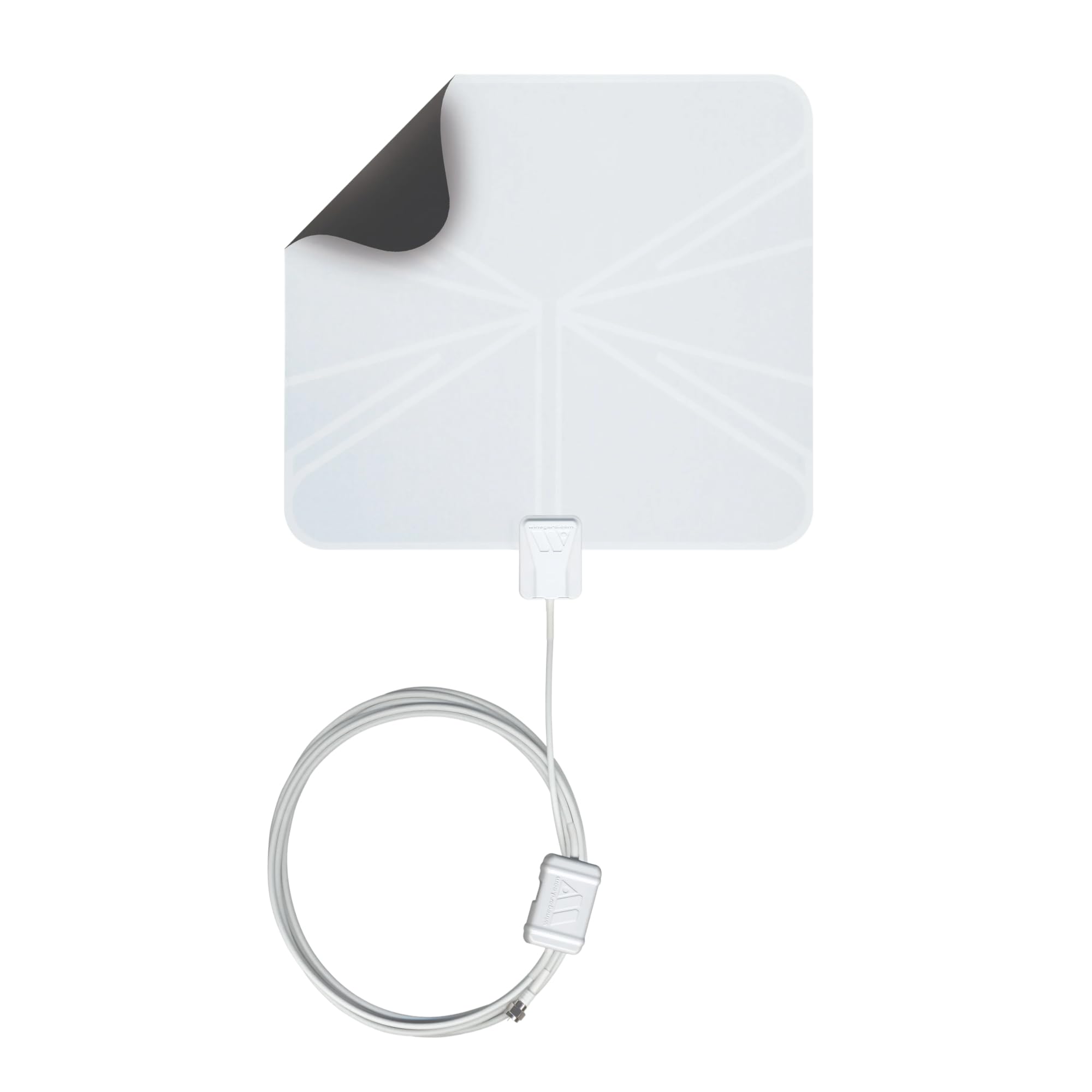
The Winegard FL5500A brings decades of U.S.-based antenna engineering to a slim flat-panel format, and its conservative 50-mile range rating is more honest than the inflated 5000-mile claims found elsewhere. It handles both VHF and UHF signals, with a dual-color design (black/white) that lets you choose which side faces outward for subtle aesthetic matching.
Users report reliable reception in metro areas like Chicago and Philadelphia, pulling in over 20 quality channels between 10 and 40 miles from broadcast towers. The included Winegard app guides placement by identifying local tower locations, which reduces the guesswork. The amplifier is powered via USB and includes a short 3-foot power cord, though some users extended it with a standard USB extension cable.
One drawback is that the coax cable is permanently affixed to the antenna, preventing the use of 90-degree adapters for tight spaces behind a TV. Additionally, reception can be finicky with weaker stations if your home has concrete or metal construction. For urban and suburban buyers who want a reliable, well-built unit with honest specs, the FlatWave is a smart pick.
Why it’s great
- Honest 50-mile range rating.
- Winegard app helps optimize placement.
- Dual-color reversible design.
Good to know
- Permanently attached coax cable limits adapters.
- Struggles with weak stations in dense buildings.
4. Ntcunie CS8558
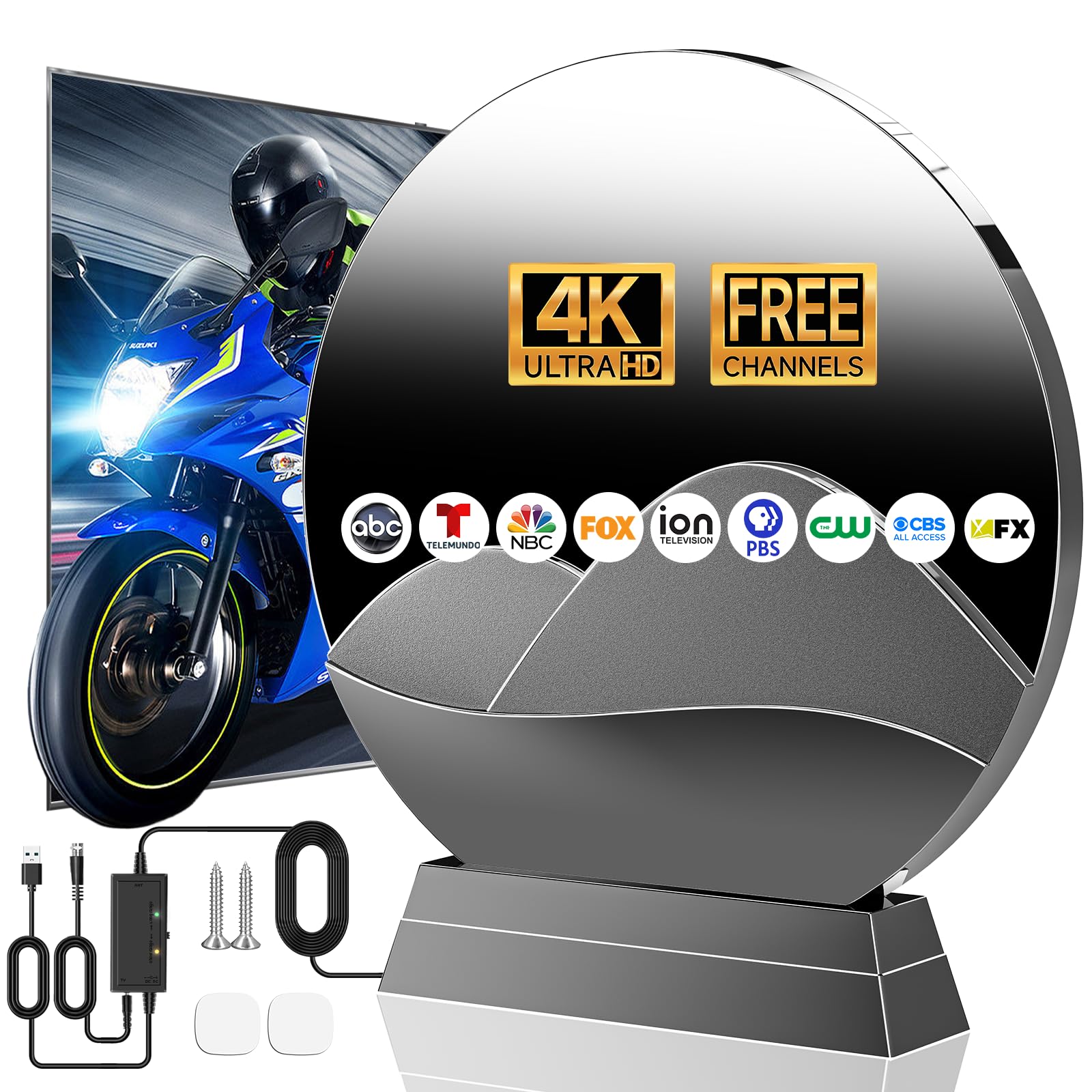
The Ntcunie CS8558 is a compact “mushroom-style” amplified antenna that prioritizes tabletop placement without sacrificing signal processing quality. Its 2026 smart IC chip is designed to filter out 95% of non-broadcast interference, a feature that matters when you place the antenna near a window where cell towers and FM stations can degrade reception.
Users report channel counts between 48 and 69 in suburban settings, with consistent HD and 4K quality across major networks. The built-in amplifier includes a short/long range switch, letting you toggle between local and fringe reception modes. The 38-foot premium coax cable with a 99% oxygen-free copper core minimizes signal loss over longer runs, a spec that makes a real difference in older homes with thick walls.
Because of its upright design, the CS8558 takes up a bit of desk space compared to flat panels, but its stability means you won’t accidentally knock it out of alignment. For users who prefer a dedicated tabletop location over window mounting, this is the most refined option in its tier.
Why it’s great
- Smart IC chip reduces interference effectively.
- 38-foot oxygen-free copper coax cable.
- Short/long range toggle switch.
Good to know
- Larger footprint than flat panel designs.
- Requires USB power for amplifier.
5. Merpersom 2026 Upgraded
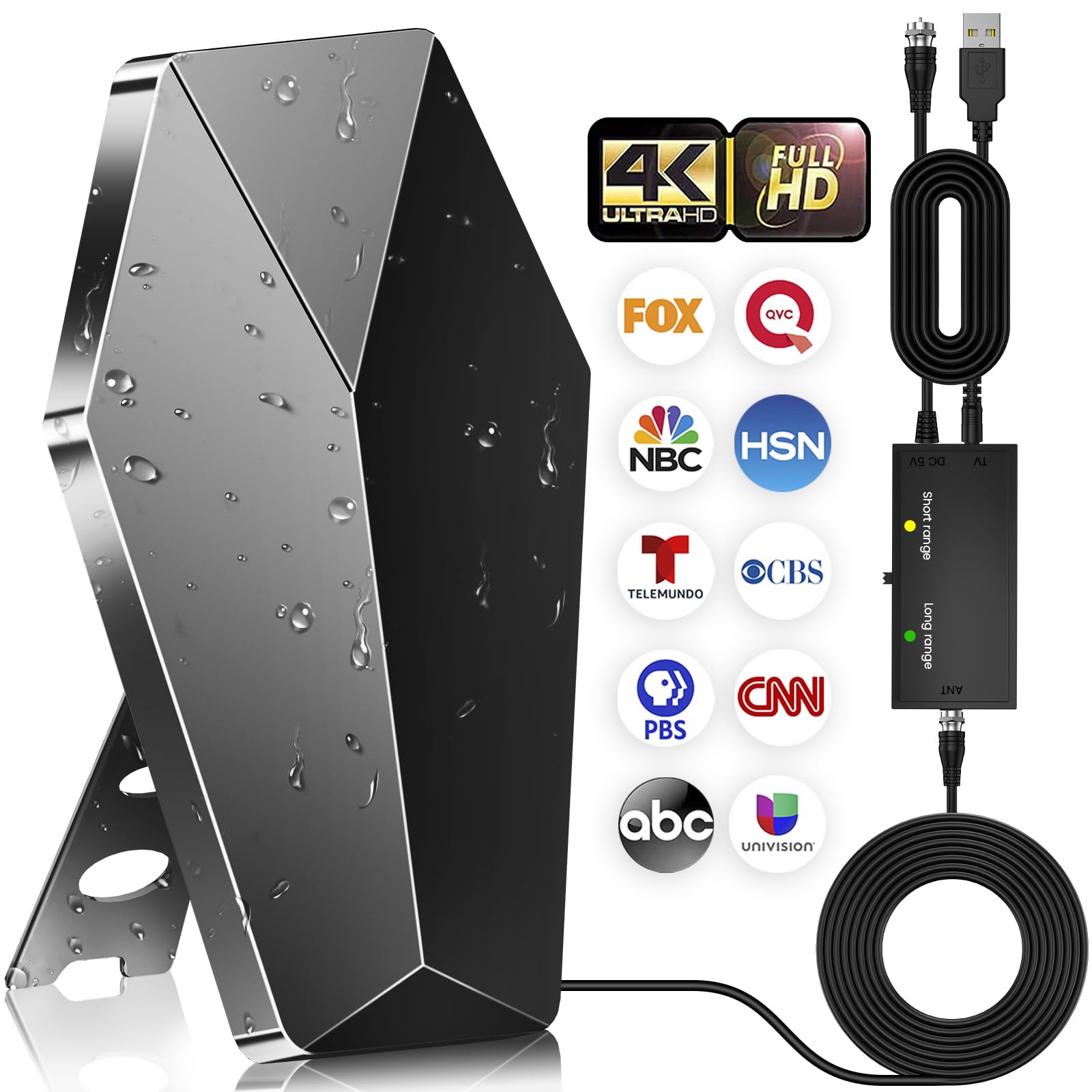
The Merpersom antenna differentiates itself with a high-strength engineering plastic housing that resists UV aging and physical impacts, making it a rare true dual-purpose indoor/outdoor pick. The amplifier uses a smart IC chip that filters out 95% of interference, and the 360° reception pattern means you don’t need to aim the antenna at a specific tower.
User feedback highlights quick installation under 5 minutes and reliable HD channel reception in suburban areas. The 38-foot coax cable gives plenty of slack for routing through walls or windows if you decide to mount it outside. The weatherproof housing handles rain and sun exposure without degrading signal quality, which is uncommon in this category.
The downsides are typical of the 5000-mile range marketing: actual usable range depends heavily on terrain and building materials. Also, the included mounting hardware is basic, and some users opted for external brackets for permanent outdoor installation. If you need one antenna for both indoor testing and outdoor fallback, the Merpersom covers both use cases.
Why it’s great
- UV-resistant, impact-resistant housing.
- Effective 95% interference filter.
- 38-foot cable for flexible routing.
Good to know
- Basic mounting hardware included.
- Actual range depends on local terrain.
6. Nelapsano HD011

The Nelapsano HD011 features a 90 Ohm impedance rating and a built-in amplifier with a short/long range switch, giving you control over how aggressively the unit boosts weak signals. Its slim, upright design is compact enough for desk or shelf placement, and the included 38-foot coax cable supports long-distance routing from window to TV.
Users consistently report finding 25 to 50+ local HD channels after a simple 10-minute setup in suburban homes. The 360° reception pattern helps in areas where broadcast towers are scattered, and the weather-resistant housing lets you move it outdoors if needed. Reviews specifically note that the signal remains stable even during bad weather, which is a real advantage for outdoor placement.
Like many long-range antennas, the 5000-mile claim is marketing hyperbole, but real-world performance in the 30-to-60-mile range is solid with the amplifier on. The 90 Ohm impedance is slightly higher than the industry standard 75 Ohm, which may cause minor signal mismatch on older TV tuners, though most modern sets compensate automatically.
Why it’s great
- Short/long range amplifier switch.
- Weather-resistant for outdoor use.
- 38-foot coax cable with good shielding.
Good to know
- 90 Ohm impedance slightly non-standard.
- Range claims are heavily inflated.
7. Five Star Flat Panel FSA-7809
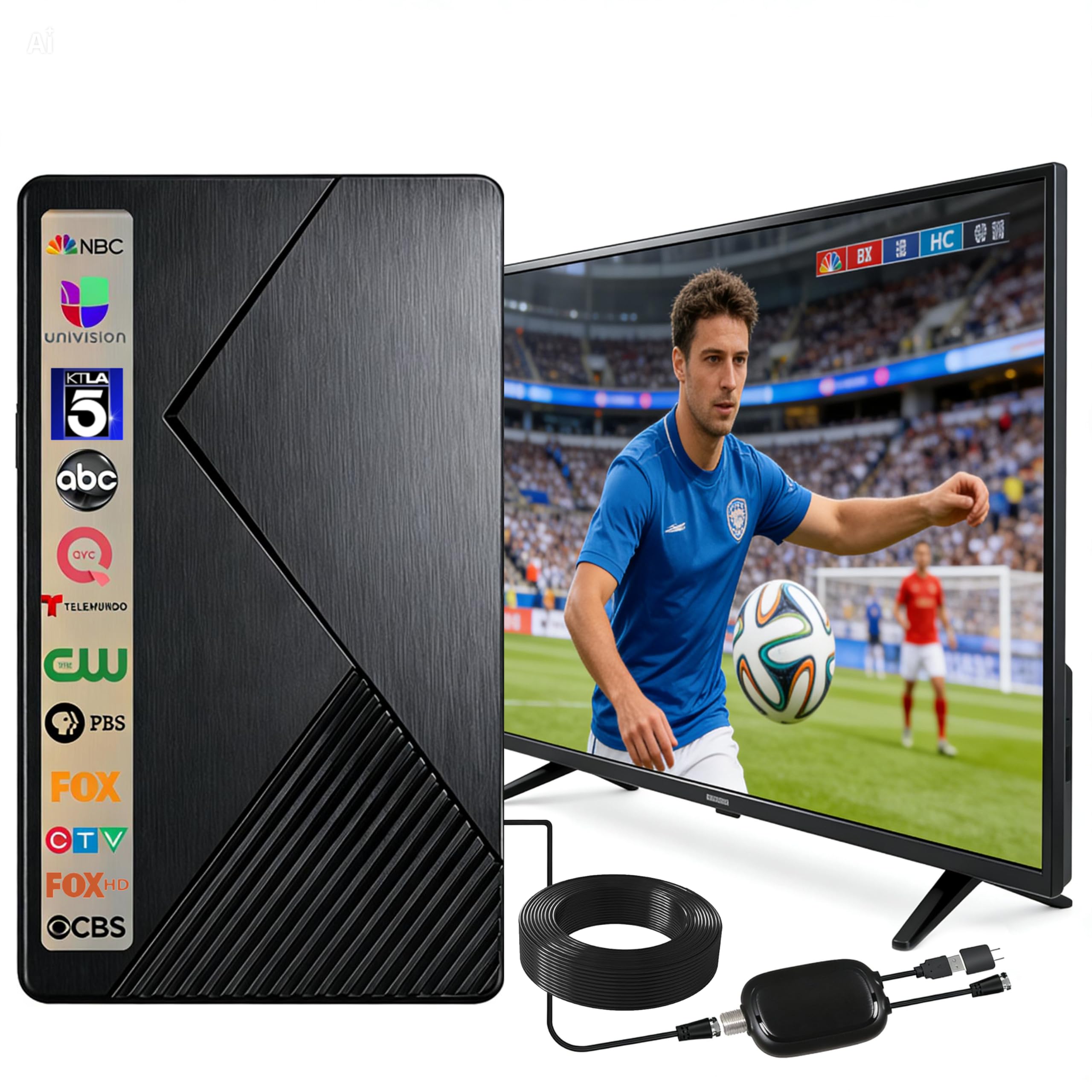
At just 0.02 inches thick, the Five Star Flat Panel is the thinnest antenna in this lineup and a solid entry-level choice for cord cutters on a budget. It includes a built-in amplifier and signal booster, with a 60-mile advertised range that is more grounded in reality than the 5000-mile claims. The 10-foot coaxial cable is shorter, but the included adhesive strips make wall or window mounting simple.
User reviews show that in suburban and rural areas within 30-70 miles of broadcast towers, this antenna delivers 20 to 25 clear channels, including major networks. One rural user reported 25 channels from 70 miles away, though they noted the coax connector was slightly undersized for their main TV. The multi-directional pickup pattern reduces the need for precise aiming, which is helpful for a budget unit.
The main limitations are the short cable and the plastic build quality, which feels less durable than the Mohu or Winegard. Additionally, a few reviews mention that it failed to pick up channels in challenging environments where premium antennas succeeded. For a spare bedroom, RV, or a secondary TV with straightforward line-of-sight to towers, the Five Star offers the best value per dollar in the entry tier.
Why it’s great
- Ultra-thin design for easy hiding.
- Adhesive strips included for quick mounting.
- Honest 60-mile coverage range.
Good to know
- 10-foot coax cable limits placement.
- Build quality feels less premium.
FAQ
Do I need an amplified indoor TV antenna if I live close to broadcast towers?
Why does my antenna say 5000 miles range but I only get 20 channels?
Should I mount the antenna on a wall or a window for best reception?
Final Thoughts: The Verdict
For most users, the best amplified indoor tv antenna winner is the Arrasolt Melas AN-5004 because it combines a smart IC chip amplifier with a 38-foot cable and 360° reception for the highest reliable channel count in suburban and exurban locations. If you need explicit VHF support for channels 7-13, grab the Mohu Leaf Amplified — its Jolt Switch and thin form factor make it the most versatile indoor design. And for a budget-friendly entry point in a secondary room or simple line-of-sight setup, nothing beats the Five Star Flat Panel.