
Our readers keep the lights on and the weekend projects moving. As an Amazon Associate, I earn from qualifying purchases.
The tactile pull of a fader, the instant feedback of a twist-knob EQ, and zero menu-diving latency define the analog audio mixer experience. For musicians, streamers, and live sound engineers, it remains the most direct path to shaping audio without digital compression artifacts or buffer delays. Selecting the right board today means balancing channel count, preamp quality, and physical connectivity for your specific setup.
I’m Rikta — the co-founder and writer behind FitlyFast. I’ve spent years analyzing audio hardware specifications, from preamp noise floors and EQ frequency points to the durability of chassis-mounted potentiometers and Neutrik connectors.
This guide cuts through the marketing to deliver a practical, spec-focused look at the best analog audio mixer options across every realistic use case — from compact desktop podcast rigs to full band live setups.
How To Choose The Best Analog Audio Mixer
Choosing an analog mixer isn’t about chasing the most features; it’s about finding the cleanest signal path for your specific gear. You need to weigh channel count, preamp quality, and connectivity against your physical space and signal chain.
Channel Count and Bus Architecture
Count your input sources. Microphones and mono instruments require mono channels with XLR inputs. Stereo line-level devices (synthesizers, drum machines, CD players) work on stereo channels. A mixer with 4 mono channels and 2 stereo channels handles a podcast mic setup plus backing tracks comfortably. Beginners often overestimate channel needs; a compact 6-input board is often enough for a solo performer.
Preamps: The Sound Foundation
The preamplifier stage sets the noise floor and headroom. Look for models with discrete Class A preamps (like Yamaha’s D-PRE or Allen & Heath’s GS-Pre) which offer cleaner gain with less hiss. Equivalent Input Noise (EIN) ratings below -128 dBu indicate professional-grade quiet operation. Boutique-style preamps on budget mixers are improving, but a mixer from a reputable pro audio brand will consistently outperform bargain-bin alternatives.
Quick Comparison
On smaller screens, swipe sideways to see the full table.
| Model | Category | Best For | Key Spec | Amazon |
|---|---|---|---|---|
| Allen & Heath ZED-6 | Compact Pro | Studio monitors & acoustic instruments | GS-Pre mic preamps, built-in HPF | Amazon |
| Yamaha MG10XU | USB & Effects | Podcasting & streaming | 24 SPX effects, USB 2.0 interface | Amazon |
| Yamaha MG10X CV | Live Band | 4-piece live bands & gigs | 10 input channels, impact resistant body | Amazon |
| Mackie ProFX10v3+ | Bluetooth & Streaming | Hybrid studio/streaming | USB-C 192kHz, Bluetooth input | Amazon |
| Behringer X1832USB | Large Input Count | Multi-mic karaoke & live bands | 18 inputs, 6 compressors, sweep EQ | Amazon |
| Mackie 802VLZ4 | Compact Utility | Guitar rig & desktop mixing | Onyx preamps, 8 high-headroom inputs | Amazon |
| Numark M6 USB | DJ 4-Channel | DJ mixing & recording sets | 4 channels, replaceable crossfader | Amazon |
| Behringer XENYX 802S | Desktop USB | Streaming & podcasting | USB streaming interface, 8 inputs | Amazon |
| Numark M2 | Entry DJ | Beginner scratch DJ & home use | 2 channels, replaceable crossfader | Amazon |
In‑Depth Reviews
1. Allen & Heath ZED-6

The ZED-6 represents a true step up in preamp quality within a compact frame. Its GS-Pre XLR microphone preamps, derived from Allen & Heath’s GS-R24 studio console, deliver exceptionally low noise and massive headroom. The 100Hz high-pass filter on every mono input is invaluable for cleaning up low-end rumble from acoustic spaces or handling breath pops, keeping your mix tight without relying on external plugins.
Build quality is a standout here: separate internal channel boards, Neutrik XLR connectors, and chassis-mounted potentiometers ensure longevity in road or studio use. The 60mm master fader provides precise output control, while the MusiQ 3-band EQ is tuned for musical adjustments across vocal and instrument ranges. The two Hi-Z inputs allow direct connection of electric or acoustic guitars without a DI box, a rare convenience at this level.
Connectivity is straightforward with 2 mic/line inputs and 2 stereo line channels, making it ideal for a vocalist with backing tracks or a compact recording rig. Some users report needing careful gain staging to avoid distortion, and the unit lacks built-in USB or effects, but for pure analog signal integrity, the ZED-6 is the benchmark. It’s a precise tool for those who value tone over convenience features.
Why it’s great
- Exceptionally quiet GS-Pre preamps with high headroom
- Road-ready Neutrik connectors and chassis-mounted pots
- Built-in high-pass filter on every mono input
- Direct Hi-Z input for guitar/bass without DI box
Good to know
- No USB connectivity or built-in effects
- Limited to 2 microphone inputs
- Requires careful gain staging to avoid distortion
2. Yamaha MG10XU

Yamaha’s MG10XU bridges analog mixing with modern streaming needs via a class-compliant USB 2.0 interface. The D-PRE discrete Class A mic preamps, featuring an inverted Darlington circuit, produce a warm, natural character with fat low end and smooth highs. This preamp design is studio-grade, providing clean gain that rivals dedicated outboard units.
The built-in SPX digital effects processor offers 24 high-quality reverb, delay, and modulation presets, saving you from needing external rack gear for live vocals or instrument ambience. One-knob compressors on mono channels take the guesswork out of dynamics control, automatically taming peaks for a more polished mix. The 3-band EQ per channel allows immediate tonal shaping across all mono inputs.
Connectivity includes 4 combo XLR/TRS inputs, 3 stereo line channels, and dedicated monitor sends. The compact footprint fits easily on a crowded desk, and class-compliant USB means plug-and-play recording on any computer or tablet. Some users note the lack of independent channel mute buttons and that the headphone volume is linked to the main mix, but for podcasters and streamers needing a hybrid analog/digital workflow, this is a premium mid-range solution.
Why it’s great
- Warm D-PRE Class A mic preamps deliver excellent clarity
- 24 built-in SPX effects eliminate need for external processors
- USB connectivity for direct recording and playback
- One-knob compressors simplify dynamic control
Good to know
- No independent channel mute buttons
- Headphone output level tied to main mix
3. Yamaha MG10X CV

The MG10X CV is built for the road, with a powder-coated metal chassis and internal power supply designed to withstand the bumps of gigging. It offers 10 input channels — enough for a 4-piece band with backing tracks — and studio-grade D-PRE preamps. The sound clarity is noticeably superior to entry-level mixers, with fat bass response that supports kick drums and bass guitar without muddiness.
One-knob compressors on the mono channels provide quick dynamic control for vocals and instruments, making it easier to achieve a consistent live mix without deep processor tweaking. The SPX digital effects engine adds reverb, delay, and modulation effects which are particularly useful for vocals and solo instruments in small venue settings. The 3-band EQ with high-pass filters on each mono channel helps eliminate low-end rumble before it reaches the mains.
Limitations include a fixed EQ without sweepable mids, which reduces precision in sculpting problem frequencies. The monitor outs are essentially a direct copy of the main L/R mix with a volume control, offering no independent routing. For a reliable, great-sounding analog board for live performance, this is a workhorse, but mixing engineers needing flexible bus routing should consider higher-tier models.
Why it’s great
- Studio-grade D-PRE preamps with excellent headroom
- Rugged, impact-resistant metal chassis for touring
- 1-knob compressors for quick dynamics control
- SPX digital effects built-in for live ambience
Good to know
- EQ lacks sweepable mid frequency
- Monitor outputs are not independently routable
4. Mackie ProFX10v3+

Mackie’s ProFX10v3+ is a forward-thinking analog mixer that integrates Bluetooth and a USB-C audio interface without sacrificing analog warmth. The Onyx mic preamps deliver clean, quiet gain with 60dB of range, suitable for dynamic and condenser mics alike. The 10-channel layout provides 4 XLR inputs with 3-band EQ, a dedicated stereo channel, and Bluetooth streaming input.
The GigFX+ effects engine offers 12 editable presets accessible via a full-color LCD screen, a step up from simple rotary-encoder-based effects. You can save custom reverb and delay settings for different performance scenarios. The USB-C interface operates at 24-bit/192kHz with three recording modes: Standard (full mix with effects), Loopback (mix plus computer audio for streaming), and Interface (direct channel 1-2 without effects).
Bidirectional Bluetooth with Mix Minus eliminates echo for phone-in guests on podcasts. The compact design is desk-friendly and includes 100Hz low-cut filters on all mic channels to reduce rumble. Some users find the FX selection a bit limited compared to dedicated units, and the lack of a second output bus restricts advanced monitor routing. Nevertheless, for streamers and content creators who need a hybrid analog-digital hub, this is a top contender.
Why it’s great
- USB-C interface with 24-bit/192kHz recording quality
- Bluetooth input with Mix Minus for clean phone calls
- Editable GigFX+ effects with full-color LCD screen
- Loopback recording mode for streaming
Good to know
- Limited internal effects library
- No separate output bus for independent monitor mix
5. Behringer Xenyx X1832USB

If you need to handle a large input count on a budget, the X1832USB packs an 18-input 3/2-bus configuration with 6 XENYX mic preamps and 6 one-knob compressors. The neoclassic British 3-band EQ with semi-parametric mid band allows surgical frequency adjustments, letting you notch out problem frequencies or boost specific vocal presence ranges. This EQ flexibility is rare in this price tier.
The built-in 24-bit multi-effects processor includes 16 editable presets with reverb, delay, chorus, flanger, and pitch shift. The tap tempo function synchronizes delays to the beat of your track. A 9-band stereo graphic EQ with FBQ feedback detection helps identify and eliminate feedback frequencies in live environments, a crucial tool for monitor mixing in small venues.
The USB interface allows 2-channel recording to a computer, though it is limited to the main mix bus. Build quality includes a metal chassis but the sliders may require maintenance over time. Some units have scratchy faders out of the box, which can be improved with lubricant. For karaoke setups, live bands with many microphones, or home studios needing extensive connectivity, the X1832USB is a giant in terms of input capacity.
Why it’s great
- Sweepable mid EQ for precise frequency shaping
- 6 built-in compressors for vocal control
- 9-band graphic EQ with FBQ feedback detection
- 16 editable effects presets for versatile sound design
Good to know
- USB recording limited to main mix bus only
- Potential for scratchy faders over time
6. Mackie 802VLZ4
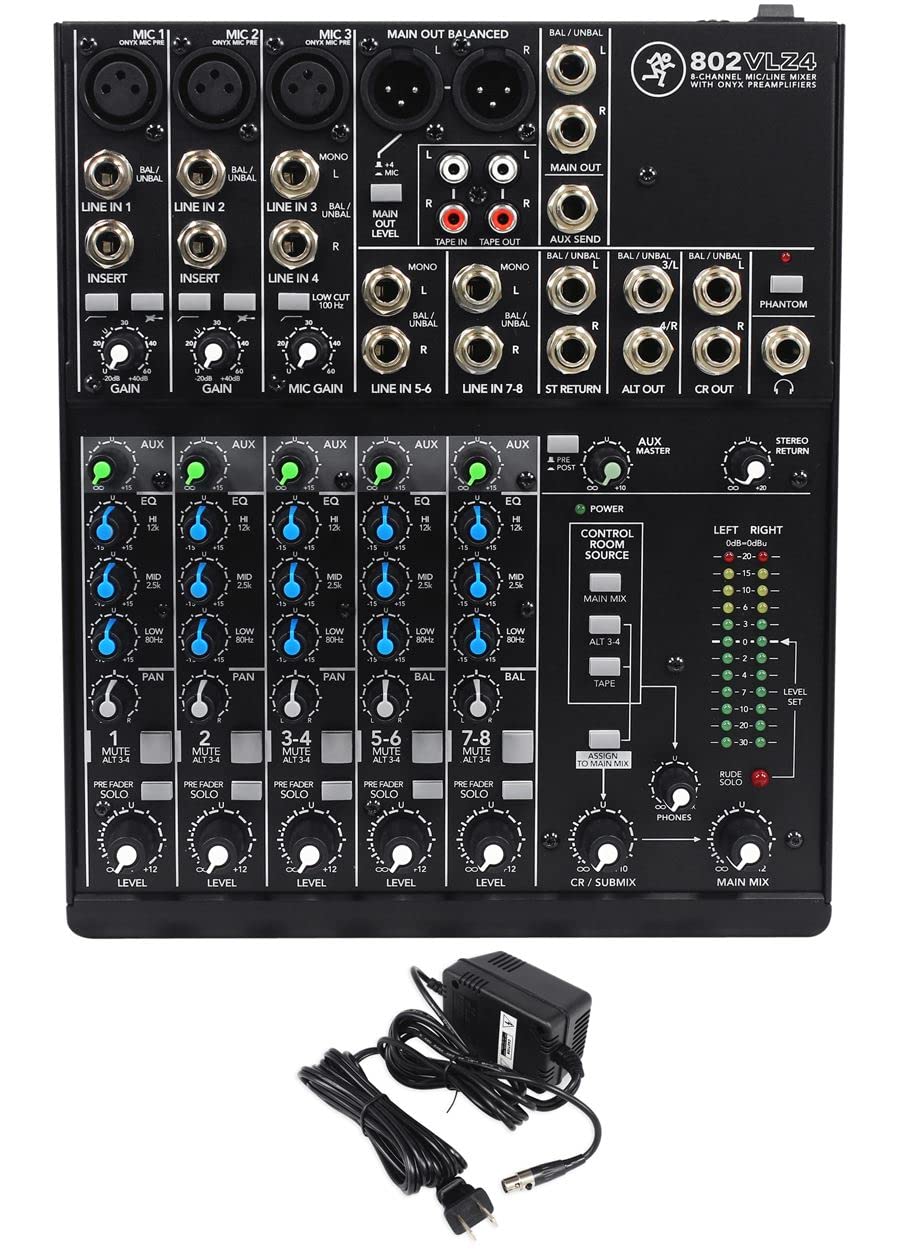
The Mackie 802VLZ4 is a tough, compact 8-channel mixer built around Mackie’s signature high-headroom, low-noise design. Its three Onyx mic preamps deliver clean, powerful gain that outclasses many competitors in the same footprint. The 8 line inputs can handle a full array of synthesizers, drum machines, and audio interfaces, while the 3-band EQ on each channel provides essential tonal shaping.
Improved RF rejection makes it suitable for broadcast applications, and the phantom power switch at the rear works with condenser microphones. The mixer includes post-fader aux sends for external effects and pre-fader aux sends for monitor mixes. The main outputs are balanced XLR, ensuring a clean signal over long cable runs to powered speakers or a PA system.
Limitations include no built-in effects, which means you’ll need external reverb or delay units. The knobs lack a center detent on all bands, making precise resetting tricky. Users report the headphone volume is not independent of the main mix. That said, for a clean, durable analog utility mixer that disappears into your signal chain, the 802VLZ4 remains a professional standard for studio and live use.
Why it’s great
- Very clean Onyx mic preamps with high headroom
- Compact chassis with durable all-metal construction
- Excellent RF rejection for broadcast
- Balanced XLR outputs for long cable runs
Good to know
- No built-in effects or USB interface
- Knobs lack center detent on EQ bands
7. Numark M6 USB

The Numark M6 USB is a 4-channel DJ mixer that bring serious functionality at a moderate price point. It offers 3-band EQ per channel, a replaceable crossfader with slope control, and dedicated cue buttons for headphone monitoring. Multiple phono/line inputs allow connection of turntables, CD players, or media players, making it suitable for DJs at weddings, clubs, or parties.
Built-in plug-and-play USB connectivity lets you record your sets directly to a Mac or PC without additional audio interfaces. The all-metal chassis is sturdy enough for regular transport, and the LED monitoring facilities provide visual feedback on levels. The layout includes master, record, and booth RCA outputs, giving flexibility for different monitoring setups.
Some users report that faders and crossfader feel a bit loose and less smooth than upper-tier models, potentially affecting fast scratch styles. There are no internal effects, so you’ll need external units. For a cost-effective 4-channel analog mixer that handles DJ duties and basic USB recording, the M6 USB is a solid foundation for developing your sound.
Why it’s great
- Four channels with 3-band EQ for versatile mixing
- Built-in USB audio interface for recording sets
- Replaceable crossfader with slope control
- Sturdy metal chassis for gigging
Good to know
- Faders can feel loose over time
- No internal effects or DSP
8. Behringer XENYX 802S

The XENYX 802S is a budget-friendly entry into analog mixing for streamers and podcasters, offering an 8-input configuration with a stereo USB interface. It allows direct mixing of PC/gaming audio into your streaming mix, eliminating the need for separate virtual audio cables. The ultra-low noise design ensures clean sound for spoken word content.
Users report excellent sound quality with no hum or white noise, and the onboard XENYX preamps provide enough clean gain to drive a dynamic microphone for casual recording. The unit has separate main/monitor controls, which is useful for setting up a headphone mix independent of the main broadcast feed. The compact footprint fits easily next to a computer monitor.
Its channel count is modest (2 mic/line, 2 stereo line), which limits scalability for multi-mic setups. The build quality feels lighter than professional-grade mixers, but it holds up for stationary desktop use. For a streamer or podcaster looking for the simplest analog USB bridge to OBS or other streaming software, the 802S is a proven, low-noise solution.
Why it’s great
- Very low noise floor for spoken word
- USB audio output connects directly to streaming software
- Separate main and monitor controls
- Compact desktop-friendly size
Good to know
- Limited to 2 microphone inputs
- Build feels less rugged than pro-level mixers
9. Numark M2

The Numark M2 is an entry-level DJ mixer designed for beginners learning to mix and scratch. It features two switchable phono/line RCA inputs for turntables or CD players, plus a mic input with volume control. The 3-band EQ on each channel (bass, mid, treble) allows basic tonal adjustments, and the replaceable crossfader with reverse and slope controls suitable for learning scratch techniques.
Users appreciate the audible improvement over ultra-low-cost mixers, with no distortion at normal volumes and clear sound for party mixing. The cue controls work well for headphone monitoring. The unit can be rack-mounted, which is useful for club installs. It pairs well with home theater or active speaker systems, as the EQ can enhance movies and music.
Limitations include a relatively cheap feel to the faders and crossfader according to some users, potentially reducing longevity for heavy use. The EQ is functional but not precise. No built-in effects or USB interface. For a first-time DJ looking for an affordable analog mixer to practice and perform at small events, this is a serviceable starting point.
Why it’s great
- Great sound quality for the entry-level price
- Replaceable crossfader with reverse and slope control
- Rack-mountable for permanent installs
- 3-band EQ per channel for basic tone control
Good to know
- Faders feel somewhat loose and cheap
- No built-in effects or USB recording
FAQ
What does Equivalent Input Noise (EIN) mean for an analog mixer?
Do I need a powered or unpowered analog mixer for my passive speakers?
Final Thoughts: The Verdict
For most users, the best analog audio mixer winner is the Allen & Heath ZED-6 because it delivers professional-grade GS-Pre preamps and a high-pass filter in a truly compact form, preserving analog purity. If you want USB connectivity for streaming and recording, grab the Yamaha MG10XU. And for large-input scenarios like multi-mic live bands or karaoke, nothing beats the input capacity of the Behringer Xenyx X1832USB.